SEO Gets You Found. AEO Gets You Recommended. Your Commerce Infrastructure Gets You Bought.
A second judge now grades your store: AI assistants that recommend products. What AEO is, what ChatGPT and Perplexity ads cost, and where the chain breaks.

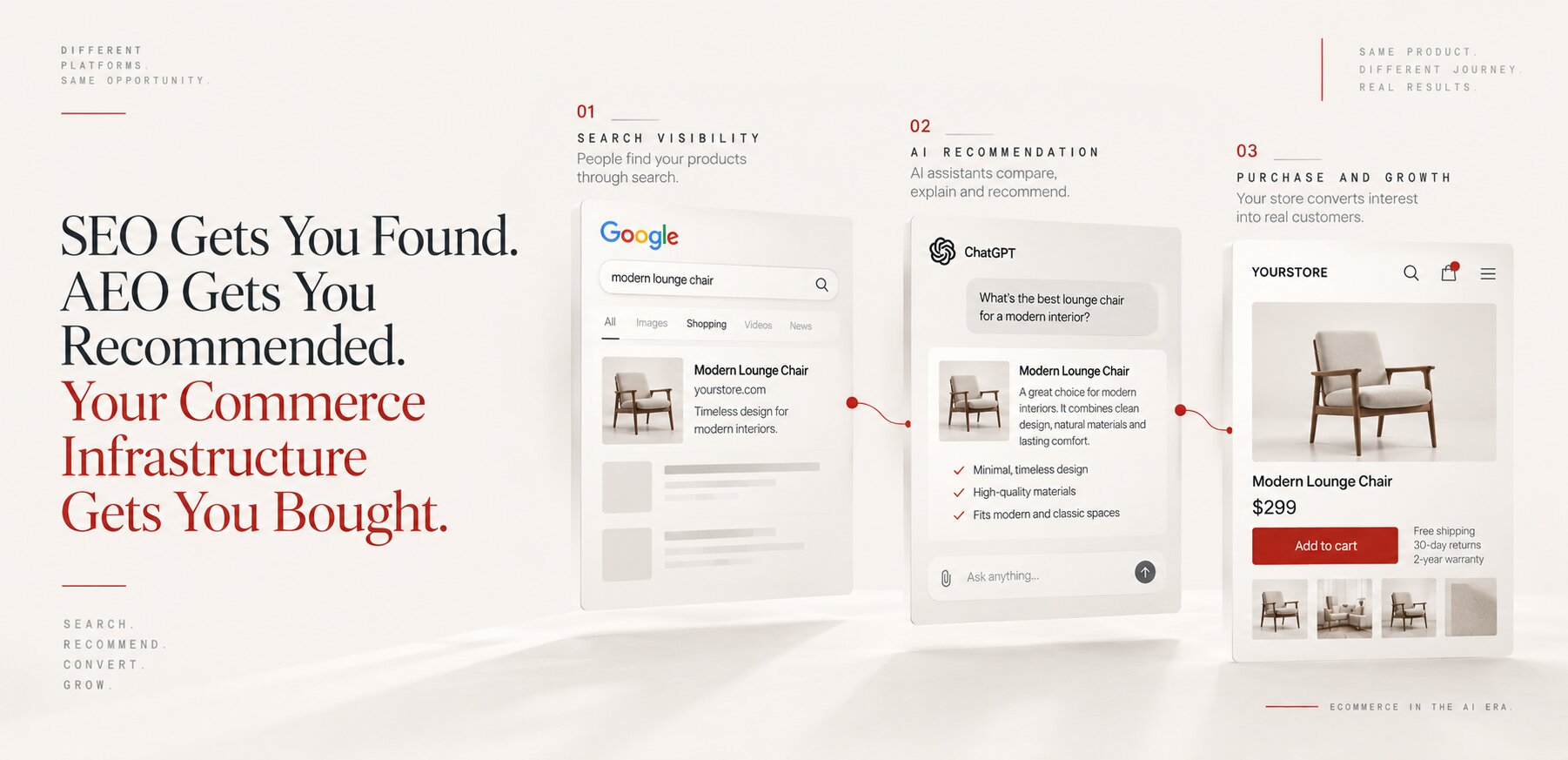
For years, growing a store meant one system: rank on Google, get clicked, get bought. That system still matters, and nothing below replaces it. But a second system is now running alongside it, and it has already started reshaping how product discovery works for e-commerce specifically, not just how search results look.
OpenAI now describes ChatGPT in plain terms as a place to shop: somewhere a buyer can search, compare products, and refine what they want in the middle of a conversation, with merchant product data feeding directly into what gets discussed. Reuters was already writing in August 2026 about AI-referral traffic as its own line item in retailer reporting, distinct from organic and paid search, while the retailers receiving that traffic work hard to keep checkout and the customer relationship on their own site rather than handing it to the assistant. That is not a speculative trend piece. That is a commercial channel that already shows up in someone's numbers.
A second judge showed up, and it grades on different evidence.
Answer Engine Optimization, AEO, is not a rebrand of SEO, and it is not a synonym for "AI ads." It is the discipline of making sure ChatGPT, Perplexity, and Google's AI features can describe your product accurately and choose to recommend it, independent of where you rank in ten blue links. Getting that right, and getting the commerce infrastructure behind it right, now sits between two other pieces of this conversation: how a store's SEO handles international search architecture in the first place, and how a store's underlying systems handle catalogue, pricing, and localization once demand actually arrives. This piece is the bridge between the two.
SEO and AEO Are Two Judges
SEO and AEO Are Two Judges
Before getting into what launched and when, it is worth being precise about what AEO actually is for a store, because the term gets used loosely. We covered the general definition in What Is AEO? and how Google specifically weighs it in SEO, AEO and GEO in 2026.
SEO optimizes for a ranking algorithm that returns a list of links, and the shopper does the comparing. AEO optimizes for a system that has already done the comparing on the shopper's behalf and is about to state an opinion out loud: this product, not that one, for this reason. Your store can rank on page one of Google and still be the product an AI assistant never mentions, because ranking and recommending are graded by different rubrics. Good SEO gets you found. Good AEO gets you chosen once you are found by something other than a human scrolling a results page.
Ranking and recommending are graded by different rubrics.
That distinction is not academic. It decides whether your next move is a content and structured-data project, an ad campaign, or, as you will see below, sometimes neither, because a channel simply is not selling what it appears to be selling.
The Formula and the Chain
The Formula and the Chain
If there is one sentence worth remembering from all of this, it is this one:
SEO gets you found. AEO gets you recommended. Your commerce infrastructure gets you bought.
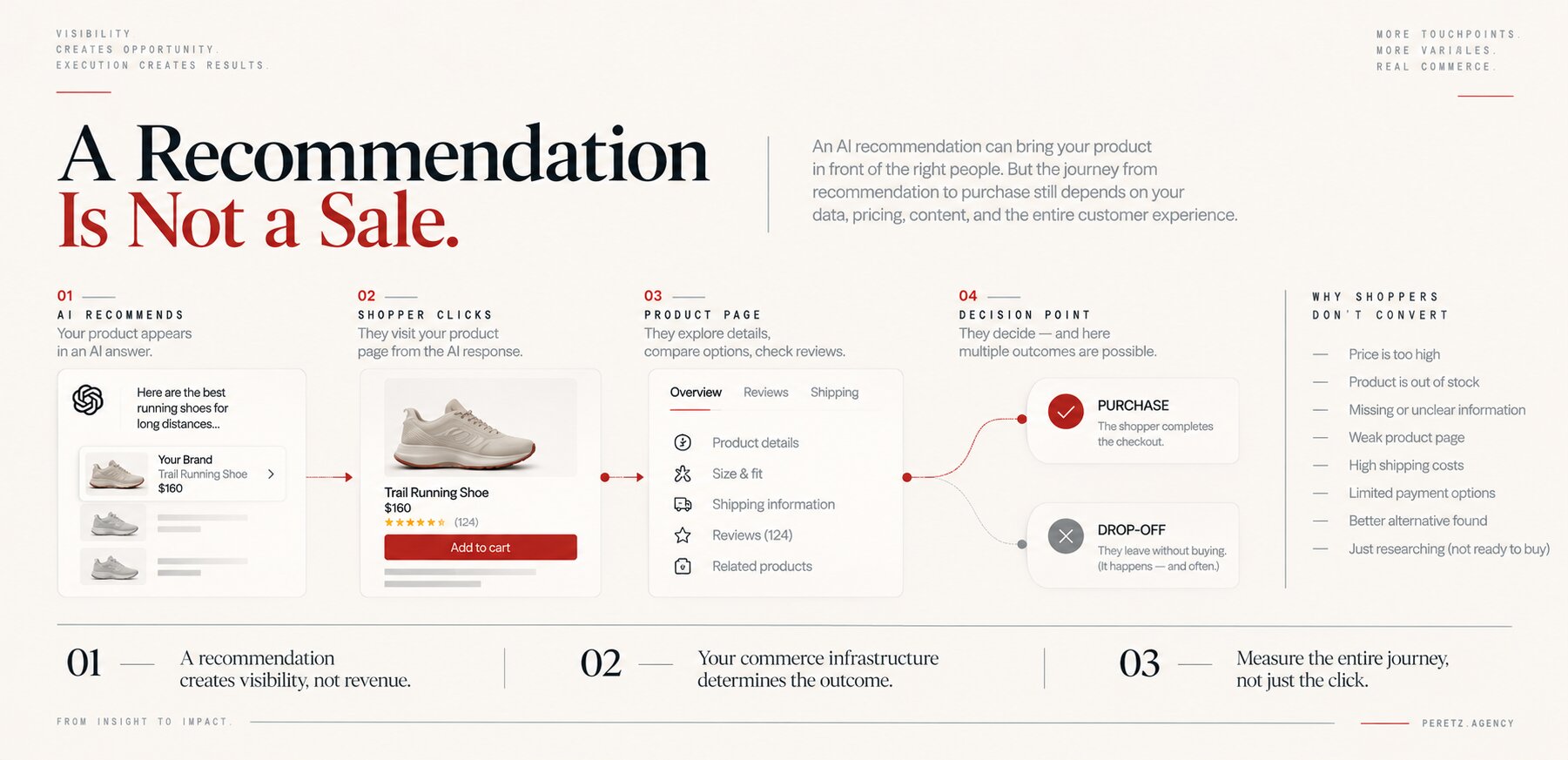
AEO on its own is not the goal. It is the middle link in a chain that only pays off if every link holds: search visibility leads to an AI recommendation, which leads to product discovery, which leads to a click or a merchant visit, which leads to a conversion, which, if the checkout and the follow-up are handled well, leads to an actual customer relationship rather than a one-time sale. Get discovered by an AI assistant with broken product data, and the chain breaks at the second link. Get recommended correctly but send the shopper to a slow, confusing checkout, and it breaks at the fifth. This is why the rest of this piece treats specific platforms and specific dates as evidence of where that chain currently breaks and holds, not as the subject of the article itself. The dates will move. The chain will not.
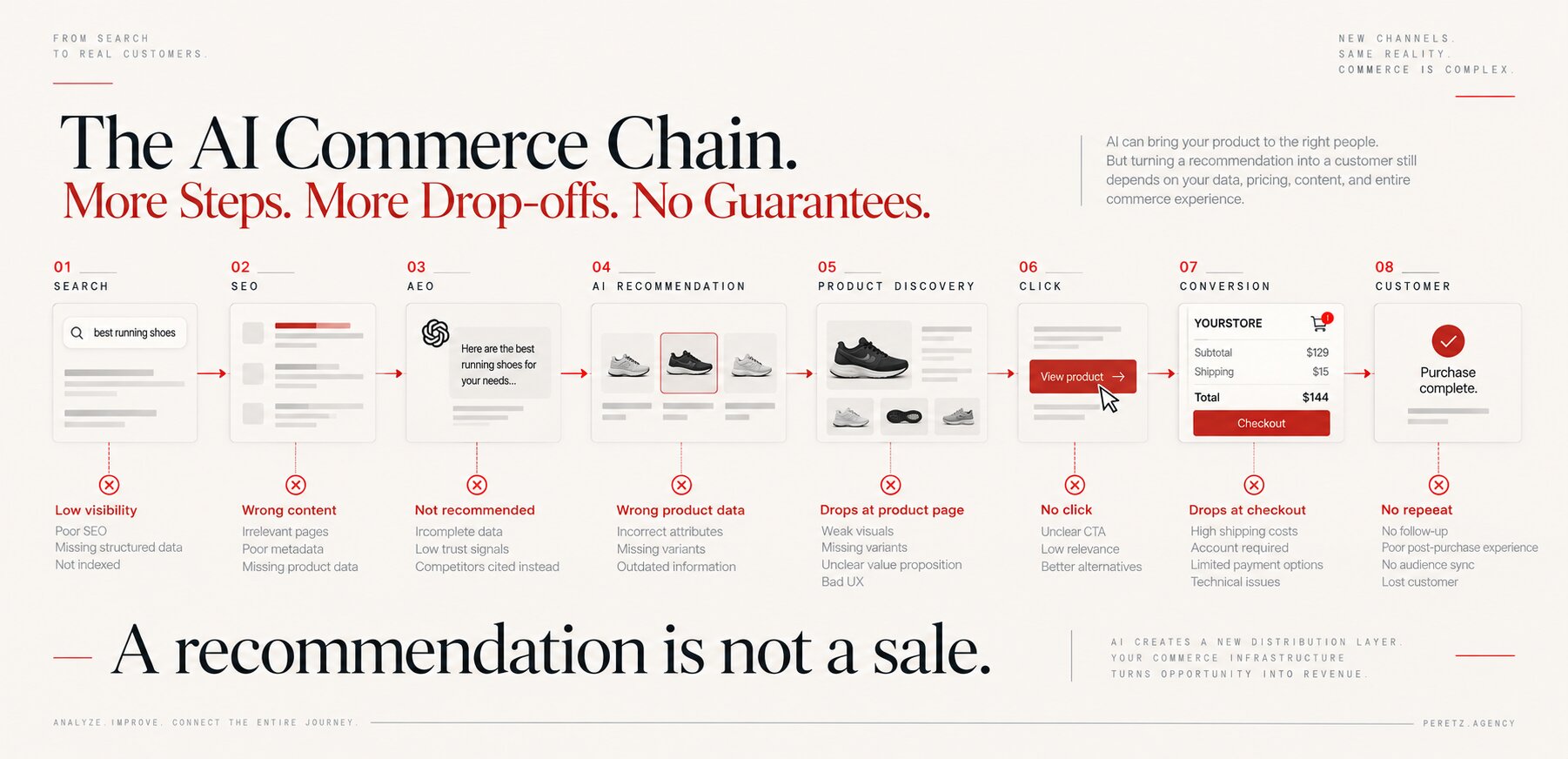
A recommendation is not a sale. Every one of those eight links has its own, distinct way of failing, and most of the content published about "AI commerce" only ever talks about the second link, getting recommended, as if it were the whole game.
Evidence, Not Speculation
Evidence, Not Speculation
Skeptical that any of this is more than marketing-conference language? Here is the sequence of confirmed events that shows the chain above is already live, not theoretical. A note on how to read what follows: the chain and the formula above this section are the part meant to hold up regardless of what OpenAI, Perplexity, or Google do next quarter. Every date, dollar figure, and percentage below is a snapshot of where things stood as this was written, sourced from multiple independent reports where possible and flagged where a figure comes from a single source. Expect these specific numbers to be out of date within months. Expect the underlying shift they document to still be true.
On January 16, 2026, OpenAI confirmed it would begin testing ads inside ChatGPT for US Free and Go tier users. The pilot itself went live several weeks later, on February 9, 2026. This was not a self-serve product. Access required a minimum spend of roughly $200, 000 with a flat $60 CPM, buying through a managed sales relationship. In practice, that meant Best Buy, Target, and similar national retailers, not a 12-person e-commerce brand in Bellevue.
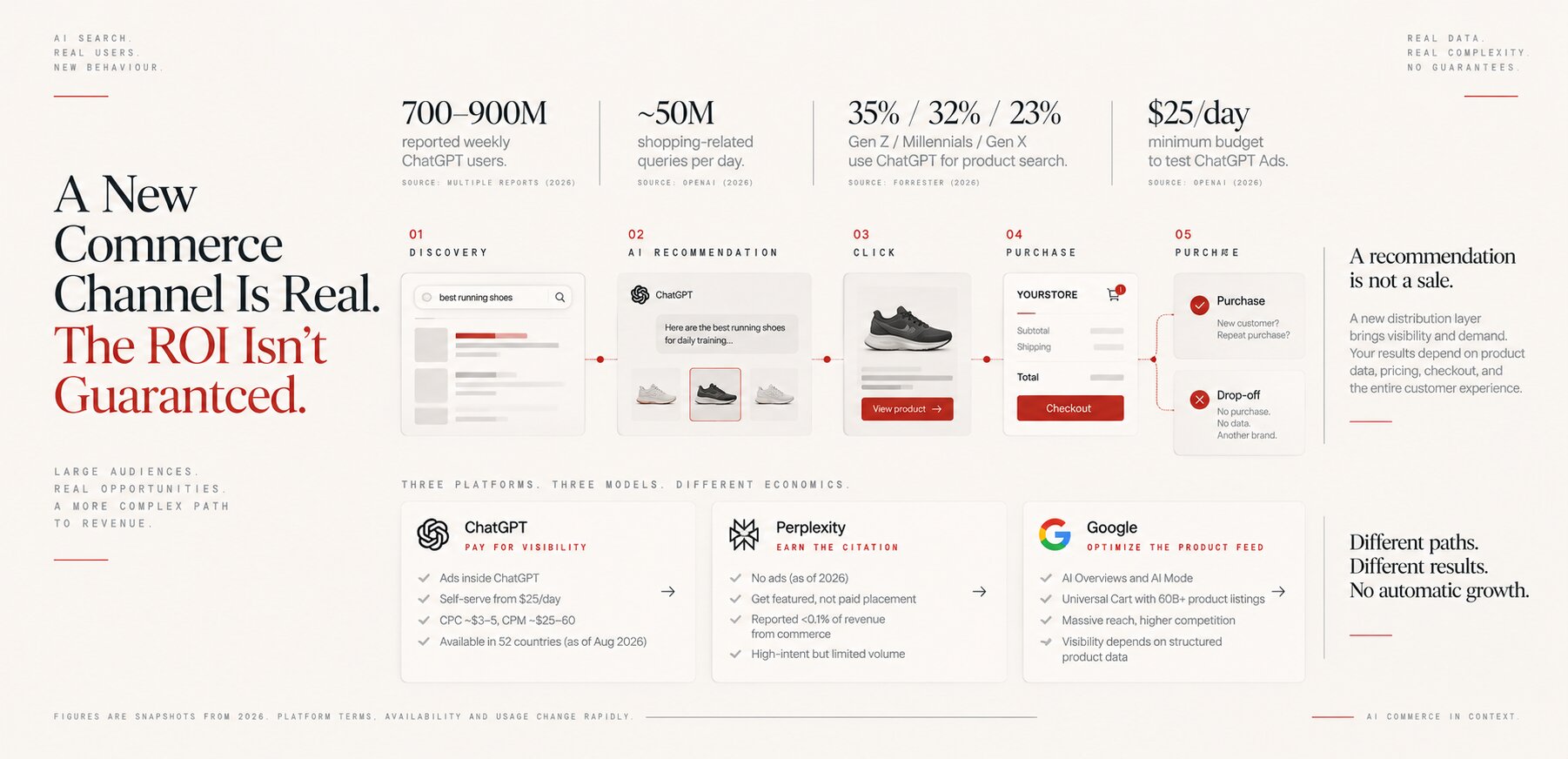
That threshold did not survive long. In April, the minimum dropped to $50, 000. On May 5, 2026, OpenAI removed it entirely and opened a self-serve Ads Manager to every US business at ads.openai.com. The terms as of this writing are a $25 minimum daily budget, CPC bidding starting around $3 to $5 per click, and CPM buying between roughly $25 and $60 depending on category. By the end of August, self-serve access had expanded to roughly 40 to 52 countries depending on the source, and OpenAI has reported the ad business reaching a $1 billion annualized run rate in under 200 days. One tracker measuring actual ad penetration in US replies has recorded real volatility along the way, from a 26.5% peak in late May down to 0.05% in mid-June and back above 50% by July, which is worth keeping in mind before treating any single week's numbers as the platform's steady state.
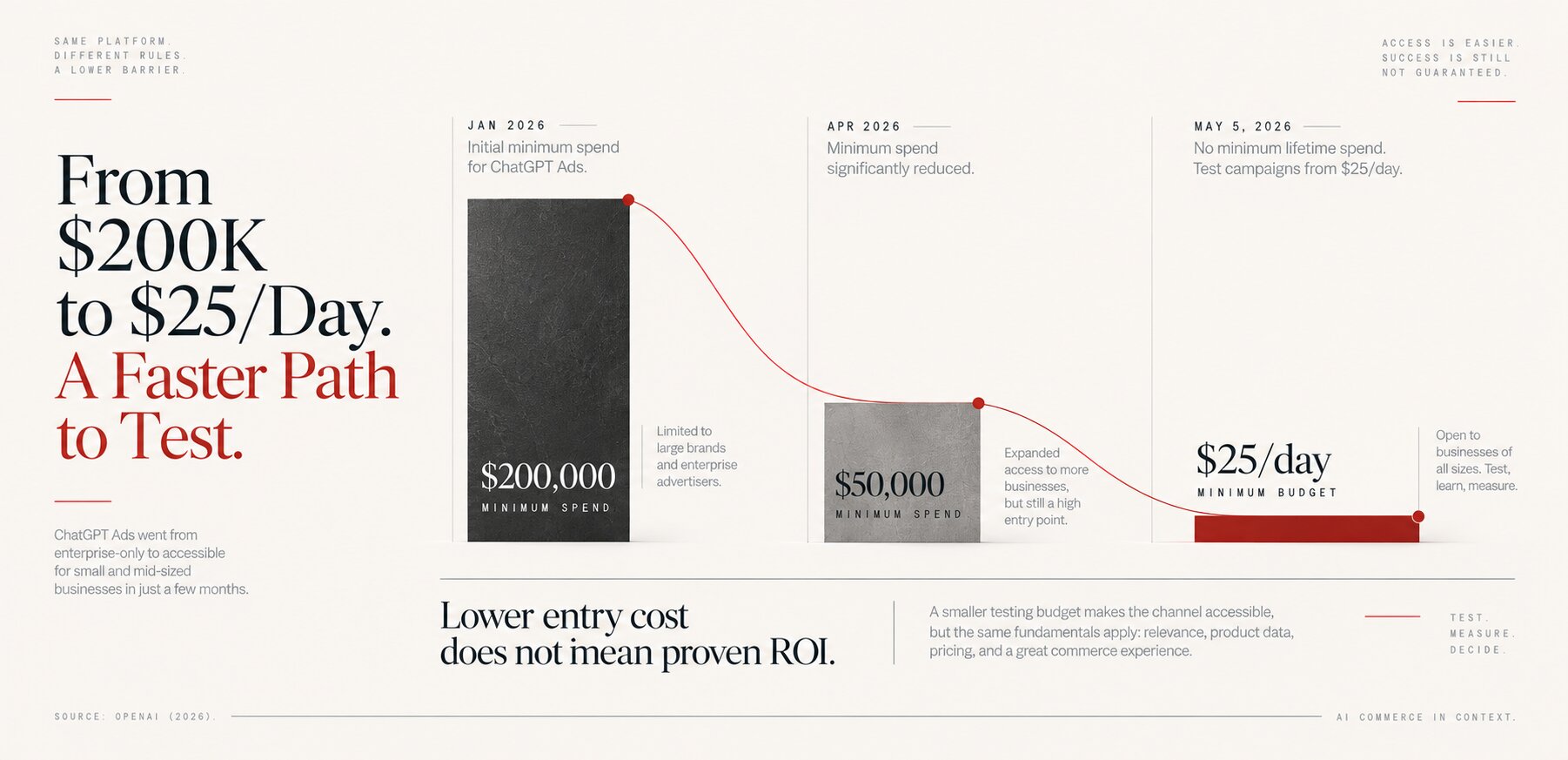
That is the part you saw in your chat window. It is real, it is live, and, as of today, the entry price is genuinely comparable to a small Meta Ads test budget rather than a national TV buy. Treat every figure in this paragraph as a dated snapshot, not a permanent spec sheet: this is a channel less than eight months old, and the terms have already changed twice.
Where the Chain Breaks
Where the Chain Breaks
Here is where most of the content written about "AI commerce" gets sloppy, because it conflates two completely different products: ads, and checkout.
In September 2025, OpenAI launched something separate called Instant Checkout, letting shoppers complete a purchase without ever leaving the chat. Etsy and Shopify signed on as flagship partners. Walmart and Target joined within weeks. The trade press treated it as the beginning of AI-native commerce.
Forrester put live Shopify merchants at roughly thirty, out of millions.
Walmart's own data showed checkout conversion inside ChatGPT running at roughly a third of what its own website converted at, with product data accuracy cited as a recurring problem. There was no multi-item cart, no promo codes, no functioning state sales tax handling. On March 4 to 6, 2026, The Information reported that OpenAI was quietly shelving Instant Checkout. OpenAI confirmed it days later, describing a shift toward "apps" instead: ChatGPT now surfaces a product and routes the shopper back out to the merchant's own site or app to actually complete the purchase. Walmart's answer was to plug its own shopping assistant, Sparky, directly into that flow in March 2026.
This matters for one very practical reason. If your instinct after reading about "buying inside AI chat" is to spend a month integrating a native checkout flow, you would have been building for a feature that already died once. The current, confirmed reality in September 2026 is: ChatGPT will happily take your ad budget, and it will happily send a shopper who clicked your ad back to your own store to finish the sale. That is a much smaller, much more familiar ask than the one being pitched a year ago. It is also good news for a small store: you do not need a new payments integration. You need your existing checkout to be fast and your ad to be honest about the product.
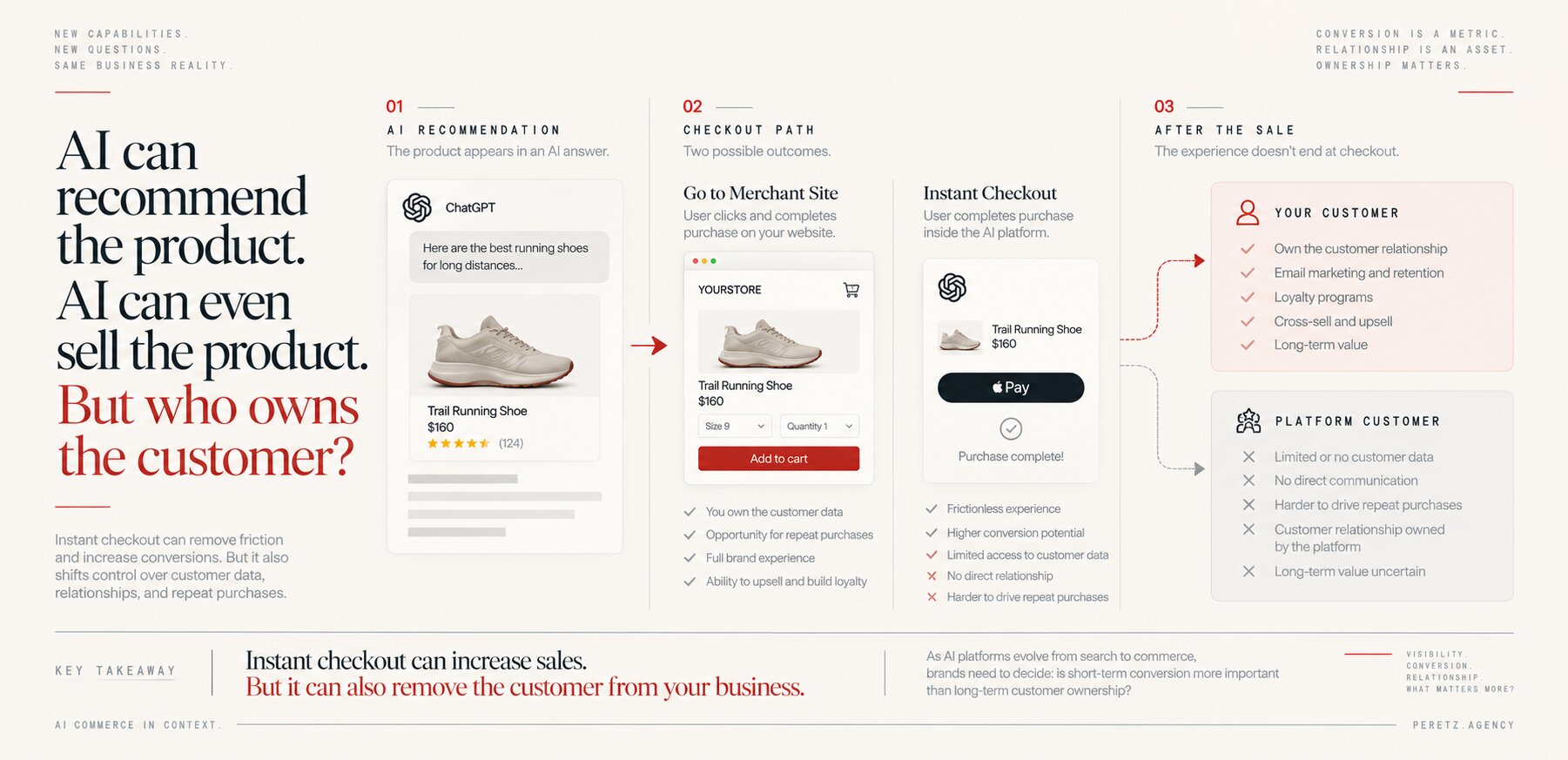
There is a quieter upside buried in that retreat. Every "buy inside the chat" pitch from the last year skipped over one detail: a sale completed entirely inside a platform is a sale where the platform, not you, holds the customer relationship. No email address for your list, no order history to build loyalty on, no data to inform your next campaign. Instant Checkout dying and ChatGPT reverting to "recommend, then send them to your site" is not just a smaller technical ask. It is also the version where you actually keep the customer once you have won them.
Perplexity Bets Differently
Perplexity Bets Differently
If you only read about ChatGPT, you would assume every AI assistant is racing toward the same ad-supported model. Perplexity did the exact opposite, and the contrast is genuinely useful for deciding where to put effort.
Perplexity tested sponsored questions from late 2024 through most of 2025, onboarding early advertisers including Whole Foods and Indeed. Then, in February 2026, it walked away from advertising entirely. The number behind the decision was blunt: advertising reportedly made up under 0.1% of Perplexity's revenue, while its subscription tiers were scaling toward hundreds of millions in annualized recurring revenue. An executive put it plainly: ads risked eroding the trust that makes Perplexity's citations worth anything in the first place.
Perplexity killed its ad business, then doubled down on checkout.
What Perplexity kept, and expanded, is Instant Buy, marketed as "Buy with Pro": in-chat checkout with a zero merchant fee and free shipping funded by Perplexity itself, not the seller. That is a direct jab at ChatGPT's now-abandoned Instant Checkout, which charged merchants a 4% transaction fee before it was retired. There is a free Perplexity Merchant Program for product feed syndication, and Shopify stores get a head start through automatic catalog sync.
So the honest state of play by product, not by press release:
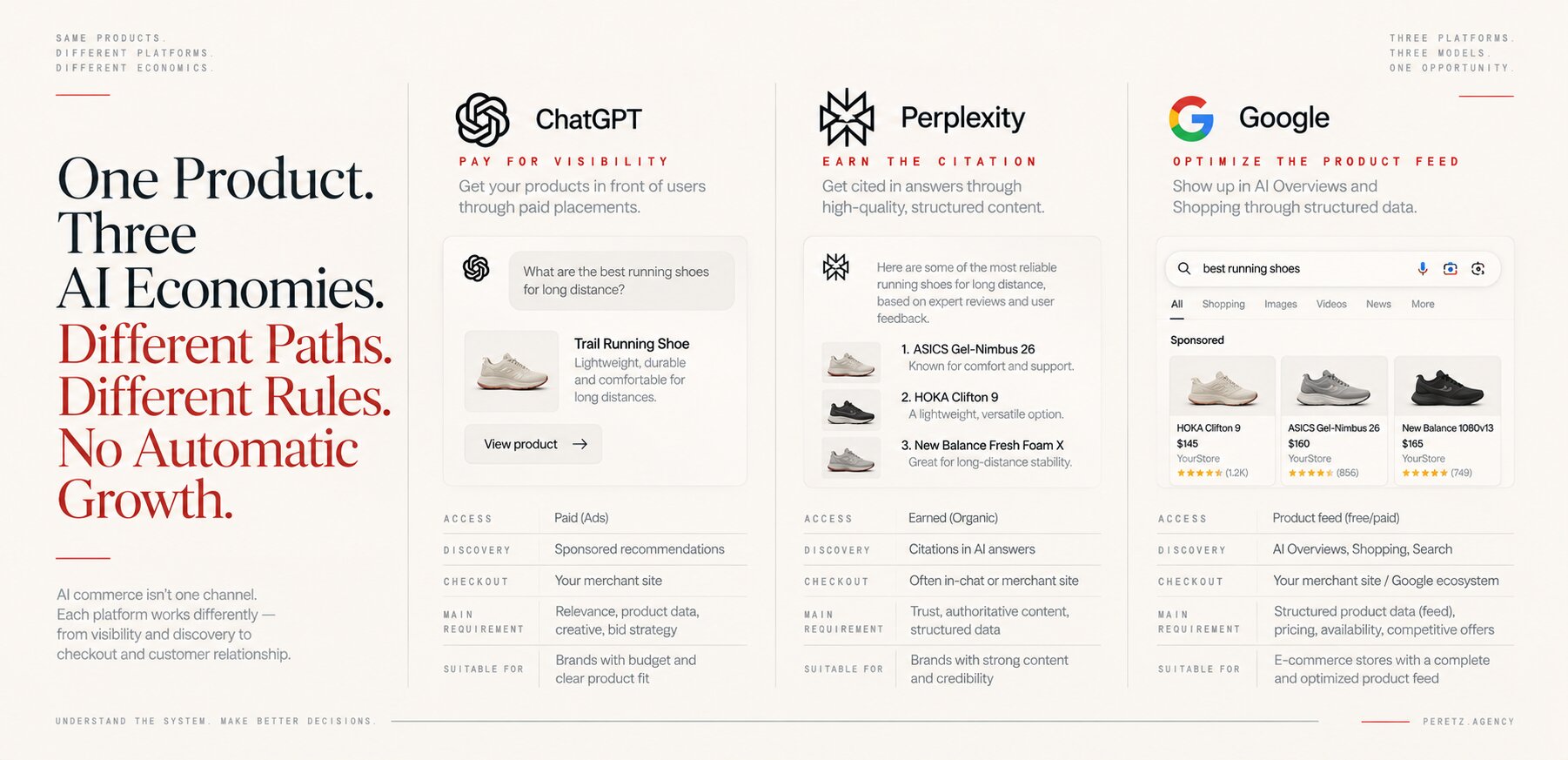
- ChatGPT: you can pay for visibility (ads, self-serve, from $25/day). You cannot check out inside the chat anymore. The path is ad, click, your own site, your own checkout. - Perplexity: you cannot pay for visibility at all. There is no ad product to buy. The only way in is being cited, which is answer engine optimization in its literal, original sense. But if you do get surfaced, there is a working, free, zero-fee in-chat checkout waiting. - Google: not a new channel so much as an extension of one you likely already use. At Google I/O on May 19, 2026, Google introduced Universal Cart, a persistent AI-managed cart that follows a shopper across Search, the Gemini app, YouTube, and Gmail, built on the existing Shopping Graph (Google states more than 60 billion product listings) and checking out through Google Pay. If your product feed is already healthy in Google Merchant Center, you are plausibly already positioned here without opening a new account or learning a new interface.
Three platforms, three genuinely different strategies, three different jobs for a small merchant. That is not a nuance you will find in most of the content currently circulating about this, because most of it is written by companies selling AI-visibility monitoring tools, and it is in their interest to describe one undifferentiated "AI commerce wave" you need a dashboard to track.
What AEO Actually Buys
What AEO Actually Buys
We have written before about what Answer Engine Optimization is in general terms. For a store specifically, it collapses into something narrower and more testable: can an AI assistant correctly describe your product, its price, and who it is for, using only what is publicly available about it?
That is not a copywriting trick. It is closer to structured data hygiene. Perplexity explicitly states it uses product data completeness as a ranking signal for what gets surfaced in shopping results. ChatGPT's own shopping surfaces state that unpaid product recommendations are ordered by relevance, not payment, with availability, price accuracy, and seller status feeding into that ordering even when Instant Checkout support is one input among several. None of the three major assistants reward vague descriptions, missing prices, or inconsistent stock information. All three, in different ways, reward the same boring fundamentals: accurate structured product data, clear pricing, and content that plainly states who the product is for and why.
The AI does not need convincing copy. It needs facts to repeat.
This is also why we would not tell a client to treat "getting into ChatGPT" and "getting into Perplexity" as the same project. The first is a paid distribution channel. The second has no media buy at all. It is closer to the SEO work you already do, just aimed at a system that summarizes instead of ranking ten blue links.
Should a Small Store Pay?
Should a Small Store Pay?
Here is the part I want to be careful about, because "you can now advertise here for $25 a day" is not the same claim as "you should."
A few honest constraints worth sitting with before testing a budget:
Reach is real but not yet enormous for a narrow niche. ChatGPT's weekly user base has been reported anywhere from roughly 700 million to 900 million depending on the month cited, and OpenAI has cited an estimated 50 million shopping-related queries a day across that base. That is a large number in the aggregate, and a much smaller one once you filter for people asking about your specific category, in your specific price range, in a country where you ship. Treat both figures as directional, not precise: a channel adding users at this pace does not hold still long enough for a single number to stay accurate for long.
A December 2025 Forrester consumer survey found that only 35% of Gen Z, 32% of Millennials, and 23% of Gen X reported having used ChatGPT for product search at all by the end of last year. Completing a purchase inside a chat interface was, per that same research, the least-adopted behavior among people who do use it that way. People are still mostly researching in AI chat and buying somewhere else, often after a Google search to double-check.
That is not a reason to ignore the channel. It is a reason to treat it the way you would treat any new ad platform in its first year: a small, deliberately sized test, with tracking in place before the first dollar goes out, not a reallocation of your existing Meta or Google budget.
Testing Without Overcommitting
Testing Without Overcommitting
If a client asked me this week where to point twenty five dollars a day, here is roughly the shape of the answer.
Start with product data, before any ad spend. Make sure your product titles, prices, availability, and descriptions are accurate and consistent everywhere they appear publicly, including your own site's structured data. This is free, it takes a normal afternoon of admin work for most small catalogs, and it is the one thing that helps you across ChatGPT, Perplexity, and Google Universal Cart simultaneously, since all three lean on public product data to decide what to surface.
Treat the first month of ChatGPT ads as a measurement exercise, not a growth channel. Use OpenAI's Conversions API so a click that eventually converts on your own site actually gets credited back to the ad, and run it in parallel with, not instead of, whatever is already working in Meta. You already have a working framework for judging whether a daily budget is doing anything: the same logic we have written about for Meta's minimum daily budgets applies almost unchanged here. A $25 daily test that cannot generate a single attributable sale in three to four weeks is telling you something, the same way an underfunded Meta ad set does.
Do not build anything for in-chat checkout. Given what happened to Instant Checkout, there is no product to build for on the ChatGPT side right now, and building custom Buy with Pro integration work for Perplexity only makes sense once you have evidence that Perplexity traffic exists for your category at all. Get discovered first. Solve checkout friction second, and only where a working checkout product currently exists.
Watch Perplexity as a citation target, not an ad platform, and stop anyone from selling you a Perplexity ad package. As of mid-2026 there is nothing to buy there. Any agency quoting you CPMs for Perplexity Sponsored Questions is quoting a product that no longer exists.
How This Connects to Meta
How This Connects to Meta
None of this replaces the budgeting discipline we have already covered for Meta Ads budgets. If anything, the ChatGPT ad auction rewards the exact same instinct: a tightly matched, honest ad on a modest bid can outperform a lazy, larger one, because OpenAI's own documentation describes the auction as relevance-weighted, not simply highest-bid-wins. That is a familiar idea if you have already spent time thinking about ad set structure and learning phase economics elsewhere. The platform is new. The discipline required to spend well on it is not.
What Promoting Now Means
What Promoting Now Means
Promoting an e-commerce store used to mean one system: SEO to get found, ads to get found faster, a decent site to close the sale. That system is not dead. It is just no longer the only judge in the room.
AEO is the second judge, and it grades on different evidence: whether your product data is accurate enough for an AI assistant to repeat it, whether your content clearly states who a product is for, and whether the assistant trusts you enough to cite you instead of a competitor. Alongside that, a real paid layer appeared in less than eight months, complete with a launch, a failure, and a price of entry that dropped from six figures to twenty five dollars a day. What is actually true today: ChatGPT will sell you an ad for $25 a day and send the click back to your own store, no in-chat checkout required anymore. Perplexity will not sell you anything at all, but will reward good product data with a free, zero-fee checkout if it decides to cite you. Google is quietly folding its version into Shopping infrastructure you likely already use.
None of the three has replaced SEO. None of them replaces a well-run ad account either. What changed is that "promoting a store" now has a second, separate scorecard, and the stores that treat AEO as part of the same discipline as SEO, rather than a strange new add-on, are the ones already showing up when someone asks an AI assistant what to buy.
Where This Fits
Where This Fits
This piece sits deliberately in the middle of a bigger picture. Search visibility itself, especially across languages and markets, is its own project: how hreflang, translated content, and local search behavior determine whether an international shopper finds you at all in the first place is a separate discussion we cover in depth in Multilingual SEO: Why Translated Pages Do Not Rank in Their Own Markets, and it is the layer that has to work before AEO has anything to recommend. On the other end, none of the discovery, recommendation, or conversion described above matters if the underlying commerce system cannot actually support it once demand shows up: a catalogue with thousands of SKUs, prices and tax rules that vary by market, and inventory states that need to stay accurate across every channel an AI assistant might pull from. We have written separately about what changes when that infrastructure has to hold up across many markets and tens of thousands of products in Multi-Country E-Commerce for Large Catalogues. Read together, the three form one line: search architecture gets a market to find you, AEO gets an AI to recommend you inside it, and commerce infrastructure is what actually survives the resulting order volume.
FAQ
Frequently Asked Questions
How much does it cost to advertise on ChatGPT in 2026?
There is no minimum lifetime spend as of the self-serve launch on May 5, 2026. Campaigns require a minimum daily budget of $25, with CPC bidding starting around $3 to $5 per click and CPM buying between roughly $25 and $60 depending on category.
Can I still sell products directly inside a ChatGPT conversation?
Not natively as a general checkout feature. OpenAI retired Instant Checkout in March 2026 after low merchant adoption and conversion problems. ChatGPT now surfaces products and routes shoppers to the merchant's own site or app to complete the purchase.
Can I run ads on Perplexity?
No. Perplexity abandoned advertising entirely in February 2026 and has stated it does not plan to bring ads back. The only way to appear in its answers is being cited organically, based on product data quality and content trust signals.
Is Google's Universal Cart a new advertising channel I need to set up separately?
It is closer to an extension of Google's existing Shopping Graph and Merchant Center infrastructure across Search, Gemini, YouTube, and Gmail. A store with a healthy, accurate Google Shopping product feed is already positioned for it without a separate signup.
Should a small e-commerce store prioritize ChatGPT ads over Meta ads?
Not as a replacement. Treat a small ChatGPT ad budget as a parallel test with proper conversion tracking in place, while keeping an already-working Meta budget intact, then compare results using the same cost-per-attributable-sale logic either way.
What happens once those assistants can act rather than recommend is the subject of Agentic AI Compliance: How to Secure, Govern and Monitor AI Agents.
If your product data is inconsistent across the places an AI assistant might read it, no amount of ad budget on any of these platforms fixes that. And if the catalogue and checkout behind the recommendation cannot handle what arrives, the recommendation is wasted.
A Strategic Session works through the whole chain rather than one link: whether your product data is accurate enough to be repeated, whether the search architecture lets a market find you at all, and whether the commerce infrastructure survives what happens next.
Explore our SEO and E-Commerce Development services.
See the fuller architecture thesis, with real cases, in the software should fit the business.
Where this architectural thinking is heading next, and what it means for a business between 2030 and 2035, is covered in the website is not dead, it has just lost its job.
Google gave the first measurable confirmation of this shift, covered directly in the search query is disappearing.
- Share
-

-

-

-

One notification a week with the new PERETZ articles. Nothing else.
Related Reading
-
07. 07. 2026
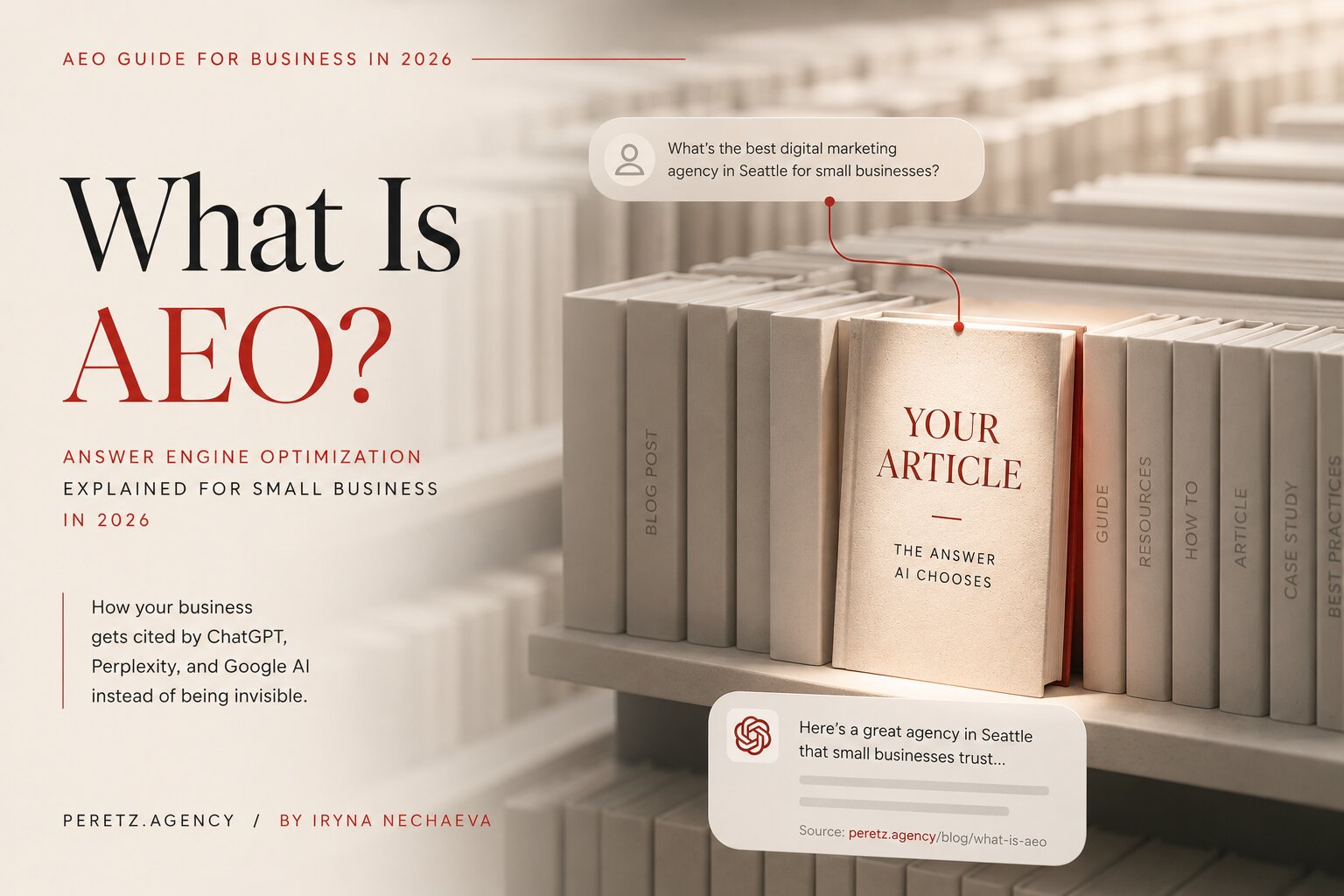
What Is AEO? Answer Engine Optimization Explained for Small Business in 2026

-
17. 08. 2026
SEO, AEO, and GEO in 2026: What Actually Matters to Google, and What Your Marketer's Report Should Show
-
27. 06. 2026
Your Business Is Invisible to AI Search in 2026 — Here's How to Fix It
-
07. 07. 2026
Human-First Content Strategy: Why AI Content Is Losing the Trust War in 2026
-
17. 08. 2026

When Everyone Can Publish 500 Articles, What Is Content Worth?
-
19. 07. 2026

The Cost of AI Isn't Generation. It's Verification.
-
29. 06. 2026

Meta Ads in 2026: What Budget Do You Really Need to See Results?
-
10. 08. 2026
Daily vs Lifetime Budget in Meta Ads Is a Fixed-Cost vs Variable-Cost Decision, Not a Setting
-
10. 08. 2026
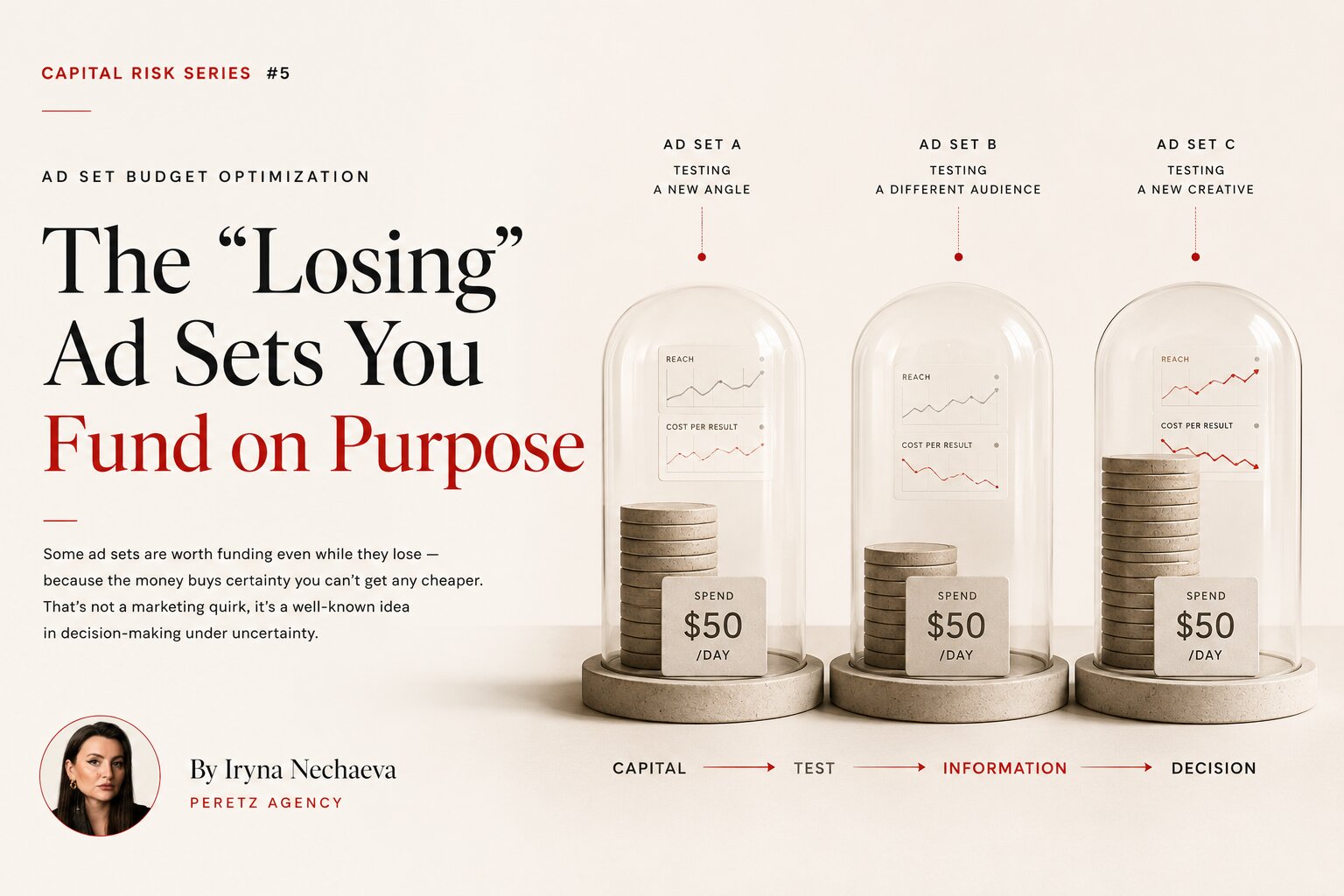
Ad Set Budget Optimization: The "Losing" Ad Sets You Fund on Purpose
-
11. 08. 2026
Meta Ads Learning Phase: The Compound Interest Nobody Lets Finish Compounding
-
07. 08. 2026
Campaign Budget Optimization Is a Governance Decision, Not a Toggle
-
06. 09. 2026
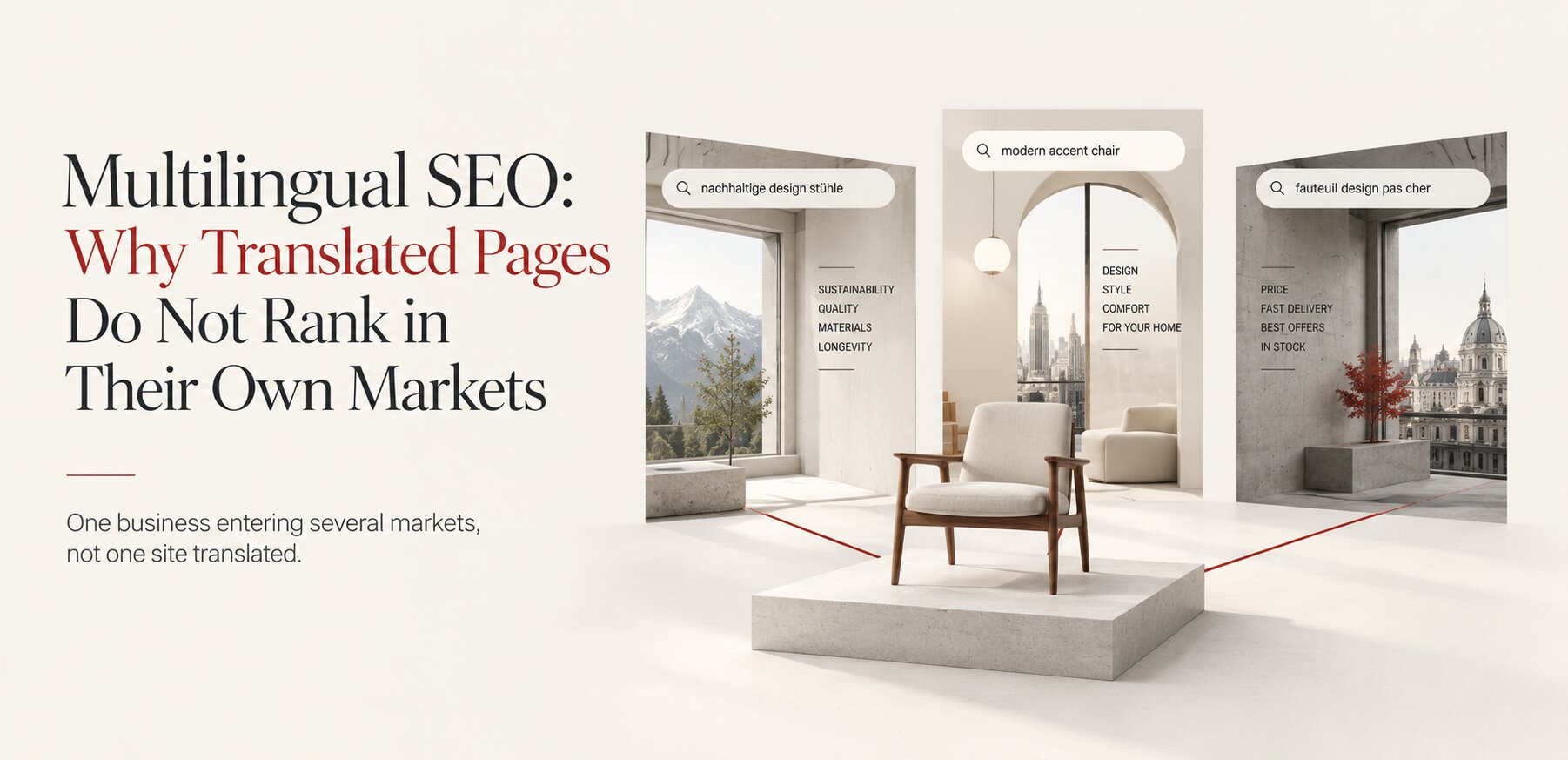
Multilingual SEO: Why Translated Pages Do Not Rank in Their Own Markets
-
06. 09. 2026

Multi-Country E-Commerce for Large Catalogues: The Architecture Decisions That Set the Ceiling
-
28. 08. 2026
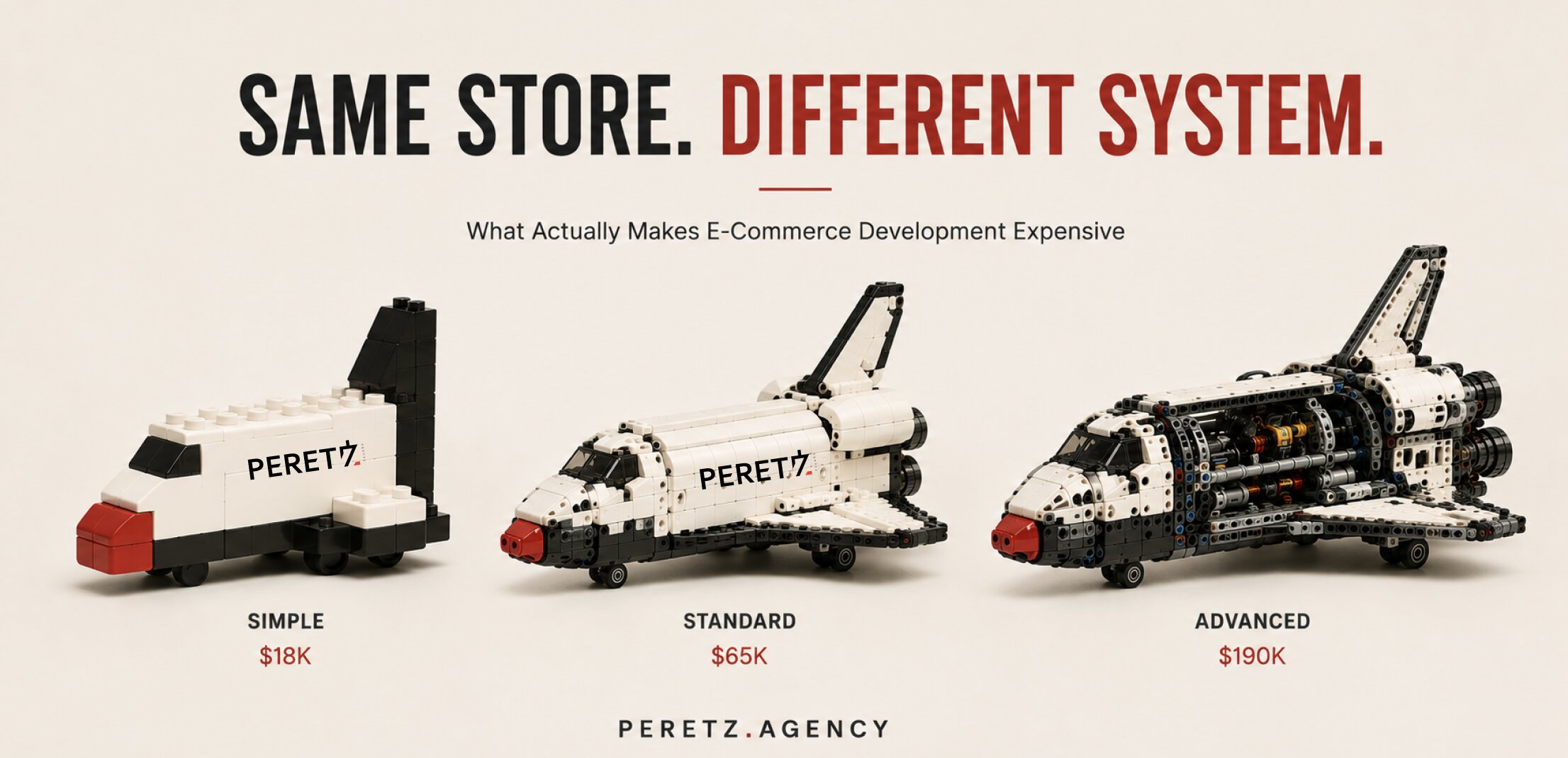
What Actually Makes E-Commerce Development Expensive
-
01. 09. 2026
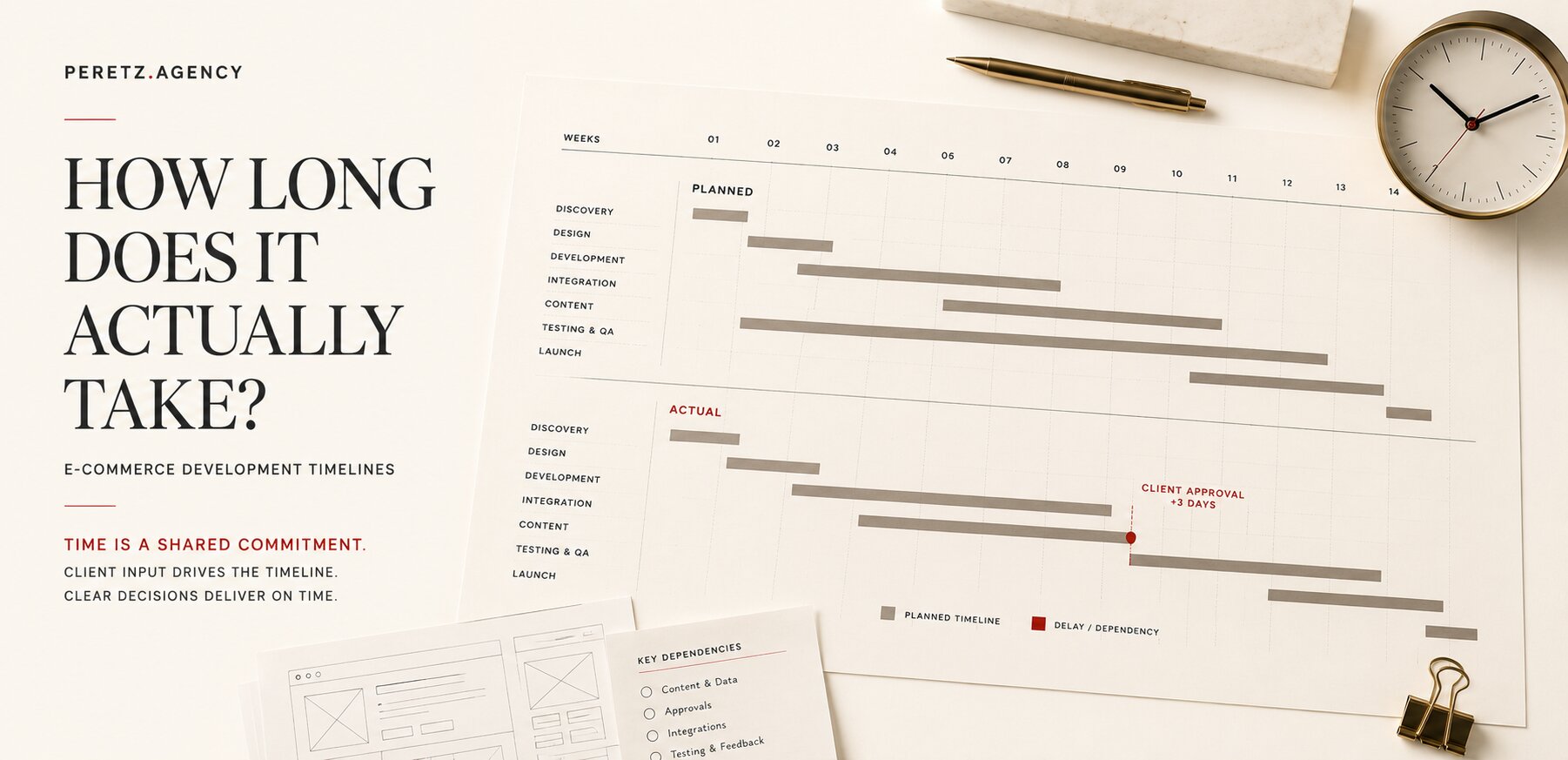
How Long Does an E-Commerce Build Actually Take, and What the Client Has to Do
-
13. 08. 2026
What Happens to E-Commerce When a Website Stops Being a Website?
-
14. 08. 2026

How We Design E-Commerce: From Objects to Experience
-
09. 07. 2026
Traffic But No Leads? Your Customer Is Doing Math You Never See
-
19. 07. 2026

High CTR But Low Conversion Rate? Here's Why Your Ad Copy Is the Problem
-
07. 09. 2026

Agentic AI Compliance: How to Secure, Govern and Monitor AI Agents
-
17. 06. 2026
Why Your Business Isn't Getting Leads From Its Website (And How to Fix It in 2026)
-
21. 09. 2026

The Software Should Fit the Business
-
24. 09. 2026
The Website Is Not Dead. It Has Just Lost Its Job.
-
25. 09. 2026
The Search Query Is Disappearing