How Long Does an E-Commerce Build Actually Take, and What the Client Has to Do
Most late e-commerce projects were not delayed by developers. What the timeline actually depends on, and which parts of it the client controls.

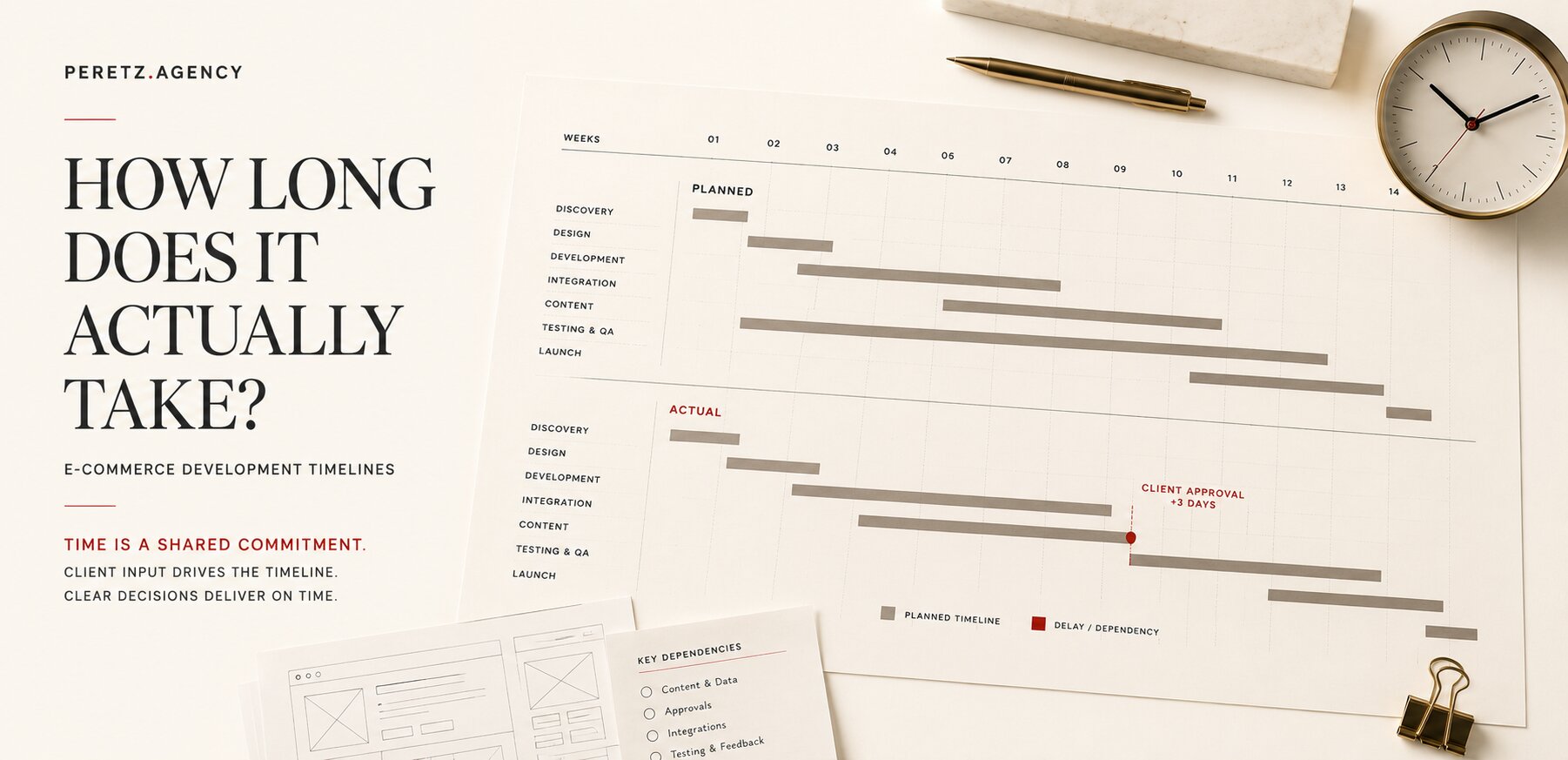
Most e-commerce projects that run late were not delayed by the people writing the code.
This is an uncomfortable thing for an agency to say, which is largely why it goes unsaid.
Pointing out that a client's own approvals, content or decisions are holding up a project risks the relationship. Absorbing the delay quietly and accepting the blame for a missed date is easier.
So the pattern repeats, and the client never learns the one thing that would have helped: which parts of the timeline they actually control.
A schedule is a shared commitment.
Only one side is usually told that.
What follows is the version we would rather have on the table before a project starts.
Where the Time Goes
Where the Time Goes
An e-commerce build moves through discovery, UX/UI design, development, integrations, content setup, testing and launch.
The instinctive assumption is that development is the long part, and that a delay means engineers were slow.
Sometimes they are.
But many delays cluster at two points that have surprisingly little to do with writing code:
before development starts, while scope and content are still being settled, and immediately before launch, during testing and approval.
Both phases depend heavily on the client.
That is not an accusation.
It is a scheduling fact that is much more useful when understood before the project starts than discovered six weeks after the original launch date.
Current 2026 e-commerce timelines reflect the same underlying reality: simple platform-based stores can be launched in weeks, while custom stores with integrations and complex catalogues take months, and those estimates generally assume that requirements and content are ready when the relevant work begins.
The difference between a realistic timeline and an optimistic one is often not how fast the developers work.
It is how much uncertainty the timeline contains.
The Multiplier Effect
The Multiplier Effect
The most useful thing a client can understand about project timelines is that their delays do not necessarily translate one-to-one into calendar delays.
Suppose the team is waiting for final product photography.
The photos were supposed to arrive Monday.
They arrive Thursday.
It is tempting to think: three days late equals three days added to the project.
It rarely works that cleanly.
The development team does not necessarily sit idle from Monday to Thursday.
People are reassigned to other work because an agency cannot hold paid capacity in suspension waiting for an email.
When the missing material finally arrives, those people may already be working on something else.
The original context has to be reconstructed.
A task that was ready to move on Monday now needs to be reintroduced into the team's schedule.
Sometimes another dependency has appeared in the meantime.
Sometimes the delayed content changes an earlier decision.
Sometimes the person who originally handled that task is no longer available that week.
So a three-day delay in sending product photos can become a considerably larger movement in the overall calendar.
This is why clients and agencies can remember the same project very differently.
The client remembers:
"We were only a few days late."
The project schedule remembers:
"The dependency became available after the team had already moved on."
Both statements can be true.
Content Is the Bottleneck
Content Is the Bottleneck
Across e-commerce projects, one of the most common causes of slippage is not technical.
It is product data.
Names.
Descriptions.
Images.
Variants.
Pricing.
Categories.
Attributes.
Specifications.
SKU structures.
Relationships between products.
All of this has to exist before a catalogue can be meaningfully built and tested.
A checkout cannot be properly tested against products that don't have real prices.
Filters cannot be properly validated against attributes that are still being invented.
Variant logic cannot be finalized when the client is still deciding which variants actually exist.
And a product migration cannot be validated when half the source data is still sitting in spreadsheets waiting to be cleaned.
Current e-commerce development guidance repeatedly identifies product-data readiness and migration quality among the factors that can push projects off schedule.
The important point is not that clients should somehow become data engineers.
It is that the team cannot build against information that does not exist yet.
And when incomplete information is used to build the structure anyway, there is a risk of doing the work twice.
What "Ready" Actually Means
Product data is usually described as ready some time before it actually is.
A practical definition is much less ambiguous.
Before development reaches the parts of the project that depend on the catalogue:
- every product has a final name, description and price
- every launch variant is defined
- each variant has the required SKU or stock reference
- images exist for the products and variants that need them
- image dimensions and quality are consistent
- categories and attributes are decided
- relationships such as bundles, sets or recommendations are specified
- the products included in the initial launch are known
- products that are intentionally being held back are identified
A catalogue that satisfies those conditions is something a team can build against.
A catalogue where three of them are still being discussed is not.
It is a moving specification.
And a moving specification tends to produce moving development.
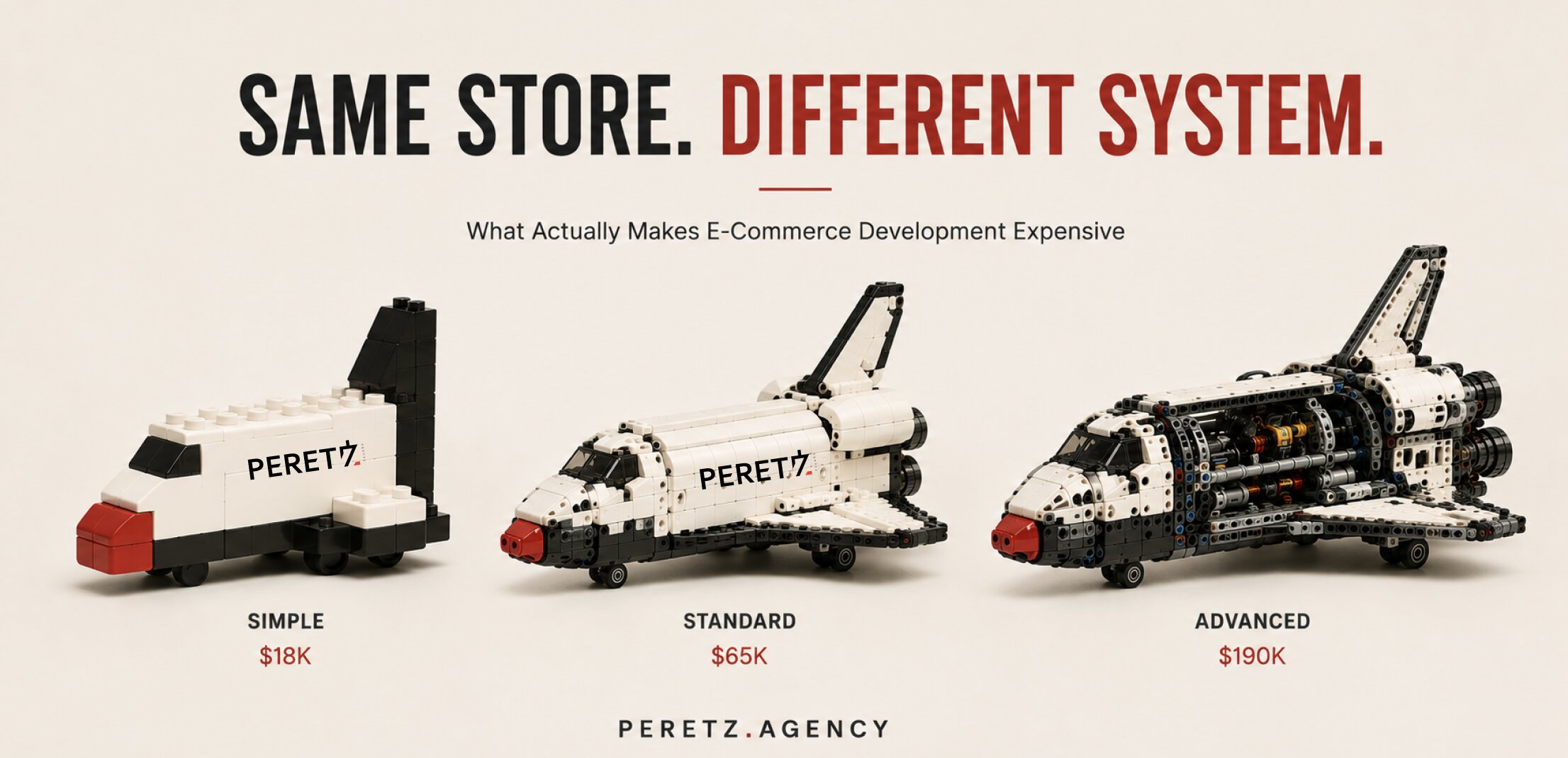
The relationship between catalogue structure and development cost is covered in more detail in What Actually Makes E-Commerce Development Expensive.
Decisions Have a Cost
Decisions Have a Cost
Content is the visible bottleneck.
Decisions are the quiet one.
A question goes to the client.
It waits.
The team cannot stop, so it proceeds on an assumption, because proceeding on an assumption is the path of least resistance and the alternative is stopping work that is already paid for.
Sometimes the assumption is correct.
When it isn't, the correction arrives later.
And the correction usually costs more than the original answer would have.
This happens with surprisingly small things:
Which products are actually launching?
Should this field be required?
Does this customer type receive wholesale pricing?
Should this integration synchronize inventory or orders as well?
Does this page need to exist in every language?
Should this promotion apply to variants?
Is this old URL still important for SEO?
Every unanswered question is technically still a decision.
It just becomes a decision made by default.
An unanswered question does not pause a project. It answers itself.
That is one of the most expensive sentences in software development.
Client Is Part of Delivery
Client Is Part of Delivery
This does not mean the client should be managing developers.
They shouldn't.
The client has a different job.
The client owns the decisions that the agency cannot responsibly make on its behalf.
That includes business rules, product information, approvals, priorities and access to internal systems.
A healthy project therefore has two delivery tracks running in parallel.
The agency owns
- discovery
- UX/UI
- development
- integrations
- QA
- technical decisions within the agreed scope
- deployment
The client owns
- business decisions
- product information
- approvals
- access to internal systems
- stakeholder alignment
- timely feedback
- final acceptance
When both tracks move together, the project moves.
When one stops, the other eventually catches up to it.
This is why a project timeline should never show only the agency's tasks.
The Conversation Agencies Avoid
The Conversation Agencies Avoid
There is a structural reason this information rarely reaches clients.
Telling a client that they are the constraint is commercially awkward.
It can sound like deflection, particularly when said after a date has already slipped.
So agencies tend to absorb the delay, adjust internally and describe the outcome in neutral terms.
But the data usually exists.
Every question asked and answered has a timestamp.
Every approval has a timestamp.
Every content delivery has a timestamp.
Every change request has a timestamp.
The project management system can often reconstruct exactly what happened.
It is simply not the kind of evidence anyone wants to produce during a retrospective, because the conversation suddenly becomes personal.
We would rather raise the dependency at the beginning, when it is useful, than at the end, when it becomes an argument.
The goal isn't to prove that the client caused the delay.
The goal is to make sure the client understands which parts of the timeline they can control.
Testing Is Not Redesign
Testing Is Not Redesign
The final phase before launch is where schedules often dissolve.
User acceptance testing belongs to the client.
Its purpose is to confirm that the system works as agreed and to catch defects before real customers encounter them.
It is not the moment to reconsider the entire design.
Those are two very different activities.
A useful UAT process has:
- a defined testing window
- a clear list of areas to test
- one structured place for feedback
- a distinction between defects and new requests
- a person responsible for consolidating feedback
A five-to-seven-business-day review window is a practical pattern used in some software delivery processes, but the exact period should depend on the project's scope and the client's availability rather than being treated as a universal rule.
The distinction between a defect and a new idea is particularly important.
"The checkout button doesn't work" is a defect.
"We should redesign the checkout before launch" is a new project decision.
New ideas are not the enemy.
They simply need to be treated as new scope rather than silently inserted into the existing launch schedule.
An open-ended testing period tends to become a second design phase, a feature-request session and an indefinite delay at the same time.
How Long It Takes
How Long It Takes
There is no meaningful universal number.
The range depends on what is being built.
A themed store on a hosted platform, with a modest catalogue and standard payment and shipping configuration, can often launch in weeks.
A custom storefront with bespoke UX/UI, a real catalogue, integrations and migration work typically takes several months.
A complex B2B or enterprise implementation with customer-specific pricing, ERP integration, multi-warehouse inventory or significant custom business logic can take considerably longer.
Current 2026 industry guides place simple platform stores roughly in the weeks category, while custom and enterprise implementations commonly move into the months category, with complex ERP/headless projects extending substantially beyond that.
Multi-language projects add another layer.
And that addition isn't simply:
One language equals X weeks, so three languages equal 3X weeks.
Content needs to be localized, reviewed and maintained.
Some layouts need to accommodate different scripts.
SEO needs localized structures.
And the business needs to actually maintain those versions after launch.
We cover why this requires a different design approach in Why Multi-Language Websites Need a Different Design Approach.
The important thing is that every timeline assumes requirements eventually stop moving.
That is usually the assumption most likely to fail.
What to Prepare First
What to Prepare First
The most effective way to compress an e-commerce timeline has surprisingly little to do with the development team.
Before development begins, a client can settle several things that otherwise become dependencies later.
Decide who has authority to approve
One person doesn't necessarily need to make every decision.
But everyone should know who has final authority.
Assign ownership of product data
Someone inside the business needs to own the catalogue.
Not necessarily prepare every spreadsheet personally.
But someone has to be accountable for whether the data is actually ready.
Identify integrations early
Which systems need to communicate?
Who administers them?
Who can provide credentials?
What data needs to move in each direction?
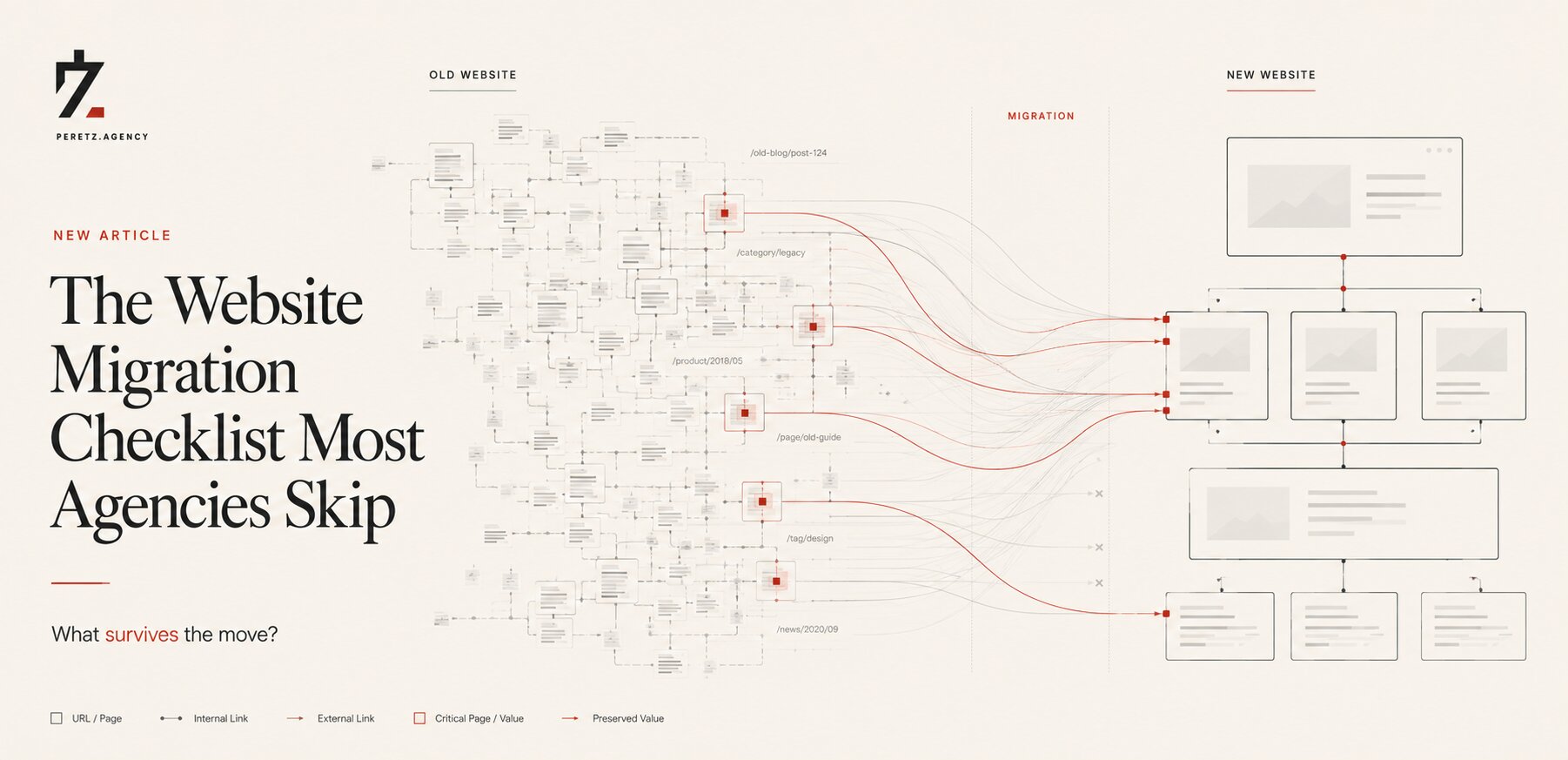
Decide what happens to existing URLs
If you're redesigning or migrating an existing store, SEO cannot become a launch-week conversation.
Existing URLs, redirects, indexed content and search visibility need to be part of the project plan.
Separate decisions from possibilities
Not every idea needs to be decided immediately.
But the team needs to know which things are settled and which are genuinely open.
Be honest about response time
This is probably the most underestimated dependency of all.
If a client says:
"We can usually respond within two days."
but realistically needs five business days for internal approval, the schedule should be built around five.
A timeline based on an optimistic response time is not an ambitious timeline. It is a fictional one. And even an honest timeline ends on launch day, which is exactly where the business starts living: your business doesn't go live, it comes alive.
Reading a Timeline
Reading a Timeline
A timeline in a proposal is a claim.
Some claims are more testable than others.
When an agency tells you that your store will launch in eight weeks, ask what those eight weeks assume.
What does the schedule assume about product data?
What does it assume about content?
What does it assume about approvals?
What does it assume about integrations?
What happens if one of those inputs is late?
Where are the client dependencies marked?
Is testing time-boxed?
What is the feedback mechanism?
What are the approval points?
How much time is allocated to each?
What is explicitly excluded from the timeline?
And perhaps the most revealing question:
What would make this eight-week schedule become twelve weeks?
A good agency should be able to answer that without hesitation.
A timeline that only describes the agency's work is not really a project timeline.
It is an estimate of the agency's own work presented as a delivery date.
The difference becomes apparent somewhere around week six.
The Timeline Is a Shared Commitment
The projects that finish close to their original date are rarely the ones with the fastest developers.
They are usually the ones where both sides understood, before the first line of code was written, what they had committed to and when.
The agency cannot control how quickly the client approves a product catalogue.
The client cannot control how long a properly scoped integration takes to build.
Neither side benefits from pretending otherwise.
The useful timeline is therefore not "we can build your store in X weeks."
It is:
"Here is what has to happen, who owns each part, what we are assuming, and what happens to the schedule when one of those assumptions changes."
That is a much less attractive sales sentence.
It is also a much more useful one.
Timelines change again once the catalogue and market count multiply, which we cover in Fifty Thousand Products, Eight Markets: Where Catalogue Scale Becomes an Architecture Problem.
Timelines change again once the catalogue and market count multiply, which we cover in Multi-Country E-Commerce for Large Catalogues: The Architecture Decisions That Set the Ceiling.
If you are planning an e-commerce project and want a realistic view of the timeline, the first conversation should not be about how quickly someone can start coding. It should establish what the business actually needs, what has to be built, what information already exists, which systems need to connect, who owns each decision, and what the business can realistically provide during the project. That is what a Strategic Session is designed to establish before scope becomes a schedule.
Explore our E-Commerce Development services.
A realistic e-commerce timeline is not the shortest one an agency can promise. It is the one both sides can actually keep.
- Share
-

-

-

-

One notification a week with the new PERETZ articles. Nothing else.
Related Reading
-
28. 08. 2026
What Actually Makes E-Commerce Development Expensive

-
01. 09. 2026

Why E-Commerce Development Quotes in Seattle Range From $25 to $300 an Hour
-
26. 08. 2026

Why Multi-Language Websites Need a Different Design Approach
-
14. 08. 2026

How We Design E-Commerce: From Objects to Experience
-
27. 08. 2026
The Website Migration Checklist Most Agencies Skip
-
02. 08. 2026

How to Choose a Web Development Company
-
06. 09. 2026

Multi-Country E-Commerce for Large Catalogues: The Architecture Decisions That Set the Ceiling
-
06. 09. 2026

SEO Gets You Found. AEO Gets You Recommended. Your Commerce Infrastructure Gets You Bought.