


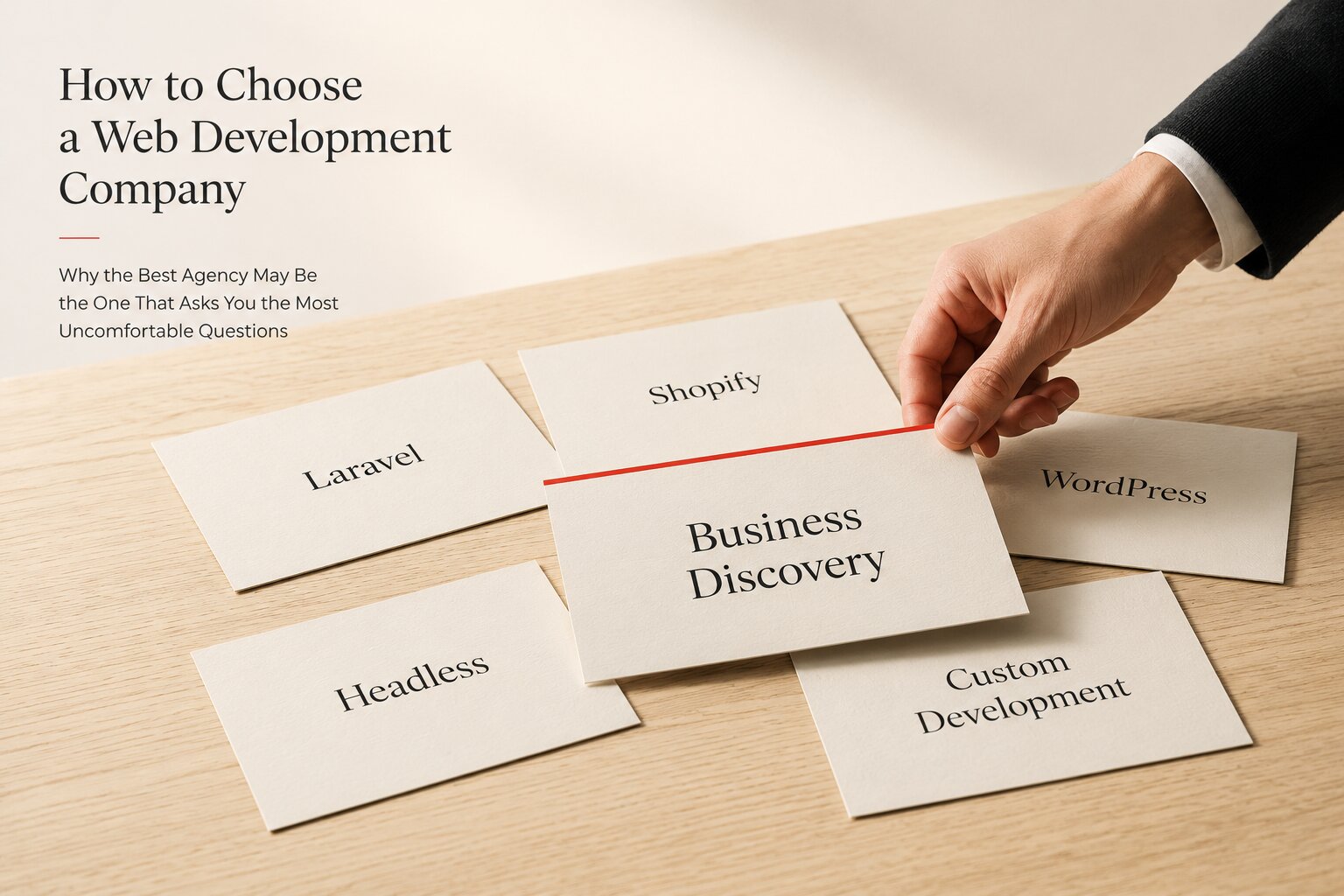
UNCOMFORTABLE QUESTIONS
Why the Best Agency May Be the One That Asks You the Most Uncomfortable Questions
Every agency has a polished portfolio.
Every agency promises quality.
Every agency claims to understand your business.
Many showcase awards, recognizable clients, and modern technologies, Laravel, React, Shopify, AI, headless commerce, custom software.
From the outside, they all look remarkably similar.
We put together a practical checklist for telling them apart in How to Choose a Web Design Agency in Seattle. This piece goes deeper into one part of that: the decisions an agency makes before it ever recommends a technology.
And that’s exactly where the problem begins.
Because the biggest difference between agencies is rarely visible in a portfolio.
It’s visible in how they think.
More importantly…
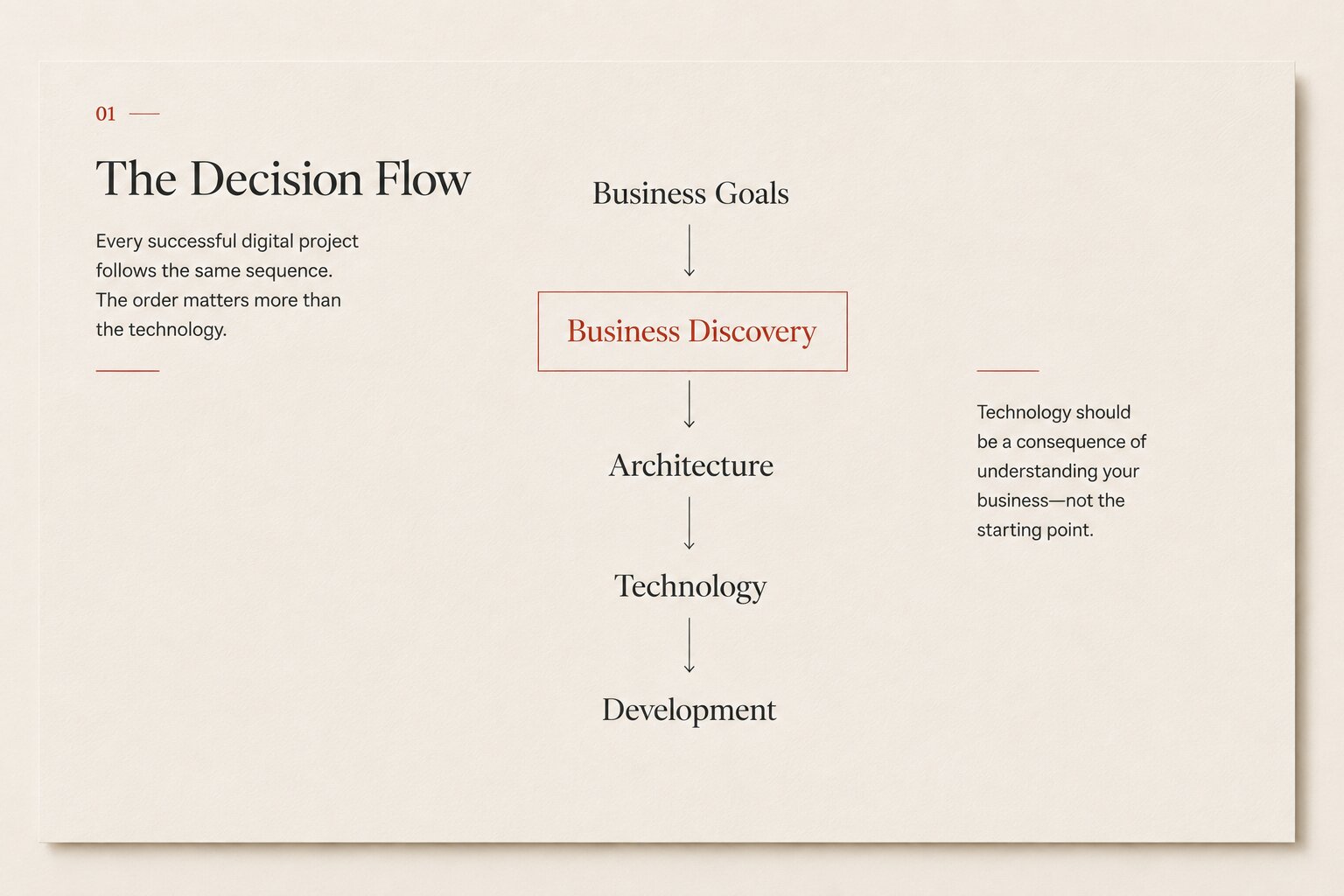
…in how they make decisions before they recommend a single technology.
Over the years, we’ve learned something surprising.
Choosing a web development company has very little to do with web development itself.
It’s about choosing people who understand your business well enough to recommend the right solution, even when it’s smaller, simpler, or less profitable for them.
We didn’t learn that from books.
We learned it from projects.
Some successful.
Some painfully unsuccessful.
Those projects changed the way we work.
This article is about them.
THE PROJECT WE DECLINED
The Biggest Project We Never Took
Several years ago, we participated in a tender for one of the largest companies in Ukraine.
The selection process lasted several stages.
Technical requirements.
Practical tests.
Meetings.
Discussions.
Dozens of competing agencies.
Eventually, we received the message every agency hopes to hear.
“Your proposal is the strongest we’ve reviewed. There’s only one question left. If you can lower your price a little, the project is yours.”
For a small agency, this was a dream project.
A major client.
A long-term partnership.
A contract capable of changing the trajectory of a business.
Most agencies would have found a way to make the numbers work.
We didn’t.
Not because we didn’t want the project.
Because we understood something the client couldn’t yet see.
The requested budget simply wasn’t compatible with the quality they expected.
Yes, we could have reduced the price.
But the money would have disappeared from somewhere else.
Less discovery.
Less architecture.
Less testing.
Fewer senior developers.
Everything would still have looked reasonable on paper.
Until development actually started.
Eventually, someone would have paid the difference.
The client.
The team.
Or the next company forced to rebuild the system years later.
That's the same pattern we broke down in The Most Expensive Mistake Business Owners Make Before Hiring a Digital Agency: the damage is rarely visible until the project is already underway.
That project taught us a lesson we’ve never forgotten.
A good agency doesn’t say “yes” to every opportunity.
It protects clients from decisions that look attractive today but become expensive tomorrow.
And that’s often much harder than simply winning the contract.
THE PROPOSAL LESSON
The Proposal That Taught Us to Slow Down
Not every important lesson comes from a successful project.
Some come from the projects you lose.
One of ours came from a large private healthcare company.
It's the kind of project we still approach the same way today in Corporate Website Development, on-site first, decisions second.
At the time, most agencies followed the same process.
A brief.
A few calls.
An estimate.
A proposal.
We wanted to do something different.
Instead of discussing the project remotely, we asked to visit the client.
We spent hours learning how the business actually worked.
Not just the future website.
The workflows.
The patient journey.
The operational details most visitors would never notice, like why surgical doors were designed to open without using hands.
Every decision inside that business had a purpose.
We left convinced that we understood the client.
We were wrong.
Walking back to the office, we genuinely believed we had done everything right.
We discovered we hadn’t.
Back at the office, we faced a problem.
The company I worked for had an internal estimating system.
It was a solid tool.
It could accurately calculate development effort based on functionality, integrations, page types, and complexity.
But it had one limitation.
It estimated software.
It couldn’t estimate understanding.
The proposal still needed to be rewritten.
Not technically.
Professionally.
It needed to explain why we were recommending certain decisions.
It needed to speak the client’s language, not the developers’.
Most importantly…
…it needed more time.
Time to validate assumptions.
Time to challenge our own conclusions.
Time to make sure we actually understood the business before recommending solutions.
We didn’t get that time.
The proposal had to be sent that day.
So we sent it.
A few days later, the client called.
I’ll never forget what they said.
“We were almost certain we would choose your team. You were the only agency that actually came to understand how we work.”
Then came the sentence that completely changed my perspective.
“But your proposal understood our business less accurately than proposals from agencies that never visited us.”
At first, it hurt.
Years later, I realized they were absolutely right.
Visiting the client isn’t enough.
Asking good questions isn’t enough.
Even genuinely trying to understand a business isn’t enough.
If you don’t give yourself enough time to transform that understanding into good decisions… you’re still making assumptions.
Since then, I’ve never looked at proposals the same way.
A proposal isn’t a pricing document.
It’s evidence of how well an agency understands a business before recommending anything.
And that’s exactly why I’m skeptical whenever someone asks an agency to estimate a complex project after a one-hour call…
…or from a brief…
…or from a technical specification.
Because if spending an entire day inside a client’s business wasn’t enough…
…how can anyone honestly promise the right solution after reading a PDF?
BEYOND SPECS
Why Technical Specifications Aren’t Enough
That experience changed the way I look at every project.
Because it led to a question I still ask today.
If spending an entire day inside a client’s business wasn’t enough to fully understand it…
…how can anyone accurately estimate a complex digital product from a brief?
Or a one-hour video call.
Or a technical specification.
Yet this happens every day.
A company prepares a detailed document.
Sometimes it’s ten pages.
Sometimes it’s a hundred.
Sometimes it’s written internally.
Sometimes by consultants.
Sometimes with the help of AI.
The document is sent to five agencies.
A week later, five proposals arrive.
Five different prices.
Five different timelines.
Five different technologies.
To the client, it looks like the agencies simply disagree.
In reality…
…they’re estimating assumptions.
Not businesses.
That’s because a technical specification rarely describes how a company actually works.
It describes someone’s current understanding of what should be built.
Those are very different things.
A specification can perfectly describe features.
It can list:
Product catalog
Customer accounts
CRM integration
Advanced search
Custom checkout
Loyalty program
Everything appears clear.
Everything appears measurable.
Everything appears ready to estimate.
But almost nothing important has been discussed.
We wrote about a similar blind spot in Most Companies Don't Own Their Website. They Own a Collection of Dependencies: the parts nobody wrote down are usually the parts that end up costing the most.
Nobody asked questions like:
Why is the company rebuilding the website now?
What business problem are we actually trying to solve?
Who makes the buying decision?
Are customers buying for themselves or for someone else?
Is this primarily B2B or B2C?
What happens if traffic doubles next year?
Which existing processes absolutely cannot be disrupted?
And perhaps the most uncomfortable question of all…
WRONG PROBLEM
What if the website isn’t the real problem?
That’s why we’ve learned to treat every technical specification as a starting point.
Not as the answer.
Because specifications describe solutions.
Discovery reveals problems.
And if you start building before you’ve challenged the assumptions behind the specification…
…you’re not reducing risk.
You’re simply making expensive assumptions with greater confidence.
THE UNNEEDED LARAVEL
The Laravel Project That Never Needed Laravel
A few years later, another project landed in our inbox.
This time, the client already had everything prepared.
A detailed technical specification.
An online store with around 8,000 products.
Custom product pages.
A sophisticated customer portal.
CRM integration.
And one requirement that appeared throughout the document.
Laravel.
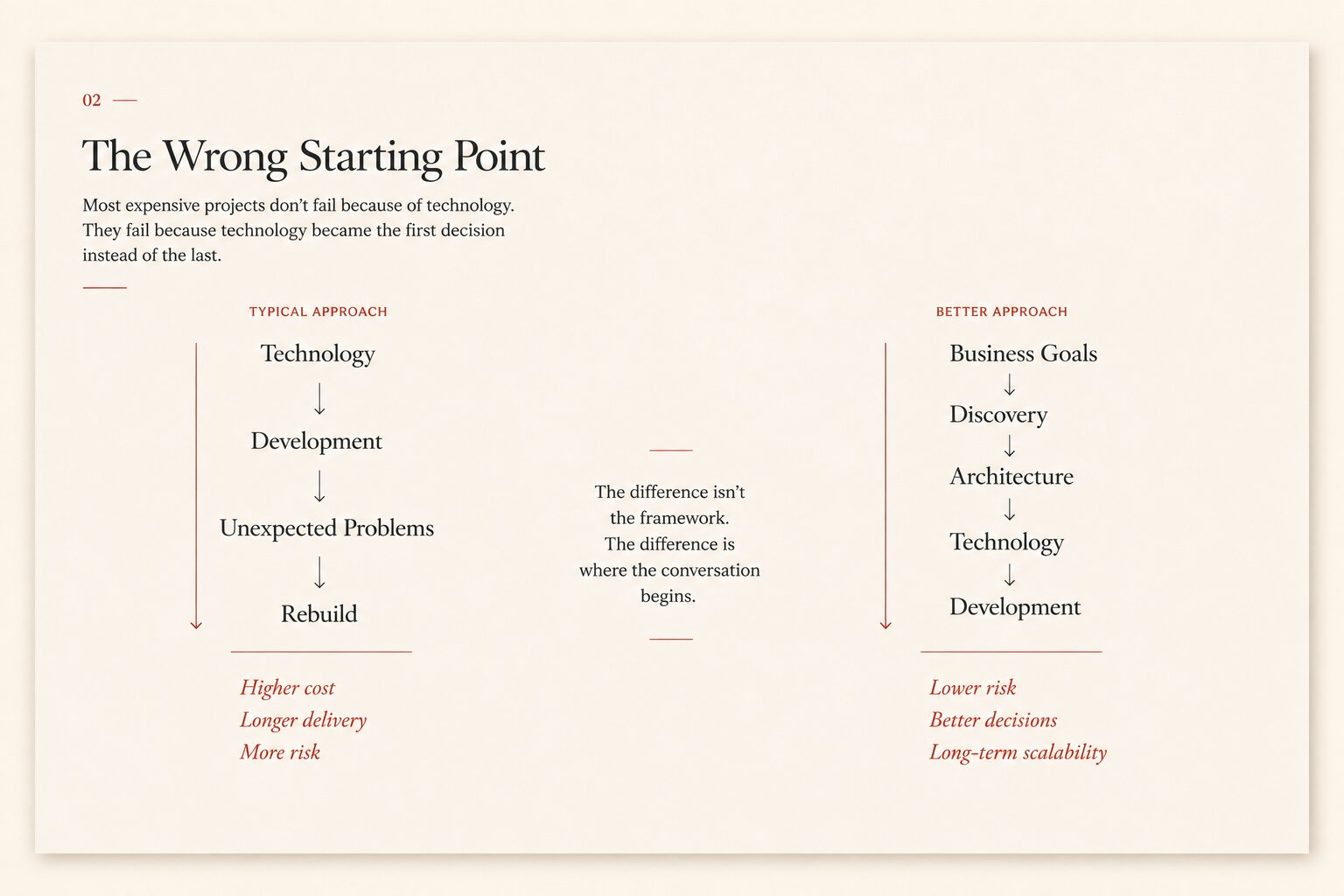
From the client’s perspective, the technology had already been chosen.
The only remaining question was:
How much will it cost?
Most agencies would have estimated exactly what they received.
We almost did the same.
Building the project exactly as specified would have cost somewhere between $35,000 and $40,000.
Then we stopped looking at Laravel…
…and started looking at the business.
The more we analyzed the requirements, the more one question kept coming back.
Why Laravel?
Not because Laravel is a bad framework.
It isn’t.
We build Laravel applications ourselves.
Our Laravel Development team ships them regularly, when the business actually needs one.
The real question was much simpler.
Does this business actually need Laravel?
Or had someone already decided on the solution before fully understanding the problem?
After reviewing the entire project, we reached an unexpected conclusion.
Nothing in the business requirements actually required Laravel.
The client needed:
a reliable online store,
flexible product management,
a powerful customer account,
CRM integration,
and room for future growth.
All of those requirements could be solved using WooCommerce.
Without sacrificing functionality.
Without limiting future scalability.
Without introducing unnecessary complexity.
Instead of sending a single proposal, we prepared two.
The first followed the specification exactly.
Laravel.
The second challenged the specification itself.
At first, the client was surprised that we were questioning their specification instead of simply pricing it.
We explained why we believed a CMS would solve the same business problems more efficiently.
Not because it was cheaper.
Because it was the better solution.
The client chose WooCommerce.
These days that same evaluation runs through our E-Commerce Development process by default, platform second, business first.
The store was built.
Years later…
…it’s still running successfully.
Nothing important was lost.
Because Laravel had never been the objective.
The business was.
AI AND DISCOVERY
AI Didn’t Give the Wrong Answer
This story has become even more relevant over the past two years.
Years ago, clients would say:
“A developer recommended Laravel.”
Today they say:
“ChatGPT recommended Laravel.”
People often assume AI is giving bad advice.
In most cases…
…it isn’t.
It’s answering the question it was asked.
If someone asks:
“Should I build my online store on Laravel?”
the biggest decision has already been made.
Nobody asked whether Laravel was necessary in the first place.
Nobody explained the business model.
The operational processes.
The budget.
The team’s technical capabilities.
The long-term growth plans.
Or whether a simpler solution could achieve exactly the same outcome.
AI didn’t misunderstand the business.
It was never given the business to understand.
That’s an important distinction, and it's the same one we made in Four AIs Agreed. We Still Hadn't Verified Anything: agreement from a model isn't the same thing as understanding.
Because the same mistake happens everywhere.
In AI conversations.
In technical specifications.
In agency meetings.
People become emotionally attached to solutions…
…before they’ve fully understood the problem.
And once that happens…
every recommendation becomes biased.
Years ago…
people outsourced thinking to developers.
Today…
many outsource it to AI.
Neither works.
Because neither understands your business until you help them understand it.
AI doesn’t replace Discovery.
It makes Discovery even more valuable, which is really the point we made in The Cost of AI Isn't Generation. It's Verification.
QUESTIONS TO ASK
The Questions Every Great Agency Should Ask
After years of winning projects, losing projects, rebuilding projects, and questioning our own decisions, we’ve reached a simple conclusion.
The quality of an agency isn’t measured by how quickly it provides answers.
It’s measured by the quality of the questions it asks before giving one.
If an agency recommends a technology during the first meeting…
…be careful.
If they confidently estimate a complex project after reading a technical specification…
…be careful.
If they never challenge your assumptions…
…be even more careful.
Because great agencies don’t begin with Laravel.
Or Shopify.
Or WordPress.
They begin with understanding.
Technology comes later.
That’s why every Strategic Session we run starts exactly the same way.
Not with budgets.
Not with timelines.
Not with frameworks.
With questions.
Because we’ve learned that the right technology almost always reveals itself once the business has been understood.
Trying to choose it beforehand is simply guessing.
CONCLUSION
Conclusion
If there’s one thing these stories have taught us, it’s this.
Choosing a web development company isn’t really about choosing a web development company.
It’s about choosing how decisions will be made for the next several years of your business.
Every architecture.
Every integration.
Every technology.
Every deadline.
Every future change.
They all begin with the same moment.
Someone decides.
The question is…
how.
The best agencies aren’t the ones with the most impressive portfolios.
Or the biggest teams.
Or the longest list of technologies.
They’re the ones willing to slow the project down before speeding it up.
The ones willing to ask uncomfortable questions.
To challenge assumptions.
To recommend a simpler solution when everyone expects a more complex one.
Even if that means earning less.
Because in our experience…
Clients rarely regret asking too many questions before a project begins.
They almost always regret asking too few.
START WITH UNDERSTANDING
Before You Build, Start With Understanding
If you’re planning a new website, e-commerce platform, AI initiative, or digital product, don’t begin by choosing Laravel, Shopify, WordPress, or even an agency.
Start by understanding the business behind the request.
Our Strategic Session exists for exactly that purpose.
Together, we challenge assumptions, explore alternatives, identify hidden risks, and build a clear decision framework before development begins.
Sometimes that leads to a new platform.
Sometimes it leads to a completely different solution.
Sometimes it proves that your current system is exactly what your business needs.
All three outcomes are equally valuable.
Because the most expensive mistakes in digital projects rarely happen during development.
They happen when the wrong decisions are made before development even begins.
One of those decisions is choosing between a website builder and custom development in the first place, covered in Custom Website vs Website Builder: What Should a Business Choose?.
If that development is happening across more than one language market, the design considerations shift too, something we cover in Why Multi-Language Websites Need a Different Design Approach.
The e-commerce version of this question, including what directory rates actually mean, is covered in Why E-Commerce Development Quotes in Seattle Range From $25 to $300 an Hour.
Once the company is chosen, the timeline becomes the next question, examined in How Long Does an E-Commerce Build Actually Take, and What the Client Has to Do.
- Share
-

-

-

-

Related Reading
-
24. 06. 2026

How to Choose a Web Design Agency in Seattle: A Business Owner’s Guide for 2026

-
30. 06. 2026
The Most Expensive Mistake Business Owners Make Before Hiring a Digital Agency
-
15. 07. 2026

Four AIs Agreed. We Still Hadn't Verified Anything.
-
19. 07. 2026

The Cost of AI Isn't Generation. It's Verification.
-
30. 07. 2026

Most Companies Don't Own Their Website. They Own a Collection of Dependencies.
-
02. 08. 2026
Every Enterprise System Started as Someone's Spreadsheet
-
23. 08. 2026
Custom Website vs Website Builder: What Should a Business Choose?
-
23. 08. 2026

How Much Does a Custom Website Cost in 2026?
-
26. 08. 2026
Why Multi-Language Websites Need a Different Design Approach
-
01. 09. 2026

Why E-Commerce Development Quotes in Seattle Range From $25 to $300 an Hour
-
01. 09. 2026
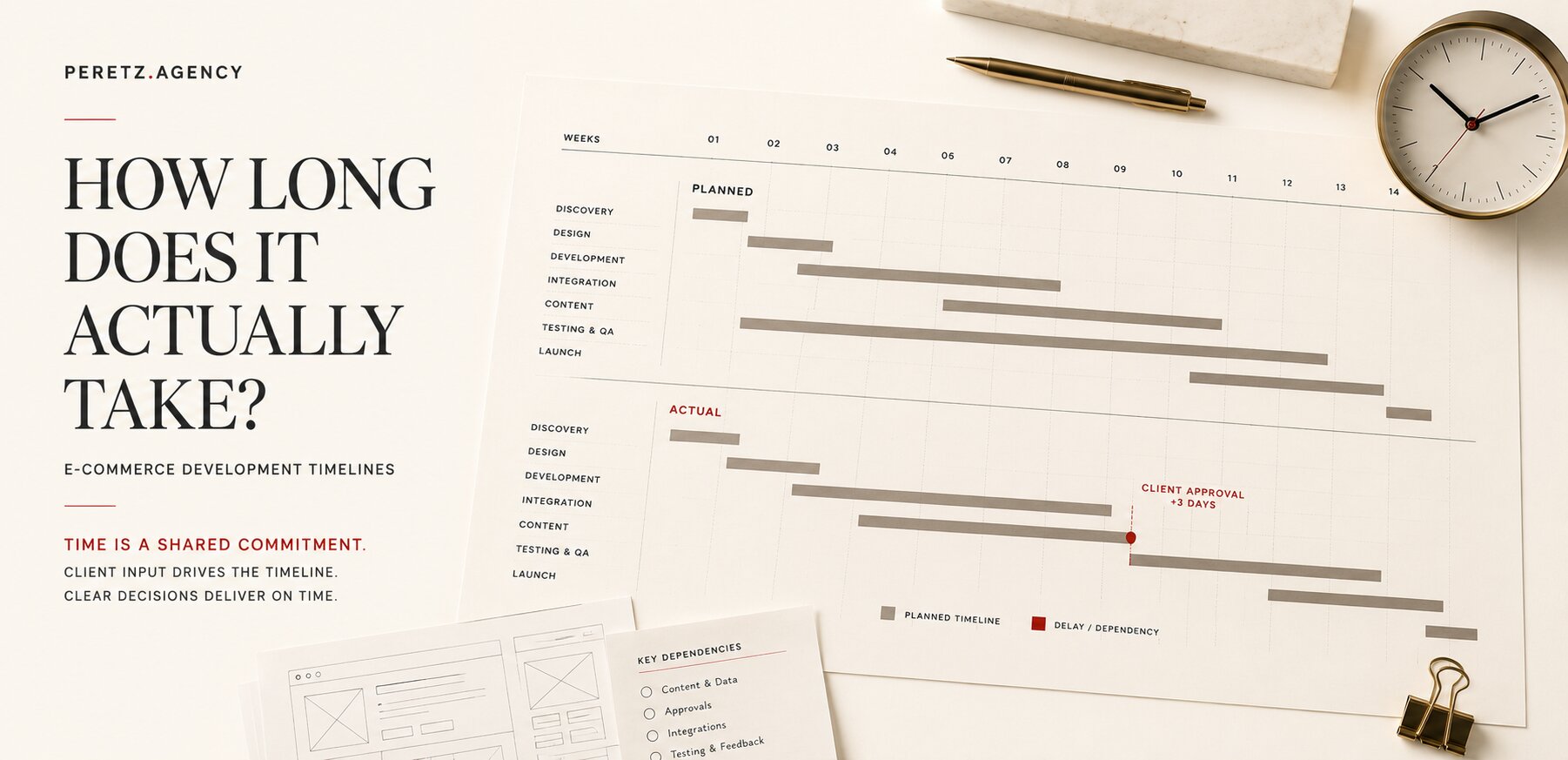
How Long Does an E-Commerce Build Actually Take, and What the Client Has to Do
-
04. 09. 2026
What Separates a Premium Laravel or Symfony Build From a Merely Functional One