

A business owner in Seattle searching for an e-commerce development partner encounters a peculiar market.
The directories list dozens of firms. Ratings cluster tightly. Service descriptions are remarkably similar.
The hourly rates are not.
Current 2026 listings show Seattle-area e-commerce providers across a very wide range: GoodFirms reports a median of $37 per hour for its Seattle e-commerce category, while Clutch listings range from $25 to $49 per hour at the lower end to $200 to $300 per hour for some providers. DesignRush likewise shows Seattle agencies ranging from very low hourly rates to approximately $199 per hour and above.
A tenfold spread looks strange until you understand what those numbers actually represent.
The important question is not why one agency charges $40 and another $200.
It is what exactly you are buying at each rate.
Because an hourly rate is only a unit price.
The total cost is determined by how much work the project actually requires, and how well that work was understood before development began.
What Directories Show
What Directories Show
The first thing to understand is that agency directories are useful for finding providers, but they are not a standardized measurement of how much it costs to build an e-commerce business.
GoodFirms currently lists 38 verified e-commerce development companies in Seattle and reports a $37 median hourly rate.
Clutch presents a much wider spread.
Current Seattle listings include firms at $25 to $49/hr, $50 to $99/hr, $100 to $149/hr, $150 to $199/hr and $200 to $300/hr.
That doesn't mean one directory is right and another is wrong.
It means they are showing a market made up of very different companies, operating models and project types.
And that distinction matters.
Agency Versus Team
Agency Versus Team
This is where directory comparisons become misleading.
A listing can associate a company with Seattle because it is headquartered there, has a local office, is registered there, or serves clients in the market.
Clutch itself distinguishes between firms actually listed in Seattle and companies that serve Seattle. Its current e-commerce listings include both locally based firms and providers serving the Seattle market from elsewhere.
That is not inherently a problem.
Distributed software teams are normal.
A company can have its client-facing operation in the United States and its engineering team somewhere else. A European or Latin American team can work effectively with a Seattle client. There is nothing inherently better about having every developer sitting within driving distance of the client.
The problem is asymmetric information.
A buyer comparing two directory listings may see:
Seattle · E-Commerce Development · 4.9 stars · $50 to $99/hr
and
Seattle · E-Commerce Development · 4.9 stars · $150 to $199/hr
and assume the difference is simply that one company is more expensive.
It may be.
But the two companies may also have completely different delivery models.
The directory doesn't necessarily make that difference obvious.
Several Businesses, One Listing
Several Businesses, One Listing
In practice, a Seattle e-commerce search can surface several very different kinds of provider.
The genuinely local agency
Senior staff are actually based in the region. The company carries local salaries, office and operational costs, and often provides local or in-person availability.
The hourly rate may be substantially higher.
That can be completely reasonable.
The distributed or offshore engineering company
The company may have a US presence or serve the US market while the actual engineering team works in Eastern Europe, South Asia, Latin America or another region.
Rates can be considerably lower.
That doesn't tell you whether the quality is good or bad.
There are excellent distributed engineering companies and terrible ones.
The marketing or design agency that also builds e-commerce
Its primary business may be branding, SEO, advertising or creative services, with development as one part of the offering.
That can be exactly what a small business needs.
It can also become a problem if the project requires deep engineering, complex integrations or a custom commerce architecture.
All three can appear under the same search query.
The label tells you less than you think.
Rate Tells You Little
Rate Tells You Little
The instinct when seeing a tenfold rate difference is to assume the cheap company is risky and the expensive company is safe.
Neither assumption is reliable.
An hourly rate is a unit price.
The project cost depends on how many hours are required, and that depends heavily on how well the problem was understood before development began.
Imagine two teams.
One charges $40 per hour.
The other charges $150.
The $40 team misunderstands the catalog structure, builds the wrong product model, discovers the problem six weeks later and has to rebuild it.
The $150 team spends more time on discovery, designs the data model correctly and builds it once.
The second team may produce the cheaper project.
The reverse is also true.
A high hourly rate does not prove that an agency has better discovery, better architecture or better project management.
Rate is a unit price. Total cost is a function of understanding.
We explore the variables behind e-commerce development costs in more detail in What Actually Makes E-Commerce Development Expensive.
What Determines Scope
What Determines Scope
For e-commerce specifically, the factors that determine development effort are surprisingly consistent regardless of where the engineering team sits.
Product complexity
Are the products simple?
Or do they have configurable options, variants, bundles, dimensions, personalization, custom pricing or thousands of possible combinations?
A catalog with 500 simple products can be technically easier than a catalog with 50 products that require complex configuration.
Integrations
Does the store need to communicate with:
- ERP
- CRM
- inventory systems
- accounting
- fulfillment
- shipping providers
- payment systems
- marketplaces
- subscription platforms?
And in which direction does the data move?
A website that only sends orders to a fulfillment system is one problem.
A system that synchronizes inventory, customer data, pricing, product information and order status across several platforms is another.
Tax and regional requirements
A business selling only locally has a different problem from a business selling across the United States.
Sales tax, exemptions, shipping rules and customer location can become part of the commerce architecture rather than something added at checkout.
Existing SEO value
If the project is a redesign or migration, existing URLs and organic visibility may have to survive.
That means redirects, metadata, content structures, internal linking and indexed pages become part of the project.
Customer journey
A customer buying a $30 product in a few clicks creates a different technical and UX problem from a customer spending several weeks researching a $5,000 product before purchasing.
The number of pages does not tell you the complexity of the business. The business model does.
None of these questions appears in a directory listing.
All of them can determine the price.
An agency that has asked these questions is quoting a project.
An agency that has not is quoting an assumption.
Questions That Clarify
Questions That Clarify
Instead of trying to infer an agency's operating model from its directory profile, ask directly.
A serious provider should be comfortable answering:
- Where are the engineers who will actually write the code?
- Who will be on the project calls?
- Are those people doing the work or managing another team?
- What hours of overlap will we have with the engineering team?
- Is any part of the project subcontracted?
- Who owns the code after launch?
- Who owns the infrastructure and hosting?
- Who will maintain the system?
- Which comparable e-commerce projects has the team actually delivered?
- What assumptions were used to produce the estimate?
These questions are not hostile.
They are basic due diligence.
And the answers tell you considerably more than an hourly rate.
Time Zones Over Addresses
Time Zones Over Addresses
There is a legitimate concern with distributed teams: communication.
But the relevant variable is not simply geographical distance.
It is working-hour overlap.
A team several hours ahead of Pacific Time can still maintain meaningful daily overlap with a Seattle business.
That can be enough for standups, reviews, design decisions, technical questions and approvals to happen during the same working day.
A team with almost no overlap creates a different operating model.
A question gets asked.
The developer sees it the next day.
The client answers after that.
The developer sees the answer the following morning.
A small decision can consume several calendar days.
On a project with significant ambiguity, those delays compound.
The question is not where they are. It is when you can work together.
Where We Sit
Where We Sit
Applying the same standard to ourselves: our engineering teams are in Europe.
We state this clearly rather than allowing a US-facing presence to imply that every person working on a project is physically located in Seattle.
The practical consequences are the ones described above.
Our teams maintain meaningful overlap with Pacific Time for scheduled calls, reviews and decisions, while our engineering cost base differs from that of an agency carrying the full cost structure of a Seattle engineering team.
That can allow a larger proportion of a project budget to go toward engineering, integrations, architecture and post-launch stability rather than local delivery overhead.
We don't present this as a discount.
A project that is cheap to commission and expensive to own is not a good deal.
It is simply a different cost structure applied to the same question: what does the business actually need to build?
A buyer should know which operating model they are purchasing.
Local Presence Still Counts
Local Presence Still Counts
There is a legitimate argument for choosing a local Seattle partner.
Some projects genuinely benefit from physical presence.
Retail environments may require on-site work.
Some businesses make major decisions in person.
Certain procurement or regulatory processes may require a local counterparty.
Those are real advantages.
But most e-commerce development does not require every engineer to live in the same city as the client.
What the project needs is an understanding of the market it serves.
For a Seattle business, that might include understanding Washington tax requirements, local customer expectations, logistics, competitors and the broader US e-commerce environment.
That understanding comes from research and discovery.
Proximity helps communication. It does not automatically create understanding.
An agency four blocks away that doesn't understand the business can be less useful than a team several time zones away that does.
Comparing Three Quotes
Comparing Three Quotes
Imagine receiving three proposals:
$18,000. $65,000. $190,000.
The instinct is to ask which price is reasonable.
That's the wrong first question.
First, normalize the scope.
Does each proposal include:
- UX/UI design?
- responsive development?
- product and catalog migration?
- integrations?
- payment setup?
- tax logic?
- shipping logic?
- SEO migration?
- analytics?
- testing?
- deployment?
- training?
- post-launch support?
Then ask who is actually doing the work.
Then ask what assumptions produced the number.
Then ask what is explicitly excluded.
At that point, the three quotes often stop looking like three prices for the same project.
They start looking like three different projects.
Which is usually what they were from the beginning.
This distinction is worth making explicit.
A $25,000 proposal can become a $50,000 project if the scope was based on assumptions.
A $100,000 proposal can be the better financial decision if it includes the architecture, integrations and migration work the business actually requires.
This is particularly important for e-commerce because mistakes don't necessarily end when development ends.
A poor product model can make catalog management painful for years.
A weak integration can create manual work every day.
A rushed migration can damage organic traffic.
A fragile checkout can affect revenue directly.
The development invoice is only one part of the cost.
The real cost includes what the system costs the business to operate after launch.
What to Compare Instead of Hourly Rates
When comparing e-commerce development companies in Seattle, don't build your shortlist around hourly rate alone.
- the operating model
- the people actually doing the work
- the scope assumptions
- the architecture proposed
- the integration approach
- what happens after launch
And most importantly, compare how deeply each company understood the business before putting a number on the project.
A company charging $50 per hour may be the right choice.
A company charging $200 per hour may be the right choice.
There is no universal "correct" Seattle e-commerce rate.
There is only a correct relationship between:
Business requirements → scope → team → architecture → time → total cost.
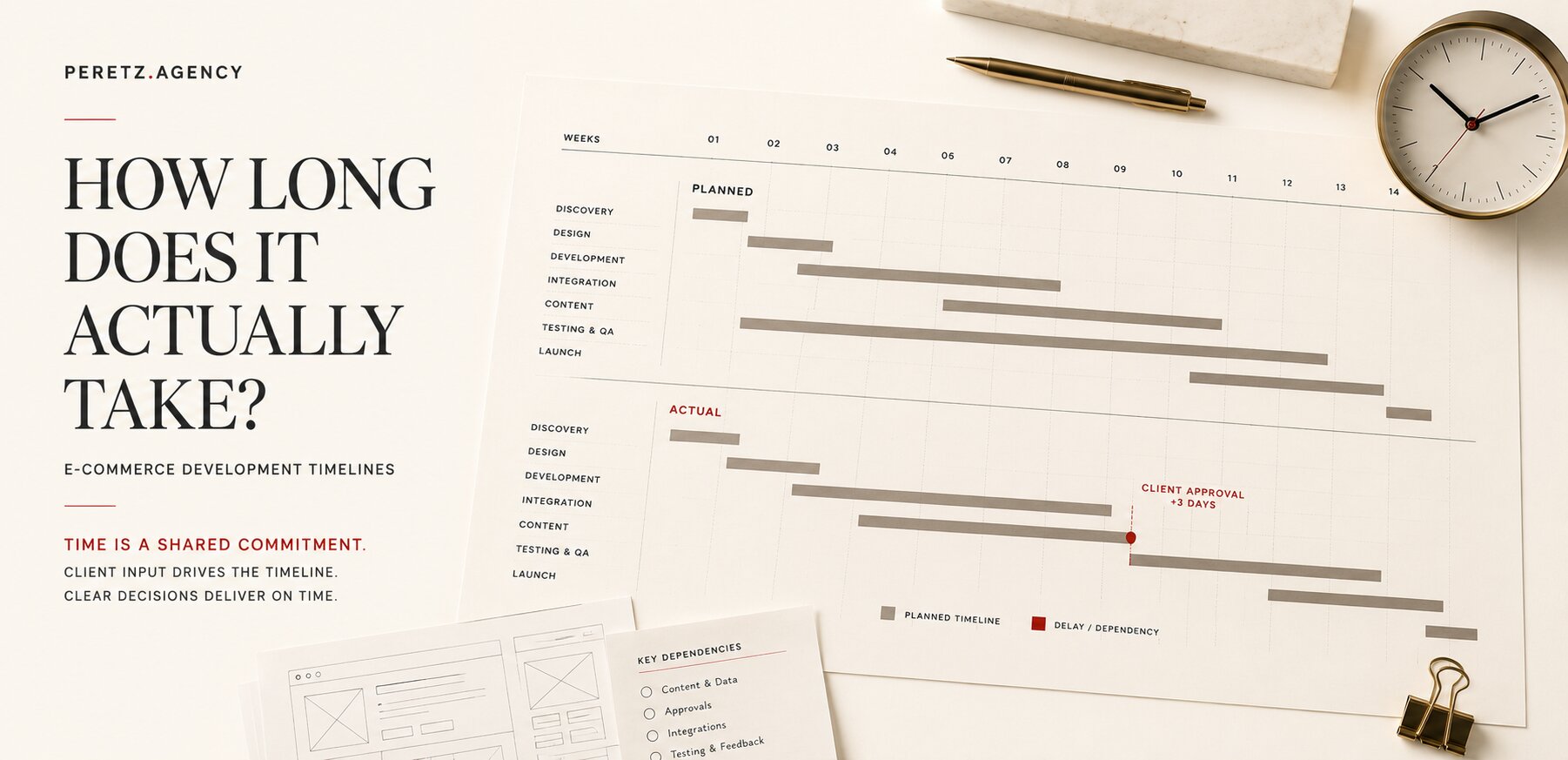
Once a provider is chosen, the schedule raises its own questions, which we cover in How Long Does an E-Commerce Build Actually Take, and What the Client Has to Do.
Projects at this scale sit outside the usual comparison entirely, as we set out in Fifty Thousand Products, Eight Markets: Where Catalogue Scale Becomes an Architecture Problem.
Projects at this scale sit outside the usual comparison entirely, as we set out in Multi-Country E-Commerce for Large Catalogues: The Architecture Decisions That Set the Ceiling.
If you are comparing e-commerce development proposals, start with the business rather than the rate. What does the catalog actually require? What systems need to communicate? What has to migrate? Who maintains the platform after launch? That is what a Strategic Session is for: understanding the business requirements and digital structure before turning them into a development scope.
Explore our E-Commerce Development services.
- Share
-

-

-

-

Related Reading
-
28. 08. 2026

What Actually Makes E-Commerce Development Expensive

-
15. 06. 2026

How Much Does a Website Cost in Seattle in 2026?
-
18. 06. 2026

How Much Does a Website Cost in Bellevue WA in 2026?
-
24. 06. 2026

How to Choose a Web Design Agency in Seattle: A Business Owner’s Guide for 2026
-
02. 08. 2026

How to Choose a Web Development Company
-
23. 08. 2026

How Much Does a Custom Website Cost in 2026?
-
23. 08. 2026

Custom Website vs Website Builder: What Should a Business Choose?
-
01. 09. 2026
How Long Does an E-Commerce Build Actually Take, and What the Client Has to Do
-
04. 09. 2026

What Separates a Premium Laravel or Symfony Build From a Merely Functional One
-
06. 09. 2026

Multi-Country E-Commerce for Large Catalogues: The Architecture Decisions That Set the Ceiling