



INTRODUCTION
Introduction

Why digital ownership is becoming one of the most overlooked business risks,and what every business owner should understand before changing vendors, scaling operations, or preparing for investment.
While reviewing a software development agreement with a client, we reached a clause about intellectual property.
At first glance, it looked straightforward.
But the discussion quickly expanded beyond copyright.
Modern software depends on frameworks, commercial licenses, APIs, cloud infrastructure, AI services, and dozens of third-party technologies.
That raised a much larger question:
What does it actually mean to own a digital product today?
Most business owners believe they own their website.
It’s an understandable assumption.
They paid for it.
Their logo is on every page.
Their products are listed in the catalog.
Their customers use it every day.
Why wouldn’t they own it?
But modern digital products don’t work the way most people imagine.
Twenty years ago, a website was little more than a collection of files stored on a hosting server.
Today, it’s an ecosystem.
Behind every website sits an invisible network of technologies, contracts, licenses, cloud services, third-party providers, security systems, development tools, design assets, and intellectual property.
The website is simply the interface.
The business depends on everything underneath it.
Most companies never notice these dependencies because everything works.
Orders are processed.
Payments arrive.
Emails are delivered.
The development team deploys updates.
Customers remain happy.
Ownership isn’t questioned while the system is healthy.
The questions appear only when something changes.
A company changes development partners.
A key developer leaves.
An investor begins due diligence.
A cybersecurity audit starts.
The business prepares for acquisition.
Suddenly, questions that never seemed important become impossible to ignore.
Who owns the source code?
Who controls the cloud infrastructure?
Who purchased the commercial software licenses?
Who owns the Git repository?
Can another development team legally continue maintaining the platform?
Who has access to production systems?
Can every critical digital asset be transferred to a future buyer?
Many business owners are surprised by these questions.
Not because they have done something wrong.
But because nobody ever explained that digital ownership has changed.
Most companies don’t own a website.
They own a collection of dependencies.
Most organizations maintain carefully organized corporate records,formation documents, contracts, insurance policies, financial statements, tax filings.
Yet few maintain the same level of structure for the digital assets their business depends on.
As digital operations become central to enterprise value, that gap becomes increasingly difficult to ignore.
Understanding those dependencies is no longer an IT responsibility.
It has become a business responsibility.
OWNERSHIP CHANGED
Digital Ownership Has Changed
One of the biggest misconceptions in modern business is believing that software is a product.
It isn’t.
Software is infrastructure.
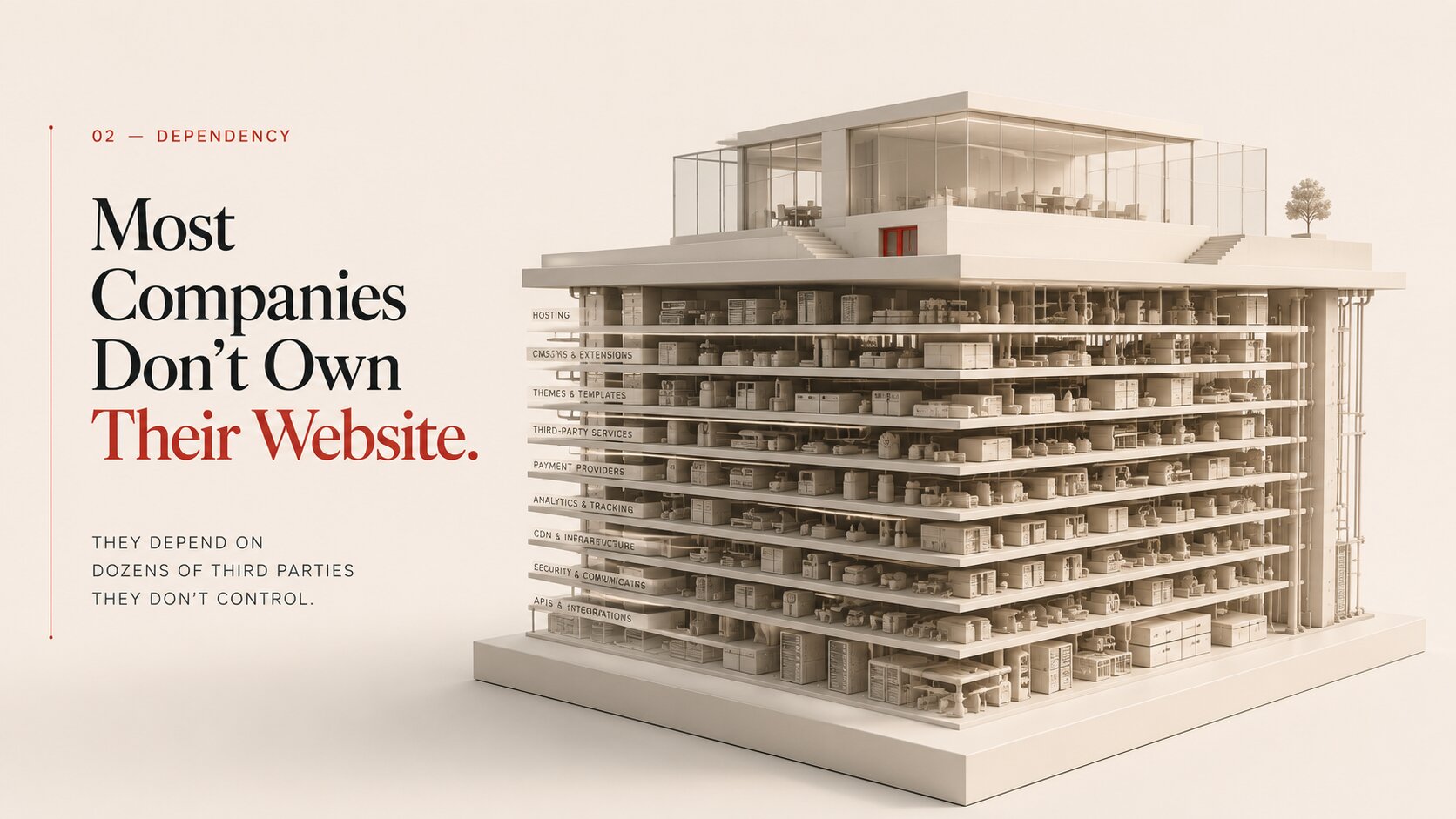
Imagine buying a commercial office building.
You wouldn’t evaluate it by looking only at the reception desk.
You would ask who owns the land.
Whether utilities are connected.
Whether construction permits exist.
Whether maintenance documentation has been preserved.
Whether future renovations are legally possible.
The visible part of the building tells you very little about the asset itself.
Modern software works exactly the same way.
The homepage is the lobby.
Everything that creates business value exists beneath the surface.
Cloud infrastructure.
Databases.
Authentication systems.
Payment providers.
Open-source frameworks.
Commercial software licenses.
Security configurations.
Deployment pipelines.
Monitoring systems.
Internal documentation.
Business logic developed over years of operation.
Together, these elements form something much larger than a website.
They form part of your company’s operational infrastructure.
And like any other infrastructure, it must be understood, maintained, documented, and governed.
The companies that recognize this early build digital assets that continue creating value for years.
The companies that don’t often discover hidden risks only when change becomes unavoidable.
Humanity can still admire the Egyptian pyramids, yet thousands of years later we continue debating exactly how they were built.
Businesses create a similar problem for themselves every day. Systems are built, integrations evolve, decisions are made,but the knowledge behind them is never intentionally preserved.
Fortunately, unlike ancient civilizations, modern organizations have every opportunity to document those decisions before they become history.
LEGAL VS COMMERCIAL
Dependency #1 - Legal Ownership Is Different from Commercial Ownership
During an investment process for a consumer brand generating eight figures in annual revenue, everything investors wanted was there,strong products, growing revenue, and a recognizable market presence.
What slowed the conversation wasn’t the business itself. It was the inability to clearly demonstrate ownership, governance, and documentation of its digital assets.
The website wasn’t the problem.
The absence of structure was.
One of the most common assumptions in software projects is remarkably simple:
We paid for it, therefore we own it.
In many situations, that’s true.
In software, it isn’t always that straightforward.
Paying an invoice and owning intellectual property are two different legal concepts.
A contract may require a developer to build a custom platform while remaining silent about copyright ownership.
Another may transfer the finished deliverable but not the underlying reusable components.
A third may grant broad usage rights without formally assigning intellectual property.
From a business perspective, all three projects may look identical.
From a legal perspective, they can be dramatically different.
This distinction rarely affects daily operations.
The website works.
Customers place orders.
Marketing campaigns continue.
Nothing appears unusual.
The difference becomes visible only when ownership must be proven.
Perhaps the company wants to bring development in-house.
Perhaps a new software partner is taking over.
Perhaps an investor requests documentation during due diligence.
Or perhaps the business is being acquired.
At that point, assumptions are replaced by documentation.
The question is no longer:
“Did you pay for the software?”
The question becomes:
“Can you demonstrate that your company owns the rights required to operate, modify, and transfer it?”
Those are not the same question.
SYSTEMS YOU NEVER BUILT
Dependency #2 - Your Technology Depends on Systems You Never Built
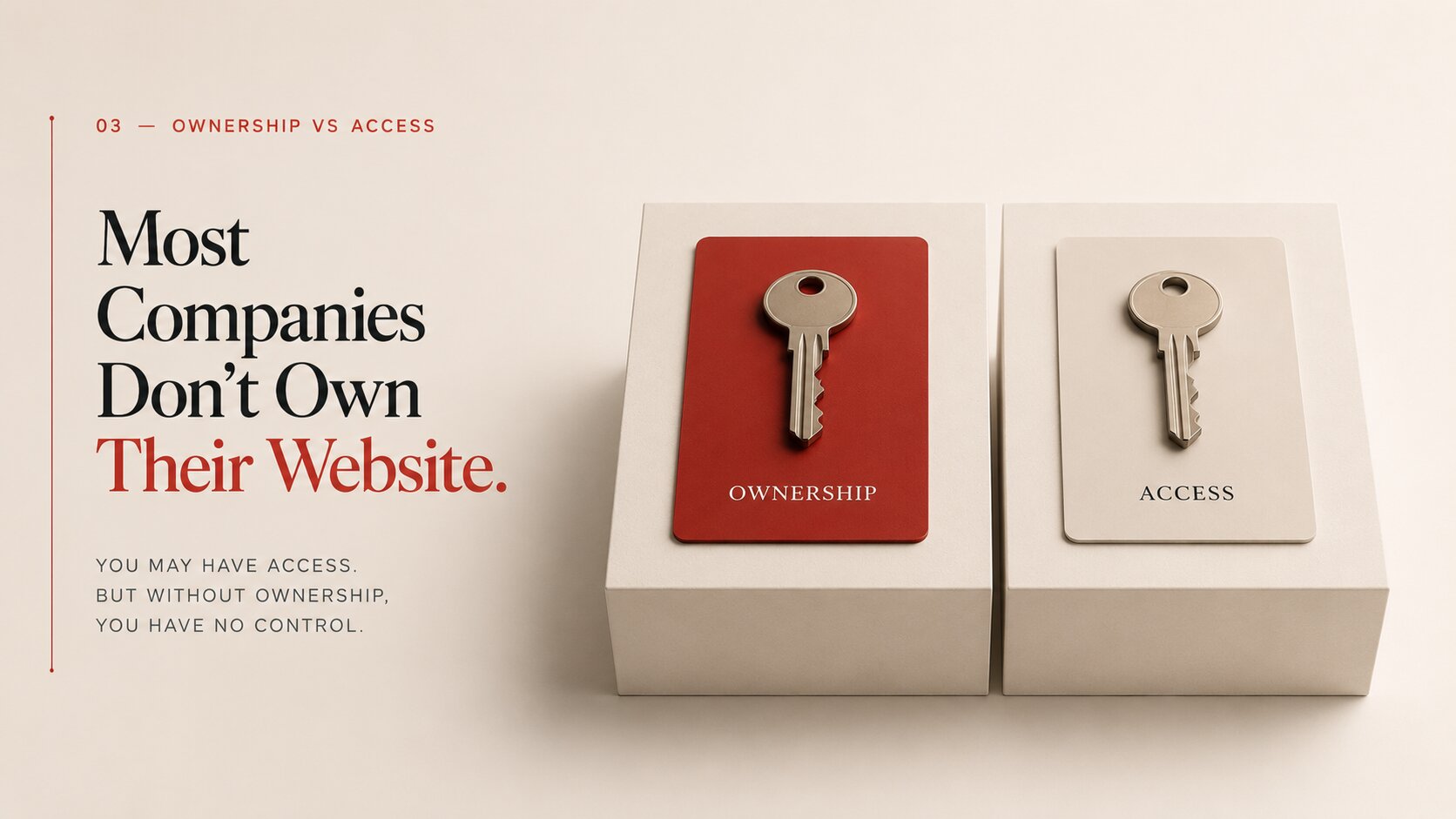
Very little modern software is written from scratch.
And that’s exactly how professional software engineering should work.
An architect doesn’t manufacture every brick before designing a building.
A construction company doesn’t produce its own electrical wiring, windows, elevators, or steel beams.
It combines trusted components into a structure that serves a specific purpose.
Software development follows the same principle.
A modern application may rely on React or Vue for the user interface.
Laravel, .NET, or Node.js for the backend.
Cloudflare for security.
GitHub for version control.
Docker for deployment.
Stripe for payments.
Google Maps for location services.
OpenAI or Anthropic APIs for AI capabilities.
Analytics platforms.
Email providers.
Authentication services.
Monitoring tools.
Hundreds of open-source packages.
None of these dependencies represent poor engineering.
In fact, they represent industry best practices.
The risk begins when the business no longer understands what it depends on,or who controls those dependencies.
If replacing a single vendor means rebuilding half the platform…
If only one developer understands the deployment process…
If production infrastructure exists under someone’s personal account…
Then the business has accumulated operational risk without realizing it.
Technology dependencies are unavoidable.
Undocumented technology dependencies are a choice.
And that choice is what separates resilient companies from fragile ones.
OPEN SOURCE RISK
Dependency #3 - Open Source Isn't the Risk. Unknown Dependencies Are.
Modern software is built on open source.
Not occasionally.
Almost universally.
Whether you’re running an e-commerce platform, a SaaS application, an internal business system, or a corporate website, thousands of open-source components are likely working behind the scenes.
That isn’t a shortcut.
It’s how professional software is built.
An architect doesn’t manufacture every brick before designing a building. Likewise, software engineers don’t write operating systems, databases, web servers, encryption libraries, or networking protocols from scratch. They assemble trusted technologies into systems that solve business problems.
Open source makes modern software possible.
The risk isn’t using it.
The risk is not understanding it.
Most business owners have no reason to know whether their application uses React, Laravel, PostgreSQL, Redis, or hundreds of other libraries. That isn’t their job.
Understanding whether the business depends on those technologies,and whether someone inside the organization has visibility into them,is.
This distinction becomes critical when something changes.
A security vulnerability is discovered.
A framework reaches end of life.
A critical library is no longer maintained.
A software vendor recommends a major upgrade.
One company immediately answers a simple question:
“Are we affected?”
Another spends weeks trying to understand what their own application is built upon.
The difference isn’t technology.
It’s governance.
Mature organizations don’t try to eliminate open-source dependencies.
That would be impossible.
They maintain visibility into them.
They know what their systems depend on, why those dependencies exist, how they’re licensed, and who is responsible for monitoring them over time.
Because software doesn’t become risky when it uses open source.
This is exactly what a Software Bill of Materials (SBOM) is designed to solve,a structured inventory of every component your software depends on. It’s no longer a niche technical practice: regulators in the United States and European Union are increasingly requiring SBOMs as part of software supply chain security (see the U.S. Executive Order 14028 on Improving the Nation’s Cybersecurity and the EU Cyber Resilience Act), which means dependency visibility is quickly becoming a compliance question, not just an operational one.
It becomes risky when nobody understands what it’s built upon.
SOFTWARE YOU PAID FOR
Dependency #4 - The Software You Paid For May Still Belong to Someone Else
Owning software and having access to software are not the same thing.
Neither is owning every component that makes it work.
Modern digital products rely on a growing ecosystem of commercial technologies.
Premium plugins.
Licensed fonts.
Icon libraries.
Stock photography.
Mapping services.
Payment gateways.
AI platforms.
Fraud detection systems.
Email delivery providers.
Identity services.
The list continues to grow every year.
These products aren’t purchased in the traditional sense.
They’re licensed.
Sometimes monthly.
Sometimes annually.
Sometimes under terms that can change with little notice.
None of this is inherently a problem.
In fact, building on proven commercial products is often the smartest business decision.
The problem begins when a company mistakes licensed access for ownership.
Imagine discovering that the payment provider your business depends on is registered under a former contractor’s account.
Or that the premium software licenses cannot legally be transferred to another development team.
Or that the AI features integrated into your product disappear because a third-party subscription expires.
The website still exists.
The business has changed.
Digital businesses rarely depend on a single technology.
They depend on dozens of commercial relationships that quietly support day-to-day operations.
Mature organizations don’t try to own every service they use.
They understand which services are business-critical, who owns each account, what contractual obligations exist, and what happens if a provider changes its pricing, licensing model, or availability.
Ownership isn’t always about possession.
Sometimes it’s about ensuring your business remains in control when circumstances change.
INFRASTRUCTURE CONTROL
Dependency #5 - Infrastructure: Who Really Controls Your Business?
Most companies know where their office keys are.
Far fewer know who controls their digital infrastructure.
At first, that doesn’t seem important.
The website is online.
Customers place orders.
Emails are delivered.
Everything appears to work exactly as expected.
Infrastructure only becomes visible when something stops working.
A server fails, a domain expires, a cloud account is suspended
, a DNS record is changed, an SSL certificate isn’t renewed, a production deployment fails.
Only then do companies begin asking questions they should have answered years earlier.
Who owns the cloud account?
Who controls the domain registration?
Who has access to DNS?
Who receives security notifications?
Who manages production deployments?
Who can restore backups?
Who holds the recovery codes for multi-factor authentication?
These aren’t technical questions.
They’re business continuity questions.
Many organizations discover that critical infrastructure was created years ago under a developer’s personal email address, a former employee’s account, or an agency profile that no longer exists.
Nothing seemed wrong,until access was needed.
Infrastructure ownership rarely becomes visible during success.
It becomes painfully visible during failure.
Technology doesn’t have to break for a business to lose control.
Sometimes losing access is enough.
True digital ownership isn’t measured by the number of servers you operate or the cloud provider you choose.
It’s measured by whether your organization,not an individual, contractor, or vendor,controls the infrastructure your business depends on.
HUMAN DEPENDENCIES
Dependency #6: Human Dependencies - When Critical Knowledge Lives in One Person
Not all dependencies are technical.
Some are built around people.
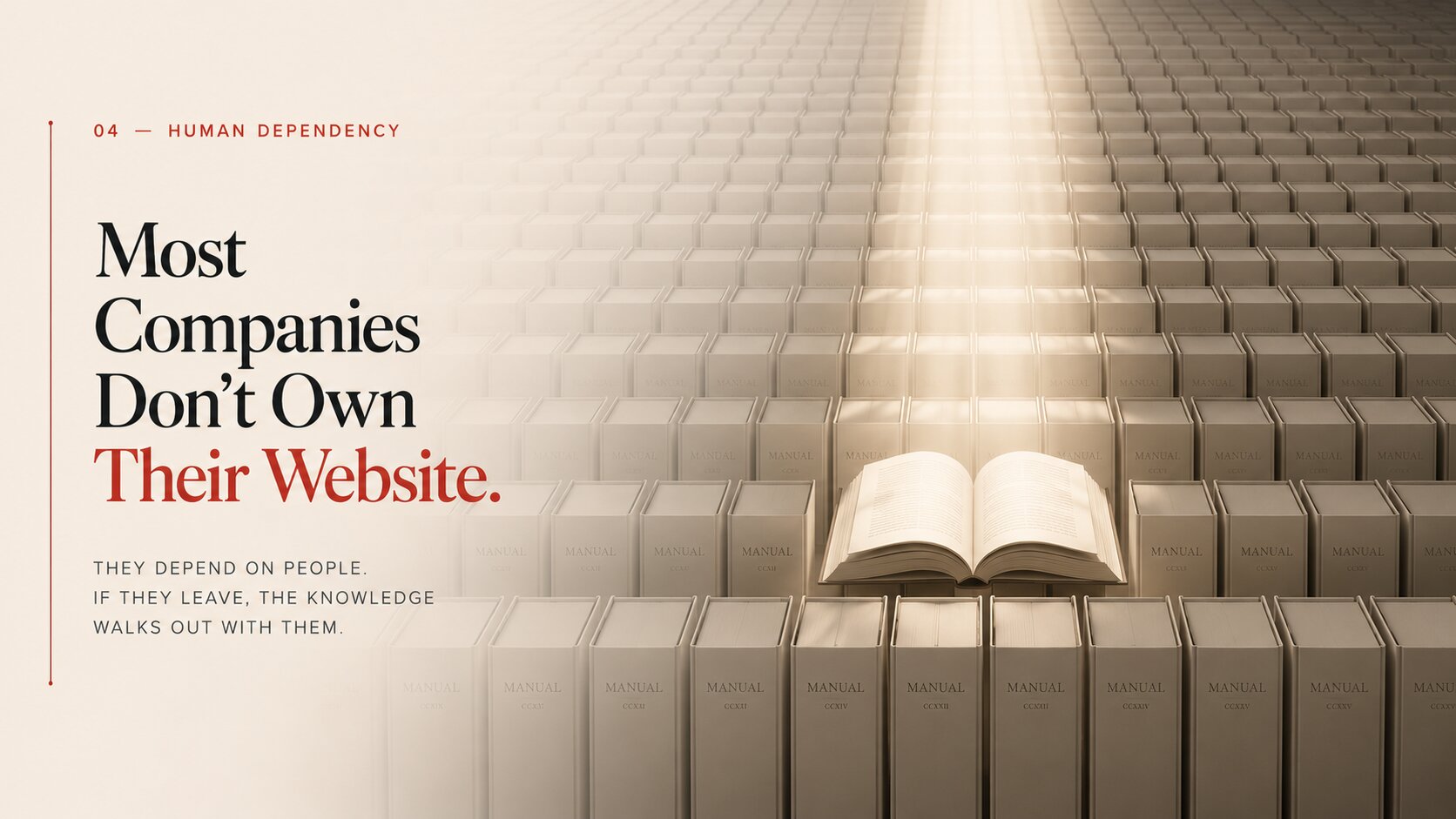
Every growing business eventually develops individuals who become deeply familiar with its systems, processes, and technology. They know why certain architectural decisions were made, where critical integrations exist, which shortcuts were taken, and how to solve problems that no documentation can fully explain.
Their expertise is valuable.
The dependency it creates is not.
A business becomes vulnerable when critical operational knowledge exists primarily in one person’s memory. That person may be an employee, a founder, a consultant, or an external agency. As long as they remain available, the dependency often goes unnoticed.
It only becomes visible when they leave.
At that point, the organization may still own the source code, the infrastructure, the licenses, and the contracts,but it has lost something equally important: the ability to confidently operate and evolve its digital assets.
Businesses don’t become dependent on people because those people are exceptionally talented.
They become dependent because knowledge never became organizational knowledge.
Mature organizations don’t try to eliminate experts. Expertise creates innovation and competitive advantage.
Instead, they reduce the operational risk created when too much knowledge depends on a single individual. They invest in documentation, shared ownership, cross-functional collaboration, succession planning, and knowledge transfer,not because they expect people to leave, but because resilient organizations are designed to continue operating when they do.
Human expertise creates competitive advantage. Human dependency creates operational risk.
This distinction becomes increasingly important as businesses scale. Technology can be replicated. Infrastructure can be rebuilt. Vendors can be replaced.
Institutional knowledge is far more difficult to recover once it’s lost.
Every undocumented process, every architectural decision remembered by only one person, and every critical workflow known only to a single expert increases the organization’s dependency on individuals rather than on its own systems.
Organizations don’t become resilient when they hire exceptional people. They become resilient when exceptional people leave behind exceptional systems.
Digital ownership extends beyond contracts and technology. It also means ensuring that no single person holds the keys to the organization’s ability to move forward.
KNOWLEDGE DEPENDENCIES
Dependency #7: Knowledge Dependencies - Can Your Business Operate Without Its Memory?
Every company accumulates knowledge.
Very few intentionally preserve it.
As organizations grow, they make thousands of decisions that shape how their digital business operates. Why one technology was selected over another. How customer data flows between systems. Which business rules exist behind seemingly simple features. Why certain integrations were implemented in a specific way. What compromises were made to meet deadlines.
Over time, this knowledge becomes one of the company’s most valuable assets.
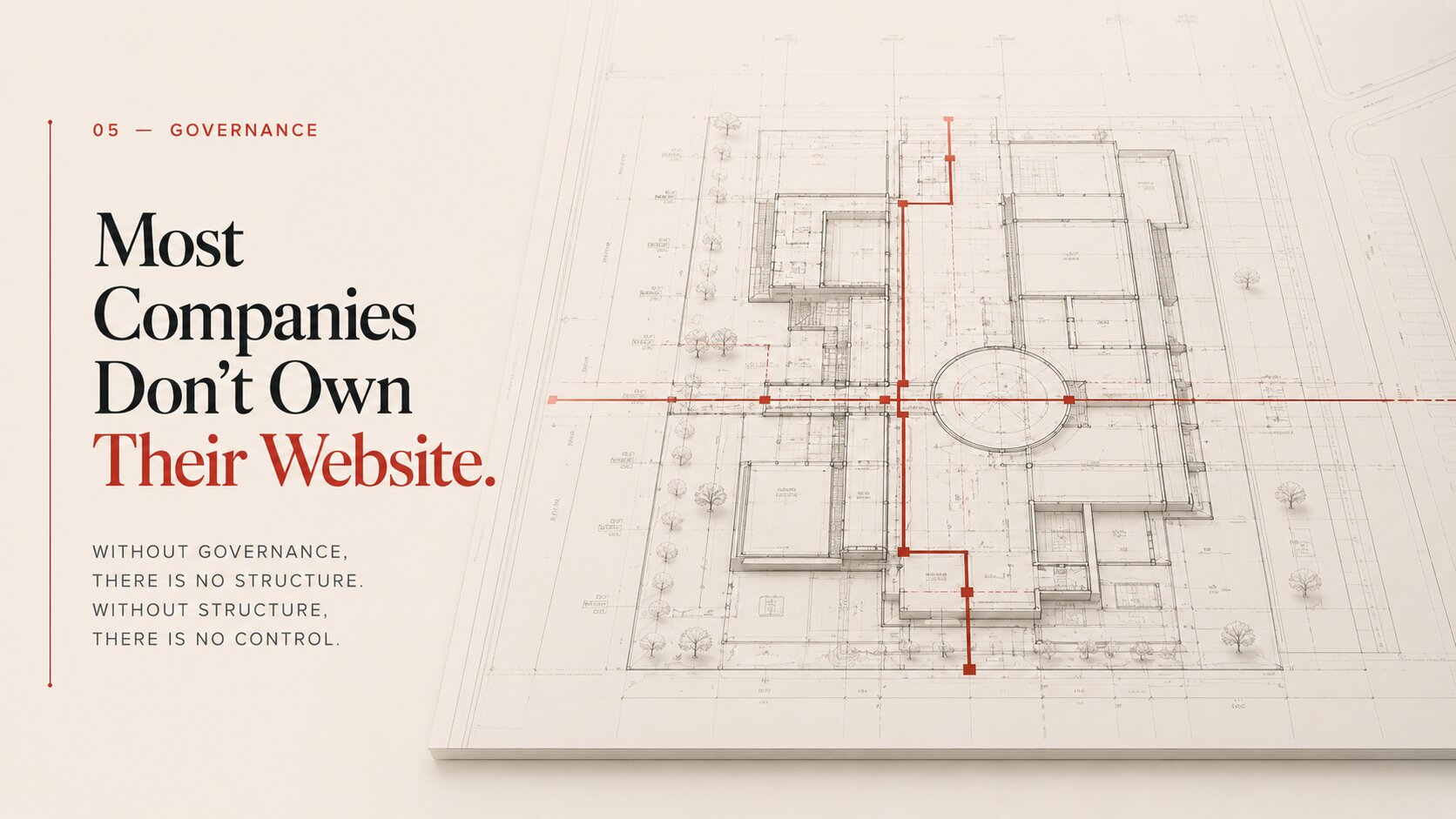
Yet in many organizations, it exists only in conversations, chat messages, meeting notes, or the memories of the people who were there.
Knowledge that cannot be transferred cannot truly be owned.
When documentation is incomplete, architectural decisions are forgotten, or operational processes exist only as unwritten habits, every future change becomes slower, riskier, and more expensive. New employees require more time to become productive. Vendors spend weeks rediscovering information the company once knew. Strategic initiatives stall because nobody is certain how existing systems actually work.
Companies don’t lose knowledge when employees leave.
They lose knowledge when that knowledge was never intentionally captured in the first place.
Digital ownership isn’t limited to software, infrastructure, or intellectual property.
It also includes the institutional knowledge required to understand, maintain, improve, and govern those assets over time.
The strongest digital organizations don’t rely on memory.
They build systems that preserve knowledge long after projects are completed, vendors change, and employees move on.
Because ownership isn’t only about keeping your digital assets.
It’s about ensuring your organization always knows how to use them.
Looking across every dependency explored in this article, a common pattern emerges.
Legal ownership, infrastructure, technology, vendors, people, and knowledge are often managed separately. Yet from a business perspective, they all describe the same question:
Can your organization continue to operate, grow, and adapt without becoming dependent on any single point of failure?
Digital ownership is no longer measured by what a company has purchased or built.
It is measured by what the organization can understand, govern, transfer, and sustain over time.
That is the difference between simply having digital assets and truly owning them.
TO GOVERNANCE
From Dependencies to Governance
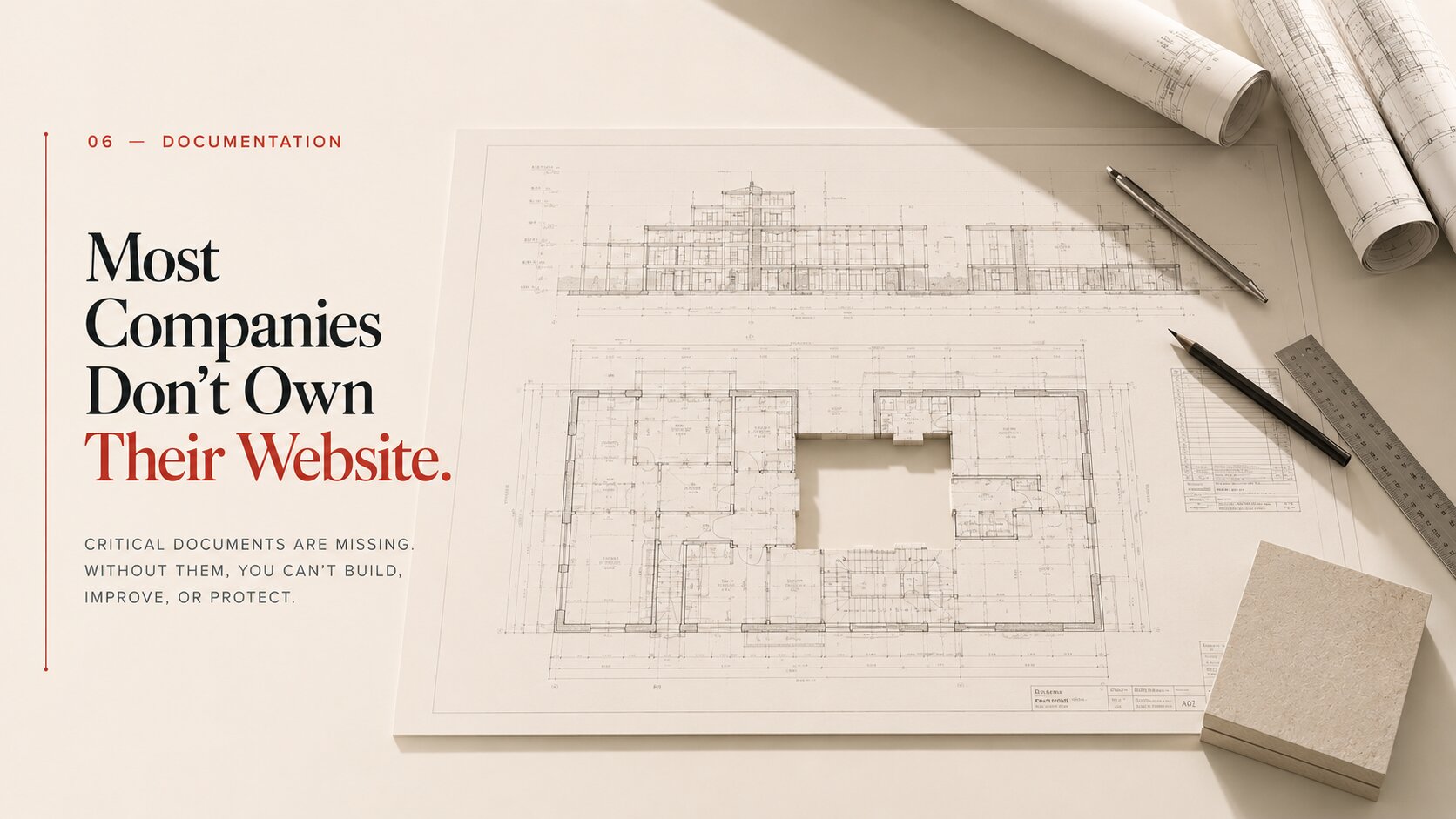
Over the course of this article, we’ve explored seven different types of dependencies that shape modern digital businesses. Some are legal. Others are technical. Some are commercial, while others exist within infrastructure, people, or organizational knowledge.
Viewed individually, each dependency may seem like a separate operational concern.
Together, they reveal something much more important.
They reveal how digital ownership has fundamentally changed.
Owning a website is no longer about possessing source code or paying for hosting. It is no longer enough to hold a copyright agreement or maintain a cloud subscription.
Modern digital ownership is measured by something far more comprehensive.
It is measured by an organization’s ability to understand, govern, and continuously control the systems its business depends on.
That responsibility extends beyond technology teams.
It belongs to leadership.
Because every dependency discussed in this article ultimately affects business continuity, operational resilience, strategic flexibility, and enterprise value. They influence how quickly an organization can adapt to change, replace vendors, integrate acquisitions, respond to security incidents, attract investors, or prepare for a successful exit.
Dependencies themselves are not the problem.
Every successful business depends on technology, vendors, partners, talented people, and external services.
The real risk begins when those dependencies remain invisible.
Organizations rarely lose control because they intentionally made poor decisions.
They lose control because critical dependencies accumulated gradually,one software subscription, one undocumented process, one external integration, one contractor account, one verbal agreement at a time.
Over the years, these individual decisions become an invisible layer beneath the business. Most of the time, everything continues to function normally.
Until something changes.
A key employee leaves.
A vendor increases prices.
An integration fails.
A domain expires.
An acquisition begins.
A cybersecurity incident exposes undocumented infrastructure.
Or an investor asks a question that nobody can confidently answer.
At that moment, organizations discover they were never managing individual systems.
They were managing an ecosystem of dependencies.
Digital maturity is not defined by eliminating those dependencies.
It is defined by making them visible, understanding their impact, and governing them intentionally.
That is what modern digital ownership really means.
It is not ownership of a website.
It is ownership of the business capabilities that website represents.
And that difference becomes increasingly important as organizations grow, scale internationally, adopt AI, acquire new technologies, or prepare for investment and acquisition.
Because in today’s economy, digital assets are no longer simply tools that support the business.
They have become part of the business itself.
Every business keeps important corporate records.
Formation documents.
Contracts.
Insurance.
Tax records.
Financial statements.
Now ask a different question.
Where are the equivalent records for your digital business?
THE CHECKLIST
Digital Ownership Checklist

Every organization has dependencies.
The question is whether they are understood, documented, and intentionally managed.
Use the checklist below as a starting point to evaluate the maturity of your digital assets and identify areas that may require closer attention.
Governance
Leadership & Ownership
□ Do we know who is accountable for every critical digital asset?
□ Is ownership clearly documented rather than assumed?
□ Are digital assets reviewed regularly as part of business planning?
□ Can leadership explain how our digital ecosystem supports long-term business goals?
Legal & Intellectual Property
□ Does the company legally own the intellectual property behind its software?
□ Are all IP assignment agreements complete and enforceable?
□ Can ownership be transferred without legal disputes?
□ Are third-party licensing obligations documented and understood?
Technology
□ Do we understand how our systems are built?
□ Is our architecture documented?
□ Do we maintain an inventory of critical technologies and dependencies?
□ Could another qualified team continue development if necessary?
Open Source & Third-Party Components
□ Do we know which open-source libraries our systems depend on?
□ Are critical components monitored for security vulnerabilities?
□ Do we understand the licensing requirements of third-party software?
□ Could we replace unsupported components if required?
Commercial Services
□ Are essential SaaS subscriptions owned by the company rather than individuals?
□ Who controls payment gateways, email platforms, analytics, AI services, and cloud accounts?
□ Are renewal dates, licensing terms, and access rights documented?
□ Could the business continue operating if a vendor relationship changed tomorrow?
Infrastructure
□ Does the company control its domains, DNS, cloud infrastructure, SSL certificates, backups, and production environment?
□ Are recovery procedures tested rather than assumed?
□ Is administrative access limited, documented, and regularly reviewed?
□ Would we be able to recover quickly from a major infrastructure failure?
Human Dependencies
□ Does any critical system depend on the knowledge of a single individual?
□ Are responsibilities shared across the organization?
□ Is knowledge transfer part of project delivery?
□ Could operations continue if a key employee or contractor became unavailable?
Organizational Knowledge
□ Are architecture decisions documented?
□ Do we maintain operational documentation, runbooks, and deployment procedures?
□ Are important business rules preserved outside individual conversations?
□ Can new team members become productive without relying on institutional memory?
Business Readiness
Finally, ask your leadership team one simple question:
If we changed vendors, lost a key employee, experienced a cybersecurity incident, prepared for due diligence, or decided to sell the business tomorrow…
…how many of the answers above are we absolutely confident about?
The goal isn’t to answer “yes” to every question.
The goal is to know where your greatest dependencies exist before they become your greatest risks.
WHERE TO START
Where to Start
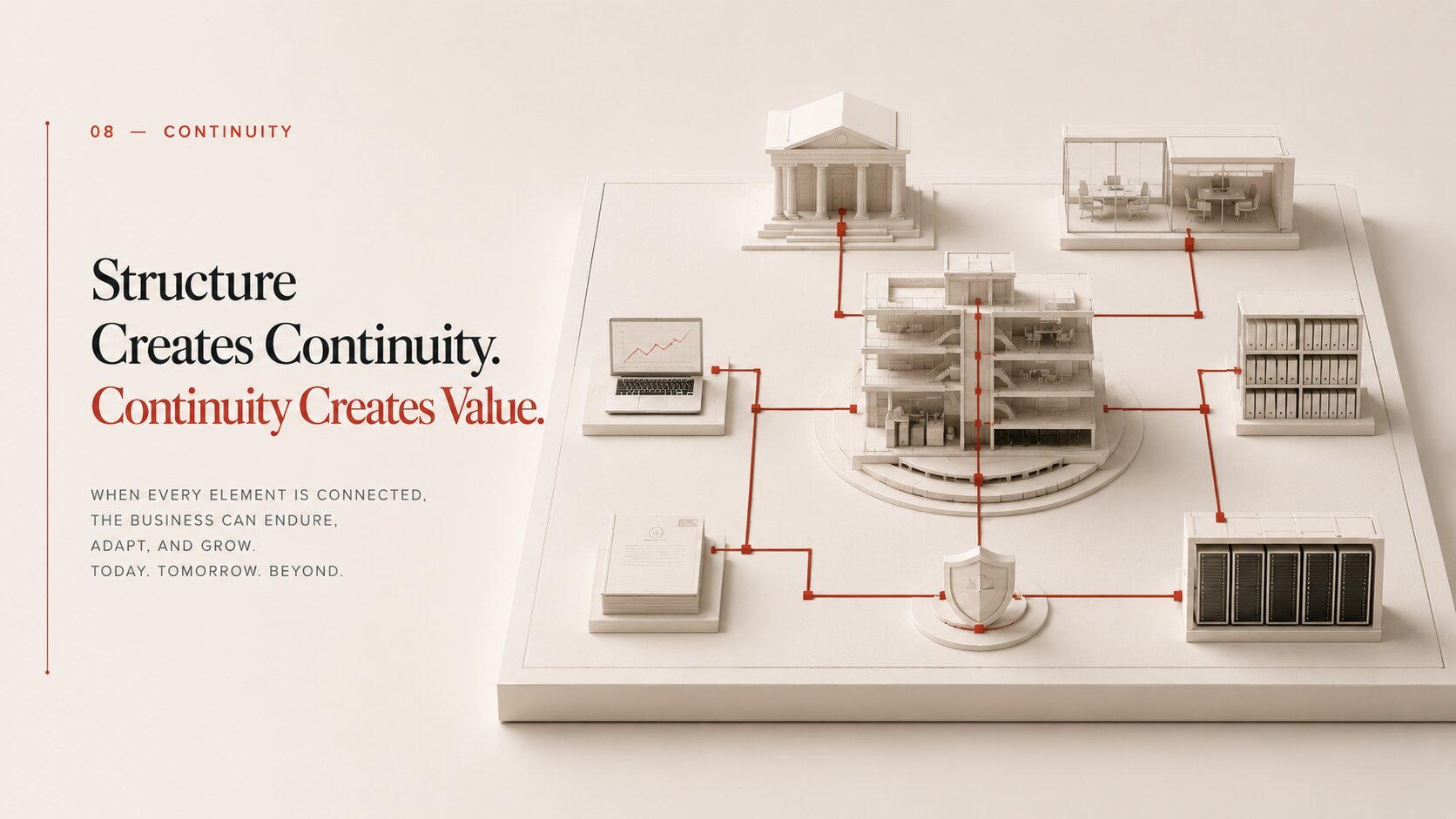
If this checklist raised more questions than answers, you’re not alone.
Most organizations don’t discover hidden dependencies during day-to-day operations. They uncover them during periods of change,when replacing a vendor, scaling operations, responding to a security incident, preparing for investment, or navigating an acquisition.
By then, resolving these issues is often significantly more expensive and disruptive.
The better approach is to identify them before they become business risks.
Whether your organization is planning its next stage of growth or simply wants greater confidence in the digital assets it depends on, the first step is gaining a clear understanding of what you own, what you control, and where hidden dependencies still exist. If you're already weighing outside advisors, Before You Hire Bankers, Diagnose the Business covers why that diagnosis should come first.
We help organizations bring structure to their digital business.
Start with a Strategic Session
Our Strategic Session is designed for business leaders who want to step back from day-to-day operations and evaluate their digital business from a leadership perspective.
Together, we map your digital ecosystem, identify critical dependencies, uncover operational and strategic risks, and prioritize the initiatives that will create the greatest long-term business value.
Rather than focusing on individual technologies, we focus on the structure behind your business,and the decisions that will make it more resilient, scalable, and easier to grow.
→ Book a Strategic Session
Preparing for Investment, Acquisition, or Long-Term Growth?
If your organization is preparing for outside investment, succession planning, a merger, acquisition, or a future business exit, understanding your dependencies is only the beginning.
Our Exit Readiness Assessment provides a comprehensive evaluation of your digital assets, governance, documentation, ownership structure, operational resilience, and overall readiness for due diligence.
The goal isn’t simply to reduce risk.
It’s to increase the long-term value and transferability of your business. We cover the earlier version of this question, well before a transaction is even on the table, in Before You Sell, Retire, or Hand It Down.
→ Explore Exit Readiness
FINAL THOUGHTS
Final Thoughts
Every modern business does.
The question is whether you understand them well enough to govern them before they begin governing you.
Perhaps the biggest misconception isn’t that companies own their websites. It’s that they believe they own their digital business.
Author: Yevhen Borovoi, Founder at Peretz Agency.
Those dependencies are exactly what a migration has to account for, we wrote a full checklist in The Website Migration Checklist Most Agencies Skip.
Not sure what your business actually owns versus what it just has access to? A Strategic Session maps your digital ecosystem and shows you exactly where the hidden dependencies are, before a vendor change, a due diligence process, or an acquisition forces the question. The same judgment gap shows up when comparing AI coding agents to a team, covered in Do I Need a Developer, or Is AI Enough?.

- Share
-

-

-

-

Related Reading
-
19. 07. 2026

Before You Hire Bankers, Diagnose the Business

-
19. 07. 2026

The Cost of AI Isn't Generation. It's Verification.
-
15. 07. 2026

Four AIs Agreed. We Still Hadn't Verified Anything.
-
12. 07. 2026

The Number Nobody Tells You: 70%
-
10. 07. 2026

Nobody Wakes Up One Morning and Decides to Sell
-
10. 07. 2026

Before You Sell, Retire, or Hand It Down
-
01. 08. 2026

The Hidden Cost of Choosing the Wrong Architecture
-
02. 08. 2026
How to Choose a Web Development Company
-
02. 08. 2026
Every Enterprise System Started as Someone's Spreadsheet
-
05. 08. 2026
Your Website Doesn't Fail When Your Developer Leaves. It Fails Years Earlier.
-
05. 08. 2026

Your Business Doesn't Go Live. It Comes Alive.
-
27. 08. 2026
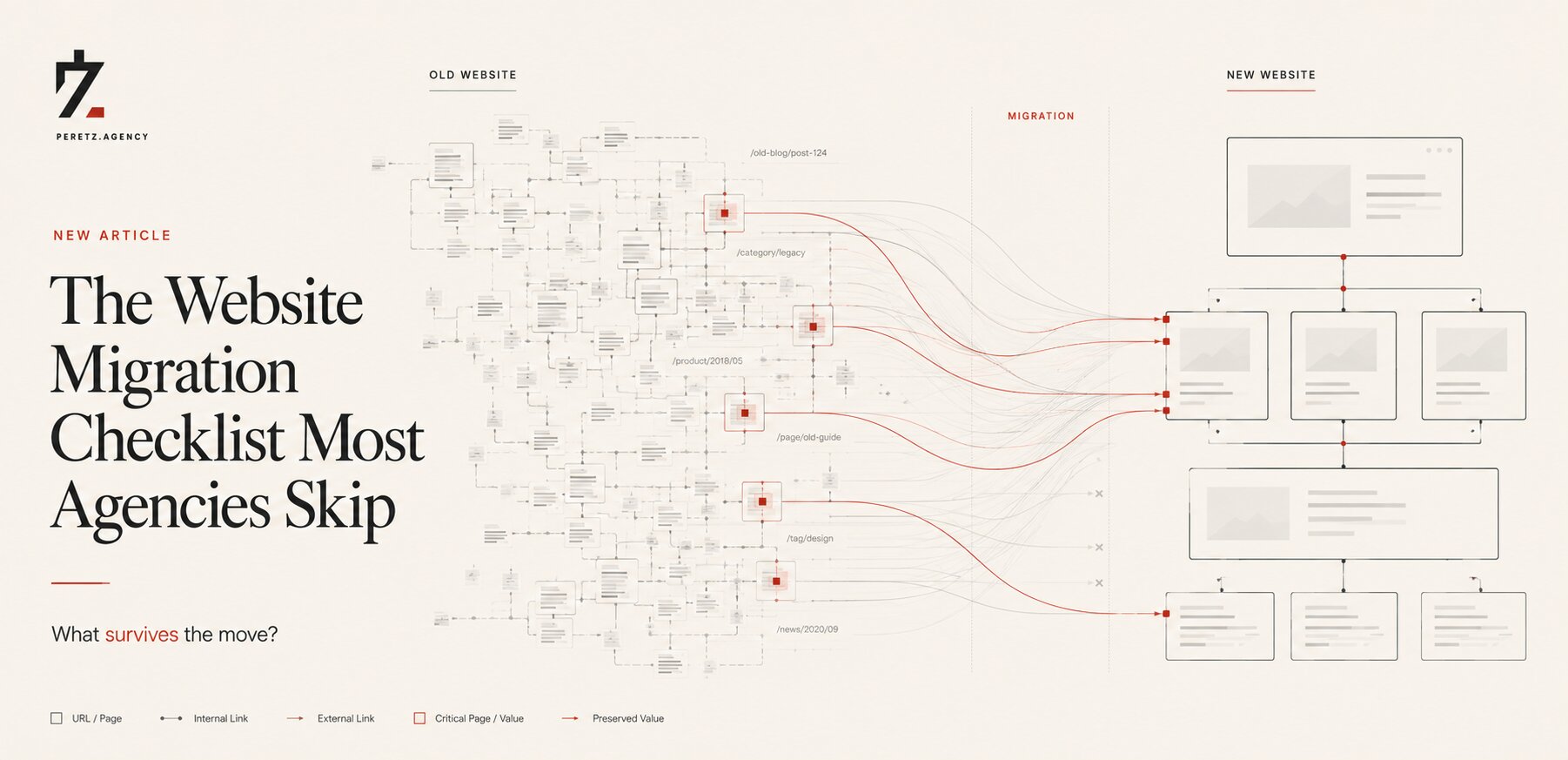
The Website Migration Checklist Most Agencies Skip
-
04. 09. 2026

Do I Need a Developer, or Is AI Enough?