



BUSINESS FIRST
Why Architecture Is a Business Decision Long Before It Becomes a Technical One
Every few years, the source changes.
The mistake doesn’t.
Ten years ago, business owners would tell us:
“My developer recommended Laravel.”
A few years later, it became:
“A friend built their store on Magento. We should probably do the same.”
Today, we hear a different version.
“AI recommended Laravel.”
Different source.
Same assumption.
Same expensive outcome.
Before we go any further, let’s make one thing clear.
This isn’t an article against AI.
Quite the opposite.
We use AI every single day.
It helps us research competitors, review code, analyze websites, challenge our own thinking and explore ideas faster than ever before.
AI has become one of the most valuable tools in our workflow.
The problem isn’t AI.
The problem is much older than AI.
The problem is that people have always searched for answers before they fully understood the question.
AI simply made that process much faster.
One of the conversations we have surprisingly often begins like this.
“We have around 10,000 products and roughly 100,000 monthly visitors. We’re thinking about rebuilding everything on Laravel. How much should we expect to spend?”
At first glance, it sounds like a detailed question.
It isn’t.
In reality, it tells us almost nothing.
Not because the numbers are wrong.
But because they’re answering a question we haven’t asked yet.
Imagine calling an architect and saying:
“I’d like to build a 3,000-square-foot house. How much will it cost?”
It’s not a bad question.
It’s simply impossible to answer responsibly.
The architect doesn’t know whether you’re building on a flat suburban lot or on the side of a mountain.
Whether the house is for a retired couple or a family with five children.
Whether it’s designed to be sold in five years or passed down to the next generation.
The square footage matters.
But it’s nowhere near enough to design the right house.
Software architecture works exactly the same way.
That’s why we rarely start talking about Laravel, Symfony, Magento, Shopify, WordPress, OpenCart or any other platform during the first conversation.
Not because those technologies don’t matter.
They do.
But choosing a framework before understanding the business is a little like choosing the foundation before you’ve seen the land.
You may accidentally make the right decision.
But it will still be a guess.
This is where AI is often blamed unfairly.
We hear it surprisingly often.
“AI recommended Laravel.”
Or Symfony.
Or Magento.
Or Shopify.
Or WordPress.
Our answer is almost always the same.
AI probably wasn’t wrong.
You just asked it the wrong question.
And that’s a very different problem.
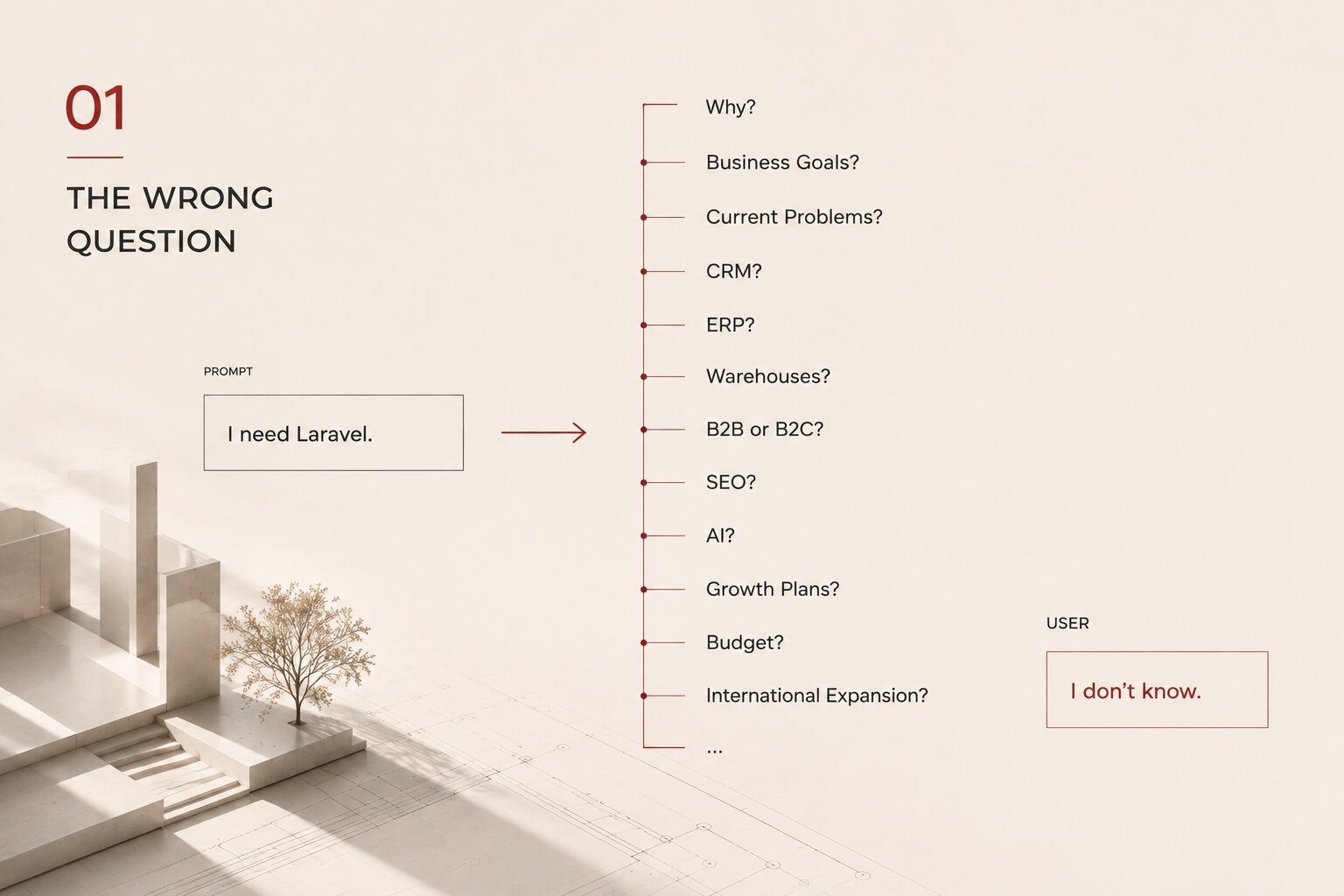
Think about the original prompt for a moment.
“I have an online store with 10,000 products and 100,000 monthly visitors. What platform should I choose?”
Hidden inside that single sentence are several assumptions.
That the current platform is the problem.
That rebuilding the platform is the right solution.
That architecture is where the business should invest next.
None of those assumptions have actually been validated.
They’re simply accepted as facts.
AI doesn’t challenge them.
It answers them.
Exactly as it should.
That’s one of the biggest misconceptions surrounding AI today.
People often say:
“AI gave me bad advice.”
Most of the time…
It didn’t.
It gave a perfectly reasonable answer to a poorly formulated question.
Those are not the same thing.
It’s the same gap we unpacked in Four AIs Agreed. We Still Hadn’t Verified Anything: agreement between models isn’t the same thing as verification.
We see this pattern everywhere.
Years ago, people relied on the opinion of a developer.
Later, they trusted a friend who had launched a successful online store.
Today, they trust AI.
The source changes.
Human behavior doesn’t.
We’re still looking for certainty before we’ve fully understood the problem.
And that’s where expensive decisions begin.
Not when someone chooses Laravel instead of Symfony.
Not when they migrate from OpenCart to Magento.
Not when they decide to build a custom platform.
The expensive part happens much earlier.
It happens the moment the business quietly accepts that technology is the answer…
before proving that technology is actually the problem.
CONFIDENT MISTAKES
The Most Expensive Projects Usually Start With Confidence
One of the clients we worked with several years ago was absolutely convinced they needed Laravel.
Their existing online store was running on OpenCart.
The platform wasn’t new anymore.
There were newer technologies.
New frameworks.
New trends.
Everything pointed in one direction.
“It’s time to rebuild.”
At least, that’s how it seemed.
We asked the same question we ask every client.
Why?
Not why Laravel.
Why rebuild the platform at all?
The answer sounded familiar.
The current platform felt old.
Laravel looked more modern.
It would be easier to expand in the future.
Everyone seemed to be talking about it.
On paper, those arguments sounded reasonable.
They often do.
We discussed the trade-offs.
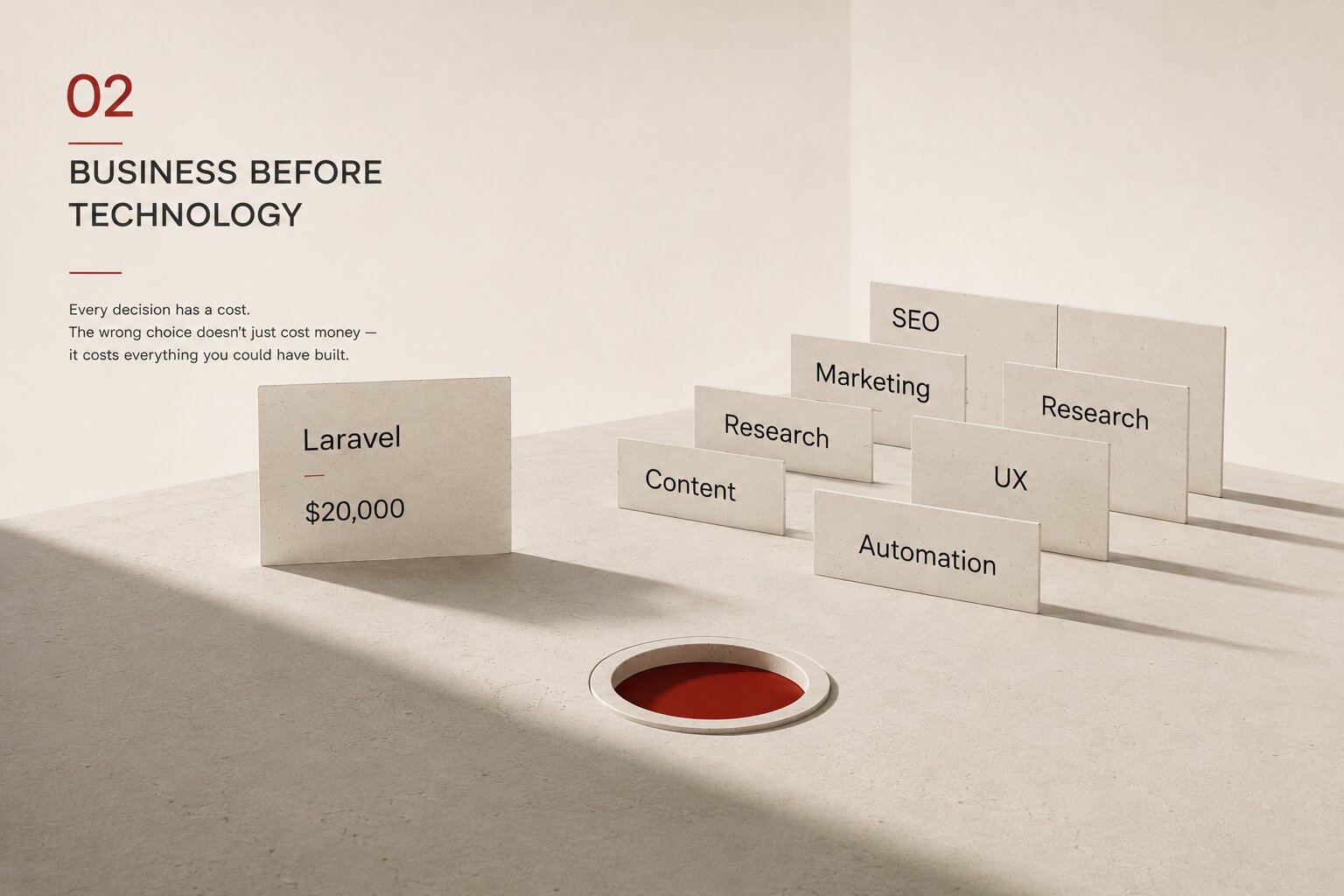
Not just development costs.
The opportunity cost.
The money that wouldn’t be available for SEO.
For content.
For improving the buying experience.
For advertising.
For everything else that actually helps customers find and trust your business.
The client listened carefully.
And then said something we’ve heard many times before.
“I understand. But I still want Laravel.”
Fair enough.
It was their business.
Their investment.
Their decision.
So we built it.
The project was successful.
The website worked well.
The architecture was clean.
The client got exactly what they asked for.
Several months later, during another conversation, the topic came up again.
This time, the client smiled.
“You were right.”
Not because Laravel had failed.
Quite the opposite.
The platform performed exactly as expected.
But looking back, they realized something that wasn’t obvious at the beginning.
The additional investment could have generated a much higher return if it had gone into growing the business instead of rebuilding technology that wasn’t limiting it yet.
Roughly twenty thousand dollars had solved the wrong problem.
That’s an expensive lesson, and one we’ve seen repeat in different forms, which is why we wrote The Most Expensive Mistake Business Owners Make Before Hiring a Digital Agency.
This is why we rarely ask:
“Which framework do you want?”
Instead, we ask:
“Where will the next dollar create the greatest business value?”
Those are completely different conversations.
One is about software.
The other is about business.
Ironically, Laravel wasn’t the mistake.
OpenCart wasn’t the mistake either.
The mistake happened much earlier.
The moment everyone involved accepted that changing the architecture was automatically the next logical step.
It wasn’t.
It was simply one possible option.
No more.
No less.
We’ve seen the opposite happen as well.
Business owners come to us convinced that they need a completely new platform.
They expect months of development.
A new technology stack.
A complete migration.
Then we start asking questions.
What isn’t working?
Where are customers leaving?
Which reports support those conclusions?
What exactly is slowing the business down?
And sometimes, after a few workshops, the answer becomes surprisingly simple.
The architecture is fine.
The customer experience isn’t.
Navigation is confusing.
Search doesn’t help people find products.
Mobile checkout creates friction.
Product pages fail to build trust.
None of those problems disappear because the website is rewritten in Laravel, Symfony or any other framework.
Sometimes the highest ROI comes from changing almost everything the customer sees…
while changing almost nothing underneath.
That isn’t always the answer.
But it’s common enough that we’ve learned never to assume the platform is guilty before examining the evidence.
Technology is often blamed for business problems it never created.
INVISIBLE COSTS
The Most Expensive Mistakes Are Often Invisible
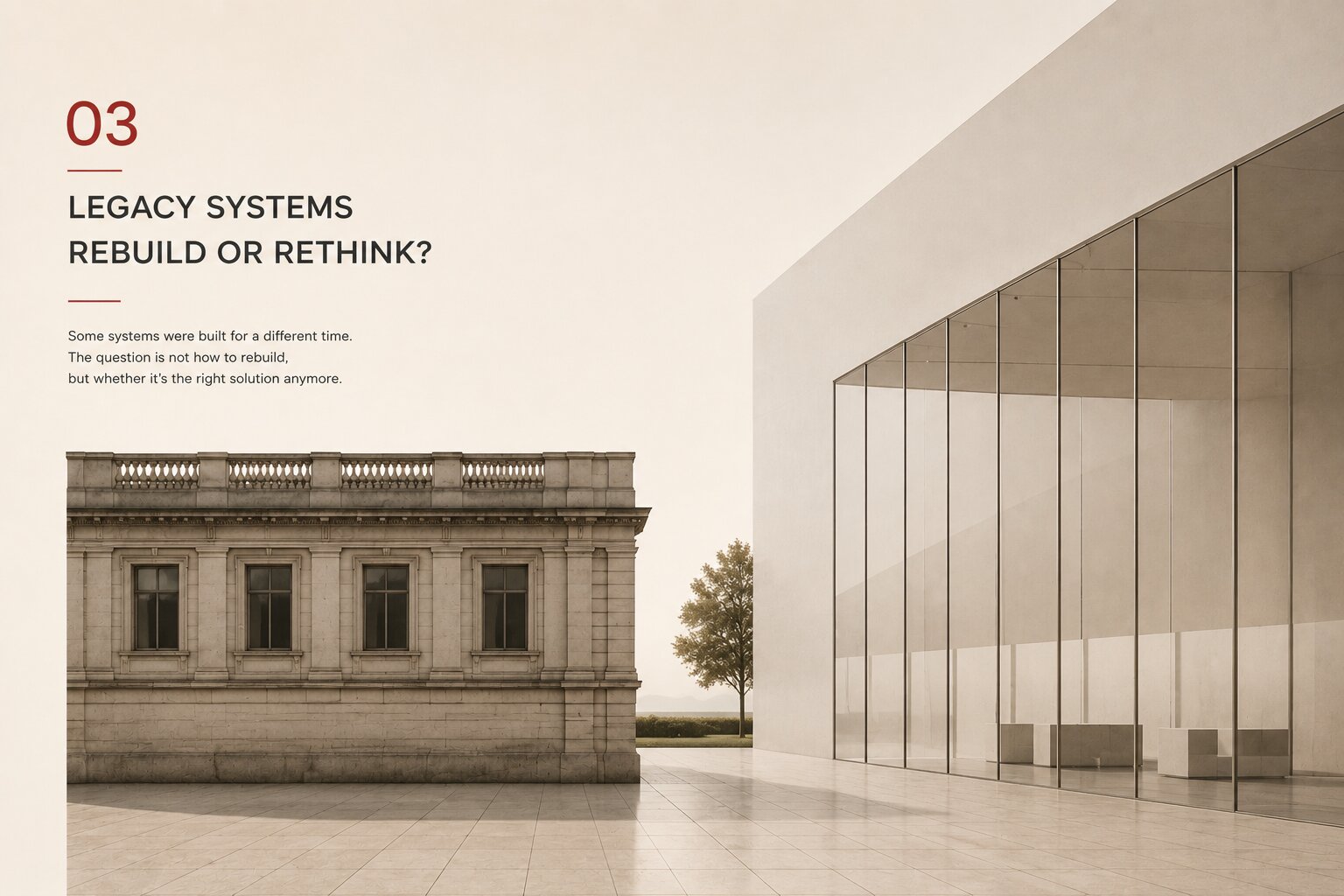
The difficult part about architecture decisions is that they rarely fail immediately.
If they did, they would be easy to spot.
The website launches.
Orders keep coming.
The servers stay online.
Everything appears to be working.
For a while.
The real costs usually arrive much later.
When every new feature takes longer than expected.
When simple integrations become expensive.
When finding developers becomes increasingly difficult.
When marketing campaigns reveal problems the architecture was never designed to solve.
Or when nobody on the team can explain why certain decisions were made in the first place.
Architecture doesn’t usually fail overnight.
It accumulates interest.
Just like technical debt.
One of the most underestimated risks has nothing to do with Laravel, Symfony, Magento or any other technology.
It’s documentation.
Or rather…
the lack of it.
We’ve inherited projects that had been touched by multiple agencies over several years.
It’s a pattern we explored in Most Companies Don’t Own Their Website. They Own a Collection of Dependencies, and it rarely shows up on an invoice.
Every team left something behind.
A custom integration.
A modified checkout.
An additional search module.
A rewritten payment flow.
A temporary workaround that quietly became permanent.
Everything still worked.
More or less.
But when we asked a simple question…
“Why was this decision made?”
Nobody knew.
Not the current developers.
Not the previous agency.
Not even the business owner.
Because the people who originally made those decisions had moved on years ago.
This is where many business owners expect AI to perform miracles.
The conversation usually sounds familiar.
“Could you take a quick look? AI should be able to analyze it in five minutes.”
We understand where that expectation comes from.
AI has become incredibly capable.
It can review code.
Explain architecture.
Find bugs.
Suggest improvements.
Accelerate research.
So why not ask it whether the website should be rebuilt?
Because that’s no longer a technical question.
It’s an investigative one.
Imagine walking into a factory you’ve never seen before.
Every machine has been modified.
Some changes happened ten years ago.
Others last month.
Half the documentation is missing.
Several engineers have retired.
The production line still works…
but nobody remembers why it works that way.
Now imagine asking AI one question.
“Should we rebuild the factory?”
It can’t answer that responsibly.
Not because it isn’t intelligent.
Because it doesn’t know the history behind thousands of tiny business decisions that shaped the current system.
Software is no different.
Source code tells you what exists.
It rarely tells you why.
And in complex businesses…
“why” is often the most valuable piece of information in the entire project.
This is exactly why architecture reviews are rarely quick.
From the outside, a website may look perfectly healthy.
Modern design.
Fast loading.
Responsive.
Stable.
But appearances can be deceptive.
Sometimes the architecture is the problem.
Sometimes it isn’t.
Sometimes the real issue lives inside business processes nobody has questioned for years.
Sometimes it’s a sales workflow.
Sometimes it’s inventory management.
Sometimes it’s a customer journey designed around assumptions that stopped being true long ago.
Technology simply becomes the visible part of a much deeper problem.
One of the biggest misconceptions in our industry is that changing technology automatically creates progress.
It doesn’t.
Replacing OpenCart with Laravel doesn’t guarantee growth.
Migrating from WordPress to Symfony doesn’t guarantee better performance.
Moving to Shopify doesn’t guarantee more sales.
A newer platform cannot fix a business model that hasn’t been properly understood.
Technology amplifies good decisions.
It also amplifies bad ones.
That’s why choosing a better framework rarely compensates for asking the wrong questions.
And that’s where we believe architecture discussions should begin.
Not with frameworks.
Not with pricing.
Not even with AI.
They should begin with curiosity.
With the willingness to pause.
To challenge assumptions.
To ask one uncomfortable question after another until the real problem finally reveals itself.
Because once you understand the real problem…
Choosing the technology becomes surprisingly straightforward.
BEFORE TECH TALK
Architecture Discovery Framework: Before We Recommend Any Technology
Whether it’s Laravel, Symfony, Magento, Shopify, WordPress, OpenCart, WooCommerce, Next.js, Django, ModX, Joomla, Wix, or even keeping your existing platform, every architecture discussion at Peretz begins the same way.
Not with technology.
With discovery.
Over the years, we’ve learned that expensive technology mistakes rarely happen because someone chose the wrong framework.
They happen because the framework was chosen before the business was fully understood.
The purpose of this framework isn’t to help you choose Laravel over Symfony, or Magento over Shopify.
Its purpose is much simpler.
To help you understand whether technology is actually the problem you’re trying to solve.
In practice, this is the same conversation we run inside a Strategic Session, before any development timeline or budget gets discussed.
DEFINE PROBLEM
Stage 1: Define the Business Problem
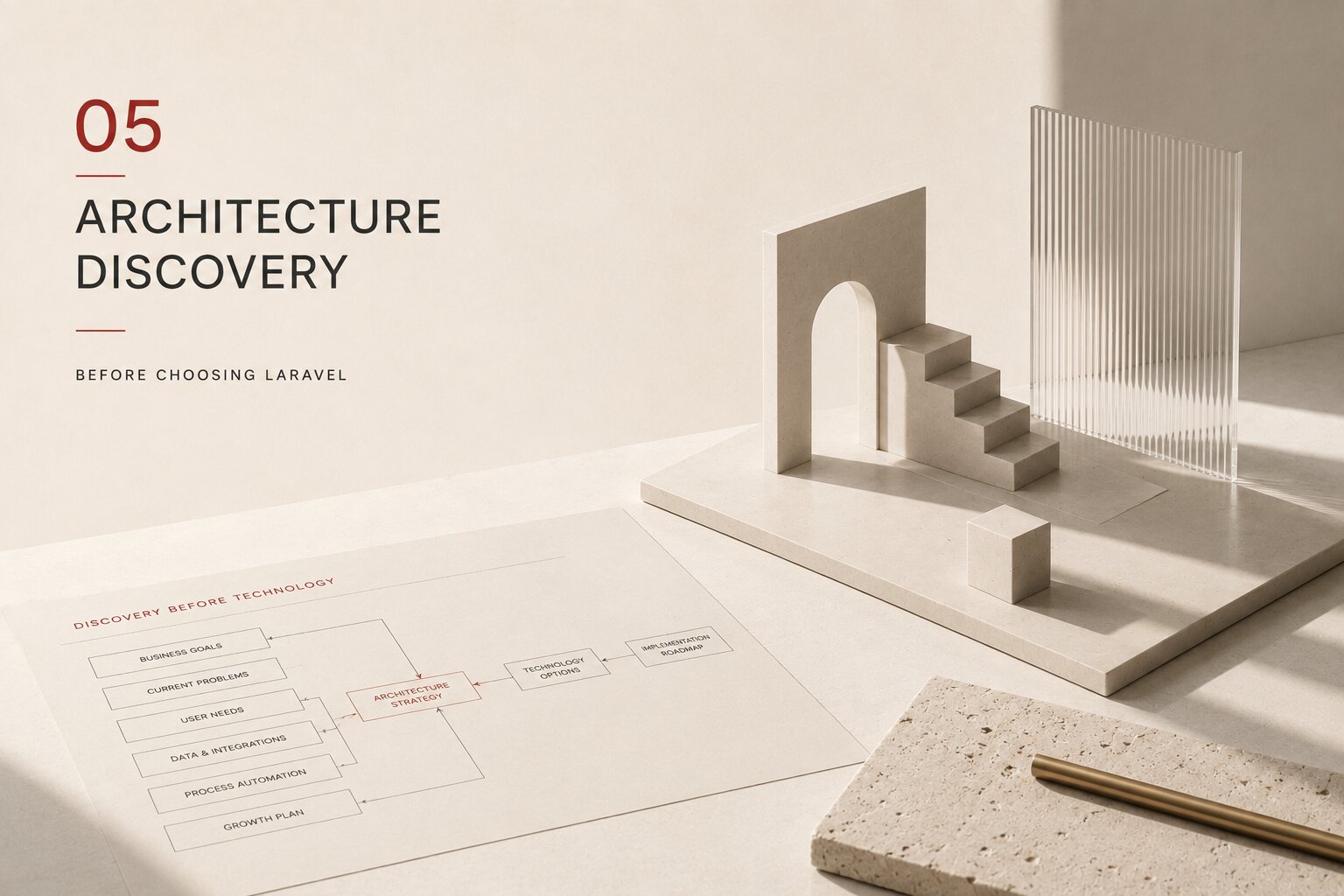
Before discussing platforms, frameworks, budgets or timelines, we always begin with the same question.
What business problem are we trying to solve?
It sounds obvious.
In reality, it’s surprisingly difficult to answer.
Many companies begin with solutions.
“We need Laravel.”
“We need a custom platform.”
“We need to move away from WordPress.”
Those aren’t business problems.
Those are proposed solutions.
Spend time understanding the problem first.
Ask yourself:
Why are we considering this project?
What changed in the business?
What prevents growth today?
What happens if we do nothing for the next 12 months?
How will we measure success?
What business outcome are we expecting from this investment?
Why this matters
Technology should solve business problems.
It should never become the business objective itself.
This is usually the exact question a Usability Audit is built to answer, before a single line of new code gets written.
CHALLENGE ASSUMPTIONS
Stage 2: Challenge Your Assumptions
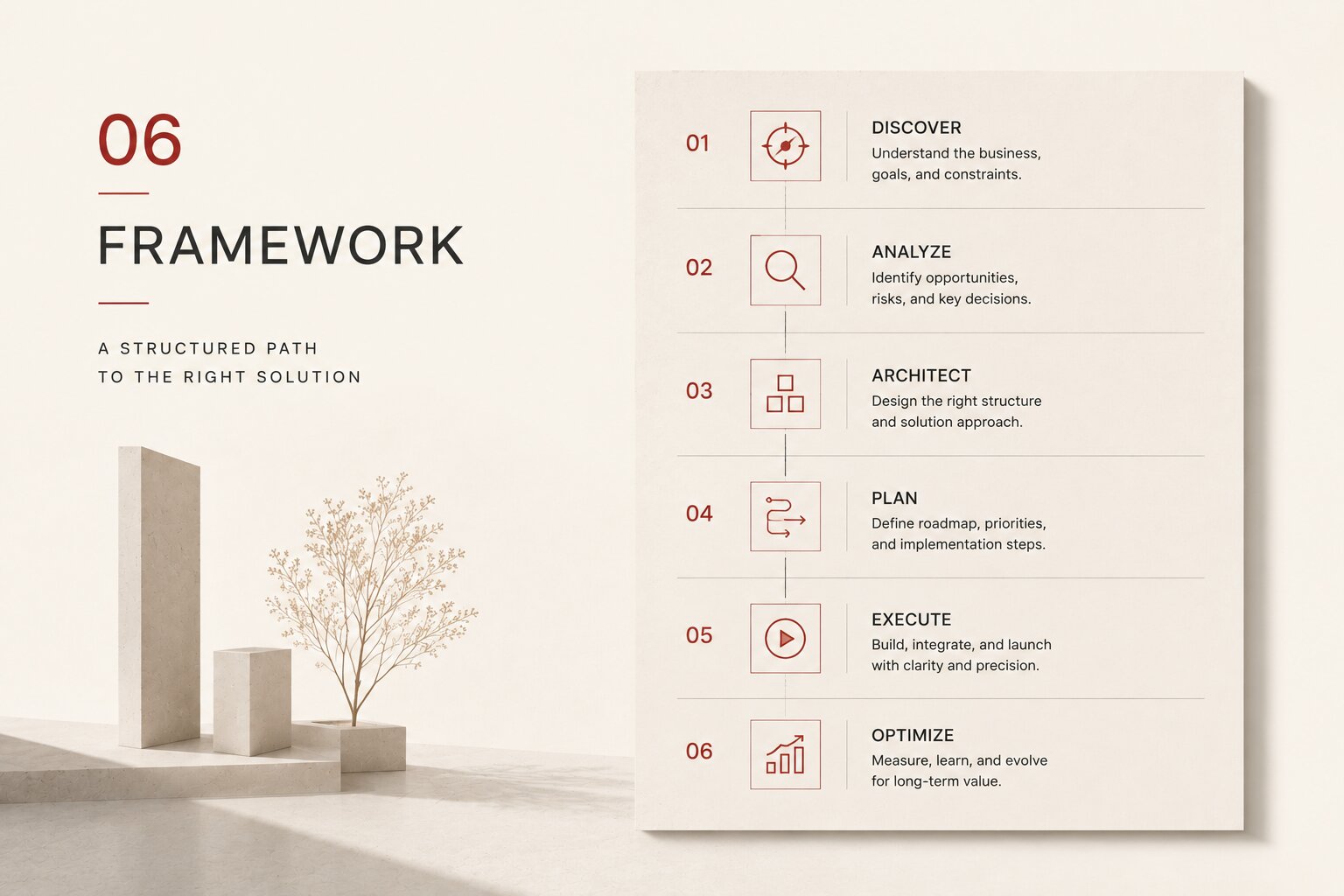
Every business makes assumptions.
The most expensive ones usually remain unquestioned.
Before accepting any recommendation, from a developer, a colleague, an agency or AI, pause and ask yourself:
Why do I believe we need a new platform?
What evidence supports that belief?
Is the current architecture truly limiting the business?
Have we validated that assumption with data?
If technology disappeared from this conversation, what business problem would still remain?
Sometimes asking a better question saves more money than choosing a better framework.
Why this matters
The quality of the solution rarely exceeds the quality of the assumptions behind it.
It's the same idea we dug into in The Cost of AI Isn't Generation. It's Verification: an unverified assumption is expensive whether a person or a model produced it.
KNOW CUSTOMERS
Stage 3: Understand Your Customers
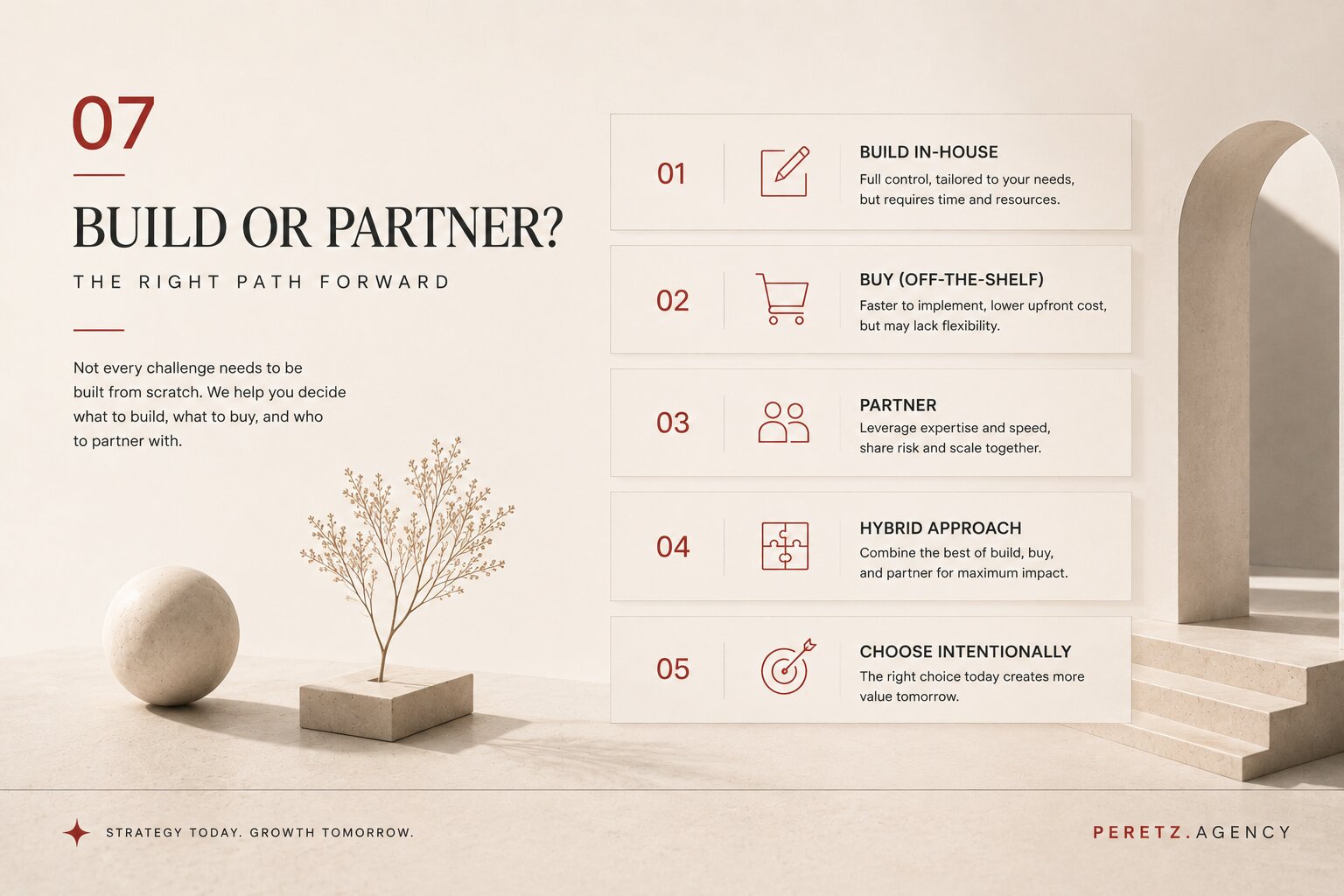
Technology should support customer behavior.
Not the other way around.
Before making architectural decisions, understand who you’re actually building for.
Ask:
Who is your primary customer?
B2B, B2C or both?
Who makes the buying decision?
Is the purchase emotional or rational?
Are customers buying for themselves, their company or someone else?
Is trust more important than price?
Which devices do they use most?
Which countries and languages matter?
How long does a typical buying decision take?
A website built for procurement managers looks very different from one designed for luxury retail customers.
The architecture behind them often does too.
It's why Corporate Website Development at Peretz starts with these questions, not with a template.
Why this matters
Technology scales behavior.
It doesn’t create it.
EXISTING SYSTEM
Stage 4: Understand the Existing System
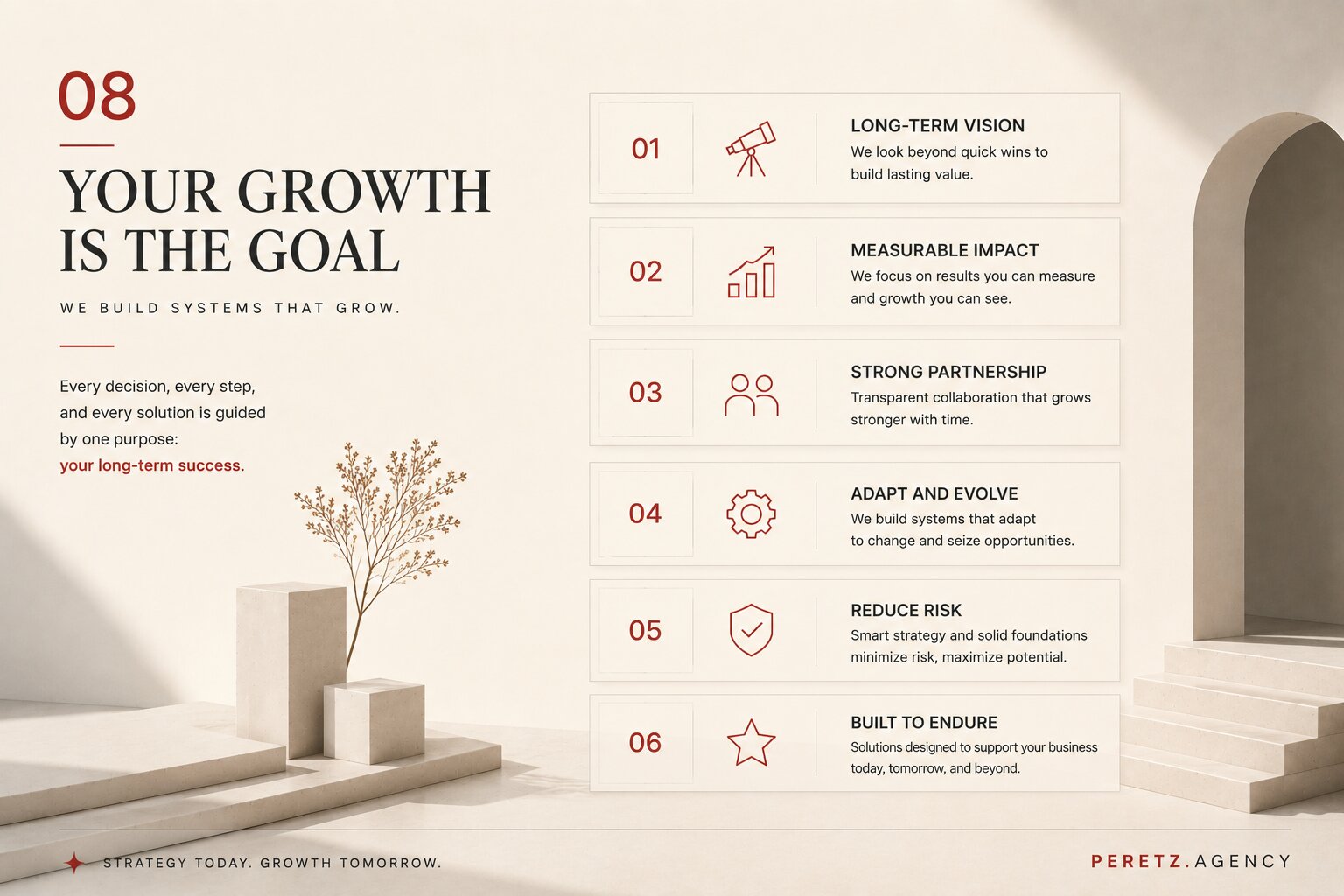
One of the biggest mistakes companies make is assuming that an existing platform has no value simply because it has become old.
Age isn’t the problem.
Lack of understanding usually is.
Before deciding to rebuild, ask:
Why was the current system built this way?
Which decisions were business-driven?
Which were technical compromises?
Is documentation available?
How many development teams have worked on the project?
Can anyone explain why previous architectural decisions were made?
What works surprisingly well today?
What actually frustrates customers?
Sometimes the architecture is outdated.
Sometimes only the experience is.
Those are very different problems.
Why this matters
Undocumented business decisions eventually become technical debt, even when the code itself is excellent.
It's exactly the kind of mapping we do in Business Digitalization engagements, before recommending a single new tool.
COST OF CHANGE
Stage 5: Understand the Cost of Change

Most companies estimate the cost of building.
Few estimate the cost of changing.
Architecture decisions affect far more than development.
They affect people, processes and future flexibility.
Ask:
What happens if we migrate?
What happens if we don’t?
Which integrations will require rebuilding?
Will employees need retraining?
Can our current data be migrated safely?
Will our SEO performance be affected?
Who will support the platform in three years?
How difficult will it be to hire developers for this technology?
What happens if our current agency is no longer available?
Sometimes keeping a stable architecture and improving everything around it creates a significantly higher return on investment.
Why this matters
The cheapest architecture isn’t always the one that’s easiest to build.
It’s often the one that’s easiest to live with.
The hiring question in particular is worth taking seriously, which is where IT Outsourcing & Outstaffing tends to come up in these conversations.
BETTER AI QUESTIONS
Stage 6: Ask AI Better Questions
AI has become one of the most valuable tools available to modern businesses.
We use it every day.
But AI can only answer the question it receives.
Before asking AI which platform to choose, ask yourself whether you’ve provided enough context.
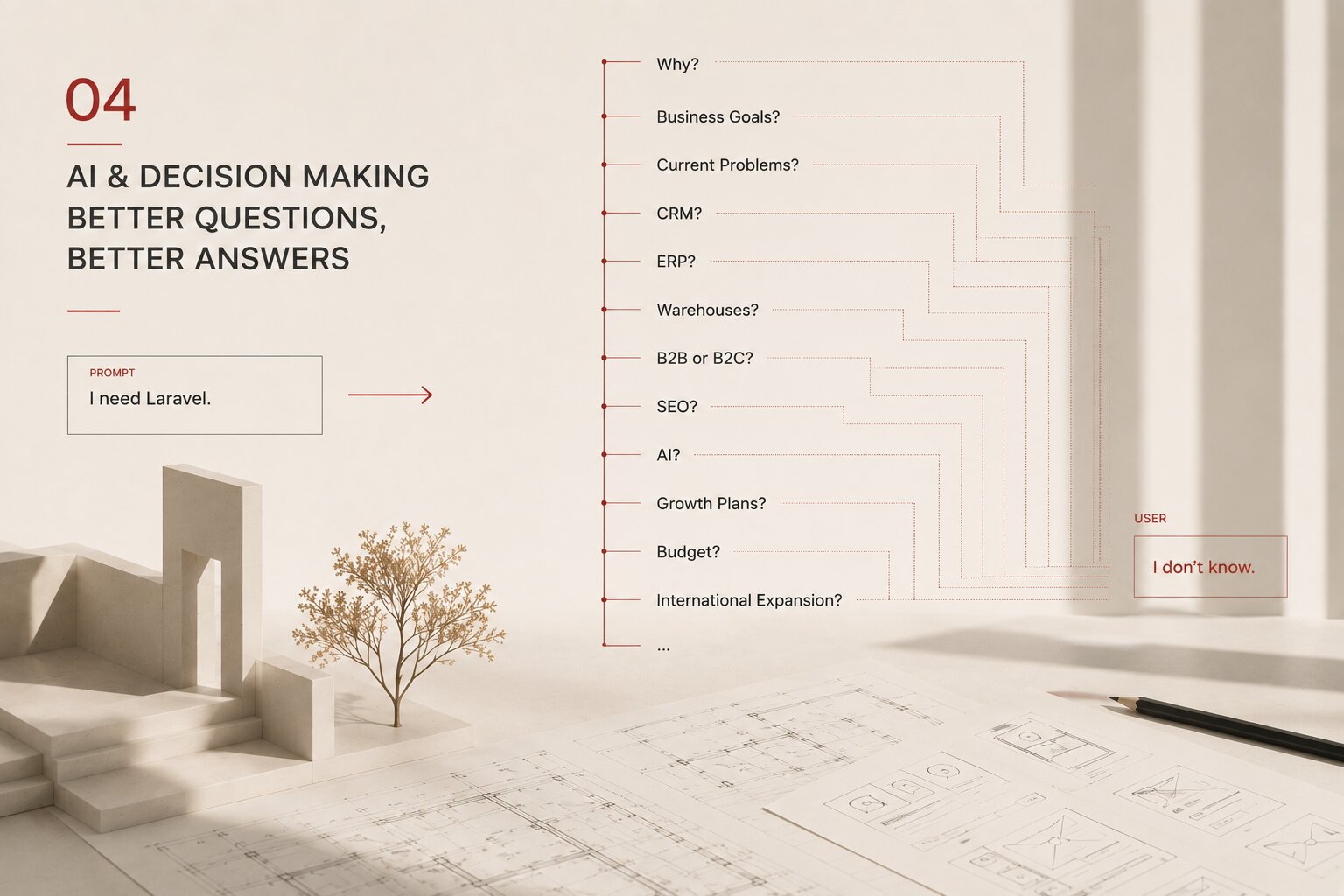
Instead of asking:
“I have 10,000 products. Should I choose Laravel?”
Try asking:
“We operate a B2B and B2C business across multiple countries with approximately 10,000 products, ERP integration, multiple warehouses, customer-specific pricing and plans to expand internationally within two years. Our current OpenCart platform performs well technically, but maintenance costs are increasing and we’re unsure whether our biggest challenge is architecture, UX or technical debt. Based on these business requirements, what additional information would you need before recommending Laravel, Symfony, Magento, Shopify or another solution?”
Notice the difference.
The second prompt doesn’t ask AI for certainty.
It invites AI into the discovery process.
Why this matters
AI doesn’t replace discovery.
It accelerates it, once you’ve asked the right questions.
We go deeper into where that acceleration actually helps in How AI Is Changing Product Development in 2026 (But Great Ideas Still Win).
DISCUSS TECHNOLOGY
Stage 7: Only Then... Discuss Technology
Only after understanding your business, customers, existing systems, operational processes and future plans does it make sense to discuss technology.
Sometimes that conversation leads to Laravel.
Sometimes Symfony.
Sometimes Magento.
Sometimes Shopify.
Sometimes WordPress.
Sometimes OpenCart.
Sometimes a custom solution.
And surprisingly often…
It leads to keeping the current platform and investing elsewhere.
Technology should never be selected because it’s popular.
Or because a developer prefers it.
Or because AI mentioned it.
It should be selected because, after understanding the business, it becomes the most rational decision available.
FINAL THOUGHT
Final Thought
Good architecture doesn’t begin with a framework.
It begins with understanding.
The better your questions become, the easier technology decisions become.
Because in the end…
You’re not choosing Laravel.
You’re choosing the future direction of your business.
We looked at what a genuinely different e-commerce architecture can look like in What Happens to E-Commerce When a Website Stops Being a Website?
We go deeper into our actual design process, from objects to experience, in How We Design E-Commerce: From Objects to Experience. The same architecture-first thinking applies to platform decisions generally, including When Does a Business Outgrow WordPress?.
What that looks like specifically at fifty thousand products across eight markets is set out in Fifty Thousand Products, Eight Markets: Where Catalogue Scale Becomes an Architecture Problem.
What that looks like specifically at catalogue scale across multiple markets is set out in Multi-Country E-Commerce for Large Catalogues: The Architecture Decisions That Set the Ceiling.
The AI version of the same problem, where the wrong architecture grants an agent authority nobody reviewed, is covered in Agentic AI Compliance: How to Secure, Govern and Monitor AI Agents.
- Share
-

-

-

-

Related Reading
-
15. 07. 2026

Four AIs Agreed. We Still Hadn't Verified Anything.

-
19. 07. 2026

The Cost of AI Isn't Generation. It's Verification.
-
30. 07. 2026

Most Companies Don't Own Their Website. They Own a Collection of Dependencies.
-
29. 06. 2026

How AI Is Changing Product Development in 2026 (But Great Ideas Still Win)
-
30. 06. 2026

The Most Expensive Mistake Business Owners Make Before Hiring a Digital Agency
-
02. 08. 2026
Every Enterprise System Started as Someone's Spreadsheet
-
13. 08. 2026

What Happens to E-Commerce When a Website Stops Being a Website?
-
14. 08. 2026

How We Design E-Commerce: From Objects to Experience
-
23. 08. 2026
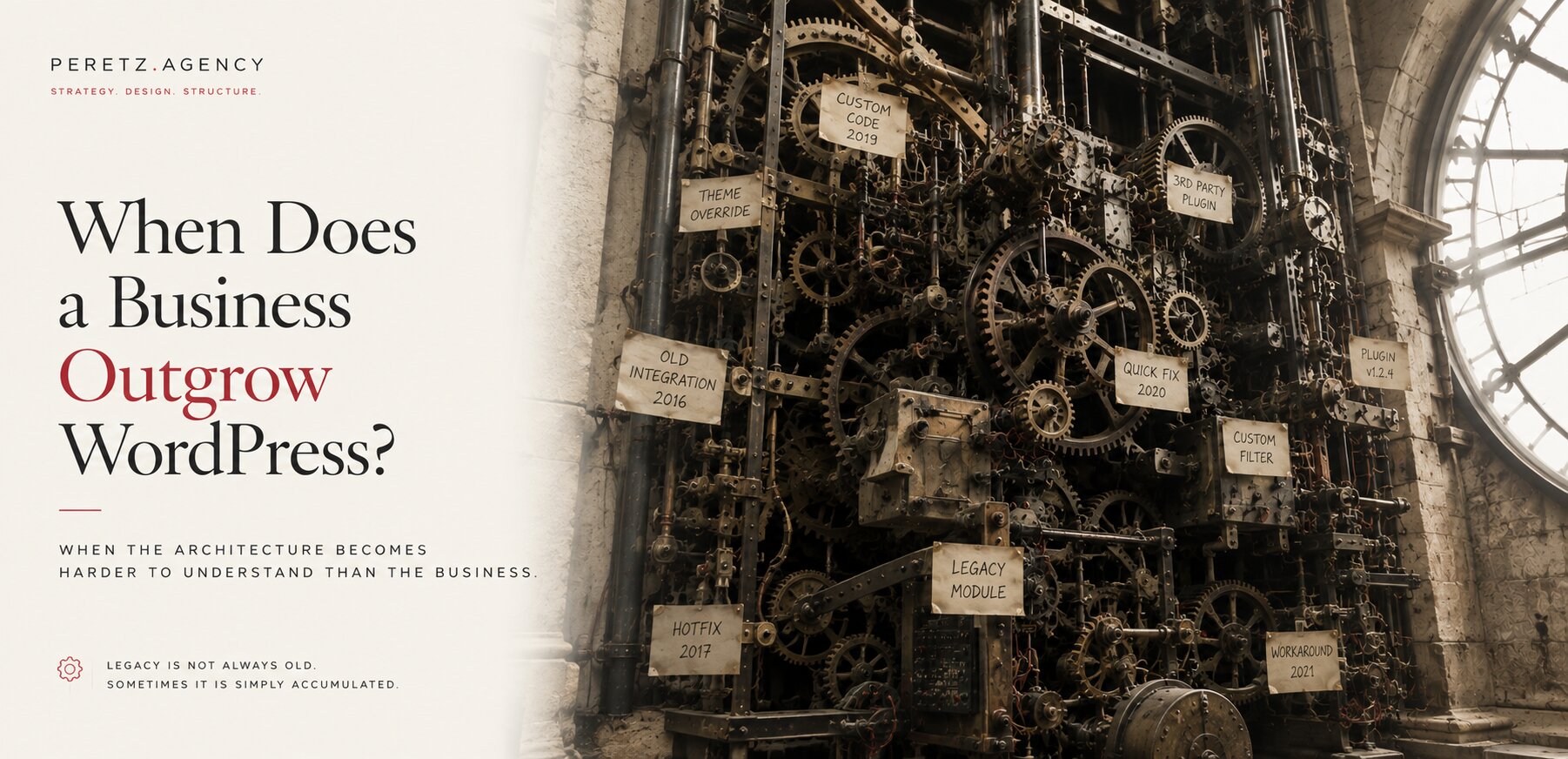
When Does a Business Outgrow WordPress?
-
04. 09. 2026
What Separates a Premium Laravel or Symfony Build From a Merely Functional One
-
06. 09. 2026
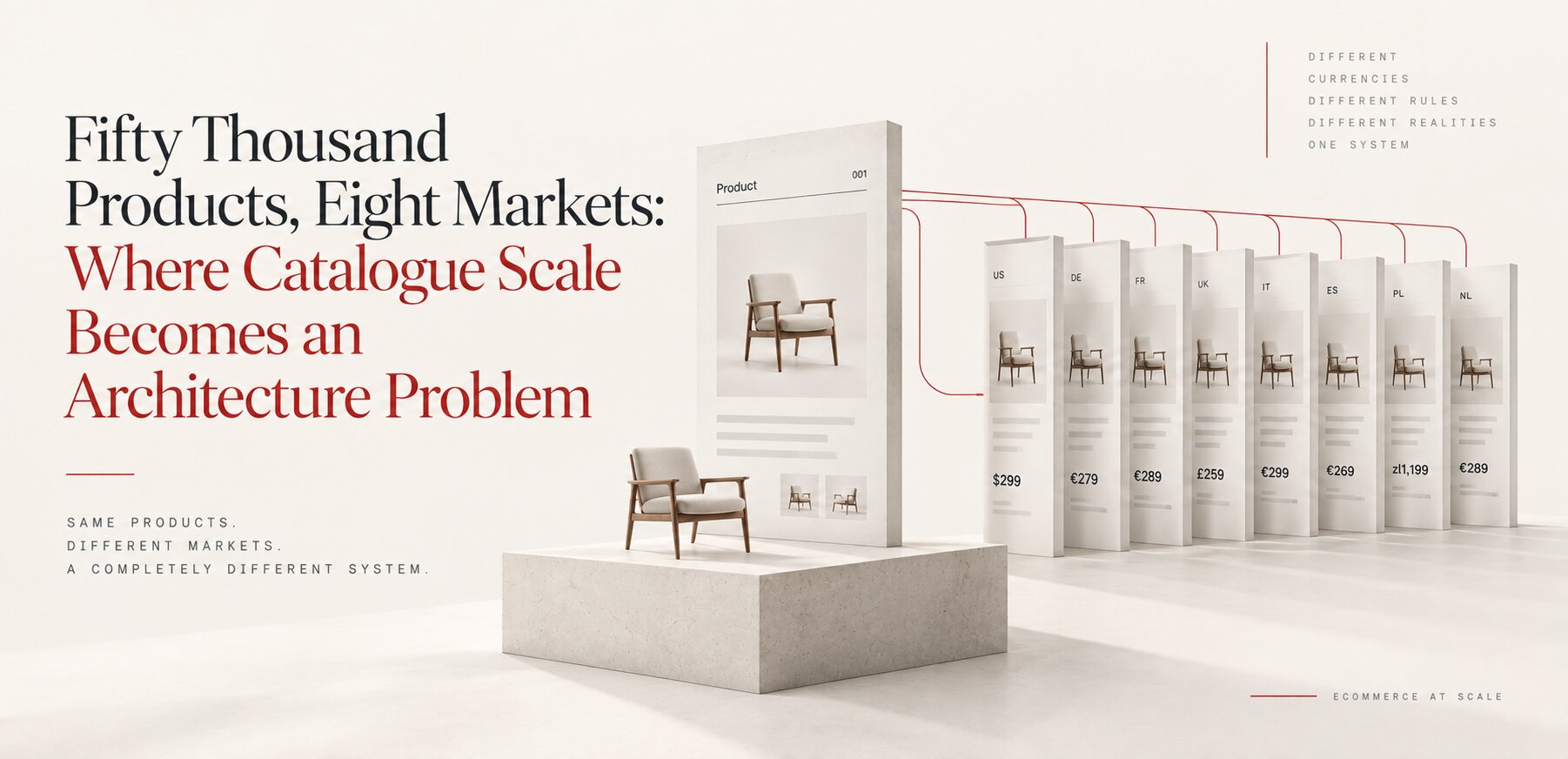
Multi-Country E-Commerce for Large Catalogues: The Architecture Decisions That Set the Ceiling
-
07. 09. 2026

Agentic AI Compliance: How to Secure, Govern and Monitor AI Agents