Laravel, Node.js or Python: Which Backend Fits Your Business Application?

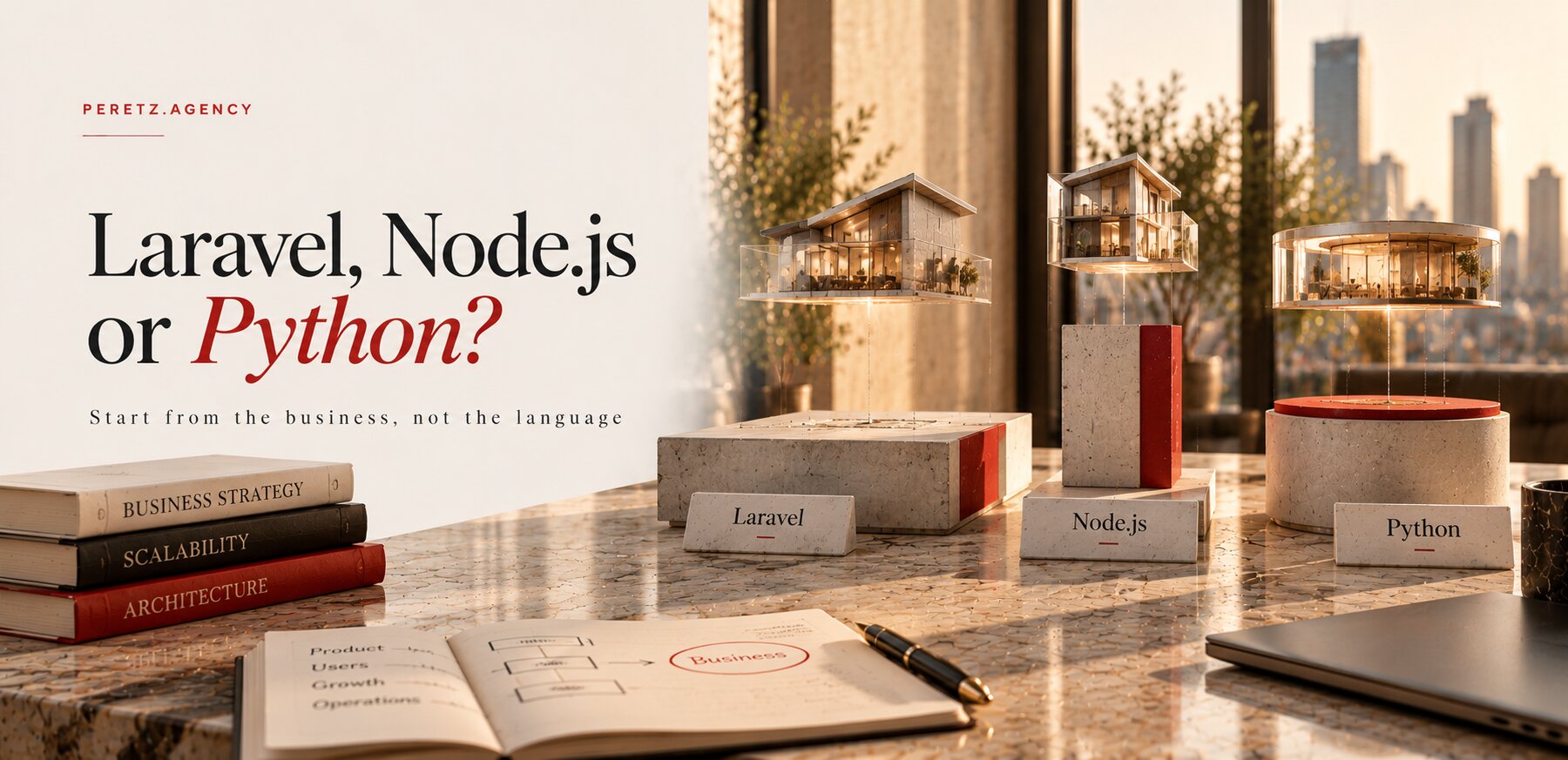
A company rarely chooses a backend twice. The system that runs orders, clients or subscriptions will outlive its first team and probably the second. Here is what Laravel, Node.js and Python are each good at in business terms, what keeping each one current costs, when mixing them makes sense, and what the choice means for hiring and for owning the result.
IN SHORT
Which backend fits a business app
For most business applications with roles, approvals, documents and a heavy admin side, such as a CRM, a client portal, a B2B store or an internal system, Laravel on PHP is the fastest to build and the easiest to hand over. Node.js earns its place when the product lives on live connections: chat, live dashboards, thousands of open screens waiting for events, or a team that wants TypeScript on both sides. Python earns it where the core of the product is data: analytics, machine learning and AI pipelines. When one product needs two of these, a Laravel core with a separate Python service is often cleaner than forcing everything into one language.
All three are mature, so the choice rarely decides whether a system can be built. It decides how fast the first version ships, how easy it is to find the next developer, and what the system costs to keep current. Those things follow from your business logic, the team that will maintain the system for years and the ecosystem around the language, far more than from benchmarks or fashion.
Laravel is our main backend, and our published cases are built on it. For Node.js and Python we work with vetted specialists from our pool. We have tried to be fair to all three below, including the cases where Laravel is the wrong choice.
Pick the stack your team can still maintain in year five.
START HERE
Start with the business, not the stack
The question "Laravel or Node.js?" usually arrives with a reason attached: a developer prefers one, a competitor uses another, or an AI assistant recommended it. We hear the last one more and more often. As we wrote in The Hidden Cost of Choosing the Wrong Architecture, the AI was rarely wrong; it was simply asked the wrong question.
Before any framework comes up, we ask three things.
- What does the system do all day? Approving orders and calculating prices is a different load from pushing live updates to five thousand screens, and both differ from scoring data with a model.
- Who will maintain it in year three and year five? The team you have, the team you can hire in your market, and whether you are willing to depend on one person.
- What has to plug into it? Payments, the CRM, accounting, AI models. The ecosystem decides how much of that is a ready package and how much is custom code you will pay to maintain.
Fashion costs money in both directions. A client with a working OpenCart store wanted a rebuild on Laravel because the platform felt old. We built it and the new site worked well, yet months later we both agreed that roughly $20,000 had gone into a problem the business did not have. The opposite story is in Laravel vs Symfony: a debate between two good frameworks ran for four months, until the investor asked how long every other decision would take, and soon afterwards the investment was gone. That comparison stays in that article; here we look at three different languages, each with its own ecosystem.
LARAVEL
Laravel and PHP: business systems
Laravel is a PHP framework built for applications where the business has rules of its own. Its strength lies in the parts a business owner rarely sees in a demo: roles and permissions, forms with validation, background queues for emails and imports, scheduled tasks, a database layer that keeps related records related, and admin panels that are quick to build. A CRM, a client portal or a B2B store with its own price lists consists mostly of those parts, and Laravel has an established convention for nearly every one.
Conventions make a Laravel project cheaper to hand over. In the JetBrains State of PHP 2025 survey, 64% of PHP developers use Laravel, so most PHP developers you hire already know where a Laravel project keeps its routes, business logic and database changes. A conventional project does not depend on the one person who wrote it.
Our cases show the kind of system Laravel suits. For IFHRS, an international federation of hair research societies, Laravel was chosen because societies relate to countries, people to roles and congresses to years. LavShash, a restaurant group with a gastro market and its own delivery, priced products and delivery differently by region and by city; we rebuilt its store on Laravel around those rules, and in the first year alone the client saved about $17,000 compared with running Magento, as we describe in Leaving Magento in 2026. Our own client portal is a Laravel application in which automated tests check that no client can reach another client's data.
The ecosystem has also absorbed what used to be arguments for Node.js. Laravel Reverb adds real-time WebSocket communication, and Laravel 13, released in March 2026, ships a first-party AI SDK for text generation, tool-calling agents and embeddings, plus vector search (Laravel documentation, October 2026). A typical business system now gets live notifications and AI features without a second language. When you need one built around your processes, that is our Laravel development work.
The trade-offs are real. Heavy computation and machine learning are not PHP's territory, and PHP still carries a reputation from code written fifteen years ago. Hosting is easy, and that ease lets old systems run unattended for years: PHP runs 69.2% of the websites whose server language W3Techs can detect, and about a third of those sites are still on PHP 7 or older, which no longer receive security fixes (W3Techs, October 2026). A Laravel project that nobody upgrades ages like any other. We moved one of our projects that had not been a priority from Laravel 7 to 13 in three days, as described in Six Laravel Versions in Three Days.
NODE.JS
Node.js: live connections, one language
Node.js runs JavaScript on the server. Its documentation describes it as an asynchronous, event-driven runtime for scalable network applications, in which many connections are handled at once by a small number of threads. In business terms, Node.js is at its best when the server mostly waits: on a database, a payment provider or a message from another user. Chat, live dashboards, collaborative editing, notifications to thousands of open screens and API layers over many outside services fit that description.
The second argument is the language. In the Stack Overflow Developer Survey 2026, 62% of respondents had worked with JavaScript in the past year and 43.8% with TypeScript, and Node.js, at 46.4%, was the most used web technology in the survey. A product with a React or Vue front end can share types and validation rules between browser and server, and a small team can move people between the two sides. For a SaaS start-up with three developers, that is a genuine saving.
A JavaScript front end does not require a JavaScript back end, though. The Nicole jewelry boutique runs Next.js on the front end with PHP and Laravel underneath, and the two sides talk through an API.
Node.js has three weak spots in business systems. First, heavy computation: the Node.js documentation warns that while a thread is busy with one client's long task, it cannot serve any other client, so reports, image processing and data crunching belong in a separate worker. Second, Node.js is a runtime rather than a framework. Respondents in the same survey split between Express (15.6%), NestJS (5.8%) and many others, so two Node.js projects can share almost no structure, and a new developer first has to learn how yours is organised. Third, the admin side that Laravel or Django provide by convention usually has to be assembled from separate packages. When your product already runs on Node.js and needs more people, see Hire Node.js developers.
Node.js is a runtime. Two Node.js projects can share almost nothing.
PYTHON
Python: data, analytics and AI
Python is the language of data. In the Stack Overflow Developer Survey 2025 its use jumped by 7 percentage points, which the survey attributed to its role as the go-to language for AI, data science and back-end development, and in the 2026 edition it held at 58% of respondents. Machine learning frameworks, data tools and AI agent libraries usually appear in Python first.
For a business application, Python comes in two shapes. Django is a full framework in the spirit of Laravel, with an automatic admin interface that its own documentation recommends for an organisation's internal management tool rather than as the base of a whole front end. FastAPI is a lighter framework for typed APIs, and its share in the survey rose from 14.8% in 2025 to 18.5% in 2026. A Django product with many related tables and roles behaves much like a Laravel one, while a FastAPI service usually sits next to another system and does one job well.
Python is the right core when the data is the product: a pricing engine that learns from orders, demand forecasts, document recognition, recommendations or an AI pipeline that processes thousands of records overnight. Data scientists already work in Python, so their code can reach production without being translated into another language.
Python is a weaker fit when the system is mostly forms, approvals, documents and an admin team at work all day. Django can build that, but the general numbers overstate the pool: in the 2026 survey 11.3% of respondents used Django and 18.5% FastAPI, against 58% for the language, because many Python users are analysts rather than web developers. Async code has its own trap, where one blocking call inside an async endpoint stalls every other request. Each Python version gets five years of support, and Python 3.10 stopped receiving security fixes on 1 October 2026. For Python work inside your own team, see Hire Python developers.
COMPARISON
Side by side, October 2026
Survey shares are for all respondents of the Stack Overflow Developer Survey 2026; support periods come from the official release pages.
| Laravel / PHP | Node.js | Python | |
|---|---|---|---|
| Typical business use | CRMs, client portals, B2B and B2C stores, booking, back offices, SaaS with a heavy admin side | Real-time products, chat, live dashboards, API layers, TypeScript SaaS | Data platforms, analytics, machine learning and AI pipelines; Django for data-heavy products, FastAPI for services |
| Hiring pool | PHP 17.7%, Laravel 7.6%; 64% of PHP developers use Laravel (JetBrains) | JavaScript 62%, Node.js 46.4%, spread across Express, NestJS and others | Python 58%, Django 11.3%, FastAPI 18.5%; many users are data specialists |
| Hosting | Almost any server, from shared hosting to the cloud; queues need a worker process | A long-running process on a VPS, in containers or on a platform service | Like Node.js; data and model jobs may need much more memory or GPUs |
| Maintenance | A Laravel major every year with two years of security fixes; about four years per PHP version | 30 months per LTS line; from Node.js 27 every yearly major becomes LTS | Five years per Python version; about three years per Django LTS |
| AI tooling | Laravel AI SDK, official Anthropic PHP SDK; the OpenAI PHP client is community-maintained | Official OpenAI and Anthropic SDKs in TypeScript, Anthropic's agent SDK | Official SDKs from both vendors, Anthropic's agent SDK, most machine learning libraries |
| Main risk | Code nobody upgrades for years | Projects without a common structure; heavy tasks blocking the server | Data scripts that grow into a product without an owner |
Read the hiring row with care: a survey counts people who used a language, not people who can design a business system in it. Laravel (7.6%) and Django (11.3%) are only a few points apart; the difference is concentration, since most PHP developers work with one framework, while JavaScript and Python developers spread across many.
Our rules of thumb:
- Mostly roles, documents, approvals and admin work: Laravel.
- Mostly live connections, or one TypeScript team on both sides: Node.js.
- Mostly data, models and analytics: Python.
- Two of these at once: one core system plus a separate service.
- An existing system that works: keep its stack and upgrade it, unless the business has outgrown the system itself.
MAINTENANCE
The support calendar
Every version of every stack here reaches an end. For a business, the real question is who will run the upgrades and how often. Where the main lines stood in October 2026:
| Platform | Version | Supported until |
|---|---|---|
| PHP | 8.2 | 31 December 2026 |
| PHP | 8.4 | 31 December 2028 |
| Laravel | 12 | 24 February 2027 |
| Laravel | 13, needs PHP 8.3 or newer | 17 March 2028 |
| Node.js | 20 | ended 30 April 2026 |
| Node.js | 24 LTS | 30 April 2028 |
| Node.js | 26 LTS | 30 April 2029 |
| Python | 3.10 | ended 1 October 2026 |
| Python | 3.14 | October 2030 |
| Django | 5.2 LTS | April 2028 |
Four of these lines end within months of this article: Node.js 20 in April 2026, Python 3.10 in October, PHP 8.2 in December and Laravel 12 in February 2027. A system built two or three years ago on any of the three stacks faces an upgrade now. Node.js is moving to one long-supported major a year, Python ships a version every October, and Laravel ships a major version each year on top of a PHP version that also has to move.
Whatever you choose, budget an upgrade window every year. The framework itself is rarely the expensive part. In our move from Laravel 7 to 13, the hard work was an abandoned forms package called more than 200 times in 29 templates, solved with a small compatibility helper instead of a rewrite. The same applies to npm and PyPI: the more third-party packages a system collects, the more of them will be abandoned five years later.
AI FEATURES
AI does not choose the backend
Most AI features in a business application are calls to a model over an API: draft a reply, classify a request, summarise a document, answer a client from a knowledge base. All three stacks make such calls well. Anthropic publishes official client SDKs in seven languages, PHP, Python and TypeScript among them; OpenAI lists official SDKs for Python and JavaScript among others, while its PHP library comes from the community (vendor documentation, October 2026). Laravel 13 adds its own AI SDK, so an application can switch model providers without rewriting its features.
Python matters when you go further: training your own models, running open models on your servers, processing large volumes of documents. New agent frameworks also tend to appear in Python and TypeScript first; Anthropic's agent SDK, for instance, is programmable in those two languages only.
Whatever the stack, three rules apply. A call to a model takes seconds, so it runs in a queue and the visitor never waits on it. An agent gets only the permissions its task needs, and its changes pass through the same business rules as an employee's. Usage is budgeted before launch: on a high-traffic construction portal where we tested our assistants, visitors used the assistant more than the owner had budgeted for.
"We will need AI" is a reason to choose Python only when the AI is the core of the product. When it is a feature inside a CRM or a portal, the stack that fits the rest of the system will serve the AI as well.
MIXING
A Laravel core with a Python service
Many products need two of these at once, such as a distributor's B2B portal with price lists and approvals that also needs demand forecasts. The pattern that works is one core system of record and a separate service for the specialised job. For most business systems the core is Laravel, and the service is Python for data and AI, or occasionally Node.js for a real-time gateway. The service gets a clear contract through an API or a queue, its own repository, deployment and monitoring, and a named owner. The core keeps the business rules and the data. In a typical flow, Laravel puts a job on a queue to score two thousand orders, the Python service scores them and sends the results back through the API, and Laravel shows them in the admin and applies its rules.
The pattern that fails is a second language by accident. On PHP sites maintained with AI tools we keep seeing a patch written in Python only because the model reached for it, tied to the main system with glue code, which we describe in Claude Can Build the Website. Nobody planned it and nobody owns it, and the next developer has to know two stacks to fix one bug.
A second language is a second system to own, upgrade and staff.
Add a second stack when the job needs a library or a skill the first one lacks, and when someone will own that part for years. When nobody on your side can make that call, a fractional CTO can make it and write it down with the reasons, from $3,500 a month for about one day a week.
OWNERSHIP
Ownership and hiring
The stack decides whom you can hire and how dependent you become on whoever built the system. Three questions protect an owner whatever the language.
Can another team take over? A conventional Laravel or Django project moves between teams with little friction, while a Node.js project needs its own structure written down. When we build a system, the code, the deployment commands, the server requirements, a rollback procedure and an AGENTS.md file describing the structure, rules and commands are handed over to you under the contract, so another team or an AI coding agent can carry on without guessing.
How would you check the code without reading it? Ask the team when the framework was last updated and what broke, whether another developer can deploy without the original one, which business logic is covered by tests, and how production errors and failed background jobs are reported. The full list is in What Separates a Premium Laravel or Symfony Build From a Merely Functional One, and the same questions work for Node.js or Python.
Where will the next developer come from? You need two to four of the right people, not the whole market. From our pool of vetted specialists whom we know personally, we usually send a shortlist of 2 to 4 candidates in 1 to 3 weeks, or 4 to 6 weeks for a niche role. Laravel, Node.js and Python developers who join your team cost $45 to $65 an hour, depending on seniority (see Hire Laravel developers), with a trial first month and at least two weeks' notice. A dedicated team with its own project manager starts from $8,000 a month.
When you need the whole system rather than people, web application development starts from $25,000, split into stages with their own estimates, and the stack is decided during discovery and written down with the reasons. If you are choosing now, a two-to-three-hour strategic session with the founder costs $500 and is credited toward the project we build within 30 days.
FAQ
Frequently asked questions
Is Laravel or Node.js better for a business application?
For a system built around roles, documents, approvals and an admin team, such as a CRM, a portal or a B2B store, Laravel is usually faster to build and easier to hand over. Node.js fits better when the product lives on live connections or one TypeScript team works on both sides.
Is Python good for web applications, or only for data?
Django and FastAPI are mature choices for web applications and APIs. Python is strongest when data, analytics or machine learning sit at the core of the product; for a plain business system, the team you can hire usually decides between Django and Laravel.
Is PHP still a safe choice in 2026?
Yes, if it is kept current: PHP 8.4 receives security fixes until 31 December 2028 and Laravel 13 until 17 March 2028. The risk lies in old versions, since about a third of PHP websites still run PHP 7 or older (W3Techs, October 2026).
Which backend is best for AI features?
For AI features inside a business system, any of the three works: Anthropic has official SDKs for PHP, Python and TypeScript, and Laravel 13 ships its own AI SDK. Python becomes necessary when you train or run models yourself or process large volumes of data.
Can we mix Laravel and Python in one product?
Yes: Laravel as the core with the business rules and the data, and a Python service for forecasts, document recognition or AI pipelines, connected through an API or a queue. Give the service its own repository, monitoring and a named owner.
Should we rewrite an existing system in a different stack?
Rarely. A working system usually needs an upgrade rather than a new language. A rewrite is worth discussing when the data model and processes no longer match the business, and then the stack should follow the new requirements.
Sources
- Stack Overflow Developer Survey 2026: Technology
- Stack Overflow Developer Survey 2026: Technology data
- Stack Overflow Developer Survey 2025: Technology
- JetBrains: The State of PHP 2025
- W3Techs: Server-side programming languages
- W3Techs: PHP by version
- PHP: Supported versions
- Laravel 13: Release notes and support policy
- Laravel 13: Reverb
- Node.js: Releases
- Node.js Release Working Group: schedule
- Node.js: About
- Node.js: Don't Block the Event Loop
- Python Developer's Guide: Status of Python versions
- Django: Supported versions
- Django: The admin site
- FastAPI documentation
- Anthropic: SDKs, CLI and libraries
- Claude Agent SDK overview
- OpenAI: Libraries
Choosing a backend for a CRM, portal or SaaS? Let's look at your business logic and pick the stack together.
- Share
-

-

-

-

One notification a week with the new PERETZ articles. Nothing else.