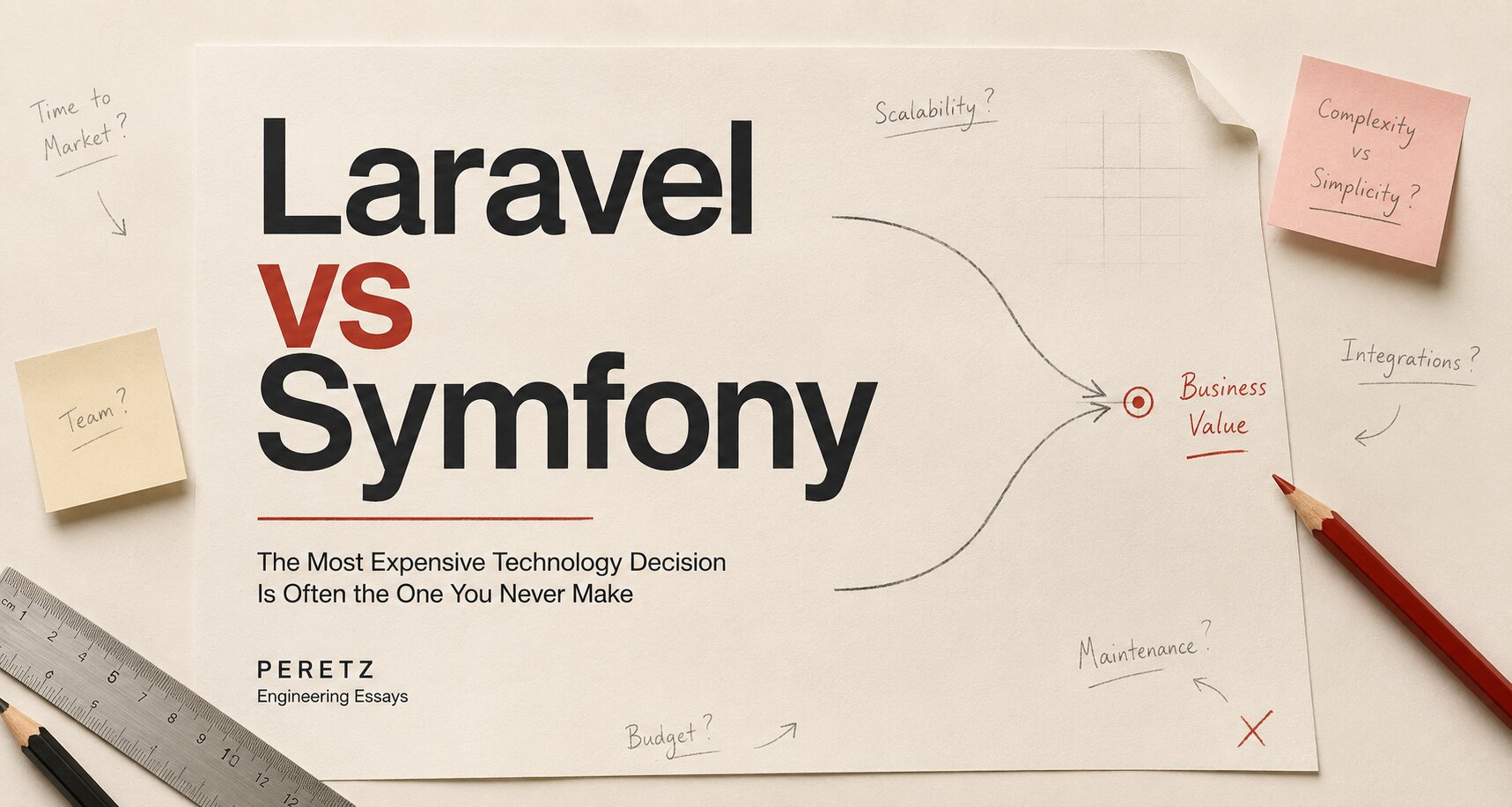
THE WRONG QUESTION
Choosing a framework is easy. Building software that creates business value for the next ten years is much harder.
Every few months, someone asks us the same question.
Should we build our project with Laravel or Symfony?
It's a fair question. And it comes up often enough that we've stopped pretending there's a quick answer.
Honestly, though, someone who actually understands what they're asking tends to ask it more like once every six months. The rest of the time, the question is really something else wearing a framework's name.
Both frameworks are mature. Both power thousands of successful products. Both are capable of running applications with millions of users. According to JetBrains' State of PHP 2025 survey, Laravel is used by roughly 64% of PHP developers, with Symfony at around 23%. Laravel won the popularity contest. Symfony has quietly stayed the backbone of a lot of the enterprise software nobody talks about on Twitter.
So which one is better?
In our experience, that's usually the wrong question.
The better question is: what problem is your business actually trying to solve?
Because after working on ecommerce platforms, enterprise software, CRMs, marketplaces, and custom business applications for more than twenty years, we've learned something surprising.
The framework is rarely the decision that determines whether a project succeeds.
A JEWELRY COMPANY THAT NEVER LAUNCHED
Several years ago we worked with a jewelry company that had an ambitious vision.
Instead of building another online store, they wanted to create an international commerce platform. Their jewelry would be sold through dozens of independent retailers and multi-brand boutiques across different countries. Every partner would have access to the catalog. Every order would be synchronized. Inventory would remain centralized. Pricing would be controlled. Availability would be updated in real time.
From an engineering perspective, it was an exciting challenge. From a business perspective, it had enormous potential.
Then the discussions started.
Should we use Laravel? Would Symfony provide a cleaner architecture? What about long-term scalability? What about future integrations? Would Doctrine be a better choice? Should we optimize for flexibility now?
Every meeting produced more diagrams. Every week produced more questions.
The negotiations went on for four months. Honestly, it was a mess.
Architecture improved. Documentation improved. PowerPoint presentations improved.
The product did not.
Eventually, the investor asked a very simple question.
If it takes this long to make your first technical decision, how long will it take to make every other decision?
Shortly afterward, the investment disappeared.
Not because Laravel was wrong. Not because Symfony was wrong. Because no decision was made.
That project changed the way we think about technology.
The most expensive engineering decision isn't choosing the wrong framework. It's never choosing one at all.
FRAMEWORKS DON'T BUILD BUSINESSES
Developers love discussing technology, and businesses care about outcomes, which is not the same conversation even when it sounds like one.
Very few companies fail because they selected Laravel instead of Symfony. Companies fail because products arrive too late, budgets disappear, markets change, competitors launch first, investors lose confidence, and customers move on.
Technology matters. Timing usually matters more.
The wrong conversation
Most comparison articles begin with features: authentication, dependency injection, ORM, performance, routing, testing. Those are all important.
But before discussing any of them, we usually ask different questions. How quickly do you need to launch? How many developers will maintain the platform? How often will your business model change? How many third-party systems will you integrate with? Is this software expected to live for three years or thirty?
Only after answering those questions do frameworks become relevant.
WHAT EACH FRAMEWORK OPTIMIZES FOR
Laravel optimizes for productivity. It removes friction with excellent documentation, a rich ecosystem, clear conventions, fast onboarding, and outstanding developer experience.
That combination allows teams to deliver business software remarkably quickly. For startups, ecommerce businesses, SaaS platforms, customer portals, marketplaces, internal CRMs, and custom business applications, that speed often creates a competitive advantage.
Shipping six months earlier can easily matter more than achieving architectural perfection.
Where Symfony earns its reputation
Symfony optimizes for something different: control, structure, configurability, long-term architectural flexibility.
Large organizations building complex enterprise platforms often value those characteristics. If multiple engineering teams maintain the same product for many years, explicit architecture becomes increasingly important. Symfony gives experienced engineers tremendous freedom.
But freedom comes with responsibility.
COMPLEXITY ALWAYS HAS A PRICE
One mistake we often see is treating complexity as a sign of quality. It isn't. Complexity is an investment, and like any investment, it only pays off if the business actually needs what it buys.
Symfony projects frequently require longer discovery phases, more architectural planning, more experienced developers, larger engineering budgets, and longer implementation timelines. That isn't a criticism. It's the cost of buying greater architectural flexibility.
If your business genuinely needs that flexibility, the investment can pay for itself many times over. If it doesn't, you're simply paying more to solve problems you don't have.
Think beyond the framework
Imagine buying a Formula One car to commute to the grocery store. It's an extraordinary machine. It's also the wrong tool.
Laravel and Symfony are similar. Neither is universally better. They're optimized for different journeys.
Choosing Symfony because it offers more flexibility is like buying industrial manufacturing equipment to produce ten handmade products each month. You certainly can. The question is whether your business benefits enough to justify the investment.
OUR APPROACH
Clients occasionally ask which framework we prefer. The honest answer surprises them.
We don't start with frameworks. We start with businesses.
Sometimes Laravel is the obvious answer. Sometimes Symfony is exactly what the project needs. Occasionally neither is the right choice.
Technology should serve business strategy. Not the other way around.
LARAVEL VS SYMFONY AT A GLANCE
| Decision Factor | Laravel | Symfony |
|---|---|---|
| Best for | Startups, ecommerce, SaaS, marketplaces, custom business apps | Enterprise platforms, complex business domains |
| Initial development cost | Lower | Higher |
| Time to first release | Faster | Longer |
| Learning curve | Easier | Steeper |
| Team size | Small to medium | Medium to large |
| Long-term architectural control | Good | Excellent, especially across multiple teams over many years |
| Time-to-market | Excellent | Moderate |
| Hiring developers | Easier, larger talent pool | More specialized, smaller pool |
FIVE-MINUTE DECISION GUIDE
Choose Laravel if you:
need to launch quickly, are building an ecommerce platform, are creating a SaaS product, have a small or growing engineering team, and want to maximize business value per development dollar.
Consider Symfony if you:
are building a long-lived enterprise platform, have a complex business domain, expect multiple engineering teams to work on the system, require extensive architectural customization, and are prepared to invest more upfront for greater long-term control.
Final thoughts
Laravel doesn't win. Symfony doesn't win. Businesses win when technology decisions match business reality.
Laravel optimizes for business velocity. Symfony optimizes for architectural freedom. Both approaches are valid. Both have powered exceptional products. But they optimize different things.
In our experience, Symfony projects typically require larger budgets, longer planning phases, and more experienced engineering teams. That investment often makes sense for sophisticated enterprise systems. For many startups, ecommerce businesses, and growing companies, however, Laravel delivers a faster path to market and a stronger return on investment because it reduces upfront complexity while remaining capable of supporting serious applications.
The best framework isn't the one with the most features. It's the one that creates the greatest business value for the investment you're making.
Not sure which one is right for your project?
We do not start with frameworks. We start by understanding what your business actually needs to launch, scale, and maintain.
Building an online store specifically? See how we approach custom e-commerce platforms. If the current platform is WordPress specifically, When Does a Business Outgrow WordPress? covers the signals worth checking before choosing a replacement.
Explore E-Commerce Development
See the fuller architecture thesis, with real cases, in the software should fit the business.
- Share
-

-

-

-

Related Reading
-
17. 07. 2026

The Build vs. Buy Equation Has Changed. Most Companies Have Not Recalculated It.

-
17. 07. 2026

The Code Remembers Every Version of the Business
-
18. 06. 2026
How to Hire a Remote Dev Team Without Getting Burned
-
05. 08. 2026

Your Website Doesn't Fail When Your Developer Leaves. It Fails Years Earlier.
-
23. 08. 2026
When Does a Business Outgrow WordPress?
-
04. 09. 2026
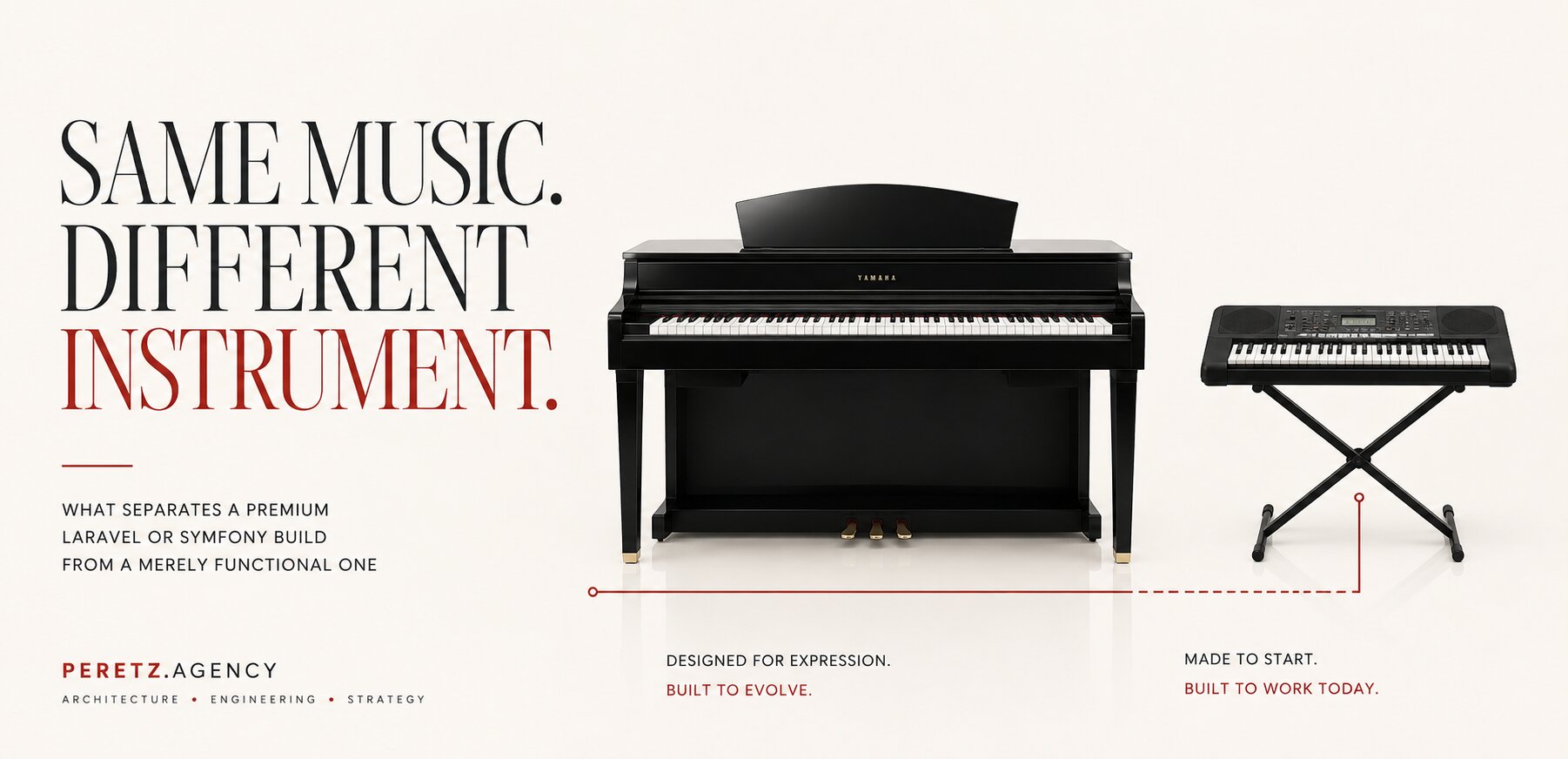
What Separates a Premium Laravel or Symfony Build From a Merely Functional One
-
21. 09. 2026

The Software Should Fit the Business