


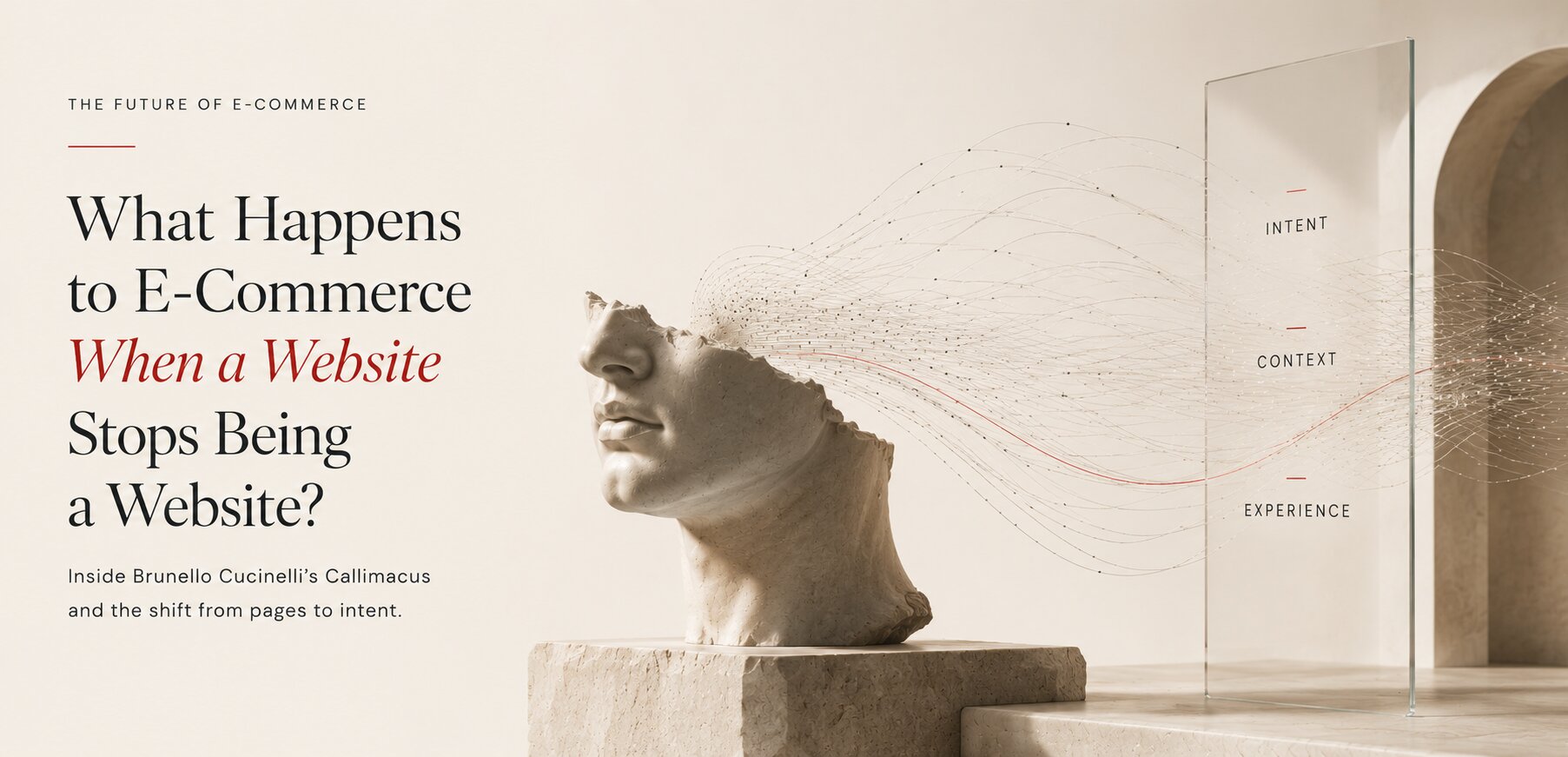
For years, e-commerce has been built around a remarkably stable idea: a website is a collection of pages.
Homepage.
Category page.
Product page.
Cart.
Checkout.
The design can change. The technology can change. The brand can be completely different.
But underneath, the structure remains surprisingly familiar.
That is why one experiment attributed to the team behind Brunello Cucinelli's new digital experience is so interesting. Take the navigation of several luxury e-commerce websites, remove their logos, and put them next to each other.
The result is uncomfortable: in many cases, they are difficult to distinguish.
The same categories. The same filters. The same product grids. The same journey from catalog to product page to cart.
For an industry built around differentiation, the digital experience has become remarkably standardized.
And this is where Brunello Cucinelli's latest experiment becomes more interesting than another story about artificial intelligence.
The real question is not whether AI can build a better website.
It is whether the website itself is still the right unit around which to build an e-commerce experience.
EXPERIMENT
Brunello Cucinelli's AI-Powered E-commerce Experiment
On January 21, 2026, Brunello Cucinelli publicly launched a new digital experience in Italy, the United States and the United Kingdom.
Its name is Callimacus.
The platform was developed by Solomei AI, the Italian luxury house’s internal R&D initiative. The team behind it brings together engineers, mathematicians, philosophers and artists, an unusual combination for an e-commerce technology project.
The actual design and implementation was handled by makemepulse, the studio credited across the industry as Callimacus's first certified partner, working closely with the Solomei AI team to translate the concept into a working experience.
Even the origin of the project says something about the company’s approach.
According to the description of the initiative, the development process began not with a conventional technical brief, but with a symposium focused on the relationship between technology, economics and the humanistic philosophy of Solomeo.
That may sound distant from the practical problems of online retail.
It isn’t.
Because the fundamental problem Callimacus is trying to address is very practical:
What if a customer does not want to navigate a website at all?
What if the experience should adapt to what that customer is trying to accomplish instead?
WHAT IS CALLIMACUS
What Is Callimacus?
Callimacus takes a fundamentally different approach to the traditional e-commerce website.
Instead of assuming that every visitor should follow the same predefined navigation structure, the system attempts to interpret the visitor’s intent.
A visitor may be:
looking for a specific product;
researching and comparing options;
exploring the brand for inspiration.
These are completely different reasons for visiting an e-commerce website.
Yet traditional websites often give all three people essentially the same interface.
Callimacus attempts to change that.
An “intent agent” interprets behavioral signals such as clicks and navigation patterns, as well as, in some cases, a direct text request entered into the interface. Other agents then contribute to the experience: interpreting intent, determining the appropriate tone, maintaining context and assembling the interface from a library of modular components.
In other words, the system is not simply recommending another product.
It is attempting to decide what kind of experience should be presented in the first place.
That distinction matters.
Traditional personalization usually starts with a predefined website and changes some of its content.
This approach goes one level deeper:
Instead of personalizing the page, personalize the experience.
WITHOUT PAGES
A Website Without Pages?
This is where the phrase “a website without pages” becomes slightly misleading.
Callimacus does not mean that Brunello Cucinelli has somehow eliminated the technical foundations of e-commerce.
The commercial infrastructure is still there.
Catalog.
Inventory.
Payments.
Logistics.
Commerce platform.
The difference is the layer between that infrastructure and the customer.
Callimacus operates as a presentation layer over existing commercial infrastructure, including platforms such as Salesforce Commerce Cloud and Shopify.
That is an important distinction because it changes the conversation.
This is not necessarily:
Old e-commerce → replace everything → build an AI platform.
It can instead be:
Existing commerce infrastructure → new intelligent experience layer.
The products still exist.
The inventory still exists.
The checkout still exists.
What changes is how the system decides what the customer should see and in what order.
And that may ultimately be the more important development.
NEVER THE BUSINESS
The Website Was Never the Business
This is something we have seen repeatedly when working on digital products.
Companies often start conversations with technology:
“Should we use Shopify?”
“Should we move to a custom framework?”
“Do we need Laravel?”
“Should we rebuild the entire platform?”
Those can be important questions.
But they are rarely the first questions that should be asked.
The first question is much simpler:
What problem are we actually trying to solve?
A more expensive technology stack does not automatically create a better business.
A custom platform does not automatically create a better customer experience.
And an AI-powered website does not automatically create a better e-commerce business.
The technology should follow the business model, the customer journey and the operational requirements.
Not the other way around.
That is why Callimacus is interesting even for companies that will never build anything remotely similar.
It forces us to reconsider something that has become almost invisible because we are so used to it:
Why does an e-commerce website have to behave like a website at all?
PAGES TO INTENT
From Pages to Intent
The traditional model looks something like this:
Page → content → product → transaction
The emerging model may look more like:
Intent → context → experience → product → transaction
That is a much more significant change than adding an AI chatbot to a product page.
If the system can understand that one visitor is ready to buy, another is comparing products, and a third is simply discovering the brand, there is no obvious reason why all three should receive the same navigation, content hierarchy or interface.
The interface itself can become part of the personalization.
And this is where AI agents become particularly interesting for e-commerce.
They are not simply another feature.
They can become an orchestration layer between the business’s existing systems and the customer’s current intent.
That does not mean every e-commerce company needs an AI agent architecture.
It means that the fixed page may no longer be the only sensible way to organize a digital commerce experience.
DOES EVERY BUSINESS
Does Every E-commerce Business Need an AI Website?
No.
And this is probably the most important conclusion to draw from the Brunello Cucinelli experiment.
It would be a mistake to look at Callimacus and conclude that every brand should immediately replace its conventional e-commerce website with an AI-powered interface.
The business case has to come first.
For a relatively simple catalog, a conventional e-commerce platform may be exactly the right solution.
For a business with complex products, multiple customer journeys, a large content ecosystem, high-value customers and a strong need for personalization, a more adaptive experience may create a very different opportunity.
The question is not:
“Can we build this?”
The question is:
“What business problem would this solve for us?”
That distinction is becoming increasingly important as AI makes technically impressive things much easier to build.
The ability to build something is no longer enough.
We have to know why it deserves to exist.
EARLY RESULTS
What Are the Early Results of Callimacus?
The idea is ambitious. But an interesting technology is not necessarily a successful business.
That distinction matters.
By the second half of 2026, Brunello Cucinelli and the team behind Callimacus had begun reporting measurable results. According to Francesco Bottigliero, the average time visitors spent on the site had roughly doubled after the launch, while increased engagement was accompanied by higher conversion.
There is an important caveat, however.
The first weeks after launch were unusual. The project attracted significant attention from competitors and people across the industry who wanted to see the new experience for themselves. That means the earliest traffic and engagement data were not necessarily representative of normal customer behavior.
In other words:
the technology generated attention.
That is not the same thing as proving that it generates sustainable commercial performance.
And this is exactly where we should be careful with the word “revolutionary.”
Is Callimacus really the future of e-commerce?
Not everyone sees it that way.
Some observers have described Callimacus as an impressive innovation, but not necessarily a disruption of luxury e-commerce.
That criticism is reasonable.
Changing the way an existing assortment is presented is not the same as changing the entire commercial model. A genuinely disruptive system might eventually go much further, for example, toward products being configured or produced around individual customer requirements rather than simply being presented differently.
Even the people behind Callimacus have cautioned against drawing definitive conclusions too early.
That is an important distinction for anyone looking at the project from outside the luxury sector.
We are looking at an important experiment, not a finished prediction of the future.
And experiments are valuable precisely because they give us something to learn from before we commit ourselves to building the same thing.
LUXURY DIFFERENT
Why Luxury E-commerce Is Different
There is another reason this experiment makes sense in the context of Brunello Cucinelli.
We've written more about why conventional CRO thinking breaks down for luxury specifically in Why Luxury E-commerce Breaks Every Rule of Conversion Optimization.
Luxury e-commerce has a problem that is fundamentally different from selling a commodity.
If the customer’s primary motivation is finding the lowest price, the job of the website is relatively straightforward:
find → compare → buy.
Luxury is different.
The customer may already know the product.
They may also want to understand the craftsmanship, the materials, the history, the philosophy of the house and the context around the collection.
In other words, the customer is not necessarily visiting the website simply to complete a transaction.
They are entering a brand environment.
Michael Kliger, CEO of Mytheresa, has made a similar observation about luxury commerce: online luxury has increasingly become a question of service, novelty and experience rather than simply convenience and price.
That makes technologies such as Callimacus particularly interesting.
If the purpose of the digital channel is partly to recreate something closer to a boutique experience, then a rigid sequence of pages begins to look less natural.
A boutique does not tell every customer:
Home → Category → Product → Cart.
A good salesperson observes the customer, understands what they are looking for and changes the conversation accordingly.
That is much closer to what an intent-driven digital interface is attempting to reproduce.
PERSONALIZATION
AI Personalization Is Not the Same as Better E-commerce
This distinction is worth making because the current AI conversation often collapses several very different ideas into one.
AI personalization can mean showing a customer different products.
It can mean generating different content.
It can mean changing recommendations.
Or, at a more fundamental level, it can mean changing the structure of the experience itself.
Those are not the same thing.
The first three can be added to a conventional website relatively easily.
The last one requires a different architectural mindset.
Instead of designing a collection of pages and deciding in advance how users will move between them, the business begins to design a system of reusable components, content and functionality that can be assembled according to context.
That is a much larger architectural shift.
And it is one of the most practical lessons hidden inside the Brunello Cucinelli experiment.
MODULAR FUTURE
The Future May Not Be Page-less. It May Be Modular.
It is tempting to describe this trend as the death of the website.
I don’t think that is quite right.
The more interesting possibility is that the page stops being the primary unit of digital experience.
For decades, we have designed websites as collections of finished screens.
A designer creates the page.
A developer implements it.
The CMS stores it.
The user visits it.
That model works extremely well when the experience is relatively predictable.
But if the interface needs to respond dynamically to intent, then the underlying system needs to be constructed differently.
Content needs to be modular.
Functional elements need to be reusable.
Commerce data needs to be accessible.
The frontend needs to be capable of assembling different combinations of those elements.
And the business needs to know which combinations actually make sense for different customer journeys.
Getting this architecture wrong at the start is expensive to fix later, we've covered that risk directly in The Hidden Cost of Choosing the Wrong Architecture.
This is why the architectural detail behind Callimacus is more important than the phrase “AI website.”
The system does not throw away the commercial infrastructure.
It introduces a more intelligent layer on top of it.
What should e-commerce brands actually do about this?
Probably not rebuild their websites tomorrow.
The practical lesson is much simpler.
Build the foundations that give you options later.
If your website is made from rigid, one-off pages, every future change becomes expensive.
If your content, commerce functionality and interface components are modular, you have more options.
You can introduce personalization.
You can experiment with different customer journeys.
You can connect new AI capabilities.
You can change the presentation layer without rebuilding the entire commercial backend.
This is particularly important for companies that are investing in a new e-commerce platform today.
You may not need an AI-driven interface today.
But you probably don’t want to make it unnecessarily difficult to build one tomorrow.
TECH IS BUSINESS
This Is Where Technology Decisions Become Business Decisions
There is a tendency in digital projects to discuss architecture as if the technology were the objective.
Should the company use Shopify?
A custom Laravel platform?
A headless architecture?
React?
A traditional CMS?
An AI layer?
Those questions matter.
But they should come after another set of questions:
What does the business actually need?
Who is the customer?
What are they trying to accomplish?
How complex is the catalog?
How many different customer journeys exist?
What does the sales process look like?
What systems already run the business?
Which parts need to change?
Which parts should remain stable?
And, perhaps most importantly:
What will the company gain from making the experience more complex?
A sophisticated architecture that solves no meaningful business problem is simply expensive architecture.
A simpler system that solves the right problem can be a much better investment.
We've written about why business needs should drive technical decisions, not the other way around, in We Design for Reality, Not for Ideal Scenarios.
DONT BUILD JUST BECAUSE
We Don't Build Technology Just Because It Is Possible
This is one of the principles that has shaped the way we approach digital projects at Peretz.
We have worked with very different stacks and very different types of businesses. Sometimes the right answer is a CMS. Sometimes it is a custom platform. Sometimes it is a headless architecture. Sometimes the project needs React and a custom backend. Sometimes the simplest solution is the best solution.
The technology is not the strategy.
The business is the strategy.
That may sound obvious, but it becomes particularly important now that AI has dramatically lowered the barrier to building sophisticated-looking products.
It is easier than ever to create something impressive.
It is not necessarily easier to create something useful.
And those are two very different achievements.
We go deeper into our actual design process, from objects to experience, in How We Design E-Commerce: From Objects to Experience.
Author: Yevhen Borovoi, Founder at Peretz Agency.
What that shift costs in practice is something we covered in What Actually Makes E-Commerce Development Expensive.
Selling across markets adds a search dimension to the same question, examined in Multilingual SEO: Why Translated Pages Do Not Rank in Their Own Markets.
Thinking about what your e-commerce platform actually needs to support, not just this year, but as your business and technology options evolve? A Strategic Session is where we map that out before any architecture decisions get made.
Explore E-commerce Development
See the fuller architecture thesis, with real cases, in the software should fit the business.
REAL SHIFT
The Real Shift in E-commerce
Callimacus may become a new standard.
It may remain an expensive experiment that makes sense primarily for a small number of luxury brands.
It is too early to know.
But the underlying idea deserves attention regardless of what happens to this particular platform.
For decades, we have treated the website as a fixed environment through which customers navigate.
The next generation of e-commerce may treat it differently.
Not as a collection of pages.
Not even primarily as a collection of products.
But as a system that interprets intent and assembles an experience around it.
That does not mean every brand needs an AI-powered website.
It means we should start asking a different question.
Not:
What technology should we use to build our website?
But:
What experience does our business actually need, and what technology is the most sensible way to create it?
The technology comes next.
And that may be the most important lesson of Brunello Cucinelli’s experiment.
We explore the same underlying tension, business complexity outrunning platform assumptions, in Why Family-Owned Jewelry Stores Outgrow Their E-commerce Platform.
- Share
-

-

-

-

Related Reading
-
12. 08. 2026

Why Luxury E-commerce Breaks Every Rule of Conversion Optimization

-
01. 08. 2026
The Hidden Cost of Choosing the Wrong Architecture
-
31. 07. 2026
We Design for Reality, Not for Ideal Scenarios
-
14. 08. 2026

How We Design E-Commerce: From Objects to Experience
-
16. 08. 2026

Why Family-Owned Jewelry Stores Outgrow Their E-commerce Platform
-
22. 08. 2026
What We Leave Behind: Heritage, Technology and the Things Worth Passing On
-
27. 08. 2026

Schoeffel Digital Foundation: The First Landing Page Is Live
-
28. 08. 2026
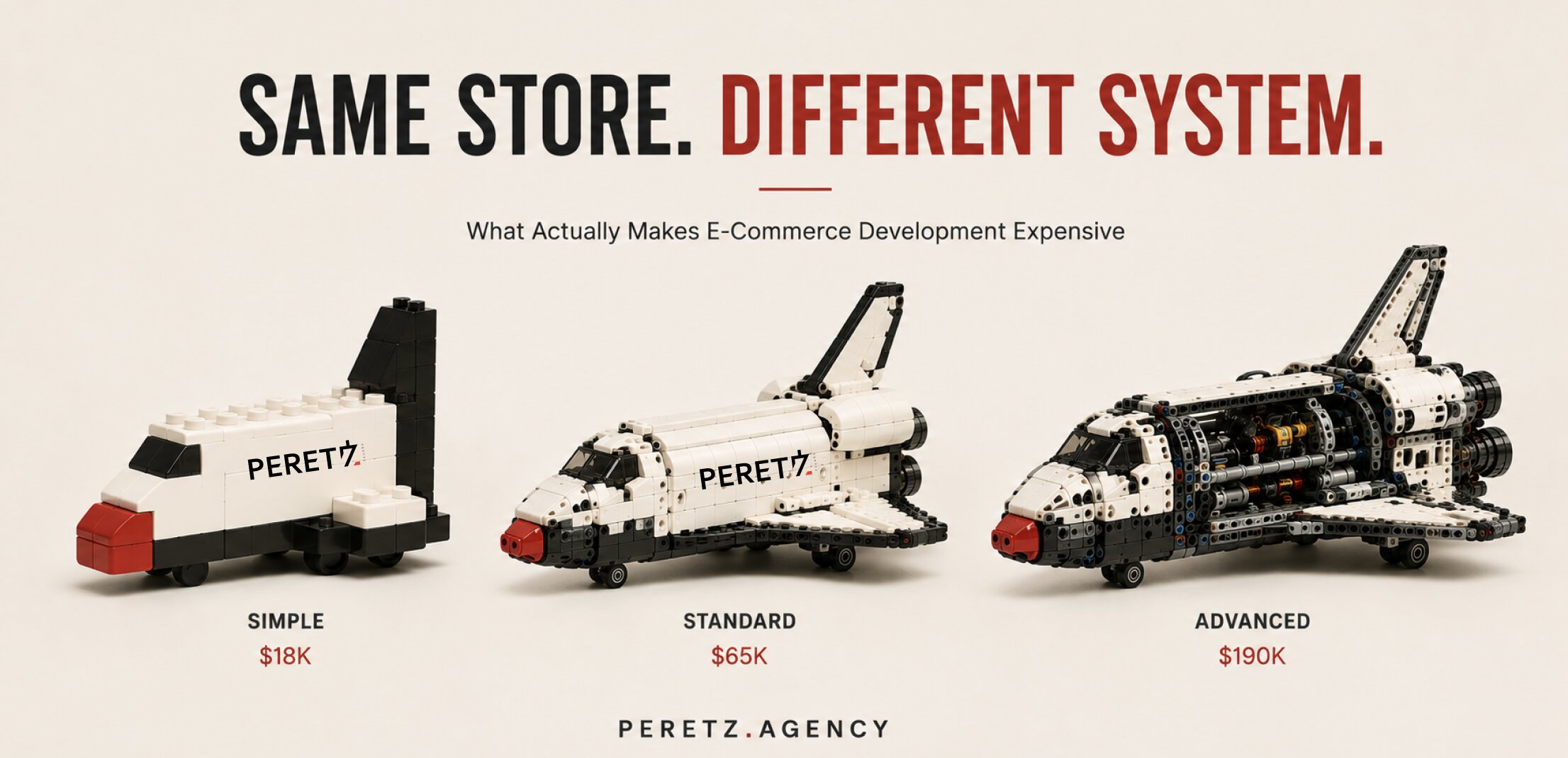
What Actually Makes E-Commerce Development Expensive
-
06. 09. 2026
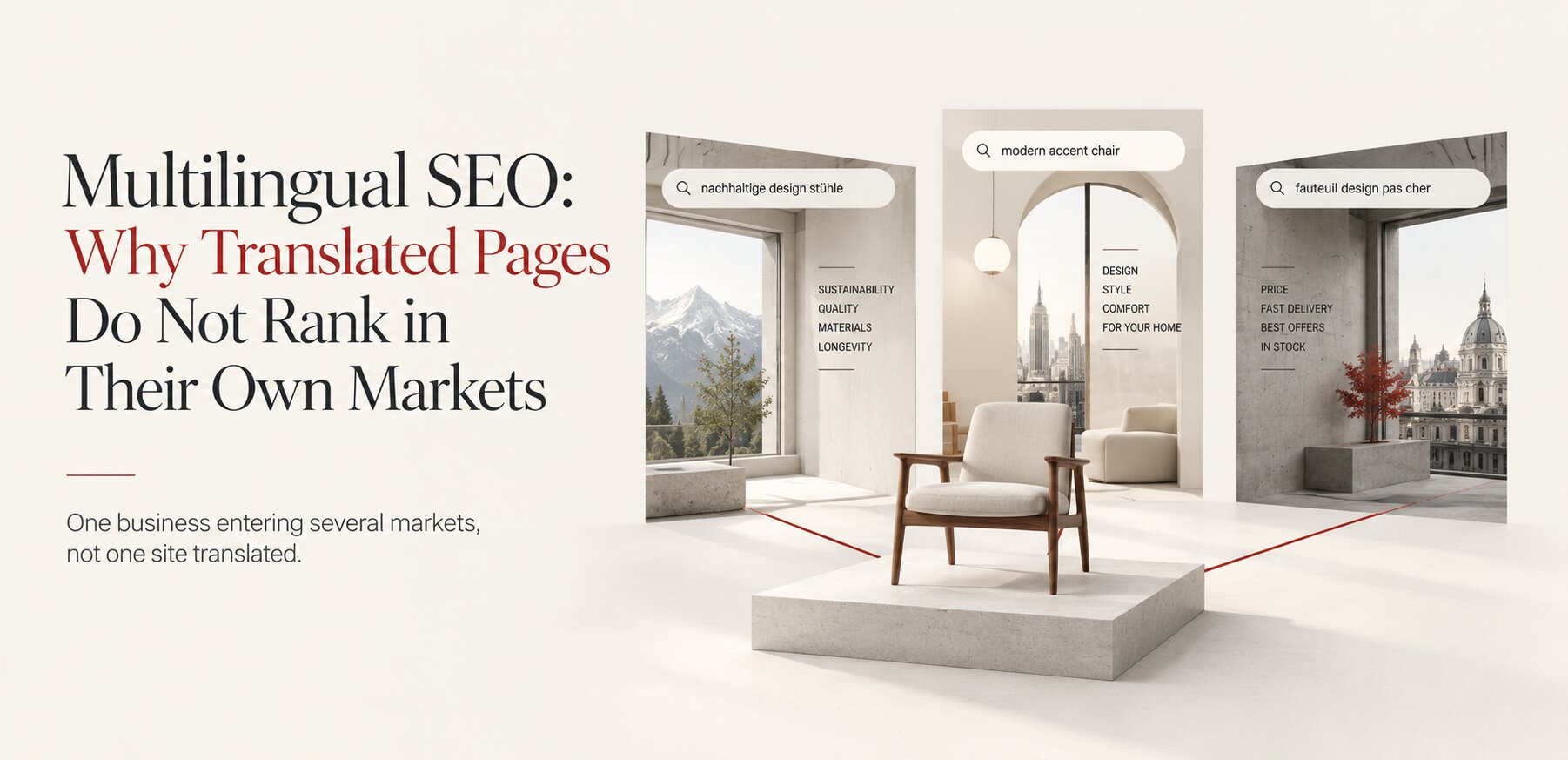
Multilingual SEO: Why Translated Pages Do Not Rank in Their Own Markets
-
06. 09. 2026
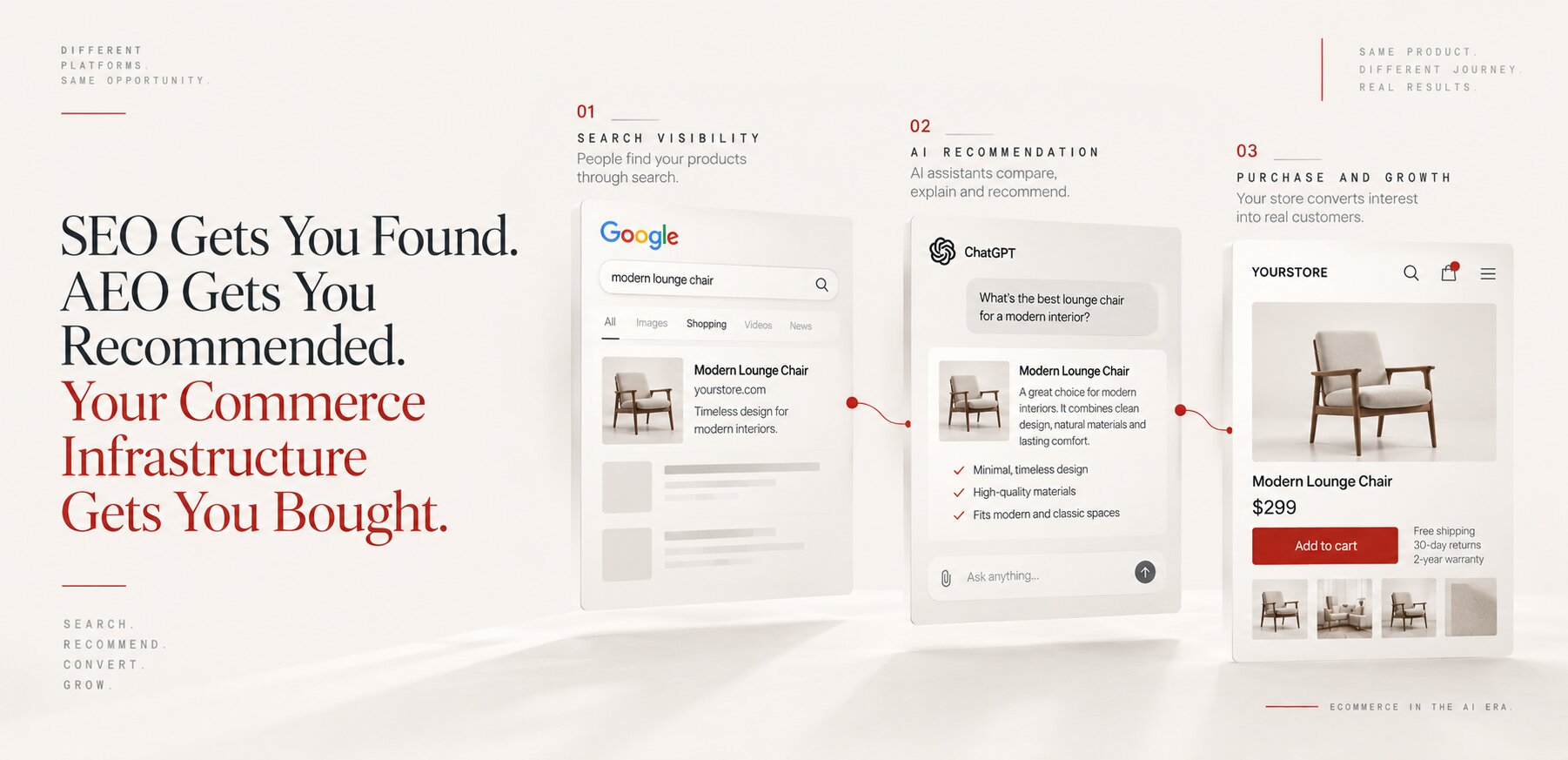
SEO Gets You Found. AEO Gets You Recommended. Your Commerce Infrastructure Gets You Bought.
-
21. 09. 2026
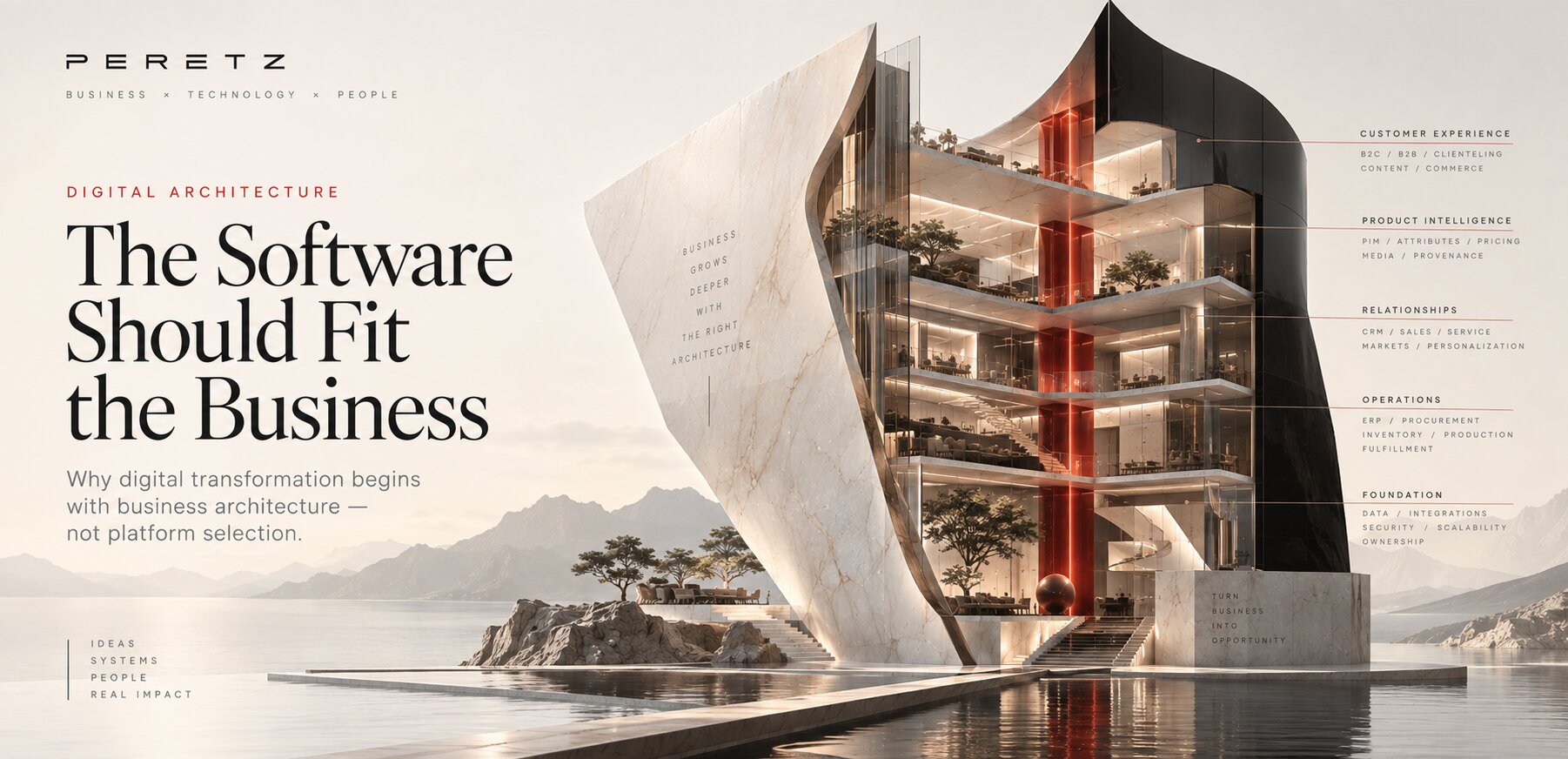
The Software Should Fit the Business