


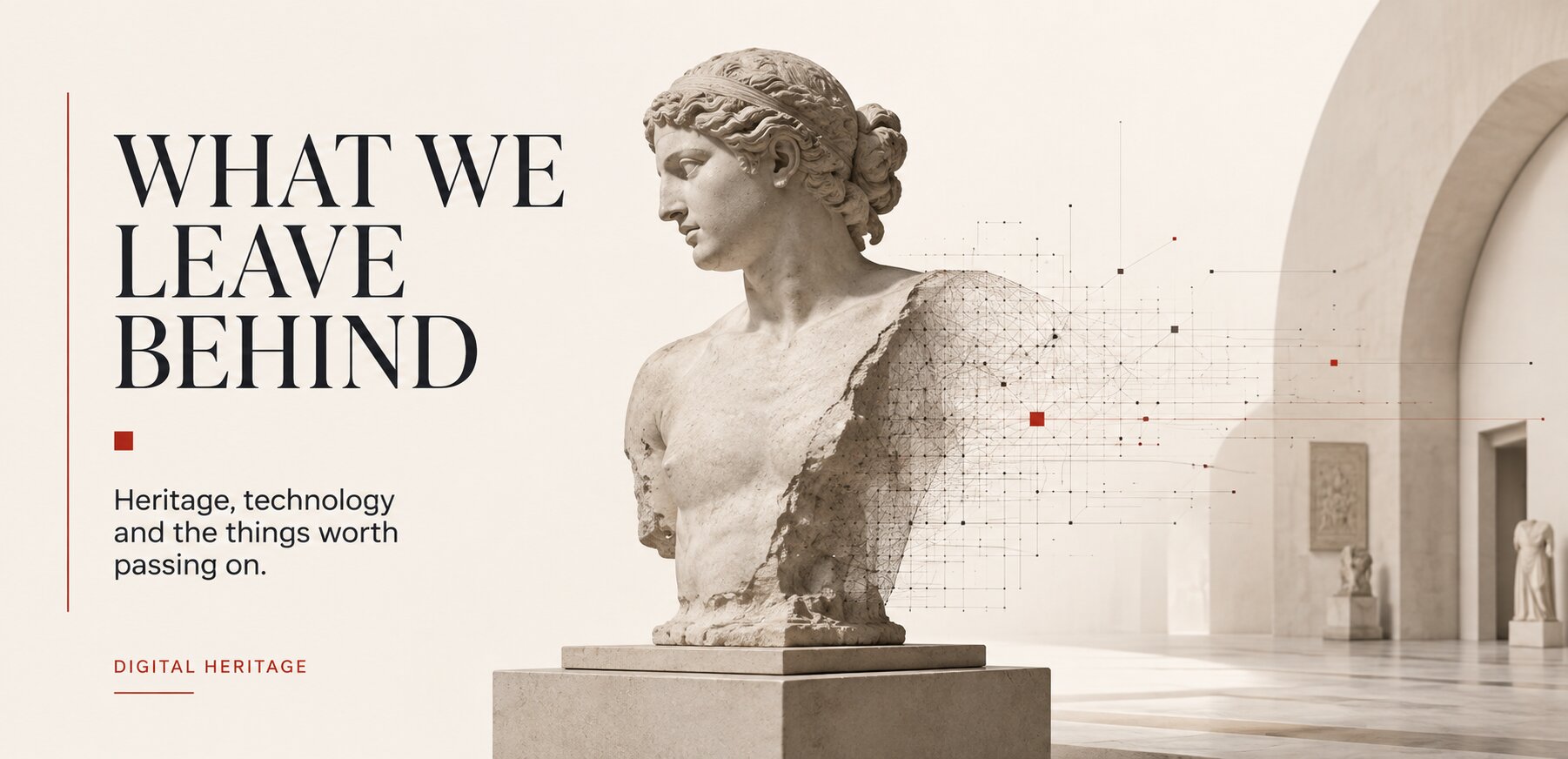
When Everything Became Available
When Everything Became Available
When I was sixteen, I got my first music center.
I loved buying CDs.
I bought albums from my favorite artists. We exchanged discs with friends, copied them, bought CD-RW drives and stacks of blank discs. Sometimes finding a particular album was half the experience because not every record was easy to get.
At the time, none of this seemed particularly philosophical.
We were simply listening to music.
But looking back, I think we were also experiencing something that has become increasingly rare: we owned the music.
When you bought a CD, it stayed with you.
You could put it into your portable CD player and carry your favorite album in your pocket. The headphones were usually terrible compared with today's AirPods Pro, Samsung Buds and other wireless devices. It didn't matter.
You had music with you.
Then you came home and put the same disc into your music center. The speakers filled the room. Sometimes you opened the window. Friends came over. Someone had found a new album. Someone else had managed to get something that nobody else had.
You listened together.
You showed each other what you had found.
You borrowed discs.
Copied them.
Collected them.
And sometimes you simply talked about music while one album played from beginning to end.
There was a physical object connecting you to the music.
And if you found that CD twenty years later in a box somewhere, you could put it into a player and hear exactly the same thing.
The object had survived.
The music had survived.
And, strangely enough, the memory had survived with it.
Today, almost everything is available.
Millions of songs are accessible instantly. Any artist, any album, any genre. Streaming is an extraordinary technology, and I would never argue otherwise. It made music accessible to billions of people and completely transformed how music is distributed.
But there is a strange paradox in it.
Everything is available, and yet almost nothing belongs to you.
You can have ten thousand songs available today.
Stop paying tomorrow, and your access may disappear.
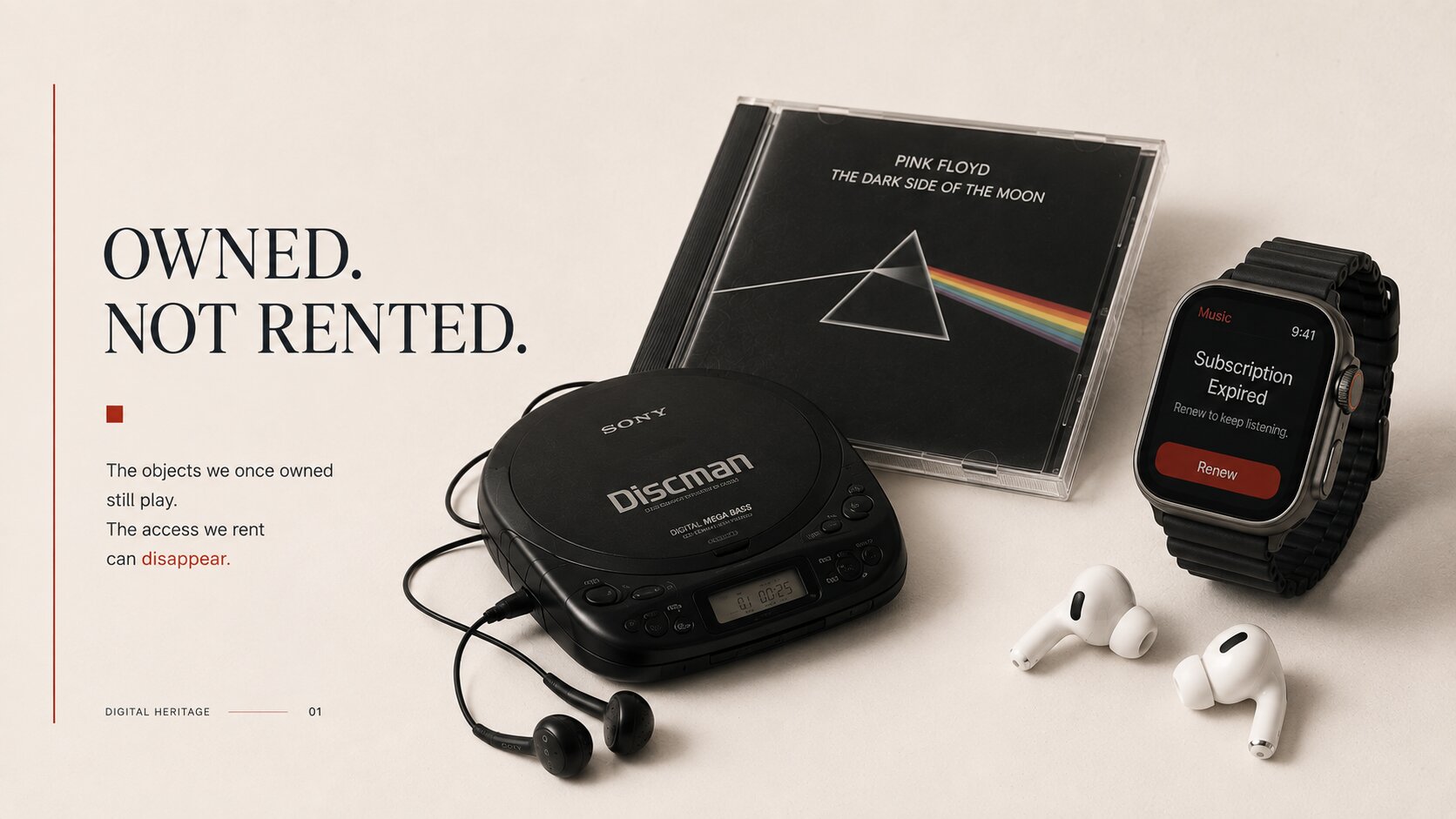
You don't necessarily lose the music because somebody physically took it away. You lose your right to access it.
That is an enormous technological achievement.
It is also a profound change in our relationship with things.
The CD sitting in a box at my parents' house does not care whether I have money this month. It does not care whether a streaming service has changed its catalogue. It does not care whether my subscription expired.
I can take it out.
Put it into a player.
And it still plays.
The object survived the transaction.
The Ritual We Lost
The Ritual We Lost
There was also an interesting period between physical media and today's streaming world.
We started transferring music directly between phones.
Bluetooth.
Infrared.
It was slow. Sometimes painfully slow.
You would hold two phones close together and wait for the file to finish transferring.
From a technological perspective, it was inefficient.
But something happened during those few minutes.
You had to stay there.
You sat next to the other person.
You talked.
"What is this?"
"Listen to this part."
"Do you have anything else?"
"Send me that one too."
The technology created friction.
And the friction created a moment between two people.
Today I can send you a song in less than a second.
I don't have to stop what I am doing.
A link appears in your messages.
You can open it whenever you want.
It is objectively better technology.
But something disappeared along the way: the ritual of sharing.
The same thing happened with photography.
There was a time when taking a photograph required a decision.
You had a limited number of frames.
You had to think about exposure, shutter speed, aperture, available light, composition and the lens you were using. You couldn't simply take fifty versions of the same photograph and decide later which one you liked.
You had to see the photograph before you took it.
Then came the waiting.
The film had to be developed. The photographs had to be printed. There was a process between pressing the shutter and seeing the result.
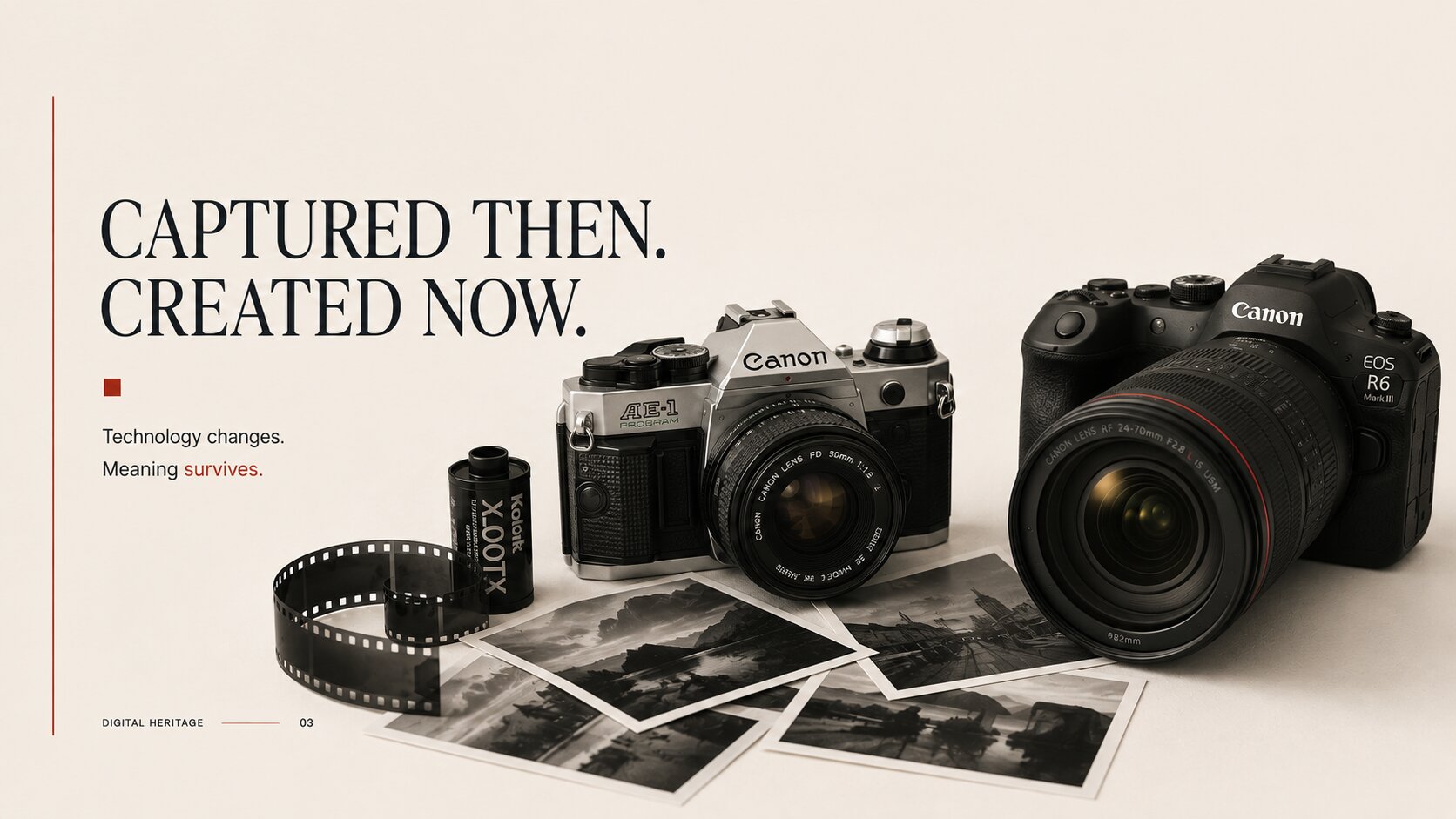
Today, a child can take a photograph with a device more powerful than the professional cameras of previous generations.
And that is extraordinary.
Digital photography did not destroy photography.
It democratized it.
It allowed millions of people to experiment, discover abilities they didn't know they had, and learn without worrying about the cost of every frame.
But technology didn't manufacture millions of great photographers.
It simply gave more people the opportunity to discover whether they were one.
Talent did not become unlimited.
Technology became unlimited.
And that distinction matters.
Because the best photographers still think about the frame.
The best designers still think about composition.
The best writers still think about the sentence.
Technology amplifies.
It does not create meaning.
We came back to this same idea from a different angle in When Everyone Can Publish 500 Articles, What Is Content Worth?, AI can multiply what a company already knows. It cannot manufacture the knowing.
This is why I am not interested in the argument that technology was somehow better or worse in the past.
It wasn't.
Technology is incredible.
Digital photography gave people freedom.
Streaming gave people access.
Smartphones put extraordinary creative tools into almost every person's hands.
AI is doing something similar today on an even larger scale.
The problem is not technology.
The interesting question is:
What did we gain, and what did we accidentally leave behind?
Because when technology removes friction, it can remove something else with it.
The few minutes spent holding two phones together.
The effort of finding a particular record.
The decision to take one photograph rather than twenty.
The physical object that remains after the transaction is over.
The thing you can put into your hand years later and say:
"This was mine."
What We Leave Behind
What We Leave Behind
And this is where I started thinking about brands.
Because a great heritage brand leaves something behind in a very similar way.
Not necessarily technology.
Not necessarily a website.
Not even necessarily the company itself.
It can be a piece of jewelry.
A watch.
A chair.
A book.
A photograph.
A bottle.
A piece of furniture.
An object sitting in someone's home for fifty years.
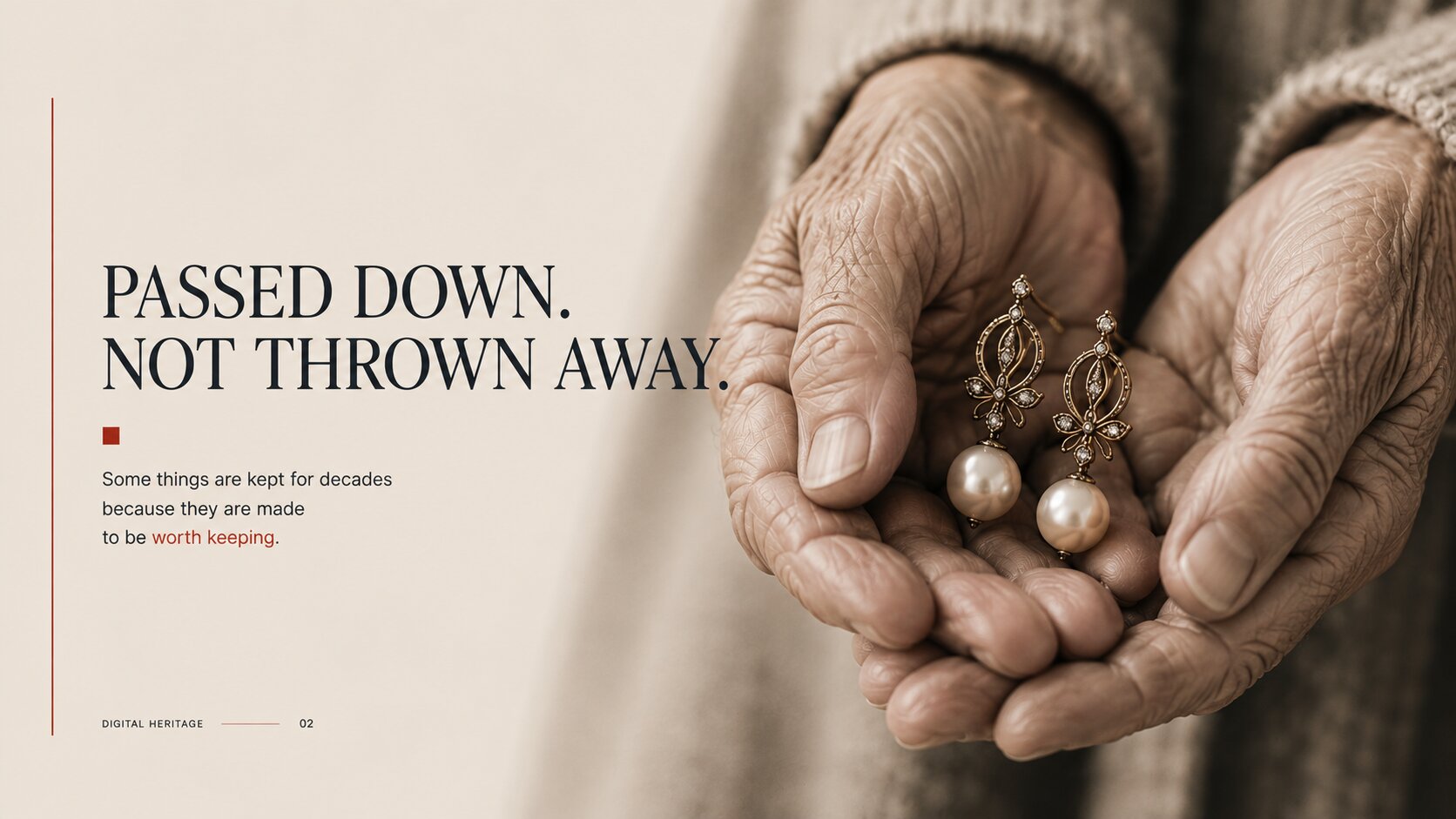
Something that can be shown to a child with the words:
"This belonged to your grandmother."
That is a completely different kind of brand value.
Digital is extraordinarily good at creating access.
It can connect people across continents, preserve archives, distribute information, sell products globally and create experiences that would have been impossible only a generation ago.
But digital can also become strangely weightless.
A website can disappear.
An account can disappear.
A subscription can expire.
A platform can shut down.
A database can become obsolete.
A social profile can simply stop mattering.
And that is why I don't think the future of heritage brands is about choosing between physical and digital.
It is about understanding what each of them is capable of preserving.
Because perhaps the most powerful digital experience is the one that eventually makes you want to touch something real.
And the most powerful physical object may be the one whose story can now travel around the world through digital.
History Is Not Heritage
History Is Not Heritage
This is where the distinction between history and heritage becomes important.
A company can be 100, 200 or even 300 years old and still have very little meaningful heritage.
Age is not heritage.
A date in a corporate history is not heritage.
A founder's portrait on an "About Us" page is not heritage.
History tells us that something happened.
Heritage tells us that something remained.
A product becomes heritage when it survives the people who created it.
When somebody protects it.
Keeps it.
Repairs it.
Remembers it.
And eventually decides that it is worth passing to someone else.
That is when an object stops being merely an object.
It becomes part of a chain.
And perhaps that is the most important thing about heritage: it moves forward.
It is not simply what a brand inherited from the past.
It is what one generation decides is valuable enough to give to the next.
When It Becomes Personal
When It Becomes Personal
This is where the idea of heritage becomes personal for me.
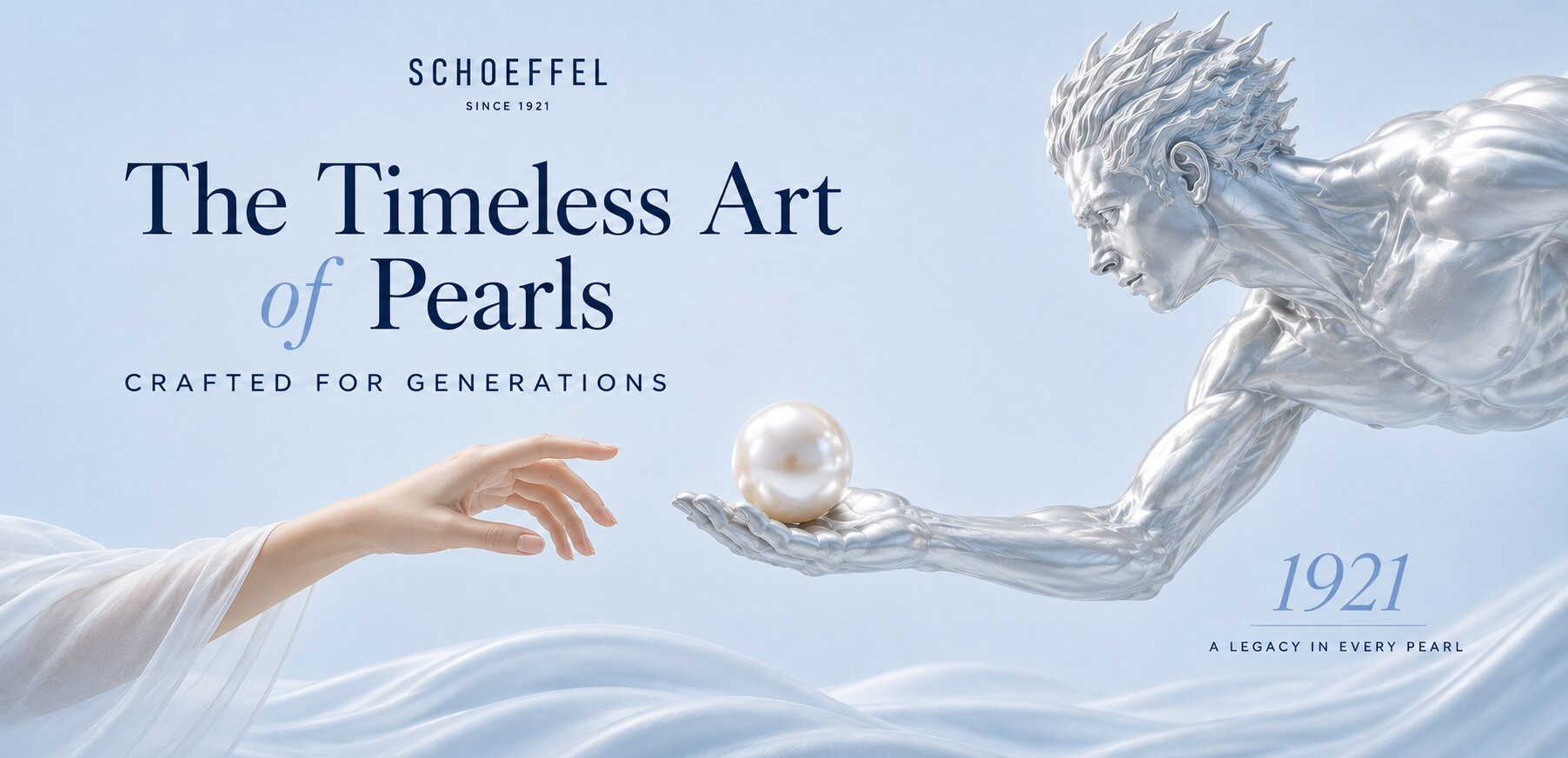
This is where the idea of heritage becomes personal for me, through a story about a colleague, her grandmother, and a pair of Schoeffel earrings that survived a war. We wrote about that story in full in When a Brand Disappears, Is It Really Dead?.
What matters here is the pattern it revealed: heritage is the fact that someone cared enough about an object to protect it, preserve it and eventually pass it to another person. Not age. Not a logo. Not a trademark. Not a line saying “Established in 1921.”
I realized that this is what makes heritage heritage.
Not age.
Not a logo.
Not a trademark.
Not a line saying "Established in 1921."
It is the fact that someone cared enough about an object to protect it, preserve it and eventually pass it to another person.
Almost like a piece of genetic code.
The object carries something forward that existed before you.
And perhaps this is why heritage cannot simply be manufactured.
You can reproduce the appearance of an old brand.
You can recreate its typography.
You can imitate its visual language.
You can manufacture a product that looks as though it has existed for a hundred years.
But you cannot manufacture the decades of care that made someone put that object back into a jewelry box and think:
"One day, this will belong to my daughter."
A Copy Reproduces the Shape
A Copy Reproduces the Shape
A copy can reproduce the shape.
It cannot reproduce the story.
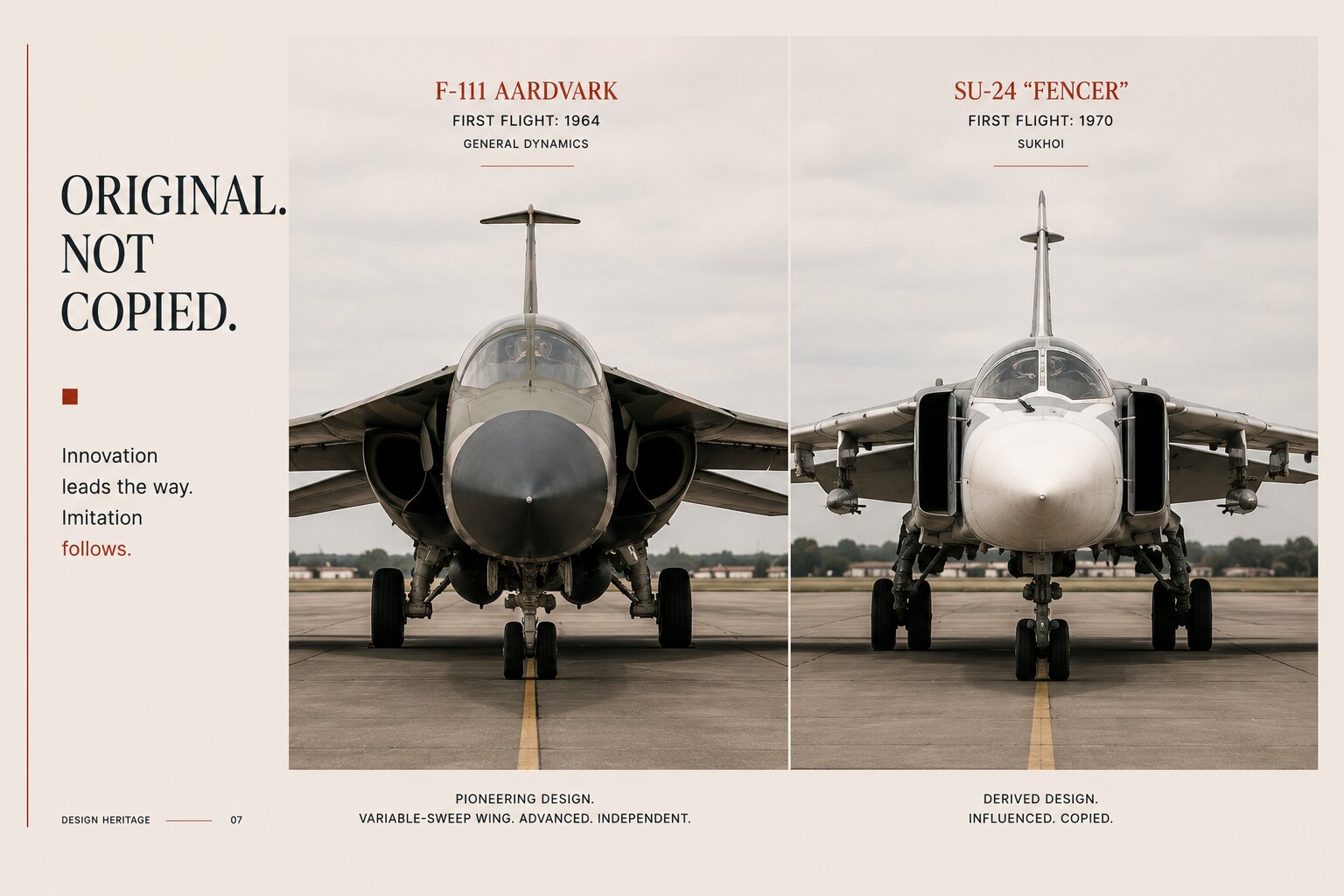
Aviation has an almost perfect illustration of this. In 1967, Soviet engineer Oleg Samoilovich was sent to the Paris Air Show to study the American F-111, the first production aircraft with variable-geometry wings. He photographed it from every angle. Those photographs became the starting point for the Su-24, the aircraft the Soviet Union built in response. Samoilovich later admitted it plainly: they had copied the shape of the F-111's nose cone.
The form was reproduced. The reasoning behind that form, decades of aerodynamic data, structural trade-offs, mission requirements that had shaped every curve, was not something a set of photographs could transmit. You can photograph a nose cone. You cannot photograph the decisions that made it that particular shape.
There is another distinction here that matters to me.
If those earrings had been made simply by following a specification, a certain weight of gold, a certain number of pearls, a more expensive stone here and a less expensive one there, would they necessarily have become an object someone wanted to preserve for generations?
Probably not.
This is not an argument against metrics.
Materials matter.
Craftsmanship matters.
Economics matter.
Specifications matter.
But none of them, individually, explain why one object survives while another becomes irrelevant.
The difference is often in the quality of the decisions behind the object.
The master who created those earrings did not need to know that someone would still be wearing them fifty years later.
He simply had the knowledge, discipline, craftsmanship and intuition to make something that did not belong exclusively to the moment in which it was created.
A great craftsman doesn't necessarily work by predicting the future.
He understands his craft deeply enough to create something that can survive it.
That is a very different kind of thinking.
Think about architecture.
Classicism remains relevant not because someone decided it should stay fashionable forever.
Minimalism does not remain relevant because an architect successfully predicted what people would want fifty years from now.
Certain works survive because they were created with such a strong understanding of proportion, material, composition and purpose that changing fashions cannot completely erase their value.
The style may change.
The context changes.
Technology changes.
But the underlying quality remains recognizable.
And this is exactly how I think about digital products.
When we work on a new digital ecosystem, we are not only asking what works today.
We study competitors.
We examine historical versions of the brand.
We look through web archives.
We analyze current behavior.
We study technological changes.
We consider AI and emerging interfaces.
And then we build hypotheses about what comes next.
We cannot know what the web will look like in ten years.
But we can design with the possibility that the work should still make sense when today's technology becomes obsolete.
That is the digital equivalent of craftsmanship.
We are not trying to predict the future perfectly.
We are trying to create something with enough depth that it can survive changes in the future.
The master worked with gold and pearls.
We work with code, interfaces, content, systems and technology.
The materials are completely different.
The responsibility is surprisingly similar.
Make something well enough that time does not immediately make it worthless.
The Pearl Metaphor
The Pearl Metaphor
And this is also why I think the word heritage is sometimes used too easily.
A brand can be 100, 200 or even 300 years old and still have very little meaningful heritage.
Age is not heritage.
History is not heritage.
Heritage is what survived because someone considered it worth preserving.
A product can disappear.
A company can change owners.
A brand can disappear from digital.
People can stop talking about it.
But if something it created continued to live in people's homes, memories and families, the story is not finished.
That is a very different situation from trying to revive an empty name.
Because a name can be purchased.
A trademark can be purchased.
A domain can be purchased.
But accumulated meaning cannot simply be purchased.
It has to be discovered, understood and carried forward.
And this is where the pearl becomes such a powerful metaphor.
A pearl is not valuable simply because it is beautiful.
It carries layers.
Layer after layer, accumulated over time.
And that is what genuine heritage feels like.
You cannot manufacture those layers overnight.
You can only decide what to do with them once you find them.
This is also why I have become fascinated by brands that have somehow been lost.
Most people love stories of rise and fall.
Someone starts with nothing, builds something extraordinary, loses everything and eventually comes back.
A heritage brand is different.
It doesn't start from nothing.
The brand may already have decades of achievements behind it.
The history has already happened.
Our role is to become part of the next chapter.
And that creates a strange possibility.
Imagine someone researching this brand a hundred years from now.
They discover the original founders.
They discover the products.
They discover the people who carried those products through generations.
And somewhere in that history, they find a digital layer created today.
They see that at some point in the twenty-first century, a particular team looked at the brand and decided that its story was not finished.
They see how we understood it.
What we preserved.
What we changed.
What we believed was important.
The technology will be different by then.
The interfaces will probably be unrecognizable.
The platforms we use today may not even exist.
But the decision will remain part of the story.
That, to me, is digital heritage.
And this is where I see a very natural match with the kind of work we do at Peretz.
Not because we are the only company capable of doing it.
There are many excellent teams working with heritage brands, digital transformation and cultural preservation.
But this particular kind of work is something we genuinely care about.
I have always been fascinated by products that are just beginning.
The opposite fascinates me just as much: products that have somehow been lost.
There is something deeply satisfying about discovering that an idea, a product or a brand that once mattered still has something inside it, something that deserves another chance.
And when you become part of that process, you are no longer simply building a website.
You are adding another layer to the story.
What We Leave for the Future
What We Leave for the Future
There is something else that makes this kind of work meaningful to me.
It is not vanity.
It is not about putting our name somewhere inside a hundred-year-old story.
It is about the possibility that, many decades from now, someone may look back at the history of a brand and see that there was a moment when it could have disappeared, but didn't.
They may see the founders.
The craftsmen.
The families who preserved the products.
The generations that carried them forward.
And then, somewhere in the middle of that history, they may find us.
A team that looked at the brand in the twenty-first century and tried to understand what was still alive inside it.
What was worth preserving.
What needed to change.
What the brand could become.
That is a strange kind of legacy because we don't know whether anyone will ever look back at it.
But I think that is precisely why it is interesting.
The technologies will change.
The websites will disappear.
The interfaces we consider revolutionary today will eventually look primitive.
AI will change almost everything around us.
But the underlying question will remain:
Did we create something worth carrying forward?
Someone Who Cares Enough
Someone Who Cares Enough
I have always been interested in products that start from an MVP, the kind of thinking we wrote about in Architecting the MVP: What Marketing Owes a Product Before Launch.
There is something exciting about taking a small idea and helping it become something much larger.
But I am equally fascinated by products that have somehow been lost.
Sometimes the problem isn't the product.
It isn't even the market.
Sometimes the wrong person was managing it.
Sometimes the people responsible for a brand knew how to manage a business, but didn't really feel the thing they were managing.
And I think this distinction matters.
We often talk about finding the best manager.
The strongest credentials.
The best MBA.
The best consulting background.
The perfect metrics.
All of these things have their place.
But a heritage brand sometimes needs something that cannot be listed on a résumé: someone who genuinely cares enough to understand it.
We explored the same distinction, caring versus performing care, in why content with a real point of view sells better than polished AI copy.
Because heritage is not a metric.
You can measure awareness.
Traffic.
Conversion.
Revenue.
Customer acquisition.
You can measure almost everything.
But you cannot put a number on the reason someone kept a pair of earrings for fifty years and then gave them to their daughter.
And yet that invisible value may be more important than many of the things we can measure.
The interesting part is that caring does not mean ignoring the numbers.
Quite the opposite.
When you genuinely care about a product, you become more demanding about understanding it.
You study the market more carefully.
You examine the data more closely.
You question assumptions.
You look at competitors.
You investigate what happened before you arrived.
You search through archives.
You try to understand why something worked, and why it stopped working.
Feeling gives the metrics a reason to matter.
A Bridge Between Generations
A Bridge Between Generations
This is why I don't think our job is simply to make old brands relevant again.
That would be too small a goal.
A heritage brand doesn't need to pretend it is young.
It needs to understand what made it survive in the first place, and then find a way to make that meaning understandable to a new generation.
That may require a new identity.
A new digital ecosystem.
A new e-commerce experience.
AI.
New content.
New markets.
New ways of communicating.
Sometimes almost everything around the product has to change.
But the center should not be destroyed in the process.
Because the goal isn't to recreate 1921.
The goal is to make sure that what was valuable in 1921 can still have meaning in 2026, and perhaps in 2126.
That is a completely different kind of digital transformation.
It is not about putting an old brand onto the internet.
It is about building a bridge between generations.
And this is why the story of Schoeffel, which we told in full elsewhere, feels so personal to us: a brand that had travelled across decades and countries reached us through someone already carrying a piece of its history in her own family. Now we have the opportunity to add something of our own, not to replace what came before, but to help carry it further.
Because heritage is not what we inherit.
Heritage is what we make valuable enough for someone else to inherit.
Author: Yevhen Borovoi, Founder at Peretz Agency.
We wrote about the personal story behind this piece, a colleague, her grandmother, and a pair of earrings that survived a war, in When a Brand Disappears, Is It Really Dead?
- Share
-

-

-

-

Related Reading
-
20. 08. 2026
When a Brand Disappears, Is It Really Dead?

-
17. 08. 2026

When Everyone Can Publish 500 Articles, What Is Content Worth?
-
19. 08. 2026

Architecting the MVP: What Marketing Owes a Product Before Launch
-
07. 07. 2026
Human-First Content Strategy: Why AI Content Is Losing the Trust War in 2026
-
14. 08. 2026

How We Design E-Commerce: From Objects to Experience
-
13. 08. 2026
What Happens to E-Commerce When a Website Stops Being a Website?
-
05. 07. 2026

SHTAYER: Building a Brand for a New Generation
-
01. 07. 2026
THE STORY BEHIND SV GROUP
-
26. 06. 2026

The Story We Never Planned to Tell - Case MEDPRESSO
-
04. 10. 2026
When Not to Rebrand: What to Change and What to Leave Alone