

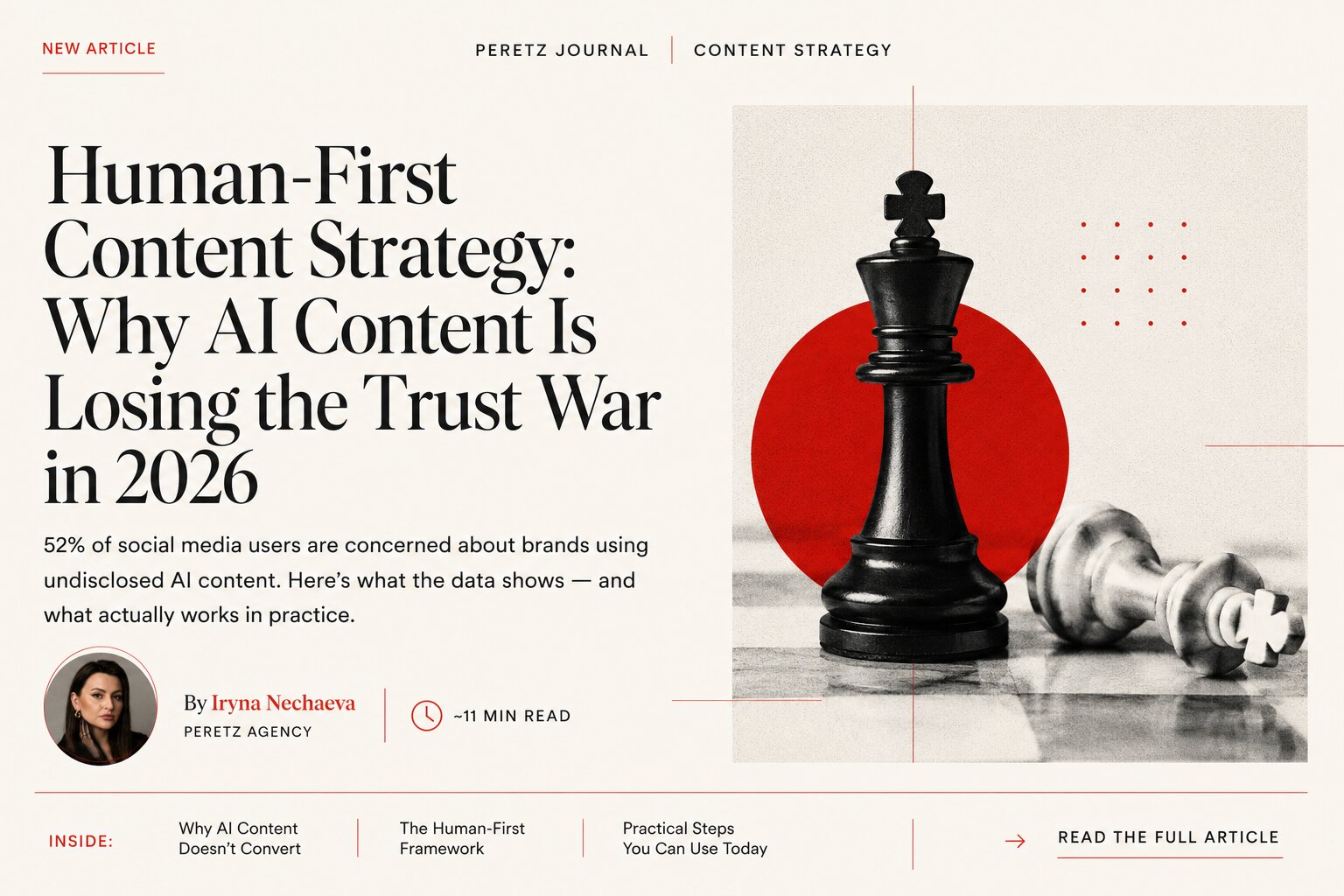
I want to tell you about a company I worked with not long ago. A real estate developer in Ukraine — solid brand, premium positioning, beautiful design work. Before me, they'd been working with a content agency.
The agency posted 1–4 times a month. A few Stories here and there. The captions? Straight from ChatGPT, unedited.
The design was genuinely good. Clean, consistent, on-brand visually. But the texts had zero soul. They didn't sound like the company. They didn't sound like anyone in particular. And the audience — people making significant real estate decisions — felt it immediately, even if they couldn't articulate exactly what was wrong.
This is the thing about AI-generated content that nobody talks about honestly: people can't always explain why it feels off. They just know it does. And in categories where trust drives the purchase — real estate, education, professional services, healthcare — 'feels off' is the same as 'I'm not buying.'
In 2026, this problem has gotten significantly worse. AI tools are everywhere, accessible to everyone, and producing enormous volumes of content at near-zero cost. Which means the feed is flooded with content that looks like content but doesn't feel like anything.
The brands that are winning aren't the ones producing more. They're the ones who figured out how to use AI without losing the signal that makes people trust them.
The Trust Problem Is Real and Measurable
This isn't intuition. The data is there:
- 52% of social media users are concerned about brands posting AI-generated content without disclosing it — Sprout Social Q3 2025 Pulse Survey
- 65% are comfortable with AI for faster customer service — but not for the content that represents the brand's voice and values
- Brands investing in human-first storytelling with consistent 'familiar faces' and recurring characters are building deeper emotional resonance than AI-produced content in the same category
- Google's 2026 Core Updates explicitly deprioritize AI-heavy content without original perspective, experience, or real-world proof
The pattern is consistent: audiences don't reject AI in principle. They reject AI when it replaces the human signal — the voice, the specificity, the point of view — that tells them there's a real person or real organization behind the content.
The uncomfortable business reality: you can build reach with AI content. You cannot build trust with it. And in most B2C and B2B categories, trust is what closes. Traffic without trust is just an expensive way to introduce yourself to people who don't buy.
What AI Content Actually Looks Like From the Inside
I audit Instagram and Facebook accounts regularly. Here's what I see in AI-heavy content strategies — not as a judgment, but as a diagnostic:
BRAND VOICE
The brand voice disappears
Every brand has a specific way of talking — a rhythm, a set of values, a personality that comes through in word choices. ChatGPT doesn't know your brand. It produces plausible, grammatically correct, well-structured text that sounds like a reasonable approximation of a brand in your category. Not your brand. A brand.
For the real estate developer I mentioned: they were a premium brand targeting discerning buyers. Their AI captions read like they were targeting everyone. 'Quality construction. Trusted by developers.' Generic. Forgettable. Invisible.
SPECIFICITY
The specificity disappears
Good content is specific. It references real things — a specific project, a specific challenge, a specific observation from actual work. AI content tends toward generality because it can't access specifics it hasn't been given. Without specifics, content doesn't build expertise. It just occupies space.
OPINION
The opinion disappears
Real thought leadership requires taking a position. Something someone might disagree with. AI, by design, produces consensus — it synthesizes the center of what's already been said, not a genuine perspective. Content without a point of view is content without a reason to be read.
I use AI every day. Claude is genuinely my favourite tool — I use it to monitor, to analyze what I've written, to check for errors, to stress-test ideas. I believe AI will be standard infrastructure in every serious company within a few years. Many businesses are already paying significant sums to equip their teams with it. But here's the distinction I try to hold onto: AI should amplify your expertise, not replace it. The moment you hand over your brand voice entirely to a language model, you've traded the thing that makes your business worth following for a marginal reduction in production time.
The Human-First Framework: What It Actually Means
'Human-first content' gets used as a vague buzzword. Let me make it specific.
Human-first doesn't mean 'no AI.' It means the human signal — real experience, real opinion, real voice — is the primary input, and AI is a production tool that serves that input, not replaces it.
In practice, it looks like this:
VOICE FIRST
1. Brand voice comes before any content
Before you write a single caption, you need a documented brand voice — not a mood board, not a color palette, a written description of how your brand talks. What words do you use? What do you never say? What's your relationship with your audience — teacher, peer, challenger, guide? What do you genuinely believe that your competitors don't say out loud?
This document is what you feed to AI when you need AI's help. Without it, AI produces generic. With it, AI produces something much closer to specific.
REAL PEOPLE
2. Real people create the core signal
The content that builds trust in 2026 is content where real humans are visible — not as props, but as the actual source of expertise and perspective. A founder talking about a real decision they made. A specialist explaining why they do something the way they do. A team member sharing a genuine observation from their work.
This content cannot be faked and cannot be generated. It can be edited, repurposed, adapted — but the raw material has to come from a human with something real to say.
ROLE OF AI
3. AI handles production, not direction
Use AI to: check grammar and readability, generate structural variations of ideas you've already had, repurpose human-created content for different formats, research and surface data points that support a position you've already taken, analyze performance patterns in your existing content.
Don't use AI to: generate your brand voice from scratch, create thought leadership content, write captions that represent your company's position on anything important, replace community management.
TRUST SIGNAL
4. Specificity is the trust signal
The most trust-building content in any category is the most specific content. Not 'we build quality homes' — but 'here's the specific decision we made about insulation on this project, and why we spent 30% more on it than the standard.' Not 'we help businesses grow on Instagram' — but 'here's the exact diagnostic I run when a client comes to me after their previous agency delivered reports but no results.'
Specificity cannot be generated. It can only be supplied by people who actually did the work.
What This Looks Like In Practice — From My Work
After the real estate developer situation I described at the start, the approach we rebuilt was simple: I interview the team about real projects. I ask about decisions, not just outcomes. What was the hardest part of this build? What did you almost do differently? What do you wish clients understood before they start? That material — honest, specific, from people who actually know the work — becomes the content. I shape it, structure it, make it readable and platform-appropriate. AI helps me check it and format it. But the core of it is human, and the audience feels the difference immediately. That's what human-first actually means. It's not a philosophy. It's a workflow.
The Business Case for Getting This Right
Here's the practical argument for investing in human-first content in 2026:
- AI-generated content is now table stakes — everyone has access to the same tools. It creates no competitive advantage, only parity at best.
- Human-specific content — your real expertise, your real cases, your real voice — cannot be replicated by a competitor running the same AI tools. It's genuinely differentiated.
- Google's 2026 updates reward Experience, Expertise, Authoritativeness, and Trust (E-E-A-T). These signals come from human-authored, experience-backed content, not AI synthesis.
- ChatGPT and Perplexity cite blog articles that demonstrate real expertise. AI-generated content without original insight is not cited. The GEO opportunity belongs to human-first content.
- Trust converts. Generic doesn't. In high-consideration categories — real estate, education, professional services, healthcare, agency selection — the brand that earns trust wins the sale, regardless of pricing or features.
The question to ask about every piece of content before publishing: 'Could this have been written by anyone with access to a language model and a Google search?' If yes — add something only you can add. A real observation. A specific case. A genuine opinion. That's the difference between content that builds trust and content that fills space.
How We Approach This at Peretz Agency
Every content strategy we build starts with a brand voice document before we plan a single post. We interview the team, we document the real positions the business holds, we identify the specific experiences that only this business can share.
Then we use AI as an accelerator — not a replacement. For checking, formatting, repurposing, analyzing. The direction and the voice are always human.
The result: content that sounds like someone wrote it, because someone did.
Working with a content agency that's producing polished posts with no results? The problem is almost certainly in the trust layer — not the design or the frequency. Contact us at hello@peretz.agency or call +1 425 471 94 96.
We explored the same idea, caring versus performing care, from another direction in What We Leave Behind: Heritage, Technology and the Things Worth Passing On.
The same trust question applies to product data an assistant has to repeat, which we cover in SEO Gets You Found. AEO Gets You Recommended. Your Commerce Infrastructure Gets You Bought..
Where an AI system acts rather than writes, the same trust question becomes an authorisation question, examined in Agentic AI Compliance: How to Secure, Govern and Monitor AI Agents.
Human-first pillars still need a build order behind them, we cover that in the actual process, step by step. One architecture bureau put exactly this balance to work, real projects at the center, AI as an assist, not a replacement.
Why an assistant needs verified business knowledge, not just a model, is covered in AI website assistants are not chatbots.
- Share
-

-

-

-

Related Reading
-
06. 04. 2021
How to Rank Your Google Business Profile Higher in 2026 (Without Paying for Ads)

-
20. 12. 2020
Why Your E-Commerce Store Needs a Blog in 2026 — And How to Start One That Actually Works
-
14. 02. 2021
SEO Copywriting in 2026: What Actually Ranks — and What Converts
-
14. 02. 2021
Link Building in 2026: What Works and What Doesn’t
-
14. 02. 2021
Link Building in 2026: Why It Still Matters and How to Do It Right
-
22. 07. 2026
Why "Authenticity" Became 2026's Most Overused Word — And What Actually Works Instead
-
29. 07. 2026
The Hidden Cost of Standing Still: Why Modern Businesses Lose Competitive Advantage Long Before They Notice
-
17. 08. 2026
SEO, AEO, and GEO in 2026: What Actually Matters to Google, and What Your Marketer's Report Should Show
-
17. 08. 2026

When Everyone Can Publish 500 Articles, What Is Content Worth?
-
22. 08. 2026

What We Leave Behind: Heritage, Technology and the Things Worth Passing On
-
06. 09. 2026

SEO Gets You Found. AEO Gets You Recommended. Your Commerce Infrastructure Gets You Bought.
-
07. 09. 2026

Agentic AI Compliance: How to Secure, Govern and Monitor AI Agents
-
08. 09. 2026
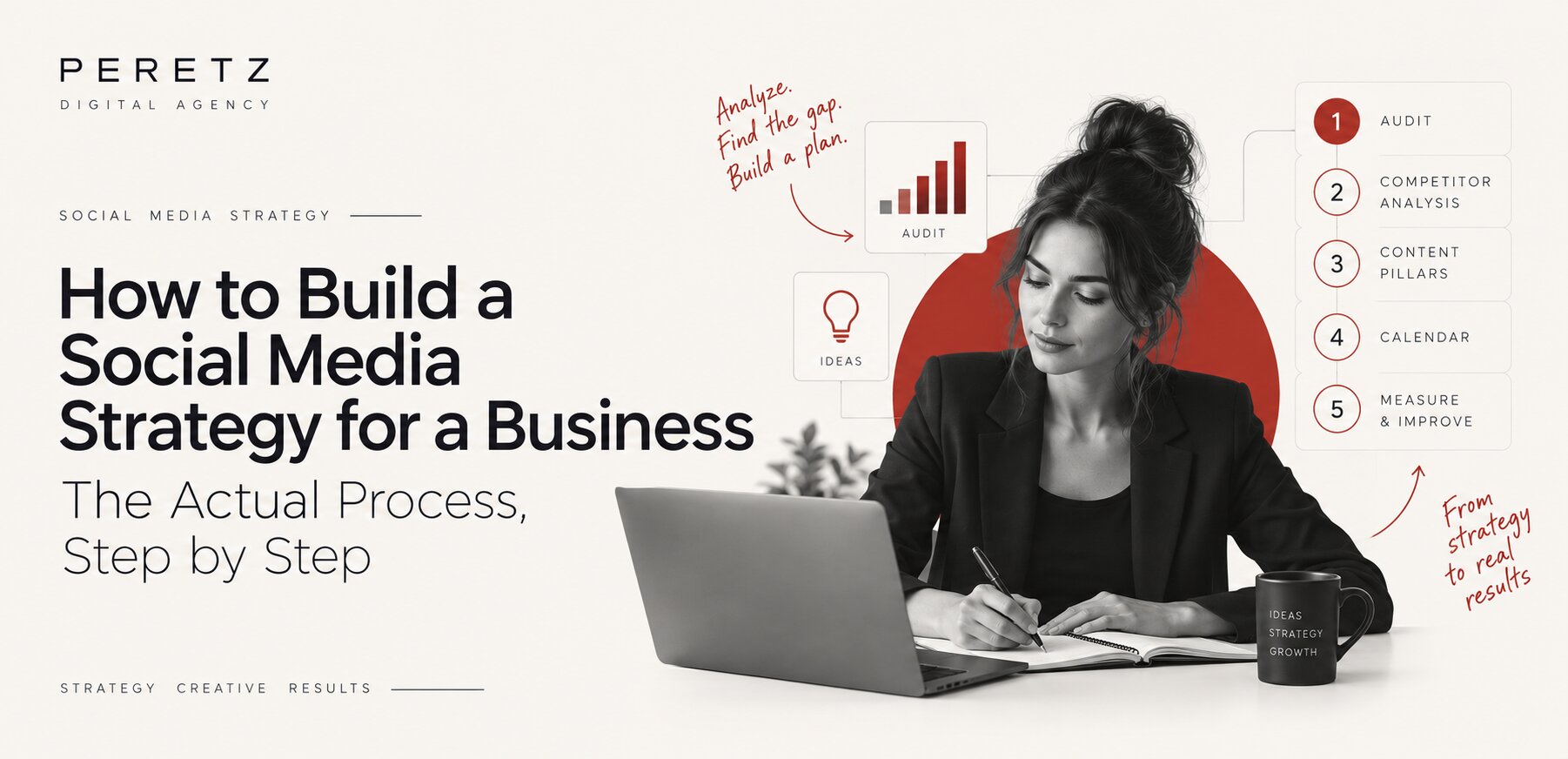
How to Build a Social Media Strategy for a Business, The Actual Process, Step by Step
-
27. 09. 2026
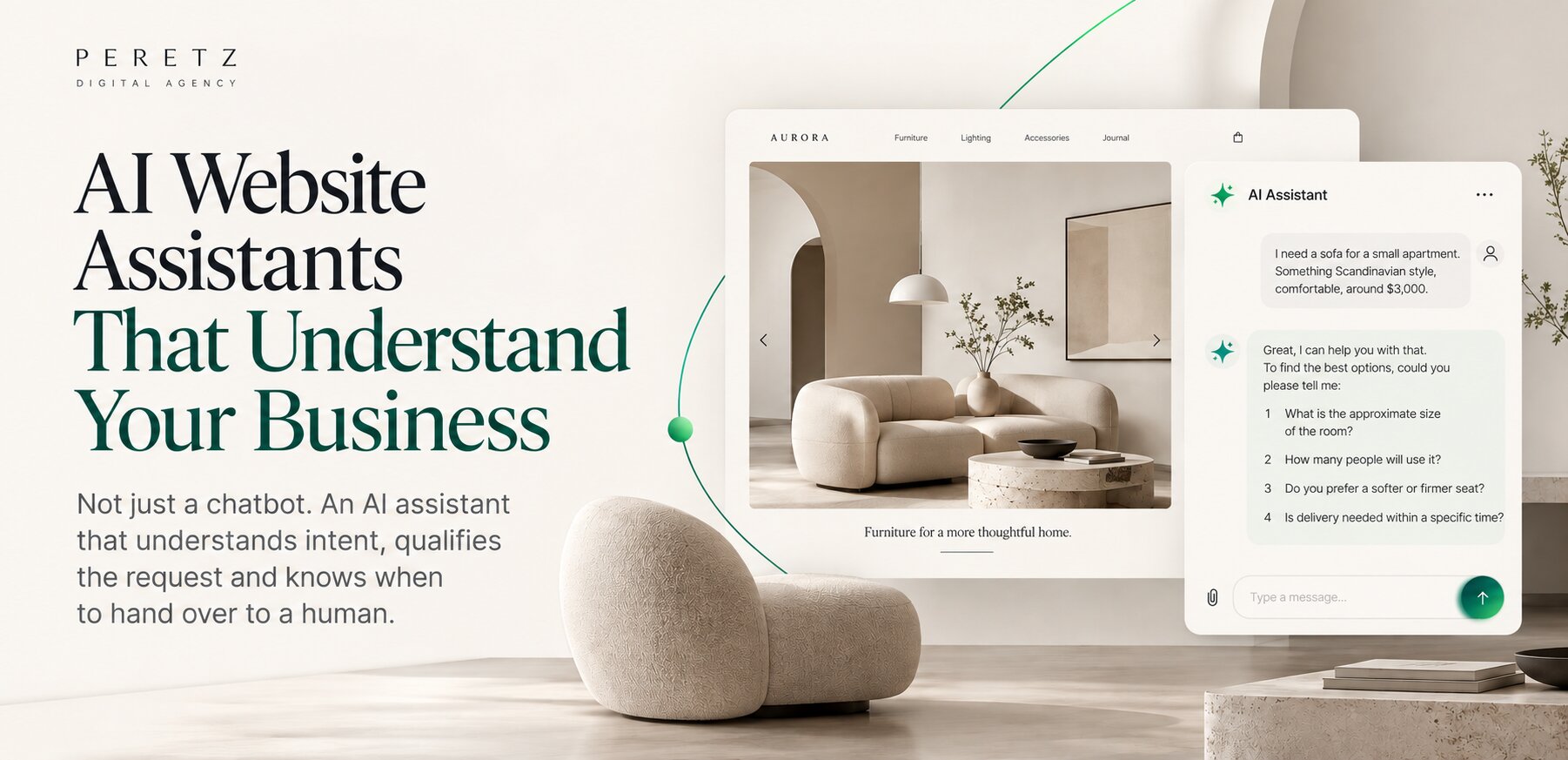
AI Website Assistants Are Not Chatbots. They Are a New Business Interface.