


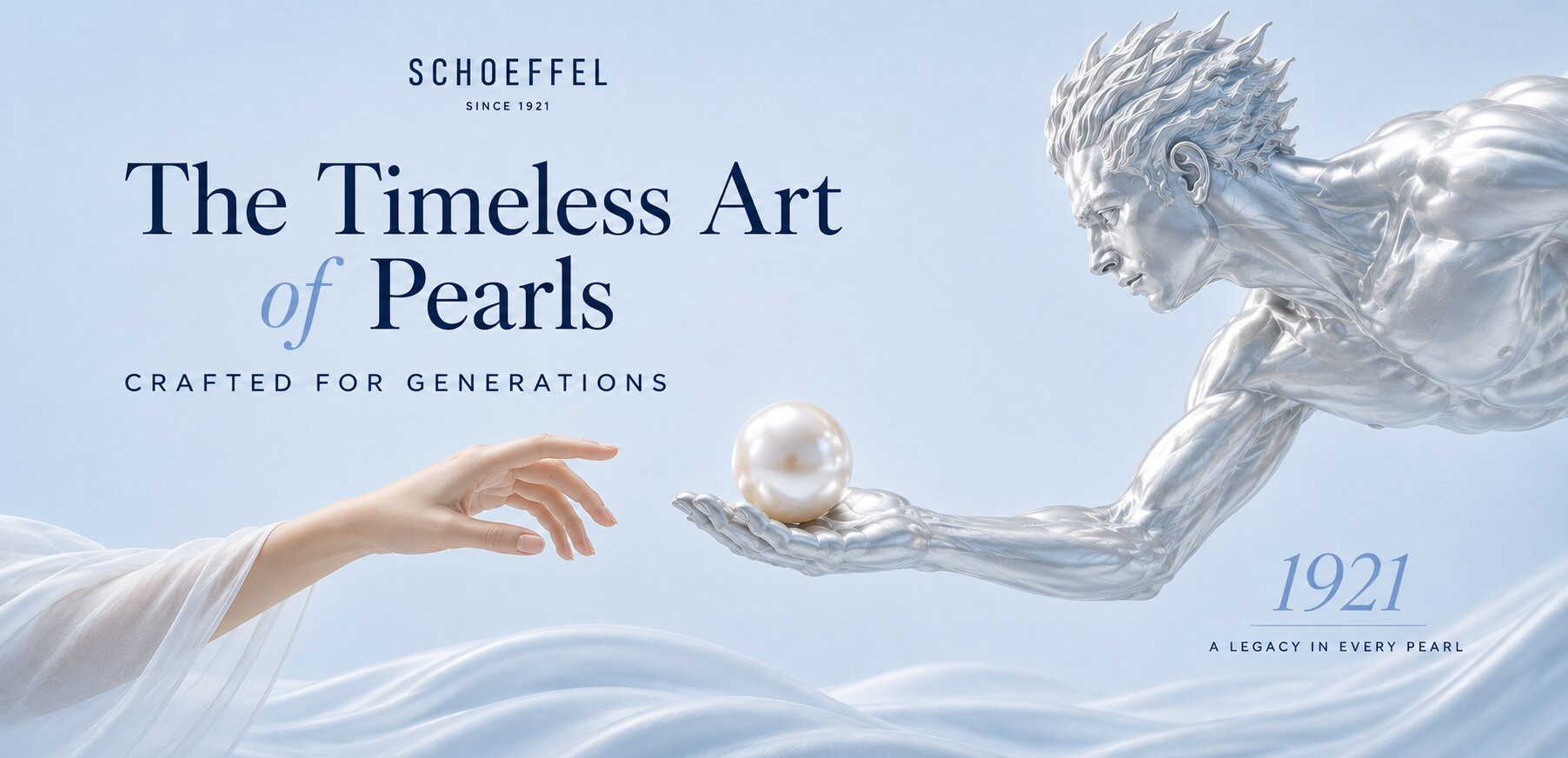
There are brands that disappear.
Not dramatically. There is no final announcement, no obituary, no moment when someone says: this brand is dead.
They simply become harder to find.
The website disappears. Social media goes quiet. Search results become dominated by something else. Younger customers stop encountering the name. A generation that once knew the brand grows older, and the next generation never learns about it.
And yet the objects remain.
A necklace sits in a jewelry box.
A pair of earrings is passed from a mother to a daughter.
Someone remembers that their grandmother owned something made by that house.
The brand has disappeared from the digital world.
But it has not disappeared from people's lives.
That distinction is where our work with Schoeffel begins.
Nine Years Old
Nine Years Old
When I first discussed Schoeffel with our marketing specialist, Irina, she said something that immediately caught my attention.
"I know this brand. My grandmother had earrings from Schoeffel."
If she had said Mercedes-Benz, I probably would not have stopped to think about it.
Everyone knows Mercedes-Benz.
But Schoeffel is a different kind of brand.
It is a German jewelry house founded in 1921, with more than a century of history in pearl jewelry. The company describes itself today as a house present in more than 40 countries across five continents. Earlier accounts also describe Schoeffel as a fourth-generation family business specializing in cultured pearls and pearl jewelry.
And yet, for many people today, the name is almost invisible.
Irina's grandmother's earrings had survived that invisibility.
They had become part of a family story. They were no longer simply products. They were objects with memory attached to them.
And suddenly I realized something almost strange:
For me, the Schoeffel story had started nine years ago. I just didn't know it yet.
Nine years earlier, I had no idea that this name would eventually become part of our work at Peretz.
I certainly could not have known that when we finally encountered the brand professionally, one of the people sitting on our side of the table would already have a personal connection to it through her grandmother.
Maybe it is coincidence.
Maybe it is simply the way heritage works.
But it changed the way I looked at the project.
Because a heritage brand is not only what can be found in a company archive.
Sometimes its most important archive is people's memory.
Digital Disappearance
Digital Disappearance
The deeper we looked into Schoeffel, the more interesting the problem became.
The brand had history.
It had products.
It had craftsmanship.
It had international recognition.
It had been part of people's lives for generations.
But its digital presence did not reflect the amount of accumulated value sitting behind the name.
This is one of the most underestimated problems in heritage branding.
A company can spend decades building brand equity and then become almost invisible in the environment where modern customers discover brands.
That creates a strange asymmetry: the physical brand survives, while the digital brand memory decays.
And digital memory matters.
A younger customer does not necessarily encounter a jewelry house through a department store, a family jeweler or a printed magazine.
They may encounter it through a search result.
A social post.
A recommendation.
A video.
An editorial article.
A digital storefront.
An AI assistant.
A friend sending a link.
If the brand is not present in those environments, its history does not automatically transfer to the next generation.
The fact that a company existed for 100 years does not guarantee that someone will know about it tomorrow.
Heritage creates potential. It does not create relevance by itself.
That is the first distinction we had to make with Schoeffel.
The task was not:
How do we make an old jewelry brand look new?
The real question was much harder:
How do we make a century-old brand relevant again without destroying the reason it became valuable in the first place?
Not a Blank Canvas
Not a Blank Canvas
This is where many branding projects go wrong.
A new company has enormous freedom.
It can decide what it wants to be.
A heritage company cannot.
It inherits decisions made by people who are no longer in the room.
It inherits visual codes, customer expectations, manufacturing traditions, stories, associations, relationships and sometimes even misconceptions.
Some of those things are valuable.
Some are outdated.
Some are invisible but essential.
And some should probably disappear.
The challenge is knowing which is which.
This is why I don't think heritage branding should begin with a moodboard.
It should begin with diagnosis.
Before changing a logo, choosing a typeface or designing a website, we need to understand the organism.
What is healthy?
What is damaged?
What has stopped working?
What is simply hidden?
What can be rebuilt?
And what should never be touched?
We don't believe in reincarnation. We believe in diagnosis.
I sometimes describe Schoeffel as a reinvention or a rebirth.
But the more I think about it, the less I like the word reincarnation.
I don't believe in reincarnation.
I believe in medicine.
For me, Schoeffel is a living project.
And that changes the role of the agency completely.
The Peretz team is not simply a group of designers and developers waiting for a brief.
We have to behave more like diagnosticians.
Sometimes like therapists.
Sometimes like surgeons.
Sometimes like rehabilitation specialists.
The metaphor is not decorative.
It describes the sequence of the work.
Diagnosis comes before treatment.
If the diagnosis is wrong, the treatment can be beautiful and still fail.
A beautiful website cannot fix a business model it does not understand.
A sophisticated visual identity cannot compensate for a broken customer journey.
A technically excellent e-commerce platform cannot create demand where the proposition is unclear.
And adding AI to a digital product does not magically make the product intelligent.
The technology comes after understanding.
The Digital Advantage
The Digital Advantage
There is, however, one enormous difference between medicine and digital products.
In medicine, there is a point after which nothing can be changed.
Digital products are different.
A business can make a terrible decision.
A brand can disappear from search.
A website can fail.
A positioning strategy can be wrong.
An e-commerce experience can destroy conversion.
A technology stack can become an expensive dead end.
The cost of a mistake can be enormous.
But there is almost always another move.
You can measure.
You can learn.
You can change.
You can rebuild.
You can test again.
You can reconnect with an audience.
You can bring a forgotten brand back into the conversation.
Digital gives businesses something extraordinary: the possibility of correction.
Not cheaply.
Not instantly.
And certainly not without consequences.
But the trajectory can change.
That is why I don't see a brand that has disappeared from people's attention as necessarily dead.
Sometimes it has simply stopped moving.
And if it can still be diagnosed, there is still something to work with.
Schoeffel is not a rebranding exercise.
This distinction is particularly important.
We are not interested in taking a historic jewelry house and making it look like a startup.
There is no value in replacing a century of accumulated meaning with whatever happens to be fashionable this year.
Nor do we want to create another generic luxury website.
There are enough of those.
A heritage jewelry brand has a fundamentally different problem.
It has to operate simultaneously in several time dimensions.
It must respect the past.
It must function in the present.
And it must be capable of surviving the future.
That means the digital product cannot simply reproduce the brand's history.
It has to translate the value of that history into a contemporary experience.
And that requires more than visual design.
It requires brand strategy, content, search, UX, e-commerce, technology, customer journey and increasingly AI to work as parts of one system.
This is where our work with Schoeffel becomes much bigger than a website.
We are not trying to make the brand look alive.
We are trying to give it the infrastructure to live again.
Not a Strategy
Not a Strategy
There is a temptation, when working with an old luxury brand, to believe that history itself is the strategy.
It isn't.
History is an asset. Sometimes an extraordinary one. But an asset is only valuable when you know how to use it.
We have seen very different approaches to this problem.
Some brands try to return to their archives.
Some try to become more contemporary.
Some build their relevance through people rather than history.
And some disappear because nobody makes the decision to carry them forward.
The interesting part is that there is no single formula for bringing a brand back to life.
Carrera y Carrera: when the archive becomes a starting point
We encountered another version of this problem while working with Carrera y Carrera.
The Spanish jewelry house traces its origins to 1885, when Saturio Esteban Carrera opened a jewelry workshop in Madrid. The brand subsequently went through significant changes in ownership and activity. After being sold in 2014, it suspended operations in 2019; the brand was later acquired by heirs of the former owners together with an investment partner and returned to the market in 2022. In 2024--2025, Carrera y Carrera was again being presented as a revived Maison, including the return to historical motifs through its Origin collection.
That is a very different situation from Schoeffel.
But it raises the same fundamental question:
What do you do with more than a century of accumulated identity when the brand has to start moving again?
One answer is to go back to the archive.
And that is precisely what Carrera y Carrera has done with Origin: historical collections and recognizable characteristics became material for new creations rather than something to be simply preserved behind glass.
We participated in that process from the digital and brand side.
And there was something important I took away from it.
You can build an exceptionally beautiful luxury website.
You can make the photography perfect.
You can create an impeccable interface.
You can make everything feel expensive.
And still miss the most important part.
Luxury is not the same thing as visual luxury.
For Carrera y Carrera, what interested us was the possibility of selling something closer to art than simply selling jewelry.
That distinction sounds subtle.
Commercially, it is not.
When someone buys a beautiful object, they may be comparing materials, price, design, reputation and availability.
When someone buys art, the relationship is different.
They are buying an object that they want to live with.
Something they want to look at.
Something that represents a particular way of seeing the world.
Something that may become part of their own story.
And that changes the customer journey.
The website cannot simply say: Here is the product. Add to cart.
Sometimes the correct experience is to stop the customer.
Let them look.
Let them understand.
Let them become emotionally attached to the object before asking them to buy it.
That is one of the reasons I am skeptical whenever someone talks about e-commerce as if there were one universal optimization principle.
Fewer clicks are not always better.
A faster decision is not always a better decision.
And conversion rate, by itself, does not tell you whether you designed the right experience. We wrote more about that skepticism in Why Luxury E-commerce Breaks Every Rule of Conversion Optimization.
Kamoka: the opposite lesson
Then there is Kamoka Pearl.
And Kamoka is fascinating precisely because it proves almost the opposite point.
It does not have a century-old European luxury-house story.
Its story is much more personal.
The Humbert family first came to Ahe in French Polynesia in the early 1970s. Patrick Humbert and his son Loic founded Kamoka Pearl in 1991; Josh Humbert joined the project soon after and eventually left his marine biology studies to work with his father on the farm. The family built the business around pearl cultivation, experimentation and an unusually direct relationship with the place where the pearls were produced.
And that story became part of the product.
Not through an elaborate mythology department.
Through the people themselves.
Josh has been writing about the farm, pearl cultivation, family, life on Ahe and the realities of the business for years. Kamoka's own material describes the company in terms of family continuity, sustainability and traceability, with the current operation involving multiple generations of the family.
That is a completely different form of luxury communication.
The brand does not need to pretend to be mysterious.
It can show you where the pearl came from.
Who grew it.
Who worked with it.
What the farm looks like.
What went wrong.
What they learned.
What the family believes.
There is something extremely powerful about that.
Because authenticity does not always need to be manufactured.
Sometimes the reality is more interesting than the brand story you could invent.
The lesson is not "be authentic"
There is a very fashionable word in branding today: authenticity.
Everybody wants to be authentic.
But the word has become almost meaningless because it is usually treated as a communication style.
Use natural photography.
Talk about the founder.
Show behind-the-scenes footage.
Write in a more casual tone.
Make a video in the workshop.
That is not necessarily authenticity.
Kamoka is interesting because its authenticity is not a content strategy placed on top of the business.
The business itself is the content.
The farm is real.
The family is real.
The lagoon is real.
The process is real.
The expertise is real.
The sustainability practices are part of how they operate, not simply claims added to a marketing page. Kamoka says every pearl on its site can be traced through its cultivation process and that the family has been working with sustainable pearl farming for more than two decades.
That is a much stronger position.
And it gives us another important lesson for heritage brands:
You do not necessarily need to make an old brand look young. You need to find the part of the brand that people can care about now.
Not a Template
Not a Template
This is where our approach to digital products becomes particularly different.
I have never believed that a good e-commerce experience begins with UX.
It begins with the business.
How does the company actually sell?
Who is involved in the sale?
What does the sales team do?
What happens before a customer arrives?
What happens after they leave?
How much trust is required?
How much education?
How much emotion?
How much time?
What is the value of the product?
What is the cost of making the wrong decision?
What happens if the customer buys immediately?
What happens if they don't?
Only then can we start talking about the customer journey.
Because a customer journey for a luxury jewelry house is not necessarily the same as a customer journey for an electronics retailer.
And even two jewelry brands can be radically different.
Sometimes we want the customer to move quickly.
Sometimes we want to slow them down.
Sometimes the best experience is an efficient path to purchase.
Sometimes the best experience is to make someone forget for a few minutes that they came to a website to buy something at all.
They came to experience the object.
To understand it.
To imagine it.
To want it.
And only then to purchase it.
That is why I don't like universal UX recipes.
There is no "best customer journey" in isolation from the business.
There is only a customer journey that is appropriate, or inappropriate, for a particular business model.
An iPhone can prove the point
Take something as familiar as an iPhone.
Two websites can sell essentially the same product.
One can be faster.
One can have fewer steps.
One can technically make the purchasing decision more efficient.
And yet the other can sell more.
Why?
Because people do not always buy the product with the shortest path to checkout.
They buy confidence.
They buy desire.
They buy belonging.
They buy reassurance.
They buy an idea of themselves.
They buy the feeling that they have made the right decision.
In some categories, efficiency dominates.
In others, emotion is part of the product.
Luxury is one of those categories.
And jewelry is perhaps one of the clearest examples.
A pearl is not simply a physical object with specifications.
It has rarity.
Origin.
Shape.
Light.
Craftsmanship.
Provenance.
Memory.
Symbolism.
And eventually, a story that belongs to the person who owns it.
You cannot reduce all of that to a faster checkout.
Organism, Not Atoms
Organism, Not Atoms
There is a methodology called Atomic Design that I like very much.
But there is an important reason why I don't begin there.
Atomic Design starts by breaking an interface down into atoms and gradually building larger systems from them.
That is useful.
But a business is not born from atoms.
It is a living organism.
Before we design the components, we need to observe the organism.
We look at other organisms.
We study patterns.
We study behavior.
We look at where they succeed and where they fail.
We compare industries.
We analyze customer journeys.
We study what changes when the business model changes.
And only then do we start breaking the problem into systems, components and interfaces.
We don't begin with the atoms. We begin by understanding the organism.
That distinction affects everything that follows.
The UX.
The content.
The technology.
The CMS.
The e-commerce architecture.
The analytics.
The AI layer.
And ultimately, the economics of the product.
Technology should follow the business
This is another area where I have seen agencies make expensive mistakes.
A client comes in asking for a particular framework.
Or a particular CMS.
Or a particular architecture.
And someone immediately starts discussing implementation.
But the question should be:
Why?
Sometimes WordPress is exactly right.
Sometimes Shopify is enough.
Sometimes Webflow, Wix or another managed platform is the rational choice.
Sometimes they are completely inadequate.
Sometimes a project needs a custom architecture.
Sometimes Salesforce makes sense.
Sometimes it is an extraordinary amount of infrastructure for a problem that does not need it.
The answer depends on the business.
How complex is the product?
How fast will it grow?
How many integrations are required?
How will it be maintained?
Who will operate it?
What happens after launch?
Is there a team?
Is there ongoing development?
Are security and compliance requirements significant?
Does the organization need SOC 2 controls?
Is this a product that will be actively evolved for five years, or a website that will be launched and forgotten?
The technology is a consequence of those answers.
Not the starting point.
And this is where AI becomes interesting
We use AI extensively ourselves.
In development.
In research.
In writing.
In repetitive tasks.
In analysis.
And that is not something we see as a threat to expertise.
Quite the opposite.
AI can remove enormous amounts of mechanical work.
It can make specialists faster.
It can help teams explore more possibilities in less time.
But there is an important distinction.
AI is a mirror of the person using it.
A sophisticated prompt does not automatically create sophisticated research.
A beautifully written document does not automatically contain a correct business analysis.
And this is becoming increasingly relevant because we now see a new category of client brief:
A document written with ChatGPT, Claude, Perplexity or Copilot that looks extraordinarily professional.
The language is excellent.
The structure is logical.
The terminology is correct.
The document may even contain competitor analysis, customer journeys and technical recommendations.
And yet something is missing.
Not because the founder is unintelligent.
Not because the marketer is inexperienced.
Not because AI is bad.
But because different disciplines see different depths of the same business.
A marketer sees one layer.
A business analyst sees another.
A project manager sees another.
A UX specialist sees another.
A technologist sees another.
A sales team sees another.
AI can accelerate all of them.
It cannot automatically replace the fact that they are looking at different parts of the organism.
That is why the best use of AI is not to ask one model to produce the entire answer.
It is to let multiple experts use AI to investigate the same problem from different directions.
That is where the technology becomes genuinely powerful.
And that is also why a perfectly written specification can still be the wrong specification.
Rarely the Problem
Rarely the Problem
Perhaps this is why Schoeffel feels different to me.
It is not simply another luxury project.
It brings together almost everything we have learned from working with brands at very different stages of their lives.
Some are global brands with enormous existing awareness.
Some are historical houses trying to find their place in a new market.
Some are businesses that have built their relevance through people, rather than heritage.
Some are digital products that have to be built almost entirely from scratch.
And then there are brands like Schoeffel, brands that already possess something extremely difficult to create, but have temporarily lost the infrastructure through which that value reaches the world.
That is a very different problem.
We have seen enough brands to know that the website is rarely the problem
At Peretz, we have worked across automotive, jewelry, architecture, technology and other industries.
The products are different.
The audiences are different.
The customer journeys are different.
The technology is different.
But there is a pattern that becomes increasingly obvious after enough projects: the digital product is rarely the real starting point.
The real starting point is the business.
How does it create value?
How does it sell?
Why does someone choose it?
Where does trust come from?
What does the customer need to understand before making a decision?
What happens internally when that customer becomes interested?
What happens after the purchase?
What part of the experience should be automated?
What part should remain human?
And, perhaps most importantly: what should the digital product actually change?
That is why we don't like receiving a 30-page specification and immediately turning it into a 30-page website.
Sometimes the specification is excellent.
Occasionally, a client arrives with a genuinely sophisticated customer journey, market research, competitive analysis and a clear understanding of the business.
When that happens, it is a gift.
It accelerates the work.
But it is relatively rare.
More often, the document describes what someone believes the website should contain.
Our job is to understand why.
A good brief can save time. A good diagnosis can save the project.
This distinction has become even more important with AI.
Today, almost anyone can produce an impressive technical specification in an afternoon.
ChatGPT can structure it.
Claude can rewrite it.
Perplexity can add research.
Copilot can help with implementation.
We use these tools ourselves, constantly.
And that is a good thing.
The problem is not AI-generated work.
The problem is confusing well-presented information with deep understanding.
AI is a mirror of the person using it.
Give a strong specialist a powerful model and you can accelerate years of expertise.
Give a superficial understanding of a business the same model and you can produce a beautifully written document describing a superficial understanding of that business.
That is why we increasingly believe that complex digital products should be examined by people with different but complementary expertise.
A business analyst sees one layer.
A marketer sees another.
A UX specialist sees another.
A project manager sees another.
A technologist sees another.
A sales team sees another.
AI can make all of them faster.
But the value comes from bringing those perspectives together.
That is how you get closer to the real organism rather than simply producing a more sophisticated description of its surface.
The Partnership
The Partnership
I was invited to participate in Schoeffel as a partner.
For me, that means something different from receiving a conventional agency brief.
Partnership is trust.
It is also responsibility.
Peretz brings years of experience working with brands across industries, from global automotive companies such as Mercedes-Benz, Honda, Toyota and Kia to jewelry, architecture and technology businesses.
But the value of that experience is not the list of logos.
The value is what happens when those experiences begin to overlap.
You start seeing patterns.
You understand that a customer journey is not a template.
You understand that technology should follow the business rather than the other way around.
You understand why one brand needs to slow the customer down while another needs to remove every possible obstacle.
You understand that a luxury customer may be buying an object, but may actually be purchasing identity, emotion, confidence, belonging or memory.
And you begin to recognize the difference between something that looks right and something that works for the business behind it.
That accumulated understanding is what we bring to Schoeffel. We announced this partnership more formally in Peretz Becomes Strategic Partner of Schoeffel, and wrote about the first phase of the work in Building the Next Century: PERETZ Begins the Digital Transformation of Schoeffel.
Intentionally Small
Intentionally Small
We have already launched a simple landing page for Schoeffel.
That may sound modest compared with everything we have discussed here.
It is intentional.
A project does not become more intelligent because its first deliverable is enormous.
Sometimes the right first move is simply to establish a digital presence, create a point of reference and begin rebuilding discoverability.
Then comes the next layer.
We are currently developing the luxury e-commerce experience.
And this is where the project becomes much more interesting.
Because the goal is not to put a catalogue of jewelry online.
The goal is to understand how a historic jewelry house should behave in a digital environment where the customer can discover, examine, compare, learn and eventually purchase an object that may remain in their family for generations.
That requires a different kind of e-commerce thinking.
The next layer is not more technology. It is better interaction.
AI will be part of that future.
Not because every luxury website suddenly needs an AI chatbot.
That would be the easiest and least interesting application.
The more interesting question is how AI can help a digital product understand the relationship between a person and an object.
How can discovery become more personal?
How can a customer find something they did not know how to search for?
How can the system explain an object without turning the experience into a technical catalogue?
How can it help someone navigate a collection according to taste, occasion, symbolism, material, history or personal preference?
How can technology make a luxury experience feel more human rather than more automated?
Those are the questions that interest us.
AI is another layer of the system.
It is not the strategy.
Designing for a horizon longer than the technology
There is another reason heritage brands fascinate me.
They force us to think about time differently.
Most digital products are designed around relatively short horizons.
A campaign.
A launch.
A three-year roadmap.
A new version.
A new framework.
A new CMS.
A new AI model.
Technology moves quickly.
Heritage does not.
The technology behind a Schoeffel website will eventually become obsolete.
The framework will be replaced.
The interfaces will change.
The way people search will change.
The way people interact with AI will change.
But the object itself may remain.
A pearl necklace can be worn today, stored for thirty years, inherited by a daughter and eventually passed to a granddaughter.
That means the digital system around the object has to understand something that most digital products don't: it is temporary infrastructure around something that may not be.
And I find that perspective incredibly important.
What Survives
What Survives
This is ultimately why I keep thinking about art.
Technology disappears.
Interfaces disappear.
Frameworks disappear.
CRM systems disappear.
CMS platforms disappear.
Even the websites we are so proud of today will eventually become artifacts of their time.
But art has a different relationship with time.
We still stand in museums looking at objects made thousands of years ago.
We don't admire them because the technology used to create them is still relevant.
We admire them because someone, thousands of years ago, managed to create something that still speaks to us.
That is an extraordinary standard for any creative work.
And it changes how I think about jewelry.
A piece of jewelry is not just a product that has to convert.
It can become an artifact.
A family memory.
A physical record of a relationship.
Something that survives its original owner.
That is why the digital experience around a heritage jewelry brand should never become more important than the object itself.
The technology is there to give the object a future.
Not to compete with it.
The next chapter is not a return to the past
This is perhaps the most important thing about Schoeffel.
We are not trying to take the brand backwards.
Nor are we trying to erase its history and make it look contemporary for the sake of being contemporary.
The future is not a reconstruction of 1921.
It is the next turn of the spiral.
The history remains underneath.
The craftsmanship remains.
The memory remains.
The mistakes remain as lessons.
But the brand has to move.
It has to become discoverable again.
It has to become understandable again.
It has to become desirable again.
And eventually, it has to become part of somebody else's story.
Maybe that story will begin with a Google search.
Maybe with an Instagram post.
Maybe with an AI recommendation.
Maybe with a visit to the website.
Maybe with a physical piece inherited from a grandmother.
We don't know.
And that is exactly why the digital product has to be designed as a living system rather than a finished monument.
We are not rebuilding Schoeffel
A century-old brand does not need another agency to tell it what it should become.
It needs people willing to understand what is already there.
To diagnose before prescribing.
To question before implementing.
To protect what matters.
To change what no longer works.
And to build the infrastructure necessary for the next chapter.
That is how I see our role at Peretz.
Not as the people who came to make Schoeffel look modern.
Not as the people who came to build another luxury e-commerce website.
And not even simply as the people responsible for its digital transformation.
We are here to help a brand with more than a century of memory become relevant to people who have never heard its name.
The brand has already survived a century.
Our job is to help make sure it has another one.
And perhaps the most beautiful part of the story is that, in a strange way, it has already begun.
Nine years before we knew we would work with Schoeffel, one of our own team members was already carrying a piece of its history in her family.
The brand had not completely disappeared.
It was simply waiting for someone to remember where to look.
Author: Yevhen Borovoi, Founder at Peretz Agency.
The first phase of that infrastructure is now live, read about the launch in Schoeffel Digital Foundation: The First Landing Page Is Live.
This is Element 002 in our ongoing series about the Schoeffel partnership. Learn more about the partners in this story.
We wrote about the first phase of this collaboration in Building the Next Century: PERETZ Begins the Digital Transformation of Schoeffel, and about the customer-journey philosophy behind it in Why Luxury E-commerce Breaks Every Rule of Conversion Optimization.
See the resulting site in the Schoeffel landing page.
- Share
-

-

-

-

Related Reading
-
08. 08. 2026
Building the Next Century: PERETZ Begins the Digital Transformation of Schoeffel

-
08. 08. 2026
PERETZ Becomes Strategic Partner of Schoeffel
-
12. 08. 2026
Why Luxury E-commerce Breaks Every Rule of Conversion Optimization
-
22. 08. 2026
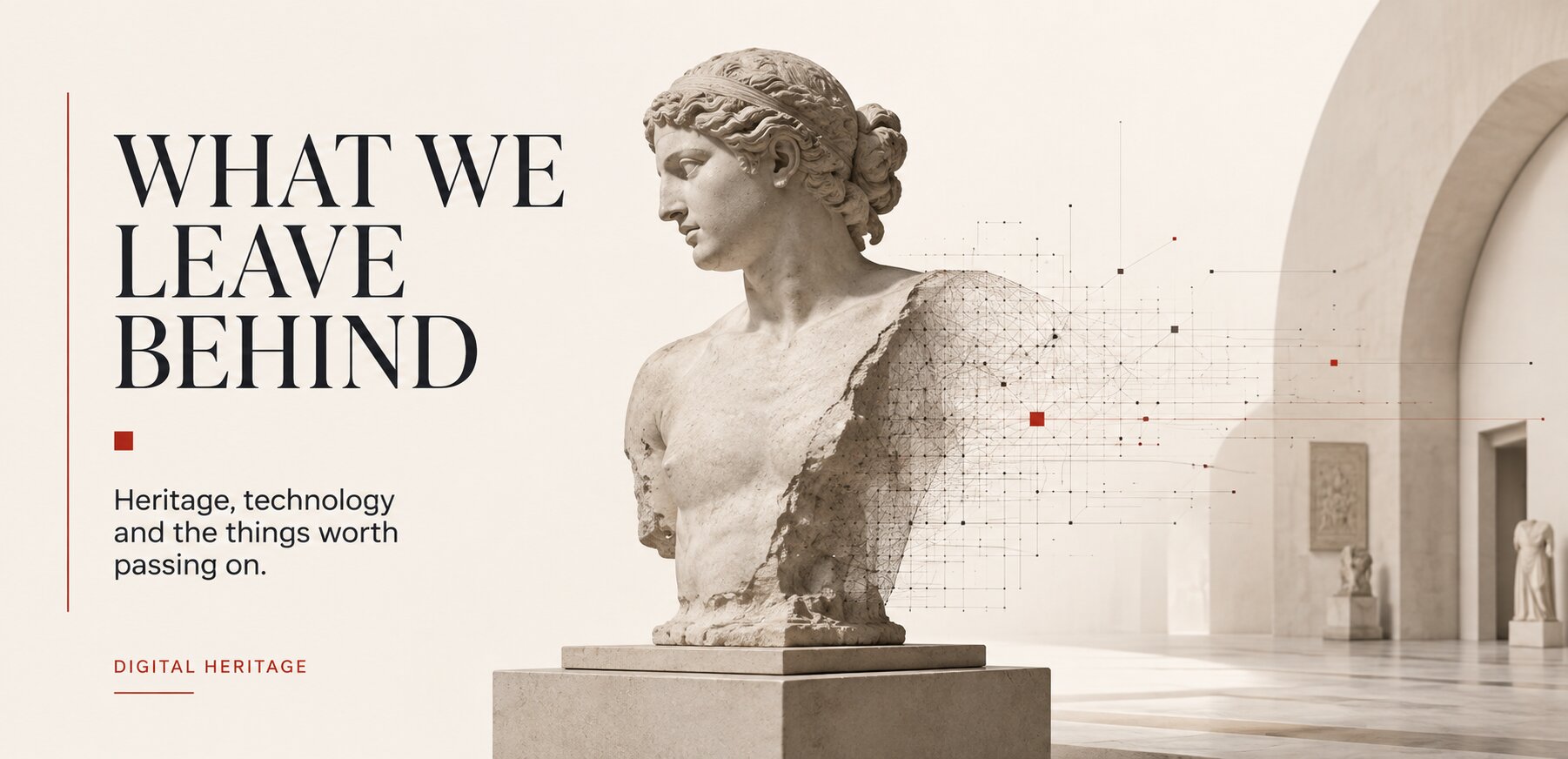
What We Leave Behind: Heritage, Technology and the Things Worth Passing On
-
27. 08. 2026
Schoeffel Digital Foundation: The First Landing Page Is Live
-
14. 08. 2026

How We Design E-Commerce: From Objects to Experience
-
16. 08. 2026
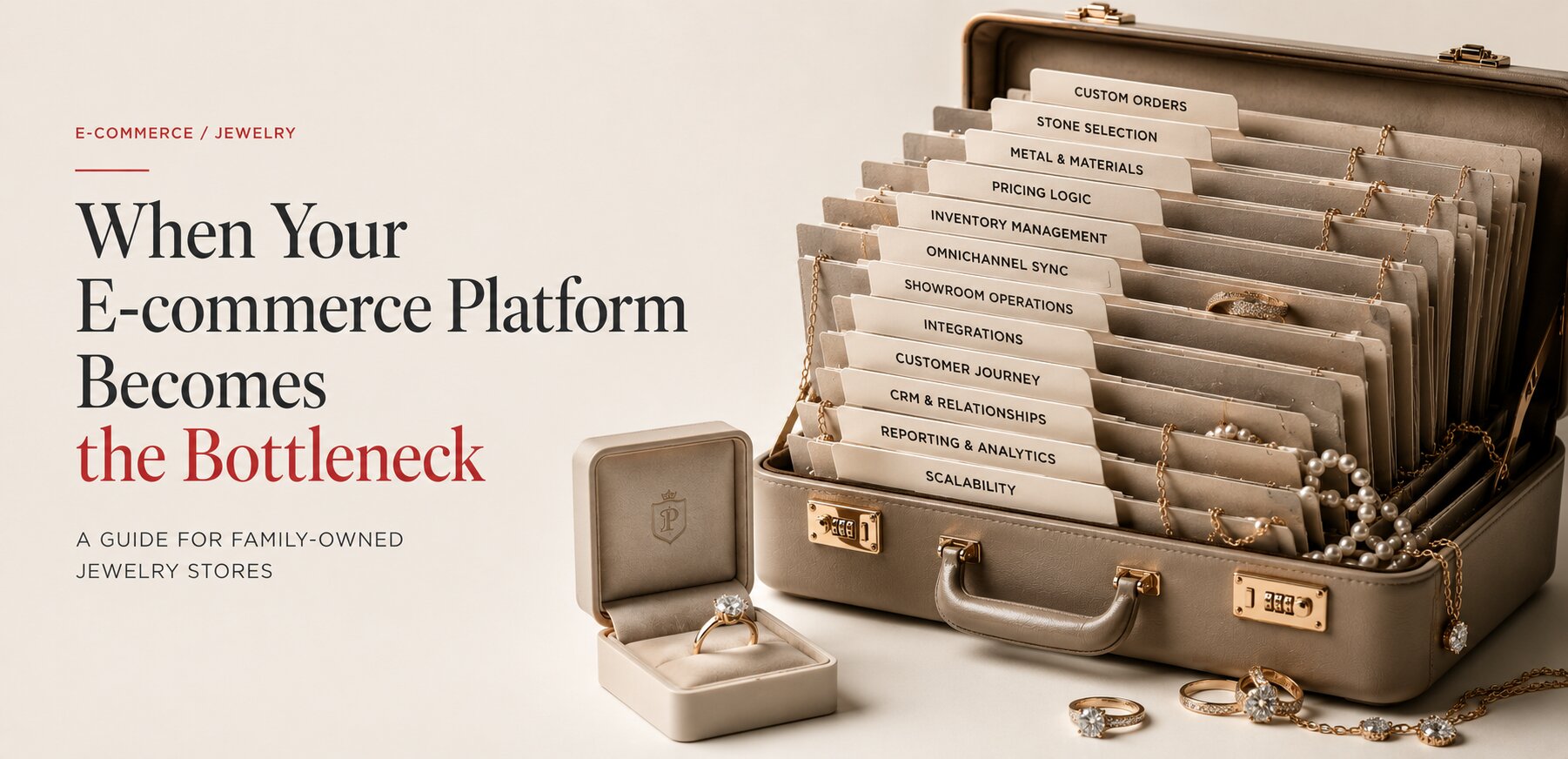
Why Family-Owned Jewelry Stores Outgrow Their E-commerce Platform
-
01. 07. 2026
THE STORY BEHIND SV GROUP
-
30. 11. 2020

The case of Laduchi