


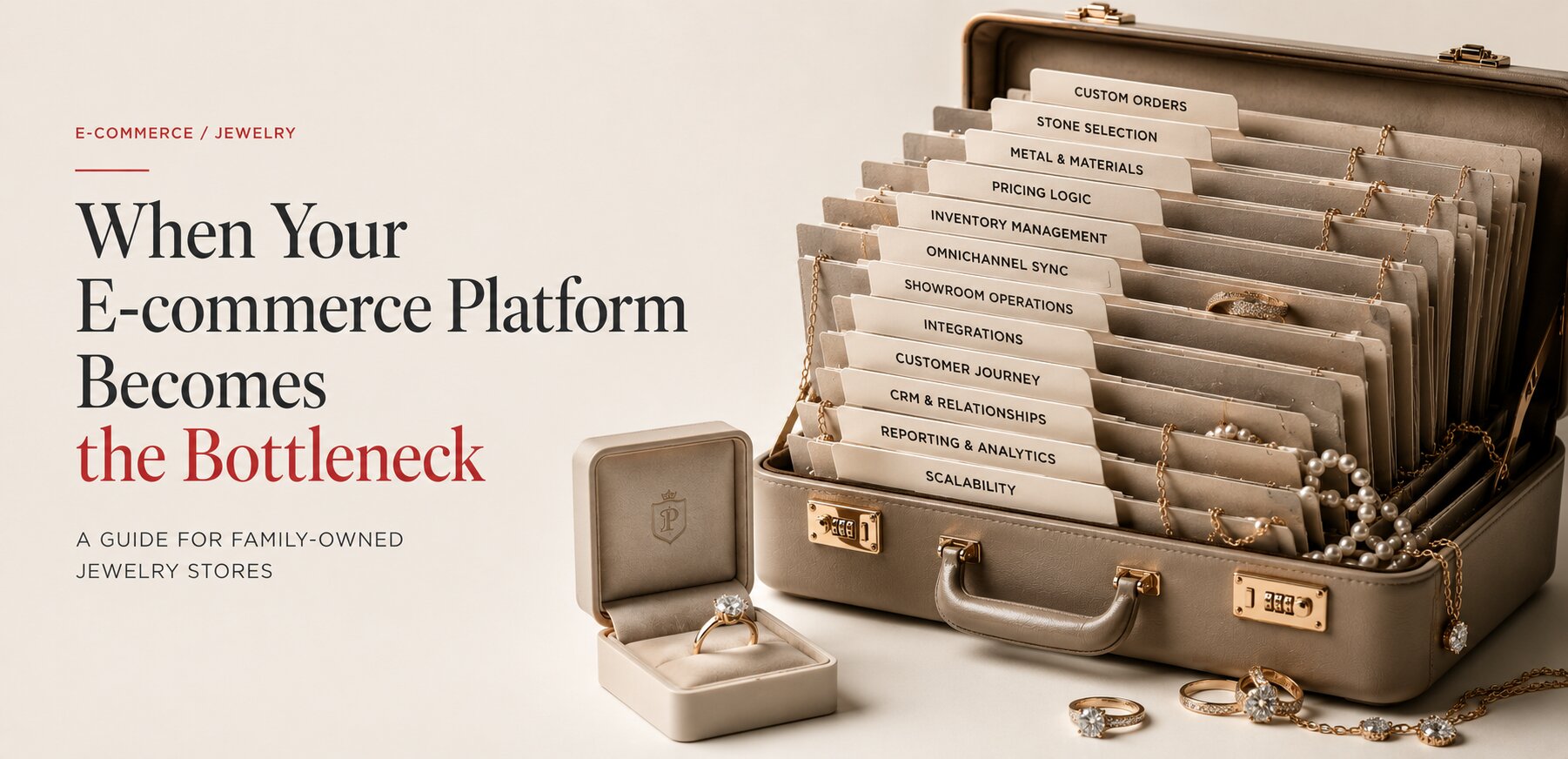
I have sat across the table from enough family jewelry business owners to know exactly how this conversation starts. They pull up their site, sometimes with real pride, and ask what I think. And the honest answer is almost never the one they expect.
The site is not the problem. The business outgrew it years ago, and nobody went back to update the assumptions it was built on.
Seattle and Bellevue happen to have a remarkable concentration of these businesses. Joseph Jewelry has been building custom engagement rings in Old Bellevue since 1996. Turgeon Raine is the only authorized Patek Philippe retailer in the Northwest, family-run since 1982. Schoener has served the region for more than 40 years and just opened a new Kirkland showroom after two decades in Bellevue. These are businesses built on trust that took generations to earn, the kind no platform, however modern, can manufacture in a weekend sprint.
The uncomfortable question is not whether that trust is real. It obviously is. The question is whether the website still knows how to carry it.
The problem is rarely that your platform is too old. The problem is that your business has become too complex for the assumptions it was built on.
That distinction is not a matter of semantics. A platform swap fixes how the site looks. It does nothing for how the business actually runs underneath it, and in almost every jewelry business I have worked with, that is where the real friction lives. Here is what I mean, in five specific ways.
THE CATALOG PROBLEM
Your Catalog Is No Longer a Catalog
Standard e-commerce logic assumes SKU, price, add to cart. Fine jewelry rarely respects that logic. A single piece can carry stone selection, metal choice, size, custom engraving, certification, and, more often than most platforms admit, one-of-a-kind inventory that exists in exactly one unit, ever. A platform built for repeatable products treats every one of those variables as friction to be minimized. In jewelry, those variables are usually the entire reason someone is buying.
TWO BUSINESSES
Your Showroom and Your Website Became Two Different Businesses
A customer browses online, calls with a question, comes in, and a staff member pulls a piece that never made it into the online catalog. The price shifts mid-conversation. A custom order gets created on the spot, on a napkin's worth of notes. Meanwhile the e-commerce platform still only understands one sequence: add to cart, checkout. The gap between what actually happens on the floor and what the platform is built to record is exactly where inventory accuracy, staff time, and customer trust quietly bleed out.
PRICING LOGIC
Your Pricing Logic Becomes Impossible to Templatize
Metal price moves daily. Stone price depends on the specific stone in your hand, not a category average. Making charges scale with complexity. Add currency, tax, dealer pricing, and custom quotes on top, and a standard product-price field simply stops being enough. Most jewelry businesses solve this the way people solve problems platforms cannot: manually, off to the side, in a spreadsheet or a phone call. Which means the price on the website and the real price were already two different things before a customer even asked a question.
INVENTORY AS SYSTEM
Inventory Becomes a Business System, Not a Product List
Once a business carries one-of-a-kind pieces, consignment inventory, and custom orders in progress alongside a repeatable catalog, inventory stops being a website widget. It becomes the operational core of the business, and it has to stay synchronized across the showroom floor, the website, and whatever system tracks fulfillment and repairs. Most platforms were never asked to do that. Most owners never noticed until the numbers stopped matching.
INTEGRATIONS, NOT PLUGINS
You Need Integrations, Not Plugins
ERP, POS, CRM, accounting, shipping, marketing, all of it needs to talk to the storefront and to each other. A plugin bolted onto a template platform can patch one connection. It rarely survives once three or four systems need to share the same data in real time. This is the exact point where the question stops being which platform, and becomes which architecture, a better version of what you already have, or something actually built around how your business runs.
I see this pattern constantly in this region, and it is never anyone's fault in particular. Family jewelry sites are rarely built once. They get built in layers, over fifteen or twenty years, one feature bolted onto the last by whoever happened to be available that year. Nobody sits down and plans it that way. It happens the way a house gets renovated one room at a time instead of redesigned as a whole, until one day the wiring simply cannot carry what the house has become.
TWO BOUTIQUES
Two Boutiques, Two Completely Different Problems
Nicole came to us with a strong physical business and almost no organic visibility online. We did not start with a redesign for its own sake. We rebuilt the search architecture first, clean information structure, proper technical SEO baked in from the migration itself, content actually built to rank, not just to fill a template. The result showed up in organic search performance within months of launch, not in a nicer-looking storefront that nobody was finding.
Nico Juliany's problem was the opposite. The showroom already delivered. Walk in, and the brand feels exactly like what it is. The website did not. It read like a catalog when the business needed it to read like a house you could recognize from across the room. So the fix was structural, not decorative: a monogram and a signature mark built to carry the same identity from packaging to boutique to site, so the digital experience finally matched the fifteen minutes someone actually spends in the store.
In luxury, the purchase rarely happens at add to cart. It happens in the time someone spends with the brand before that.
OUTSIDE THE CATEGORY
A Story From Outside the Category, Worth Telling Carefully
The sharpest version of this pattern I have seen recently is not even in jewelry. It is a pearl farm, and I want to tell it straight, without dressing it up more than the facts support.
Kamoka Pearl is a small, family-run operation on a remote atoll in French Polynesia. For years it was, by the family's own account, financially stagnant. During the pandemic, the founder's grandson, who by his own team's description is not a trained marketer, he is credited on their own site as photographer and, in his words, tech support, started posting unpolished videos of the actual farming process. The account grew substantially, fast, and kept growing. We work on this exact growth pattern through Social Media Marketing. The platform underneath the storefront is an ordinary Shopify template, nothing built, nothing custom about it.
I am not telling you this because content beats architecture, or because any business can copy it and expect the same outcome. It is one data point, not a formula, and I would distrust anyone who tells you otherwise. What it does show, cleanly, is this: a well-built platform did not create that growth, and an under-built one did not stop it. The constraint was a decision about audience, made at a specific moment when almost everyone else in the category chose to wait the downturn out.
WHAT CLOSING TELLS YOU
What a Closed Door Can and Cannot Tell You
Fox's Seattle closed in April 2024, after 112 years and three generations of the same family. Harry Fox opened the store in 1912. Sid and Berta Thal bought it in 1948. Their granddaughter, Zoey Mann, ran it for the last decade before closing it, and she said plainly to local press why: a choice she had been making for years between her family and the business, and she finally chose her family. Business had also been down since the pandemic, and by her own account it never fully came back.
I want to be precise here, because it would be easy, and dishonest, to overreach. That story does not prove a different website would have changed the outcome. Zoey Mann's own explanation was personal, not technological, and I take her at her word. What the story does show is a business with a century of earned trust that had almost none of that trust represented anywhere a new customer might actually find it. Whether closing that gap would have changed anything, I genuinely do not know. I think it is worth asking the question before your own decision gets made under different circumstances than a choice about family.
WHICH PLATFORM
So, Which Platform Do You Actually Need?
Sometimes a platform like Shopify is genuinely enough, Kamoka is the proof of that much. Sometimes a more structured platform like Magento fits better once catalog complexity outgrows what a template can hold cleanly. Sometimes a headless architecture makes sense, when the storefront and the backend logic genuinely need to move independently of each other. And sometimes, once a business has outgrown the assumptions built into every off-the-shelf option available, a custom commerce platform is the only architecture that will actually hold what the business has become.
The honest starting point is never picking a platform first. It is diagnosing which of these five constraints, catalog complexity, the showroom-website split, pricing logic, inventory as infrastructure, or integration depth, is the one actually limiting growth right now. Everything else follows from that answer, and almost nothing useful follows from skipping it.
The Results
Nicole's rebuild moved organic search from an afterthought to a functioning acquisition channel, measurable within months of launch. Nico Juliany's redesign gave the brand a consistent identity system, monogram and signature mark alike, carried across packaging, boutique, and site, closing the gap between what a client feels walking in and what they see online.
Every external fact in this piece was checked directly before publishing, Kamoka Pearl's team background and public follower counts, Fox's Seattle's closure against local press coverage, not assumed or taken secondhand. See how the underlying architecture questions played out in Nicole E-commerce and Nico Juliany E-commerce. For more on how we think about luxury e-commerce specifically, read Why Luxury E-commerce Breaks Every Rule of Conversion Optimization and How We Design E-Commerce: From Objects to Experience.
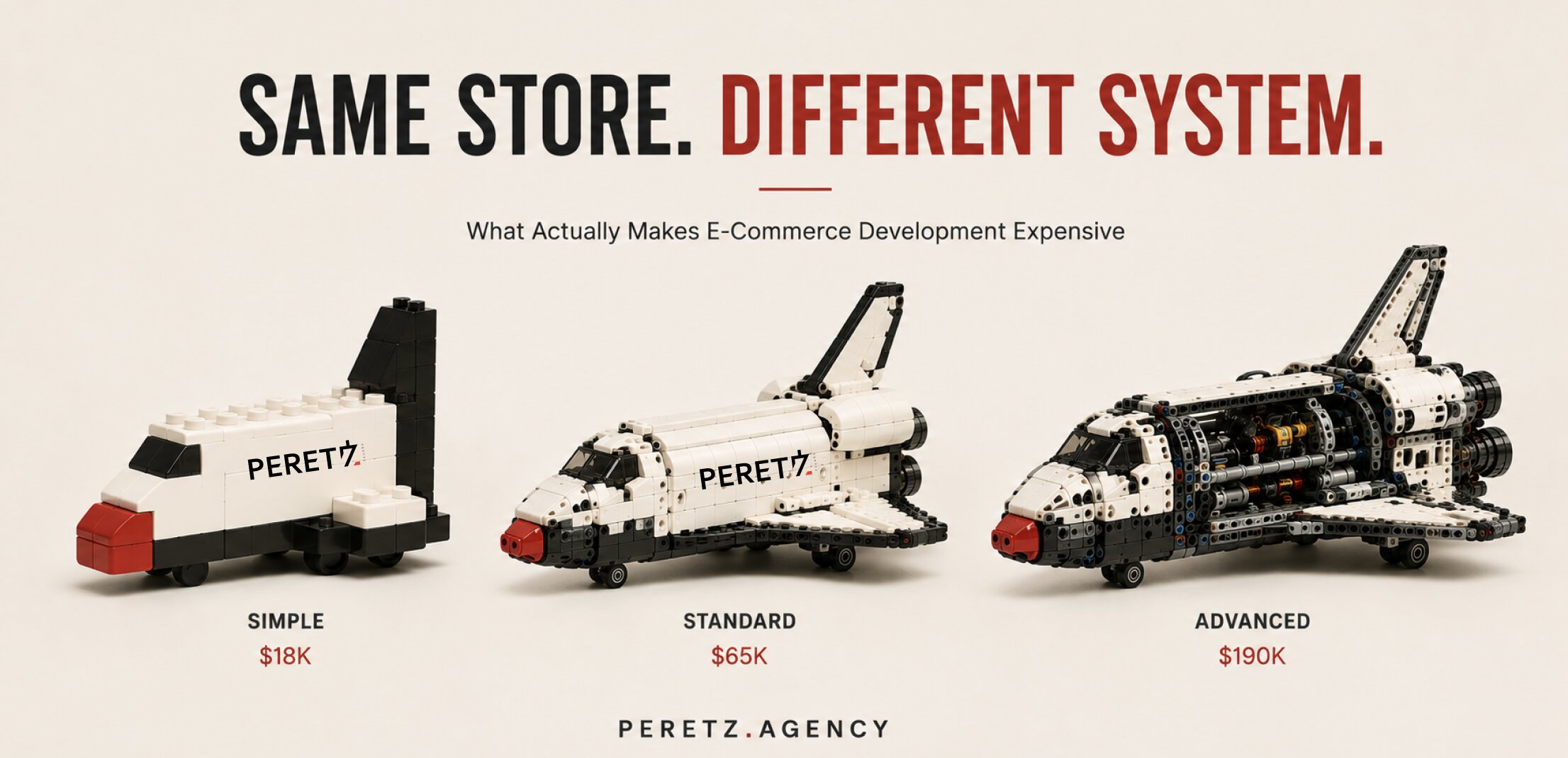
What replacing that platform actually costs is broken down in What Actually Makes E-Commerce Development Expensive.
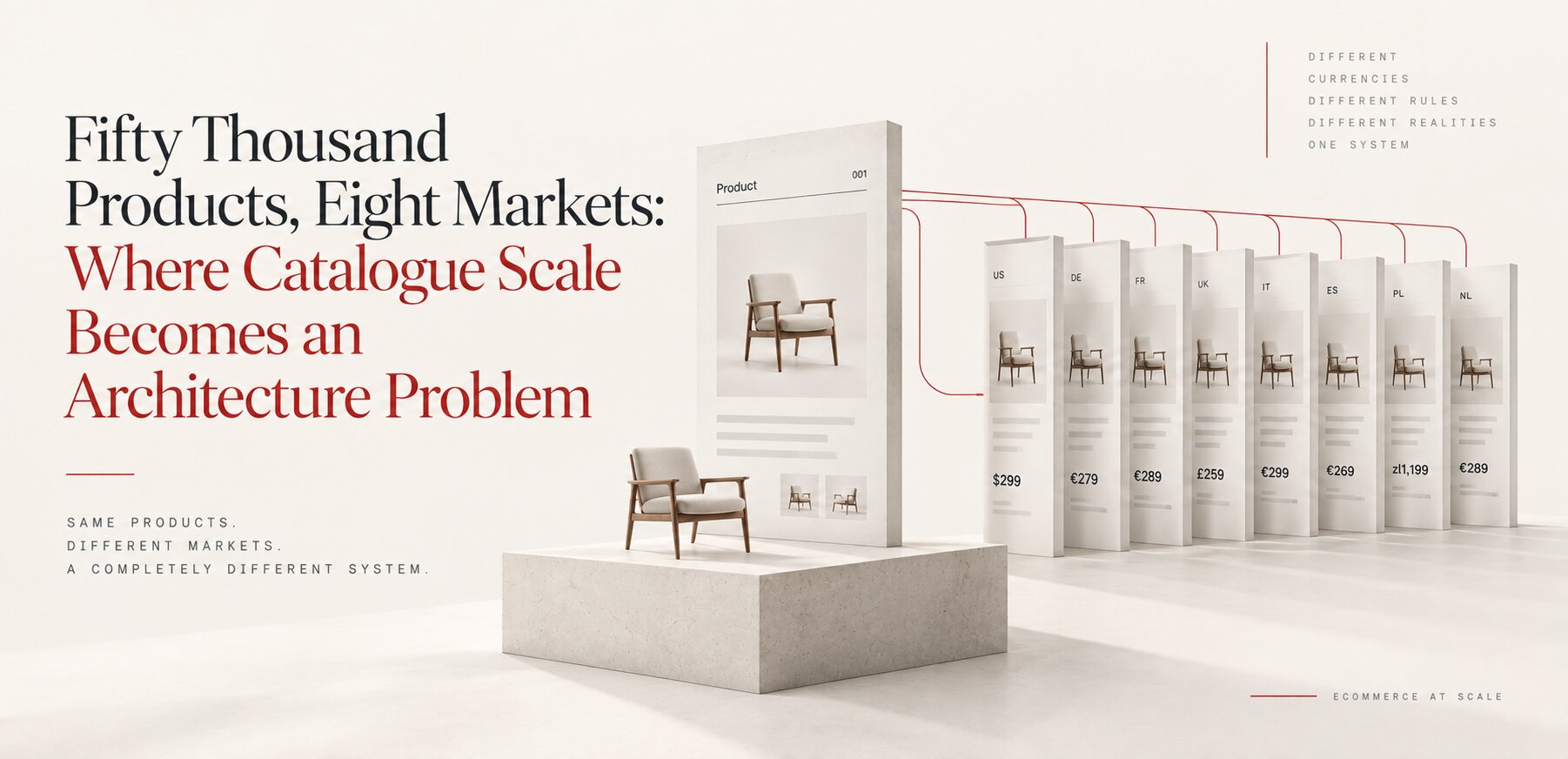
The same pressure at a larger catalogue and more markets is examined in Fifty Thousand Products, Eight Markets: Where Catalogue Scale Becomes an Architecture Problem.
The same pressure at a larger catalogue and more markets is examined in Multi-Country E-Commerce for Large Catalogues: The Architecture Decisions That Set the Ceiling.
If you are not sure whether your e-commerce platform is the real constraint, or something else is, a Strategic Session is built to answer exactly that question before anyone recommends a rebuild.
Explore E-commerce Development
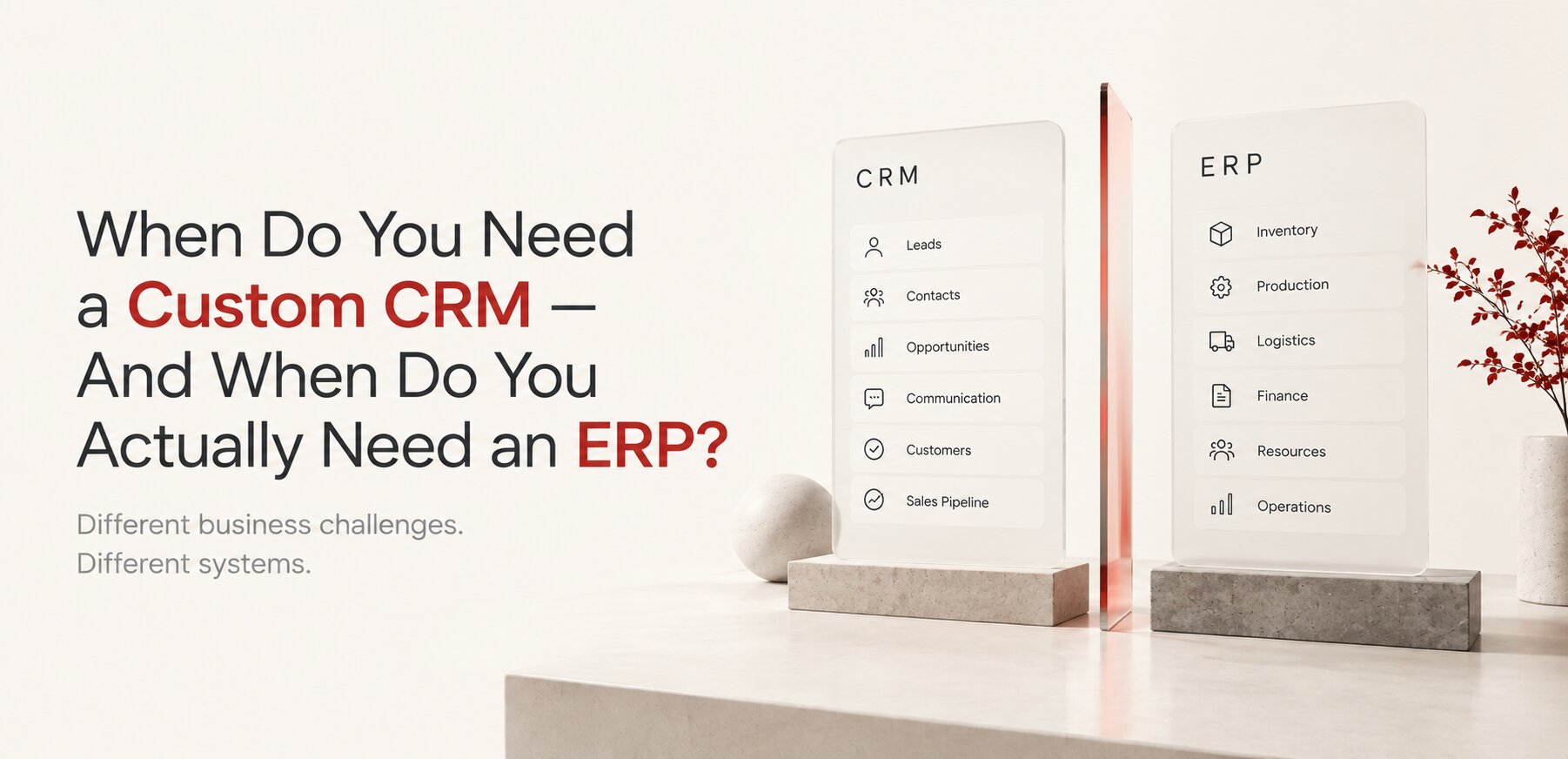
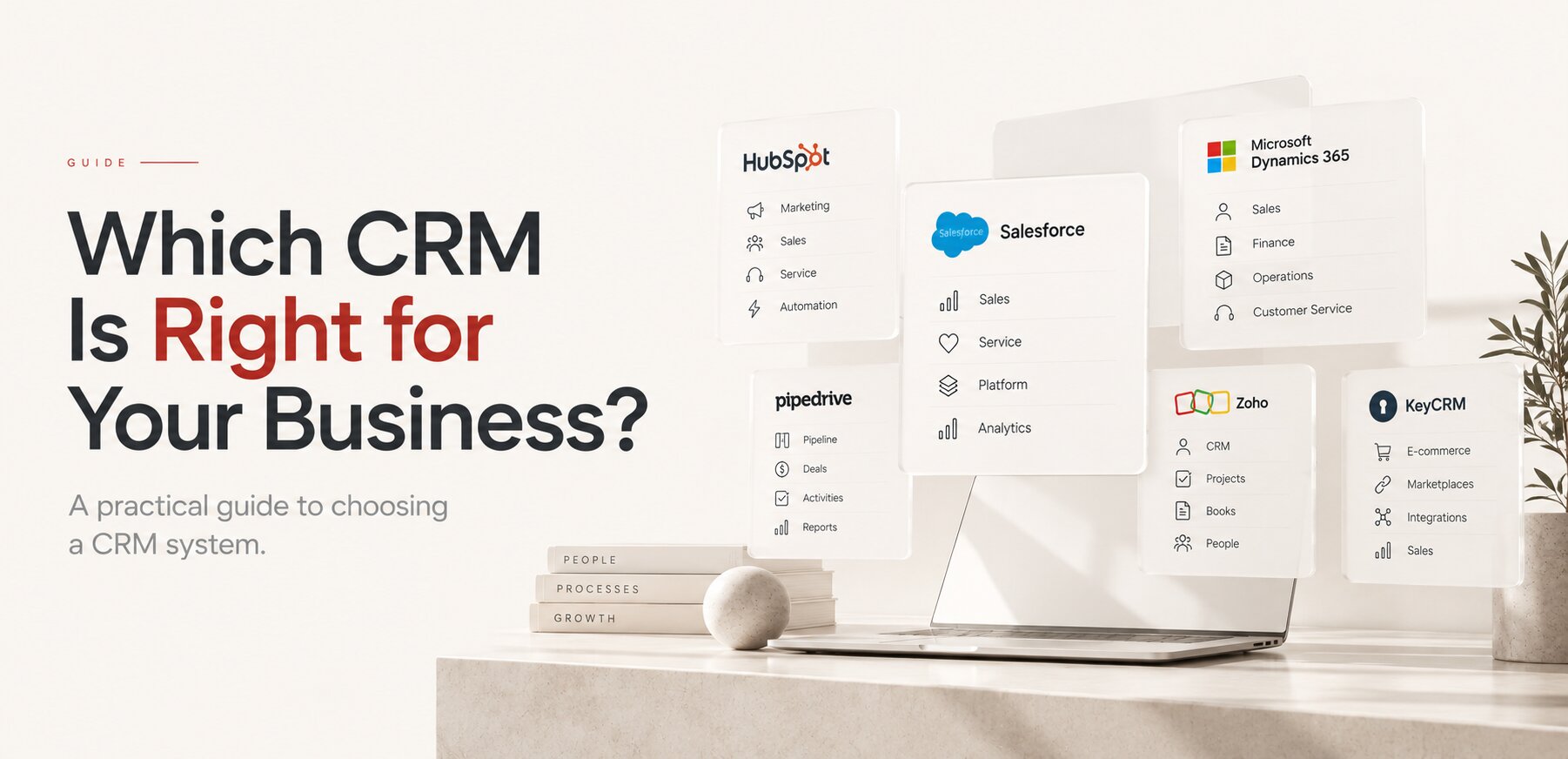
For jewelry and other order-heavy retailers, the platform constraint is often a CRM quietly turning into an ERP, see custom CRM vs ERP, and, if a standard platform is still the right call, which CRM actually fits. The same underlying pattern, systems accumulating without anyone designing how they relate, shows up repeatedly, including in every enterprise system started as someone's spreadsheet.
The same multichannel complexity is covered more broadly in when e-commerce becomes a business system.
- Share
-

-

-

-

Related Reading
-
12. 08. 2026

Why Luxury E-commerce Breaks Every Rule of Conversion Optimization

-
13. 08. 2026
What Happens to E-Commerce When a Website Stops Being a Website?
-
14. 08. 2026

How We Design E-Commerce: From Objects to Experience
-
20. 08. 2026

When a Brand Disappears, Is It Really Dead?
-
08. 08. 2026

Building the Next Century: PERETZ Begins the Digital Transformation of Schoeffel
-
28. 08. 2026
What Actually Makes E-Commerce Development Expensive
-
06. 09. 2026
Multi-Country E-Commerce for Large Catalogues: The Architecture Decisions That Set the Ceiling
-
10. 09. 2026
When Do You Need a Custom CRM, and When Do You Actually Need an ERP?
-
10. 09. 2026
Which CRM Is Right for Your Business? A Practical Guide to Choosing a CRM System
-
02. 08. 2026

Every Enterprise System Started as Someone's Spreadsheet
-
17. 09. 2026
When E-Commerce Becomes a Business System