
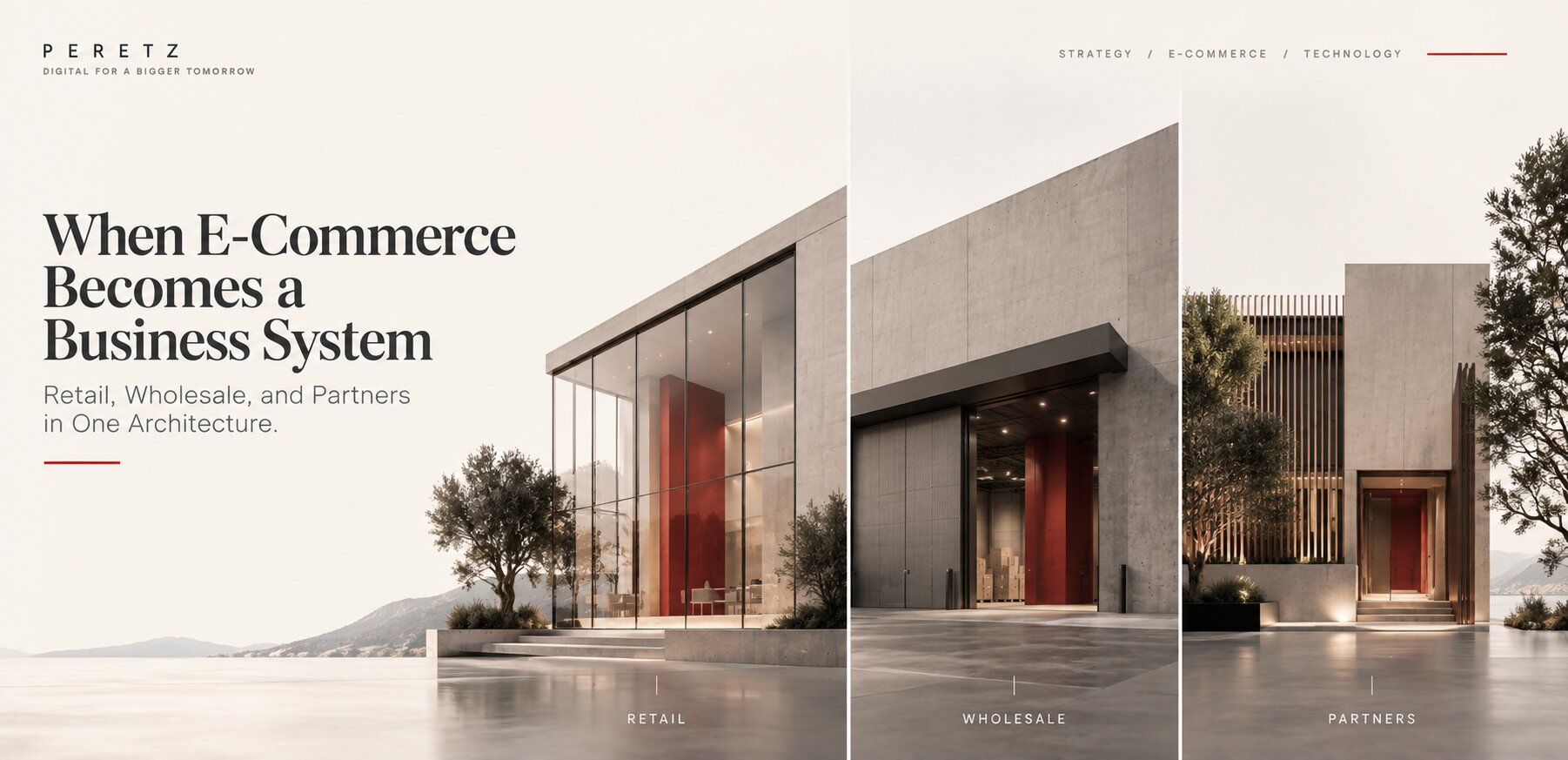
Retail, wholesale, and partner channels in one architecture.
The moment a single storefront starts serving retail customers, wholesale buyers, and dropshipping or reseller partners at once, it starts behaving like three businesses that happen to share a catalog. Most of the real engineering difficulty in that transition has nothing to do with adding a wholesale page or a partner login. It's in the parts nobody sees on the storefront: pricing logic, inventory allocation, order routing, and who the CRM actually thinks the customer is.
Adding a wholesale tier is not a feature. It's a second business model running through the same catalog, and it needs its own architecture, not a checkbox.
STOREFRONT NOT SYSTEM
The Storefront Is No Longer the System
Once multiple channels share customers, inventory, pricing, fulfillment, and data, the storefront becomes only one interface into a much larger operational system. Retail may have one interface. Wholesale may have another. Partners may never see the storefront at all. But underneath all three, the business still needs one version of the truth, one place where a price, a stock level, and a customer record mean the same thing regardless of which channel is asking. That's the point where e-commerce stops being a website problem and becomes an architecture problem.
THREE TRANSACTION MODELS
Three Channels, Three Transaction Models
A retail customer buys one unit at list price and expects same-day confirmation. A wholesale buyer orders in bulk, at a negotiated or tiered price, often on payment terms rather than immediate card payment, and expects a completely different relationship with the business. A dropshipping or reseller partner never touches the product at all, they need real-time inventory visibility, their own pricing, and an order flow that routes fulfillment somewhere other than the business's own warehouse. These aren't three variations of the same checkout. They're three different transaction models, and treating them as one flow with a few conditional fields is where most multichannel builds start accumulating debt on day one.
The natural instinct is to bolt a wholesale section onto an existing retail store, a separate page, a minimum order quantity field, a password-protected catalog view. That solves the visible problem and creates three invisible ones. The pricing engine now needs to know which price applies to which visitor, not just which price is on the product. The inventory system needs to reserve or allocate stock differently depending on which channel is drawing from it. And the order management system needs to route fulfillment differently, ship from the warehouse for retail, generate a purchase order for a dropship partner's supplier, apply net-30 terms for a wholesale account, all from what looks like the same "place order" button to a customer.
PRICING ACCOUNT LOGIC
Pricing Is Account Logic, Not a Discount
Retail pricing is usually one number, sometimes with a sale price layered on top. Wholesale pricing is rarely one number at all, it's frequently tiered by volume, sometimes negotiated per account, occasionally different by product category or season. A dropship or reseller partner might work on a fixed margin structure entirely separate from both. The real question a pricing system has to answer isn't "what's the discount," it's "given this account, this channel, this quantity, this product, and these commercial terms, what price and what permissions apply right now." Treating wholesale pricing as "retail price minus a percentage" works until the first wholesale customer negotiates a custom rate, or a specific product line needs a different margin than the rest of the catalog, at which point a percentage-based rule quietly becomes a genuine account-level pricing system, a materially different piece of architecture than a coupon code.
INVENTORY ALLOCATION
Inventory Is an Allocation Model, Not a Number
A single stock number works when there's a single channel drawing from it. The moment retail, wholesale, and a dropship partner are all selling from the same physical inventory, a single number stops being enough, because the business needs to represent physical stock, reserved stock, available-to-retail, available-to-wholesale, and partner availability as related but distinct figures, not one shared count everyone draws from blindly. Businesses that skip this step discover it the expensive way, when a wholesale order for one hundred units succeeds against inventory that retail had already sold twice over that same afternoon, or a partner's storefront shows stock that vanished hours earlier.
ORDERS DIFFERENT SHAPES
Orders Need Different Shapes
| Channel | Typical fulfillment path | Typical payment pattern |
|---|---|---|
| Retail | Ship from the business's own warehouse | Immediate card or wallet payment |
| Wholesale | Bulk shipment, sometimes on a schedule | Invoiced, often net-30 or net-60 terms |
| Dropship / Reseller | Order routed to a supplier or the reseller's own fulfillment | Varies, often margin-based settlement, not a direct customer charge |
Each row in that table is effectively a different order type, and a system that only has one concept of "an order" will keep forcing all three into the same shape until something breaks, usually a wholesale invoice with no way to represent payment terms, or a dropship order with no field for which partner it belongs to.
CUSTOMER NOT JUST LOGIN
The Customer Is No Longer Just a Login
Once multiple channels exist, the account model has to represent something more complex than one person with one email address. A retail account is usually still a straightforward person-to-account relationship. A wholesale account is often a company, with multiple users who share a credit line and commercial terms that belong to the account, not any individual buyer within it. A reseller or partner account adds another layer, a partner entity with its own users, its own pricing agreement, and its own fulfillment relationship with the business. The real question underneath all of it, and the one worth asking before any of it gets built, is simple to state and easy to get wrong: what exactly is "the customer" in this system, and does the answer change by channel. This is exactly the pattern covered from the systems side in custom CRM vs ERP, once e-commerce spans multiple channels, the CRM and the storefront have to agree on a shared, consistent model of what an account actually is, or the business ends up with three incompatible definitions of "customer" living in three different places.
ONE CATALOG MANY FACES
One Catalog, Many Faces
The product catalog itself usually needs to stay singular, one source of truth for what exists, its specifications, its media, while the presentation layer varies sharply by channel. Retail wants rich imagery, marketing copy, and a browsing experience built for discovery. Wholesale often wants a dense, spec-first, searchable catalog built for someone who already knows exactly what they need to order. A dropship partner typically wants a clean data feed, not a page at all, structured product data they can pull into their own storefront. Building three separate catalogs to serve these differently is expensive and creates drift the moment a price or spec changes in one and not the others.
The catalog should have one source of truth and many faces, not many sources of truth wearing the same logo.
PARTNER LAYER PRODUCT
The Partner Layer Is Its Own Product
A dropship or reseller partner interacts with the business through an interface that deserves the same design attention as the retail storefront, even though it's rarely customer-facing in the traditional sense. What does a partner actually need: real-time stock visibility so they don't sell what isn't available, their specific pricing without needing to ask, order status they can check without emailing support, and a data feed reliable enough that their own site doesn't quietly go stale. Treating this layer as a lightweight afterthought, "we'll just email them a spreadsheet," works for exactly as long as the business has one or two partners, and turns into a genuine operational liability the moment there are ten.
WHEN SOMETHING GOES WRONG
What Happens When Something Goes Wrong
Exceptions are where immature multichannel architecture becomes visible faster than anywhere else. A retail return is usually simple, refund the card, restock the item. A wholesale return is rarely that clean, it might be a partial return against a larger order, a credit applied to a future invoice rather than an immediate refund, or a negotiated restocking fee that a retail return flow has no concept of at all. A dropship dispute is different again, the business may never have physically held the product, so the return has to route through the original supplier, and the reseller sits in the middle of a conversation the storefront's return logic was never built to represent. A system designed only around the clean retail case usually has no real answer for any of this, and exceptions have a way of surfacing exactly when the business can least afford to solve them manually.
ONE SYSTEM MULTIPLE INTERFACES
One System, Multiple Interfaces
CUSTOMER / PARTNER
↓
CHANNEL / INTERFACE
↓
COMMERCE LAYER
↓
PRICING · INVENTORY · ORDERS
↓
CRM / ERP / FULFILLMENT
↓
FINANCE / REPORTING
The interfaces at the top of that chain can, and often should, look completely different for each channel. The business logic underneath them should not be duplicated three times to match. This is exactly the discipline covered more broadly in digital architecture, retail, wholesale, and partner access are different views into one underlying system, sharing catalog truth, inventory truth, and order logic, with channel-specific behavior layered on top rather than rebuilt sideways for each one.
Revenue by channel is a related, often confused, problem worth naming directly here. Revenue by channel is not the same as profitability by channel, and if pricing, inventory, and fulfillment data live in three inconsistent systems, that comparison becomes a spreadsheet exercise built on numbers that were never designed to sit next to each other. A single system, even with different interfaces on top, is what makes that comparison possible at all.
WHAT BREAKS FIRST
What Breaks First
A common failure sequence looks like this. Pricing often breaks first, usually as a hand-maintained spreadsheet of exceptions nobody fully trusts. Inventory tends to break next, once two channels oversell the same stock in the same week. Order management often breaks third, when a wholesale invoice or a dropship order doesn't fit the shape the system expects and someone has to process it manually. And reporting tends to break last, and often stays broken longest, because by the time the business tries to compare true margin by channel, the data is already split across systems that were never designed to be compared against each other.
WHAT IT COSTS
What It Actually Costs, and Why
Multichannel e-commerce architecture costs meaningfully more than a single-channel store, and the honest reason isn't the visible storefront, it's everything described above: account-level pricing logic, channel-aware inventory allocation, an order system that can represent three genuinely different transaction types, and a CRM built to model real account relationships rather than individual logins. Businesses evaluating cost purely by comparing storefront features against a single-channel quote are usually comparing the wrong thing entirely. The storefront is the cheapest part of this system to build. What determines both the cost and the long-term stability is whether the business, and the team building it, correctly identify upfront that this is one system with three faces, not three stores that happen to sell the same products.
The Real Question
The question worth asking was never "how much does a wholesale website cost." It's "what changes in our business system when we add another channel," pricing, inventory, order handling, account structure, exceptions, and reporting all shift the moment a second or third channel enters the picture, whether or not anyone planned for it in advance. The second question changes what gets designed. The first mostly changes how the initial quote is framed. The cost of the system is largely determined before the storefront is ever designed.
What is the biggest architectural mistake in multichannel e-commerce?
Treating retail, wholesale, and partner operations as separate stores instead of different interfaces into one business system. That single framing decision determines almost everything else, pricing structure, inventory model, order handling, and how expensive the system becomes to maintain once it grows.
When does a storefront need CRM or ERP integration?
As soon as an account represents more than one person, a company with multiple users, shared commercial terms, or a partner relationship rather than an individual login. Most native e-commerce account systems were built around a single retail customer and don't model that complexity well on their own.
Do we need three separate websites for retail, wholesale, and partners?
Usually not, and building three separate storefronts typically creates more long-term maintenance cost than it saves upfront. A single system with channel-specific logic and presentation, sharing one catalog and one inventory truth, is generally more stable and considerably cheaper to maintain over time.
How is wholesale pricing actually different from a retail discount code?
A discount code applies the same percentage to any customer who has it. Wholesale pricing is usually account-specific, sometimes negotiated individually, and often tiered by volume or category, which requires a real pricing engine tied to customer accounts, not a coupon system layered on top of retail pricing.
How do returns and exceptions actually differ across channels?
A retail return is typically a refund and a restock. A wholesale return is often a partial credit against a future invoice rather than an immediate refund. A dropship dispute may never touch the business's own inventory at all and has to route through the original supplier. A return flow built only for retail usually has no real answer for the other two.
What's the first thing that usually breaks when a business adds a wholesale or dropship channel without planning for it?
Pricing, most often, followed shortly by inventory. A hand-maintained spreadsheet of wholesale exceptions works until it doesn't, and inventory conflicts between channels usually surface as an oversold order rather than a warning anyone saw coming.
Can wholesale or partner channels be added later without rebuilding the whole system?
Sometimes, if the original system was built with a real account model, allocation-based inventory, and flexible order handling from the start. If it was built as a single retail flow with no separation between those layers, adding a second channel later usually means rebuilding the parts that were never designed to be shared in the first place.
Not sure whether your current platform can actually support another channel, or where the real cost lives before you get a quote?
Explore E-Commerce Development
This same growth pattern shows up directly in why family-owned jewelry stores outgrow their platform, in the cost breakdown covered in what actually makes e-commerce development expensive, and along a different axis of complexity in multi-country e-commerce for large catalogues. A real example of retail, wholesale, and dropshipping running through one connected system is the Riccardo case.
- Share
-

-

-

-

Related Reading
-
10. 09. 2026
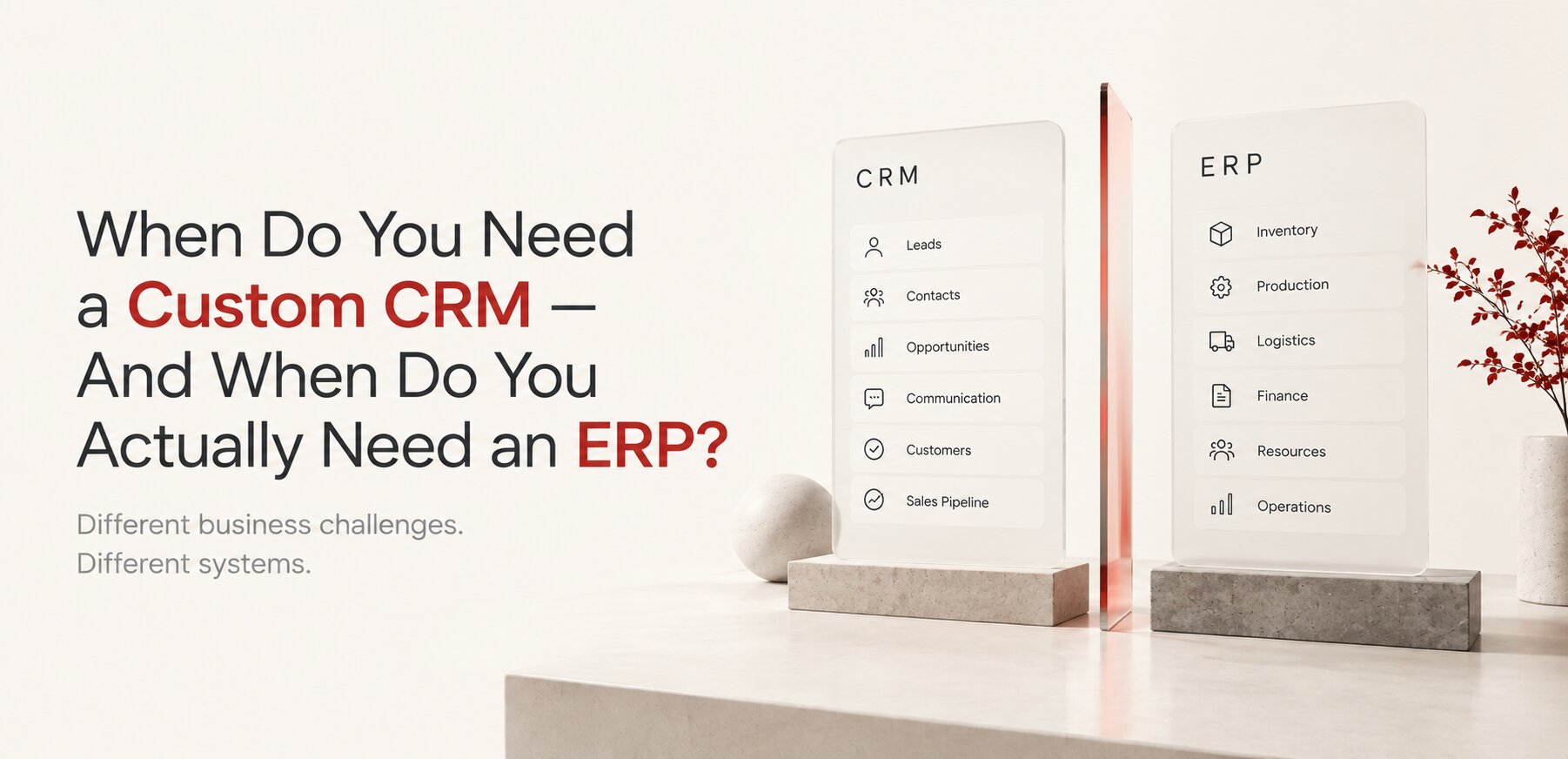
When Do You Need a Custom CRM, and When Do You Actually Need an ERP?

-
11. 09. 2026

Digital Architecture: How to Build a System That Can Grow With Your Business
-
16. 08. 2026
Why Family-Owned Jewelry Stores Outgrow Their E-commerce Platform
-
28. 08. 2026
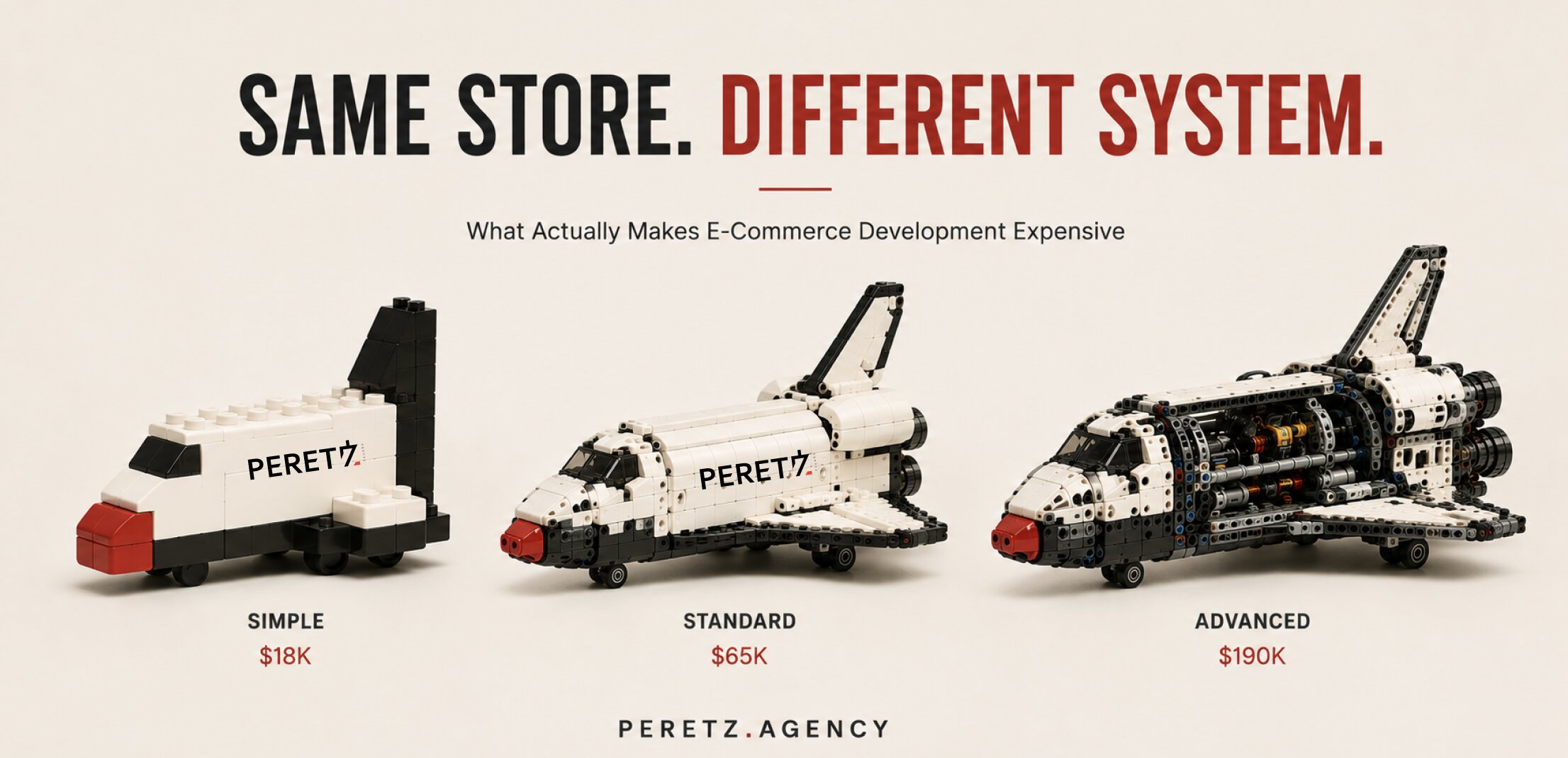
What Actually Makes E-Commerce Development Expensive
-
06. 09. 2026
Multi-Country E-Commerce for Large Catalogues: The Architecture Decisions That Set the Ceiling