Digital Architecture: How to Build a System That Can Grow With Your Business
When your website, CRM, ERP, and e-commerce become interconnected, you need more than a website. Here is how to build a system that can evolve.



A business rarely decides one morning to build a digital system. It happens gradually. First a website. Then a contact form. Then a CRM. Then online payments. Then an e-commerce store. Then inventory. Then marketing automation. Then a customer portal. Then another language, another country.
Then someone asks whether the website can pull data from the ERP. Someone asks why the CRM doesn't know what happened in the store. Someone asks why changing a product price requires updating three different systems.
Nothing seemed unreasonable when each decision was made. The problem appears later. The business has built a collection of digital tools, but nobody designed the system connecting them. That is the point where digital architecture starts to matter, not because the business suddenly needs a more sophisticated website, but because it has already outgrown the idea of a website as a standalone product.
The website is still there. It is no longer the system, it is one interface into the system.
WHERE IT STARTS
The Website Is Usually Where It Starts
Most businesses begin with a website because the website is visible. Customers see it, marketing sends traffic to it, executives can look at it. It feels like the obvious digital center, and at the beginning, it often is. A small business might genuinely need only website, contact form, email. That's a perfectly valid system.
The mistake is assuming that because the website was the beginning, it should remain the center of everything forever. As the business grows, the website starts becoming an interface to other systems. A customer sees a product, the website gets the product information from somewhere, the price comes from somewhere, inventory comes from somewhere, the order goes somewhere, the customer may exist somewhere else entirely.
TOOLS DEPEND
The Point Where Tools Stop Being Independent
A collection of independent tools is manageable while each tool can operate largely by itself. The situation changes when one system depends on information from another: a product changes in the ERP, the website needs the new price, the e-commerce system needs the new inventory, the analytics need to record the change, the CRM needs to know what the customer purchased, fulfillment needs the order. That's no longer five independent tools, it's a network, and the quality of that network determines how reliably the business operates.
I audited exactly this problem for a distribution client last year. Five systems, all individually well-built, none of them designed to talk to each other. Every price change required manually updating four places, and nobody could say with confidence which one was actually correct at any given moment. The tools weren't the problem. Nobody had ever designed the relationships between them.
When people hear "architecture," they often think about technology: Laravel, Shopify, AWS, MySQL. Those things matter, but they aren't architecture by themselves. Architecture is about relationships and boundaries: what owns the data, which system is the source of truth, how information moves, what happens when something fails, which parts are allowed to change without breaking everything else. The technology is how you implement the answers, not the answer itself.
SOURCE OF TRUTH
The Source of Truth Problem
One of the clearest signs a business has accumulated systems without architecture is duplicated truth. The product price exists in the ERP, in the website, in a spreadsheet, exported into a marketplace, manually changed in an email campaign. Now there are five prices. The answer can't be "the latest one."
A well-designed system decides where authoritative information lives: ERP for inventory and financial data, PIM for product information, CRM for customer relationships, e-commerce for orders and transactions, CMS for editorial content. The exact arrangement varies by business, the principle doesn't: every important piece of data needs a clear owner. Without that, synchronization becomes a permanent manual task, the exact trap covered in every enterprise system started as someone's spreadsheet.
ARCHITECTURE FIRST
Architecture Before Integration, and Why APIs Aren't the Answer
One of the most common mistakes is treating integrations as isolated projects. "Connect the website to the CRM." Done. "Now connect the ERP." Done. "Now the warehouse." "Now the marketing platform." Eventually the architecture looks less like a system and more like a pile of cables, every service knows about every other service, and a small change becomes dangerous. Replacing the CRM means touching the website. Changing inventory means touching checkout. The objective was never "connect everything to everything," it should always have been "create deliberate boundaries between systems."
APIs get treated as the solution to everything, but an API only lets two systems talk, it doesn't tell you which system owns the information, what the data means, when it should sync, what happens when sync fails, or which system has priority. Two systems can have beautifully documented APIs and still have terrible architecture. The hard part isn't making systems talk, it's deciding what they should say to each other.
BUSINESS DOMAINS
Build Around Business Domains
A growing digital system becomes easier to manage when its structure reflects how the business itself works. An e-commerce company might have distinct domains: catalog (products, variants, categories), inventory (stock, locations, availability), commerce (cart, checkout, payments), customer (accounts, relationships), marketing (campaigns, attribution), content (editorial, guides), operations (fulfillment, shipping). These areas interact, but they don't have to become one giant block of code, they can have clear boundaries.
We saw this play out directly with Nico Juliany, a Spanish jewelry house. The catalog domain (products, variants, pricing) and the brand experience domain (collections, concept, storytelling) needed to stay genuinely separate, a customer could enter through either path, catalog first or story first, but neither domain could quietly depend on the other's internal structure. That separation is what let the brand experience evolve creatively without ever risking the product data underneath it.
That matters because businesses change unevenly. Marketing workflow might change every month, inventory might stay stable for years, checkout evolves slowly, content strategy might change completely. Good architecture lets these areas evolve at different speeds instead of forcing every change to touch everything.
SAME FOR CRM
The Same Principle Applies to CRM
A CRM is not simply a database of contacts, it represents a business process. A lead arrives, someone qualifies it, an opportunity moves through stages, a sale happens, the relationship continues. Connect that CRM to the website and the website generates the lead. Connect it to e-commerce and the purchase becomes part of the customer record. Connect it to support and the team sees the full history. At some point the CRM stops being a separate tool and becomes part of the company's digital operating model.
That's why the question isn't always "which CRM should we buy," it's often "what role should CRM play inside the larger architecture." That distinction matters even more when deciding between an off-the-shelf CRM and a custom one, which is exactly what we cover in custom CRM vs ERP and, for choosing between standard platforms specifically, in which CRM is right for your business.
| Layer | What lives here |
|---|---|
| Customer experience | Website, app, portal |
| Application layer | Business logic, workflows, permissions |
| Domain systems | Commerce, CRM, content, inventory |
| Data and integrations | ERP, APIs, payments, analytics |
| Infrastructure | Hosting, database, queues, storage, monitoring |
The customer only ever sees the top layer. Most of the business value gets generated by everything underneath it, which is why rebuilding the frontend alone often doesn't solve a company's real digital problems. The interface can look completely different while the system underneath remains exactly as difficult to work with as before. A redesign changes what customers see. Architecture changes what the business is actually capable of doing.
E-COMMERCE SCALES
E-Commerce Becomes a System Faster Than Most Businesses Expect
A basic store can be simple: catalog, cart, checkout. A growing business rarely stays there. Soon there's variants, pricing rules, inventory sync, shipping logic, tax handling, promotions, returns, connections to ERP and CRM, marketplace feeds, search, content. The store is now part of the business infrastructure, not a standalone product. This is exactly why the gap between a simple online store and a custom e-commerce system is so large, the first sells products, the second becomes how the company actually operates. We go deeper into what specifically drives that cost jump in e-commerce development.
A jewelry retailer we worked with hit this wall almost immediately after launch. A single order for a custom piece needed to trigger inventory checks across multiple suppliers, update a CRM record, notify a workshop, and eventually sync with accounting, none of which the original "simple store" was ever built to do. The store itself hadn't failed, it had just never been architected to be part of a system.
CONTENT + LANGUAGE
Content, Multilingual, and Why Both Are Architecture Problems
Content is often treated as the least technical part of a digital business. It shouldn't be. Product content, editorial content, support documentation, case studies, service descriptions, structured data, all of these increasingly reference each other: a product page links to a guide, the guide references a product, the product belongs to a category that exists in several languages. Search engines and AI systems need to understand those relationships, which makes content architecture part of the same discipline as everything else, not a separate writing problem.
Schoeffel, a heritage pearl jewelry house, is a real example of what happens when content architecture is treated seriously from the start. A century of brand heritage, editorial storytelling, and product content all needed to exist coherently across multiple languages and markets, without the heritage content and the commerce content quietly fighting each other for the same page real estate. Getting that right mattered more to the final result than any single design decision.
Multilingual systems make this obvious fast. The naive model is "English page, translate, publish." Real businesses quickly discover different markets need different products, currencies, tax rules, terminology, and customer journeys. AI makes translation faster, it doesn't remove the need for human review, and good internationalization was never "translate everything," it's designing the system so different markets can evolve without breaking the underlying product.
A redesign changes what customers see. Architecture changes what the business is capable of doing.
ANTICIPATE CHANGE
Architecture Should Anticipate Change, Not Predict the Future
Good architecture doesn't mean predicting everything a business will ever need, that's impossible. The goal is different: make reasonable change easier. If the company might enter new markets, localization shouldn't be an afterthought. If e-commerce might grow, the product model should support it. If the CRM might change, integrations shouldn't be welded into every page.
At launch, almost any architecture looks successful. Then eighteen months later: "Can we add a new region?" "Can we replace the CRM?" "Can we introduce B2B pricing?" And the answer becomes "yes, but," which is technical debt quietly becoming business debt. The original developers weren't incompetent, the system was simply optimized for the business as it existed on launch day, not the business it became.
A useful way to evaluate any digital system is to stop asking "does it work" and start asking "how does it change." Can you swap the CRM? Add a payment provider? Add a language? Introduce a new product type? The answers reveal far more about architecture quality than any demo does.
An acquisition is the most abrupt version of such a change: two digital systems built for different businesses suddenly have to work as one. What that means for the website, the CRM and customer accounts is described in What Happens to the Website After an Acquisition?
AVOID ONE MONOLITH
Don't Build One Giant System Either
Once a business realizes everything is connected, the reaction can swing too far the other way: "let's put everything into one giant custom platform." That's just as dangerous. Some capabilities should remain separate, some systems are genuinely better purchased than rebuilt, some business logic is genuinely unique. The real question isn't "build everything ourselves," it's "where does owning the architecture create meaningful business value."
For every component, there are usually several real options: buy an existing platform, configure it to fit, integrate several specialized systems, build custom where requirements are genuinely unique, or combine approaches across different parts of the ecosystem. The mature answer is rarely "custom everything," and it's rarely "SaaS everything" either. Commodity where commodity is enough, custom where differentiation actually matters, the exact logic behind the build vs. buy equation.
WHERE AI FITS
Where AI Actually Fits
AI introduces another architectural layer. A business may eventually use it for content, support, recommendations, search, lead qualification, internal knowledge, even software development itself. But an AI feature still needs access to data, permissions, context, boundaries, and monitoring, it needs a real place in the existing workflow. Adding AI to an existing system isn't "let's connect an API," the deeper question is what role AI should actually play in the business process and what information it's allowed to use. AI makes execution easier, it doesn't make systems coherent automatically.
OBSERVE + DOCUMENT
Observability and Documentation Are Part of Architecture Too
A growing system needs to tell you when something goes wrong, a failed payment, a broken integration, a queue that stops processing, before the business finds out from a customer complaint. Logging, monitoring, and alerting belong to the architecture for the same reason documentation does: a system you can't observe is a system you can't reliably operate, and a system that only exists in the heads of the people who built it doesn't survive the developer leaving, the agency changing, or a new CTO arriving.
Architecture also reflects organizational reality more than people expect. If five departments use the same customer data, the system needs to reflect that. If nobody agrees who owns product information, no database design fixes the underlying organizational problem. Software can clarify a process, it can't make an unclear organization coherent by magic, which is exactly why that work has to start with strategy, before "Laravel or Symfony," before "Shopify or custom," before any technology decision at all.
THE REAL TEST
The Test We Actually Use
There's a simple mental model worth applying to any digital system: imagine the business changes significantly tomorrow, a new market, a new CRM, a new product category, a new integration. Then ask, does the architecture absorb the change, or does the change fight the architecture? The answer is usually more revealing than any technology comparison, and it captures what technical debt quietly becomes: competitive debt. Not just difficult software, software that limits the business's ability to compete.
Quick Diagnostic
| What you're seeing | What it actually means |
|---|---|
| Changing a price means updating three systems | No clear source of truth |
| Replacing one vendor means touching five other systems | No real boundaries, integration without architecture |
| A new market takes months to launch | Localization was never built into the architecture |
| Nobody can explain why the system works the way it does | Missing documentation, tribal knowledge only |
| Every new feature request becomes a multi-team project | Domains were never separated in the first place |
| The system works today but nobody wants to change anything | Technical debt has already become business debt |
This doesn't mean building the five-year architecture on day one, that's often just as wasteful as ignoring the future completely. The actual goal is building today's system with tomorrow's reasonable changes in mind, without speculative complexity, without ignoring obvious growth, without custom-building things the business doesn't actually differentiate on.
A well-designed digital ecosystem rarely impresses customers directly. They just see that the business works.
The Practical Question
So when should a business actually start thinking about digital architecture? Not at a certain employee count, not at a certain revenue figure. Start when the systems supporting the business begin depending on one another: when the website needs the CRM, when the CRM needs the website, when the e-commerce system needs the ERP, when changing one thing unexpectedly affects five others. That's the moment a business is already dealing with a digital architecture. The only real question is whether it was designed deliberately.
At Peretz, we don't believe every business needs a custom platform, and we don't believe every company should replace its existing tools. We start with the business: what exists today, where does it break, which capabilities are strategic, which technologies are interchangeable, what should be bought, integrated, or built. Only after that does the architecture become clear, which is exactly why we run a Strategic Session as a separate step before any technology gets chosen.
A website answers how a business presents itself online. A digital system answers how the business operates through technology. Digital architecture answers the question in between: how should those components work together so the business can keep changing. Good architecture doesn't predict the future. It makes the future cheaper to build.
FAQ
Frequently Asked Questions
How is digital architecture different from just having a good CRM and website?
A CRM and a website are individual systems. Architecture is the design of how they, and everything else the business runs on, relate to each other, who owns what data, and what happens when one of them changes. You can have excellent individual tools and still have no real architecture connecting them.
Do we need to redesign everything to fix bad architecture?
Rarely. The better approach is usually understanding what already exists, identifying where the boundaries are actually broken, and gradually creating coherence around the business, not rebuilding everything at once. That's almost always less disruptive and less expensive.
At what size of business does this actually start to matter?
Size and revenue are weak signals. The real trigger is dependency: the moment one system starts needing information from another on a regular basis, you already have an architecture question, whether or not anyone has named it yet.
Does adopting AI change how we should think about architecture?
It raises the stakes rather than changing the fundamentals. AI needs clean data, clear permissions, and a defined role in the workflow to be genuinely useful, all things a coherent architecture already provides and a disconnected pile of tools does not.
Not sure whether your business needs a full architecture rethink, or just better boundaries between what already exists? We start by understanding the system you actually have.
Depending on where the architecture actually breaks, that can mean:
Corporate Website Development, when the website itself needs to become the right foundation.
Custom CRM Development, when the CRM is the piece that needs to fit the business instead of the other way around.
E-Commerce Development, when the store has already become more than a store.
Laravel Development, when the custom logic underneath everything needs a real technical foundation.
Business Digitalization, when the manual work between systems is the actual bottleneck.
Digital Ownership & Debt Audit, when you need to know exactly how much technical debt you're carrying before deciding what to fix.
Technical Due Diligence, when you're acquiring, investing in, or inheriting a system you didn't build.
Once the system is architected, the next question is often who defines what it should actually enable people to do, see Product Design vs UX/UI.
Before any of this gets designed, someone has to validate whether the assumed problem is even real, see Product Discovery.
See this exact pattern in a real business in the Riccardo case, an outerwear manufacturer running retail, wholesale, and dropshipping through one connected system.
Architecture and ownership are two sides of the same question, see the digital ownership audit.
This same principle applies directly to AI visibility, see multilingual AEO for how translation and true internationalization diverge in practice.
A mobile app raises the same architecture question in a mobile-specific form, see when does a business actually need a mobile app.
Automotive is one of the most demanding real-world versions of this same architecture, see automotive digital systems, from catalog to lifecycle.
See the fuller architecture thesis, with real cases, in the software should fit the business.
- Share
-

-

-

-

One notification a week with the new PERETZ articles. Nothing else.
Related Reading
-
10. 09. 2026
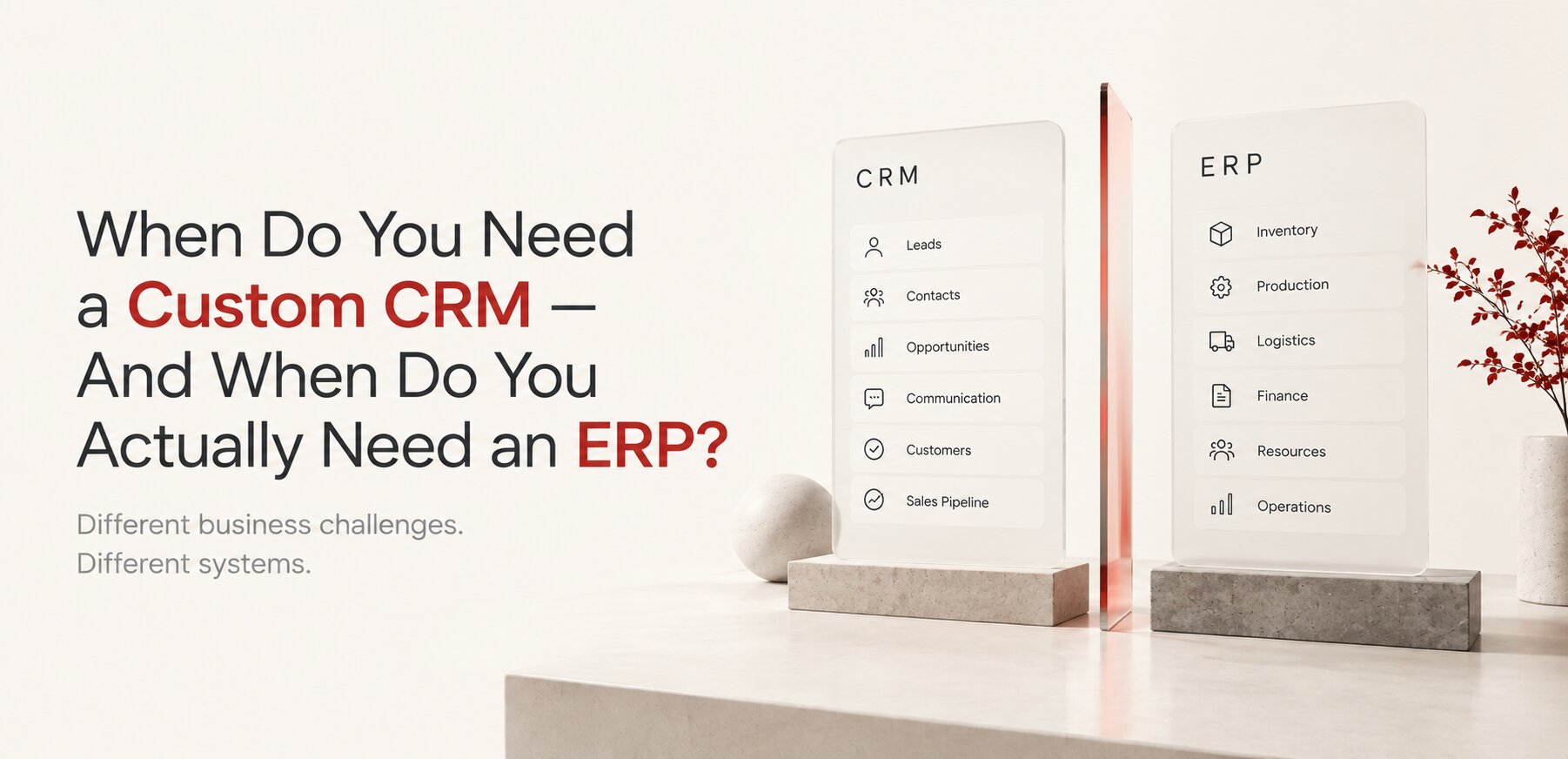
Custom CRM or ERP? The Difference, and When You Need Each

-
10. 09. 2026
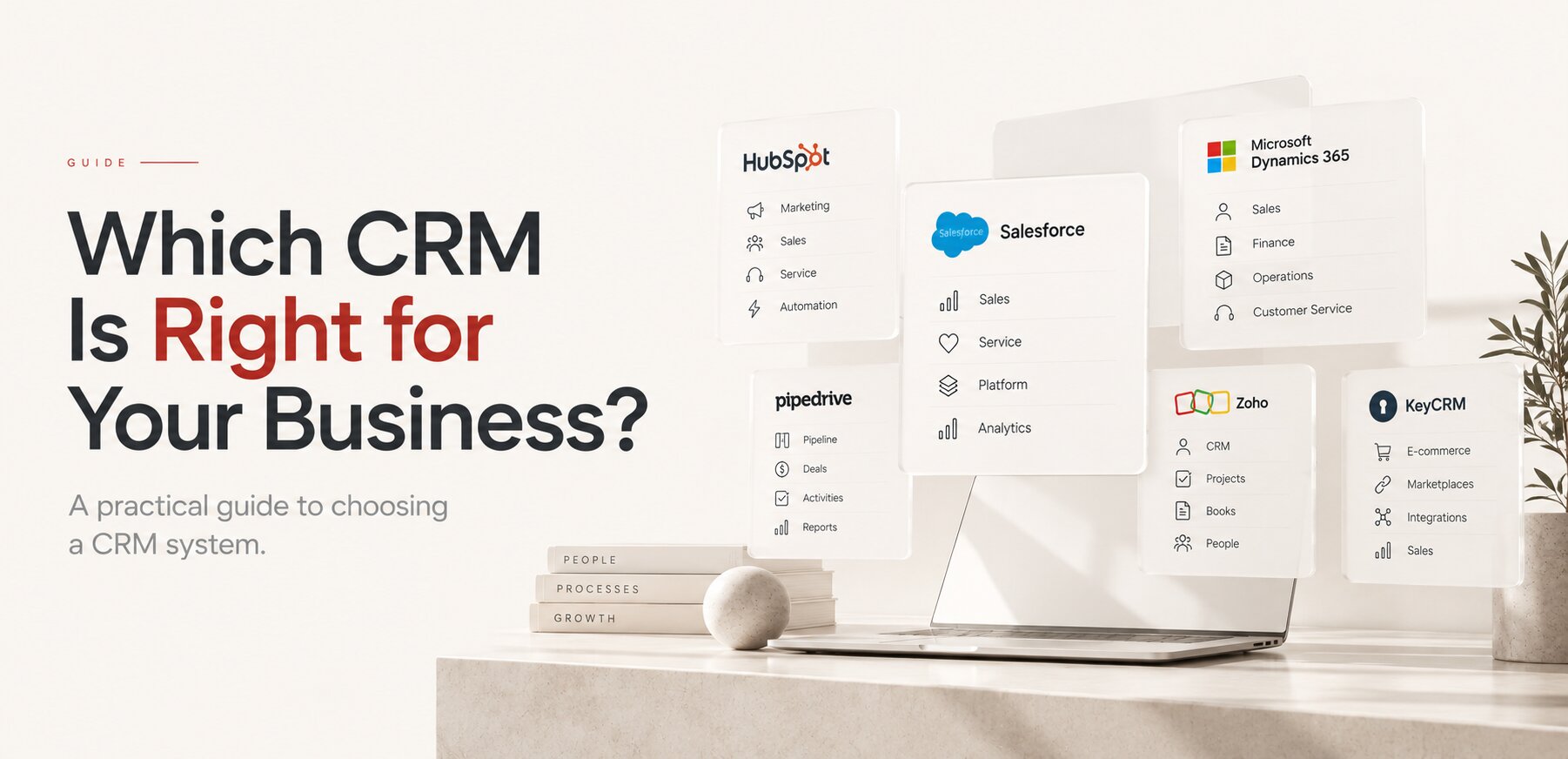
Which CRM Is Right for Your Business? A Practical Guide to Choosing a CRM System
-
17. 07. 2026
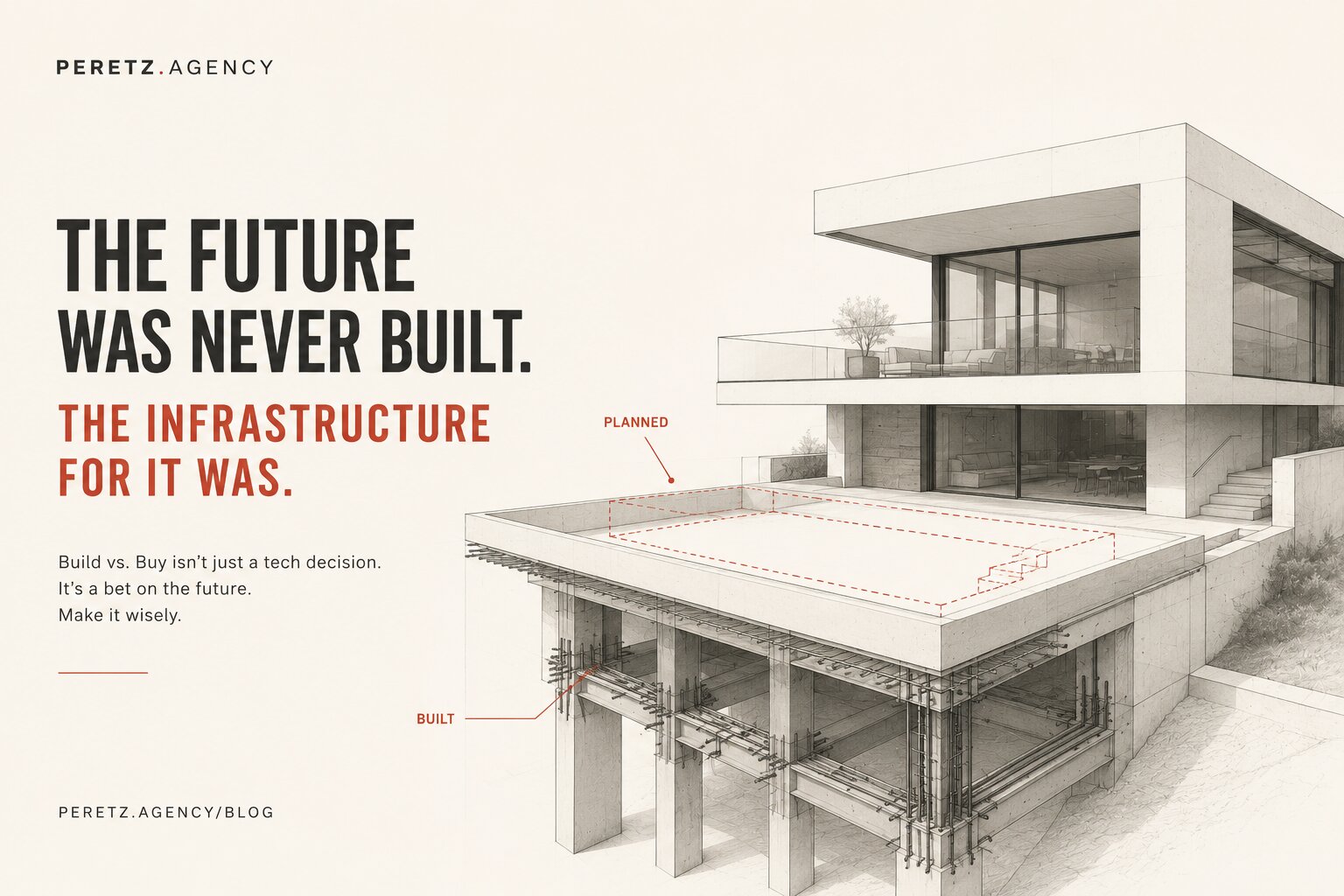
The Build vs. Buy Equation Has Changed. Most Companies Have Not Recalculated It.
-
02. 08. 2026

Every Enterprise System Started as Someone's Spreadsheet
-
23. 08. 2026

Custom Website vs Website Builder: What Should a Business Choose?
-
23. 08. 2026

When Does a Business Outgrow WordPress?
-
19. 06. 2026
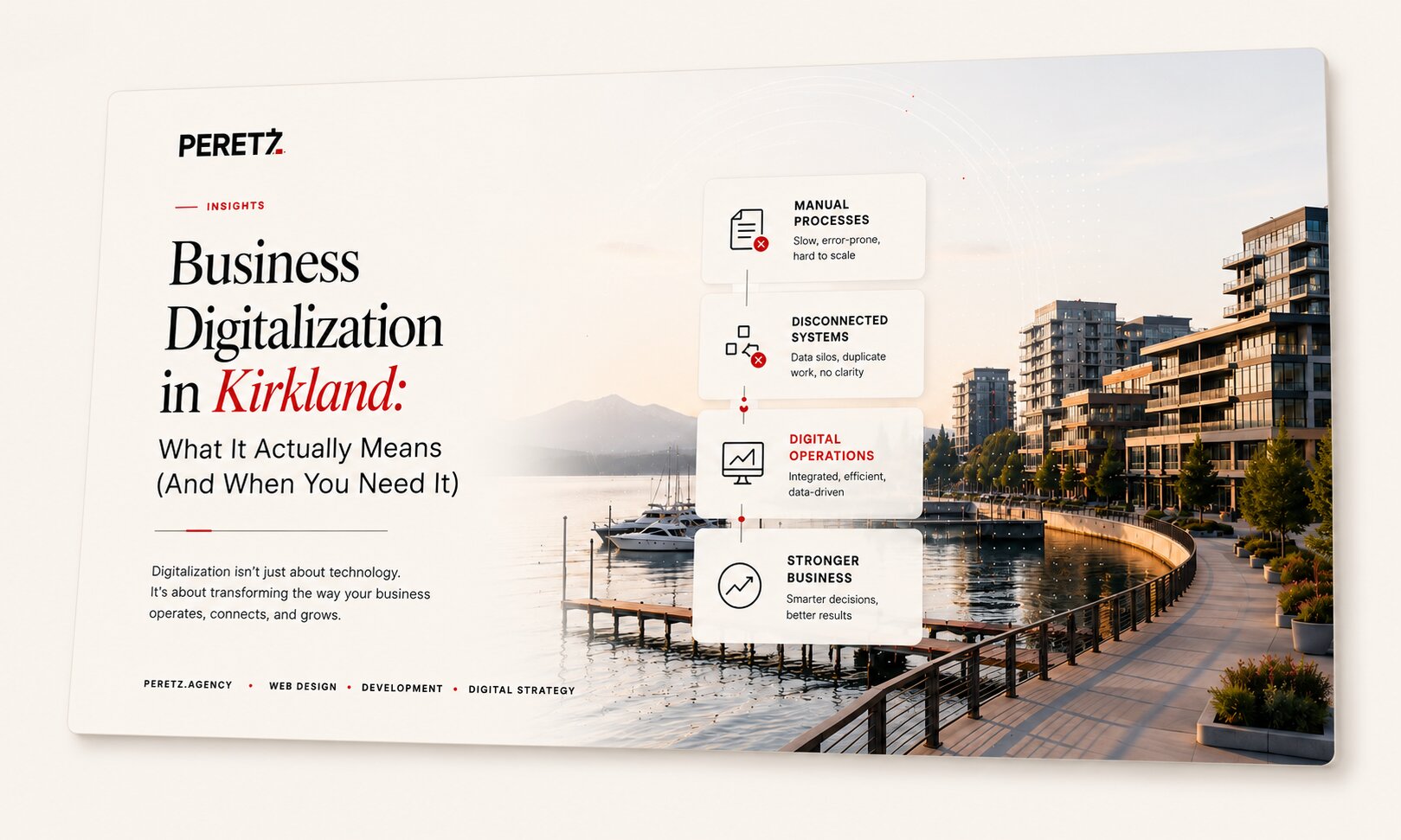
Business Process Automation in Kirkland: What Digitalization Actually Means (And When You Need It)
-
12. 09. 2026

Product Design vs UX/UI: Where Does a Digital Product Actually Begin?
-
12. 09. 2026

Product Discovery: What Should You Know Before You Start Designing?
-
16. 09. 2026

What You Own vs What You're Renting: The Digital Ownership Audit
-
16. 09. 2026

Multilingual AEO: Why Translation Isn't Enough for AI Search
-
17. 09. 2026

When Does a Business Actually Need a Mobile App?
-
17. 09. 2026

When E-Commerce Becomes a Business System
-
18. 09. 2026

The Customer Sees a Car Catalog. The Business Runs a Lifecycle System.
-
21. 09. 2026
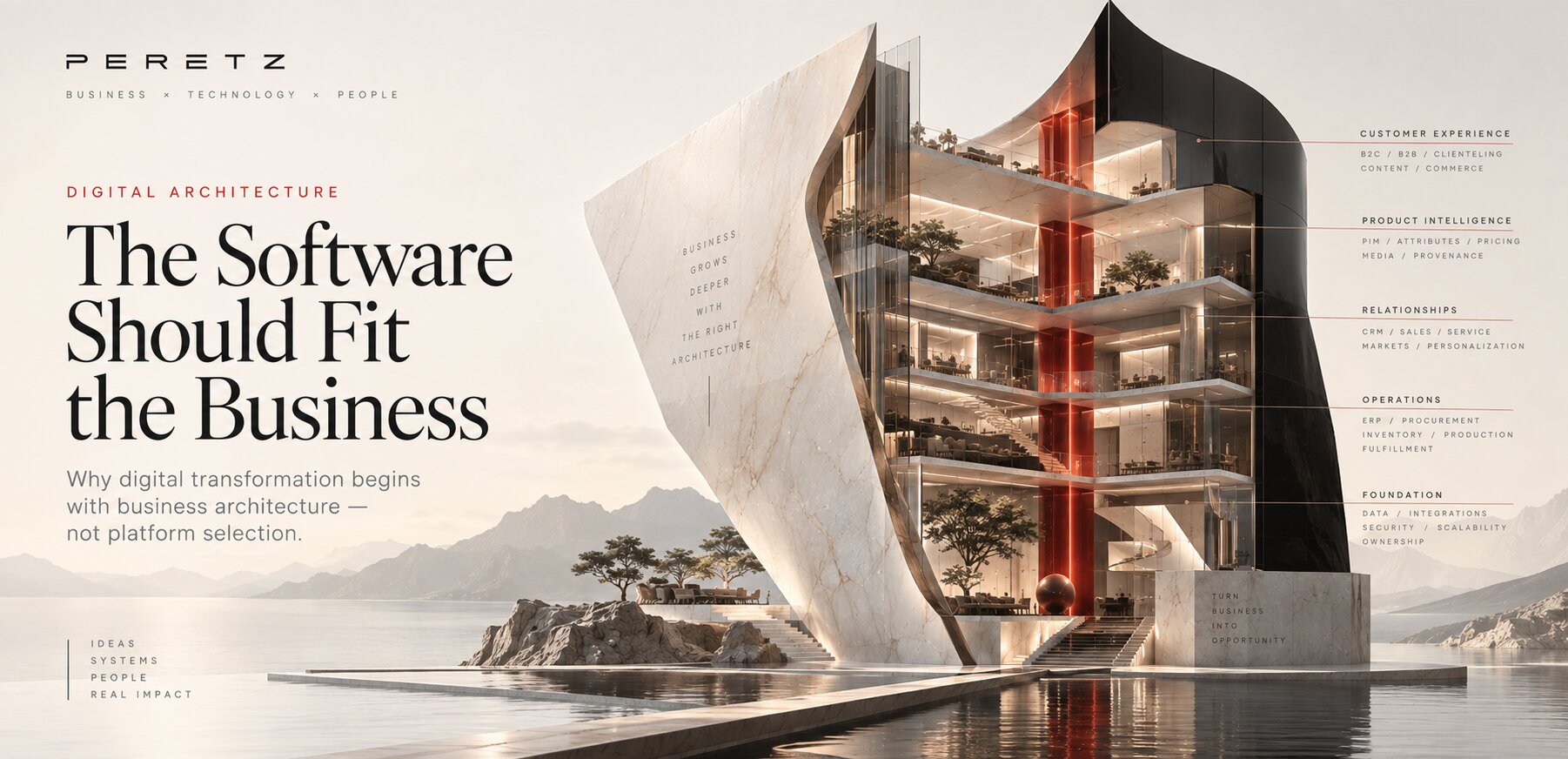
The Software Should Fit the Business