Multilingual SEO: Why Translated Pages Do Not Rank in Their Own Markets
A market is not a language. Why hreflang, canonical logic and domain architecture decide whether translated pages ever reach the markets they were written for.


One business entering several markets, not one site translated.
A business that sells in three countries does not have one website in three languages.
It has one business entering three search markets, each with its own competitors, its own vocabulary, its own buying behaviour, and its own idea of what matters about the product.
Translation moves the words. It does not move the business into the market.
That distinction is where most multilingual projects quietly fail, and it operates on two levels.
The first is mechanical: a set of technical declarations that tell search engines which version belongs to whom. When these are wrong, nothing else has a chance, because the pages never reach the market they were written for.
The second is strategic, and it is the part almost nobody budgets for: the recognition that a market is not a language, and that a page which ranks in one country may be answering a question nobody asks in another.
This article covers both, in that order, because the mechanical layer determines whether the strategic work ever becomes visible.
The Layer That Fails Silently
The Layer That Fails Silently
The technical layer of multilingual SEO has an unusual property: when it breaks, nothing tells you.
The pages load. The language switcher works. No error appears anywhere. The German version simply never surfaces in German results, and the English page appears instead.
Two facts explain this.
First, Google treats hreflang as a hint rather than a directive. A broken implementation is not rejected with a warning. It is disregarded, and the site continues operating as though it had no annotations at all.
Second, the reporting that once existed is gone. Google deprecated the International Targeting report in Search Console in August 2022 and removed it that September, stating that country targeting through Search Console had little value for the ecosystem and was no longer supported. The same report carried the hreflang error monitor, and nothing replaced it. Google's own documentation now points to third-party tools.
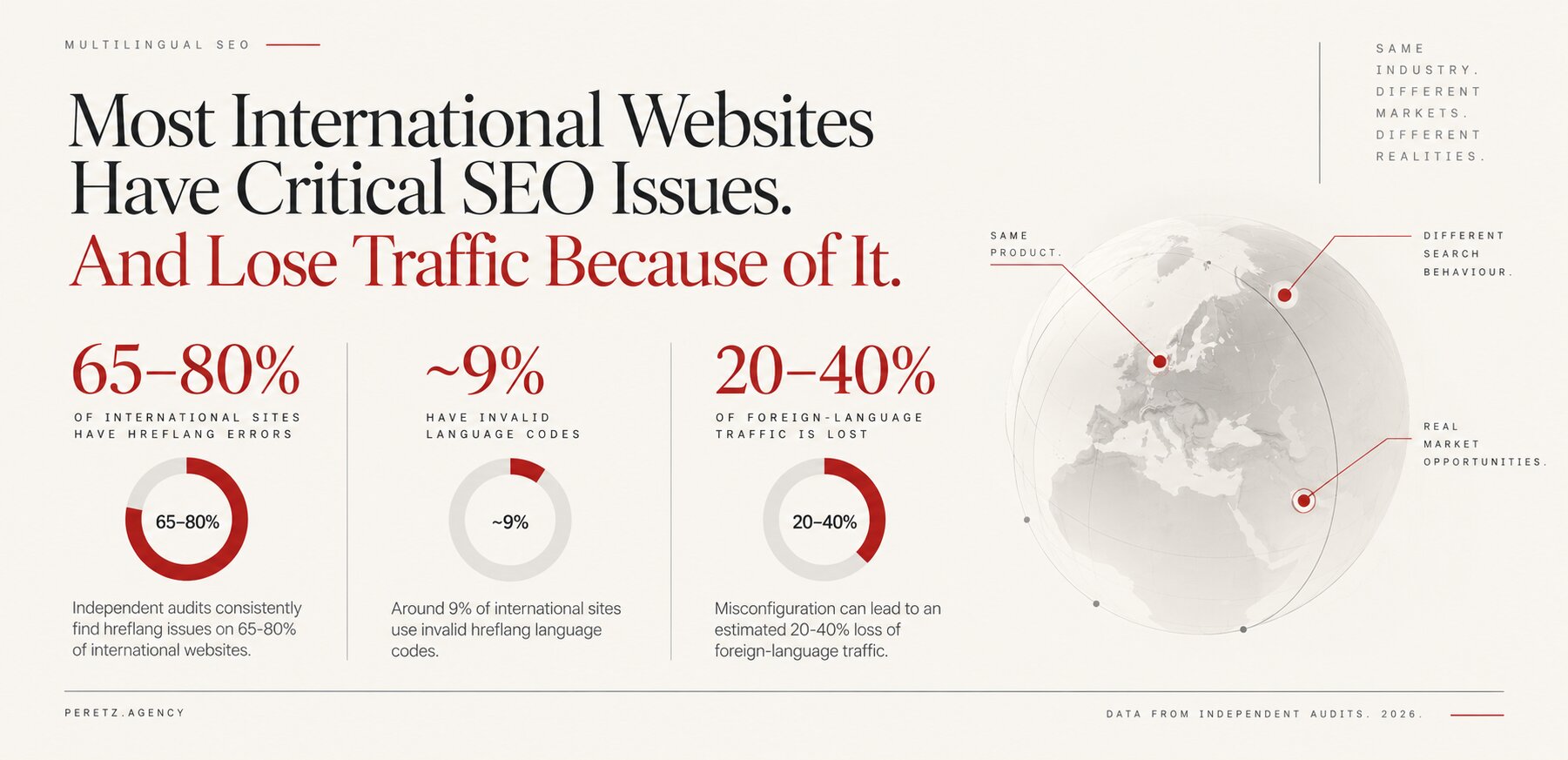
On the scale of the problem, the honest position is that no peer-reviewed measurement exists. Vendor analyses of large crawl samples report error rates between roughly 60 and 80 per cent of international sites, with one figure attributed to Screaming Frog crawl data and others to individual agency audits. The exact percentage should be treated with caution. What is meaningful is that independent samples keep landing in the same range.
The Set Must Agree
The Set Must Agree
Language versions form a set that validates as a whole rather than page by page.
Google Search Central states the core rule directly: if page X links to page Y, page Y must link back to page X, and missing return links cause annotations to be ignored or not interpreted correctly.
The requirement is defensive rather than pedantic. Without reciprocity, any site could declare itself the alternate version of any other site.
Alongside it sits a second requirement: every page must include an annotation pointing to itself, not only to its alternates. The self-reference is what establishes which position the page occupies in the set it is describing.
Missing self-references are common in content management systems that generate these links dynamically, because the natural way to write this loop is to output every language except the current one. That loop is wrong on every page of the site simultaneously.
Neither error breaks at launch. They appear later, when a language is added and the existing versions are not updated to declare it, or when a URL changes and the references pointing to it do not.
Reciprocity is not implemented once. It is a state to stay in.
The Canonical Conflict
The Canonical Conflict
This is one of the most damaging errors available, and it is usually introduced by someone being careful.
Canonical tags exist to consolidate duplicates. A site owner sees several near-identical pages across languages, reasons that they should not compete with one another, and points every canonical at the English version.
That configuration tells search engines that the non-English pages are duplicates of the English page. The result can be that the English URL is selected as canonical and the translated versions are not indexed or served as the intended alternates.
Canonical and hreflang are separate systems addressing separate questions, and they have to agree. A site should not simultaneously signal that a page is the appropriate version for a specific market and that another URL is its canonical representative.
The standard configuration is that each equivalent language version canonicalises to itself. They are not duplicates competing for the same query. They are alternates serving different markets, and hreflang is the mechanism that says so.
It is worth being precise about what hreflang does and does not do here. Gary Illyes of Google has described it as not functioning as a direct ranking signal, while still carrying substantial value within a content cluster. Correct annotations determine which version is served to whom. They do not make that version rank better than it otherwise would.
Codes Are Stricter Than They Look
Codes Are Stricter Than They Look
Language and region codes follow published standards and are not interpreted charitably. Language uses ISO 639-1. Region, where present, uses ISO 3166-1 alpha-2, and language always comes first.
The errors are consistent enough to list.
- Region codes that look correct and are not, most often en-uk where the standard requires en-gb
- Continental groupings such as en-eu, which is invalid because the EU is not a country
- A country code used alone, such as mx, which is a region rather than a language
- Three-letter language codes where two-letter codes are required
- Confusing script and region, for example using zh-CN when the intended distinction is Simplified Chinese as a script, which is represented by zh-Hans
An invalid code is not partially accepted. The annotation containing it is ignored, and because the set depends on reciprocity, the pages that referenced it lose that relationship too.
Related to this is x-default, which specifies the fallback for users whose language and region match nothing in the set. It belongs once, on the fallback destination. Applying it to every language version is a common misreading that removes its purpose.
Architecture Is a Business Decision
Architecture Is a Business Decision
Beneath the annotations sits a decision made much earlier, usually without SEO in the room, that sets the ceiling on everything above it.
A country-code domain is among the strongest geographic signals available to a search engine. That is exactly what makes it valuable at home and costly abroad. Google has described country-code domains as receiving a localisation benefit for users searching from the corresponding country, which is another way of saying the benefit does not travel.
It does not even travel between markets sharing a language. A French country-code domain suggests France, not Belgium or Switzerland.
This has become a live problem for businesses that expanded faster than their domain did. A company launches on a national extension because it serves that country, then years later sells into Germany, Poland and the United States, adds language versions, implements hreflang correctly, and cannot understand why the new markets do not respond.
Two facts make this harder than it appears.
Search Console country targeting no longer exists, having been removed in September 2022. And it was never available for country-code domains in the first place, because Google already associates those domains with their country. There was never an override, and now there is not even one for generic domains.
Google also treats a short list of country extensions as generic, including several adopted by technology companies. Most national extensions are not on that list, and a business cannot opt into it.
The domain states a country. There is no setting that says otherwise.
Below the domain, the same decision repeats at the structural level. Subdirectories consolidate authority under one domain, so a link earned in any market supports every market, which is why they are the default recommendation for businesses entering new territories. Separate country domains give the strongest local signal and divide authority, so strength in one market contributes nothing to another. Subdomains sit between the two and frequently inherit the disadvantages of both.
Architecture decides whether international growth compounds or restarts each time.
Reversing the decision later means a full migration with everything that entails. We wrote about what that costs in The Website Migration Checklist Most Agencies Skip.
Behaviour Does Not Translate
Behaviour Does Not Translate
Once the mechanical layer holds, the harder work begins, and no amount of correct markup addresses it.
There are three distinct operations hiding inside what most businesses call translation, and only the first one is usually paid for.
Translation converts the language. Localisation converts the meaning. International search requires understanding the behaviour.
The first two are content work. The third is research, and skipping it is why technically flawless multilingual sites still fail commercially.
Because the thing that does not survive the border is not vocabulary. It is the path.
Buyers in different markets reach the same purchase through a different sequence of questions. One market starts with the problem and arrives at the product category late. Another starts with the brand. A third starts with a comparison against a specific competitor, or with a regulatory question, or with a price bracket.
Each of those starting points is a different search, at a different stage, requiring a different page to answer it.
Two markets can buy the same product and never search the same way.

A translated site has been built around one market's sequence. It answers questions in the order the original audience asks them, which means that in the new market the right answers exist but appear at the wrong moment, on pages nobody arrives at.
The visible symptom is easier to spot than the cause. Keywords do not translate. Markets use different words for the same product, search at different levels of specificity, and sometimes search for a different thing entirely because the purchase is structured differently.
This shows up most clearly in the parts of a page written explicitly for search: category descriptions, footer text, the paragraph beneath a product grid, copy assembled around a keyword rather than around a reader.
Those blocks were written for the original market. Translating them produces grammatically correct sentences optimised for how another country searches, aimed at competitors who do not operate there, built on search volumes that do not apply.
They read correctly and target nothing.
The same applies to titles and meta descriptions generated from a template. A pattern that works in one market often produces phrasing in another that nobody types, because the template encodes an assumption about word order and intent that was only ever true at home.
What the Market Cares About
What the Market Cares About
Beneath the sequence sits the version of this problem that is missed most often, because it is invisible to anyone checking the translation.
Different markets do not merely search differently for the same product. They care about different things about it.
One market's buyers arrive concerned with certification, materials and compliance. Another asks first about delivery time and return conditions. A third weighs price and availability before anything else. A fourth wants provenance and the story of the manufacturer, and will pay more for it.
These are not differences of tone. They determine what belongs at the top of a product page, which questions a category description has to answer, which objections must be handled before a visitor will proceed, and what an article in that market should be about at all.
A translated product page presents the original market's priorities in a new language. Everything the local buyer wanted to know may well be on the page, three screens down, beneath the things they were not asking about.
The product is the same. The priorities are not.
The research this requires is unglamorous and difficult to skip. Reading how local competitors present the same category. Examining the questions that appear in local search suggestions and forums. Noting what local reviews complain about, because complaints are unmet expectations stated out loud.
It takes days rather than weeks, and it changes what the pages contain rather than how they are worded. This is the work that separates a site available in several languages from a site competing in several markets.
Auditing What Exists
Auditing What Exists
On a small or medium site, the checks below can be completed in an afternoon and will expose most of the common failure modes. On a large multilingual catalogue running to tens of thousands of URLs, they identify what to investigate rather than constituting the investigation.
Since Search Console no longer reports hreflang errors, the technical portion depends on external tools: a crawler such as Screaming Frog for site-wide validation, or a free hreflang tester for spot-checking individual pages.
- Confirm hreflang annotations are present in the source of each language version
- Confirm every page includes an annotation pointing to itself
- Take one page and verify that every alternate it declares declares it back
- Check the canonical on a non-English page and confirm it points to itself
- Validate every language and region code against the standards
- Confirm x-default appears once, on the intended fallback
- Confirm all annotation URLs are absolute, not relative
- Establish whether the domain extension signals a country other than the markets being targeted
- Read the SEO text blocks on a non-original language version and ask which market they were written for
- Compare a product page against a local competitor's and check whether the same information appears in the same order
- Search a target query on the relevant regional Google and see which version appears
The last check matters most, because it tests the outcome rather than the configuration.
If the English page appears for a German query in Germany, something in the set is wrong regardless of how the tags look.
What Fixing It Looks Like
What Fixing It Looks Like
Corrections are not instant. Search engines have to recrawl the affected pages and reprocess the relationships between them, which typically takes several weeks and longer on large sites.
This matters for expectation setting. A fix deployed on Monday does not produce a result by Friday, and the absence of immediate change is not evidence that the fix was wrong.
It also matters for sequencing. Repairing annotations while the pages themselves still address the wrong market produces correctly served pages that nobody wanted. The technical work makes the content reachable. It does not make it relevant.
Both have to happen, and the order is not interchangeable, because the strategic work cannot be measured until the mechanical layer stops discarding it.
Market Architecture
Market Architecture
The framing that causes most of these problems is the one embedded in the request itself.
A business asks to have its website translated. The request sounds like a content task with a defined scope, and it is priced and delivered as one.
What the business is actually doing is entering a market where it has no history, competing against companies that have been answering that market's questions for years, in a search environment with its own structure, and where its own domain may be signalling that it belongs somewhere else.
That is not a translation project. It is an expansion, and the website is the part of it that happens to be visible.
Treated as translation, it produces a site that is available in several languages and competitive in one. Treated as expansion, it forces the questions that determine whether the other markets were ever winnable: which markets justify the investment, what those buyers actually need to know, who already occupies that space, and whether the current architecture can carry the answer.
A multilingual website is one business entering several markets. Not one site translated.
The content usually already exists. Whether it counts depends on decisions made well above the level of the tags.
FAQ
Common Questions
Why does my translated page not rank in another country?
Usually for one of two reasons. Either the technical set is broken, so the page is never properly associated with that market, or the page answers the original market's questions in a new language. The first is a configuration problem, the second is a research problem, and they are frequently present together.
Does hreflang improve rankings?
No. Google has described hreflang as not functioning as a direct ranking signal, while still carrying real value within a content cluster. Correct annotations help determine which version is shown to whom. They do not make that version rank higher than it otherwise would.
Should each equivalent language version canonicalise to itself?
Yes. In a standard multilingual implementation, each equivalent language version should normally point its canonical to itself. Pointing every version at the English page can lead search engines to treat the others as duplicates and select the English URL as canonical. Language versions are alternates, not duplicates, and hreflang expresses that relationship.
Are subdirectories better than subdomains for multilingual sites?
For most businesses, yes. Subdirectories keep authority consolidated under one domain, so a link earned in any market supports every market. Subdomains and separate country domains divide that authority, although a separate local domain can be justified when a strong country-specific presence is part of the business strategy.
Is translating a website enough for international SEO?
No, and this is the assumption that causes most of the failures described above. Translation converts language. Entering a market also requires understanding how that market searches, what it wants to know first, and who already answers those questions there.
The data side of the same problem, where catalogue scale multiplies the number of states before search is even involved, is covered in Multi-Country E-Commerce for Large Catalogues: The Architecture Decisions That Set the Ceiling.
Once a market can find you, a second judge decides whether it recommends you, which we cover in SEO Gets You Found. AEO Gets You Recommended. Your Commerce Infrastructure Gets You Bought..
Search is one side of a multilingual site. What changes in the design itself, from Arabic layouts to local prices and taxes, is covered in Multilingual Website Design: What Changes Beyond Translation.
If a language version is underperforming, the useful question is not whether the translation was good. It is whether that market is technically reachable and commercially worth reaching.
A Technical Due Diligence Session answers both together: whether the hreflang set, canonical logic and domain architecture allow the market to see the site at all, and whether the content addresses what that market actually asks. Those findings are only meaningful in combination, which is why we do not sell them separately.
Book a Technical Due Diligence Session
The design side of the same question is covered in Why Multi-Language Websites Need a Different Design Approach, and our SEO services page sets out how we approach this work.
- Share
-

-

-

-

One notification a week with the new PERETZ articles. Nothing else.
Related Reading
-
26. 08. 2026

Why Multi-Language Websites Need a Different Design Approach

-
27. 08. 2026
The Website Migration Checklist Most Agencies Skip
-
26. 08. 2026
The Hidden Technical Debt That Makes Website Redesigns More Expensive Than Planned
-
27. 08. 2026

Why Some Websites Look Cheap Even When They Are Well Designed
-
13. 08. 2026

What Happens to E-Commerce When a Website Stops Being a Website?
-
06. 09. 2026

Multi-Country E-Commerce for Large Catalogues: The Architecture Decisions That Set the Ceiling
-
06. 09. 2026

SEO Gets You Found. AEO Gets You Recommended. Your Commerce Infrastructure Gets You Bought.
-
15. 10. 2026
Multilingual Website Design: What Changes Beyond Translation