We Sent an AI Agent Shopping in 15 US Online Stores. Here Is Where It Gave Up



In the week Walmart opened a gateway for AI shoppers and retailers split over whether to let agents buy, we gave one agent a shopping list and sent it to 15 well-known US stores.
SHORT ANSWER
What Happened
An AI agent working in an ordinary browser put the right product into the cart in 11 of 15 large US online stores, while 4 stores stopped it before the cart: two with bot checks, one with a waiting page and one with a button that did nothing and showed no error. In 2 of the 11 stores where it succeeded, the price the agent would have paid was not the price the product page showed: an add-on it never chose appeared in the cart and checkout, and a discount advertised on the page required a code. In a third, the product data and the page disagreed about which offer was available.
A second, server-side check showed a different picture of the same stores. An agent that reads pages without a browser, the way many assistants fetch a link, received a product page from only 6 of the 15. None of the 13 robots.txt files we could read forbid such agents. In our check they were stopped by bot protection, which in most cases treated an assistant acting for a shopper like any other bot; two stores refused agents by name. And in the product data that machines read, only one store described its shipping terms and only two described their return policy.
| Measure | Result |
|---|---|
| Stores tested | 15 |
| Browser agent added the right product to the cart | 11 |
| Stopped before the cart: 2 bot checks, 1 waiting page, 1 button that did not respond | 4 |
| Request without a browser received the product page | 6 |
| Checkout price differed from the product page | 2 |
| Product data contradicted the page about an available offer | 1 |
| robots.txt forbids shopper-directed agents from product pages | 0 of 13 read |
| Shipping terms in product markup | 1 of 13 readable |
These are not small stores with no budget. They are well-known brands and retailers with strong teams, which is exactly why the result matters for everyone else.
THE NEWS
Why We Ran the Test This Week
Agentic shopping stopped being a conference topic in the last few weeks. In September, Meta introduced Muse, an agent that browses products and completes purchases for its users, and on September 20 Amazon began blocking it, saying apps that buy for customers should operate openly and respect a store's decision whether to take part. On October 22, Walmart announced an Agent Gateway for AI shoppers, with user-set spending limits and approval controls. On October 23, a Wall Street Journal report described retailers splitting into camps: QVC and HSN let agents complete purchases, Tapestry, the parent of Coach and Kate Spade, lets them browse but not buy, and Kohl's restricts agent-initiated orders.
The same day, PYMNTS Intelligence published a survey of 2,191 US consumers. Only 6.3% of their most recent AI-assisted purchases were completed on a brand's own site, against 59.7% on Amazon. Even with identical price, shipping and returns, only 16.1% would send an agent to the brand's site, and 40.2% would send it to a large marketplace. Only 12.1% of marketplace shoppers would switch to a brand for AI-handled checkout, while 53.9% would switch for a lower price and 49.9% for equally fast free shipping.
AI changed where people research products, not yet where they buy.
The debate is mostly about policy: let agents in or keep them out. We wanted to see something more basic. If a shopper sends an agent to a store today, can the agent actually find the product, understand the terms and reach the checkout?
HOW WE TESTED
How We Ran the Test
We picked 15 well-known US online stores across apparel, footwear, electronics, home goods, beauty, jewelry, outdoor gear and pet supplies, and gave each one a concrete task of the kind a shopper would give an assistant: a specific product, a size or variant, add it to the cart, find out the total with shipping and the return terms. The test ran on the evening of October 23, 2026, in two parts.
- The live run. An AI agent (Claude, operating a desktop browser) worked through each task on a residential US connection, one store at a time. It stopped at the cart or at the first step of checkout, with no addresses, accounts or payment. On each product page it also read the structured data that search engines and AI systems use.
- The server-side audit. Claude Code checked the same stores without a browser: what robots.txt says to AI agents, what a plain request returns for a normal Chrome identity and for the ChatGPT-User and Claude-User identities, and what a headless browser renders. Where a product page had moved or been discontinued, the audit measured the closest available product.
This test is a diagnostic snapshot of what one agent met in each store on one evening, not a ranking of brands and not a measure of how their systems always behave. Every observation below should be read as "in our test":
- each store got one attempt, so load, a regional setting or a different agent could change the outcome;
- our browser agent behaved like a person in a browser and did not consult robots.txt;
- we kept refusals (403, 429, challenge pages) separate from timeouts and from interface failures, and saved screenshots, status codes and page data as evidence;
- where a result was ambiguous, we checked it by hand, and where we could not, we say so;
- we did not try to defeat any bot check, and the one exception to a clean run is described at Mejuri below.
THE RESULTS
Store by Store
| Store | Agent in a browser | Agent without a browser |
|---|---|---|
| Allbirds | Reached checkout; 12 Add to Cart buttons on the product page | Product page returned |
| Everlane | Reached checkout after closing a signup popup; a $1.75 add-on appeared in checkout | Product page returned |
| Glossier | Reached checkout | Product page returned |
| Brooklinen | Reached checkout; the advertised 20% off needed a code | Product page returned, product data only after JavaScript |
| Mejuri | Reached checkout after we removed an invisible overlay that blocked every click | Product page returned |
| Coach | Reached checkout; search showed three different bags with the same name and price | Access denied (403) |
| Kohl's | Reached the cart | Access denied (403) |
| lululemon | Reached the cart; the cart showed empty placeholders for about 12 seconds | Access denied or no answer |
| REI | Reached the cart | No answer |
| Best Buy | Reached the cart; the default offer came from a marketplace seller | No answer |
| Walmart | Reached the cart; checkout opened a sign-in page | Blocked by agent name |
| Nike | Add to Bag did nothing, twice, and showed no error | Blocked by agent name (403) |
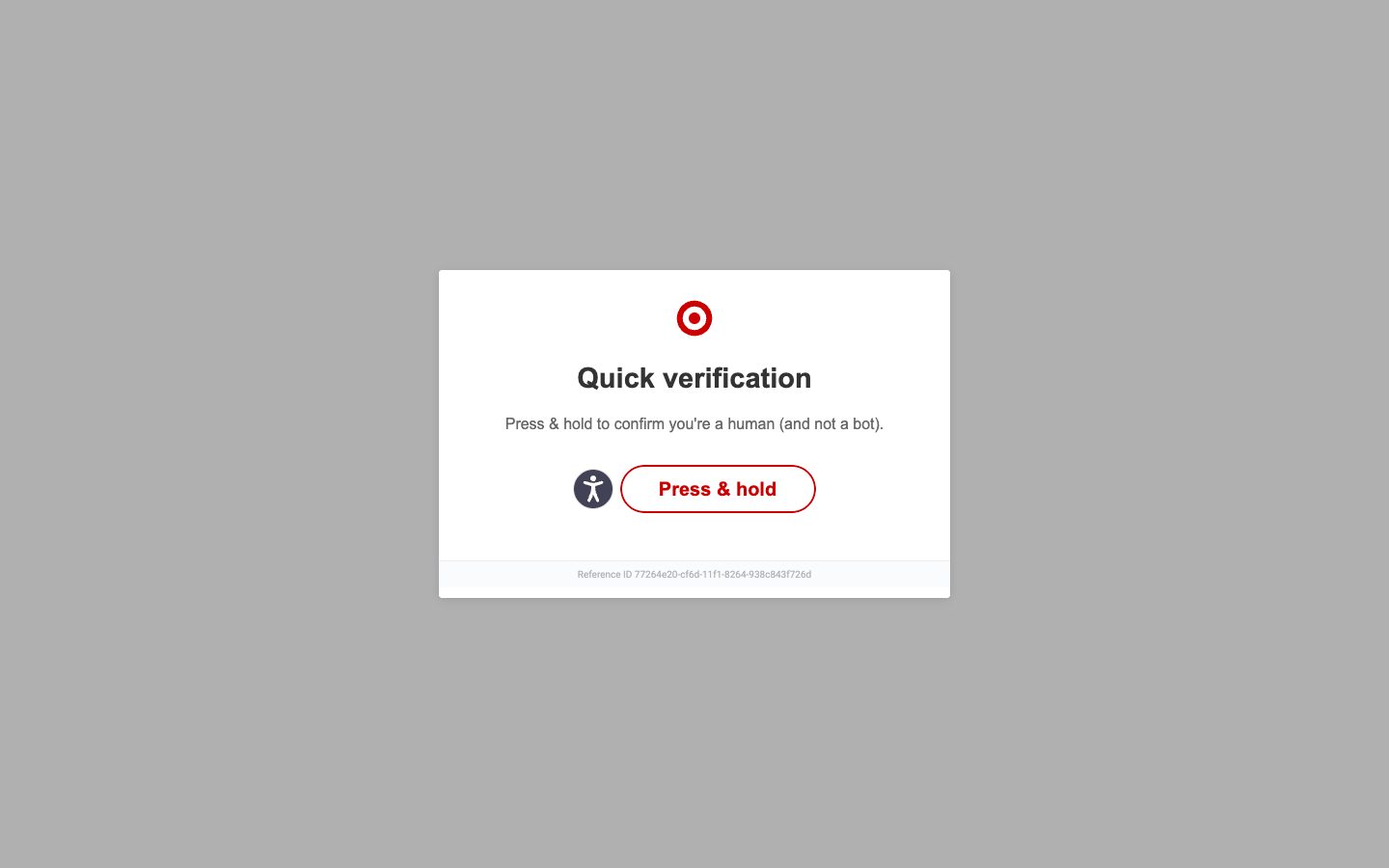
| Target | Bot check "Press & hold" on the product page | Product page returned, no product data |
| Chewy | Blank page, status 429 | Status 429 |
| Patagonia | Waiting page on every page but the home page | Waiting page |
The two columns rarely agree, and that is the first lesson. A store's readiness for agents depends on which kind of agent arrives. Target served its product page to a plain request but stopped the browser agent with a challenge. Coach, Kohl's, lululemon, REI and Best Buy refused plain requests but let the browser agent shop.
THE DOOR
Stopped Before the First Click
None of the 13 robots.txt files we could read forbid ChatGPT-User, Claude-User, GPTBot, ClaudeBot, OAI-SearchBot or PerplexityBot from product pages. Three stores close the door to one AI crawler each: Patagonia to Google-Extended, lululemon to Meta's crawler and Chewy to Amazonbot. Five stores publish an llms.txt file. On paper, almost everyone welcomes agents.
In practice, bot protection decides first. In our audit, 9 of the 15 stores did not return a product page to a request without a browser: Akamai answered with 403 or a waiting page at Coach, Kohl's, Nike and Patagonia, PerimeterX showed "Press & hold" at Walmart, Kasada answered 429 at Chewy, and REI, Best Buy and lululemon dropped the connection. In our audit, Nike and Walmart refused by agent name: they served the page to a normal Chrome identity and refused the same request when it came under the ChatGPT-User or Claude-User name.
Coach is the most deliberate case. Its robots.txt has separate groups for nine AI agents, including ChatGPT-User and Claude-User, that allow product pages and close the bag and checkout. That matches Tapestry's stated "browse but not buy" policy, but it is also the rule Coach applies to every crawler, and robots.txt is advisory. Our browser agent reached the Coach checkout page without resistance.
THE PAGE
Popups, Overlays and Silent Buttons
Once inside, the agent mostly struggled with things built for people.
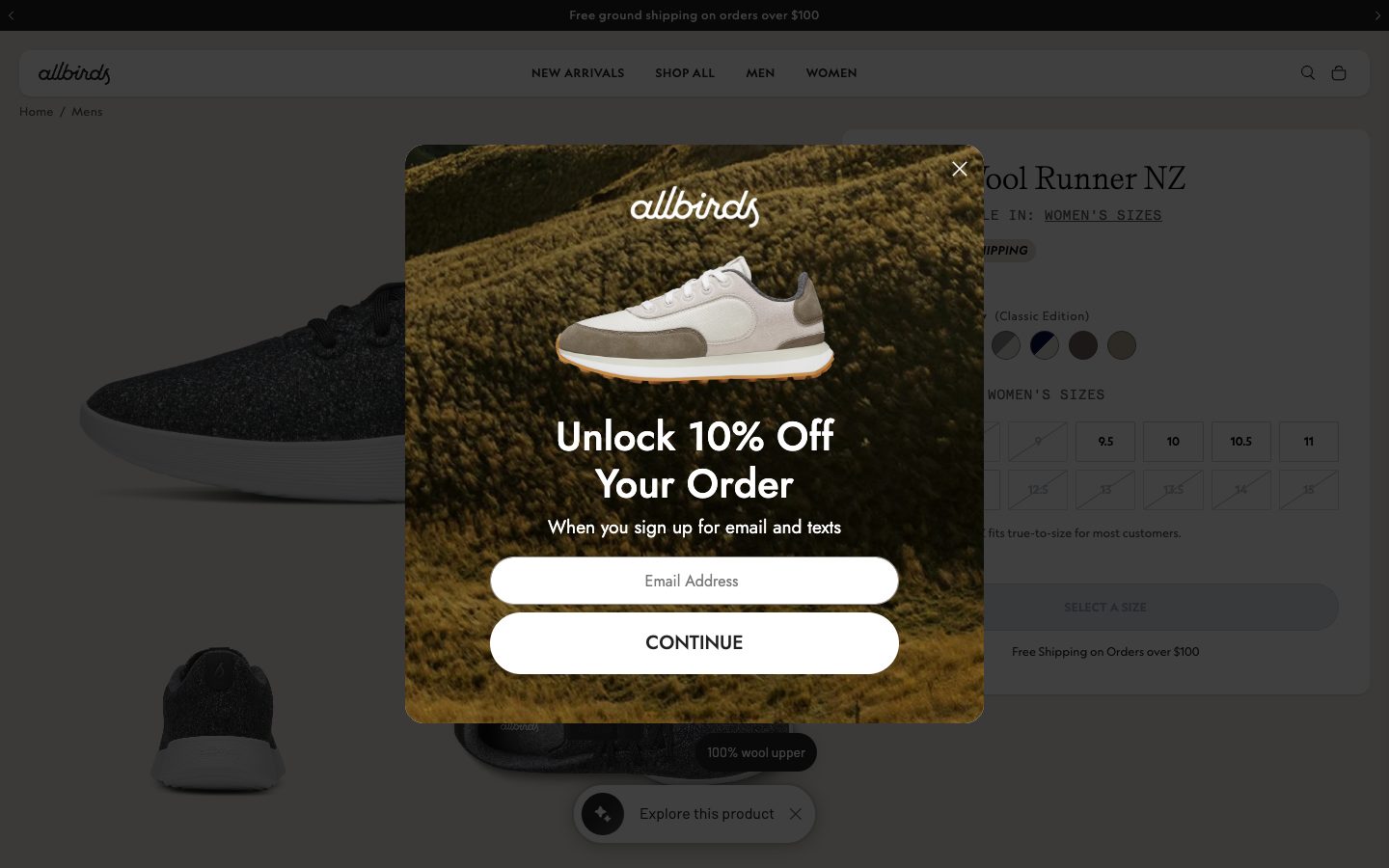
- Signup popups. Allbirds, Everlane, lululemon and Coach opened subscription or discount windows over the product. In the server-side render of Allbirds and Everlane, the full-screen popup left nothing in the page's accessibility tree but an iframe, so an agent that reads the page through that tree sees no price, no sizes and no button until it closes the window.
- Invisible overlays. At Mejuri, a full-screen marketing iframe sat on top of the page and intercepted every click. In our test it was transparent because the third-party script was not allowed to load; in a normal browser it is a text-message signup window. We removed the layer to continue, and an ordinary agent might well have stopped there. At Everlane, a similar layer kept catching clicks in the cart drawer after the popup was closed.
- Failures without a word. At Nike, the agent selected size 10 and pressed Add to Bag twice. The button greyed out, nothing appeared, and the bag stayed empty. There was no error to read and no reason to try something else.
- Late layouts. At Best Buy, the first click missed because the price and fulfillment block loaded after the button and moved it. Walmart's cart badge stayed at zero for several seconds after a successful add, which looks exactly like a failure.
- Too many buttons. The Allbirds product page had 12 Add to Cart buttons, the Walmart page 35, and the Glossier page 28 buttons named Add to bag, most of them for recommended products. On Walmart, the main button was not even first in the page's reading order.
- Search that assumes a person. Mejuri's search ignores the common q parameter, so an agent that builds a search address gets "No results for undefined". On other sites, the first product links on the results page were a gift card (Nike, Brooklinen, Glossier) or a promoted parka (REI).
THE PRICE
When the Page Price Is Not the Price
The most expensive problems were the least visible. Two stores would have charged the agent something other than what the product page suggested, and a third showed an offer in its data that it would not sell.
- Brooklinen showed the Queen sheet set as $199 crossed out and $159.20 with "20% off". In checkout the total was $199 plus tax, because the discount needs the code FRIENDSANDFAM typed in by hand. An agent that trusts the page overpays by $39.80, or reports the wrong total to its user.
- Everlane listed one $34 tee in its cart data, while the cart drawer and checkout showed $35.75, "Subtotal, 2 items": a $1.75 package protection add-on the agent never chose. The fee was visible before checkout, but only to someone reading the drawer line by line.
- Best Buy showed the same $274.99 on the page and in the cart, so the price itself held. But the default, and the only new offer available to buy, came from a marketplace seller above Best Buy's own comparison value of $249.99, with AppleCare+ and store pickup unavailable, while the product data on the same page listed a new offer at $212.99 as in stock that the buying options window marked "Unavailable". An agent reading the data would promise a deal the page would not honor.
None of this is unusual for e-commerce, and a careful person can handle each case. An agent acting on behalf of a person turns each of them into a trust problem: the user asked for a price and got a different one.
An agent reports the price it sees. Make sure it is the real one.
THE DATA
What the Product Data Does Not Say
Agents and AI assistants lean on structured data, the Product and Offer markup that describes a product in a standard machine-readable way. We read it on every product page the browser agent reached, and the server-side audit checked it with and without JavaScript.
- Shipping and returns are almost absent. Of the 13 stores whose product data we could read, only Brooklinen described shipping terms in its markup, and only Brooklinen and Best Buy described a return policy. Every store we could reach showed shipping terms to people, and most showed return terms too.
- Some product pages have no product data at all. On Walmart and Target, the product pages we received carried no Product markup at all. Walmart announced its Agent Gateway the day before, and it may intend agents to use that channel rather than the page.
- Ratings shown, not declared. Everlane showed a 3.9-star rating from 232 reviews and Glossier showed 7,154 reviews, but neither declared a rating in the markup.
- One product, several names. Mejuri's pearl earrings were "Freshwater Pearl Double Drop Earrings" in the page title, "Essential Pearl Earrings" in the heading and "Solid Yellow Gold (14k) / Pearl" in the markup. Brooklinen's sheet set had two Product blocks, one with the shipping and return terms but no price and one with the price but no brand.
- Variants without meaning. Kohl's listed 50 offers for the Levi's 505, each with an internal code, a price and availability, but none said which waist and inseam it was. An agent cannot find the 34x32 in that data.
The test also had good examples: on the page our browser agent read, Nike described 41 variants of the Pegasus 42, each with its own GTIN, size, color, price and availability. lululemon described 348 variants and expressed the inseam as a measurement in inches. Coach declared the GTIN, material and color of the bag it showed. In our reading, the difference between the best and the worst data in this test looked less like budget and more like a decision to describe the product as data. We wrote about that approach in our guide to product page SEO.

WHAT IT MEANS
What This Means for a Mid-Size Store
In the PYMNTS survey, shoppers explained their choice of seller type by easier returns (36.6%), better selection (34.9%) and habit (32.7%). A brand site will not out-select Amazon. It can be the place where an agent finds a clear product, a clear price and clear terms in one visit, and every failure in this test works against that.
It helps to read the results in three layers. Can an agent find the product, can it understand the product and its terms correctly, and can it act on them? In this test, search and access decided the first layer, product data and price consistency the second, and popups, buttons and bot checks the third. A store can do well in one layer and fail in another, which is why a single score would hide more than it shows.
For a mid-size store, the practical conclusions are these:
- Decide your policy on purpose. Letting agents browse and buy, browsing only, or neither are all legitimate choices. Blocking by accident through default bot settings is not a choice; it is a side effect.
- Treat agents as a traffic type. Look at what your bot protection does to ChatGPT-User, Claude-User and similar agents that act on a shopper's request, separately from scrapers and crawlers.
- Make the price final. If a discount is real, apply it automatically, and if an add-on is optional, leave it unchecked.
- Put shipping and returns into the data, not only into a footer page or a cart message.
- Fail out loud. If Add to Cart cannot complete, say why on the page.
The store an agent understands first is the store it recommends.
This is not a reason to rebuild a store for robots. Almost everything that helped the agent here, such as named buttons, clear sizes, honest prices and complete product data, helps people with slow connections, screen readers and short patience just as much. We covered the wider shift in SEO, AEO and commerce infrastructure.
CHECKLIST
Test Your Own Store in an Hour
You do not need a lab to repeat a small version of this test:
- Ask an AI assistant with browsing to find a specific product in your store, pick a size and add it to the cart, then compare what it reports with what you know is true.
- Request a product page with the ChatGPT-User and Claude-User identities and look at the status code and the content you get back.
- Read your robots.txt as an agent would: does it say what you actually intend for product pages, the cart and checkout?
- Open a product page with popups enabled and count the windows that appear before the price is visible.
- Check your Product markup for price, availability, variants, shipping and return policy, and compare every value with the page.
- Put a discounted product into the cart and check that the cart and checkout show the discounted price without a code.
- Count the buttons named Add to Cart on a product page and make sure the main one is clearly the first.
- Press Add to Cart with your network throttled and see whether the page explains a failure.
HOW WE WORK
How We Prepare Stores for Agents
We build and optimize online stores with the data model first: the product as a structured, verifiable entity, then the pages, filters and feeds on top of it. For existing stores, we start with an audit of how the store looks to search engines, AI assistants and agents, including bot settings, product data and the purchase path, and then fix the issues in order of impact. The result is a report with the shopping scenarios we ran, every issue reproduced with screenshots and server responses, its effect on the path to purchase and a prioritized list of fixes. This work is part of our e-commerce SEO, and for new stores it is part of e-commerce development from the first sketch.
FAQ
Frequently Asked Questions
Can AI agents buy from online stores today?
Some can, in some stores: in our test of 15 large US stores, an agent working in a browser added the right product to the cart in 11; in 6 of them we went on to the checkout page. Four stores stopped it before the cart with bot checks, a waiting page or a button that failed without an error.
Do online stores block AI agents in robots.txt?
Rarely: none of the 13 robots.txt files we could read in this test forbid the agents that act on a shopper's request from product pages. The blocking happens in bot protection services, which in most of the stores we tested treated an assistant acting for a person like any other bot.
What should a store fix first for AI shopping agents?
Start with access and honesty: check what your bot protection does to known AI agents, and make sure the price on the product page is the price in checkout. Then complete your product data with variants, shipping and return policy, and remove popups that cover the product.
Is structured data important for AI agents?
Yes, because agents and AI assistants use Product and Offer markup to understand what a product is, what it costs and whether it is available. In our test, only one of the 13 stores whose product data we could read described shipping in its markup and only two described returns, so agents have to guess or read it from text.
Should a store let AI agents complete purchases?
That is a business decision, and retailers in the news this month made different choices, from letting agents buy to allowing browsing only. What matters is that the policy is deliberate and that the store behaves consistently with it, rather than blocking agents by accident.
How can I check how my store looks to an AI agent?
Repeat a small version of this test: send an assistant to buy a specific product, request your product pages with agent identities, and compare your product data with what the page shows. Or book a strategic session and we will look at it together.
Sources
- PYMNTS: Shoppers Would Send AI Agents to Marketplaces Over Brand Sites (October 2026)
- Iceclog: Retailers Divided Over AI Shopping Agents as Agentic Commerce Expands, citing The Wall Street Journal (October 2026)
- GuruFocus: Walmart Launches Agent Gateway for AI Shopping Integration (October 2026)
- The Star: Amazon blocks Meta's Muse AI agent from its retail site (September 2026)
- Google Search Central: Product structured data
Not sure what an AI agent sees in your store? Let's run the test on yours.
- Share
-

-

-

-

One notification a week with the new PERETZ articles. Nothing else.
Related Reading
-
23. 10. 2026
Product Page SEO: Descriptions, Reviews and Structured Data That Earn the Click

-
06. 09. 2026
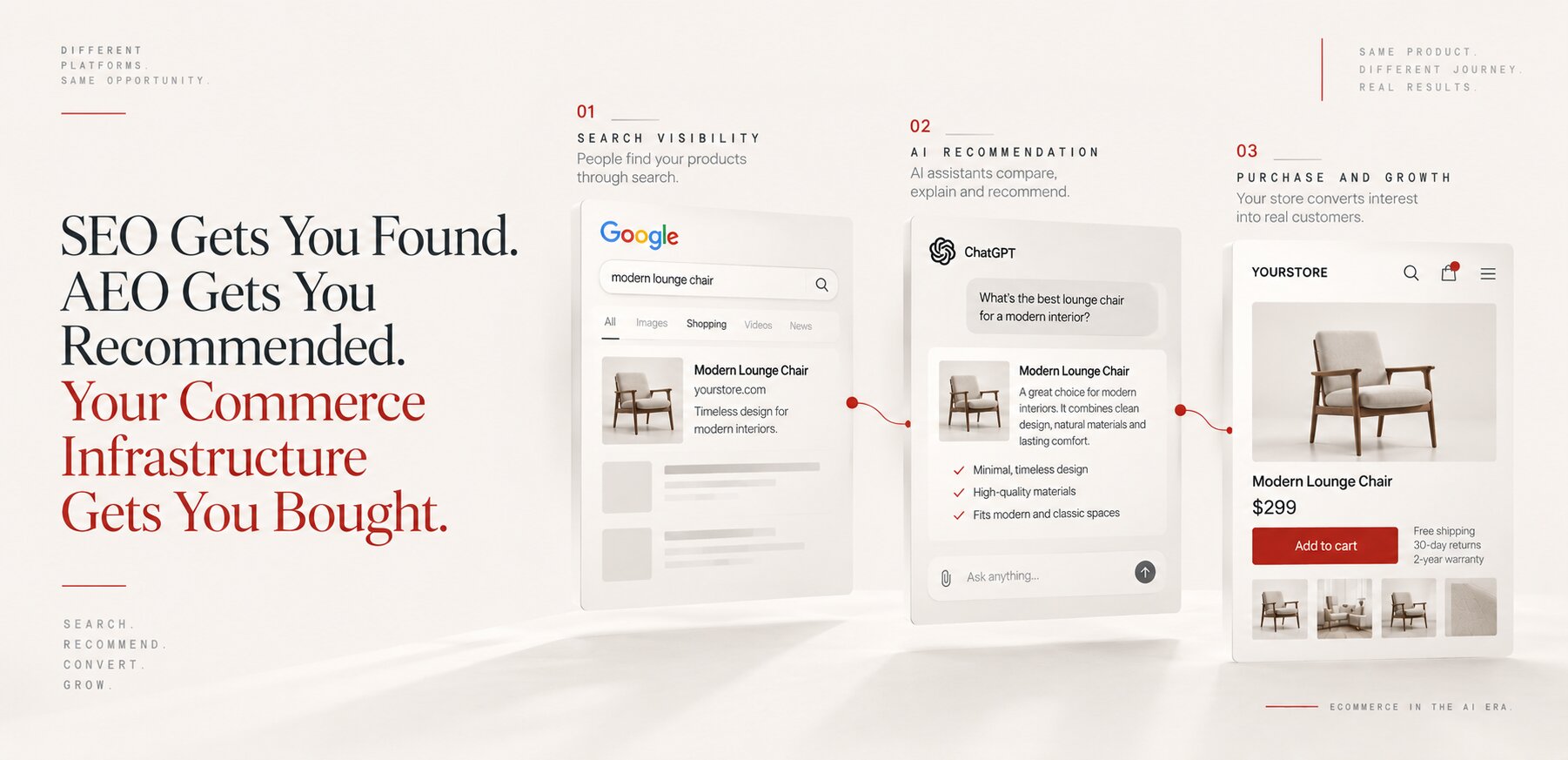
SEO Gets You Found. AEO Gets You Recommended. Your Commerce Infrastructure Gets You Bought.
-
13. 08. 2026
What Happens to E-Commerce When a Website Stops Being a Website?
-
22. 10. 2026
E-Commerce SEO in 2026: What Has to Be Built Into the Store, Not Added Later