E-Commerce SEO in 2026: What Has to Be Built Into the Store, Not Added Later




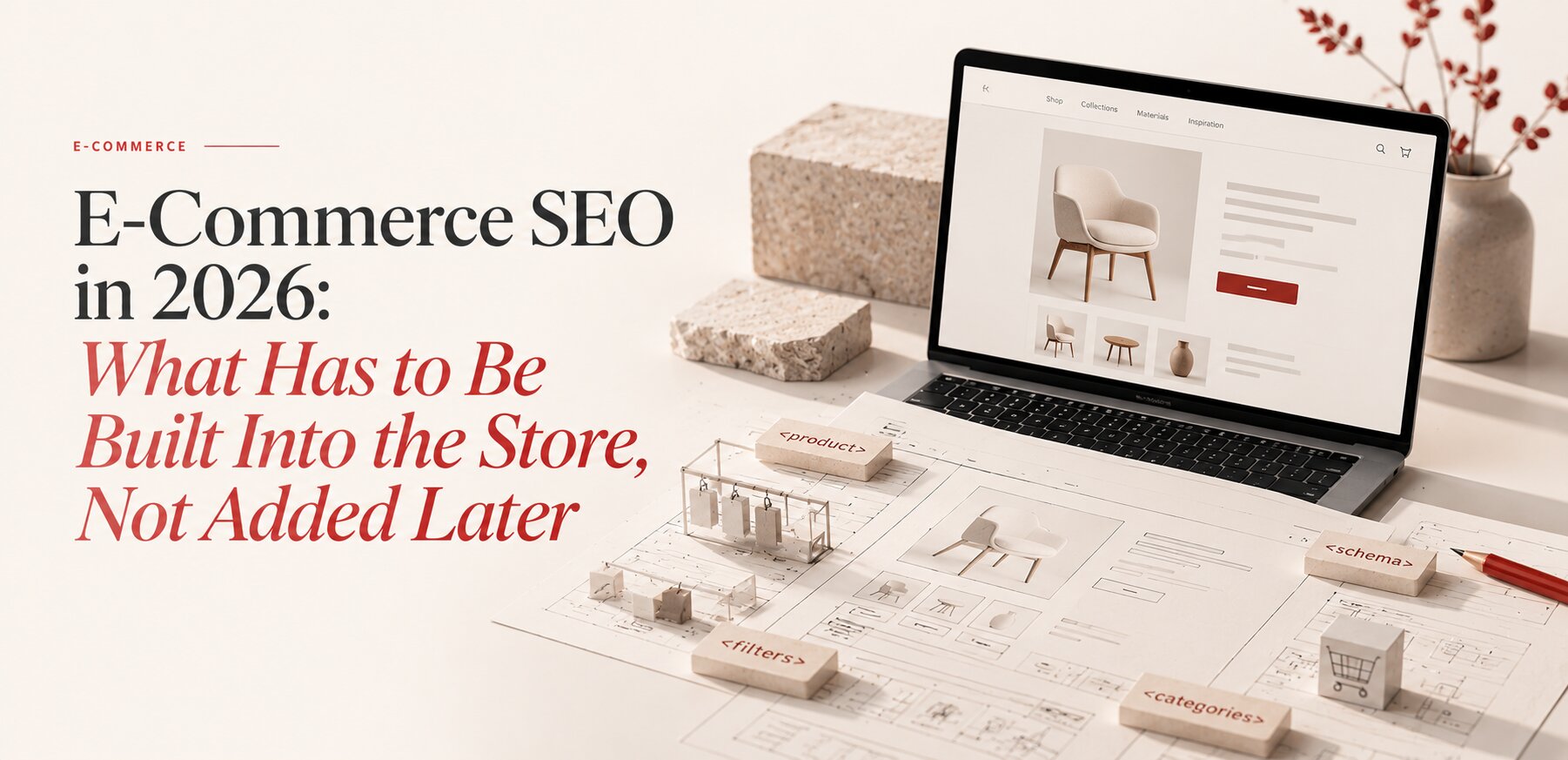
Most of the SEO problems we see in online stores were not caused by weak texts or missing keywords. They were designed in, months before anyone thought about search, and no SEO specialist can fully fix them later without changing the store itself.
SHORT ANSWER
Built In, Not Added
E-commerce SEO in 2026 is decided mostly while the store is being designed and built: in the category structure, the filters, the product card and the data behind them. Texts, meta tags and links still matter, but they work on top of that foundation, not instead of it. Search engines now read meaning rather than counting keywords, Google weighs who stands behind a store, and AI assistants recommend the stores whose products they can understand. A store that is easy for people to navigate and easy for machines to read wins on all three fronts at once.
For an owner, the practical conclusion is simple. The best moment to think about SEO is before the designer draws the first product card, and the right people to require it from are the team that builds the store, not only the agency hired a year later to promote it.
THE USUAL STORY
Designed First, Optimized Later
The story we hear most often goes like this. A business orders a store, the designer draws beautiful categories, filters and product pages, developers build them, and the store launches. A few months later the owner notices that traffic is not growing and hires a company for SEO, sometimes us. The SEO specialist opens the store and finds that the structure was built by people who never thought about how search engines read a page.
We saw this on some of our earliest store projects, about nine years ago: a large bicycle store, a pet supply store and a custom cake shop with a cake builder. The designers could draw beautiful interfaces. What nobody had designed was the structure of the information and how it would work in HTML, in the navigation and in the index. Specifications lost their text structure, the product card became a single block of text with no hierarchy, no links to other products and no recommendations, and the filters worked for the user while generating pages nobody needed. Fixing the code was only half the job: we had to explain why the original decisions caused the problems and rethink the structure of the catalogue. A designer does not have to write HTML, but has to understand that an interface is not a picture: it represents information, objects and the relationships between them. If that model is wrong from the start, development only cements the mistake.
The same patterns still appear in stores we see today: categories that follow the warehouse rather than how customers search, filter combinations that create thousands of near-identical pages, manufacturer descriptions copied from fifty other stores, and key facts hidden in images or tabs that load only after a click. None of this can be fixed with an SEO text at the bottom of the category page. It has to be fixed in the store.
PLATFORMS
Every Platform Breaks Differently
Each platform adds its own version of the problem:
- OpenCart. The core is simple, so stores rely on third-party SEO modules. Several modules installed by different developers over the years often conflict with each other, generate duplicate addresses or overwrite each other's settings.
- Shopify. Owners often expect the Plus subscription, which starts at $2,300 a month on a three-year term and $2,500 on a one-year term, to cover everything. In practice, apps, payment and currency fees and partner work are added on top, and the URL structure is fixed: product and collection addresses follow Shopify's pattern, and redirects only work from addresses that no longer exist. Moving an established store to Shopify needs a team that plans every redirect in advance, as we explained in our Shopify Plus migration checklist. One of our clients went through exactly this: once the real needs of the store were counted, the question became the full cost of ownership, and the client is now planning a custom build. Shopify suits many stores well; the point is to count everything before choosing.
- Magento. The flexibility is real, but so is the cost of keeping it current, which is why many stores are now deciding where to go next.
The OpenCart case we remember best is a pet supply store that came to us after the previous company had missed its deadlines. A third-party SEO module generated broken addresses full of technical parameters, the product descriptions were copied, the cards had no structure, there were no related products and the site search did not work. Many developers advised the owner to build a new store. But the client had already spent money, had been burned by the previous contractor and had a budget for SEO, not for a rebuild. So we worked inside the existing system, fixed what could be fixed and brought the store to a working state within that budget, without abandoning the platform. About seven or eight years ago we added questions and answers, product ratings and badges to the product cards, and those additions worked organically, both for customers and for search. We also worked on the store's reputation in search and consistently asked customers to leave reviews on its Google Business profile. Today it is still one of the largest pet stores in Ukraine. A problem store does not automatically need a new one: first find out what is actually broken and what can stay.
Whatever the platform, a migration is the moment when structure is most easily lost, which is why our website migration checklist starts with old addresses rather than new designs. The platform matters less than the decisions made on it. A well-planned store on any of them will outperform a carelessly built one on the most expensive.
STRUCTURE
Structure Before Pages
In the stores we work with, category pages usually bring more search traffic than individual products. A person searching for "linen shirts for men" or "pearl earrings" wants a selection, and the page that answers that query is a category. That makes the category tree the most important SEO decision in the whole project, and it is usually made by someone thinking about the menu.
We start from the objects the business sells and how customers think about them, an approach known as object-oriented UX. For a jewelry store the objects might be the piece, the material, the collection and the occasion; for a sports store, the product, the sport, the level and the brand. Each object and each relationship between objects is a candidate for a page, a filter or a link. Site search belongs here too: it is how customers find what the menu does not show, and its queries are free research into what people want and what they call it. We work this way on Schoeffel, Nicole, Nico Juliany, SHTAYER and other stores where the relationships between products matter: by collection, material, purpose or compatibility, depending on the business. When the structure follows how customers search, the navigation, the filters and the SEO stop fighting each other.
Filters are where most stores lose control. Every combination of color, size, price and brand can create a separate address, and Google's own guidance from December 2024 describes the result: crawlers spend their time on near-infinite filter variations instead of new products. Which combinations deserve their own page has to be decided in the code, because a plugin cannot know which filter pages matter to your customers. A simple rule works for most stores: a filter page deserves to be indexed when people actually search for that combination, when it holds enough products to be a real selection, and when it can carry its own heading and text. Everything else stays out of the index, combinations with no products return a 404, and the parameters always appear in the same order. We saw the cost of getting this wrong with a clothing store whose visibility in Google dropped sharply in early 2026; duplicate addresses were one of the causes, and we describe below what we did about it.
For stores that sell in several countries or languages, the structure multiplies: every market needs its own pages, its own language versions linked correctly and often its own categories, because people in different countries search for the same product differently. We explained why translated pages do not rank in their own markets and how large multi-country catalogues set their own ceiling.
Most store SEO problems are designed in, not written in.
THE PRODUCT CARD
The Product Page Is a Sequence
A product page is not a container for a photo, a price and a button. It is a sequence: the order in which a customer receives information decides whether they understand the product, trust it and buy it, and the same order decides how well a search engine or an AI assistant understands it.
A strong product card usually answers questions in the order a customer asks them: what is this, is it right for me, what exactly is it made of, how much and when will I get it, what do others say, and what goes with it. The details depend on the category, but the logic does not. A customer should never have to open three tabs to find the one fact that decides the purchase.
Several elements on the card carry both UX and SEO weight:
- A unique description. Manufacturer text copied across dozens of stores tells Google nothing new about yours. A description written for your customers, with the use cases and details they ask about, is one of the few things competitors cannot copy overnight.
- Specifications as real data. Material, dimensions, compatibility and care instructions should be text and structured fields, not part of an image.
- Related products. Accessories, sets, items from the same collection and alternatives, built from real relationships between products, become part of the information architecture rather than a decorative "you may also like" block. They help the customer and give search engines a map of the catalogue. Linking everything to everything does the opposite: a relationship has to make sense to the buyer.
- Reviews and questions. Real experience of real buyers is exactly what Google means by experience in E-E-A-T.
- Structured data. Product, offer, price, availability and review markup, so that Google and AI assistants read the facts without guessing.
The basics still apply, and they are worth checking on every template: a page title of roughly 50 to 60 characters with the product name and its key attribute, a meta description of up to about 155 characters written as a short advertisement rather than a list of keywords, one clear heading, clean addresses, and image descriptions that say what is in the picture. FAQ blocks are still useful to shoppers and give AI assistants clear questions and answers, but Google stopped showing FAQ rich results in May 2026, so they should be written for people, not for snippets.
LUXURY AND MASS
Luxury and Mass Market Need Different Cards
The logic of the product card changes with the market. A mass-market store lives on speed: the customer compares, decides quickly and leaves if the page hesitates. Fast loading, a price and delivery date visible at once, filters that respond instantly and specifications that can be scanned in seconds are what sell. Google's own thresholds for a good experience are a reasonable floor: the main content visible within 2.5 seconds, a response to a tap within 200 milliseconds and almost no layout shift as the page loads.
A luxury store works by different rules. The card may open with a video, the transitions can be slow and deliberate, and a preloader before a collection is not a mistake but part of the experience, as we described in why luxury e-commerce breaks the rules of conversion optimization. For heritage brands such as Schoeffel, Carrera y Carrera or Nicole, the page has to feel like the brand before it sells anything.
What luxury does not cancel is information. Behind the video and the animation, the page still needs full text: the materials, the craftsmanship, the dimensions, the care and the story of the piece. That text should be part of the page itself, not loaded only after an animation finishes, so that search engines and AI assistants can read it. Technically this is not a compromise: the text sits in the page's HTML from the first load, the video gets a poster frame and a proper description, and heavy media below the first screen loads only when the customer scrolls to it. A customer spending several thousand dollars reads more, not less, and the most beautiful card fails if it cannot answer the question a buyer types into a search bar or asks an assistant.
MEANING AND TRUST
Meaning and Trust
For years, store SEO meant a block of text at the bottom of each category, written for search engines and packed with every variation of the main keyword. Nobody read it, and in 2026 nobody should. Search engines now evaluate meaning, context and usefulness rather than counting phrases, and Google folded its helpful content system into its core ranking in 2024: pages written mainly to rank lose ground to pages written for people.
If your store still carries those old SEO texts, it is time to rework them. A good category text today does something a customer needs: it explains how to choose, what the difference between options is, which material suits which use, and what the store knows that a marketplace does not. The keyword still appears, because people use it, but it is no longer the reason the text exists.
A category text should help someone choose, not help a page rank.
We wrote about what happens to content when it is produced only for search in When Everyone Can Publish 500 Articles.
Meaning is half of the picture; trust is the other half. Google's quality guidelines describe it as E-E-A-T: experience, expertise, authoritativeness and trust. For an online store, E-E-A-T is the answer to a customer's silent question: who is selling this, and why should I believe them?
In practice, trust is built from concrete things: a real company with an address and contacts, clear delivery, return and warranty terms, real reviews, and content written by people who know the product. The online store of the Institute of Trichology is a good example of expertise that can be shown rather than claimed: the products sit next to the knowledge of trichologists who work with these problems every day. A small specialist store can compete with a marketplace exactly here, because a marketplace sells everything and knows nothing in particular.
AEO AND GEO
When AI Recommends the Store
Shoppers increasingly ask AI assistants instead of typing queries: which running shoes suit flat feet, which pearl necklace works as a gift, what to buy instead of a discontinued model. Answer engine optimization (AEO) and generative engine optimization (GEO) are about being the store those assistants can understand, trust and cite.
The foundations are the same ones described above, which is why the structure matters so much. An assistant needs clear product data, consistent structured markup, specifications as text, honest answers to common questions and signals that the store is real and trusted. A product feed in Google Merchant Center makes the catalogue available for free product listings in Google, and the same clean data helps every system that reads it.
The channels themselves change quickly. Google says its Shopping Graph holds more than 50 billion product listings, about 2 billion of them updated every hour, and since November 2025 its AI Mode in the US answers shopping questions with prices, reviews and stock, and can even complete a purchase on the merchant's site for the customer. OpenAI went the other way: in March 2026 it confirmed it was shutting down Instant Checkout in ChatGPT and moving to shopping apps built by retailers. What stays constant through all of these changes is the store's own data: clean, structured and true. A store that has it can follow any new channel; a store that does not will have to rebuild it for each one. We explained how these layers fit together in SEO Gets You Found. AEO Gets You Recommended. and why SEO, AEO and GEO amplify a business rather than replace it.
An assistant recommends what it understands. Structure is how it understands.
BEYOND THE SITE
SEO No Longer Ends at the Site
For us, SEO stopped being only about making a search engine understand a website. A store's visibility now comes from its blog and news, from the bloggers and experts who mention it, from its social channels and partner platforms, and from how consistently the brand is described across all of them. Search engines and AI assistants both look at that whole picture. A store does not have to be everywhere, but the work has to be connected: a guide on the blog that links to the right category, a blogger collaboration that points to a real product page, a social post that uses the same names and facts as the store. A blog for an online store is worth having only as part of that system.
The clothing store mentioned earlier shows how many layers this involves. When its presence in Google dropped sharply in early 2026, there was no single fix. This is what we did, roughly in order:
- repaired the SEO module that was generating duplicate addresses;
- rewrote the product cards and the articles, and strengthened internal links, including links inside product descriptions;
- went through PageSpeed, improved loading speed and optimized the images further;
- added image descriptions, which the store had none of;
- added breadcrumbs carefully where they were needed: the original design had left them out for the sake of looks, which made navigation slightly awkward, and session recordings later showed that customers use them;
- moved buttons, added payment in installments and connected a current shipping module;
- started regular email campaigns to the customer base through SendPulse and set up a proper CRM integration;
- placed sponsored editorial content on relevant fashion sites such as ELLE.
Half of this list is not SEO in the old sense at all, and that is exactly why it works. Search visibility, conversion, repeat purchases and brand mentions now feed each other, and a store that fixes only one layer usually finds the next problem waiting in another. The store has since gone through a redesign and its traffic is growing. It is now run by colleagues of ours: after our move to the US and the relocation of part of the team to Europe, our prices no longer fit that market. Even after the redesign, the structure we built stayed in place, which says more about what lasts in a store than any design does.
It is worth keeping the effects apart, though. A mention by a blogger or a strong social channel brings direct visitors, recognition and more people searching for the brand by name. That does not mean every mention automatically lifts the store in Google or makes language models recommend it. What builds lasting visibility is consistency: the same facts, names and products described the same way everywhere, and connected to real pages on the site.
WHAT TO REQUIRE
What to Require From Your Developer
Before the store is designed, or before the next redesign, these are the questions worth putting to the team that builds it:
1. How is the category structure built, and is it based on how customers search or on how the warehouse is organized?
2. Which filter combinations get their own indexable pages, and how are the rest kept out of the index?
3. How are product descriptions written, and who writes the unique ones?
4. Which specifications are stored as structured data rather than text in images?
5. What structured markup will product pages carry, and how is it tested?
6. How are related products defined: by real relationships, or by a random block?
7. How are titles and meta descriptions generated for thousands of products without duplicates?
8. What happens to the page of a product that is out of stock or discontinued?
9. Will the main content be readable without waiting for animations and scripts?
10. If the store is migrating, who maps every old address to a new one before launch?
A team that answers these calmly and in detail understands that SEO is part of the build. A team that says "SEO comes later" is planning for someone else to pay for its decisions.
HOW WE WORK
How We Build It Into the Store
At Peretz, SEO and UX come out of the same analysis as the design, not after it. The structure of categories, the logic of filters and the sequence of the product card are designed together, so that the designer, the developer and the SEO specialist work from one map instead of correcting each other later. That is also why we rarely start a store project from a page layout: first the objects, the relationships and the data, then the screens.
When a store comes to us already built, we audit exactly these layers before touching texts or links, because a text cannot fix a structure. The answer may be rework inside the existing store, as with the pet store, a move to a new platform, as with the stores we moved off Magento, or a new site built around the proven parts of the old one, which can be good for SEO when done properly, as the Nicole case showed. Either way, it costs less when it is decided before launch than after a year of lost traffic.
For orientation, our e-commerce SEO in the US starts at $2,500 a month for a smaller store in one market, $5,000 for a growing store with thousands of products, and $8,000 for catalogues above 10,000 products or several markets and languages. A one-time audit of the store's structure starts at $2,500. These prices cover the work itself, including technical fixes in the store, content and internal linking; advertising budgets are separate and are paid directly to the platforms. SEO needs time to show results, so we plan engagements for at least six months, as we explained in how long marketing results really take. Our e-commerce SEO work starts there, and for stores that are still being planned, so does e-commerce development.
FAQ
Frequently Asked Questions
What is e-commerce SEO?
The work of making an online store visible in search engines and AI assistants: the category structure, filters, product pages, structured data, content, speed and the signals of trust around the store. In 2026 most of it is decided while the store is designed and built.
Why do category pages matter more than product pages for SEO?
Because most shoppers search for a type of product rather than a specific model, and the page that answers that search is a category. A well-built category tree based on how customers search usually brings more traffic than individual products.
Do filters hurt an online store's SEO?
They can, because every combination of filters may create a separate address, producing thousands of near-identical pages. The fix is deciding in the code which filter pages deserve indexing because people search for them, and keeping the rest out of the index.
Are unique product descriptions still important?
Yes, because manufacturer descriptions copied across many stores add nothing new for search engines or customers. Unique descriptions with real details, use cases and answers to common questions are one of the few advantages competitors cannot copy quickly.
Does a luxury online store need a different SEO approach?
The experience can be slower and richer, with video and animation, but the page still needs full text about materials, craftsmanship, dimensions and care that search engines and AI assistants can read without waiting for the animation.
Do SEO texts with keywords still work in 2026?
Texts written mainly for search engines lose ground to content written for people. A category text should help the customer choose; the keyword still appears naturally, but it is no longer the reason the text exists.
How do AI assistants decide which stores to recommend?
They rely on what they can understand and trust: clear product data, structured markup, specifications as text, honest answers to common questions and consistent signals that the store is real. The same foundations that help SEO help AEO and GEO.
Sources
- Google Search Central: Crawling December, faceted navigation
- Google Search Central: Introduction to Product structured data
- Google Search Central: Creating helpful, reliable, people-first content
- Search Engine Journal: Google drops FAQ rich results
- Elogic: Shopify Plus pricing 2026
- TechCrunch: Google expands AI shopping with agentic checkout (November 2025)
- Shopifreaks: OpenAI pivots from Instant Checkout (March 2026)
Your store was designed before anyone thought about search? Let's find out what the structure is costing you.
- Share
-

-

-

-

One notification a week with the new PERETZ articles. Nothing else.
Related Reading
-
06. 09. 2026
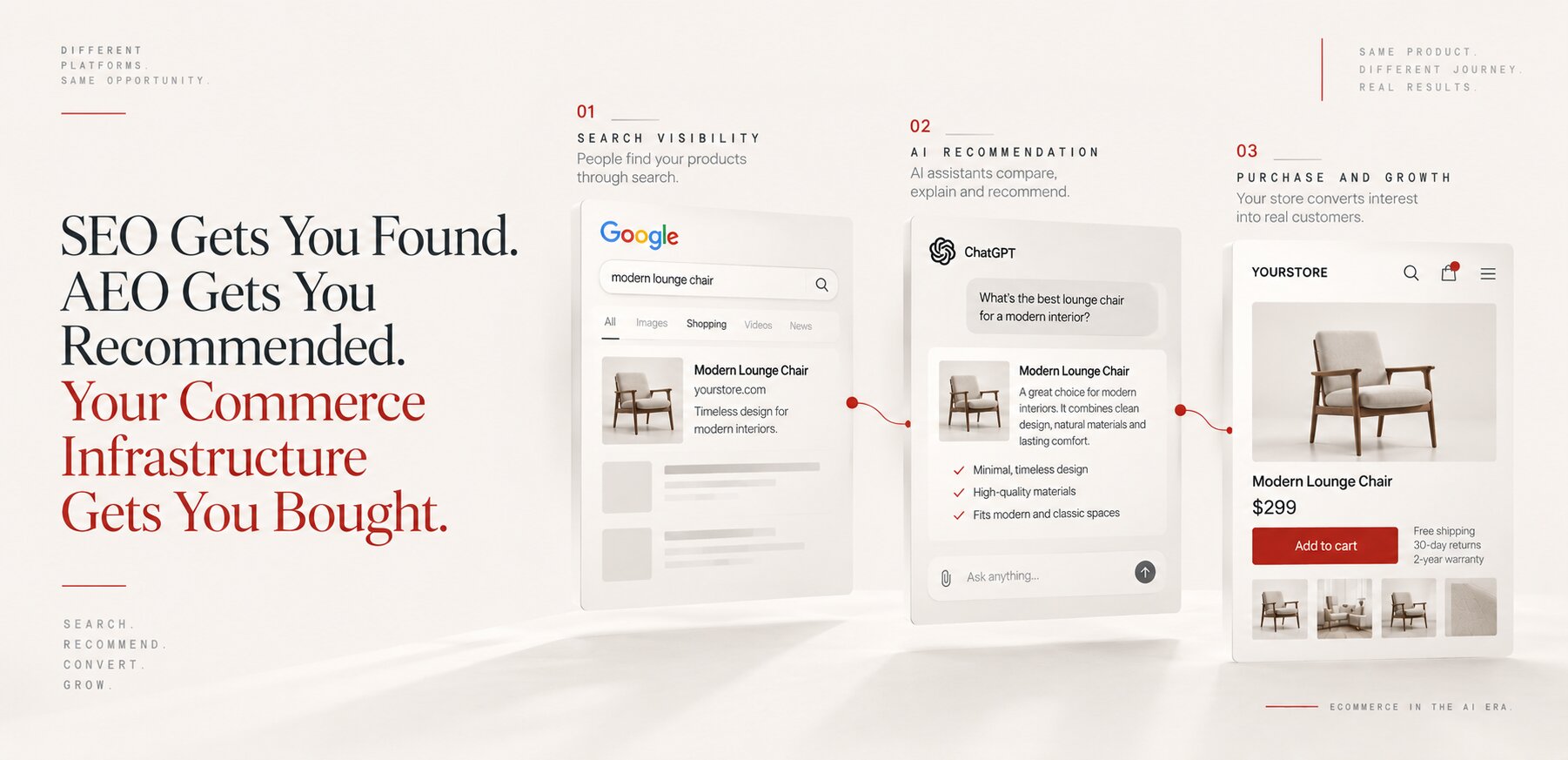
SEO Gets You Found. AEO Gets You Recommended. Your Commerce Infrastructure Gets You Bought.

-
06. 09. 2026

Multi-Country E-Commerce for Large Catalogues: The Architecture Decisions That Set the Ceiling
-
06. 09. 2026
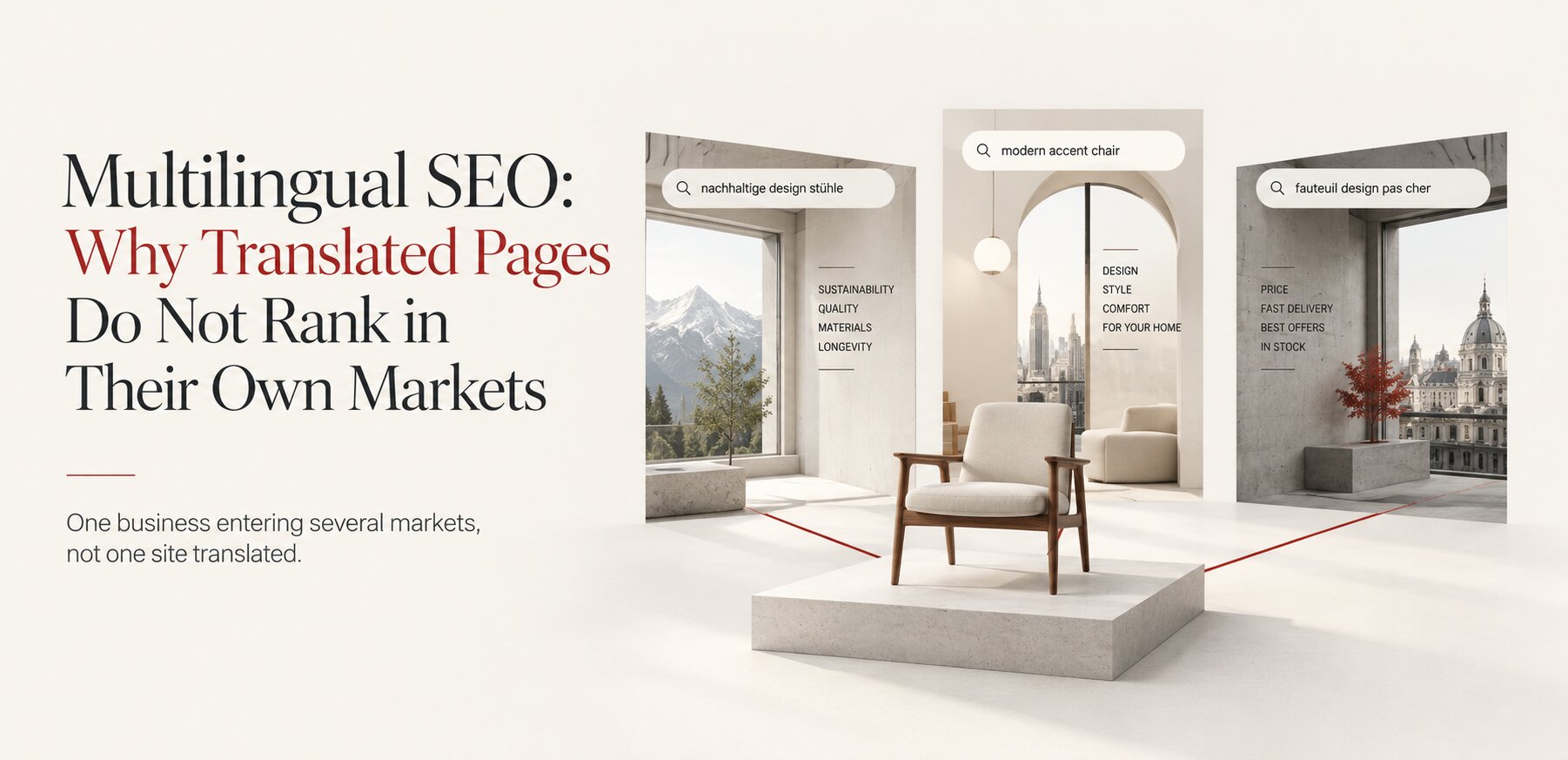
Multilingual SEO: Why Translated Pages Do Not Rank in Their Own Markets
-
20. 12. 2020
Why Your E-Commerce Store Needs a Blog in 2026 — And How to Start One That Actually Works