

What AI can amplify, what it cannot invent, and why the business still has to come first
THE PROMISE
The Promise
For fifteen years, SEO was sold as a growth engine.
Get the rankings right. Publish enough content. Build enough links. The clients will come.
Then search changed. AEO appeared. Then GEO. Now the promise sounds almost the same: make your business visible to AI, and the clients will come.
But there is a problem with both versions of the story.
Search can amplify a business. It cannot create one.
In short
- SEO, AEO and GEO make a business easier for search engines and AI assistants to find and describe. They amplify what already exists. They do not create the reasons people talk about you.
- AI assistants recommend businesses the rest of the web talks about. In an Ahrefs study of 75,000 brands, branded web mentions correlated with visibility in Google's AI Overviews about three times more strongly than backlinks.
- Buyers have moved: in G2's 2026 survey, 51% of B2B software buyers started their research with an AI chatbot more often than with Google.
- Most B2B buyers rank their preferred vendors before the first conversation. Being known before the need appears matters more than ever.
- A business has three layers, the 3R model: Reality, what it actually does; Reputation, what people say about it; and Representation, how it is described to machines. SEO, AEO and GEO work mainly on the third.
- AI can speed up research and drafting. It cannot replace the owner's story, judgment and voice.
THE AMPLIFIER
The Amplifier
SEO helps search engines find, understand and rank your pages. AEO helps answer engines give a correct and complete answer about your business. GEO helps generative systems like ChatGPT, Gemini and Perplexity include your business in the answers they compose, and describe it accurately.
Different names. Similar job: making an existing business easier for machines to find and understand.
None of them creates a reason for someone to talk about you. That part comes from the business itself.
AI INPUTS
What AI Works With
When someone asks ChatGPT, Perplexity or Google's AI for a recommendation, the answer is not built only from your website. It is assembled from a much wider information environment.
Ahrefs studied 75,000 brands and found that branded web mentions correlated with visibility in Google's AI Overviews at 0.664, compared with 0.218 for backlinks. A later analysis extended the work to ChatGPT and Google's AI Mode, where mentions on YouTube showed the strongest connection of all. These are correlations, not proof of causation, but they point to something important: the web outside your website has become part of your AI-readable reputation.
Buyers are listening to those systems. G2's March 2026 survey of 1,076 B2B software buyers found that 51% now begin research with an AI chatbot more often than with Google, up from 29% a year earlier. Sixty-nine percent said a chatbot's recommendation led them to choose a different vendor than they had planned.
THREE LAYERS
Reality, Reputation, Representation
It helps to see a business in three layers. We call it the 3R model: Reality, Reputation, Representation.
Reality is what the business actually does: its projects, results, craft, judgment and history.
Reputation is what people say about it: mentions, reviews, partners, clients, conversations.
Representation is how the business is described to machines: the website, structured data, case studies, articles, directories and everything else AI systems can read.
SEO, AEO and GEO work mainly on the third layer. They can make Representation clear, accurate and complete. They cannot replace Reality, and they cannot fully manufacture Reputation. When the first two layers are thin, a perfect third layer has very little to amplify.
THE LETTER
What Your Website Can't Do
In the businesses we help develop, we see the same pattern again and again.
The website gets better. Content gets published. Traffic grows. Positions improve. The charts look healthy. And for months, almost nobody new writes in.
Then the owner does something that rarely appears in an SEO plan. They choose a few companies they genuinely want to work with, study each one properly and write to them personally.
A letter is opened twice. Someone forwards it inside the company. People from that company start reading the website.
The website didn't bring them. The letter did. But the website was what met them when they arrived.
A personal letter does something an SEO campaign cannot. It gives someone a reason to look for you.
They search your name. They open your website. They forward your company to a colleague. They ask someone else about you, and more and more often, they ask an AI assistant. In the same Ahrefs research, how often people search for a brand by name also correlated with AI visibility more strongly than backlinks did.
The letter creates the signal. The digital infrastructure carries it.
An empty mass mailing does the opposite. Nobody looks you up after a letter that wasn't written for them.
EARLY CHOICE
Buyers Choose Early
There is a harder truth behind all of this.
6sense surveyed close to 4,000 B2B buyers for its 2025 Buyer Experience Report. Ninety-four percent of buying groups had already ranked their preferred vendors before the first contact with any seller, and they bought from that early favorite 77% of the time. Around 80% of first conversations were started by the buyer, not the vendor, and 85% of buyers had prior experience with the vendors they evaluated.
The important part isn't the number. It's what it means: by the time a seller enters the conversation, much of the decision may already be underway.
And most of the market isn't buying at all at any given moment. Professor John Dawes of the Ehrenberg-Bass Institute, working with LinkedIn's B2B Institute, described it as the 95-5 rule: only about 5% of B2B buyers are in the market right now. The rest won't buy for months or years, and when they do, they mostly rely on memory. The brand that gets remembered is the brand that gets bought.
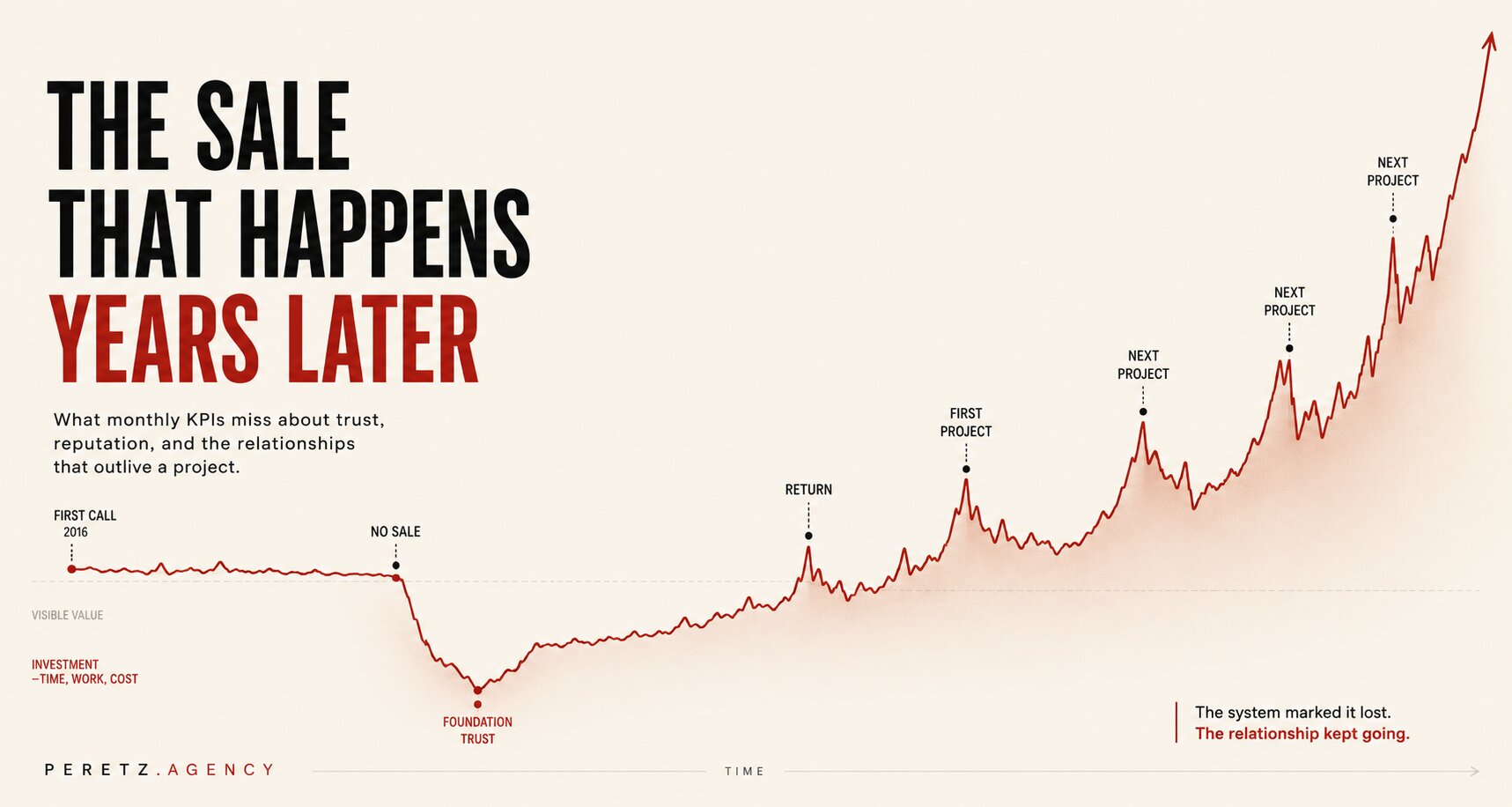
So the first job of a personal letter is not to sell this week. It is to make you known, remembered and trusted before the need appears. That is why the sale so often happens years later.
MY STORY
I Started Without a Website
I'm not writing this from the outside.
When I started this business, I didn't even have a website. A shoemaker without shoes. No portfolio that could impress anyone, no famous clients, no reputation. What I had was a car, a phone and a habit: I drove to clients and talked to them.
I couldn't compete on reputation, so I competed on preparation.
Before the first conversation, I asked myself one question: should I even be talking to this company? Then I studied it. Its competitors, not to copy them but to understand the business. Its own website in the web archive, to see what had changed over the years and what had already been tried. Its social media. The best companies in its field in Europe and America, and what had already become standard there but had not reached our market yet. Even small details: the thickness of a line, whether a sentence ended with a period or an ellipsis. Details like that are rarely just about design. They show whether a business works with discipline or in occasional bursts.
Very often I didn't come empty-handed. I brought a prototype that compressed everything I had understood into one page.
It didn't always work. The company that eventually gave us our name rejected us four times before saying yes. Somewhere between those meetings, I stopped trying to convince them and started trying to understand them. The full story of those five meetings is here.
Long before AI had a word for this, I was already doing the same thing manually. I was gathering signals before the first conversation.
WORKING AHEAD
We Always Work Ahead
The research says most buyers have chosen before they talk to you. That describes how most deals happen. It doesn't describe the only way.
Many times I walked into companies that had budgets, access to the top agencies in their market, and had already decided who they would work with. More than once, that decision changed. Not because I was more persuasive, but because we always work ahead. We came with a result before there was a contract: a deep understanding of their business and a solution they could see and feel rather than imagine.
Nothing has changed since. We don't stop, and we still show results before contracts. But the order matters: first we try to understand the business, through research and, whenever possible, a real conversation about its goals. Only then do we come back with a result. A solution offered before understanding is a guess with good design. A solution offered after it is the beginning of a partnership.
The clearest description of what that looks like wasn't written by us. It was written by a client. SV Group, a Kharkiv company that has built wooden interiors for families for decades, had been through several developers before us and had almost given up on a new website. Years later, their executive director, Sofya Shapko, wrote their own account of how the project went. The line I value most is about listening: we were, in her words, "learning our language instead of making us speak his." She describes the finished site as "an artifact of the client company coming to understand itself." And she ends with a sentence I could never have written about us myself: "Peretz doesn't sell websites. They dig into the essence of a business." Our side of that story is here.
Large companies and investors often see working ahead as a risk: effort that might never be paid back. I see it as a line in the budget, the same as marketing. Except that instead of buying impressions, it buys the chance to work with people we genuinely want to work with, and to build something on the next level with them. Not only with those who chose us, or didn't, long before we met, based on a portfolio or a budget. Those things matter. Our ambition just lies somewhere else.
The same logic shapes our marketing. We would rather spend our resources offering a strong solution to a business we admire than on impersonal advertising.
I want to be honest: this is our approach, not a universal rule. It depends on the business and the task. For some companies, working ahead without a contract would be reckless, even fatal. For us, it is how most of our best relationships began.
OUR SITE
Our Own Site Too
Over the past months we rebuilt our own site for the way the web is being read now: a modern framework instead of an aging one, structured data that describes who we are, files that tell AI assistants which pages matter, and a cleanup of scripts we had inherited and no longer controlled.
It is real work, and it matters. But it taught us the same lesson our clients learn.
The rebuilt site is ready to be found. It still needs a business that gives people a reason to look.
AI LIMITS
What AI Can't Know
AI can research your business. It can draft your letter. It can make the process dramatically faster.
But it cannot supply the part that makes a letter worth reading: your judgment. It does not know why you started, which projects changed the way you think, what you refused to do and why, or what your best clients actually value. It knows what has been written down somewhere, and the most valuable part of many businesses has never been written down anywhere.
This is especially true for craft. A surgeon's judgment, a chef's palate, an engineer's instinct for where a system will break: none of that lives neatly in a database. If your craft is not described anywhere, then for a machine it barely exists.
There is also a trust cost. Research published in Computers in Human Behavior found that people rarely suspect AI in everyday messages, but once they know AI wrote a message, they judge the sender as less sincere and less trustworthy. A study of more than 1,100 professionals by Peter Cardon and Anthony Coman found the same tension at work: AI-assisted messages looked professional, but senders who relied on AI heavily were trusted less. One template phrase can cost a letter everything the rest of it earned.
AI can make the work faster. It can't make it yours.
HUMAN LETTER
The Letter Needs a Human
Most outreach fails because it is empty: addressed to a role, not a person, about the sender, not the recipient, and sent to a thousand companies at once. The letters that get read are few, and each one is specific.
Before writing, you study the business: its history, what it is proud of, what has just changed. Then you write about that, not about yourself. You say what you genuinely noticed, including the uncomfortable part, but in proportion and with respect. And you make it a conversation between equals: if this sounds interesting, let's find a time that works for both of us and see how we could be useful to each other.
In B2B this matters more than anywhere else. Decisions are made by people who have been building their business for decades. They can tell in two sentences whether a letter was written for them or for a list.
And when owners draft such letters with AI, the same three versions tend to appear. The first draft is a critique: accurate, and it reads like an auditor's report from someone nobody invited. The second swings the other way: polite, careful, almost apologetic, and it reads like someone asking for a favor. The draft worth sending is the third, and the owner has to write it. It opens with the other company's story, says plainly and with respect what you see, mentions small problems as small problems, and ends as a conversation between two businesses that might be useful to each other.
The facts are the same in all three. What changes is the posture.
AI can help you find what to say. It cannot decide how you stand when you say it.
THE LOOP
The Loop
This is the part that is easy to miss when SEO, AEO, GEO, sales and content are treated as separate departments.
You do something worth talking about. Someone talks about it. Someone else searches for you by name. Your website explains the story in more depth. AI systems synthesize what is available across the web. More people discover you, more conversations happen, more reputation accumulates. Then the loop starts again.
Optimization sits inside this loop. It does not replace it.
PRACTICE
What This Means in Practice
If you have been waiting for your website to start bringing clients, the uncomfortable conclusion is not that SEO doesn't work. It is that the website needs something to amplify.
Do. Create something worth talking about.
Document. Make your thinking visible.
Talk. Have real conversations with real companies.
Amplify. Then make the website and AI-readable infrastructure carry those signals further.
What that looks like in practice:
- A few real letters every week. Not a hundred. Five or ten, to people whose business you have actually studied, saying something specific and true.
- A rhythm, not a single shot. Most of the people you write to are not buying this quarter. Plan three to five meaningful touches over the following months: a useful article, congratulations on their news, an invitation, a thought about their market.
- Create prior experience. Most buyers choose from vendors they already know. A small first project, a diagnostic or a strategy session is often worth more than a big proposal.
- Document your craft. Your history, decisions, projects and way of thinking are part of the information layer machines can understand.
- Earn third-party signals. Mentions, reviews on the platforms your buyers use, partner articles, interviews, videos and case studies a client agrees to publish make your reputation visible beyond your own website.
- Use AI for acceleration, not authorship. Let it research, structure and challenge you. Do not let it erase your voice.
- Then optimize the amplifier. Make the website, structured data, content and technical foundation clear enough for both people and machines.
Action first. Amplification second.
AGENCIES
An Honest Note on Agencies
This is an odd thing for an agency to write. We sell websites, SEO, AEO and GEO. We believe in them, and we have watched them change businesses.
But be careful with anyone, us included, who promises that search optimization alone will fill your calendar. A well-built site, readable by people and machines, is necessary. It is the amplifier, and a good one makes every real signal of your business louder and clearer. It is not a substitute for the signals themselves.
The best thing an agency can do is build that amplifier properly and be honest about what it will not do. The conversations, the relationships, the reputation you build one client at a time, the work worth remembering: those remain yours. Nobody can outsource them completely. Not to an agency. Not to a model.
THE ENGINE
The Business Is the Engine
The sale often happens long after the first contact, sometimes years later. Search and AI can shorten the path for businesses people already talk about. They cannot start the path for a business nobody has heard from.
So the question is not whether to invest in SEO, AEO or GEO. You should. The question is what they will amplify.
Your business is the engine. Everything else, search, AI, the website, this article, is there to make it heard.
FAQ
Frequently Asked Questions
Can SEO alone bring B2B clients?
Rarely as a complete system. SEO makes a business easier to find, but B2B buyers usually choose based on trust, relevance, reputation and prior experience. SEO amplifies those signals; it does not replace them.
What is the difference between SEO, AEO and GEO?
SEO helps search engines find and rank pages. AEO helps answer engines understand and answer questions about a business correctly. GEO helps generative AI systems like ChatGPT, Gemini and Perplexity include a business in their answers and describe it accurately.
What is the 3R model?
A way to see a business in three layers: Reality, what it actually does; Reputation, what people say about it; and Representation, how it is described to machines. SEO, AEO and GEO work mainly on Representation, so they can only amplify what the first two layers provide.
What do AI assistants use to decide which businesses to recommend?
Largely what the rest of the web says about you. In an Ahrefs study of 75,000 brands, branded web mentions correlated with AI Overview visibility at 0.664, compared with 0.218 for backlinks.
Do B2B buyers really use AI chatbots to choose vendors?
Increasingly, yes. In G2's March 2026 survey of 1,076 B2B software buyers, 51% started their research with an AI chatbot more often than with Google, and 69% chose a different vendor than planned because of a chatbot's recommendation.
Do most B2B buyers choose a vendor before contacting them?
Yes. In 6sense's 2025 survey of close to 4,000 B2B buyers, 94% of buying groups ranked preferred vendors before the first contact, and they bought from that early favorite 77% of the time.
Should I let AI write my sales emails?
Use it for research and a first draft. Then rewrite the message until it reflects your own judgment, voice and understanding of the recipient. People who learn a message was written by AI tend to trust the sender less.
Can personal outreach improve my search and AI visibility?
Indirectly, yes. A relevant, personal letter makes people search for your company by name, read your site, discuss you internally and sometimes mention you elsewhere. Brand searches and mentions are among the signals most closely linked to visibility in AI answers.
Is it worth doing work before a contract?
It depends on the business. For some it is an unacceptable risk. For us it is a deliberate investment, similar to a marketing budget, that lets us work with companies we genuinely want to work with and show what we can do before they have chosen someone else.
Sources
- AI Overviews Tracker and the 75,000-brand study summary, Ahrefs
- 9 Marketing Trends in 2026, with data, Ahrefs
- New G2 Research: Half of B2B Software Buyers Now Start Their Research With AI Chatbots, G2 via PR Newswire
- 2025 B2B Buyer Experience Report, 6sense
- The 95:5 rule: why B2B growth starts long before the purchase, Ehrenberg-Bass Institute
- Blissful (A)Ignorance: people do not suspect AI use in realistic contexts, Computers in Human Behavior
- Why AI emails can quietly destroy trust at work, ScienceDaily, on Cardon and Coman's study
- How the Story of One Website Became a Story of Self-Awareness, SV Group
Want to understand what your website should amplify, and what only you can do?
- Share
-

-

-

-