Website Design for Specialty Clinics: When the Doctor's Name Is the Brand





We build websites for a clinic, three professional medical societies and an education platform with more than 10,000 pages. The hardest problem in medicine is not attracting patients. It is making real authority visible.
SHORT ANSWER
What a Specialty Clinic Website Has to Do
A specialty clinic's website has to carry the authority of its physicians into search and AI answers, and route each patient to the right specialist, because in medicine the people are the brand. Reviews, before-and-after photos and stock images of equipment matter less than most agencies assume. What decides the choice of a serious patient is who will treat them, how much that person knows, and how quickly the clinic can actually see them. A site built around those three questions works for the patient, for search engines, and for anyone who will one day value the clinic as a business.
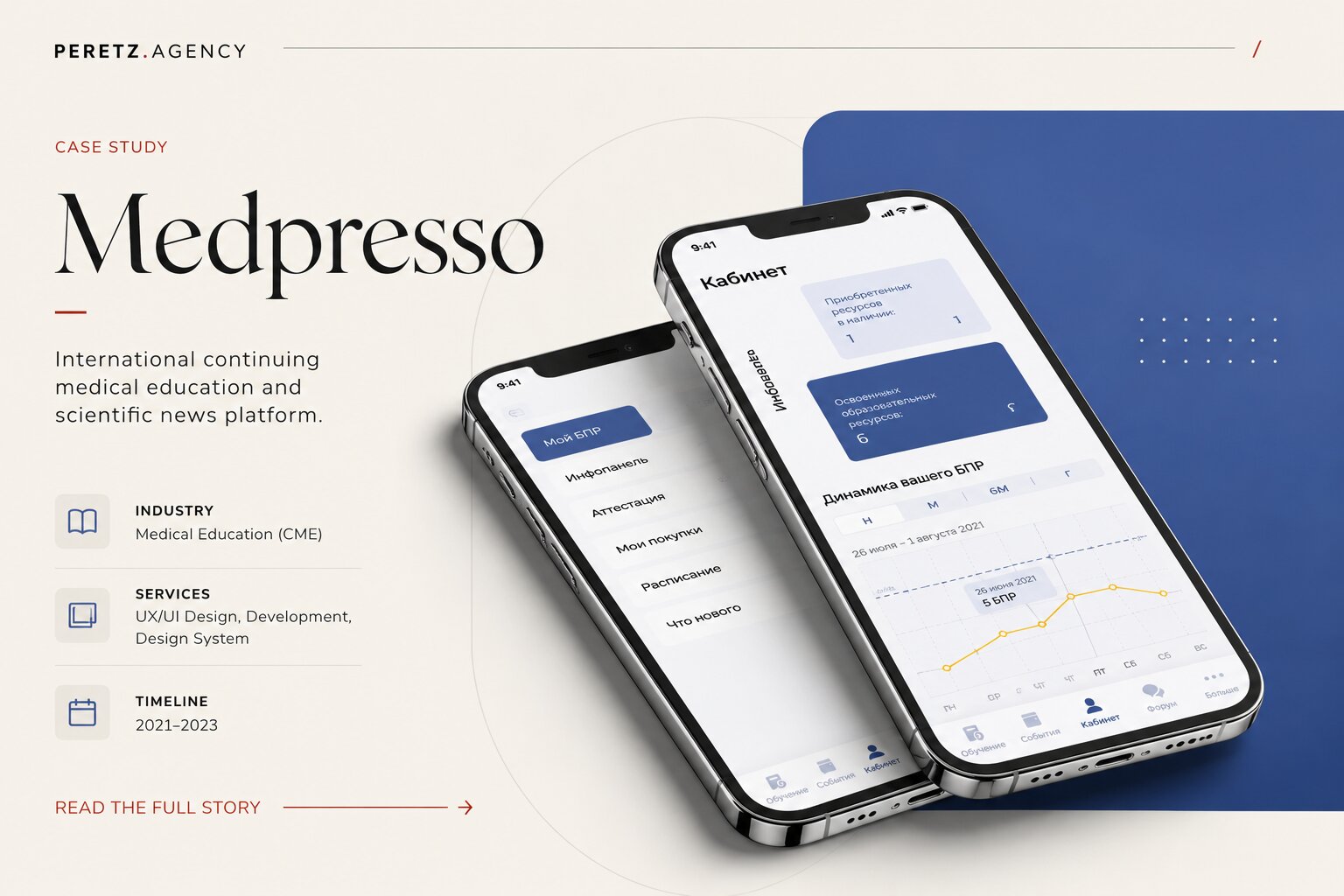
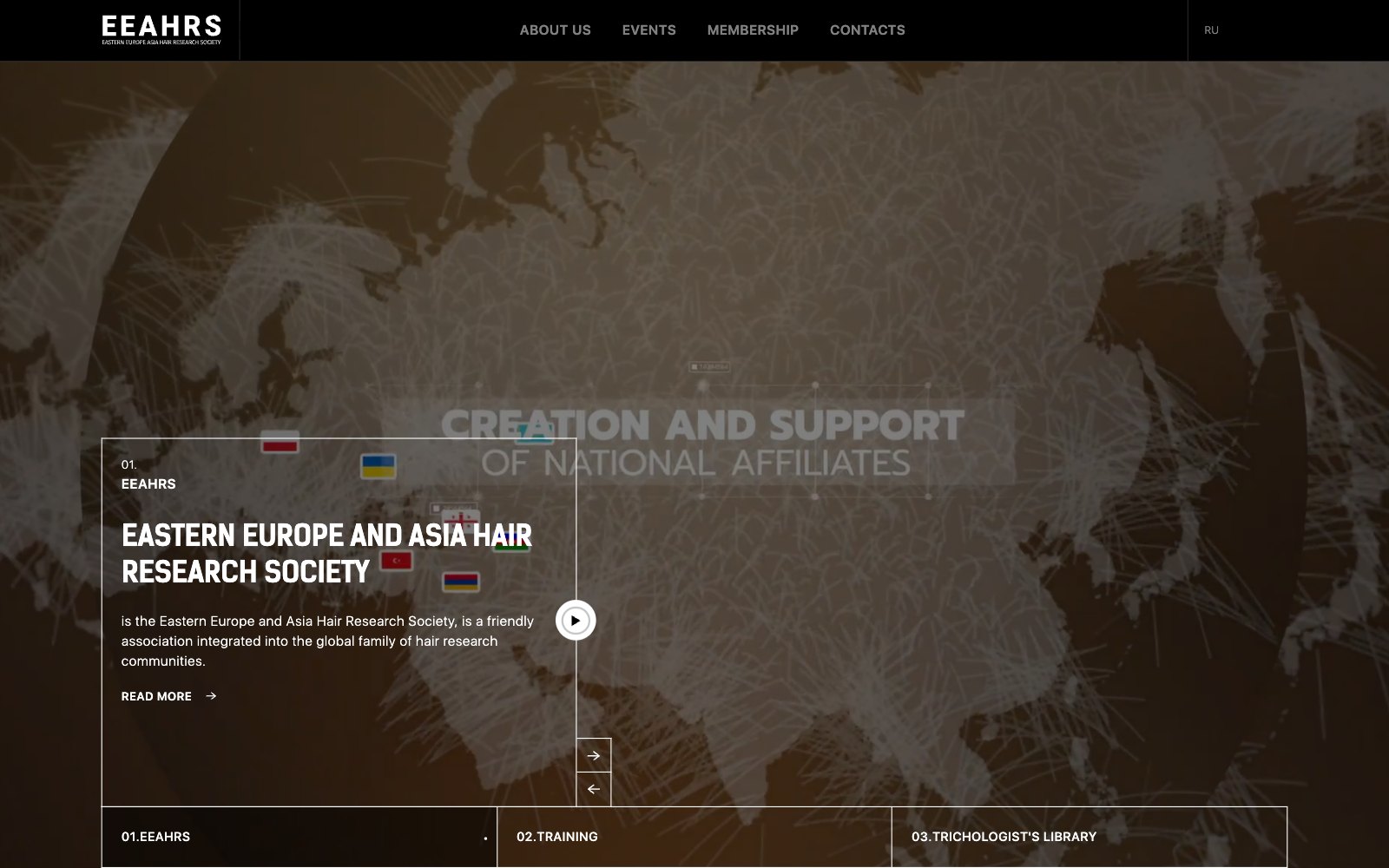
We see this from inside the field. Peretz has built and supported the websites of the Institute of Trichology, three professional societies in hair research and dermatology, and MEDPRESSO, a medical education platform with more than 10,000 pages of material and its own community for medical professionals.
WHO IT IS FOR
A Clinic, a Society and a Platform Are Three Different Websites
The first decision is who the website is for, and in medicine there are at least three very different answers.
- A clinic serves patients. They need departments, specialists, methods of treatment, a clear way to book and a sense of how soon they will be seen.
- A professional society serves doctors, residents, interns and students. Here publications, congresses, a directory of members and registration for educational programs do the work.
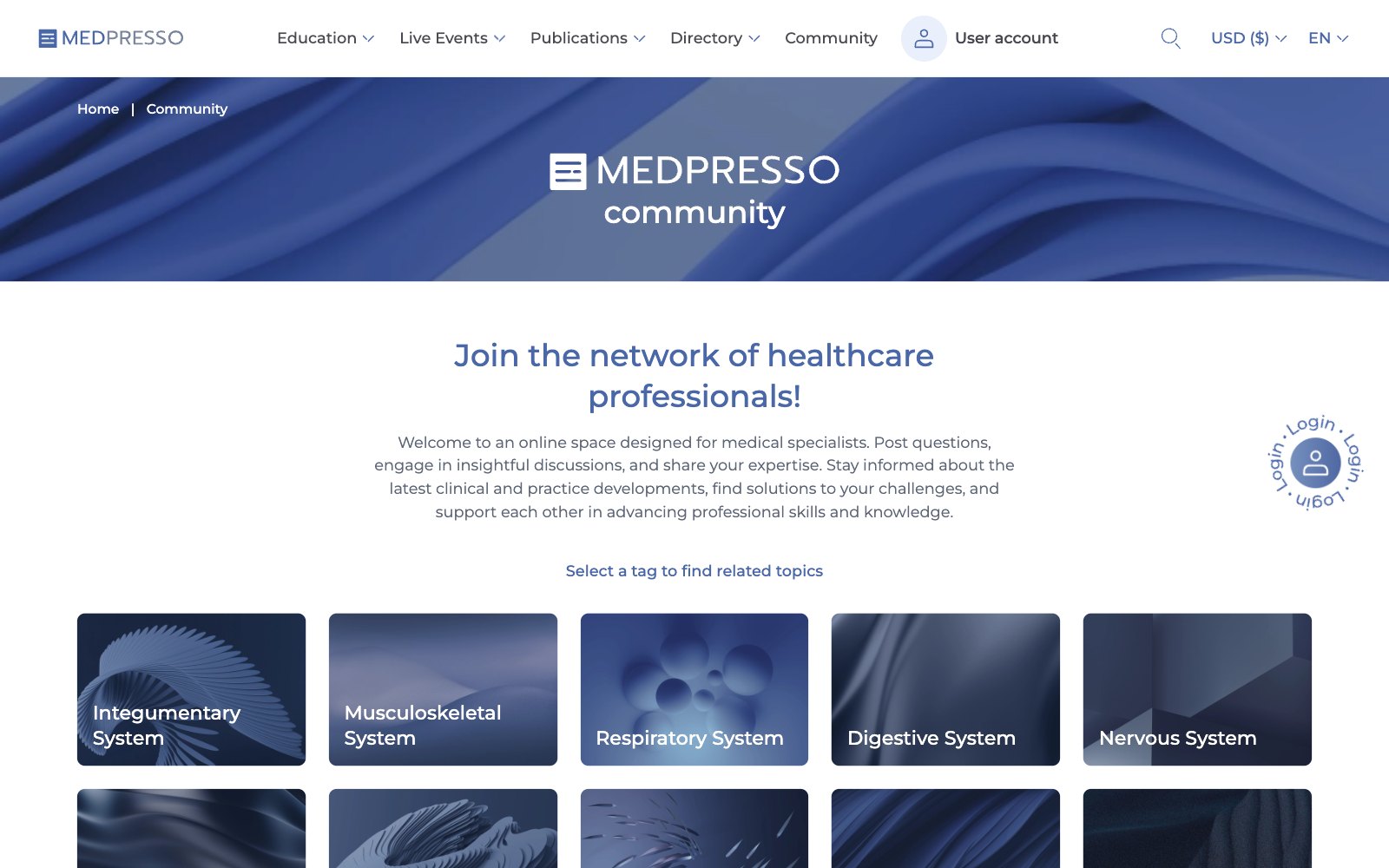
- An education platform serves the whole profession. MEDPRESSO covers every field of medicine, from video lectures and modules to clinical protocols, podcasts and a professional forum.
Each of these has its own user journey, and mixing them on one site serves nobody well. We always start with who the resource is for and how they actually use it, including how the competitors' users move through their sites, offline as well as online.
THE NAMES
When the Doctor's Name Is the Brand
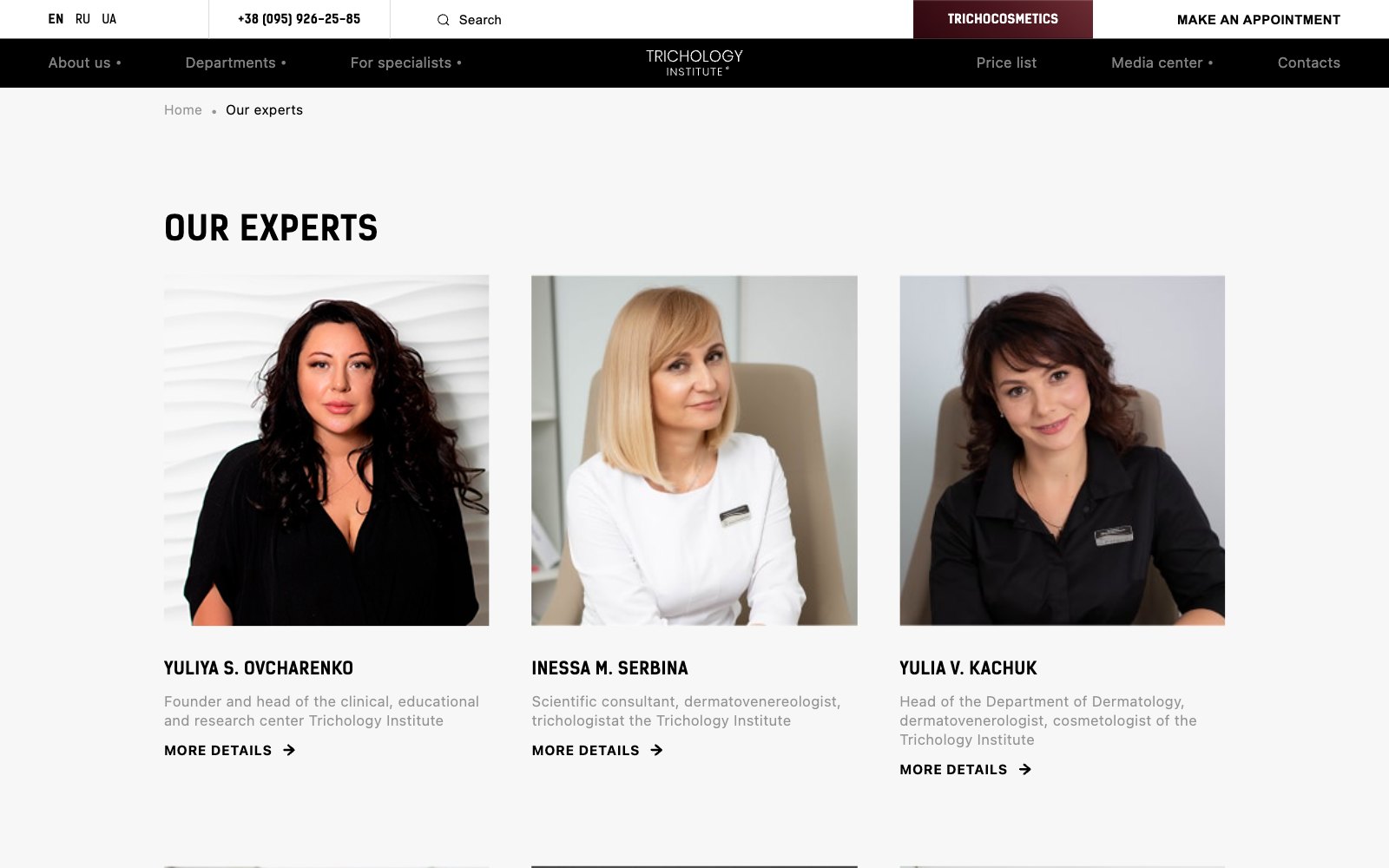
The Institute of Trichology is a clinic where the names do the marketing. Its founder and director, Prof. Yulia Ovcharenko, is president of the Ukrainian Hair Research Society, treasurer of the International Trichoscopy Society, vice president of the Eastern European and Asian Hair Research Society and the author of seven books, including *Trichology* and *Psychotrichology*. Patients and doctors book consultations and education with the Institute's specialists not weeks or months ahead but up to a year ahead. Reviews and before-and-after photos stopped playing a role long ago: the authority was built at congresses, in research and within the international professional community.
MEDPRESSO has a similar story. Its co-founder and member of the supervisory board, Prof. Oleg Vyrva, chief physician of the Sytenko Institute of Spine and Joint Pathology, author of more than 350 scientific publications and creator of the Ukrainian system of modular tumor endoprostheses, is one of the leading figures in bone oncology and orthopedics. He deliberately does not promote himself or use his name to push the platform. His position is that the material should speak first, not the authority of a particular person.
That restraint is admirable, and it is common among the best physicians. People who move science forward usually prefer doing science to doing marketing. The problem is what happens in the space they leave empty.
The best doctors are rarely the loudest ones online.
TWO EXTREMES
Real Authority Without Content, Content Without Authority
Medical websites tend to fall into one of two extremes.
The first is real authority with too little content. The names are serious, the expertise is deep, and the website shows a fraction of it: a short biography, a list of services, almost no publications. The knowledge exists, often a vast body of it, but it lives at congresses, in journals and on other platforms. Search engines and AI assistants cannot see what is not on the site, so they cannot connect the clinic to the knowledge behind it.
The second extreme is the opposite. There is no name and no clinical depth, but there is a steady flow of popular science articles written in exactly the structure that language models like to quote. Some of these projects go further, with mirror sites and networks of cross-links that inflate an authority that does not exist. Google treats several of these tactics as spam: since March 2024 its policies explicitly cover scaled content abuse, site reputation abuse and expired domain abuse. Still, such projects often surface in search and in AI answers before the real experts do.
In most industries this is unfair competition. In medicine it is a risk to people's health. We see the same pattern in the US with back and joint pain: patients often end up with whoever is most visible online rather than with an orthopedic specialist, and some of them pay for that choice with their health.
The answer is not for real physicians to imitate content farms. It is to make the authority they already have visible and verifiable on their own site.
If real experts stay silent online, someone else will answer for them.
MAKING AUTHORITY VISIBLE
How to Carry Offline Authority Onto the Site
Prof. Ovcharenko has built an enormous body of knowledge, but most of it lives offline and on other platforms, and we consider that a gap worth closing. For the Institute, the next step is a much larger publications section. In general, carrying real authority onto a clinic's site comes down to a few things:
- A real page for every physician: education, positions, memberships, books, publications, congresses and the conditions they treat, with links to the original sources.
- Publications on the clinic's own domain: reviews of research, clinical cases with consent, explanations of methods, written or checked by the specialists themselves.
- Structured data: markup that tells search engines which page describes a physician, which a medical clinic and which a condition, and how they connect.
- Links in both directions: from the clinic to its professional societies, journals and congresses, and from them back to the clinic.
This is exactly the work that search and AI assistants reward, because it connects a name to evidence. We explain the general principle in SEO, AEO and GEO Are Amplifiers, Not Engines: these channels amplify what is real, and they cannot replace it.
PATIENT JOURNEY
Start With the Patient Journey, Not the Clinic's Pride
When we built the Institute's current website, we did not start with a design. We studied heatmaps of its previous sites and of sites in related fields, and we mapped the patient journey both online and offline: how people find the clinic, what they read, when they call, what happens at the reception desk.
That work regularly exposes a gap between what the clinic wants to show and what patients look for. A physician wants to present expertise, equipment or the clinic's history. A patient wants to know which department deals with the problem, which specialist to see, what the method involves and how soon an appointment is possible. On the Institute's site, the departments and the specialists are the most read pages, by a wide margin.
Closing that gap sometimes means explaining to a brilliant specialist that patients do not read what the specialist is proudest of. That conversation is part of our work, and on difficult projects the founder of Peretz joins it personally.
DEMAND
When Demand Outgrows the Clinic
Most articles about clinic websites are about attracting more patients. The Institute's problem is the reverse. It uses social media, advertising, email and occasionally search ads, and in recent months the clinic has struggled to keep up with the flow. The waiting list for some specialists is very long, and turning off the booking forms is not an option.
There is a second complication. Among the requests are urgent cases and unusual clinical cases that need help quickly and are valuable to the profession precisely because they are rare. Those must not disappear in a general queue.
When demand outgrows capacity, the website's job changes from attracting to routing:
- sending each patient to the department and specialist that fits the problem;
- separating urgent requests from routine ones at the first step;
- showing honestly how long the wait is and what the alternatives are;
- growing the directions that used to be secondary.
For the Institute, those growing directions are trichopigmentation, hair replacement systems and hair transplantation. The clinic is expanding its departments and bringing in specialists, and each new direction needs its own pages, specialists and patient journey.
US PATIENTS
What Changes for an American Patient
In the United States, most patients reach a doctor through their insurance network, and the clinic's website plays a smaller role in that choice than in Europe. An American patient rarely studies a clinic's departments and methods the way a Ukrainian patient does. The exception is specialty care that patients pay for themselves, such as hair restoration, dermatology and aesthetics, and there the research before booking is as careful as anywhere.
What American patients and doctors do research closely is education and the specialists themselves. That is where we see a large gap: many US clinic websites run on template designs with weak patient journeys and little human tone, and very few of them carry the authority of their physicians the way a strong academic profile would. Education platforms such as MEDPRESSO address the professional side of this gap, and clinic websites can close the patient side.
US RULES
Privacy and Accessibility in the US
Two areas need attention on any American clinic website, and both are worth checking with legal counsel.
The first is tracking. In December 2022 the Office for Civil Rights at HHS warned that analytics and advertising pixels on healthcare websites could expose protected health information, and it revised that guidance in March 2024. In June 2024 a federal court in Texas vacated the part covering public, unauthenticated pages, and HHS later dropped its appeal. Tracking on pages behind a login, such as patient portals, remains a clear risk, and booking forms deserve careful review of what any pixel can see.
The second is accessibility. Lawsuits over website accessibility under the Americans with Disabilities Act are common in the US, and WCAG 2.1 at level AA is the usual benchmark for forms, contrast, navigation and alternative text. For a medical site, where many visitors are older or unwell, accessibility is also simply good design.
ROLL-UPS
How Clinic Roll-Ups Erase Authority
Clinic groups are buying practices at scale. In dermatology alone, more than 35 private equity backed platforms operate across nearly 20 states, and single mergers now bring together more than 150 practices. The same consolidation is under way in dental care, ophthalmology, orthopedics and aesthetics.
When we reviewed the websites of US clinic groups, we kept seeing the same pattern. The acquired clinics are folded into one brand and moved onto subdomains or thin location pages. Each location gets an address, opening hours, a list of accepted insurance plans and a row of photos with a doctor's name and title. Everything that made the practice known locally disappears: the physicians' experience, their publications, the conditions they are known for, the years of articles and links built around the old domain. What remains is an insurance clinic that looks like every other location of the group.
For a group that sells through insurance networks this may look efficient, but it throws away the one asset an acquisition cannot rebuild quickly: visible medical authority. Subdomains also split the authority of the main domain instead of adding to it, and old URLs that are not redirected carefully take their search history with them. We describe the technical side of this choice in Multilingual SEO: Why Translated Pages Do Not Rank in Their Own Markets, where the same domain, subdomain and folder decision decides whether authority accumulates or starts again.
THE MAYO MODEL
The Other Way: The Mayo Clinic Model
There is an example of the opposite approach, and it is the best known name in American medicine. Mayo Clinic has led the U.S. News & World Report Best Hospitals ranking for 2025-2026, for the 36th time since the ranking began, and its website is built the same way the institution is.
The structure follows the medicine. Expertise comes first, then the specialists, then the departments and centers, and the whole site leans on serious medicine with a strong emphasis on diagnosis. A patient who searches for a condition lands on a page that explains it, shows how it is diagnosed and treated, and leads to the physicians and departments who handle it. The physicians are presented with their areas of expertise and their research, so the authority of the people and of the institution reinforce each other on every page.
When we build our own medical projects and products, we follow the same path: expertise, specialists, directions, high medicine and a strong focus on diagnostics. A clinic group does not need Mayo's scale to use the model. It needs to decide that the website will carry medical authority rather than only list locations.
Mayo's website is built the way Mayo practices medicine.
CLINIC GROUPS
A Checklist for Clinic Groups and Buyers
For a group that acquires and develops clinics, all of this becomes a question of value. When a clinic's authority lives in the names of a few physicians and mostly offline, the business carries a key-person risk that a buyer will notice. Valeriya Chumachenko describes this discount in Founder Dependency: The Discount Nobody Puts in the Deck, and what happens to the site after a deal is covered in What Happens to the Website After an Acquisition?
Before buying a clinic, or before folding it into a group brand, it is worth answering a few questions:
1. Where does the clinic's authority live? On its own domain, on the physicians' personal profiles, in journals and congresses, or nowhere online at all?
2. Who owns the domain, the content and the accounts? The practice, a physician personally, or an agency that built the site years ago?
3. Which physicians carry the reputation, and will they stay after the deal?
4. Which pages bring patients today? Departments, physician pages, condition pages or the home page?
5. What happens to the old URLs if the clinic moves onto the group's site, and who maps every redirect?
6. Will each physician keep a full profile with credentials and publications, or shrink to a photo and a title?
7. Where do the publications go: onto the group's domain, into a folder for the clinic, or nowhere?
8. What do the tracking tools on the booking forms and patient portal collect, and has anyone reviewed them?
The answers show whether a clinic's digital authority is an asset the group is buying or a value that will disappear after the rebrand.
MISTAKES
Mistakes We See Most Often
- The main subject is not covered: too few materials, texts and pieces of evidence about what the clinic actually treats.
- Authority hidden offline: world-class names with a two-line biography on the site.
- The clinic's pride instead of the patient's question: equipment and history first, departments and specialists buried.
- One queue for everything: urgent and rare cases lost among routine requests.
- Tracking pixels everywhere: analytics on booking forms and patient portals without a review of what they collect.
- A template group site on subdomains: acquired clinics lose their physicians' visibility and their search history in a single rebrand.
FAQ
Frequently Asked Questions
What should a specialty clinic website include?
Departments, a detailed page for every physician with credentials and publications, clear descriptions of methods, an easy way to book, honest information about waiting times and a publications section on the clinic's own domain.
Do reviews and before-and-after photos matter for a clinic website?
For clinics with established medical authority they matter less than most agencies assume. What decides a serious patient's choice is the specialist, the evidence behind the method and how soon the clinic can help.
How can a clinic appear in AI answers?
By publishing real expertise on its own site: physician pages with verifiable credentials, publications written or checked by specialists, structured data and links to professional societies and journals. AI assistants amplify evidence they can find.
Can a clinic use Google Analytics or Meta Pixel on its website?
Use them with care. US guidance treats tracking on authenticated pages such as patient portals as a clear risk, and booking forms need a review of what any pixel can see. Check the setup with legal counsel.
What can clinic websites learn from Mayo Clinic?
To build the site the way the medicine is organized: expertise and conditions first, then specialists and departments, with diagnosis explained on every condition page and physicians presented with their research.
Why do acquired clinics lose search visibility?
Often because they are moved onto a template group site or a subdomain, the physicians' pages shrink, old URLs disappear and the authority built over years is not carried over.
Sources
- Karazin University: Prof. Yulia Ovcharenko
- Mayo Clinic News Network: Mayo Clinic leads U.S. News Best Hospitals 2025-2026
- Healio: Private equity in dermatology, consolidation and modernization
- Google Search Central: Spam policies
- Search Engine Journal: Google March 2024 core update and new spam policies
- Morrison Foerster: HHS withdraws appeal on online tracking guidance
Your clinic's authority is real, but search and AI cannot see it yet? Start with a strategic session on how patients and buyers will see your clinic.
- Share
-

-

-

-

One notification a week with the new PERETZ articles. Nothing else.