
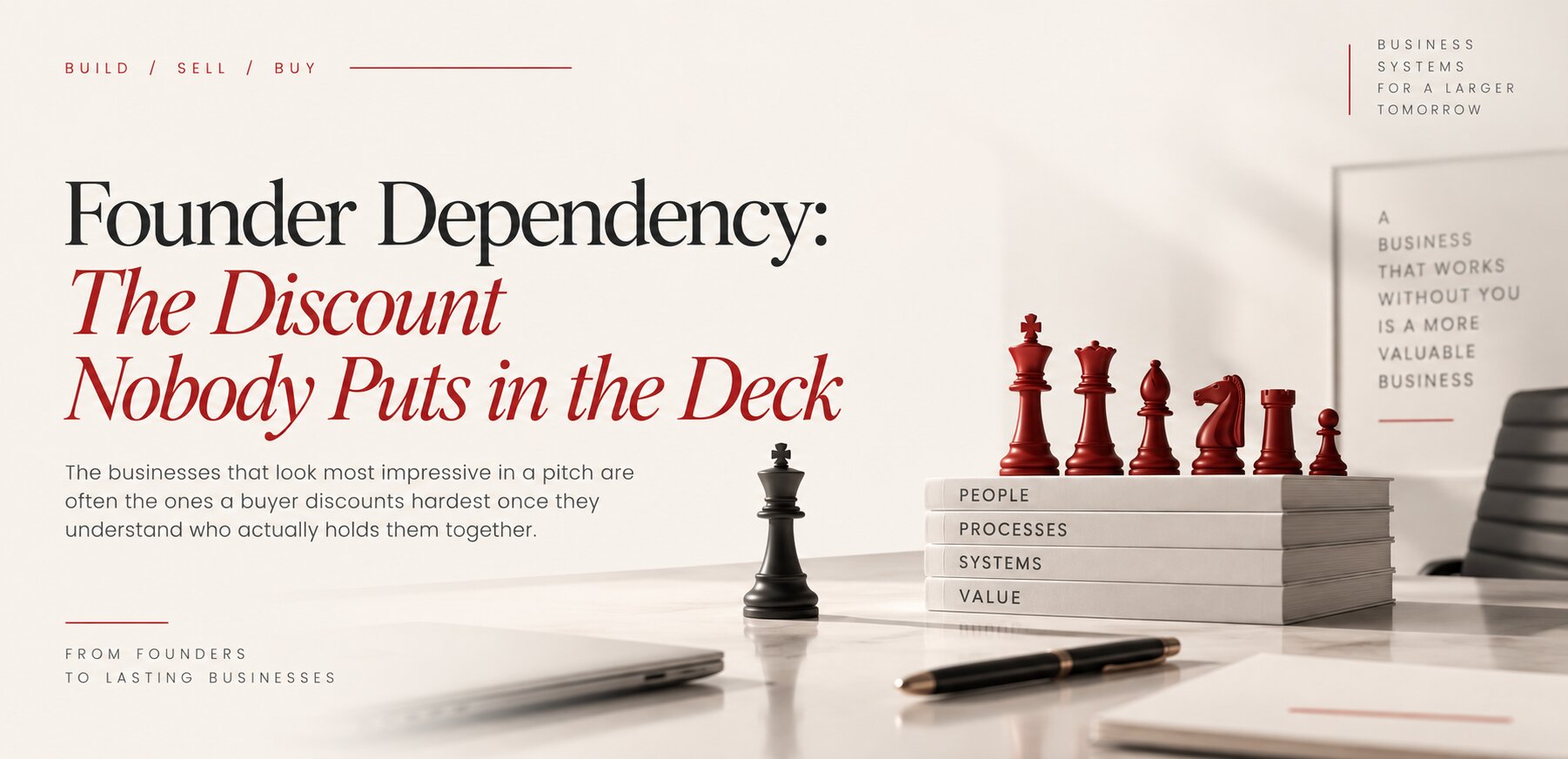
The businesses that look most impressive in a pitch are sometimes the ones a buyer discounts most heavily once they understand who actually holds them together.
Revenue is up. Margins are healthy. Customers are happy.
And underneath all of it is one person who knows which vendor actually ships on time, which client will only take the call if it's them personally, which process breaks twice a year, and which internal system nobody else has ever had to touch because it has never failed while they were watching it.
None of that appears on a financial statement.
All of it appears in a valuation.
A business that depends entirely on one person isn't really independent yet.
It is that person, wearing a business as a coat.
WHAT DEPENDENCY MEANS
What Founder Dependency Actually Means
Founder dependency is not simply that the founder works hard, cares deeply, or remains important to the business.
Almost every founder does.
The more useful definition is narrower: founder dependency exists when critical knowledge, key relationships, or final decision-making authority are concentrated in one person, and the business would perform materially differently if that person became unavailable for an extended period.
That distinction matters. "Of course the founder is important" is not a finding.
The questions a buyer actually needs answered are much more specific. Which decisions can only be made by the founder. Which customers will only deal with the founder. Which operational problems can only the founder solve. Which relationships exist because of the company, and which exist because of the individual. And which parts of the business have never been documented simply because the person who knows them has always been there.
That is founder dependency.
INVISIBLE FROM OUTSIDE
Why It Is Invisible From the Outside
Founder dependency is particularly dangerous because a dependent business can look completely healthy right up until the dependency is tested.
Revenue can be strong. Growth can be real. Customers can be satisfied. The team can appear capable. Financial statements can look excellent.
None of those things tell a buyer whether the company runs on documented processes and transferable capability, or on one person's judgment, relationships, and constant availability. The real operational logic of a business can live in places no balance sheet captures, inside one person's head, inside one person's spreadsheet, inside one person's inbox, or inside a set of decisions that everybody understands only because someone always knows who to ask, exactly the pattern behind every enterprise system started as someone's spreadsheet, the same pattern covered from the knowledge side in how to audit a digital product before you buy it.
That is why dependency is so easy to miss during normal operations. Nothing is broken. The problem is that the system has never been tested without its central component.
WHERE IT HIDES
Where Dependency Actually Hides
The pattern tends to appear in the same places.
A key account may technically belong to the company, but if the customer calls one person, trusts one person, negotiates with one person, and would reconsider the relationship if that person left, the relationship is not fully institutionalized.
A critical process may exist nowhere except in someone's memory. Everyone knows who to ask. Nobody knows what to do when that person is unavailable.
Revenue may look repeatable in the financials while the actual engine is a founder's personal network, reputation, and ability to close the right conversations. That is not the same thing as a repeatable sales process.
Terms, exceptions, and continuity may depend on personal trust rather than a structured relationship another executive could inherit.
Pricing exceptions. Hiring. Product direction. Client escalation. Major spending. Strategic decisions. A founder may technically have a leadership team around them while still remaining the final decision-maker on everything that matters. Delegation that exists only occasionally is not the same as delegated authority.
Where Dependency Concentrates
| Area | What Dependency Looks Like |
|---|---|
| Customer relationships | Key accounts deal with one specific person, not the company |
| Operational knowledge | Critical processes exist undocumented in one person's head |
| Sales and growth | Revenue depends on one person's network and credibility |
| Vendor relationships | Continuity rests on personal trust rather than a durable company relationship |
| Decision authority | Meaningful decisions have never actually been delegated |
None of these are automatically signs of a badly run company. Most early-stage businesses work this way because they have to.
Founder dependency becomes a valuation problem when it is still present, unaddressed and unpriced, at the point a buyer is evaluating the business.
EFFECT ON VALUATION
The Direct Effect on Valuation
Buyers do not need to call founder dependency by name to price it. They can price it through the deal structure.
A highly dependent business may receive a lower valuation multiple because the buyer is effectively underwriting transition risk. The issue is not necessarily that the historical numbers are wrong. The issue is whether those numbers survive a change in ownership.
That can lead to an earn-out, with part of the purchase price tied to future performance. It can lead to a retention or consulting agreement requiring the founder to remain involved for a defined transition period. And in severe cases, it can stop a transaction altogether.
The business may be profitable. The customers may be real. The growth may be real. But if the buyer cannot build a credible model of the company after the current owner stops showing up, the asset becomes much harder to underwrite.
A buyer is not necessarily discounting the business because they distrust the numbers. They may be discounting it because they cannot verify that the numbers survive the transition.
NOT INVISIBILITY
The Goal Is Not Founder Invisibility
There is a bad version of operational independence. A founder disappears. The business becomes bureaucratic. Relationships weaken. Decision-making slows down. The instinct to remove every trace of the founder can destroy part of what made the business valuable in the first place.
The goal is not to eliminate the founder's contribution. The goal is to make that contribution visible, documented, and transferable.
The judgment that built the company has value. The relationships that created growth have value. The instincts behind product and commercial decisions have value, the same ownership question covered more broadly in what you own vs what you're renting. What creates risk is when all of that value exists only in one person's head. That is a very different problem.
HOW TO REDUCE IT
How to Reduce Founder Dependency Without Destroying the Business
The practical work is usually less dramatic than founders expect.
Document the decisions that currently exist only as judgment calls. Not to eliminate judgment, but to make the reasoning visible enough that someone else can apply it consistently.
Create a second layer of relationship with key accounts. The goal is not to replace the founder's relationship. It is to make sure that relationship is not the only relationship the customer has with the company.
Build a repeatable sales process alongside whatever personal network currently drives growth.
And delegate actual authority. Not as a one-time experiment. Not as "they can handle it while I'm away." Real authority, exercised repeatedly enough that a buyer can see evidence the business continues to function without constant founder intervention, exactly the kind of durable, evidenced pattern covered more broadly in why tech companies get valued on different math.
That is what turns founder value into company value, the same discipline described from the inside, in the founder's own words, in systems, but human.
90 DAY TEST
The 90-Day Test
A buyer's most useful question is surprisingly simple: what happens to this business in the first ninety days after the founder becomes unavailable?
Not forever. Ninety days.
Do the key accounts continue to be served. Does anyone else know how to solve the operational problem that appears twice a year. Does revenue continue to come through a process. Can pricing decisions be made without escalation. Can the team make consequential decisions without waiting for the founder. Does the business keep moving, or does it quietly start waiting.
These are not theoretical questions. They are checkable. And the answers are more informative than almost any reassurance a seller can provide.
ASSET BUYER BUYS
The Asset a Buyer Is Actually Buying
There is an important difference between owning a business and buying one.
An owner can personally compensate for almost any missing system. A buyer cannot assume they will.
The founder can work late. The founder can fix the client problem. The founder can remember the vendor history. The founder can make the exception. The founder can close the sale. That can keep a business running for years.
But eventually the buyer has to ask a different question: what exactly am I buying that continues to exist after you leave?
That is the point where founder dependency becomes visible, one of the most common reasons a buyer hesitates regardless of how well the business otherwise fits their strategic thesis, covered from the buyer's side in buyer universe: reasons, not names. That is why it rarely appears as a line item in the pitch deck.
It appears in the price.
BUILD FOR SOMEONE ELSE
Build It So Someone Else Can Own It
The founder who can never stop working is not necessarily demonstrating commitment. From a buyer's perspective, they may be demonstrating something else: that the business still contains concentrated risk no one has successfully transferred.
Building a company that can operate without its founder is therefore not simply an operational exercise. It is part of building an asset. And for an owner who may eventually sell, that distinction matters enormously.
A business becomes more transferable when its critical knowledge can be transferred, its relationships can survive a change in ownership, its decisions can be made by more than one person, and its revenue can continue without the founder acting as the permanent operating system.
The strongest proof is not a statement in the sale deck. It is the evidence that the company has already learned how to function without you.
What is founder dependency in M&A terms?
Founder dependency is a risk where critical knowledge, key relationships, or final decision-making authority are concentrated in one person, such that the business would perform materially differently if that person became unavailable for an extended period.
How does founder dependency affect valuation?
It can influence the valuation multiple, the structure of an earn-out, the need for a founder retention or consulting agreement, and, in severe cases, whether a transaction can be credibly underwritten at all.
Does reducing founder dependency mean the founder should disappear?
No. The objective is not founder invisibility. It is making the founder's knowledge, relationships, and judgment at least partly transferable, so they become part of the business rather than remaining solely attached to the individual.
How can a business measure founder dependency?
A practical test is the first ninety days after the founder becomes unavailable. Look at customer continuity, recurring operational problems, sales activity, decision-making, and revenue generation. The question is whether the business continues to operate through systems and people rather than through the founder's constant intervention.
Does founder dependency only matter in small businesses?
No. A larger company can still have concentrated dependency in a major customer relationship, a specific piece of undocumented knowledge, or a critical decision-making bottleneck. Scale changes the financial impact of the risk, not the nature of the risk.
Not sure how dependent your business actually is on you? The 90-day test is a good place to start finding out.
- Share
-

-

-

-

Related Reading
-
18. 09. 2026

How to Audit a Website or Digital Product Before You Buy It

-
19. 09. 2026
Why Tech Companies Get Valued on Different Math Than Everyone Else
-
19. 09. 2026

Buyer Universe: Why "Anyone Could Buy This" Means No One Will
-
02. 08. 2026
Every Enterprise System Started as Someone's Spreadsheet
-
16. 09. 2026
What You Own vs What You're Renting: The Digital Ownership Audit
-
19. 09. 2026

I Sometimes Feel Like I Became Michael Scott by Accident