


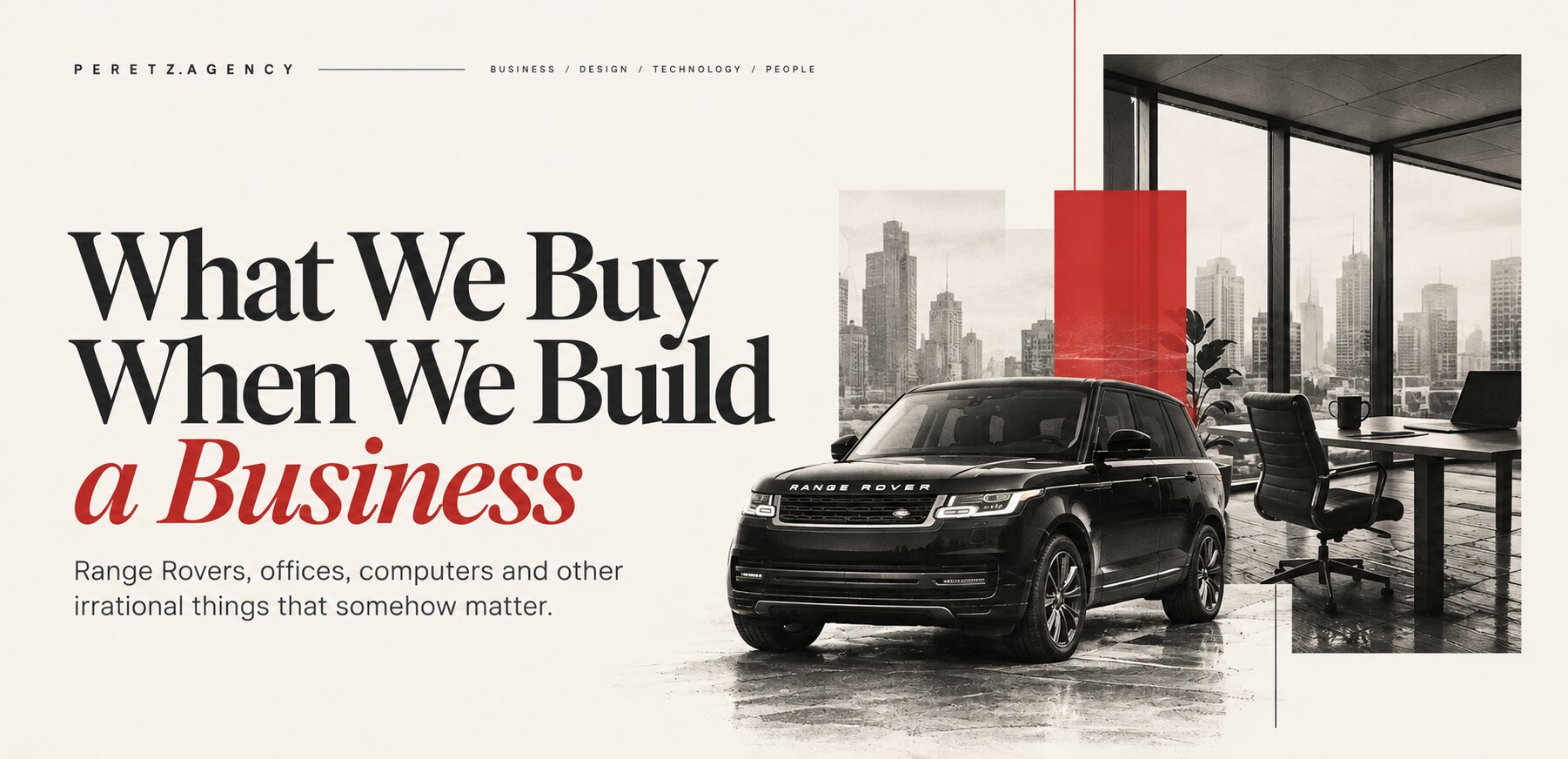
What we actually buy when we build a business, cars, offices, and the version of ourselves we're trying to prove.
My first real car was a top-of-the-line Range Rover.
Not because I needed one.
At least, not entirely.
I needed to prove something to myself.
The interesting part is that when I bought it, the business was already successful. I wasn't trying to escape financial problems or pretend things were going better than they were.
But the business was still at a stage where every dollar could be put back into growth.
There was always another developer to hire. Another market to test. Another project to finance. Another problem to solve.
So there was a real choice.
Keep putting everything back into the business, or allow myself to have something I had wanted for a long time.
I bought the Range Rover.
And then things got interesting.
THE RANGE ROVER
The $50,000 Range Rover
It turned out that owning a top-of-the-line Range Rover and owning a top-of-the-line Range Rover that actually worked were two very different things.
I started fixing it.
Then fixing what I had already fixed.
Suspension. Electronics. Air suspension. Engine. Transmission.
Eventually, practically everything went through my hands.
I rebuilt the engine.
The transmission was completely rebuilt.
The suspension was rebuilt.
I replaced things that most people would never notice, including the glass and badges, because if I was going to restore the car, I wanted the original parts.
By the end, I had put around fifty thousand dollars into rebuilding it.
Which is a ridiculous amount of money to put into an old Range Rover.
And yet I don't regret it.
Not because it was a good financial decision.
It wasn't.
I don't regret it because I grew together with that car.
It belonged to a particular period of my life. The business was growing, I was growing with it, and somehow that ridiculous machine became part of the story.
There was another funny thing about it.
When I first bought it, I parked it far away from the office.
I didn't want people to know I was driving it.
I wasn't trying to show anyone that I had made it.
I was trying to prove it to myself.
Eventually, of course, clients noticed.
And the car did have an effect on how people perceived the company. It wasn't a sales strategy. But people see things, connect them, and make their own assumptions about the success and weight of a company, the same thing The Sale That Happens Years Later is really about.
So the car wasn't entirely irrational either.
It just wasn't rational in the way a spreadsheet would understand.
Later I bought another new Range Rover.
It was objectively a better car.
Newer. More reliable. More comfortable.
But it wasn't the same.
The first one had cost me blood, time, money and an unreasonable amount of patience. I had rebuilt it almost piece by piece.
The second one was simply a very good car.
The first one was mine.
That distinction stayed with me.
SAME PATTERN BUSINESS
Then I Started Seeing the Same Pattern in Business
I know many people who have bought expensive cars for similar reasons.
Porsche.
Mercedes.
Audi V12.
Sometimes they need the car.
Sometimes they want the car.
And sometimes they need to prove to themselves that they can have the car.
There is nothing inherently wrong with that.
We don't build businesses purely to maximize a spreadsheet.
We build them because we want a certain life.
We want freedom.
We want interesting work.
We want to be proud of what we created.
And sometimes we want beautiful things.
That's part of the deal.
The interesting part is what happens when the same psychological pattern moves into the business itself.
Because business gives us much more sophisticated ways to justify the things we want.
You don't buy a car anymore.
You build an office.
You don't buy a watch.
You build a brand.
You don't buy a computer.
You build a technology stack.
And suddenly something that started as a personal desire can acquire the language of strategy.
That's when I became more careful.
Because I've done it too.
THE OFFICE
The Office
I was a perfectionist.
And perfectionism can become expensive very quickly when you are building a company.
I invested heavily in a new office.
Not just in making it functional.
I cared about the materials, the finishes, the details and the facade.
I wanted it to feel premium.
I wanted the physical space to represent the level of work we were trying to create.
And there were good reasons for some of it.
I cared about the people who worked there.
I wanted them to have a place they actually wanted to come to.
A place where people could stay late, argue about ideas, drink coffee, make stupid jokes and somehow turn all of that into good work.
Sometimes I had to be a little bit like Michael Scott.
Not because everything had to be perfectly efficient.
Because sometimes the slightly ridiculous things are what make a workplace feel alive.
A perfectly optimized office can be efficient.
But it doesn't necessarily become a place people love.
And that matters too.
The problem was that I didn't always know where the line was.
Some of the money going into the office could have gone somewhere else.
Marketing.
Security.
Technical debt.
Infrastructure.
Testing new markets.
Things that could have made the company stronger in ways nobody would notice when they walked through the door.
And then the war came.
And I never got to use the new office the way I had imagined. A Place to Build tells the fuller story of that office, before any of this happened to it.
But there was something even stranger about it.
I never got to say goodbye.
Not to the old office.
Not to the new one.
There was no final evening.
No last coffee.
No moment when everyone packed their things and said, "Well, that's it."
The war simply changed the coordinates of everyone's lives.
One day there were offices.
Then there weren't.
And only later did I understand how much those rooms had accumulated.
The walls had seen the first projects, the arguments, the deadlines, the celebrations, the stupid ideas that somehow worked.
The new office was supposed to be the next chapter.
We never got to finish the previous one properly.
And the same thing happened with the Range Rover.
I never got to say goodbye to that car either.
For all its irrationality, it had become a member of the family.
There was no final drive.
No last look at it.
No moment of putting the keys down and saying goodbye.
It simply disappeared from my life along with a whole part of the world I had known.
Sometimes I think about Michael Scott leaving The Office.
He didn't really get the kind of ending you would expect from someone who had spent so many years there.
And strangely, I understand that feeling. I sometimes feel like I became Michael Scott by accident, quietly leaving a place that had been a huge part of my life without getting the last day I was supposed to have.
And after that, it was another office.
Technically, it was still an office.
The company was still there.
The work continued.
People continued doing great things.
But it wasn't the same.
I don't know what the ratings said about the later seasons of The Office, and honestly, I don't care.
I just know that, for me, something had changed.
It wasn't the same office after Michael left.
And it wasn't the same office after we left either.
INVISIBLE THINGS
The Invisible Things
The Range Rover and the office made me think differently about another category of spending: technology.
I have bought computers that were far more powerful than some of the work we actually needed them for.
Again, there was a perfectly reasonable explanation.
We were a design and technology company.
We needed good machines.
But sometimes "good" quietly became "the best thing I can justify."
There is a psychological satisfaction in buying powerful equipment.
You know exactly what you are getting.
You can see it.
You can touch it.
You can benchmark it.
And you can tell yourself that you are investing in the company.
Sometimes you are.
Sometimes you are buying the feeling of being a company that has invested in itself.
The distinction is easy to miss.
And the more successful the company becomes, the easier it gets to hide.
Because the purchases get bigger.
The language gets more sophisticated.
And the justification starts sounding like strategy.
A beautiful website can be a genuine growth investment.
Or it can simply make the company look more established.
A sophisticated CRM can transform a sales organization.
Or it can become an expensive database nobody actually uses.
A new technology can create enormous leverage.
Or it can become another system your team has to maintain.
A rebrand can clarify what a company has become.
Or it can become an expensive way of avoiding a much harder problem.
The object isn't the problem.
The question is what job you expect it to do.
WHAT YOU PAY FOR
What You're Actually Paying For
This is where business becomes much harder than buying a car.
Every dollar can have several possible lives.
The money I put into the office could have gone into marketing.
Money spent on hardware could have gone into security or infrastructure.
Money spent making something perfect could have gone into testing something new.
But the reverse is also true.
If I had optimized every decision exclusively for financial efficiency, I might have built a company that was more efficient and considerably less human.
That isn't necessarily the company I wanted.
The answer isn't simply to spend less.
It's to understand what kind of value you are creating.
Some investments create revenue.
Some create capacity.
Some create resilience.
Some create options.
Some create culture.
Some create memories.
And some simply make life more enjoyable.
They don't all belong in the same spreadsheet.
The mistake is pretending they do.
When you don't have much money, the temptation is obvious.
You see something expensive and want it.
When you have a successful business, the temptation becomes harder to recognize.
It doesn't look like consumption anymore.
It looks like strategy.
You don't say "I want this because it makes me feel successful."
You say "this is what a serious company needs."
And sometimes that's absolutely true.
But sometimes you have simply moved the same psychological pattern into a more sophisticated vocabulary.
The Range Rover becomes the office.
The office becomes the technology stack.
The technology stack becomes the platform.
The numbers get larger.
The invoices get more professional.
The justification gets better.
But underneath it all can still be the same old human desire: I want to see the successful version of myself, or my company, made real.
There is nothing shameful about that.
It is probably part of why many of us build anything in the first place.
The important part is recognizing when it is happening.
WHAT I BELIEVE NOW
What I Believe Now
I still believe in beautiful things.
I still believe in good design.
I still believe that the environment people work in matters.
I still believe that technology can create enormous leverage.
I still believe that sometimes you should spend significantly more than the obvious minimum.
And I don't believe that every entrepreneurial decision should be reduced to ROI.
That would be a miserable way to build a life.
We don't build companies only for the companies.
We build them partly for what we want our lives to become.
For freedom.
For interesting work.
For people we enjoy working with.
For things we are proud to create.
For experiences we couldn't have had otherwise.
Sometimes even for a ridiculous car.
The trick is not eliminating the irrational parts.
It is understanding them.
Knowing when you are buying capability.
When you are buying resilience.
When you are buying culture.
When you are buying something for yourself.
And when you are buying an image of success.
Sometimes it is all of those things at once.
That's okay.
Just know which one you're paying for.
SYSTEMS BUT HUMAN
Systems, But Human
Maybe this is what I have taken from all of it.
I still believe in systems.
In fact, I believe in them more than ever.
A good business needs systems that work without constant heroics.
Digital products need architecture that can scale.
Processes need to be clear.
Technology needs to solve real problems.
Infrastructure needs to be reliable.
But over time, I've become convinced that there is something a system can lose when we make it too rational.
Humanity.
A system is ultimately built for people.
And people don't experience systems as diagrams, processes or technical specifications.
They experience them.
They experience the office they walk into every morning.
The space where they spend years of their lives.
The home they return to.
The product they open every day.
The website they visit again because it simply feels good to use.
The small details that nobody put into the business case but everyone notices.
This is something we try to bring into the work we do at Peretz, the same thread running through Medpresso, SV Group, MDC LUX, and the story behind Hair.
We build systems, digital products and business infrastructure.
But we don't want to build cold machines around people.
We want to make them human.
And this is also why our work with physical spaces through DeZZign matters to us.
A good office shouldn't only be efficient.
It should be a place people actually want to come to.
A home shouldn't only be functional.
It should be a place you want to return to.
A digital product shouldn't only perform its task.
It should make you want to come back.
Maybe this is the balance I've been looking for all these years.
Build the system.
Make it work.
Make it resilient.
Make it efficient where efficiency matters.
But leave enough humanity in it for people to actually want to live and work inside it.
Because in the end, that's what we are building.
Not offices.
Not websites.
Not software.
Not even businesses.
We're building the places, systems and experiences around which people spend their lives.
And if we can make those places a little more comfortable, a little more beautiful, a little more intuitive, and give people a reason to come back tomorrow and create something great together,
then maybe not everything needs to make perfect sense on a spreadsheet.
Sometimes, that's the whole point.
If any of this resonates, and you want to build something with fewer blind spots than I had.
What that dependency actually costs at the point of a sale, in plain M&A terms, is covered in founder dependency: the discount nobody puts in the deck.
- Share
-

-

-

-

Related Reading
-
22. 07. 2026
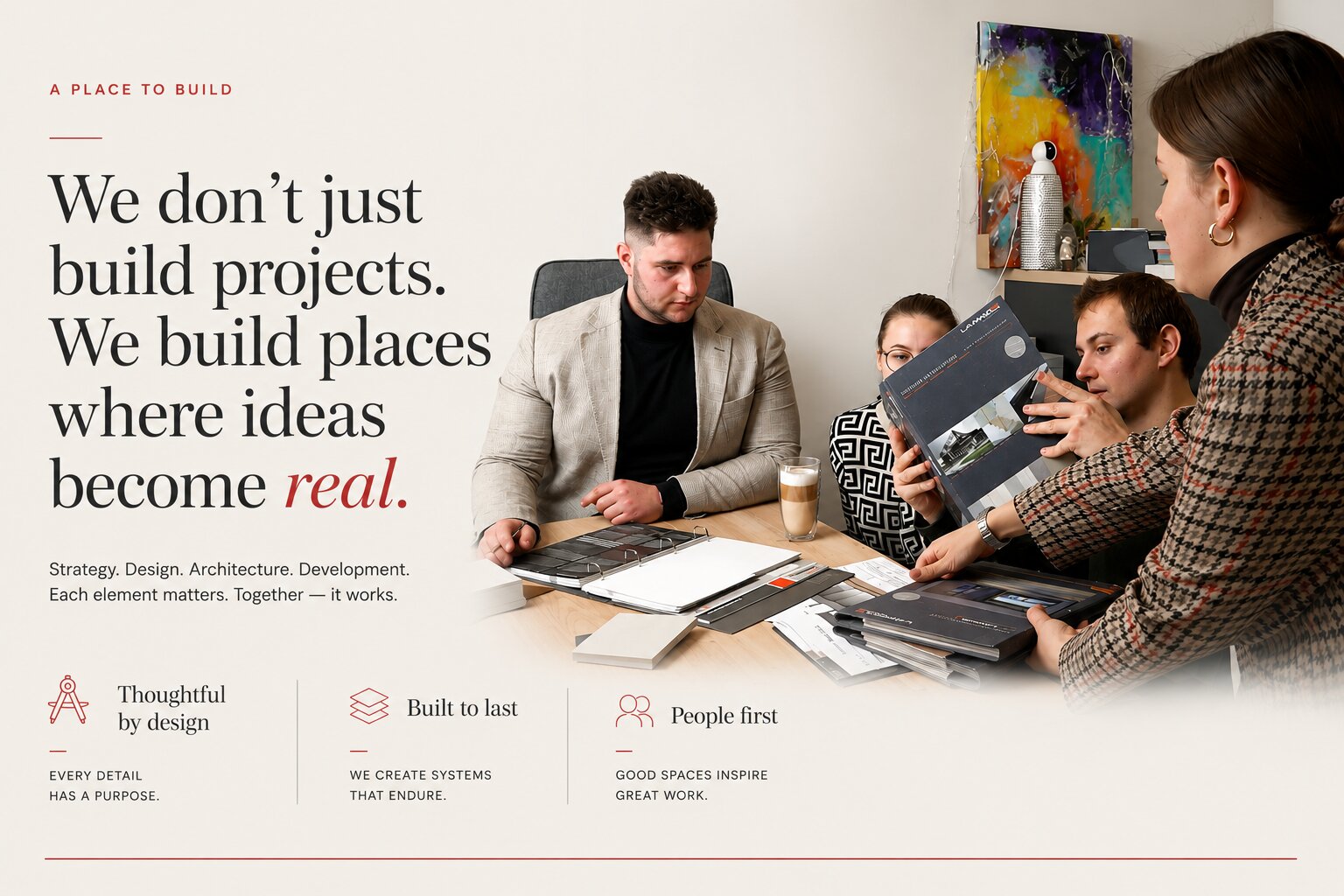
A Place to Build

-
13. 07. 2026
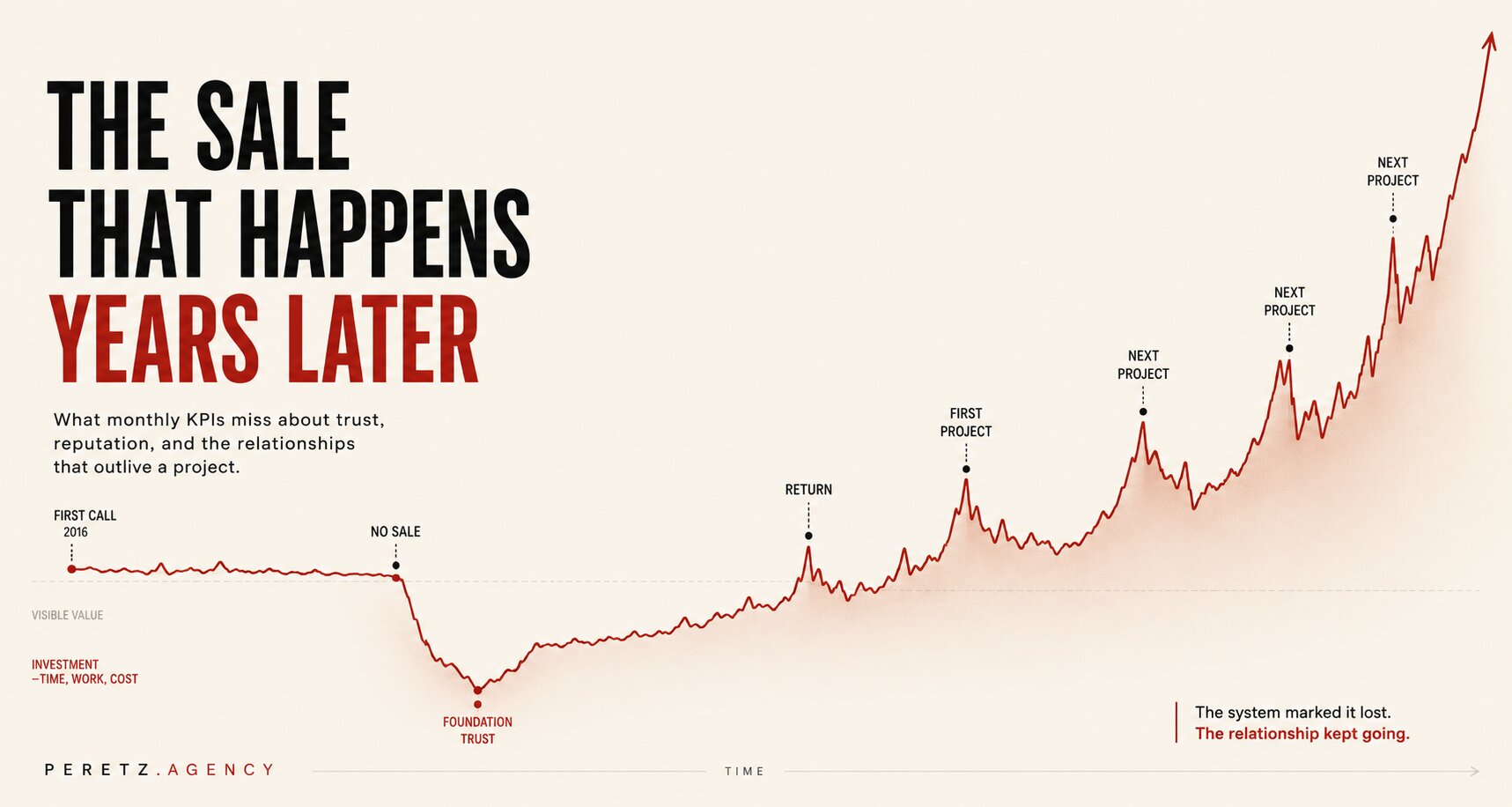
The Sale That Happens Years Later
-
26. 06. 2026
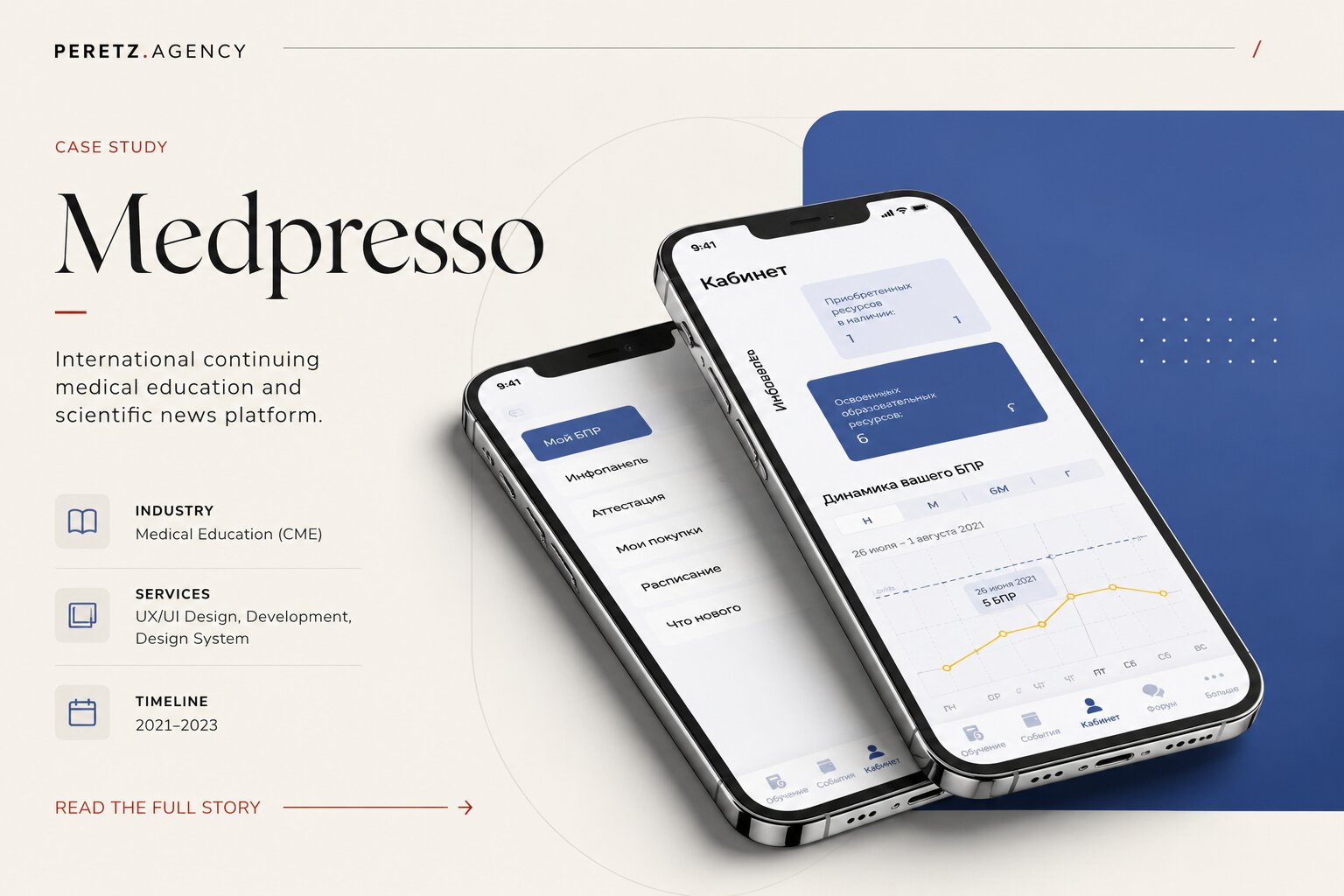
The Story We Never Planned to Tell - Case MEDPRESSO
-
01. 07. 2026
THE STORY BEHIND SV GROUP
-
06. 07. 2026

Some Clients Change Your Business. MDC LUX Changed Ours.
-
11. 07. 2026

The Story Behind Hair
-
20. 09. 2026
Founder Dependency: The Discount Nobody Puts in the Deck