


THE CALL
When people look at a finished project, they assume it started with a signed contract. Almost never. Most important projects begin much earlier: with a conversation, a chance meeting, an idea that goes nowhere and then, months or even years later, comes back unexpectedly.
That’s exactly what happened with UHRS.
A few months before the work began, I met a young trichologist. We talked about a possible project, about growth, about what a website could look like. The meeting was interesting, but nothing came of it right away. That happens all the time. Not every meeting ends in a contract.
About six months passed. I was visiting my parents, I don’t even remember why anymore. But I remember the phone call clearly. It was supposed to take a few minutes. It stretched into nearly three hours. I stood by the window in my parents’ house talking, not about design, not about colors, not about technology. I was talking about why this project couldn’t be treated like an ordinary medical clinic website. Why it had to explain to people what made this company different from dozens of others. Why structure sometimes matters more than pictures. Why trust starts long before the first consultation is booked.
At the end of the call, one simple line.
“Zhenya, we’re ready. I’ll pass your number to the director.”
That’s how I met Yulia Sergeevna Ovcharenko. I didn’t know yet that this call would become the start of several years of work together and seven completely different projects.
“If that call had never happened, I would have called myself.”
NOT WEBSITES
Looking back, one thing stands out more clearly than anything else: we were never any good at selling websites. Strange, given what the company did. In meetings, we rarely talked about design. We almost never mentioned the CMS. We practically never tried to win a client over with beautiful animations. The conversation always went somewhere else entirely: what is this business, why does it exist, how do people actually see it today, and why is there a gap between what the company really is and how it looks from the outside.
I rarely showed up to important meetings alone. Sometimes a partner came with me. Sometimes a designer. Sometimes an architect. Sometimes someone from the team. We argued with each other right in front of the client, not because we disagreed, but because a good project never comes out of one person’s head. I always wanted the client to see a team that thinks together, not a set of hired hands. That habit never went away.
It became clear very quickly that this wasn’t just a medical clinic. Trichology, as Yulia Sergeevna practiced it, was never about beauty for its own sake. It was medicine: research, ongoing education, international conferences, books, studies, a professional community. That was exactly what needed to come through the moment someone opened the site for the first time. The problem was never building a modern interface. The problem was showing, in the first few seconds, that this wasn’t just another clinic. This was a place where a professional field was being shaped.
That’s when I stopped thinking of websites as a product at all.
A website was just a tool. The real job was telling the story of the business correctly.
NEEDED YESTERDAY
Some people can’t be described in a few words. Yulia Sergeevna is one of them, so I’ll just tell you what she said instead. After the first project launched, she looked at the result and said:
“What took so long? Let’s do the next one.”
I laughed. Though honestly, laughing wasn’t always easy. Almost every project came with the same thought: faster, even faster, needed yesterday. Sometimes it felt like the next project started before the last one finished. First UHRS, then the clinic website, then an event site, then an online store for professional trichology cosmetics built together with L'Oréal, then an architecture project, books, brand identities, marketing, strategy sessions, nearly without a pause.
PERETZ itself was being built at the exact same time. We were hiring. Setting up the office. Looking for new clients while learning how to keep the old ones. Every evening closed out more than one process at once: the UHRS project, hiring, negotiations with a new client, getting our own space in order.
The phone could ring late at night. A new idea would come up that needed discussing right away: redo this, add that, come up with something, launch it. Every young entrepreneur goes through a stretch like this at least once, when you don’t know how to say no yet, and real service feels like always answering, always helping, always making it in time.
I’d organize a lot of it differently today. But that period taught me something I still carry: a person is often capable of far more than they think they are.
THE NIGHT
Some projects get remembered for their design. Some get remembered for the people. And some stay in your memory forever because of a single night. UHRS was that kind of project.
The main work was done. All that was left was moving everything onto the CMS, when the thing no manager wants to see happened: the developer left. Nothing dramatic, he was just offered better terms. It happens, especially when a team is still forming and the market keeps pulling strong people away. The problem wasn’t him leaving. The problem was the timing. The deadline hadn’t moved. Yulia Sergeevna was still waiting on the project, and rightly so. She had partners lined up, plans in motion, the next stage of growth already being prepared. For her, launching the site wasn’t the finish line. It was the start of something new.
Stopping wasn’t an option, so we kept working. Nights, no heroic stories, no drama. The project needed to launch. It launched.
After the warm evening meetings in Yulia Sergeevna’s office, I almost never went straight home. I went back to our own office, which at the time had no real heating, temporary furniture, and renovations that never quite finished. I mopped the floors. Cleaned the kitchen. Straightened up the meeting room. Not because there was no one else to do it, and not to look like a hero. Just because in a few hours a new day would start, new people would walk in, new meetings would happen, and I wanted them to walk into a space where everything was in its place.
How you treat the small things almost always says something about how you treat the big ones.
If you stop caring about what’s around you, at some point you’ll stop caring about what’s inside your product too.
SEVEN PROJECTS
People sometimes ask how to keep clients for years. I never had a single answer for that, probably because we never actually tried to keep anyone. We just kept working. After UHRS came the clinic site, then international events, an online store, marketing, books, a brand identity, architecture. Honestly, I couldn’t even tell you the exact number of projects anymore. It was well past seven.
Each one came naturally. Nobody ever sat down and said, “let’s sell one more service.” It always started differently.
“We’ve got a new problem. Can you help?”
And if we genuinely thought we could, we said yes.
We never sold services. People brought us problems.
Once trust is real, a client stops buying individual services. They start bringing you problems, all kinds of them: digital, architectural, marketing, strategic. And slowly you stop being a vendor. You become part of the team.
One of the most unexpected projects was architecture. Early on, people saw us purely as a digital shop: website, marketing, branding. Then at some point I floated a different idea: let’s design the entrance to the clinic. I don’t think anyone in that room seriously considered us architects at that moment. But Yulia Sergeevna said yes. We brought in our architect, Roman, and worked through every detail together. We showed up to the construction site in the evenings, discussed materials, watched the build happen, kept the contractors honest.
That stopped being a website story a long time ago. We wanted someone to feel, before they even walked into the clinic, the same thing they felt opening the website: minimalism, calm, attention to detail, quiet luxury without showing off.
“Sometimes online starts with offline. Sometimes online creates offline.”
To the person experiencing it, it’s all one story.
BEFORE THE CONCRETE
A lot of people think architecture starts with drawings. I’ve never thought that. It starts much earlier, with understanding what someone should feel.
Yulia Sergeevna was a genuine aesthete, probably the only way to survive in her profession. Every detail took a long time to settle, sometimes too long. We’d argue about a line, a material, a proportion, a color. From the outside it probably looked ridiculous. But those conversations were exactly what gave the project its character. I’ve always liked people who insist on quality, not because they want to make things harder, but because they can tell the difference between good and actually right. That’s probably why we worked together for so long. We both cared, and that held us together more than any contract could.
At one point we developed the brand identity for a series of medical books called “Charisma.” I remember talking about the Bugatti Chiron during that project. What always struck me is how, eventually, a car’s name stops explaining anything at all. What’s left is just character: a line, a shape, instant recognition. We spent a long time discussing whether the same feeling could exist somewhere completely different, so that someone would see a name and need no further explanation.
It was a small project. But culture gets built out of details exactly like that one. We never built things to just function. We wanted whatever we made to still look good years later.
THE ARGUMENTS
If someone asked me to describe my relationship with Yulia Sergeevna in one word, I wouldn’t say “trust.” I’d say “argument.”
In years of working together, I don’t think we ever had a single meeting where we fully agreed on everything. She’d come in with ideas. I’d come in with questions. She’d say, “let’s do it this way.” I’d say, “I don’t think that will work.” Sometimes she reacted emotionally. Sometimes she genuinely couldn’t understand why I was saying no again. But time would pass, we’d meet again, go through everything point by point, and keep working.
That’s where I learned something important: real trust isn’t built when two people keep agreeing with each other. It’s built when both sides understand the disagreement isn’t about ego. It’s about the outcome. If I ever went to Yulia Sergeevna as a patient, it would never occur to me to tell her how to practice trichology. Eventually, the same thing happened in reverse: she stopped telling us how to build digital products. Not because she lost interest, but because she saw that every time we said no, it wasn’t to argue. It was because we actually believed in the position we were taking.
Professional respect can’t be bought. It can’t be written into a contract. It can only be earned.
RED POPPY
Some things never make it into a case study. Those are usually the ones you remember best, years later.
Every time we came to the office, Miroslava Yurievna would bring us coffee, and always a box of “Red Poppy” candies. A small thing. But it’s exactly the small things that seem to stay with you. We’d talk about websites, upcoming conferences, books, architecture, marketing. Sometimes we argued, sometimes we laughed, sometimes we just sat around discussing ideas that had nothing to do with the current project at all. Those stopped being vendor meetings a long time before we noticed. They were conversations between people who both genuinely wanted to build something good.
Yulia Sergeevna rarely slowed down at all. A full medical practice, books, international conferences, a dozen projects running at once, and somehow she still had time to discuss the line of a logo or the color of a meeting room wall. That’s part of the story too, and it’s easy to lose it under a list of projects.
People sometimes ask why we took on such different kinds of work. The answer is simple: nobody ever asked us to build “one more website.” People came to us with problems, and if we thought we could help, we said yes. That’s how architecture found its way alongside the digital projects, then branding, then strategy sessions, then conversations about an education platform, because UHRS was never just a clinic, and education was part of the strategy from the very beginning. We’d sit between Yulia Sergeevna’s patient consultations, drink coffee, and try to figure out what the next stage of the company should look like. Not the next website. The next stage of the business.
That’s when I really understood the value of a strategic conversation. More often than not, the best ideas don’t happen in the meeting room. They happen right after the meeting officially ends.
WHAT IT TAUGHT ME
A few years have passed since then. Today I rarely remember specific design pages or interfaces. What I remember clearly are the people: the evenings spent watching the construction site, Yulia Sergeevna’s books, the clinic facade, the constant feeling that the next project was already somewhere nearby.
If I had to do the whole thing over again from the start, I wouldn’t change much. Except one thing: I’d learn to say no sooner. Everything else about this project gave me far more than a portfolio piece. It taught me to look at business more broadly, to understand that a good project rarely ends when the website launches. If an owner keeps growing their company, the digital product has to keep growing with it, and sometimes so does the marketing, the architecture, the brand, the team, even the strategy itself.
That’s where the philosophy PERETZ still runs on today was born. We stopped starting conversations with “what website do you need?” We started asking, “what problem are you actually trying to solve?”
NOT ABOUT HAIR
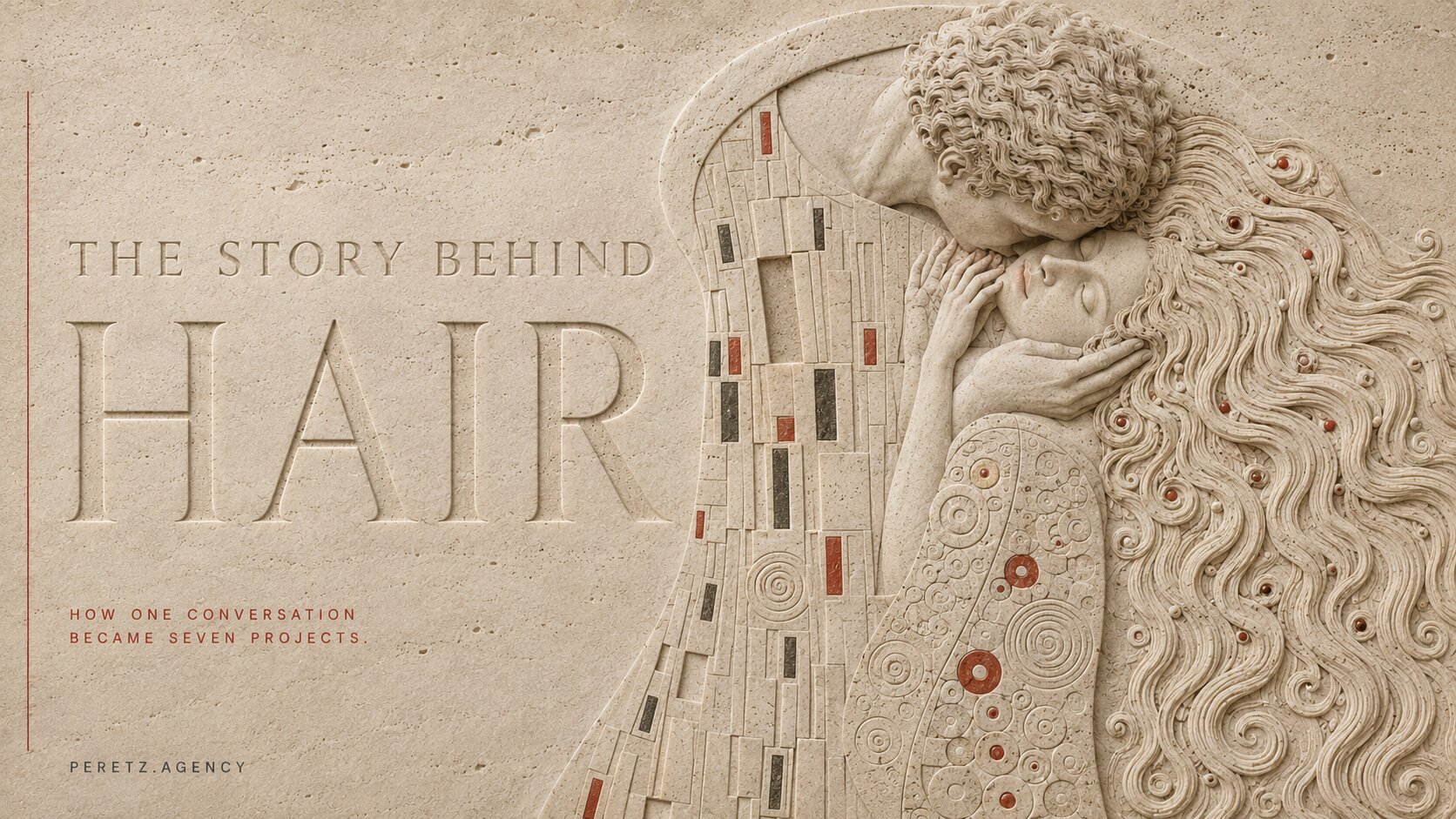
Odd, given the title. This is called “The Story Behind Hair,” but if you removed the word trichology, almost nothing would change. Because this was never a story about hair. It was a story about people: about a founder who never learned how to slow down, about a team that was still learning how to build an agency, about endless arguments, respect, trust, responsibility, and the desire to make each next project better than the last.
Years later, you stop remembering projects at all. You start remembering people. Not the design. Not the technology. Not the presentations. People.
I still smile sometimes, thinking about one line.
“What took so long? Let’s do the next one.”
That’s probably where this whole story lives, more than anywhere else.
And if someone asked me, years from now, what I remember about UHRS, I doubt I’d start talking about websites. I’d probably remember the coffee, the “Red Poppy” candies, the evening trips to the construction site, the empty office I came back to at night to mop the floors before the next workday. And the people whose eyes were genuinely lit up.
Because that, I think, is where every big business actually starts.
I wanted to end this story with a line about how I sincerely hope I never see the light go out of Yulia Sergeevna’s eyes.
She read the draft and corrected me.
“‘Gone out’ isn’t a word in my vocabulary, Zhenya. I haven’t changed. Trust someone who’s written fifteen books.”
Well. Some things really don’t change. Including getting corrected by Yulia Sergeevna.
A Note from Yulia Sergeevna
Zhenya, I read this story and for a few minutes I was back in those wonderful years: our warm office, the endless conversations, the arguments, the new ideas, the books, the websites, the construction sites, the coffee, and of course, the “Red Poppy” candies.
It’s strange to see this path through your eyes. Back then we really didn’t think of any of it as separate projects. We just kept creating, kept moving, and almost the moment one stage ended, the next one began. That’s probably why the line “What took so long? Let’s do the next one” still feels so close to me.
Thank you to you and the whole PERETZ team for never once being just contractors to us. You became part of the team, part of the story of UHRS, the clinic, and so many projects that shaped not just how we looked from the outside, but how we understood who we wanted to be.
We really did argue a lot. Sometimes very emotionally. But now I especially appreciate that behind every one of those arguments was a shared wish to do things not just well, but actually right. That’s probably why our work together turned out to be so long, and so important to all of us.
Thank you for this memory, for the respect, for the honesty, and for the chance to feel that atmosphere again. For me, that was a time of incredible inspiration, of building things, and of people whose eyes were genuinely lit up.
And you know… I still want to rewrite the ending of this story a little. I truly hope there are many more projects ahead of us, ones that will light up our eyes the same way the very first one did. People with lit-up eyes don’t disappear. They just find new heights, new meaning, and new projects.
Zhenya… what took so long? Let’s do the next one.
See the related projects in Trichology Institute and its logo identity.
See a more personal reflection on this same theme in I sometimes feel like I became Michael Scott by accident.
What this project taught us about clarity, and what it brought a year later, is part of When Not to Rebrand.
How the Institute itself sees this journey, and why an online store became its next step, Professor Ovcharenko explains in her article Diagnosis First, Care Second.
- Share
-

-

-

-

Related Reading
-
05. 07. 2026

SHTAYER: Building a Brand for a New Generation

-
01. 07. 2026
THE STORY BEHIND SV GROUP
-
26. 06. 2026
The Story We Never Planned to Tell - Case MEDPRESSO
-
30. 11. 2020

The case of Laduchi
-
06. 07. 2026

Some Clients Change Your Business. MDC LUX Changed Ours.
-
13. 07. 2026
The Sale That Happens Years Later
-
19. 08. 2026
Collaboration Strategy: Why One-Off Partnerships Don't Build Lasting Growth
-
12. 07. 2026

How to Build a Community, Not Just an Audience
-
19. 09. 2026

I Sometimes Feel Like I Became Michael Scott by Accident
-
04. 10. 2026
When Not to Rebrand: What to Change and What to Leave Alone
-
05. 10. 2026

How Much Does a Brand Identity Cost in 2026?