


A company can own its domain and still not own its website. It can own its website and still not control its data. It can have a CRM and still not own the workflows built around it. It can have source code and still be unable to maintain the system. It can have accounts, passwords, and administrator access, and still depend completely on another company.
Digital ownership is rarely binary. It's usually a collection of rights, dependencies, subscriptions, credentials, systems, and relationships that accumulate over years, and most businesses have never mapped them. They know who built the website, what CRM they use, where the files are, and probably how much the software costs every month. But ask a more uncomfortable question: what would still belong to you if the vendor disappeared tomorrow? The answer is often less clear than it should be.
Dependency often looks exactly like ownership, until something changes.
TRANSFERRED NOT OWNED
When "Everything Was Transferred" Isn't the Same as Ownership
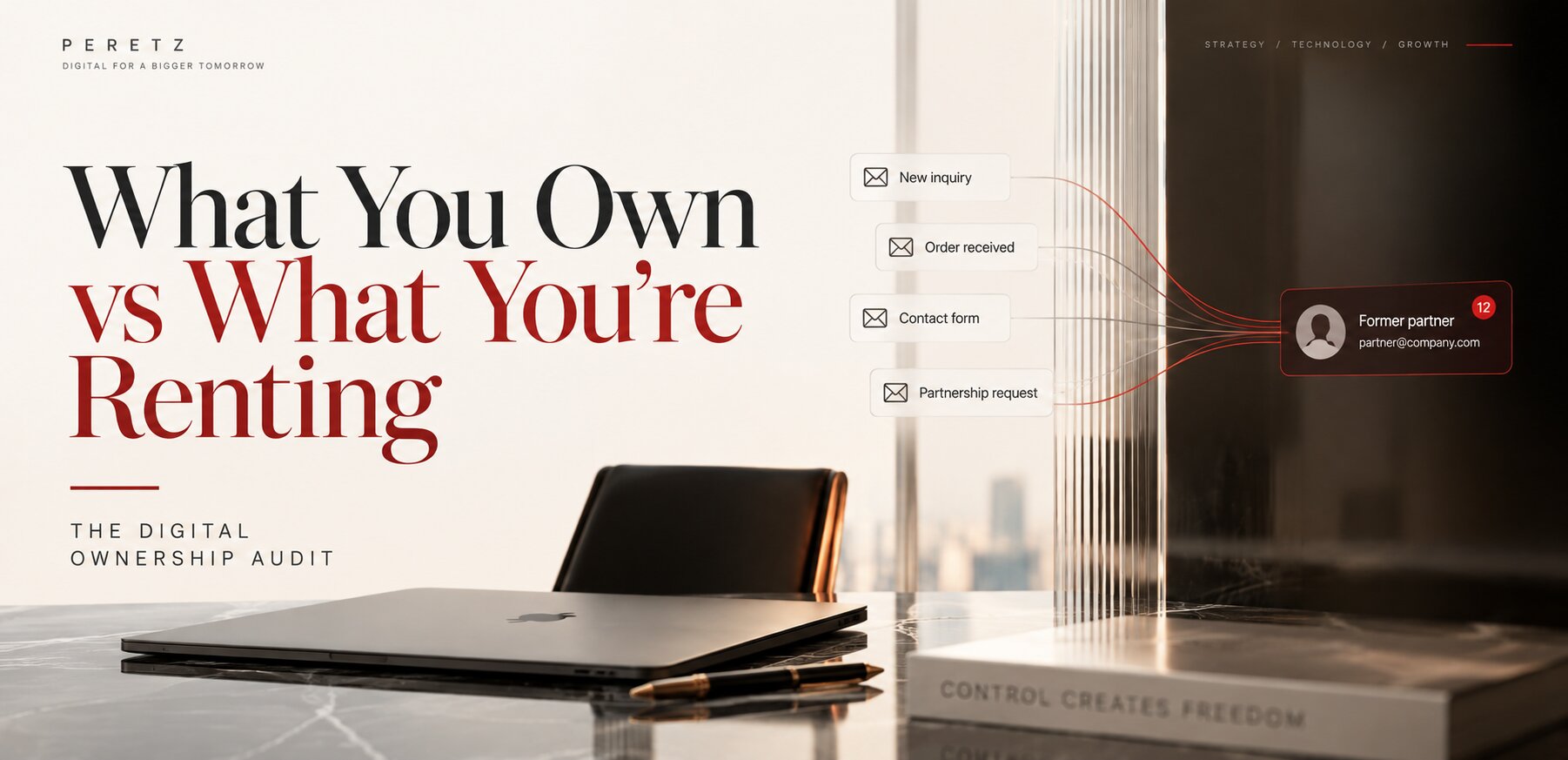
One of the clearest examples of this gap involved a business going through a partner transition. The outgoing partner handed over what appeared to be the company's entire digital infrastructure. The website was transferred, the systems were transferred, the accounts were handed over. At first glance, everything seemed to be in place.
Nobody had performed a proper digital ownership audit. Later, while reviewing the infrastructure, we found something more important than any of the accounts that had changed hands: some website forms were still connected to the former partner's email address, some requests and order notifications were being quietly duplicated there, and in several cases, the new owner's own email address wasn't connected to the form at all. Part of the business's incoming communication was technically still flowing through an account controlled by someone no longer responsible for the business. We can't say whether those requests were ever read or acted on, there wasn't enough evidence for that. But the technical problem itself was unambiguous: the person who inherited the infrastructure did not automatically inherit visibility into everything that infrastructure was receiving. The business had been transferred. The information flow hadn't been.
This is exactly why a digital handover can't end with "here are the passwords." A proper transition has to answer where inquiries go, who receives order notifications, which email addresses receive form submissions, who receives error alerts and password resets, and which integrations still quietly point to former employees or partners. In this case, the website wasn't broken, it was working exactly as configured. That was the problem. The configuration still reflected an organization that no longer existed.
Digital infrastructure preserves history far more literally than people do. A former employee leaves, a partner leaves, an agency relationship ends, ownership changes hands, and somewhere inside the system remain old email addresses, old users, old permissions, old integrations, old forwarding rules, old notification recipients. The organization changes. The software doesn't, unless someone deliberately changes it. A handover transfers assets. It does not automatically transfer relationships, permissions, and information flows, and that gap is where a real audit earns its value.
OWNERSHIP VS ACCESS
Ownership Is Not the Same as Access
That's the first distinction worth making generally. You can have access without ownership. A developer may hand you administrator credentials. An agency may let you log into the CMS. A SaaS vendor may let you export your data. None of that automatically means you own or control the underlying system.
Consider a common setup: the domain is registered under the company's name, good, but the website is hosted under an agency account, the source code sits in the agency's private repository, deployment credentials belong to the agency, the database is hosted by the agency, the analytics property was created under an employee's personal account, the CRM belongs to a SaaS provider, and the integrations were built by a contractor whose cloud account still holds the product photography. You technically have access to the website. But how much of the system could you actually operate without those people? That's the real question, and it's exactly why most companies don't own their website the way they assume they do.
FIVE QUESTIONS
The Five Questions of Digital Ownership
For every important digital asset, five questions are worth asking. Do we own it, is the legal or contractual ownership actually ours. Can we access it, do we have administrative access without asking another company. Can we export it, can we retrieve the underlying data in a usable form. Can someone else operate it, could another qualified provider take over. And can we leave, can we change vendors without losing the business.
These questions are related but not the same. A company can own something and have no practical ability to operate it. It can access something and have no right to transfer it. It can export data and discover the export is useless without the proprietary logic that made it work. Ownership only becomes meaningful once it includes control, portability, and continuity together, not any one of them alone.
START WITH DOMAIN
Start With the Domain, Then Ask What "the Website" Actually Includes
The domain is one of the simplest assets to check and one of the easiest to overlook: who's the registrant, who controls the registrar account, who receives recovery emails, who controls the DNS and billing, and what happens if the employee who owns that account leaves. A company can spend hundreds of thousands building a digital business and still have its domain tied to a personal email address. That isn't sophisticated technical debt. It's basic ownership debt, and it becomes surprisingly hard to resolve once a relationship deteriorates.
"The website belongs to us because we paid for it" sounds obvious until you ask what "the website" actually includes: domain, source code, database, hosting, design files, content, images, fonts, plugins, licenses, deployment configuration, APIs, analytics, third-party accounts, documentation, credentials, infrastructure. If ten different parties control those components, saying you own your website doesn't tell you much. The practical question is whether another team could take over without depending on the people who built it. If the answer is no, ownership is incomplete, no matter what the contract says.
CODE VS WORKING SYSTEM
Source Code Is Not the Same as a Working System
Suppose a company receives the full repository. Good. But the system depends on private packages, undocumented environment variables, vendor-specific infrastructure, proprietary deployment scripts, external APIs, credentials nobody else has, custom libraries, licenses another company controls, and knowledge that exists only in the original developer's head. The company now owns the code. Can it run it, deploy it, fix it, migrate it, maintain it? Owning the files is not the same as owning the capability, which is exactly what the code remembers every version of the business gets into from the development side.
SAAS + CRM TRAP
SaaS, the CRM Trap, and Hidden Ownership
Modern businesses increasingly build on rented infrastructure, and that's not automatically bad. Nobody needs to build their own email infrastructure or payment network. The problem isn't renting, it's renting without understanding the dependency: what exactly is being rented, from whom, what data lives there, what happens if pricing changes or the service closes, and how long would migration actually take.
CRM systems make this especially visible. A company says "our customer data is in Salesforce," or HubSpot, or Dynamics. But the database is only one part of the CRM. Over time the business builds custom fields, workflows, automation, pipelines, integrations, reports, permissions, lead scoring, business rules, and eventually it isn't simply using a CRM, it's operating through one. Now imagine changing vendors: the company can probably export the contacts, but what about the workflows, the automation, the historical context, the custom logic? The business may own the customer data without owning the operational system built around it, and that difference is exactly what makes custom CRM vs ERP the right next question once this pattern shows up.
Analytics has the same fuzziness. Who owns the Google Analytics property, the Search Console property, Tag Manager, the advertising accounts, the conversion events. A company can lose years of historical visibility simply because a former employee created the original account under the wrong email, and the data may still technically exist while access to it becomes a legal or operational battle. Content deserves the same attention and rarely gets it: product photography, campaign assets, technical documentation, case studies, years of accumulated work sitting inside an agency's account, disappearing the day the contract ends.
INTEGRATIONS
Integrations Create Hidden Ownership, and a Test Worth Running
A business might run twenty systems. The important question isn't how many, it's how they're connected. A CRM talks to the website, the website talks to e-commerce, e-commerce talks to the ERP, the ERP talks to the warehouse, the marketing platform talks back to the CRM, a payment provider talks to the store, analytics collects events from everything. That network of relationships is often more valuable than any single system in it, and also more of a liability, since an integration isn't just an API key, it's a dependency, one more reason architecture and ownership have to be discussed together, the same connection covered from the systems side in digital architecture.
A surprisingly effective test: could we replace this vendor within a reasonable period without losing critical business functionality? Ask it about the developer, the agency, the hosting provider, the CRM, the ERP consultant, the e-commerce platform. Some honest answers will be no, not immediately, and that's fine, the goal was never eliminating every dependency, it's knowing which ones exist. A business can intentionally depend on Salesforce. That's a different situation from accidentally depending on the one consultant who happens to know how it was configured.
EMPLOYEE + FOUNDER TEST
The Employee Test and the Founder Test
A useful thought experiment: your senior developer leaves tomorrow. What disappears? "Nothing, the system is documented and another qualified engineer can take over" is a good answer. "We have no idea how the deployment works" is not, and it's exactly the gap covered in your website doesn't fail when your developer leaves. The same test applies to the marketing manager, the CRM consultant, the agency, the CTO.
The founder version is the uncomfortable one. A founder often becomes the unofficial system of record: which vendor built what, why the architecture was chosen, which account holds the credentials, why the CRM has a strange workflow nobody questions, which integration must never be touched. If the founder disappears for three months, the organization discovers that the "company's system" was actually one person's memory the whole time. That's not scalability. It's dependency wearing a founder's face, and the same problem resurfaces during acquisitions, in a much more expensive form.
THE EXIT TEST
The Exit Test
Digital ownership becomes urgent the moment ownership itself is about to change. A company can be operationally successful and still be surprisingly difficult to acquire. An acquirer will ask who owns the source code, who owns the customer data, who controls the domains, which licenses are transferable, how dependent the business is on the founder, what happens if the current development team disappears, whether there are undocumented systems or contracts that restrict assignment. A financially healthy digital business can still carry significant transfer risk, and that risk shows up directly in diligence, valuation, and transition cost, exactly the numbers covered in the number nobody tells you and before you sell, retire, or hand it down.
This is why digital ownership belongs inside the exit conversation, not after it. A buyer isn't simply buying a website, they're buying the ability to keep operating the digital business the day after the deal closes. Anything that depends on one person, one agency, or one inaccessible system becomes part of that risk. The right exit question was never "do we own the website," it's "could someone else own and operate this tomorrow." That's the same discipline behind the build vs. buy equation, decisions made years before a sale quietly determine what that sale is actually worth.
Post-Handover Audit Checklist
| Check | Question to answer |
|---|---|
| Forms | Where does every submission actually go? |
| Orders | Who receives every order notification? |
| CRM | Who has access to customer and sales data? |
| Which addresses receive operational notifications? | |
| Analytics | Who controls the properties and historical data? |
| Integrations | Which systems still connect to former people or vendors? |
| Credentials | Who can reset access? |
| Automation | What runs automatically in the background? |
| Permissions | Who can still see information they no longer need? |
OWN RENT DEPEND
What You Own, What You're Renting, What You Depend On
The simplest version of the audit sorts every important digital component into three categories. Own, you control the rights, access, data, and operation. Rent, you intentionally depend on a vendor or platform, and the dependency is understood and managed. Depend, you may technically own or use the asset, but its operation relies heavily on a person, vendor, or proprietary process nobody else can access. That third category is the dangerous one, because dependency often looks exactly like ownership until something changes.
There's nothing wrong with renting. Cloud infrastructure, SaaS, payment networks, email, analytics tools, even development capacity, all reasonably rented. The real question is whether the terms are understood: what the vendor owns, what stays with you, what leaves with you, how much migration would cost, how long it would take, and what would stop working on day one after the relationship ends. Answer that before you need the answer, not during the crisis.
The worst time to discover your agency controls your domain is after the relationship breaks down. The worst time to discover your CRM workflows can't migrate is during an acquisition.
PORTABILITY
Portability Is the Hidden Value
Underneath digital ownership sits a quieter concept worth naming directly: portability. Can you move the domain, the code, the database, the content, the customer records, the analytics history, the workflows? Can another provider realistically take over? The easier it is to move, the greater your practical control, and this doesn't mean everything has to be portable in seconds, it means the cost of leaving should be known in advance, not discovered in the middle of leaving.
Sometimes the honest answer is "yes, we could move, it would take six months," which is genuinely useful information. Sometimes it's "we could export the data, but the business logic would need to be rebuilt," also useful. The answer to worry about is "nobody knows." A good ownership audit isn't chasing perfect independence, it's making dependency visible and measurable before it becomes expensive.
AI ADDS A LAYER
AI Adds a New Layer of the Same Question
AI makes digital ownership more complicated, not less relevant. A modern product may depend on AI models, prompts, agent workflows, tool permissions, vector stores, knowledge bases, model providers, and evaluation systems that didn't exist as ownership categories five years ago. Who owns the prompts. Who controls the underlying knowledge base. What happens if the model provider changes pricing or shuts down. What happens if an AI workflow is deeply embedded in daily operations. AI doesn't eliminate the ownership question, it multiplies it, and the same principle still applies: know what you own, know what you're renting, and know what you depend on.
NOT OWNING EVERYTHING
The Audit Isn't About Owning Everything
This is worth saying directly. You don't need to own your own servers, build your own CRM, host your own analytics, or create your own AI model. That would be both expensive and unrealistic. The mature question is which dependencies are strategic, which are operational, and which are simply accidental. Rent what makes sense, own what differentiates the business, control what would be dangerous to lose, document what can't reasonably be owned, and understand the cost of leaving everything else.
For every critical asset, a simple sentence finishes the test: "if the current vendor disappeared tomorrow, we would..." A specific, immediate answer, move the repository, restore from documented configuration, reconnect the integrations, keep operating, is a good sign. "We'd contact our account manager and see what happens" means the business doesn't control enough. "I'm not sure" is exactly where the audit should start.
The deepest value of digital ownership isn't legal. It's strategic. Dependency reduces options. Good architecture preserves them.
The Question Most Companies Don't Ask
Everything can be working. The website looks modern, the CRM works, analytics is connected, the agency is excellent, and the business can still have a digital ownership problem, because the real question was never "does our infrastructure work today." It's "would we still control this business if the people and platforms around it changed tomorrow." That's a harder question, and a far more important one.
Digital businesses accumulate history: code, content, customers, decisions, data, workflows, relationships, knowledge, years of it. Making sure that history stays yours, not quietly rented from someone else, is the actual point of a Digital Ownership Audit. Not another software inventory, an honest map of where the business has control and where it has exposure, so that when the tools eventually change, and they always do, the business itself remains yours.
Isn't this the same thing as a technical audit?
Related but not identical. A technical audit usually asks whether the code is good. A digital ownership audit asks who actually controls it, whether the business could operate it without the people who built it, and what would happen if any single vendor or employee disappeared tomorrow.
When is the right time to do a digital ownership audit?
Before you need the answer, ideally, before an acquisition, before a major vendor relationship ends, before a key employee leaves, or simply as part of regular business hygiene. The worst time is discovering the gap during the crisis that made it matter.
Does this apply to a small business, or only larger companies with complex systems?
It applies earlier than most small businesses expect. A domain tied to a personal email, a CRM nobody else can configure, or a website hosted under an agency's account are common at every size, and they're cheaper to fix before the business has grown around them.
We're planning to sell the business in a few years. Should we do this now or closer to the sale?
Now. The findings from a digital ownership audit often take months to properly fix, moving accounts, documenting infrastructure, clarifying licenses, and buyers notice unresolved ownership gaps during diligence regardless of how well the business otherwise performs.
Not sure how much of your digital business you actually control, or thinking about a sale, succession, or major vendor change? We start by mapping what you own.
Explore Digital Ownership & Debt Audit
Already planning an exit or succession specifically?
- Share
-

-

-

-

Related Reading
-
30. 07. 2026

Most Companies Don't Own Their Website. They Own a Collection of Dependencies.

-
05. 08. 2026
Your Website Doesn't Fail When Your Developer Leaves. It Fails Years Earlier.
-
17. 07. 2026
The Code Remembers Every Version of the Business
-
10. 09. 2026
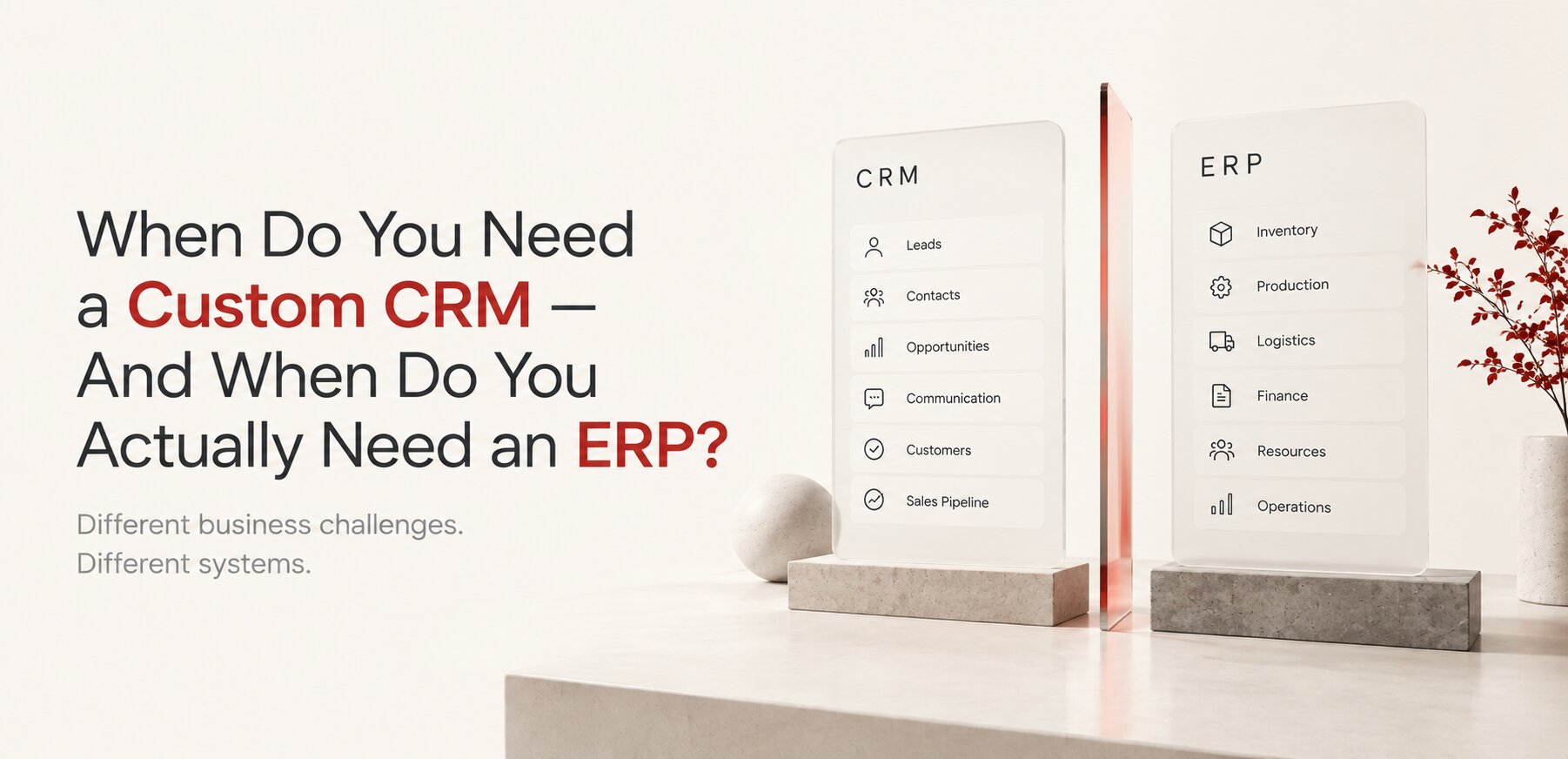
When Do You Need a Custom CRM, and When Do You Actually Need an ERP?
-
11. 09. 2026

Digital Architecture: How to Build a System That Can Grow With Your Business
-
12. 07. 2026

The Number Nobody Tells You: 70%
-
10. 07. 2026

Before You Sell, Retire, or Hand It Down
-
17. 07. 2026

The Build vs. Buy Equation Has Changed. Most Companies Have Not Recalculated It.