
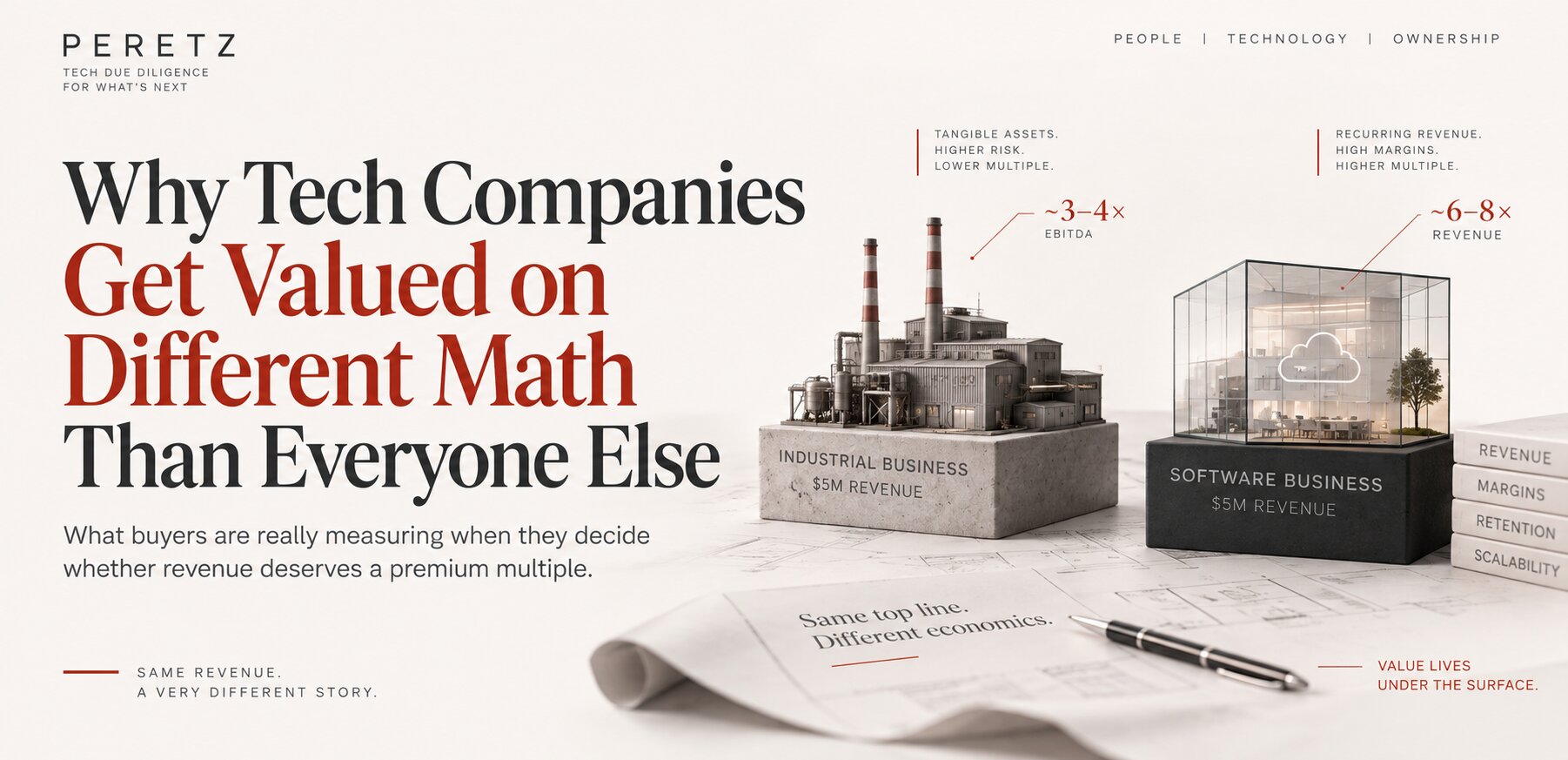
What buyers are really measuring when they decide whether revenue deserves a premium multiple.
Two companies can generate the same revenue and still be worth radically different amounts. The reason isn't that one founder negotiates better. It's that buyers are not really buying revenue. They're buying the probability that the revenue will still be there next year, and the economics attached to keeping it.
A software company with recurring revenue, high gross margins and strong retention can support a very different valuation framework than a project-based business generating the same top line. Founders who don't spend their careers in M&A often find this genuinely confusing, and understandably so. It looks arbitrary from the outside. It isn't. There's a real, learnable logic underneath it, and understanding it changes how you build a business years before you ever sell one.
The multiple isn't a reward for revenue. It's a bet on how confidently that revenue repeats itself.
SAME REVENUE
Two Companies, Same Revenue
For many established businesses, valuation starts with earnings or cash flow, what a business actually keeps after costs, with a multiple applied based on risk and growth. It's a reasonable, well-established approach, and it works well when a business's future looks roughly like its past: similar margins, similar customer relationships, similar operating costs, next year onward.
Software businesses often get evaluated differently because that assumption doesn't always hold, and revenue, specifically the right kind of revenue, becomes a more useful proxy for future value than current earnings are. Revenue is useful to a buyer when it's a reasonable proxy for future cash generation, and when the business has the characteristics that make that revenue durable and scalable. A company generating five million dollars a year with brutal churn, thin gross margin, and dependence on one enterprise customer is not automatically valuable just because the top line says "software," the same gap between label and reality covered from the ownership side in what you own vs what you're renting. The label never does the work. The underlying economics do.
MULTIPLES DIVERGE
Why Multiples Diverge So Much
Once revenue becomes part of the conversation, the next question is what kind of revenue actually earns a premium, because not all revenue is treated equally, not even close. A dollar of revenue that's reasonably predictable to continue, backed by low churn, real switching costs, or a contract, is worth more to a buyer than a dollar that has to be re-earned from scratch every cycle. The first dollar behaves like an asset. The second behaves like a forecast, and forecasts get discounted.
Multiples reward predictability, and predictability is mostly a function of how revenue is structured, not how large it is. It isn't the only factor, growth, margin, customer concentration, capital intensity, and competitive position all matter too, but it's the one most founders underweight until a buyer's model makes it explicit.
RECURRING MEANING
What "Recurring" Actually Has to Mean
The word "recurring" gets used loosely, and the loose version is where a lot of founders overestimate what their business is actually worth. Recurring revenue isn't simply revenue that happens to repeat. It's revenue whose continuation can be modeled with reasonable confidence.
Contracts are one way to create that confidence. They're not the only one. Usage-based and consumption models, month-to-month subscriptions with strong historical renewal behavior, and cohort performance that holds up predictably over time can all support the same kind of confidence a multi-year contract does, sometimes more. A customer who happens to buy again every year, with no contract and no real pattern behind it, is not the same thing as revenue a buyer can model forward with confidence. The difference isn't the paperwork. It's whether the continuation is genuinely predictable, and by what evidence.
RULE OF 40
The Rule of 40
One heuristic shows up constantly in SaaS valuation conversations: revenue growth plus a profitability measure, commonly EBITDA margin, should roughly equal forty percent or more. The exact definition varies from one conversation to the next, some use free cash flow margin instead, which is exactly why it should be treated as a rough heuristic rather than a valuation law.
The Rule of 40, in Practice
| Growth | Margin | Rule of 40 | What It Tells You |
|---|---|---|---|
| 60% | -10% | 50% | Growth dominates the economics |
| 30% | 10% | 40% | Balanced growth and profitability |
| 10% | 15% | 25% | Neither growth nor margin compensates |
| 5% | 35% | 40% | Profitability carries the equation |
None of these rows is automatically good or bad on its own, sixty percent growth funded by unsustainable spending or heavy churn tells a very different story than sixty percent growth with healthy retention, even at the same combined number. The Rule of 40 is a question generator, not a valuation formula. It gives a buyer a fast way to ask a better follow-up question, not a verdict.
NET REVENUE RETENTION
Net Revenue Retention
One of the most revealing metrics in a software valuation conversation is net revenue retention, what happens to a fixed group of existing customers' revenue over the following twelve months, with no new customers added at all. Sustained NRR above 100% means the existing customer base is expanding, through upgrades, add-ons, or usage growth, faster than it's contracting through churn. Higher retention can materially reduce how much new-logo growth a company needs just to maintain momentum.
A business that has to sell to new customers just to replace the ones quietly leaving isn't really growing. It's refilling a bucket with a hole in it.
Retention meaningfully above 100% is telling a buyer something genuinely useful: a real share of future growth is already showing up inside the existing base, before a single new customer is signed. It's one of the more durable signals in the numbers, not because it's magic, but because it's hard to fake over multiple years.
GROSS MARGIN
Gross Margin Reveals What Kind of Business You Actually Are
Gross margin is where a lot of "tech company" self-identification quietly runs into trouble. Software businesses often have structurally higher gross margins because serving one more customer adds relatively little incremental delivery cost. But that isn't universal. AI inference, human-in-the-loop support, data licensing, and heavy infrastructure can materially change that equation, exactly the kind of hidden cost structure covered from a different angle in the AI wrapper problem, where what looks like a software margin on paper can behave more like a services margin once real usage costs show up.
Neither a high-margin nor a lower-margin structure is inherently better. They're different economic engines, and buyers price them according to what the numbers actually show, not what the pitch deck calls the business.
TECH VS TECH-ENABLED
Technology-Enabled vs Technology
This is where a lot of founder disappointment actually originates, not from a buyer being unfair, but from a mismatch between how a business describes itself and how its financials actually behave. A technology label doesn't create technology economics. "We built proprietary software" is a real, meaningful claim when that software actually changes the underlying economics, margin, scalability, retention, switching costs. It's a much weaker claim when the software simply supports an operation whose economics haven't fundamentally moved.
The honest test isn't whether the business uses technology, almost every business does now. A logistics company doesn't become a software company merely because it has a good app, and a recruiting firm doesn't become one merely because its internal tools are excellent. The real question is whether the technology has actually changed the underlying economics of the business, its margin structure, how it scales, how customers renew, what it costs to acquire the next one. When it has, the business can legitimately be evaluated through a different economic lens. When it hasn't, the label doesn't move the number.
BUILD FOR MULTIPLE
Build for the Multiple Before You Need the Multiple
None of this is retroactive once a deal is on the table, which is exactly why it's worth understanding years before that point, not during it. If revenue predictability is what earns a premium, structuring customer relationships that way starting now, not the year before a sale, is what actually shows up in the numbers a buyer will eventually see. If net revenue retention is one of the more durable signals in the numbers, the decisions that improve it, reducing churn, building genuine expansion revenue, are operating decisions, not deal-prep decisions, and they take years to show a real track record.
This isn't really M&A preparation, the same discipline covered from the buyer's side in how to audit a digital product before you buy it. It's how you build a better business either way, recurring revenue, real retention, and margin discipline make a company stronger to run, not just easier to sell. The founders who get the best outcomes usually aren't the ones who present well in a single meeting. They're the ones whose financials already tell the story a buyer wants to hear, because the business was quietly built that way for years before anyone started shopping it.
A buyer does not fall in love with a pitch. They fall in love with a pattern that already existed before the pitch was written.
Why are SaaS businesses often valued using revenue or ARR multiples?
Because a well-run software business often reinvests heavily in growth, showing thin or negative earnings while building a customer base, retention pattern, and margin structure worth considerably more than current profit suggests. Revenue becomes a more useful signal than earnings only when it's genuinely predictable and durable, not simply because the business calls itself software.
What is the Rule of 40, and does every company need to meet it?
It's a heuristic used in SaaS valuation conversations stating that revenue growth plus a profitability measure, commonly EBITDA margin, should roughly equal 40% or more. The exact definition varies between conversations, which is exactly why it's treated as a rough heuristic rather than a strict valuation rule, useful for prompting better follow-up questions, not for producing a verdict on its own.
What is net revenue retention, and why does it matter?
It measures what happens to a fixed group of existing customers' revenue over the following year, with no new customers included. Sustained NRR above 100% means existing customers are expanding faster than they're contracting through churn, which reduces how much new-customer growth a company needs just to maintain momentum. It's one of the more useful indicators of revenue durability a buyer can look at.
What makes recurring revenue valuable to a buyer?
Not the label, and not necessarily a contract. What matters is whether the revenue's continuation can be modeled forward with reasonable confidence, through contracts, strong historical renewal behavior, or consistent cohort performance over time. A repeat customer with no real pattern behind the repetition isn't the same asset as revenue with real predictability evidence behind it.
What is the difference between ARR and genuinely predictable revenue?
ARR is a snapshot, the annualized value of current recurring contracts at a point in time. Predictable revenue is a claim about the future, that this snapshot will hold or grow, supported by evidence like low churn, strong renewal rates, or consistent cohort behavior over multiple years. A large ARR number with no evidence behind its durability is a starting point for a buyer's questions, not an answer to them.
Can a services business ever get a software-like valuation?
It can, but only when its underlying economics genuinely resemble those of a software business: high gross margin, real scalability, low marginal cost to serve the next customer, and durable retention. Calling a services business a technology company doesn't change what a buyer's model will show if the economics underneath haven't actually moved.
Does proprietary software automatically increase a company's valuation?
No. Proprietary software only matters economically if it changes the underlying economics of the business, its scalability, margins, retention, differentiation, or switching costs, in some meaningful combination. Software that doesn't move any of those numbers is a feature, not a valuation driver.
Preparing for a raise, a sale, or just want to know what your numbers actually say to a buyer?
Who actually pays for that verified economics, and why, is the subject of buyer universe: reasons, not names.
One specific concentration risk that quietly moves that same math is covered in founder dependency: the discount nobody puts in the deck.
- Share
-

-

-

-

Related Reading
-
19. 09. 2026

The AI Wrapper Problem: Why "We Use AI" Doesn't Mean What Buyers Think

-
16. 09. 2026

What You Own vs What You're Renting: The Digital Ownership Audit
-
18. 09. 2026

How to Audit a Website or Digital Product Before You Buy It
-
12. 07. 2026

The Number Nobody Tells You: 70%
-
10. 07. 2026

Before You Sell, Retire, or Hand It Down
-
19. 09. 2026

Buyer Universe: Why "Anyone Could Buy This" Means No One Will
-
20. 09. 2026

Founder Dependency: The Discount Nobody Puts in the Deck