

Why the real buyer universe is defined by reasons, not names.
Almost any company with capital could technically write the check to acquire almost any other. That's not a useful definition of a buyer universe.
The useful question was never who could buy the company. It's who has a specific, articulable reason to value this particular business above its standalone worth, and who has the capital, mandate, timing, and ability to actually execute on that reason. A broad list of theoretical buyers isn't itself a weakness. A genuinely strong business can have many credible acquirers. The real warning sign is different: many theoretical buyers, none of whom have a specific reason to pay a premium, all pricing the same generic asset the same generic way.
Working on digital products creates a slightly uncomfortable perspective on acquisitions. You learn very quickly that founders and buyers can look at the same technology and see completely different things. The founder sees years of investment. The buyer sees dependencies. The founder sees a platform. The buyer sees rebuild cost. The founder sees an AI capability. The buyer sees an external API and a vendor roadmap. The founder sees a hundred thousand users. The buyer sees retention, concentration, and acquisition economics.
Neither side is necessarily wrong. They're assigning value to different things. Understanding how a digital asset was actually built, not just how it performs on a spreadsheet, tends to surface risks and value that financial statements alone rarely show. That gap between the two views is most of what this article is actually about.
Don't ask who could buy the company. Ask who has a reason to value it differently.
THEORETICAL VS STRATEGIC
The Theoretical Universe vs the Strategic Universe
The theoretical buyer universe is every company and investor with sufficient capital, or plausible access to it, to write the check. It's a large, mostly uninformative list.
The strategic universe is much narrower and much more useful: the subset of that list who have an actual acquisition thesis, a specific reason this business solves a problem or accelerates an opportunity that matters to them, right now.
Moving from the theoretical list to the strategic one is most of the real work in understanding what a business is actually worth to someone else, and it's a distinction worth understanding years before any process starts, not discovering during one.
STANDALONE VS STRATEGIC
Standalone Value vs Strategic Value
Standalone value is what the business is worth as an independent asset, based on its own economics, risk, growth, and cash-generation profile, the number a financial buyer generally starts from.
Strategic value is what the same business can be worth to a particular buyer once you account for the assets, customers, capabilities, distribution, or competitive position that buyer already owns.
A useful, deliberately rough mental model is: strategic value equals standalone value, plus buyer-specific synergies, minus integration costs and risk.
That qualification matters. Strategic value creates room for a premium. It doesn't guarantee the seller captures it. Competition among buyers, alternatives each buyer has, financing, and negotiating leverage determine how much of that theoretical value actually becomes purchase price.
The same company can legitimately be worth different amounts to different buyers, and both numbers can be correct at once.
THE ASSET
The Asset, Not the Buyer List
The buyer universe conversation usually starts in the wrong place, with a list of companies, before anyone has properly named what actually exists inside the business being valued.
A buyer isn't acquiring an abstract company. They're acquiring a specific combination of customers, revenue, technology, intellectual property, data, distribution, market access, processes, brand, people, and geography. Different buyers can assign radically different economic identities to that exact same combination.
A proprietary e-commerce platform can be an operating asset to its current owner, a capability shortcut to a direct competitor, a market-entry mechanism to an enterprise trying to reach a category it can't easily enter organically, and an integration platform to a consolidator building a portfolio around it.
The code hasn't changed at all across those four readings. What changed is the buyer's reason for owning it.
The buyer universe isn't really a list of companies. It's a map of reasons.
Asset → Capability → Advantage → Economic Impact → Strategic Value → Captured Price
ASSET, what does the business actually own?
↓
CAPABILITY, what does that asset let a specific buyer do?
↓
ADVANTAGE, what do they gain versus their own alternatives?
↓
ECONOMIC IMPACT, what changes in revenue, margin, speed, retention, or risk?
↓
STRATEGIC VALUE, why is this worth more to this buyer than to others?
↓
CAPTURED PRICE, how much of that can realistically become purchase price?
Skipping straight to the buyer list without walking that chain first is how a seller ends up with a long list of names and no real understanding of why any particular one of them should pay more than any other.
ONE ASSET FOUR REASONS
One Asset, Four Different Reasons to Pay for It
Consider a hypothetical company built around a proprietary customer-routing algorithm for a logistics platform. The same asset, viewed by four different buyers, produces four genuinely different economic answers.
One Asset, Four Different Reasons to Pay for It
| Buyer | What the Asset Gives Them | Where the Value Comes From |
|---|---|---|
| Direct competitor | Closes a routing-efficiency gap they've struggled with for years | Removes a competitive weakness; value measured against what losing more market share could cost |
| Enterprise entering the category | A working algorithm instead of an eighteen-month internal build | Time saved and market-entry risk avoided, measured against the delay of building it |
| Consolidator / platform buyer | A routing engine that plugs into three portfolio companies at once | Value multiplied across existing assets, not just the target |
| Financial sponsor | A defensible, hard-to-replicate technology inside an otherwise ordinary logistics business | A stronger standalone return profile, justified by durability rather than a specific synergy |
The code is identical in all four rows. What differs is what each buyer would otherwise have to build, lose, or go without. That difference is where each buyer's number actually comes from.
STRATEGIC VS FINANCIAL
Strategic Buyers vs Financial Sponsors, Precisely
It's worth being more precise here than the usual shorthand allows.
A financial sponsor generally anchors on standalone economics and the returns achievable through growth, margin improvement, leverage, operational changes, and eventual exit. That doesn't mean sponsors never see strategic value. Add-on acquisitions to an existing portfolio company, platform consolidation plays, and operational theses built around specific improvements can all create a version of strategic value that isn't exclusive to corporate acquirers.
A corporate strategic buyer adds a distinct layer on top: value created specifically by combining the target with assets the buyer already owns, cross-selling into an existing customer base, closing a capability gap, or changing a competitive position.
The honest correction is simple: strategic buyers don't automatically pay more. They may simply have an additional source of value available to them, and how much of it survives negotiation follows the same logic already at work everywhere else in this chain.
BUILD VS BUY
Build vs Buy: The Economic Reason Acquisitions Actually Happen
Underneath many strategic acquisitions sits an implicit comparison: what would it cost to build this capability internally instead of buying it.
Buying carries purchase price, integration cost, transition risk, and execution risk. Building carries engineering or hiring cost, time to market, the cost of acquiring customers from zero, market-entry risk, and its own execution risk, the same calculation covered more broadly in the build vs. buy equation.
A strategic acquisition becomes genuinely compelling when the cost, delay, and uncertainty of building exceeds the premium required to acquire. That comparison, made explicitly or not, is frequently the real source of a buyer-specific premium, not a generic sense that the target is simply a good business.
BUYER UNIVERSE FRAMEWORK
The Buyer Universe Framework
A structured way to move from the theoretical list to the strategic one runs through five questions, each testing something genuinely different.
Five Questions That Separate Theoretical From Strategic
| Question | What It Tests |
|---|---|
| Who could buy you? | The theoretical universe: capital or plausible access to it |
| Who would seriously consider you? | Strategic or financial fit: a credible acquisition thesis exists |
| Who has a reason to pay above standalone value? | Buyer-specific synergy: solves a problem or accelerates an opportunity that matters to this buyer |
| Who can actually execute? | Capital, acquisition mandate, financing, regulatory feasibility, integration capacity |
| Who needs you now? | Timing: market pressure, a product gap, a strategic shift, a competitive threat, or a technology window |
Buyer fit isn't static, which is why the fifth question deserves its own attention. A company can be strategically relevant to a buyer without being actionable today. Budget cycles, integration capacity, a recent strategy change, or regulatory constraints can delay a buyer who otherwise fits everywhere else on the list.
MAPPING THE UNIVERSE
Mapping the Universe Before You Need It
A real buyer universe map isn't a list of every company in the industry. It's a structured answer, for this specific business, to who has a strategic reason to want it, what they'd actually be buying, and what's likely to constrain them.
What a Buyer Universe Map Actually Contains
| Buyer Type | Strategic Thesis | Main Constraint |
|---|---|---|
| Direct competitor | Market share, customers, capability, competitive position | Overlap, antitrust, integration |
| Adjacent player | New capability, customer base, market entry, cross-sell | Integration and strategic fit |
| Platform / consolidator | Scale, recurring revenue, operating leverage, consolidation economics | Integration and concentration risk |
| Financial sponsor | Standalone returns, growth, margin expansion, leverage, exit | Entry price and return threshold |
| Adjacent-market entrant | Fast market entry, distribution, relationships | Domain knowledge and execution |
Building this map is worth doing years before a process starts, not the month before. The answer to who would actually pay a premium and why can change how a business should be built in the meantime, not only how it should eventually be sold.
LONG LIST SHORT LIST
Why a Long List Can Still Be Weak, and a Short One Powerful
A long list of potential buyers is not itself a weakness. It can be a genuine strength when each name on it has a distinct, specific reason to pay a premium: customer base for one, technology for another, geographic footprint for a third.
What actually signals weakness isn't the length of the list. It's whether anyone on it has an articulable reason to value the business meaningfully above standalone worth, or whether the whole list would price the same generic asset the same generic way.
A short list can be considerably more powerful than a long one when it's built from real strategic fit rather than narrow appeal. A well-positioned business has identifiable buyers with specific reasons to value it differently.
EVIDENCE
Evidence: What a Seller Must Actually Be Able to Prove
A buyer doesn't pay a premium because a seller claims strategic value. They pay because they can underwrite it, verify it with evidence specific enough to build into their own model and defend internally.
What a Buyer Needs to Underwrite the Premium
| Customer concentration and retention data |
| The quality and predictability of recurring revenue |
| Proprietary technology and intellectual property ownership |
| Technology dependencies and what it would cost to replace them |
| Genuine geographic or vertical market access |
| Real switching costs and customer durability |
| The underlying growth and margin profile |
| The build-versus-buy economics from the buyer's side |
A buyer doesn't pay a premium because you claim strategic value. They pay because they can underwrite it.
None of this appears automatically at the point of sale. It's the accumulated result of how the business was actually run for years beforehand, the same discipline that sits behind why technology companies can be valued on different math, covered in why tech companies get valued on different math.
BUILDING TOWARD RELEVANCE
Building Toward Buyer Relevance, Not a Buyer
This isn't a case for building a business exclusively to be acquired by a specific named buyer. That approach tends to produce something narrow and fragile, and buyers can usually see through it.
It means understanding, well before any process starts, which types of buyer would have the strongest strategic reason to want this business, and building genuinely specific, defensible value that happens to be disproportionately useful to those buyer types, rather than generic value aimed at appealing to everyone at once.
A buyer universe isn't static either. Strategic value shifts with a buyer's own situation: competitive pressure, product roadmap, board priorities, budget, or market timing. A business that wasn't strategically relevant to a given buyer two years ago can become highly relevant to that same buyer today, without changing anything about itself.
BUILDING SOMETHING VALUABLE
The Difference Between Building Something and Building Something Valuable
The founder who built the thing sees years of work. Eventually, someone else will see it as a rebuild avoided, a market entered faster, a threat removed, or a multiple justified, and rarely all four at once.
Knowing which of those someone actually needs, understanding what they would otherwise have to build or sacrifice, and being able to prove the difference is closer to the real work than any list of names ever was.
The real question isn't who could buy the business. It's what you've built, who needs it badly enough to value it differently, and whether you can prove why.
What is a buyer universe in M&A terms?
The full set of companies and investors who could plausibly acquire a business, distinguished from the much smaller strategic subset who have both a specific reason to value it above standalone worth and the capital, mandate, and timing to act on that reason.
What is the difference between standalone value and strategic value?
Standalone value is what a business is worth as an independent entity, based on its own economics, risk, and growth. Strategic value is what the same business can be worth to a specific buyer once combined with what that buyer already owns. The gap between the two is where a premium becomes possible, not guaranteed.
Do strategic buyers always pay more than financial sponsors?
Not automatically. Strategic buyers may have an additional layer of value available through existing assets and capabilities, while financial sponsors can also have strategic theses through add-ons, consolidation, or operational improvement. The specific deal matters more than the buyer category alone.
Is having many potential buyers a bad sign?
Not on its own. A long buyer list is a genuine strength when each buyer has a distinct reason to pay a premium. It becomes a warning sign when the entire list would price the business the same generic way.
How does build-versus-buy economics affect what a buyer will pay?
An acquisition becomes more compelling when the cost, delay, and uncertainty of building the same capability internally exceeds the premium required to acquire it.
What evidence does a buyer actually need before paying a premium?
Specific, verifiable evidence they can build into their own model: customer concentration and retention data, recurring-revenue quality, proprietary technology ownership and dependencies, switching costs, growth and margin profile, and genuine geographic or vertical market access.
Trying to understand who would actually pay a premium for what you've built, and why?
One of the most common reasons a buyer hesitates regardless of strategic fit is covered in founder dependency: the discount nobody puts in the deck.
- Share
-

-

-

-

Related Reading
-
17. 07. 2026

The Build vs. Buy Equation Has Changed. Most Companies Have Not Recalculated It.

-
19. 09. 2026
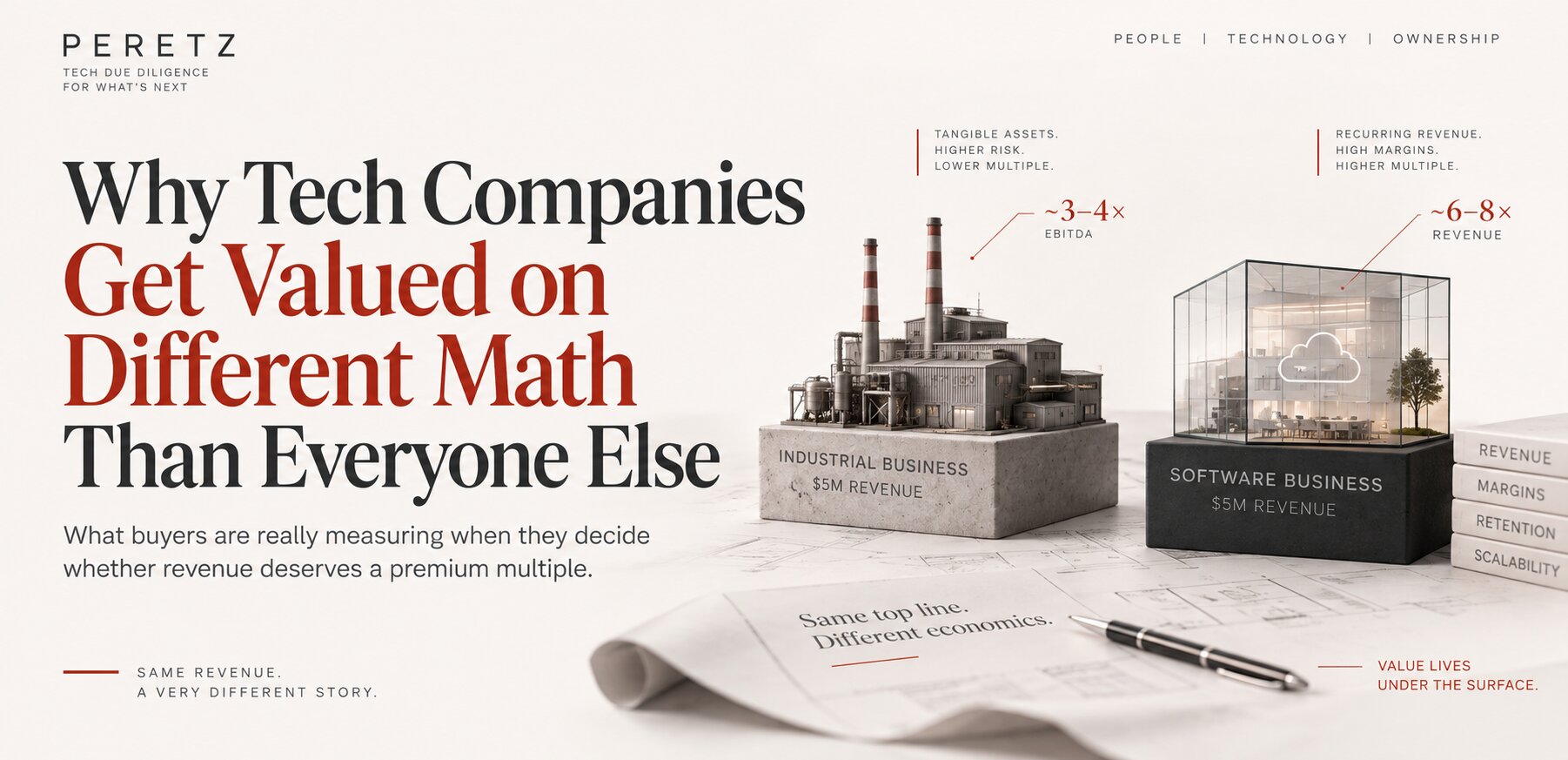
Why Tech Companies Get Valued on Different Math Than Everyone Else
-
19. 09. 2026

The AI Wrapper Problem: Why "We Use AI" Doesn't Mean What Buyers Think
-
20. 09. 2026
Founder Dependency: The Discount Nobody Puts in the Deck