Organic Search Is Shrinking and Ads Cost a Fortune: Where Growth Comes From Now



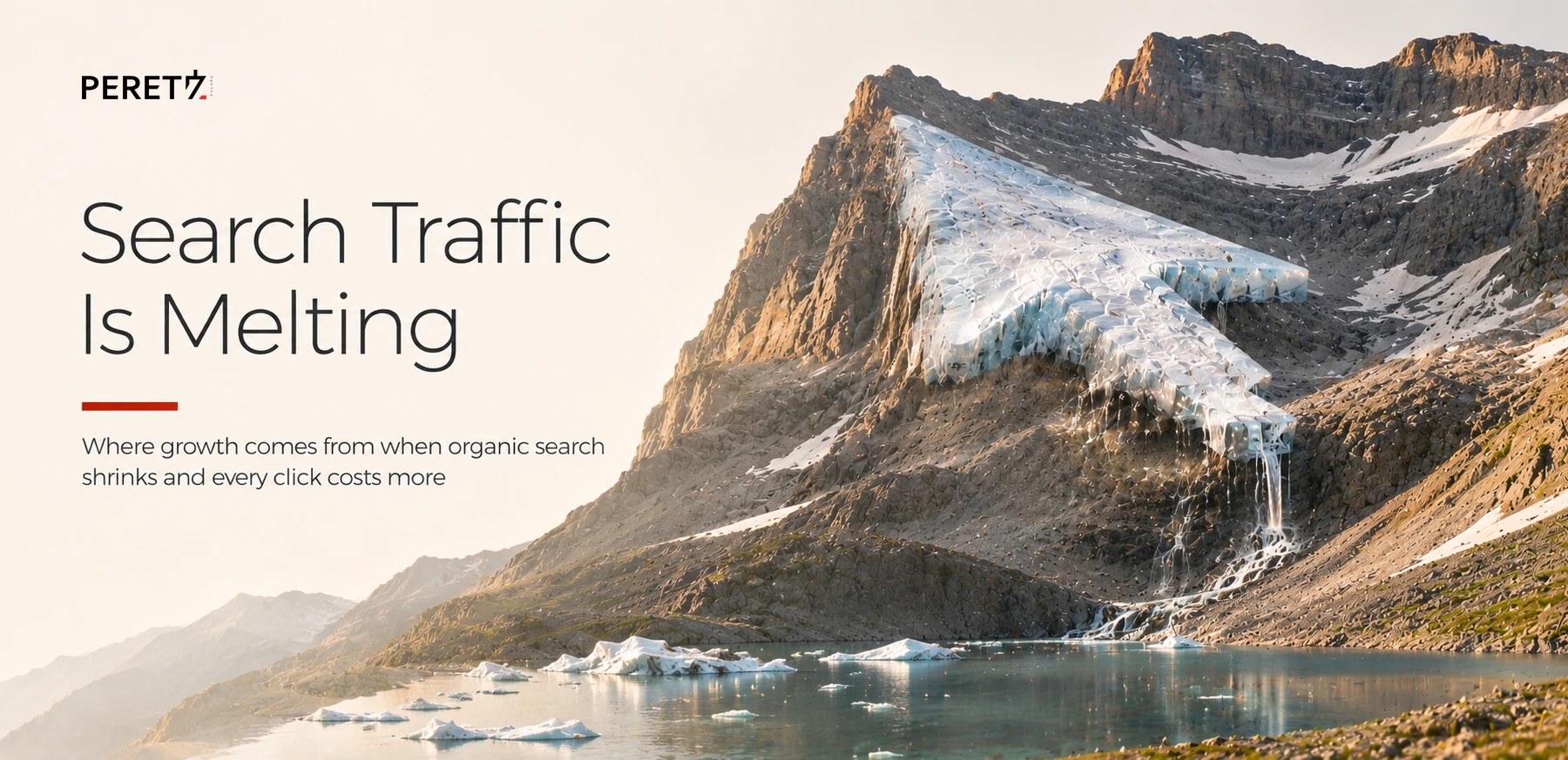
What we see on our own site and on our clients' projects, and a plan for a Seattle bike shop that cannot buy its way to the top. Status as of November 2026.
IN SHORT
The short answer
Fewer people click through from Google, a click on an ad costs more every year, and for many products the audience cannot be described well in ad settings. Growth now comes from material only you can write, from contacts you own, from people and partners around the business, and from ads only where the numbers work. Classic SEO built on keywords is finished. SEO itself is not: the same expert material that ranks in Google is what AI answers quote, so the work feeds both channels at once.
This is the question we hear most from owners. They rarely ask only "how else can we sell?". They ask how to keep growing in search while everyone talks about AI, because nobody knows yet whether AI search stays or fades, and nobody wants to stop while competitors keep going. Below is what we see on our own site, on a clinic we work with, and a worked example: a bike shop in Seattle.
WHAT CHANGED
What changed in two years
Three things moved at once, and they hit small and mid-sized businesses hardest.
People click less: in a study of browsing data from 900 US adults in March 2025, Pew Research Center found that people clicked a regular search result in 8% of visits when Google showed an AI summary, and in 15% when it did not. Links inside the summary itself got clicks in about 1% of visits. Ahrefs compared December 2023 with December 2025 on keywords that show an AI Overview and estimated that the top result now gets about 58% fewer clicks than it used to. Google disputes such studies, and the numbers differ by method, but the direction is the same everywhere.
Ads cost more: WordStream's 2025 Google Ads benchmarks, built on more than 16,000 US search campaigns between April 2024 and March 2025, put the average cost per click at $5.26, up from $4.66 a year earlier, with prices rising in 87% of industries.
Targeting got blurry: ad systems now decide more on their own, and many products do not have a neat audience. Who buys a $2,500 gravel bike? A commuter, a retiree, a parent buying for a teenager, a rider who already owns three. You can pay for all of them and still miss the one who is ready this week.
Paying for every visitor works only when the margin can carry it.
The figures above are a snapshot as of November 2026 and will change. The idea behind them will not: a business that depends on one paid channel rents its customers instead of owning the way to them.
OUR OWN PATH
How clients find us now
We can describe this from our own site, because we live it. We have not run paid search or social ads for a while. Requests still come, and the path to them has changed.
Before, it was short: a person searched, found a page of ours in Google, opened a case study and wrote to us. Now it often starts with an answer in ChatGPT, Perplexity or Google's AI Overview that names us or quotes our material. The person then opens our portfolio, reads the blog, comes back over several days, compares us with others, asks the AI more questions about us, and only then sends a request. By the time they write, they have read more of our work than a visitor from an ad ever would.
What brought that about is not a trick. We write large layers of material from our own experience: cases, prices, how we work, what went wrong and how we fixed it. Every piece is linked to the related ones, to the services and to the cases, so a reader and a crawler can walk from any article to the whole picture. We keep a glossary of the terms our texts use, a public price list, and an llms.txt file that tells AI crawlers what matters on the site. We also checked that AI crawlers can reach us at all, which is not a given: our article on why ChatGPT and Perplexity cannot see a website lists the four places the block usually hides.
A CLINIC
The Trichology Institute
The second example is a medical one, where ads are restricted and a click is expensive. The Trichology Institute in Kharkiv treats hair, scalp and skin conditions, and its site had been neglected for years before we took it over: forms not connected, pages empty, no English or Russian versions, no publications.
What works there now is not ad spend. It is scientific publications, ties with professional journals, and the personal name of Prof. Yuliia Ovcharenko, who is a recognised authority in her field. Her journal articles are now published on the site in three languages, and every publication links to the doctor's profile, to the department and to the services it describes. When we added the first pages on specific conditions, they brought three requests in five days. We wrote about building such a site in Website Design for Specialty Clinics: When the Doctor's Name Is the Brand.
The honest part: classic search traffic as a whole is falling there too, as it is almost everywhere. What grows is the weight of the doctor's name and the depth of the material. A patient who asks an AI about a hair loss condition is more and more likely to get an answer built on the work of someone who has published on it for years.
The name and the depth of the work bring people. Keywords no longer do.
THE FEAR
"If we leave SEO, will we regret it?"
Here is the worry most owners carry, put plainly. AI search may be a passing phase. If we move our effort there and competitors keep doing SEO, we lose both. So they want to keep classic SEO and not miss it.
Our answer: you do not have to choose, because it is one job. SEO in the old sense, pages written around keyword lists with the right density and a stack of bought links, has died. Google has said for years that it rewards helpful, reliable content written for people, and in December 2022 it added Experience to its quality guidelines, turning E-A-T into E-E-A-T: does the author have first-hand experience of the subject? We looked at what this means for a business site in SEO, AEO and GEO in 2026: What Actually Matters to Google.
The same qualities make a page useful to AI answers: a clear author, real cases, facts in a structure a machine can read, and links that tie a topic together. That is why we call SEO, AEO and GEO amplifiers, not engines: they amplify a business that has something to say and do little for one that does not.
| What died | What still works in Google | What also feeds AI answers |
|---|---|---|
| Pages written around a keyword list | Pages that answer a real question fully | The same pages, quoted as a source |
| Bought links in bulk | Links earned by material people cite | Mentions of your name next to the topic |
| Text with no author | A named expert with a history | An entity the model can recognise |
| Thin category text | Structured data on products and prices | Facts a machine can read without guessing |
| One page per keyword | A cluster of linked articles on one topic | A clear picture of what you know |
If you take these points into account, it does not matter much whether the next customer comes from a Google result, an AI answer or a friend who read your article. The material is yours, and it keeps working in classic search too.
NOT EMPTY
You cannot be an empty shell
One more change makes this possible for a small team: editing is no longer the bottleneck. Claude, ChatGPT and Perplexity are good editors and fact checkers. They help turn notes, cases and interviews into clean text in three languages, check sources and find gaps. That is how we can publish whole layers of material, not one article a month.
The catch is that an AI editor needs something to edit. Our base is real: years of projects, original cases, our own history, prices we actually charge, mistakes we made. Take that away and you get the same text as everyone else, which neither Google nor an AI answer has any reason to show. We wrote about this in When Everyone Can Publish 500 Articles, What Is Content Worth? and in The Internet Has Enough Content. Where Is the Meat?.
So the rule we follow: AI for editing and checking, never for experience. The cost of AI was never in writing, it is in verifying, as we explained in The Cost of AI Isn't Generation. It's Verification.
THE SHOP
Meet the shop: a bike shop in Seattle
Now the worked example. It is a hypothetical shop, and every number below is an illustration for the reasoning, not a benchmark.
A family-owned bike shop in north Seattle: one store with a workshop, an online store, about a dozen people. It sells commuter, gravel, road and e-bikes, parts and clothing, and services everything it sells. Its competition is REI, a few big chains and online sellers who ship anywhere.
Some rough numbers for the reasoning. A bike sells for $1,400 on average and earns the shop about $400 gross. Accessories and parts average $60 with $25 gross, and a tune-up is $120. Most customers buy a bike every four to six years, but they come to the workshop once or twice a year.
Now the ad math, which is where the trouble starts. Suppose a click on "buy gravel bike Seattle" costs $3 and one visitor in 80 buys. That is $240 to sell one bike before discounts, more than half its gross. For accessories the same math never works. Meanwhile the shop has things REI cannot copy: its mechanics, its local rides, and the people who already trust it with their bikes.
FOUR LAYERS
Where the shop's growth comes from
We would build growth for this shop in four layers. They work together: each one feeds the others.
Layer 1: search and AI answers built on first-hand material. The shop writes what only it knows:
- what its mechanics see on bikes after a wet Seattle winter, and what to check in spring;
- commuting guides for real routes, the Burke-Gilman Trail, hills and rain gear that holds up;
- honest comparisons of the bikes it sells, including when not to buy an e-bike;
- workshop prices on the site, so an AI can quote them and a visitor can plan.
Each guide links to the products and the services it mentions. Product pages carry structured data on price, stock and reviews (we covered this in Product Page SEO), and the Google Business Profile is kept full and current, which still drives local visits (how to rank it without ads).
Layer 2: contacts the shop owns and can reach at any time. Every bike sold and every repair goes into a CRM with the bike, its age and its mileage when known. From there the shop sends useful reminders: a spring tune-up, a chain check after a season of commuting, a trade-in valuation when the bike turns five. This costs almost nothing per message and reaches people who already chose the shop once. We help build this as part of custom CRM development, or around an existing system.
Layer 3: people and partners around the shop. Weekly group rides that start at the store; bike fitting sessions; commuter programs with local employers who want staff to ride to work; a basic repair class for beginners. Every one of these creates something to write about, photos for the site and reasons for people to mention the shop. A mention by a local club or employer is worth more than a bought link.
Layer 4: ads only where the math works. Google Shopping for high-ticket bikes during the spring season, when people are ready to buy; remarketing to visitors who read a comparison guide; never broad campaigns for accessories. If the shop runs ads, they amplify layers 1 to 3 instead of replacing them. Our Google Shopping Ads service is set up this way.
Search finds new people. The CRM keeps them. The workshop brings them back.
90 DAYS
The first 90 days
A realistic start for a shop like this, with one person on the owner's side for a few hours a week:
| Weeks | What gets done | What it gives |
|---|---|---|
| 1 to 4 | Audit of the site, product data and Google Business Profile; AI crawlers allowed; CRM records from sales and repairs | A clean base, and a list of what customers really ask |
| 5 to 8 | The first six guides from the workshop and the owner's experience, linked to products and services; workshop prices on the site | Pages that answer real questions in Google and AI answers |
| 9 to 12 | Service reminders from the CRM; the first group ride and a commuter partner; Shopping ads only for the spring season | Returning customers, local mentions, ads with a clear budget |
After that the work becomes a rhythm: two or three new pieces a month from real cases, one reminder flow at a time, one partnership at a time. Results in search come in months, not weeks, which we explained in How Long Does It Take to See Marketing Results?.
MEASURING
How to measure a longer path
When a customer reads an AI answer, visits three times over a week and then walks into the store, the old "click, then sale" report misses most of the story. We look at a few signals together:
- referrals from chatgpt.com, perplexity.ai, gemini.google.com and copilot.microsoft.com in Google Analytics;
- the number of searches for the shop's own name in Search Console, which grows when the material works;
- direct visits and returning visitors;
- a short "how did you hear about us?" question in the request form and at the till.
Search Console itself has had its moments: in autumn 2026 its Page indexing report stopped updating for weeks (what we did meanwhile). Another reason not to judge growth by one chart.
WHERE WE FIT
What we do in this
For businesses like this shop we build the parts that make the four layers work as one system: an online store with clean product data and fast pages (e-commerce development), e-commerce SEO built into the store rather than added later, AEO and GEO optimization so AI answers can read and quote the site, and a CRM that turns past customers into returning ones. We start with a strategic session to see which layer gives your business the most for the least.
FAQ
Frequently asked questions
Is SEO dead because of AI search?
No, but it has changed. SEO built on keyword lists and bought links has stopped working. SEO built on expert material, structure and links between topics still works in Google and is also what AI answers draw on.
Should a small business stop paid ads?
Not always, and not everywhere. Keep ads where one sale clearly pays for the clicks, such as high-ticket products in season, and stop them where the margin cannot carry the cost of a click.
How do I know if AI search sends me customers?
Check referrals from chatgpt.com, perplexity.ai and similar sites in Google Analytics, watch searches for your brand name in Search Console, and ask new customers how they found you.
Can AI write our articles for us?
AI can edit, translate and check. It cannot supply your cases, prices and experience, and without them the text is the same as everyone else's, so it has no reason to rank or be quoted.
How long before the four layers show results?
Contacts you own and partnerships can bring customers in weeks. Search and AI visibility usually take several months, and keep working long after that.
Sources
- Google users are less likely to click on links when an AI summary appears in the results (Pew Research Center)
- Update: AI Overviews Reduce Clicks by 58% (Ahrefs)
- Google Ads Benchmarks 2025 (WordStream)
- Creating helpful, reliable, people-first content (Google Search Central)
- Our latest update to the quality rater guidelines: E-A-T gets an extra E for Experience (Google Search Central Blog)
Fewer clicks from Google and dearer ads? Let's look at where your next customers can come from.
- Share
-

-

-

-

One notification a week with the new PERETZ articles. Nothing else.