SEO, AEO, and GEO in 2026: What Actually Matters to Google, and What Your Marketer's Report Should Show



Chapters
Not long ago, SEO was a fairly straightforward game: find keywords, optimize pages, write articles, get links, raise positions, get traffic.
At some point this model became so familiar that an entire industry of reports, spreadsheets, and pretty charts grew up around SEO.
"We moved 37 keywords." "Average position up 18%." "Published 24 articles." "Got 46 backlinks."
Sometimes real work stood behind that. Sometimes it was just a lot of activity that looks good in a report.
In 2026, Google is no longer just a page with ten blue links. AI Overviews are showing up, AI Mode is expanding, and Search Console has started separately reporting site visibility in generative AI features (Google Support).
So the question is no longer only where the site ranks.
The question is broader: does Google understand what your business actually does? Can it find, verify, and correctly interpret that information? And is your brand becoming visible where people are actually looking for answers today?
That is SEO in 2026.
ONE SYSTEM
SEO, AEO, and GEO: One System, Not Three
The last couple of years produced a lot of new terminology. SEO. AEO. GEO. AI SEO. LLM SEO. Generative Search Optimization.
Sometimes it feels like every new way of searching needs its own profession. I would look at it more simply.
SEO remains the foundation. AEO, Answer Engine Optimization, is working with search that has to give a person a direct answer. GEO, Generative Engine Optimization, is working with generative search systems and AI answers.
But these are not three separate worlds. Google itself points out that appearing in AI search features does not require some separate, magic optimization: fundamental SEO practices still matter (Google Support).
Which makes sense. AI also has to first find the page, understand it, evaluate it, and determine its relevance.
So I would not split the strategy into "here's our SEO, and separately, AEO and GEO." It is more accurate to think of one system: search visibility, content, authority, entities, AI visibility, business results.
WHAT GOOGLE WANTS
What Google Is Actually Trying to Understand
Google does not need to be told what a "SEO-friendly article" is. It needs to answer a much simpler question: does this page genuinely answer the user's question, and does it deserve to be shown?
Every fundamental requirement follows from that: the page needs to be crawlable, it needs to index properly, its content needs to match search intent, the site needs to demonstrate real expertise, and the business behind it needs to be clear enough that a search engine can connect the company, its services, and its topics.
That is exactly why technical SEO never went away. It just stopped being the whole strategy.
The biggest mistake is thinking SEO equals keywords. Keywords never disappeared. But a good SEO specialist stopped thinking "how do I fit this keyword in five more times" a long time ago. The real question is: what did this person actually want to know?
Say someone searches website redesign cost Seattle. Behind it is intent: what does it cost, what is included, do I actually need a new site, how long does it take, who does this work.
If a page only answers the first sentence, it technically contains the keyword. It does not solve the visitor's problem. That is exactly where modern SEO starts.
Content has to answer the question, not just exist. This matters even more in the AI era. When someone asks Google or an AI assistant a question, they do not need another 2,000-word article just because "SEO recommends it." They need an answer, sometimes short, sometimes detailed: an article, a table, a case study, a guide, a calculator, a service page.
Good content is not a specific word count. It is a solved problem.
AEO AND GEO
AEO and GEO, In Practice
Answer Engine Optimization gets sold as a bag of small technical tricks: add an FAQ, break the text into blocks, put a question in an H2. That can help, but reducing AEO to tactics like that just means optimizing format instead of substance again.
I would put it more simply: make the information clear and well structured enough that a person and a machine can both understand the answer quickly. Answer first, then what it depends on, then options and examples. That is good for the reader and good for the search engine at the same time.
GEO is even more interesting. Generative Engine Optimization shows up where the search engine stops just showing links and starts generating the answer itself.
Google has started separately measuring site visibility inside its own generative AI features, including AI Overviews and AI Mode (Google Support).
We used to ask "where does our page rank?" Now a second question is starting to matter: "is our site being used as the source of the answer?"
But I would not chase this as a shiny new KPI just yet. There is a more fundamental question underneath it: why should AI choose us at all?
ORIGINAL EXPERTISE
Why Original Expertise Wins
Picture a thousand articles titled "How to redesign a website." Nearly all of them the same: the same advice, the same definitions, the same "10 tips."
If your piece is the 1,001st variation of the same text, it is not obvious why a search engine should treat it as especially valuable. Now picture the opposite: you show a real project, real constraints and decisions, before and after data, real conclusions.
That is new information. Which is exactly why one of the strongest SEO strategies for 2026 is not to write more. It is to have more of your own material worth writing about.
E-E-A-T matters more, not because it is a magic ranking factor. Experience, Expertise, Authoritativeness, Trustworthiness is not four switches you flip in a site's settings. It is a way of thinking about the quality of information: did the author actually have this experience, do they understand the topic, is there a reason to treat them as a source, can the information be trusted.
For a business, that means not writing "we are a professional digital agency," but showing your actual projects, what you did, and what the results were.
Which is why a case study often beats ten ordinary articles. If an agency writes "How to build an effective website," that can be useful. But if it writes "How we rebuilt Company X's site: what was broken and what changed after launch," that is its own information asset.
It demonstrates real experience, creates genuinely unique content, and gives AI an actual source to point to.
That is one reason case studies, original research, and first-party data keep getting more valuable.
TECHNICAL & ARCHITECTURE
Technical Foundation and Site Architecture
All the AI talk sometimes creates the impression that robots.txt and indexing no longer matter. They do. Google still has to be able to find and process your pages properly.
The basics remain the foundation: crawling, indexability, canonicals, redirects, internal linking, structured data where it is genuinely useful.
But there is another piece: site architecture. Say you have 100 great articles, but they exist in isolation. The article does not link anywhere. The service page does not link anywhere. The case study sits in a different section.
Google sees a lot of pages but poorly understands the relationship between them. That is a missed opportunity.
A much stronger structure looks like: Topic → Article → Service → Case study → Conversion.
For website redesign, for example: Website Redesign vs New Website, Website Redesign Cost, our process, a case study, the service page itself.
That way content stops being a pile of separate pages and starts working as a system of knowledge around a commercial topic.
Which is why I like content clusters. Not because "Google likes clusters." Because they are logical.
If a company genuinely does website redesign work, questions naturally exist around that service: what it is, how much it costs, how to pick a contractor, what real case studies show.
Those are real business questions, not artificially invented SEO copy. A cluster built on them holds up far better than a random pile of a hundred keywords.
THE REPORT
What to Actually Look At in an SEO Report
Here I would flip the whole approach. If a report opens with "27 articles published, 48 backlinks acquired, 63 keywords improved," I would turn the page.
What I actually want to know first is: what changed for the business?
Level one, Search Visibility. Google Search Console has four core metrics: Impressions, Clicks, CTR, Average position (Google Support). What matters is not the raw number, it is the trend.
Impressions rising means Google is showing the site more often. If clicks rise too, visibility is turning into real traffic. If impressions rise and clicks stay flat, it is a CTR problem, the snippet is not compelling enough.
Why I do not trust a positions-only report. "We went from position 17 to position 9." Good. For which query? How many people search it? Is there commercial value? Position without context says almost nothing.
Google itself recommends focusing on impression and click trends rather than average position as a single metric (Google Support).
Position is a diagnostic metric. Not the main business KPI.
Level two, Search Queries. What actually interests me is: which queries have started showing up? That is where you see how Google is starting to understand the site.
Especially the queries that are new, growing fast, sitting at positions 4 through 15, and pointing to the right pages (Google Support).
Level three, Pages. I would want to see every month: which pages grew, which fell, which get a lot of impressions but few clicks, which sit at positions 4 through 15.
That last one matters most. A page at position 8 is not a failure, it is an asset already sitting next to the first line of results. A rewritten title, a few strong internal links, and deeper content sometimes deliver more than ten new articles.
Level four, Non-Brand vs Brand. Brand search means people already know the company. Non-brand search means they are searching for a problem or a topic, not you specifically.
Growing brand traffic is good. But what actually matters more: are we becoming visible to people who do not know us yet? Search Console now lets you filter branded versus non-branded queries in certain reports (Google Support).
Level five, Conversion. This is where SEO stops being a numbers game.
Say organic traffic is up 80%. Great. But qualified leads are up 2%. Then the real question is: what did we actually improve?
SEO should bring the right people, not just people. I would track organic leads, qualified leads, calls, booked consultations, revenue, tied to specific landing pages.
And only then, AI Visibility. Google is rolling out a separate Generative AI Performance report inside Search Console: visibility in AI Overviews and AI Mode, broken down by page and device (Google Support).
It is an interesting new metric. But I would not turn it into a new religion. "We got 500 AI impressions, so SEO is working" is not an argument. Look at the whole chain: AI visibility, clicks, leads, business.
AI CONTENT
So What Do We Do With AI Content?
AI genuinely lets you produce content much faster. That is a real advantage.
But there is a wide gap between AI-assisted content and an AI-generated content factory. The first can make an editorial team stronger. The second can turn a site into a warehouse of near-identical pages fast.
Google does not ban generative AI for content creation. But mass-producing pages without added value for the reader can fall under scaled content abuse. The question is not whether a human or a machine wrote it, it is why it was made, and what value it actually carries.
We went deeper into exactly that line, between content that genuinely helps a reader and content that just fills pages, in Human-First Content Strategy: Why AI Content Is Losing the Trust War.
MONTHLY CHECKLIST
What I Would Require From an SEO Agency Every Month
If I owned the business and paid for SEO, my report would look like a compact checklist over everything above:
1. Search visibility (impressions, clicks, CTR, non-brand share) → 2. Growth (new queries, pages up and down) → 3. Content (what shipped, what needs updating) → 4. Technical SEO (indexed pages, crawl issues, Core Web Vitals) → 5. AI Search (generative AI impressions) → 6. Business (qualified leads, organic revenue).
And only at the very end, 7. what we actually did: articles, links, technical fixes.
Meaning I want to see not "here is how much work we did," but "here is what changed because of it."
GOOD SEO MONTH
What a Genuinely Good SEO Month Looks Like
A marketer walks in and says: this month we published 12 articles. That is information.
Organic impressions up 34%. Non-brand clicks up 21%. 14 new queries entered the Top 10. Three service pages started getting meaningful search traffic for the first time. Two articles crossed 10,000 impressions and need CTR work. Organic leads up 18%. Four pages started appearing in generative AI features.
That is management-grade information. You can make decisions from it.
PART OF BUSINESS
Which Is Where SEO Becomes Part of the Business
I have never liked the idea that SEO is some separate technical department quietly "raising rankings" somewhere. If a company sells website redesign, SEO should gradually build visibility around cost, process, case studies, and lead people to the service page, then to contact.
And here is probably the real shift: SEO is looking less and less like a game against an algorithm, and more like work on a company's informational capital.
If a company has real projects, experience, data, and its own point of view, it has the material for a genuinely strong digital presence. If it does not, AI can help write 500 articles, but it cannot manufacture the experience itself.
Which is exactly why I would bet less on volume of content and more on the density of real expertise inside it.
At the end of the month, I do not particularly care how many hours the SEO team spent in Ahrefs. What I want to know is: did it get easier for our business to be found, understood, and chosen?
If impressions rise, Google is showing us more often. If clicks rise, people are choosing us among the results. If non-brand visibility rises, we are being found by people who did not know the company yet.
And if all of it rises together, then we are not just talking about "SEO activity" anymore. We are talking about growth in a company's digital asset.
Assistants outside Google grade on their own evidence, which we examine in SEO Gets You Found. AEO Gets You Recommended. Your Commerce Infrastructure Gets You Bought..
If you want the full picture of your site's visibility, not just rankings, but impressions, qualified queries, and conversions, a Strategic Session starts with an honest audit of where you actually stand.
Explore SEO & Website Promotion
If your business operates in more than one language, see multilingual AEO for how to measure this per language, not just once for the whole site.
- Share
-
-

-

-
Related Reading
-
15. 06. 2026
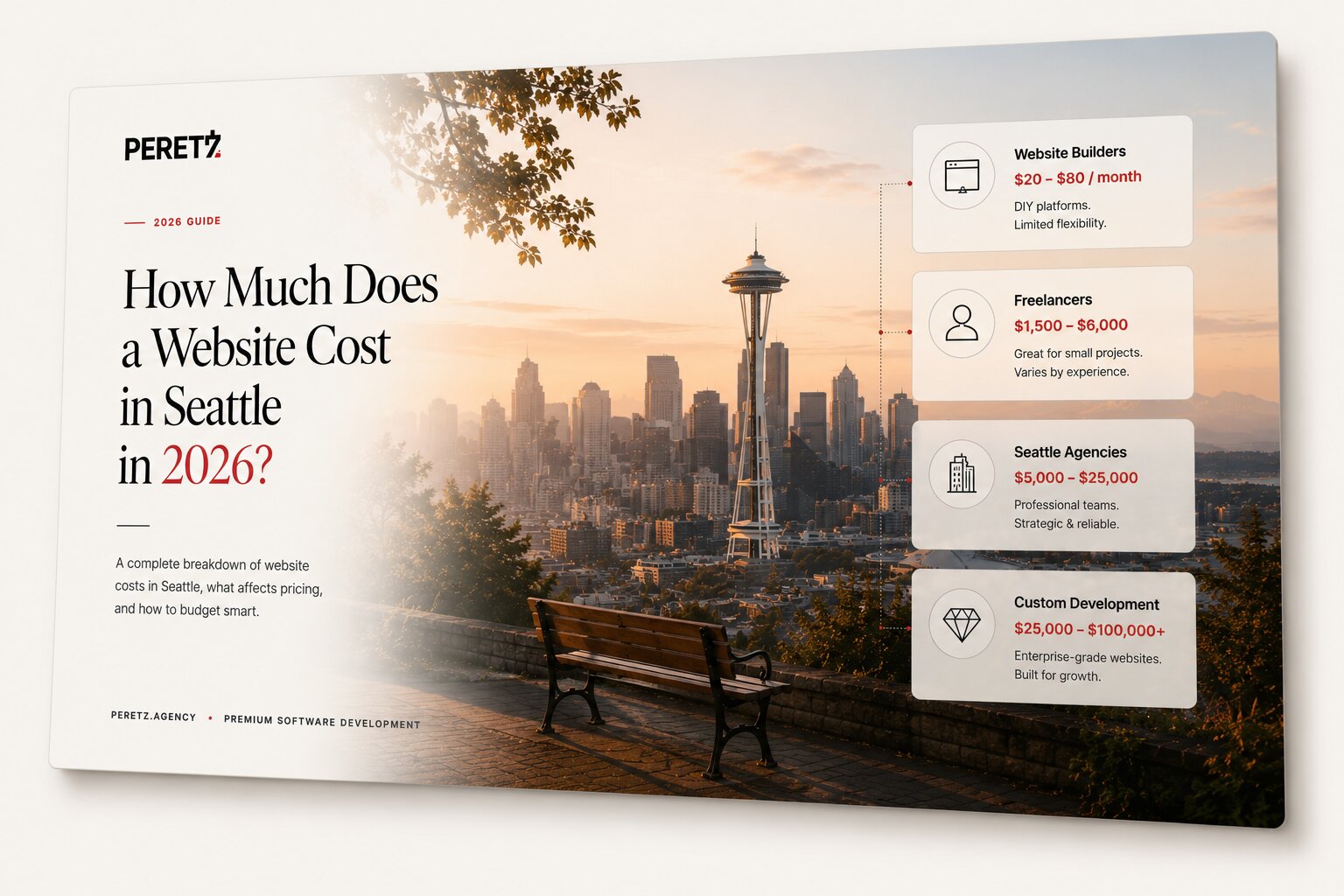
How Much Does a Website Cost in Seattle in 2026?

-
25. 06. 2026

Website Redesign vs New Website: How to Make the Right Decision in 2026
-
07. 07. 2026
Human-First Content Strategy: Why AI Content Is Losing the Trust War in 2026
-
07. 07. 2026
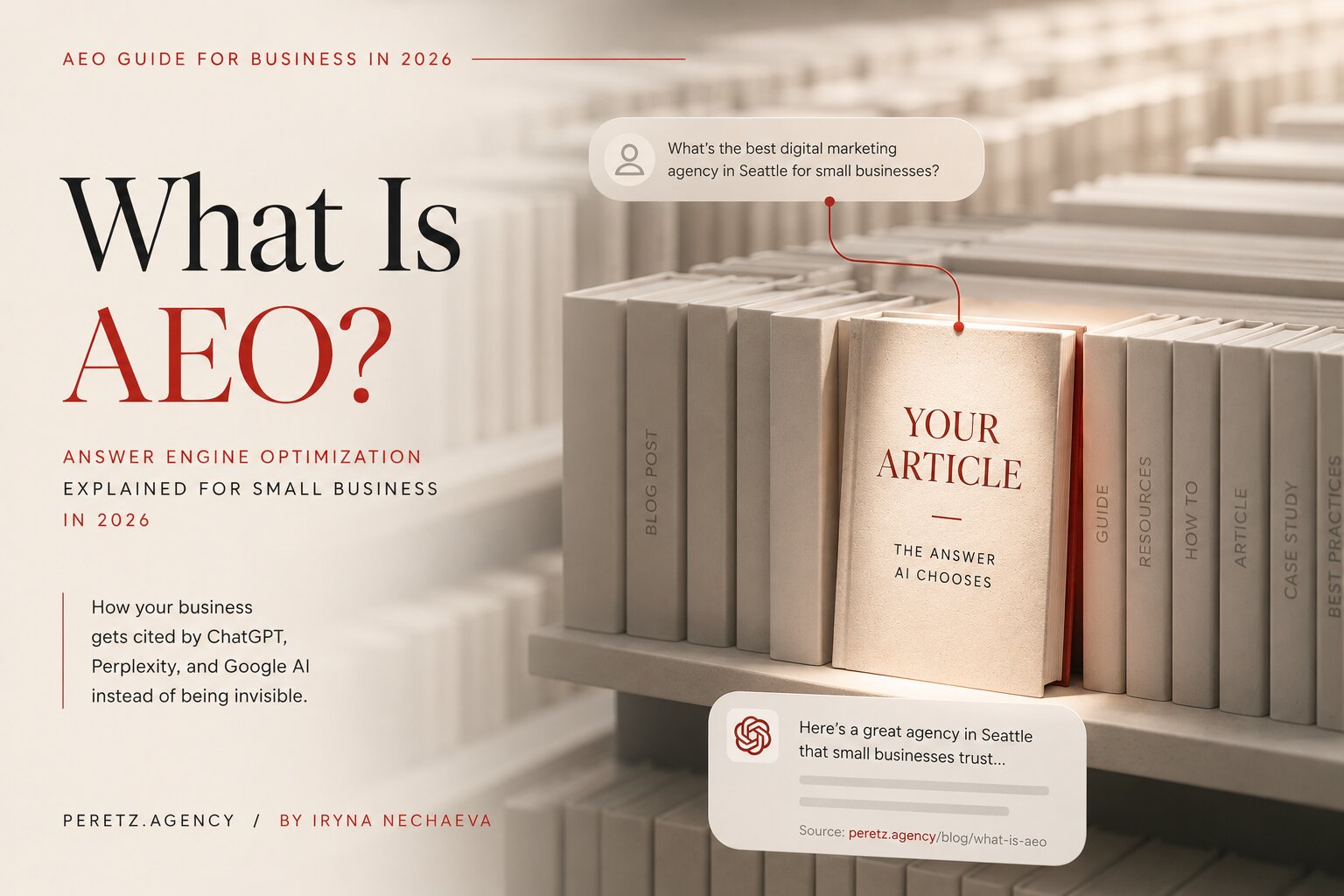
What Is AEO? Answer Engine Optimization Explained for Small Business in 2026
-
17. 08. 2026

When Everyone Can Publish 500 Articles, What Is Content Worth?
-
06. 09. 2026

SEO Gets You Found. AEO Gets You Recommended. Your Commerce Infrastructure Gets You Bought.
-
17. 06. 2026
Why Your Business Isn't Getting Leads From Its Website (And How to Fix It in 2026)
-
16. 09. 2026
Multilingual AEO: Why Translation Isn't Enough for AI Search