
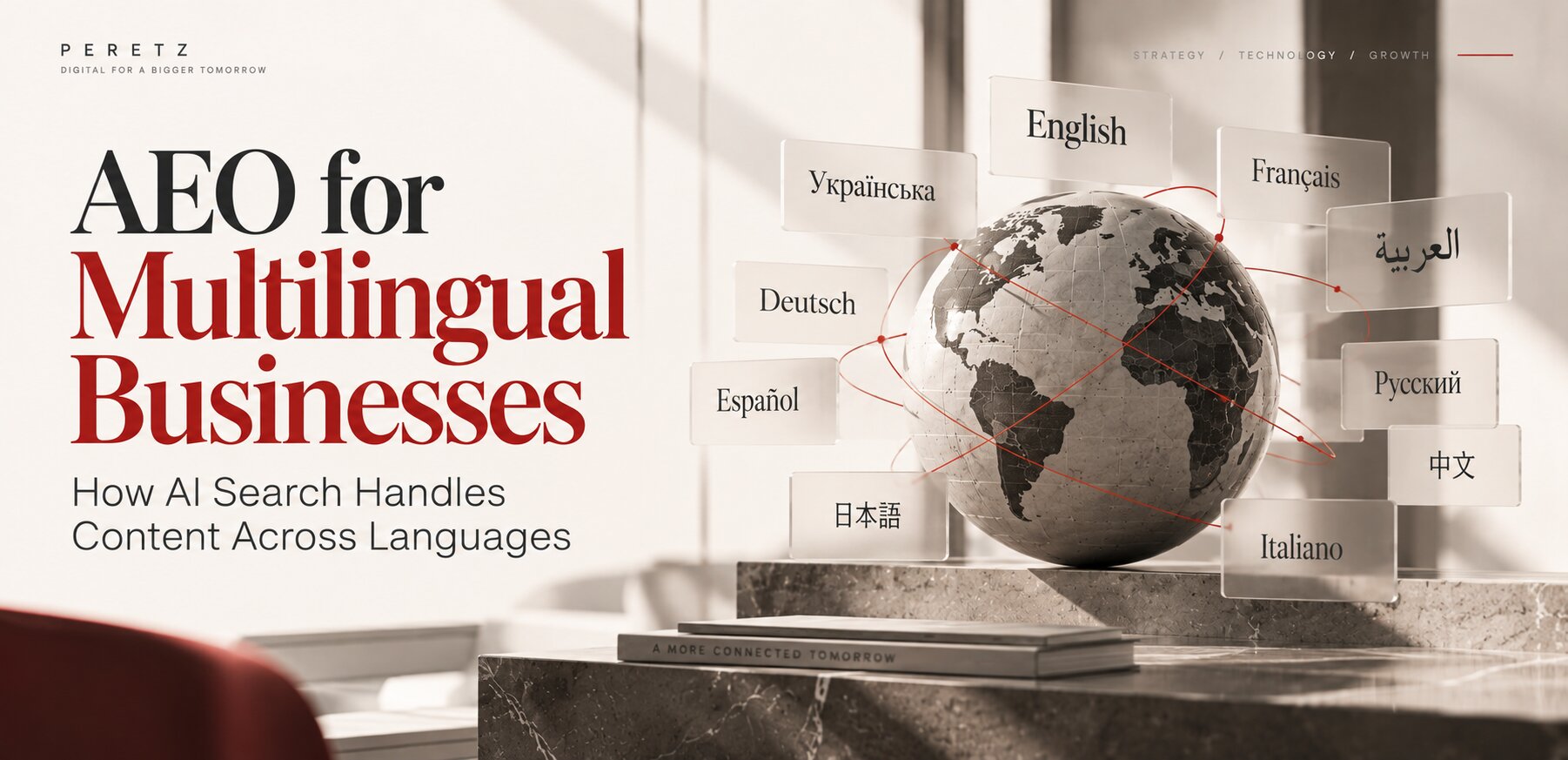
How to make your business visible, understandable, and citable across languages.
A translated website gives a language to your content. It doesn't automatically give that language a voice, a reputation, or a place in the AI's answer. That gap is easy to miss because everything looks fine on the surface, the Ukrainian pages read well, the Russian pages read well, the site technically exists in three languages. Whether an AI system actually retrieves and cites the business when a customer asks in Ukrainian, separately from when they ask in English, is a different question entirely, and testing it usually reveals more gaps than businesses expect.
Translation gives a language version to a page. It doesn't automatically give that language its own search footprint, local relevance, citations, or external recognition.
TRANSLATION NOT PRESENCE
Translation Is Not the Same as Presence
A business can have genuine authority in English, cited confidently by ChatGPT and appearing reliably in Google AI Overviews, while being functionally invisible in Ukrainian or Russian, on the exact same website, covering the exact same services. This isn't a translation quality problem. The Ukrainian and Russian pages can read perfectly, grammatically correct, locally appropriate, genuinely well-written, and the gap can still exist.
The reason sits one layer beneath the writing itself. In practice, the signals that make a business easy to retrieve and cite in one language don't reliably transfer to another, even on a page-for-page identical site. Translation solves the language. It doesn't automatically solve everything that made the original version visible in the first place.
SEPARATE PROBLEM
Why Multilingual AI Visibility Is a Separate Problem
Traditional SEO has a mature answer for multilingual sites: hreflang tags tell search engines which language version to show which audience, refined by Google over more than a decade. Answer engines are working with a younger, less standardized version of the same challenge, and the internal signals aren't fully public. What's observable, without needing to know the exact mechanism, is the outcome: a business with strong AI visibility in English can score close to zero on the identical test run in Ukrainian. Each language ends up behaving closer to its own visibility project than a byproduct of the main one.
LANGUAGE VS CONTENT PARITY
Language Parity Is Not Content Parity
A natural instinct is to measure multilingual effort by page count, five hundred English pages, so translate five hundred into Ukrainian and Russian too. That's language parity, and it's the wrong target. Five hundred English pages plus five hundred Ukrainian plus five hundred Russian isn't automatically stronger than five hundred English plus eighty Ukrainian plus sixty Russian, if the smaller language versions cover the pages that actually matter, entity-defining pages, core services, the questions customers actually ask commercially, FAQs, and real cases, more completely than a mirrored translation of everything would.
The right question was never "how much of the site exists in this language." It's "what information must exist in this language for the business to be understood and discovered here." Those are frequently very different amounts of content.
FOUR LAYERS
Thinking About Multilingual Visibility in Four Layers
It helps to break "make it visible in Ukrainian" into four distinct layers, since they fail independently and get fixed differently. Technical, separate URLs per language, correct hreflang, canonicals, crawlability, sitemaps, a clear language structure a crawler can actually parse. Content, real local questions answered in natural phrasing, FAQs, terminology that matches how the market actually talks about the category. Entity, the business, its services, its people, and its locations named the same way everywhere in that language, so the entity stays recognizable. External, citations, mentions, and independent sources in that language that reinforce the business beyond its own site.
Translation, by itself, mainly addresses the content layer, and only partially. It does nothing automatic for technical structure, entity consistency, or external signal, which is usually where the real gap actually lives.
THREE DIFFERENT JOBS
Translation, Localization, and AEO Solve Different Problems
These get treated as one task when they're really three. Translation is linguistic equivalence, the same information expressed in another language. Localization is market relevance, whether the information reflects how people in that market actually search, compare, decide, and talk about the category. AEO is answer-worthiness and retrievability, whether the business and its information are structured and supported well enough to be a useful source for an answer system. A business can complete the first step perfectly and still have done none of the second or third, and that's usually the actual explanation when a well-translated site still underperforms in the language it was translated into.
ENTITY CONSISTENCY
Cross-Language Entity Consistency
Entity consistency sounds abstract until you look at how many variants a single name can accumulate across languages. Consider a business name, its founder's name, and a core service, each needs a canonical form and a defined set of accepted variants per language, so an AI system encountering any of them still resolves to the same entity: the company itself might appear as Peretz, Peretz Agency, or PERETZ.agency depending on context. A founder's name might render as Yevhen Borovoi in English, Eugene Borovoy in an older transliteration, Євген Боровий in Ukrainian, and Евгений Боровой in Russian, four genuinely different strings for one person. A core service might be called web design, website design, or custom development in English, and веб-дизайн or розробка сайтів in Ukrainian, terms that need to map back to the same offering rather than reading as unrelated services.
A practical way to manage this: for every entity that matters, canonical name, the accepted language variants, preferred terminology per language, the URL, related services, related cases, and known external references. Without that mapping, an AI system has no reliable way to know that four different strings across four contexts all point to the same business.
INDEPENDENTLY CITABLE
What "Independently Citable" Should Mean
By independently citable, we mean a language version has enough native, relevant, and externally supported information for search and answer systems to retrieve and cite it in that language when appropriate, not because it inherited trust from another language version of the same site. A page that's a direct translation carries the original's phrasing, but not necessarily its accumulated citation history, backlinks, or topical authority in the new language. Genuine independent citability usually means the language needs its own foundation, not an assumption that it inherits one from wherever the site started.
RETRIEVAL PATHS
Different AI Search Systems Use Different Retrieval Paths
Google AI Overviews, ChatGPT, and Perplexity aren't interchangeable, and each has its own relationship to search indexes, training data, and live retrieval, some of it publicly documented, much of it not. Rather than asserting exactly how each one weighs a signal internally, the more useful approach is testable: what can actually be observed by asking the same question across each system, in each language, and comparing the results. Strong visibility in English should never be assumed to produce equally reliable visibility in every other language across any of these systems, that assumption is worth testing directly rather than taking on faith.
hreflang deserves the same precision. It solves one problem: helping search engines understand which language and region a page targets. It does not, by itself, create locally relevant content, independent citations in that language, or any guarantee that an answer engine selects that version as a source. Getting hreflang right is necessary technical hygiene. It isn't a substitute for the content, entity, or external layers.
THE VISIBILITY TEST
The Multilingual AI Visibility Test
This is the practical center of the whole approach, and running it requires no assumptions about internal ranking mechanics. Choose one real commercial or research question a customer would actually ask. Ask it in English. Repeat it in Ukrainian. Repeat it in Russian. Run each version across the relevant AI and search environments, not just one. Record whether the brand is mentioned, which URL gets cited, which competitors appear instead, and how relevant the answer actually is. Compare the results across languages, and repeat the test over time rather than treating one result as permanent evidence.
It's worth distinguishing four different outcomes when reading the results, since they call for different fixes. The brand is mentioned, it shows up by name in the answer. The brand is cited, the system references the business's own domain as a source. The relevant page is cited, not just any page, but the correct one for that question. And the brand is recommended, it appears as an actual suggestion, not just a passing mention. A language that only ever reaches the first outcome has a different, usually smaller, problem than one that never reaches it at all.
Multilingual AI Visibility Matrix
| Language | Query | Engine | Brand Mentioned | URL Cited | Competitor Cited |
|---|---|---|---|---|---|
| English | Q1 | AI/Search A | Yes | /service | No |
| Ukrainian | Q1 | AI/Search A | No | None | Yes |
| Russian | Q1 | AI/Search A | Yes | /blog | No |
A version of this table, run consistently, turns into a useful ongoing scorecard: brand mention rate, citation rate, correct-page rate, and the language gap between them, tracked across the questions that actually matter to the business.
INTERNAL LINKING
Language-Specific Internal Linking
Translation creates a URL. Internal linking creates a place in the site's knowledge structure, and a translated page without that place behaves like an orphan inside its own language version, even when the equivalent English page sits deep inside a well-connected cluster. The pillar to cluster to service to case to related article structure that supports AI visibility in English has to be rebuilt, deliberately, in each strategic language, not assumed to exist just because the pages themselves were translated. A Ukrainian article floating with no Ukrainian internal links around it is structurally isolated in a way its English equivalent likely isn't, exactly the kind of architecture problem covered more broadly in digital architecture: internationalization was never just translation, it's designing content so each market can develop, and connect internally, on its own terms.
LOCAL PROOF
Local Proof and Local Authority
External signal isn't only about what other sites say, it's whether an ecosystem of independent recognition exists in that specific language at all. A local-language service page is one signal. A local-language ecosystem around the business, local case studies, mentions in industry publications, local directories, partner references, interviews, client mentions, is a meaningfully stronger one. A business can have excellent on-site content in Ukrainian and still lack this layer entirely if nothing outside its own domain reinforces it in that language.
WHAT TO TRANSLATE FIRST
What to Translate First
The instinct to translate the entire site at once usually isn't the right one, and it isn't necessary. A workable priority order: entity-defining pages first, the ones that establish who the business is. Core service pages next. Then the specific commercial questions customers actually ask before buying. Then proof, case studies and results. Supporting editorial content comes last, useful, but rarely what an AI system needs to recognize and cite the business in a new language. The question was never "what should we translate." It's "what information must exist in this language for the business to be understood and discovered."
WHAT TO DO
What to Actually Do About It
None of this requires three separate content operations built from scratch. What actually helps: prioritize the strategic language or languages first rather than trying to fix everything simultaneously, work through the priority order above rather than translating everything at once, add a meaningful layer of content written natively for that market rather than relying only on mirrored translation, rebuild internal linking deliberately in each language rather than assuming it carries over, and measure with the visibility test and matrix above, per language, on a recurring basis rather than once.
You need enough native signal in each strategic language for the business to be understood, retrieved, and cited there, not a parallel content factory. This follows the same discipline covered more broadly in what AEO actually is, SEO, AEO, and GEO in 2026, and AI search visibility, it just can't be assumed to carry over automatically from the language where it was first built.
A multilingual business already does the harder work of genuinely serving multiple markets. AI visibility should reflect that reach, not quietly stop at whichever language got attention first.
Does strong AEO in English automatically transfer to our other languages?
Not reliably. The signals that support retrieval and citation in one language don't automatically carry over to another, even on an identical site, so each strategic language generally needs its own foundation rather than inheriting one from English.
Is hreflang enough for AI search visibility?
No. hreflang helps search engines understand language and regional targeting, but it doesn't create locally relevant content, independent citations, or any guarantee that an answer engine selects that version as a source.
Should multilingual websites translate the same content everywhere, or create native content for each market?
Both, but they solve different problems. Translation covers the language layer efficiently for entity-defining and core service pages. Some genuinely native content, even a modest amount, tends to build local relevance and citability faster than a large volume of mirrored translation alone.
Not sure whether your business is actually visible to AI search in every language it operates in? We start by testing, not guessing.
- Share
-

-

-

-

Related Reading
-
07. 07. 2026

What Is AEO? Answer Engine Optimization Explained for Small Business in 2026

-
17. 08. 2026

SEO, AEO, and GEO in 2026: What Actually Matters to Google, and What Your Marketer's Report Should Show
-
27. 06. 2026

Your Business Is Invisible to AI Search in 2026 — Here's How to Fix It
-
11. 09. 2026

Digital Architecture: How to Build a System That Can Grow With Your Business