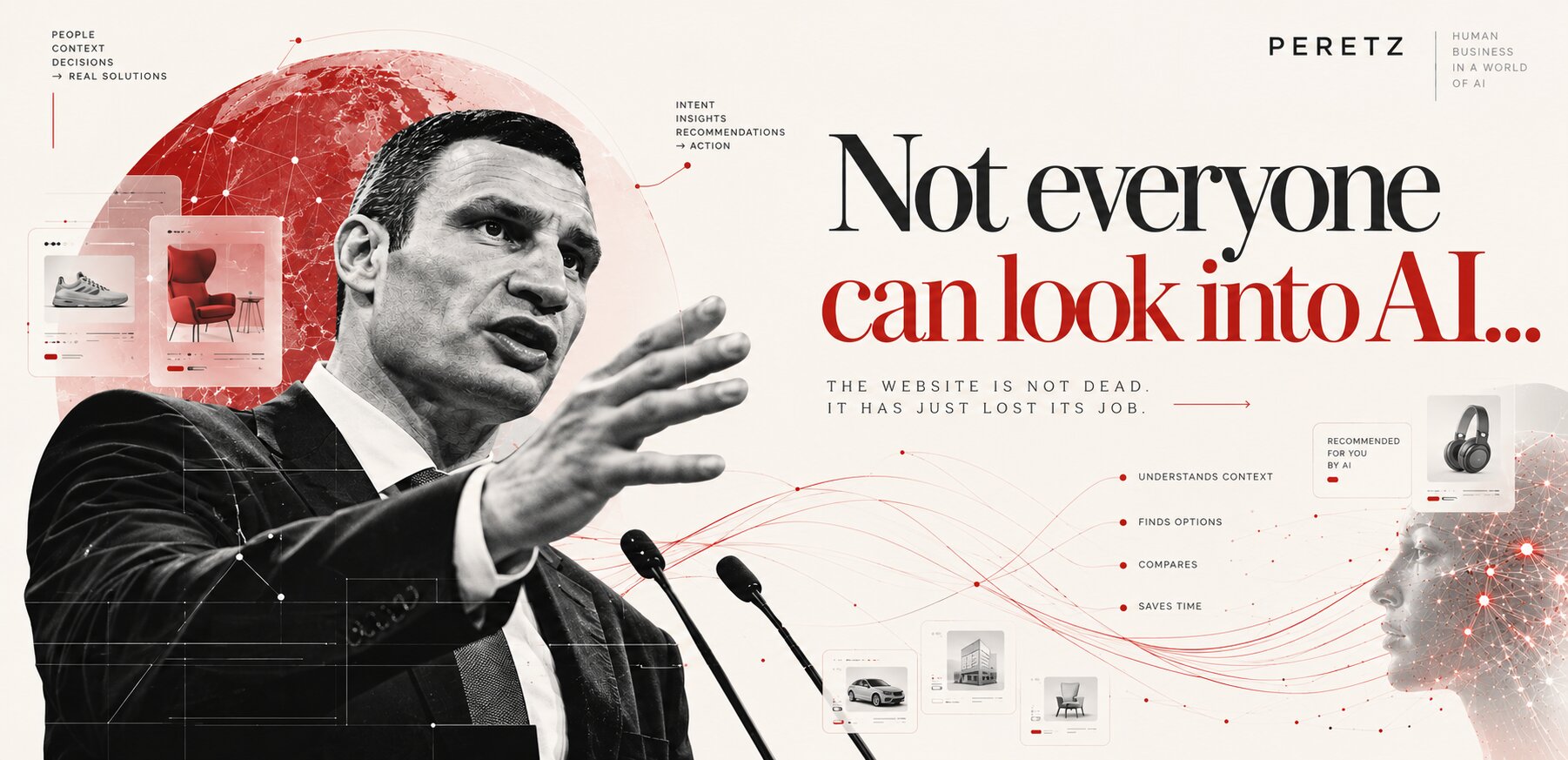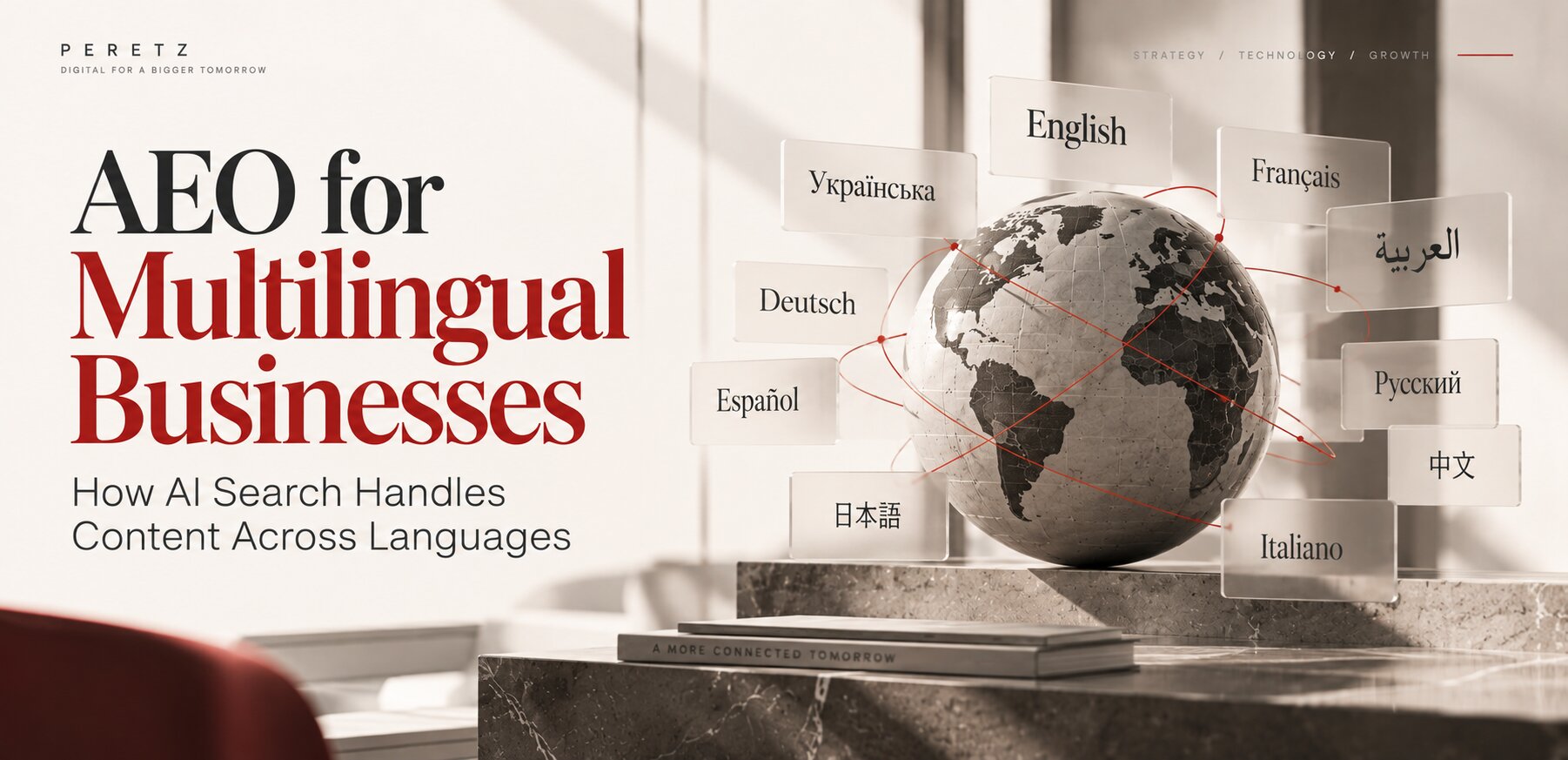
We just published a piece arguing that the website is not dead, it has just lost its job.
Today, Google gave us the first measurable proof.
Google quietly introduced a new type of reporting in Search Console.
It is called multimodal search.
For website owners, it may look like a small addition to a performance report.
A new filter. A new category. Another way to segment impressions and clicks.
But the underlying change is much bigger.
Google is beginning to measure what happens when the starting point of a search is not a sentence.
It is an image.
A photograph.
A screenshot.
A product someone is looking at.
A room someone wants to recreate.
A building.
A piece of furniture.
Something the user cannot name, or simply does not want to describe.
The next search query may not be something you type.
It may be something you show.
SEARCH BUILT AROUND WORDS
Search Was Built Around Words
For decades, the basic model of search was remarkably simple.
You had a question.
You translated that question into words.
You typed those words into a search engine.
The search engine matched your query against an enormous index of documents and returned a set of results.
Query → Search → Results → Page.
This model shaped almost everything we built around the web.
SEO was built around keywords.
Content was written around queries.
Navigation was designed around pages.
Analytics was organized around search terms.
And businesses spent enormous amounts of time trying to predict what people would type.
But there was always a fundamental problem with this model.
People do not naturally think in keywords.
They think in situations.
They see something. They want something. They recognize a problem. They compare possibilities.
They have an intention that may be difficult to express.
And sometimes they simply do not know the name of the thing they are looking at.
DONT KNOW WHAT TO SEARCH
What If You Don't Know What to Search For?
Imagine you are walking through a beautiful hotel.
You see a chair you like.
You do not know the designer. You do not know the model. You do not know the material.
You do not even know whether it is a chair, a lounge chair, or a particular type of architectural seating.
Traditional search asks you to translate what you see into language.
You might type: "modern curved beige lounge chair hotel interior."
And hope the search engine understands what you mean.
Multimodal search changes the first step.
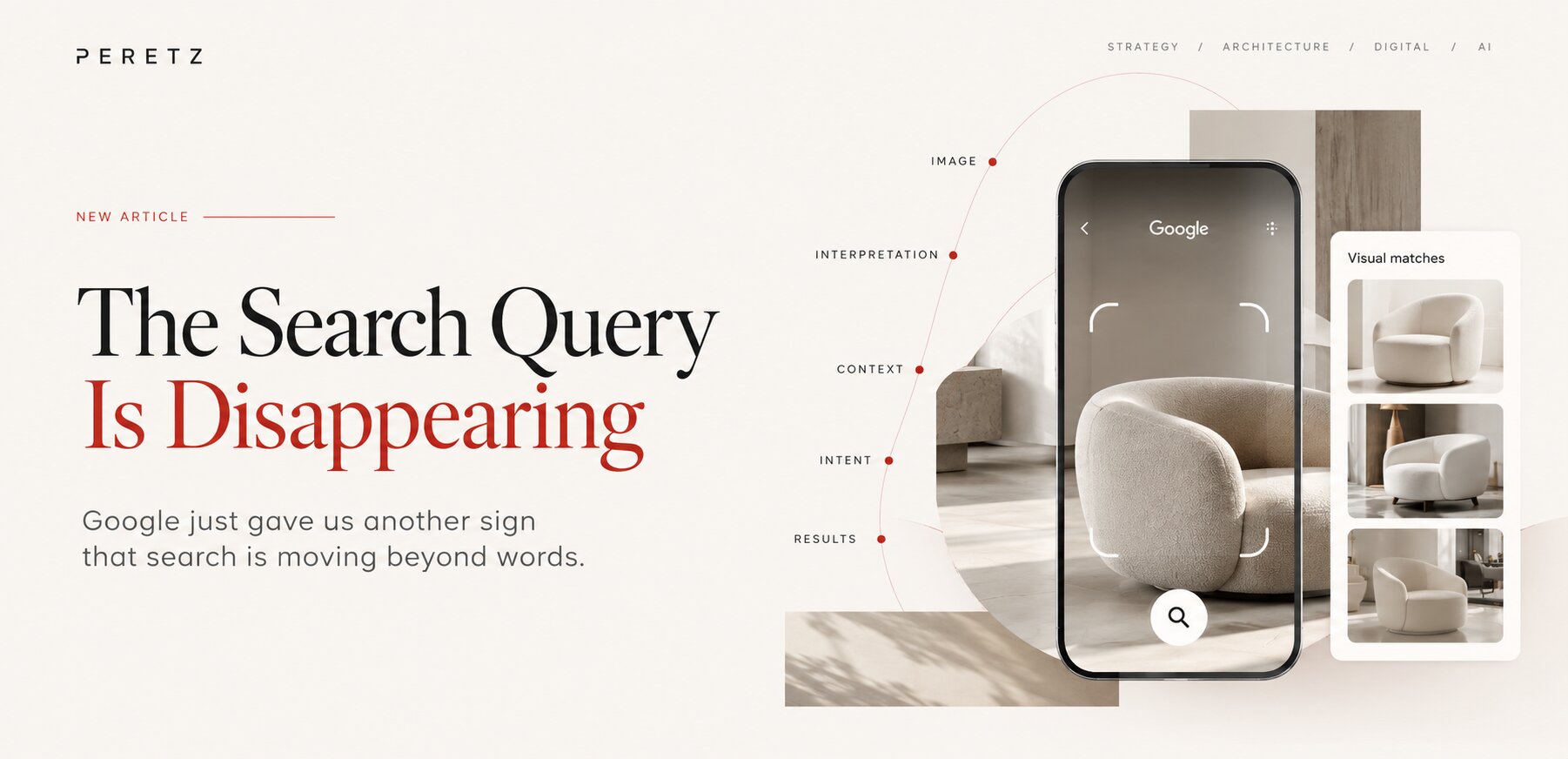
You show it the chair.
The image becomes the query.
And the system has to do something much more complicated than matching words.
It has to understand what it is looking at.
GOOGLE IS NOW MEASURING
Google Is Now Measuring This
Here is exactly what happened, as Google described it.
On September 24, 2026, Google began rolling out a new "multimodal search" reporting type inside Search Console, appearing in both the standard Search performance report and the newer Generative AI features report.
The new type covers web searches that begin with an image: Google Lens, Circle to Search on Android, image uploads directly to Google Search, and Chrome's "Search this image" right-click feature. Google confirmed the rollout is global, starting the same day.
One detail stands out from Google's own documentation. For this new search type, the standard query dimension is not available the way it is for text search, because there is no text query to report. The input was a photograph, not a sentence.
That is the fact.
Here is what it means.
The important part is not simply that Google can search from images. It has been doing that for years. The important part is that Google is now giving website owners a way to measure how their content performs specifically in these image-led searches, as their own distinct, countable category, not folded into general web search.
If the user uploaded a photograph, what exactly is the query?
The photograph itself? The objects inside it? The visual characteristics? The inferred intent? The context surrounding the image?
The system may be dealing with all of these simultaneously.
That is a very different model of search.
KEYWORDS TO INTERPRETATION
From Keywords to Interpretation
This is where things become more interesting.
Traditional search is fundamentally about matching.
A user provides language. The search engine finds language that appears to match it.
Multimodal search introduces another layer: interpretation.
The system has to determine what the user is showing it before it can determine what information is relevant.
The sequence begins to look more like:
Image → Interpretation → Context → Intent → Results
rather than:
Keywords → Index → Results
That distinction matters enormously for businesses.
Because the question is no longer only: what keywords describe our business?
It becomes:
What would an AI system need to understand about our business to know that we are relevant to what it is seeing?
That is the same question we just asked about the future of digital architecture generally, in the website is not dead, it has just lost its job. Today, Google handed us the first measurable proof that the question is no longer hypothetical.
IMAGE ONLY THE BEGINNING
The Image Is Only the Beginning
This is not really a story about images.
Images are simply an early manifestation of a larger change.
Consider what a modern AI system can potentially receive as context:
A photograph. A screenshot. A location. A conversation. A previous purchase. A calendar event. A product someone is already considering. A room they are standing in. A budget. A preference. A constraint. A previous decision.
The more context a system can interpret, the less dependent the interaction becomes on a carefully constructed text query.
The interface changes.
And eventually, the distinction between search and assistance begins to disappear.
SEARCH ALWAYS AN INTERFACE
Search Was Always an Interface
We often talk about Google as a search engine.
But from the user's perspective, search has always been an interface between intent and information.
For a long time, that interface was a text box.
The text box was an extraordinarily successful abstraction.
But it was still an abstraction.
It required the human to convert their situation into language before the machine could help.
Multimodal systems remove part of that translation layer.
Instead of "I need something like this," the user can simply say "find me this."
Or sometimes they do not even need to say that.
They can show it.
THIS CHANGES SEO
This Changes SEO
SEO has historically rewarded businesses for making information discoverable through language.
That remains important.
But a world in which search increasingly begins with images introduces another question:
Can machines understand what your content represents?
Consider an architecture firm.
It is not enough for Google to know that a page contains the words "modern house, Seattle, architecture, interior design."
The visual content itself may communicate:
Architectural style. Materials. Spatial relationships. Construction type. Geography. Quality level. Intended use. Design language.
The image may contain information that never appears in the surrounding copy.
The same applies to furniture, fashion, automotive design, hospitality, jewelry, real estate, interiors, architecture and thousands of other categories.
In these industries, the visual layer is part of the meaning.
WEBSITE MUST BE UNDERSTANDABLE
The Website Has to Become Understandable
This brings us back to a broader question.
If an AI system is going to represent a business to a person, it needs to understand more than its homepage.
It needs to understand:
Who you are. What you do. What you sell. Who you serve. Where you operate. What makes you different. What your products and services actually mean. What your images represent. What relationships exist between all these things.
And increasingly: what is true right now.
This is why we believe the next generation of digital architecture will be less about building a collection of pages and more about building a coherent model of a business, the same discipline covered from the language side in multilingual AEO.
The website becomes one expression of that model.
Search becomes another.
AI assistants become another.
Product discovery becomes another.
And visual search becomes another entry point into the same underlying system.
NEW PROBLEM NOT VISIBILITY
The New Problem Is Not Visibility
For years, businesses have asked:
How do we get Google to show us?
That question is becoming incomplete.
The next question is:
When Google or an AI system encounters us, does it understand what we are?
There is a profound difference.
A company can have thousands of indexed pages and still be poorly understood.
It can rank for keywords while remaining semantically ambiguous.
It can have beautiful photography while giving machines very little context about what those images actually represent.
It can have hundreds of products without clearly defining the relationships between products, services, audiences, use cases and business capabilities.
Visibility without understanding has limits.
WHERE IT GETS INTERESTING
And This Is Where Things Get Interesting
Imagine the future search interaction.
You take a photograph of a house.
You ask: "I want something like this, but for Seattle. Four bedrooms. More energy efficient. Under $1.5 million."
The system does not simply search for the words "modern house Seattle."
It interprets the image.
It understands the architectural characteristics.
It combines that with your location. Your budget. Your requirements. Your preferences.
And perhaps even information you have already provided.
Then it reconstructs the relevant experience.
The result is no longer simply a list of pages.
It is a decision environment, the same environment described in the architecture diagram from the website is not dead: business, knowledge, agent, contextual experience.
And the businesses appearing inside that environment are not necessarily there because they optimized a page for one keyword.
They are there because the system understood that they were relevant, exactly the infrastructure layer covered in SEO gets you found, AEO gets you recommended, your commerce infrastructure gets you bought.
SEARCH QUERY DISAPPEARING
The Search Query Is Disappearing
Not literally.
People will continue typing.
Keywords will not suddenly become irrelevant.
Google will not stop being a search engine.
Websites will not disappear.
But the query as the primary representation of intent is becoming less dominant, for the reasons already laid out.
That means the future of search may be less about asking:
What did the user type?
and more about asking:
What was the user trying to accomplish?
WHAT BUSINESSES SHOULD DO
What Businesses Should Do Now
There is no need to redesign an entire website because Google added a new Search Console filter.
But there is a reason to rethink digital architecture.
Start by asking:
Can machines understand your visual content? Are images properly associated with the things they depict?
Can machines understand your products and services? Are specifications, use cases, audiences and constraints structured clearly?
Can machines understand your business? Is there a coherent representation of your company beyond marketing copy?
Can machines understand relationships? Does the system understand which project demonstrates which capability, which service belongs to which category, and which product solves which problem?
Can machines understand what is current? Are availability, pricing, locations, people, services and other changing facts maintained reliably?
These questions extend far beyond traditional SEO.
They belong to digital architecture, the same architecture argued for in the software should fit the business.
WEBSITE IS STILL THERE
The Website Is Still There
And this brings us back to something we just wrote:
The website is not dead. It has just lost its job.
It is no longer necessarily the first place every customer has to go.
It may become a source of truth. A brand environment. A place for deep information. A proof layer. A transaction layer. A human fallback. A structured representation of the business.
And increasingly, a source from which other interfaces can reconstruct an experience, exactly the shift mapped out in full in the website is not dead, it has just lost its job.
The website may remain exactly where it is.
But the number of ways people can arrive at it, or interact with what it represents, is expanding.
NEXT QUERY MAY BE PHOTO
The Next Search Query May Be a Photograph
The most interesting part of Google's announcement is therefore not the new Search Console filter.
It is what that filter reveals about the direction of the web.
For decades, we designed digital experiences around a person who knows what to ask.
The emerging web has to work for a person who may only know what they are looking at.
And that changes everything.
The next search query may be a sentence.
It may be a voice.
It may be a screenshot.
It may be a photograph.
Or eventually, it may be nothing that resembles a query at all.
The machine may simply understand what is happening and determine what information is relevant.
Search is not disappearing. The box is.
Which means the real work ahead is not writing better keywords. It is making a business understandable enough that a machine, working from an image, a sentence, or nothing that looks like a query at all, can still recognize when that business is the right answer for someone.
What did Google actually announce on September 24, 2026?
Google began rolling out a new "multimodal search" reporting type in Search Console's performance reports, covering searches that begin with an image, including Google Lens, Circle to Search on Android, image uploads, and Chrome's "Search this image" feature. Text-based query data isn't available for this search type, since the input isn't text to begin with.
Does this mean traditional keyword-based SEO is becoming obsolete?
No. Keywords and text search remain important. What's changing is that they're no longer the only, or even the primary, way search starts. The practical shift is toward making visual content and business information machine-understandable, not away from language entirely.
How is multimodal search different from Google being able to search images, which it has done for years?
The capability itself isn't new. What's new is that Google is now giving website owners visibility into how their own content performs specifically in these image-led searches, as a distinct, measurable category rather than lumped into general web search.
What should a business actually do in response to this?
Not redesign the whole website. Start by checking whether images are properly associated with what they depict, whether products and services are structured clearly enough for a machine to understand relationships between them, and whether the business has a coherent, current representation beyond marketing copy.
Why would an architecture firm or furniture brand care about this more than, say, a software company?
Because in visually-driven categories, furniture, fashion, architecture, interiors, real estate, jewelry, automotive design, hospitality, the visual layer often carries meaning that never appears in the surrounding text copy. A photo can communicate style, materials, and quality that keywords alone can't capture.
Making your business understandable to machines, not just visible?
- Share
-

-

-

-