


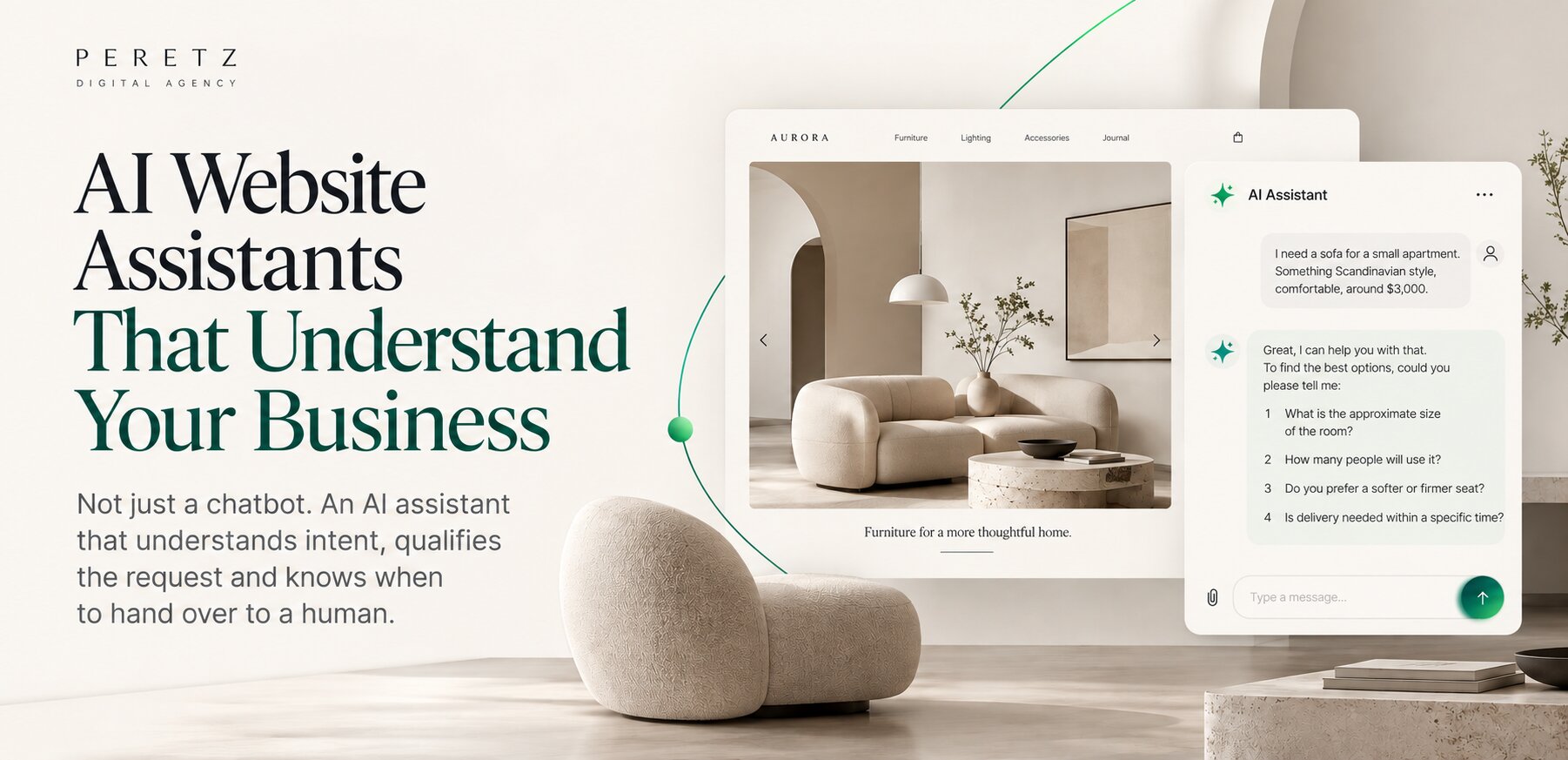
Why the next generation of website assistants needs to understand your business, not just generate answers from your pages.
For years, the promise of the website chatbot was simple.
A visitor asks a question. The bot finds an answer. If the conversation becomes complicated, the bot transfers the visitor to a human.
It was useful. But it was also remarkably limited. The conversation often looked like this:
Visitor: I’m looking for a sofa.
Bot: Here are our sofas.
Visitor: Something for a small apartment.
Bot: Here are our small sofas.
Visitor: Scandinavian style. Comfortable. Around $3,000.
Bot: Please contact our sales team.
The machine answered every sentence. It did not understand the request.
That distinction is becoming much more important.
The new generation of AI website assistants is not simply better at answering questions. It can understand context, qualify intent, compare options, connect information across business systems and, when properly integrated, help move a customer toward an actual decision.
The difference is not a better chat window. It is a different interface to the business.
QUESTIONS
Built Around Questions
Traditional chatbots were largely designed around predefined questions and answers. A business would identify its most common customer questions:
- What are your opening hours?
- Do you ship internationally?
- How much does this service cost?
- Where are you located?
- What is your return policy?
- Can I book an appointment?
Then the chatbot would retrieve an answer. This model made sense when conversational automation was mostly a combination of decision trees, search and predefined responses.
But customers rarely arrive with perfectly formed questions. They arrive with incomplete intentions.
“I need a sofa.” “I want to redesign my kitchen.” “I need a website.” “I’m planning an event.” “I need furniture for a new apartment.”
These aren’t really questions. They are the beginnings of decisions.
A good salesperson has always understood this. They do not immediately answer with a catalogue. They ask: What are you trying to accomplish? What is the space? Who will use it? What is your budget? When do you need it? What style do you prefer? What have you already considered?
The conversation gradually turns an incomplete request into something actionable. That is precisely where AI changes the model.
INTENT
From Question to Outcome
The fundamental difference can be expressed very simply.
Traditional chatbot: Question → Answer.
AI website assistant: Intent → Context → Qualification → Recommendation → Action.
The second model is much closer to how a real commercial conversation works. The customer may start with “I need a sofa.” The assistant can gradually discover:
Small apartment. Scandinavian interior. Two people. Occasional guests. Medium-firm seating. Budget around $3,000. Delivery needed within six weeks.
Now the system has something much more valuable than a question. It has a qualified requirement.
And once the requirement is understood, the next step becomes possible. The assistant can narrow the catalogue, explain why certain products fit, identify trade-offs, check relevant information, and ask one more question when the answer actually matters.
If the decision requires a human, the human receives the context that has already been collected. The conversation does not start over.
HANDOFF
The Broken Handoff
This is one of the most visible differences between traditional chatbots and modern AI assistants. Historically, a conversation might look like this: Bot, bot, bot, bot, and then “Let me connect you with an agent.”
The human then receives: Customer wants help with a sofa. So the customer has to explain everything again. The human effectively starts from zero.
An AI assistant can change the handoff itself. Instead of “transfer to human”, the system can produce a qualified request:
Customer is furnishing a 78 m² apartment in Bellevue. Scandinavian style. Sofa required for a 3.2 m wall. Budget: approximately $3,000. Preferred delivery: before November 15. Customer shortlisted three models and prefers the second because of seat depth.
The human is no longer starting the conversation. The human is entering it after discovery and qualification. That is a very different operational model.
NOT THE PRODUCT
AI Is Not the Product
There is another misconception worth removing. An AI website assistant does not require a company to build its own large language model. In practice, a business can use leading foundation models such as GPT, Claude or others, depending on the project.
The model is the reasoning and language layer. It is not the business. The business layer has to come from somewhere else: business knowledge, verified facts, rules and constraints, the CRM, catalogue, calendar and APIs, the actions the assistant is allowed to take, and the path to a human.
A powerful model does not automatically know:
- which services a company actually provides;
- which prices are current;
- which locations it serves;
- what it refuses to do;
- what its delivery constraints are;
- which products are available;
- which actions it is allowed to perform;
- when a human must take over.
The model provides intelligence. The business provides truth.
That is why the quality of an AI assistant depends less on the model name in the technology stack than many companies assume.
KNOWLEDGE
Information vs Knowledge
A website might say: Interior design services. But the actual business may operate differently.
Perhaps the studio works only on projects above a certain size. Perhaps it serves three cities. Perhaps residential and commercial projects have different processes. Perhaps the studio currently has a six-month lead time. Perhaps certain services are only available as part of a larger engagement. Perhaps pricing depends on scope and cannot be responsibly reduced to a single number.
That information is not always represented in one paragraph on a website. It exists across pages, documents, CRM records, internal processes, conversations and people. An effective AI assistant therefore needs more than website content. It needs a business knowledge layer.
And not every business fact has the same shelf life. A brand identity might remain stable for years, services might change over months, pricing every few weeks, and inventory within minutes. Treating all of them as equally authoritative is a recipe for bad AI. A responsible assistant needs to know where information comes from and how current it is, which is one reason simply feeding a website into a language model is not enough.
I DON'T KNOW
When to Say “I Don’t Know”
This sounds obvious. It is not. Generative AI is exceptionally good at producing plausible language. That is precisely why business AI needs boundaries, and why the real cost of AI is verification, not generation.
If a customer asks, “Can you deliver this sofa next Tuesday?” and the system does not have verified delivery data, the correct answer may be: “I don’t have confirmed availability for that date. I can check with the team.” That is a better business interaction than confidently inventing an answer.
The objective should not be to make AI answer every question. It should be to make it reliably useful within a defined business context.
Recent Gartner research reflects the same tension. In a survey of 3,566 B2B and B2C customers conducted in February and March 2026, 50% said interactions were easier when companies use GenAI, while 87% said access to a human agent remains essential. Gartner recommends that AI attempt resolution when confidence is high, with a clear path to human support.
After a negative chatbot experience, tolerance is even lower: Gartner reported in September 2026 that only 27% of customers would be willing to try a chatbot again. The lesson is not that AI should disappear. It is that bad AI experiences are still bad experiences.
OUTCOMES
Beyond Containment
A badly designed chatbot optimizes for containment: how many conversations did we prevent from reaching a human? But that is not the same as success. A customer might abandon the conversation because the bot was useless. Technically, the conversation ended. It was not resolved.
This is why AI performance metrics need to distinguish between:
- AI involvement;
- automated resolution;
- human handoff;
- abandonment;
- qualified lead;
- recommendation;
- booking;
- transaction.
Published figures show how much these definitions vary. One 2026 contact center benchmark treats AI handling 30 to 50% of volume as healthy, while far higher “resolution” rates circulate in the market depending on what is counted. An impressive-looking “80% resolution rate” means very little without explaining what counts as resolved.
A conversation ending is not the same as a customer reaching an outcome.
UNDERSTANDING
The Business-Aware Assistant
Imagine two conversations.
Without business-aware AI. Customer: I need furniture for a new apartment. Bot: Here are our furniture collections. The customer now has to browse.
With a business-aware AI assistant. The assistant begins discovering the actual requirement: What size is the apartment? Which rooms are you furnishing? Do you already have an interior concept? What style are you looking for? What is your approximate budget? When do you need everything delivered?
Now the conversation is no longer a search interface. It is becoming a decision interface. The customer doesn’t have to know the company’s product taxonomy. They can describe what they are trying to accomplish, and the system maps that intent onto the business.
This becomes particularly powerful when a business has many products or services. The traditional website asks the customer to navigate: Category → Subcategory → Product → Product → Product. The AI assistant can instead start with: Goal → Constraints → Preferences → Suitable options.
This doesn’t mean AI should make every decision for the customer. It means the system can reduce the distance between what the customer wants and what the business can actually provide. “I need something comfortable, but I don’t want the room to look heavy” is not a product category. It is a preference, and a good assistant can turn it into meaningful constraints and use the company’s actual catalogue and business rules to narrow the possibilities.
QUALIFIED LEAD
A Better Qualified Lead
For years, websites have treated a lead form as the end of the digital journey: name, email, phone, message, “I am interested in your services.” The business then has to discover everything.
AI can move some of that discovery earlier. Instead of collecting only contact information, the assistant can collect decision context.
For a design studio: project type, location, approximate size, style, budget, timeline, scope and current stage.
For a software company: business type, existing stack, number of users, integrations, requirements, timeline, budget and decision stage.
For an e-commerce company: intended use, preferences, constraints, budget and delivery requirements.
The result is not simply a lead. It is a qualified business conversation.
AI + HUMAN
AI Before the Human
The strongest model is not “AI replaces people”. It is “AI prepares the conversation”.
AI can handle discovery, FAQs, qualification, basic recommendations and information collection. The human can concentrate on complex decisions, exceptions, negotiation, relationships and the final sale.
Gartner research published in April 2026 points in a similar direction: 85% of surveyed customer service and support leaders reported expanding human agent responsibilities as AI reduces contact volume and shifts work toward higher-value tasks.
The human does not become less important. The human receives a better starting point.
INTERFACE
The Website as Interface
This may be the biggest change. A website used to be designed primarily around pages: Home, About, Services, Products, Contact. Then came responsive design, search, personalization and conversational interfaces. Now another layer is emerging: AI systems can become interfaces to the business themselves. It is the same shift behind the argument that the website is not dead, it is changing its role.
Customers are also increasingly beginning their journeys outside company-owned websites. Gartner reported in July 2026 that customers were approximately three times more likely to use third-party GenAI tools than company-provided chatbots during service interactions.
That means businesses increasingly have two problems: how does a human understand our website, and how does an AI understand our business? Those are not the same problem. The second one requires more than good copy. It requires structured knowledge, verified information, clear constraints and controlled actions.
And the next interface may not look like a chat window. A useful assistant might show three recommended products, compare them, ask one clarifying question, calculate a configuration, check availability, build a project brief, schedule an appointment, create a quote request, update a CRM, or transfer a complete conversation to a human. The interface changes according to the task.
WHAT WE BUILD
What We Actually Build
At PERETZ, we use leading AI models such as GPT and Claude as part of the technology stack. But the model is only one component. The work begins with the business.
We map what the company knows, what it offers, what can be verified, what actions are possible and where human judgment is required. Then we connect that knowledge to the AI layer and to the systems that make the business work. The result is not another chat bubble in the corner of a website. It is one of the AI website assistants we build as an interface between the customer and the business: one that can move from question to intent, from intent to context, from context to recommendation, and from recommendation to action, and that knows when the next step belongs to a human.
The real question is no longer “Do we need a chatbot?” That question is already too small. The better questions are: What does our business need AI to understand? Which facts can it trust? Which information needs to stay current? What can it recommend? What can it actually do? When should it stop? And what should the human receive when the conversation is handed over?
An AI website assistant is not another chat window. It is a business interface built on verified knowledge, controlled actions and a clear path from question to outcome. The model provides the intelligence. The business provides the truth. And the quality of the interface between the two may become one of the most important parts of the modern website.
Sources: Gartner, July 2026: customers are about three times more likely to use third-party GenAI than company chatbots; Gartner, August 2026: 87% of customers say access to a human agent is essential; Gartner, September 2026: only 27% would try a chatbot again after a negative experience; Gartner, April 2026: 85% of service leaders are expanding human agent responsibilities; Lorikeet, July 2026: contact center benchmarks.
FAQ
What is the difference between a chatbot and an AI website assistant?
A traditional chatbot matches questions to predefined answers. An AI website assistant works from intent: it clarifies what the customer is trying to achieve, qualifies the request, recommends suitable options and knows when to hand over to a human with the full context.
Does a business need its own AI model for an assistant?
No. Assistants are usually built on leading foundation models such as GPT or Claude. The model provides language and reasoning; the value comes from the business knowledge, verified facts, rules and system connections built around it.
How does an AI assistant avoid making things up?
By answering only from verified business knowledge, knowing how current each piece of information is, and saying “I don’t know” or handing over to a person when it lacks confirmed data, for example about prices, availability or delivery dates.
When should an AI assistant hand over to a human?
When a decision is complex, when it involves exceptions or negotiation, when confidence is low, or when the customer asks for a person. A good handoff passes along everything already collected, so the customer does not have to start over.
What does a qualified lead from an AI assistant include?
Decision context rather than just contact details: project type, size, style, budget, timeline, constraints and current stage for a design studio, or stack, users, integrations and decision stage for a software company.
How should the success of an AI assistant be measured?
Not by containment alone. Useful metrics separate AI involvement, automated resolution, human handoff, abandonment, qualified leads, recommendations, bookings and transactions, because a conversation ending is not the same as a customer reaching an outcome.
Which businesses benefit most from AI website assistants?
Businesses with many products or services, complex offers, or long decision cycles: design studios, furniture and e-commerce, clinics, B2B and software companies, where a customer starts with a goal rather than a product name.
Want an assistant that understands your business and knows when to bring in a person?
- Share
-

-

-

-

Related Reading
-
19. 07. 2026

The Cost of AI Isn't Generation. It's Verification.

-
07. 07. 2026
Human-First Content Strategy: Why AI Content Is Losing the Trust War in 2026
-
04. 09. 2026

Do I Need a Developer, or Is AI Enough?
-
22. 09. 2026

Claude Can Build the Website. It Can't Build the Understanding. Not Yet.
-
24. 09. 2026
The Website Is Not Dead. It Has Just Lost Its Job.
-
25. 09. 2026
The Search Query Is Disappearing