Do I Need a Developer, or Is AI Enough?
AI coding agents can genuinely build software now. Here's exactly where they stop being enough, and why, from a team that uses them daily.


The question is no longer whether AI can write software. It can. The question is who decides what should be built, why it should exist, and whether the result will actually work for the business.
Someone asked me this directly, not hypothetically, while we were talking about a project.
I gave the honest answer, not the defensive one.
The answer is yes and no. And the useful part isn't the yes or the no. It's where the line actually falls.
Tools such as Claude Code, Codex, and other AI coding agents can genuinely write good software. They can read a codebase, plan an implementation, edit multiple files, run tests, use git, inspect errors, and iterate when something breaks.
I use these tools myself. They are extraordinarily productive. And they are going to become much more capable.
That last point matters. This article is not an argument that today's AI is too limited to replace certain development work. Some of that work is already being replaced, and more will be.
The more interesting question is what remains valuable when the execution itself becomes increasingly cheap.
WHAT AI CHANGES
1. AI Can Already Do a Remarkable Amount of the Execution
Given a clear specification, a capable AI coding agent can execute a surprisingly complex engineering task. It can generate code faster than a human. It can work across multiple files. It can inspect existing patterns in a repository. It can write tests. It can refactor. It can identify obvious errors. It can use development tools and iterate.
For well-defined tasks, the execution gap between hiring a developer and giving the same task to an AI agent has narrowed dramatically. That is not a small change. It changes the economics of software development. It changes team structures. It changes who can build software.
And it means that pretending AI is merely a slightly better autocomplete is no longer a serious position. The technology is much further along than that.
But there is an important distinction.
Writing the solution is not the same as defining the solution.
HARDEST PART
2. The Hardest Part Was Never Typing the Code
The hardest part of a software project was never writing the code. It was knowing what to build before anyone wrote a line of it.
A specification is not the business. It is someone's interpretation of what the business needs at a particular moment.
That distinction becomes critical with AI. An AI agent answers the question you give it. It does not automatically know whether that was the question worth asking.
If the specification is wrong, incomplete, based on an outdated assumption, or solving a symptom instead of the underlying problem, AI can execute that mistake extraordinarily well. Fast, clean, well-tested execution of the wrong thing is still the wrong outcome.
In fact, AI makes this problem more interesting because it reduces the cost of execution. When execution was expensive, bad ideas naturally encountered friction. Someone had to spend three weeks implementing them. Now an AI agent can produce a working prototype in an afternoon. That means we can discover bad ideas faster. But it also means we can build the wrong thing faster.
The bottleneck moves upstream.
GENERATION VS JUDGMENT
3. Generation Got Cheaper. Judgment Did Not.
We wrote about this from another angle before: the cost of AI was never generation. It was verification.
Someone still has to determine whether the software is actually correct. Not whether it runs. Whether it is correct. Whether the architecture will survive the business doubling in size. Whether the edge case that never appeared in testing is the one a real customer encounters six months later. Whether the security assumptions are appropriate. Whether the data model reflects the actual business. Whether the integration will remain maintainable. Whether the product is solving the original problem at all.
AI can increasingly help with parts of this verification process too. And it will get better.
We saw this gap play out directly, not hypothetically, in Four AIs Agreed. We Still Hadn't Verified Anything.
But verification ultimately depends on having a definition of what correct means. That definition comes from understanding the product, the business, the users, the constraints and the consequences of being wrong.
AI WILL IMPROVE
4. AI Will Get Better. That Does Not Make the Argument Against It.
This is where I think discussions about AI and software development often become unnecessarily defensive.
The models will improve. They will remember more. They will understand larger codebases. They will reason better. They will use more tools. They will have better testing capabilities. They will have better project context. They will learn from previous interactions.
There will be better presets, specialized agents, reusable architectures, development workflows and increasingly sophisticated autonomous systems. Many tasks that currently require a developer will eventually require much less direct human intervention.
I don't think that is something to argue against. I think we should use it.
The question is what happens to the role of the people using those tools. And this is where the comparison with architecture becomes useful.
ARCHITECT ANALOGY
5. Great Architects Don't Spend Their Careers Drawing Every Line
Consider what happens in a large architectural practice. A senior architect may not personally draw every wall. They may not produce every construction detail. They may not model every component. They may not even touch most of the production software used by the team.
That doesn't make them less important. It makes their role different.
Their value increasingly lies in understanding the whole system. What should this building be? How should people move through it? What should the building communicate? How should structure, light, materials, circulation and function work together? What compromises are acceptable? What should be preserved? What should be changed? What happens ten years after completion?
The architect is not valuable because they are the fastest person at drawing a line. They are valuable because they know which lines need to exist and why.
Software is moving in exactly the same direction.
SOFTWARE ARCHITECT
6. When Code Becomes Cheap, Architecture Becomes More Important
A future software team may write far less code manually. That does not mean the team disappears. It means the team operates at a higher level.
Someone still has to understand what problem the product is solving, who actually has that problem, what the business model requires, which requirements are essential, which requirements are distractions, how the system should be structured, where the boundaries between components belong, what should be automated, what should remain human-controlled, what data the system needs, how the system should evolve, what happens when assumptions change, and what the cost of being wrong is.
The AI can increasingly help implement those decisions. But the decisions still need to come from somewhere. That is the judgment layer. And it may become the most valuable layer of the entire software process.
JUDGMENT LAYER
7. Someone Has to Understand the Product, Not Just the Prompt
This is the distinction I would make between an AI coding tool and an engineering team.
An AI agent can understand the repository. A good team understands the product. An AI agent can understand the specification. A good team questions the specification. An AI agent can implement a feature. A good team asks whether the feature should exist. An AI agent can refactor a system. A good architect decides what the system should become. An AI agent can tell you that all tests pass. A good engineering team asks whether you are testing the things that actually matter.
That is not an argument against AI. It is the reason to use AI inside a competent team.
WHERE ENGINEERING MOVES
8. AI Does Not Remove Engineering. It Changes Where Engineering Happens.
The mistake is thinking that if AI can write the code, engineering has disappeared. It hasn't.
Some of the engineering work moves from implementation toward: discovery → architecture → specification → orchestration → verification → evolution.
The amount of manual typing may decrease dramatically. The amount of reasoning required to make the product successful does not necessarily decrease with it. It may increase.
Because when implementation costs $100 instead of $10,000, the number of things you can build becomes enormous. The difficult question becomes: which of them should you build?
MEMORY
9. A Product Is More Than Its Current Codebase
There is another difference that is easy to underestimate.
A business accumulates context. Why was this architecture chosen? Why was a particular feature rejected? Why does this customer have a special workflow? Which integration failed two years ago? Which assumption turned out to be wrong? Which part of the system cannot safely be changed? Which stakeholder actually has veto power? Which seemingly strange business rule exists because of a real-world constraint?
Some of this can be documented. Much of it historically lives in people.
AI systems are becoming much better at retaining and retrieving context. That will continue. But someone still has to decide what context matters and maintain the institutional knowledge around the product. That is a leadership responsibility, not merely a prompting problem.
This is exactly the failure mode we described in Your Website Doesn't Fail When Your Developer Leaves. It Fails Years Earlier, just moved one level up: the code can survive a departure. The judgment behind it often doesn't, unless someone deliberately preserved it.
ACCOUNTABILITY
10. Who Owns the Outcome?
There is another layer that technology cannot simply erase. Accountability.
Upgrades of old sites show this especially clearly: AI can rewrite code for a new framework version in minutes, but only a developer checks that contact forms still deliver leads and the site stays open to search. That is how we approach website modernization.
If a production system fails at 2 AM, someone needs to decide what to do. If an AI-generated implementation creates a security vulnerability, someone needs to own the response. If an automated workflow causes a customer to lose money, someone needs to understand the business consequences. If the product turns out to solve the wrong problem, someone needs to recognize that before another six months of development is spent on it.
An AI agent has no business stake. A competent team does.
Accountability is not a technical capability. It is a relationship. The same principle applies to what your business actually owns underneath the code, not just who wrote it, a distinction we unpack in Most Companies Don't Own Their Website. They Own a Collection of Dependencies.
SHOULD YOU USE AI
11. So Should You Use AI? Absolutely.
This is where the answer should be deliberately uncomfortable for a traditional development agency.
Yes. Use it.
A good development team that refuses to use powerful AI tools will increasingly be less competitive than a good team that does.
AI can make the team faster. It can reduce repetitive work. It can accelerate prototyping. It can improve documentation. It can help test ideas. It can analyze existing code. It can assist with migrations. It can generate test cases. It can help developers explore multiple solutions before committing to one. It can make sophisticated engineering more accessible.
And all of that can improve the final product.
The right response is not to protect the old development process. It is to make the process better.
WRONG QUESTION
12. The Wrong Question Is "Can AI Build My Website?"
It probably can. The better question is: can AI build the right website for my business? And then: who decides what "right" means?
If you already know the answer, the project is small, the consequences of being wrong are limited, and you can personally verify the result, using an AI coding agent may be the smartest option. You don't necessarily need an agency. You may not even need a traditional developer. That's a legitimate conclusion.
But the situation changes when the product is strategically important. When requirements are unclear. When multiple systems need to work together. When the product will evolve for years. When security matters. When the cost of architectural mistakes compounds. When the business itself is still discovering what it needs. When nobody on the inside has enough technical and product judgment to evaluate the output.
That is where a team becomes valuable.
NEW TEAM
13. The Best Teams Will Not Compete With AI. They Will Operate Above It.
The strongest teams of the future will probably contain fewer people doing repetitive implementation and more people responsible for product thinking, architecture, systems design, business understanding, technical leadership, verification, security, quality, integration, and long-term evolution.
That is exactly the shift we mapped out on the hiring side in How to Get Hired in 2026: The Job Interview Has Changed. The same judgment that makes someone hireable now is what makes a team worth keeping.
And they will use AI aggressively underneath that layer. The result may actually be better software, produced faster, with less wasted effort. That is the opportunity.
The real divide will not be AI versus humans. It will increasingly be teams that know how to use AI versus teams that don't. And beneath that: teams that know what they are building versus teams that simply build what they are asked to build.
The first group will use AI to multiply its judgment. The second will use AI to multiply its output. Those are not the same thing.
A team with poor judgment and extremely powerful execution can become extremely efficient at producing mediocre products. A team with strong judgment and powerful AI tools can become extraordinarily productive.
AI does not create competence. It amplifies whatever is already there. Give it to a strong specialist, and they become dramatically more effective. Give it to weak judgment, and it doesn't improve the judgment. It just makes the failure happen faster, and at a larger scale.
PREMIUM CONNECTS
14. What This Means for What "Premium" Actually Is
This connects directly to the idea we explored in what actually separates a premium Laravel or Symfony build from a merely functional one.
A premium software build is not premium because a developer typed every line manually. And it is not premium because AI was not used. It is premium when the system is well thought through. When its architecture reflects the business. When its technical decisions are deliberate. When it can change without collapsing. When its risks are understood. When someone knows why it was built the way it was built. And when the people responsible for it can distinguish between "the code works" and "the product works." Those are very different statements.
The irony of AI in software development is that the better AI becomes at execution, the less valuable execution itself becomes as a differentiator. That is already happening.
The value moves upward. From typing to thinking. From implementation to architecture. From individual features to systems. From specifications to understanding. From producing code to deciding what deserves to exist.
That is exactly what happened in other professional disciplines. Architects did not disappear when CAD arrived. Designers did not disappear when Photoshop arrived. Engineers did not disappear when simulation software became powerful. The tools changed what professionals spent their time doing. Software engineering is going through the same transition.
SO DO YOU NEED ONE
15. So, Do You Need a Developer?
Sometimes. But that may eventually be the wrong way to frame the question.
You need someone who understands what you are trying to build and why. You need someone capable of designing the system. Someone who can challenge assumptions. Someone who can recognize when the specification is wrong. Someone who can evaluate the output. Someone who understands the consequences of technical decisions. Someone who can maintain continuity as the business changes. And someone who is accountable for the result.
That person may write code. They may supervise developers. They may work through AI agents. They may do all three.
The job is changing. The responsibility isn't.
The developer of the future may write less code than the developer of the past. That does not necessarily make the profession less important. It may make the best developers more like architects. They will spend less time drawing every line themselves and more time deciding what the building should be.
The teams that understand this transition will not compete with AI. They will build better products because of it.
If the answer is an agent rather than an assistant, the controls it needs are covered in Agentic AI Compliance: How to Secure, Govern and Monitor AI Agents.
One practical way to give agents that understanding is a short project manual. We explain ours in Your Codebase Needs a Manual for AI.
We use AI across our own workflow every day. We're not precious about who, or what, types the code.
What matters is whether the technology is solving the right problem, whether the architecture can support what comes next, and whether someone experienced is responsible for making those decisions.
AI can dramatically improve the execution layer. It does not eliminate the judgment layer. And as execution becomes cheaper, the judgment layer becomes more valuable. That's where the real work is.
What actually separates a working AI-built site from a demo is covered directly in Claude can build the website, it can't build the understanding.
What a real AI-powered analytics system actually requires, beyond a demo, is covered directly in AI can build your analytics system in two days.
Why an assistant needs verified business knowledge, not just a model, is covered in AI website assistants are not chatbots.
- Share
-

-

-

-

One notification a week with the new PERETZ articles. Nothing else.
Related Reading
-
19. 07. 2026

The Cost of AI Isn't Generation. It's Verification.

-
04. 09. 2026
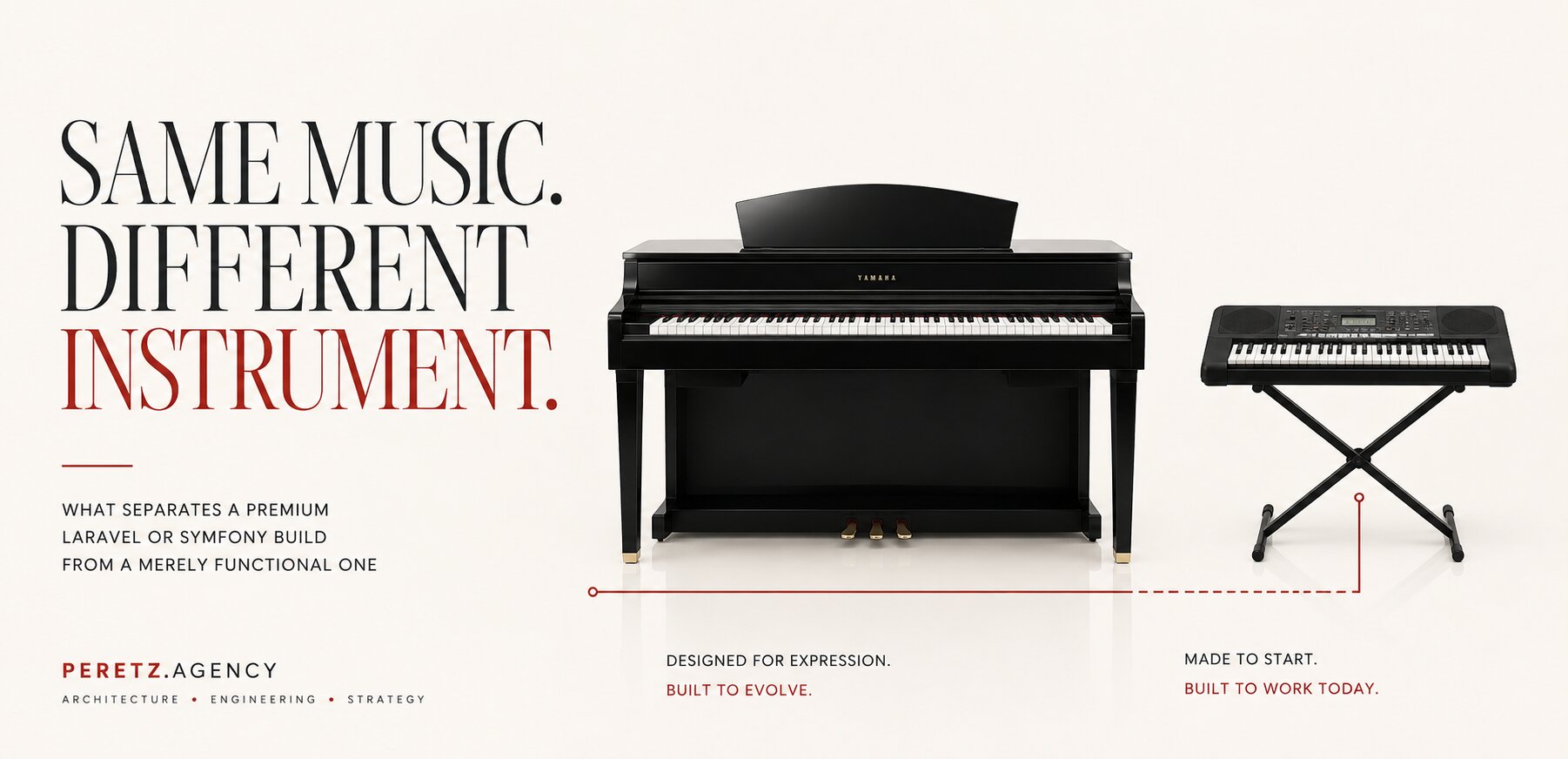
What Separates a Premium Laravel or Symfony Build From a Merely Functional One
-
05. 08. 2026

Your Website Doesn't Fail When Your Developer Leaves. It Fails Years Earlier.
-
30. 07. 2026

Most Companies Don't Own Their Website. They Own a Collection of Dependencies.
-
15. 07. 2026

Four AIs Agreed. We Still Hadn't Verified Anything.
-
23. 08. 2026

How to Get Hired in 2026: The Job Interview Has Changed
-
07. 09. 2026

Agentic AI Compliance: How to Secure, Govern and Monitor AI Agents
-
22. 09. 2026

Claude Can Build the Website. It Can't Build the Understanding. Not Yet.
-
23. 09. 2026
AI Can Build Your Analytics System in Two Days. Here's What That Number Actually Describes.
-
27. 09. 2026
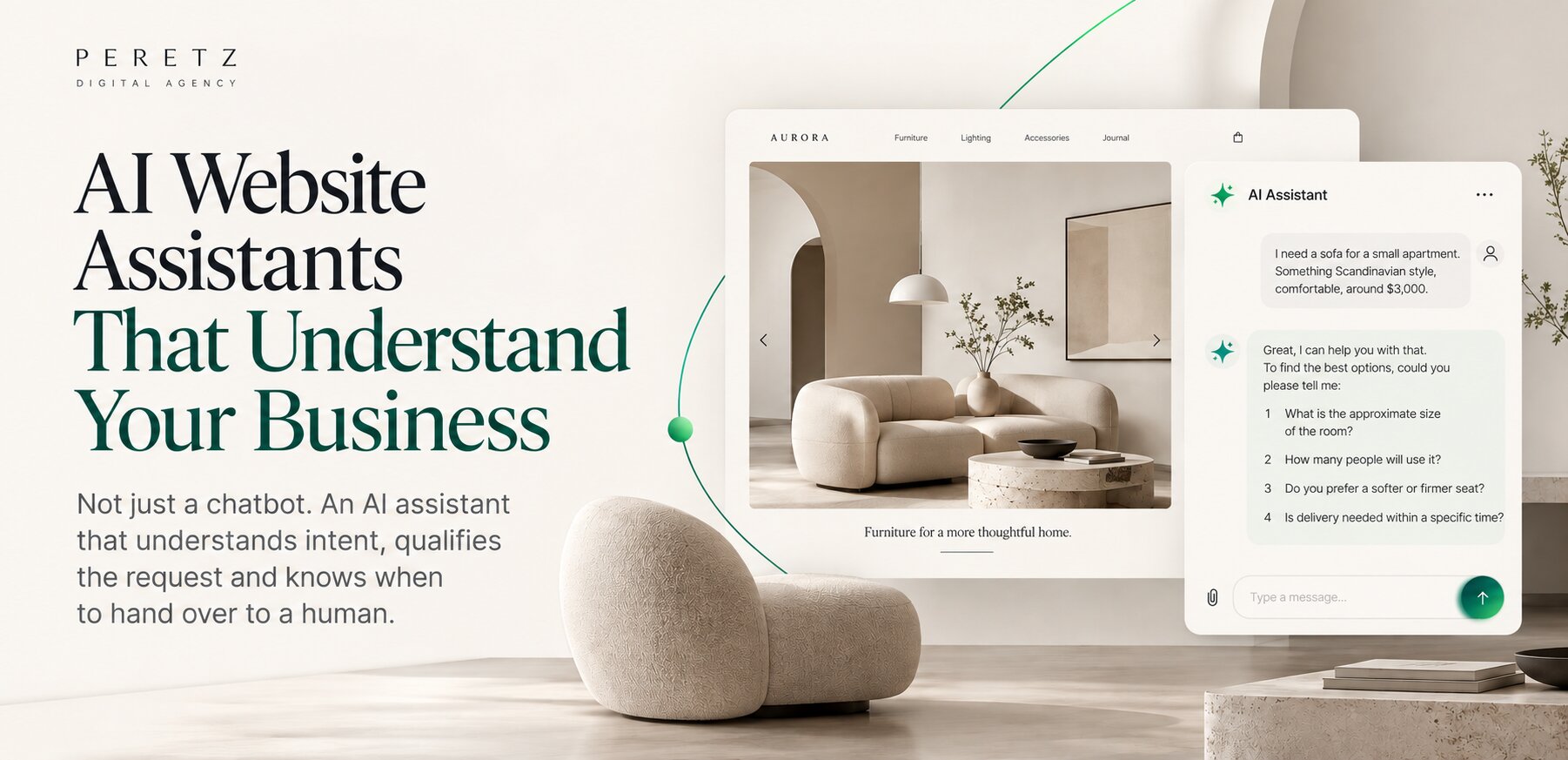
AI Website Assistants Are Not Chatbots. They Are a New Business Interface.
-
29. 09. 2026

Upgrading an Old Laravel or PHP Site in 2026
-
30. 09. 2026
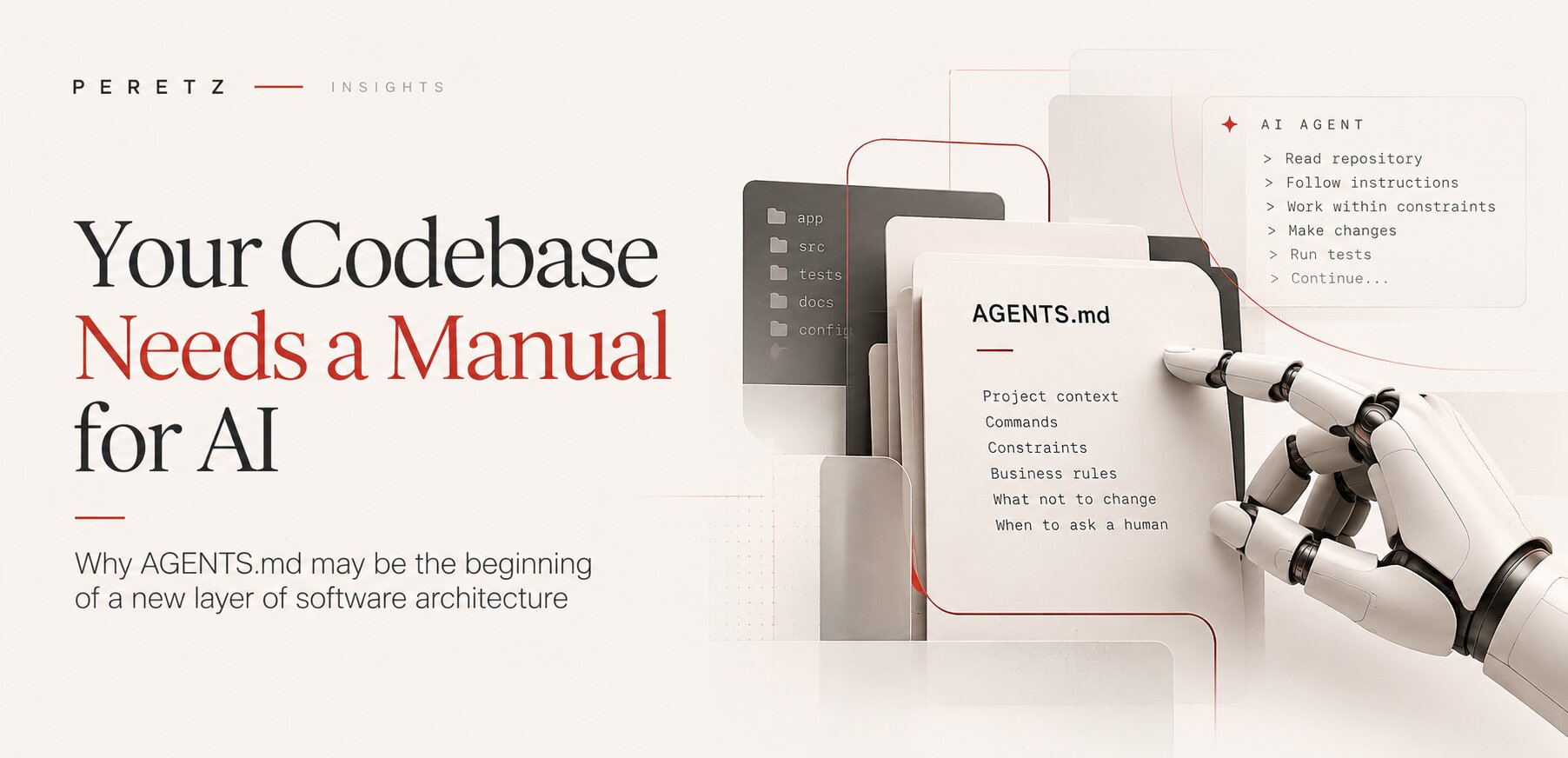
Your Codebase Needs a Manual for AI
-
01. 10. 2026

Six Laravel Versions in Three Days