There is something strange happening in the job market.
Companies are receiving more applications than ever. AI can write résumés, cover letters, code, presentations, marketing plans, and even prepare candidates for interviews. At the same time, many employers are discovering that a surprisingly large number of applicants are genuinely good.
We recently experienced this at Peretz. We opened a position for frontend and backend developers and received around 1,600 applications.
The surprising part wasn't the number. It was how many candidates were actually capable.
That changes the question.
A few years ago, getting hired was largely about proving that you could do the job. In 2026, that is becoming much harder to prove, and much less valuable as a differentiator.
Because increasingly, the question isn't: can you do this job? It is: what can you contribute that the tools cannot do without you?
That is changing the job interview itself.
OLD INTERVIEW BROKE
Why the Old Interview Stopped Working
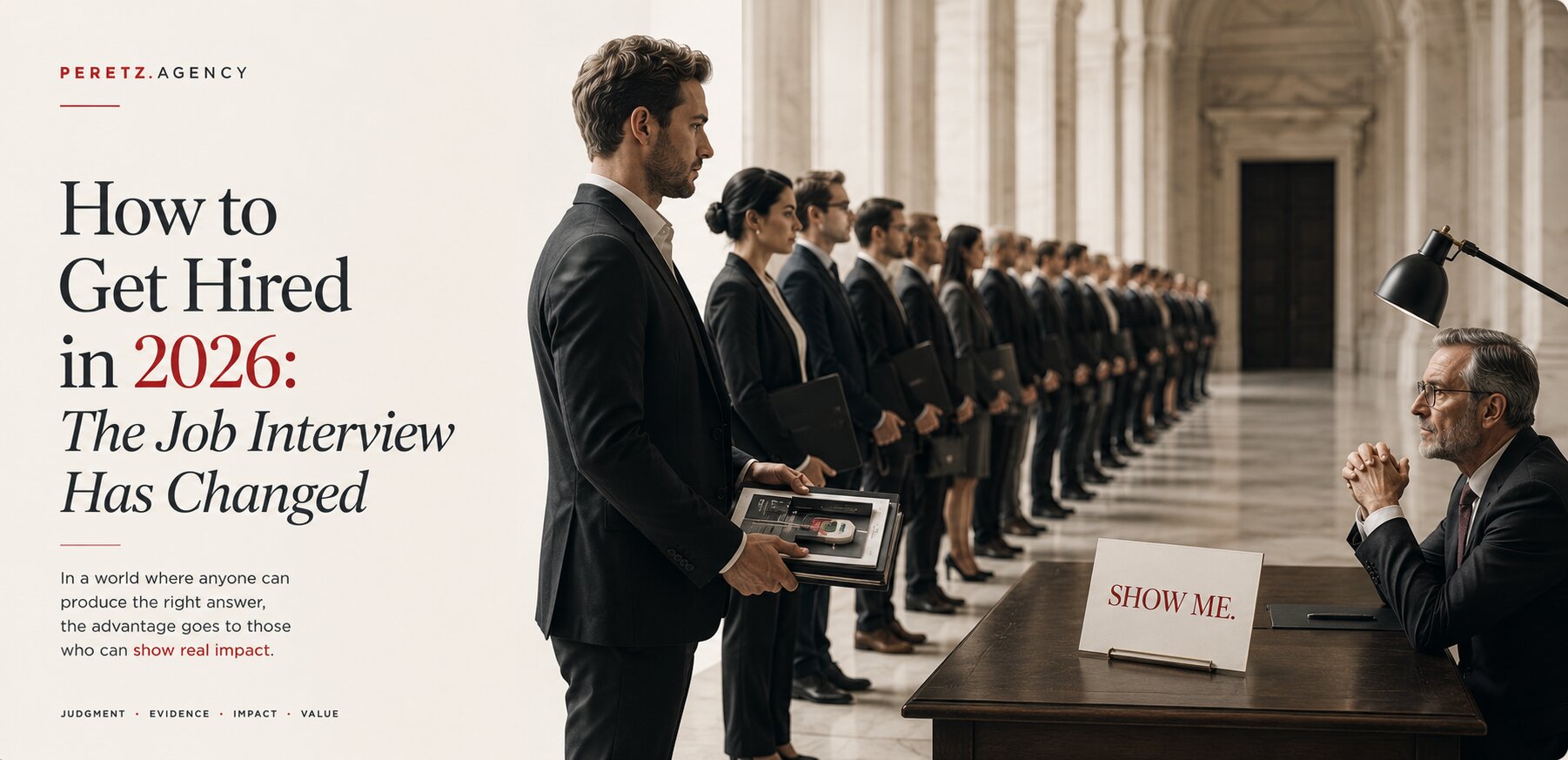
Traditional hiring was built around scarcity. A company needed a developer. There were perhaps 100 qualified developers available. The hiring process tried to determine which candidate was the best.
The résumé was useful because it contained information the employer couldn't easily obtain elsewhere. You had worked at Company X. You had five years of experience. You knew React, Python, Java, AWS, or whatever technology mattered at the time.
The interview then confirmed those claims. But that model depended on one important assumption: skills were relatively difficult to acquire and demonstrate.
AI is attacking that assumption.
Today, a candidate can use AI to improve a résumé, rewrite a cover letter, prepare answers to common interview questions, generate code, analyze a technical problem, build a prototype, create a presentation, and research the company before the interview.
The result is not necessarily that candidates became less qualified. In many cases, the opposite happened. The average quality of the application can increase while the value of the application itself decreases.
And that is a very different problem.
Imagine receiving 1,600 applications for one position. You don't have 1,600 people who are obviously unsuitable. You may have hundreds who look reasonably qualified. Some have excellent résumés. Some have impressive portfolios. Some have worked at recognizable companies. Some can probably do the job. And now the employer has a problem.
The old hiring process was designed to distinguish between qualified and unqualified. The new market increasingly requires distinguishing between qualified, very qualified, and genuinely exceptional in a way that matters to this particular business. Those are not the same thing. And AI makes the first two categories much larger.
This is not just our experience. Recruiters are now handling a documented 93% surge in application volume year over year, according to Gem's 2026 Recruiting Benchmarks Report, even as talent acquisition teams operate with less headcount than during previous hiring booms. The same report found that only about 0.5% of applicants ultimately receive an offer. The flood is real, it is measured, and it is reshaping the funnel everywhere, not just at one agency.
A résumé used to be evidence. Increasingly, it is becoming a statement. "I am a strategic thinker." "I am a highly motivated developer." "I have excellent communication skills." "I am passionate about innovation." AI can write all of these sentences better than most people can. It can also make an ordinary résumé sound extraordinary.
That doesn't mean résumés are useless. They are still useful for understanding someone's background and filtering obvious mismatches. But they are becoming a weaker signal of actual ability. The more AI improves written self-presentation, the less impressive written self-presentation becomes.
A 2026 Resume Genius survey of 1,500 U.S. hiring managers found that the share screening resumes with AI jumped from 35% to 58% in a single year, the largest increase among all the hiring practices the survey tracked. When more than half of employers are running your résumé through a model before a human ever sees it, the résumé is no longer competing for a person's attention. It is competing for a pattern match.
WHAT EMPLOYERS WANT
What Employers Are Actually Looking For Now
The answer is not "people who don't use AI." That would make little sense. If AI is part of the modern workplace, banning it during an interview can test the wrong skill.
Imagine hiring a developer and saying: "You will use AI every day at work, but during the hiring process we want to see how well you can work without it." That is similar to hiring an architect and forbidding CAD during the interview.
The more useful question is: can this person use AI to produce a better result? But even that isn't enough. Because if everyone has access to similar tools, the differentiator moves one level higher.
Judgment becomes more valuable than execution. AI can generate ten solutions. Someone still has to decide which one is worth implementing. A developer can ask an AI model to create a feature. But: is the feature actually necessary? Is the architecture appropriate? What will break six months from now? Is the security model acceptable? Is this technical debt worth taking? What happens when the requirements change? Is the problem even a technical problem?
These are judgment questions. And judgment becomes increasingly valuable when execution becomes cheap, a pattern we saw play out directly in Four AIs Agreed. We Still Hadn't Verified Anything. This applies far beyond software. A marketing specialist can ask AI for twenty campaigns. A designer can generate hundreds of concepts. An analyst can generate reports. A lawyer can produce drafts. An accountant can automate calculations. A manager can generate plans. But someone still needs to decide: which problem are we solving? And: why does it matter?
Problem solving beats tool knowledge. For years, professionals were encouraged to accumulate tools. Learn Photoshop. Learn Figma. Learn React. Learn Python. Learn Salesforce. Learn AWS. Learn another framework. That made sense when tools were difficult to operate. But tools are becoming easier to operate. The scarce resource is shifting from knowing how to use a tool to knowing what to do with it.
A strong candidate doesn't necessarily say "I know React." They might say: "I had a performance problem caused by unnecessary client-side rendering. Here's how I identified it, what I changed, and why." That is much stronger evidence. It demonstrates reasoning.
SHOW DONT TELL
Show, Don't Just Say
One of the best ways to stand out in 2026 is remarkably simple: bring evidence.
Don't just say you are good. Show what you built. Show what you changed. Show what went wrong. Show what you learned. Show the result.
For a developer, that might be a GitHub repository, a real product, a technical case study, or a project you built independently. For a designer, it might be a case study showing the problem, decisions, iterations, and final outcome. For a marketer, show what happened to traffic, leads, conversion, or revenue. For a product manager, show how you made a decision with incomplete information. For an architect, show how a design constraint changed the final solution.
The important part is not the portfolio itself. It is the thinking behind it.
Learn to explain why. This may become one of the most important interview skills. Anyone can increasingly produce an answer. Fewer people can explain why this answer. And even fewer can explain what would make you change your mind. That is what separates someone who generated a solution from someone who understands the problem.
If you use AI to build something, be prepared to explain: what you asked it to do, what you accepted, what you rejected, what you changed, what you verified, what assumptions you made. Using AI isn't the problem. Using AI without understanding the result is, the exact gap we cover in The Cost of AI Isn't Generation. It's Verification.
Don't hide the AI. Candidates sometimes assume that mentioning AI makes them look less competent. The opposite may increasingly be true.
If you used AI to accelerate a project, explain how. For example: "I used an AI coding assistant to generate the initial implementation, but I changed the database structure because the generated approach wouldn't scale for our expected traffic." That tells an interviewer much more than "I know Node.js." It demonstrates that you can work with a powerful tool without surrendering your judgment to it.
This advice comes with a real caveat worth knowing. Research from KraftCV on 2026 hiring found that roughly 49% of hiring managers still auto-dismiss résumés they suspect were AI-generated, describing the dynamic as asymmetric expectations: companies frame their own AI use as efficiency, but read candidate AI use as laziness. The gap is not in whether you used AI. It is in whether your explanation shows judgment or just disclosure. "I used AI" is not the differentiator. The reasoning you attach to it is.
TECHNICAL INTERVIEW
The New Technical Interview
Technical interviews also need to change.
The traditional model often looks like this: "write a function that reverses a string." That may test something. But it may also test something increasingly irrelevant.
In actual work, nobody cares whether you can write a string-reversal function from memory. You have documentation. You have search. You have AI. You have libraries. You have testing tools. What matters is whether you can solve the actual problem.
A better interview might look like: "here is a simplified version of a real problem we have. You have access to documentation and AI tools. Show us how you would approach it."
Now the interviewer can observe how the candidate investigates, how they formulate questions, how they use AI, whether they verify outputs, how they debug, how they communicate, how they make tradeoffs. That is much closer to the real job.
And the stakes behind that interview are rising. National University's 2026 hiring data shows interviews per hire are up 33% overall as employers grow more selective, with technical roles now averaging 35 to 36 interviews and 26 interviewer hours before a single hire is made. Every one of those rounds is now more likely to include some version of the AI-assisted problem-solving test above, not the memorized whiteboard question.
GENERALISTS
The Best Candidate May Not Be the Best Specialist
This is perhaps the most uncomfortable change.
For decades, companies often optimized for specialists. The best developer. The best designer. The best accountant. The best analyst.
But when AI makes specialist execution cheaper, another type of employee becomes disproportionately valuable: the person who understands several domains well enough to connect them.
A developer who understands business. A designer who understands conversion. A marketer who understands product. A product manager who understands technology. An engineer who understands customers.
These people can connect problems that previously belonged to separate departments. And AI makes those connections even more powerful, the same shift we cover from the product side in How AI Is Changing Product Development in 2026.
JUNIOR PROBLEM
What This Means for Junior Candidates
This is where things become difficult.
The traditional career ladder depended on junior employees doing relatively simple work until they gained enough experience to become senior. But what happens when AI can perform much of the simple work?
The entry-level position itself becomes harder to obtain. This is one of the most serious problems created by AI.
If companies stop hiring juniors because AI can perform junior-level tasks, where will tomorrow's senior professionals come from?
There is no easy answer. The industry will eventually have to develop new ways of training people.
This is not a hypothetical concern. ZipRecruiter's 2026 AI Employer Report found that the bar for entry-level roles is genuinely rising: candidates now need a stronger, more technical skill set just to land early-career positions, often without the formal training or structured support to build it, since employers are investing in AI tools faster than they are investing in junior training programs. The report frames this as a real gap employers should be closing, not a natural filter working as intended.
But for candidates, the immediate lesson is clear: don't position yourself only as someone who needs to be trained.
Build something. Experiment. Contribute to open source. Create a small product. Solve a real problem. Learn to work with AI. Develop domain knowledge. Give an employer evidence that you can already create value.
BUSINESS CONVERSATION
The Interview Is Becoming a Business Conversation
This may be the biggest shift of all.
The strongest candidates will increasingly ask questions like: what is the biggest problem this position is supposed to solve? Why hasn't it been solved yet? What would success look like after six months? What decisions would I be responsible for? What parts of this job are already being automated? Where do you expect AI to change this role?
These are not just interview questions. They demonstrate that the candidate understands the position as a business problem, not simply a list of tasks.
And that is exactly the direction the labor market is moving.
RESEARCH BEFORE APPLYING
Research Before You Apply
There is another habit that is becoming increasingly ineffective: applying to every company with the same résumé and the same cover letter.
For years, job seekers were told to maximize the number of applications. Apply to fifty companies. Then a hundred. Then two hundred. The logic was simple: more applications mean more chances.
But the job market has changed. When a company receives hundreds of applications, sometimes thousands, sending another generic application does very little to distinguish you from everyone else.
In 2026, applying for a job increasingly requires the same thing companies expect from candidates once they are hired: research.
Before applying, learn something about the company. You don't need to become an expert. You don't need to understand its entire business model.
But you should know: what does the company actually do? What does it sell? Who are its customers? What problem does its product or service solve? Why is this position open? What might this person be expected to accomplish? What can you learn from the company's website, products, recent announcements, and public presence? How does your experience relate to what the company is doing?
This doesn't need to take hours. Even 20–30 minutes of focused research can completely change the quality of an application. The goal isn't to prove that you know everything. The goal is to demonstrate that you chose this company deliberately rather than simply clicking "Apply" again.
Your cover letter should not sound like everyone else's. Cover letters have an even bigger problem. There are two particularly common approaches, and both are bad.
The first is a poorly written letter with grammatical mistakes, vague statements, and little evidence that the candidate even read the job description. The second is the opposite: a perfectly polished AI-generated letter that sounds impressive but could have been sent to a hundred different companies.
You know the type: "I am excited to bring my passion, innovative mindset, and proven track record to your dynamic and forward-thinking organization." Replace the company name and the same paragraph could be sent to a software company, a law firm, a construction company, or a dental clinic.
AI has made this kind of writing almost free. That means it has also made it almost worthless. A cover letter should answer three simple questions: why this company? Why this position? Why you? And it doesn't need to be long. In fact, a short, specific message is often much stronger than a page of generic enthusiasm.
For example: "Hi Sarah, I came across your frontend position while looking at [specific product or project]. I noticed that your team is expanding [specific area], which caught my attention because I recently worked on [relevant experience]. At my current company, I [specific result or responsibility]. I believe that experience could be particularly relevant to what your team is building. I'd be glad to discuss it further."
There is nothing spectacular about the writing. That's the point. It sounds like a person who actually looked at the company.
USING AI RIGHT
AI Should Help You Research, Not Pretend to Be You
This is where AI can be extremely useful. But there is an important difference between using AI to prepare an application and asking AI to impersonate you.
Don't start with "write me a cover letter for this job."
Start with: "here is the company's website, the job description, and my experience. Help me understand what this company does, who its customers are, what this role is likely expected to accomplish, and where my experience may be relevant. Separate facts from assumptions."
Then ask: "what should I research before applying?" And: "what questions should I ask during the interview to verify my assumptions?"
AI can help you research, organize information, identify connections, check your writing, remove grammatical errors, translate your message, and make your communication clearer. But you should decide what you actually want to say. Otherwise, you are simply producing another AI-generated application in a market already flooded with them.
There is a very simple test before you hit send. Read your cover letter and ask: could I send this exact letter to another company?
If the answer is yes, don't send it. Try replacing the company's name with the name of one of its competitors. If the letter still works perfectly, it isn't really a cover letter. It's spam.
A good application should contain at least one thing that could not reasonably have been written for another company. It might be a product you actually used, a project you noticed, a recent development at the company, a specific problem mentioned in the job description, or a connection between their needs and your experience. It doesn't have to be clever. It has to be specific.
ONE LEVEL UP
You Don't Need to Understand the Entire Business
There is another misconception worth addressing. When we say that candidates need to understand the business, that does not mean that every frontend developer needs to understand the company's financial statements, pricing strategy, or entire organizational structure.
You don't need to become a CEO before your first interview. You need to understand one level above your task.
If you're a frontend developer, understand: who uses the product, what the user is trying to accomplish, what your interface is supposed to help them do.
If you're a backend developer, understand: what the system does, what depends on it, what risks your technical decisions create.
If you're a designer, understand: who the design is for, what behavior it should influence, what problem it is supposed to solve.
If you're in QA, understand: what could go wrong, who would be affected, what risk your work is preventing.
If you're a project manager, you will probably need to understand further: what the business is trying to accomplish, what constraints exist, how success is measured.
And if you're applying for a business, strategy, product, or leadership position, then yes, the expectation is higher. You should understand the business itself.
The principle is simple: you don't need to understand everything. You need to understand how your work creates value.
Move one level above your task. This may be one of the most useful ways to think about your career in 2026. You don't have to become a business strategist. You don't have to know everything. Just move one level above the task you're being asked to perform.
Don't think only "I need to build this button." Think: "what is this button supposed to help the user accomplish?"
Don't think only "I need to optimize this API." Think: "what part of the product depends on this API, and what happens if it becomes slow or unreliable?"
Don't think only "I need to make this page look better." Think: "what should the user understand or do differently after seeing this page?"
That additional layer of context is increasingly valuable because AI can execute tasks extremely well. The person who understands why the task exists has a much better chance of remaining valuable.
And if you genuinely don't understand something, don't pretend that you do. Ask. Good candidates don't necessarily have all the answers. They know how to find the answers they don't have.
During an interview, questions such as these can be extremely valuable: who is the primary user of this product? What is the biggest problem this role is expected to solve? How do you measure success in this position? What would you like this person to accomplish in the first six months? What are the biggest challenges the team is facing right now?
These questions don't make you look inexperienced. Quite often, they demonstrate the opposite. They show that you're trying to understand the problem behind the job description, not just the list of tasks.
NEW STRATEGY
The New Application Strategy
The old approach was: find a job, send résumé, send cover letter, repeat.
The new approach should look more like: research, decide whether you actually want the job, understand the role, connect your experience to the problem, apply specifically, prepare for the conversation.
This may result in fewer applications. That is not necessarily a bad thing.
If you send 200 generic applications, you are competing with everyone else doing the same thing. If you send 20 thoughtful applications to companies you actually understand, you may create far more meaningful conversations.
The goal is no longer simply to maximize the number of applications. The goal is to maximize the number of applications where the employer can immediately understand why you might be a good fit.
There is a strange irony in all of this. AI makes it easier for candidates to apply to more companies. It also makes it easier for companies to receive and process more applications.
So both sides can produce more volume. But volume doesn't necessarily create better matches. It creates more noise.
The advantage shifts toward people who can create a signal, not more noise.
A specific résumé. A thoughtful application. A relevant example. A clear explanation. A real project. A good question. A genuine understanding of the company.
In a market where everyone can generate a polished application in seconds, showing that you actually care where you are applying becomes surprisingly valuable.
HOW TO PREPARE
How to Prepare for an Interview in 2026
If you have an interview coming up, don't spend all your preparation time memorizing answers. Do these instead.
Research the company. Understand what it sells, who it sells to, how it makes money, and what its biggest challenges might be.
Study the job description. Don't just identify the required skills. Ask: why does this company need this person?
Prepare three real stories. Have examples of something you built, something that went wrong, and a difficult decision you made. Be ready to explain your reasoning.
Prepare your AI workflow. Know how you use AI in your actual work. Be able to explain where you trust it and where you don't.
Build something. If you don't have professional experience, create something yourself. A small real project is often more informative than another certificate.
Practice explaining decisions. Don't only practice answering "what did you do?" Practice answering "why?" And "what would you do differently now?"
There are also some approaches that are becoming increasingly ineffective. Don't send the same résumé everywhere. If AI can generate a customized résumé in seconds, employers will increasingly assume that everyone is doing it.
Don't memorize perfect interview answers. Interviewers can increasingly recognize polished AI-generated language. And even when they can't, rehearsed answers don't demonstrate judgment.
Don't pretend you don't use AI. The workplace probably does. Pretending otherwise can make you look disconnected from reality.
Don't list 30 technologies. Technology lists are becoming less meaningful. Explain what you actually built with them.
Don't make the interview entirely about yourself. Understand the company's problem. The employer isn't hiring a résumé. They are buying a solution to a problem.
WHAT MAKES SOMEONE HIREABLE
So, What Actually Makes Someone Hireable in 2026?
It is tempting to create another list: communication, leadership, adaptability, creativity. But these words have been repeated so many times that they have almost lost meaning.
A better definition is simpler. A highly valuable employee is increasingly someone who can: understand a problem, formulate a solution, use AI and other tools, make good decisions, verify the result, communicate it, and take responsibility for the outcome.
Notice what is missing. There is no specific programming language. No specific design tool. No specific AI model. Those things will continue to change. The underlying capability is more durable.
There is a larger question behind all of this. What happens if AI keeps improving faster than people can adapt?
We may eventually reach a point where the problem isn't that there are no jobs. It is that there are fewer jobs than people who are capable of doing them.
We are already seeing early signs of this in parts of technology.
And this is why the 2026 job interview matters. It isn't just a better version of the old interview. It may be the beginning of a different relationship between people and work.
For most of modern history, the basic economic proposition was straightforward: I have a skill. You need that skill. You pay me for my time.
AI is beginning to weaken every part of that equation. The skill can increasingly be replicated. The output can increasingly be generated. And the amount of human time required to produce the output can fall dramatically.
That doesn't mean humans become worthless. It means human value has to move somewhere else. Toward judgment. Toward ownership. Toward responsibility. Toward relationships. Toward entrepreneurship. Toward defining problems instead of merely executing solutions.
So if you are preparing for a job interview in 2026, don't only ask: "how do I convince this company to hire me?"
Ask a harder question: if this company could accomplish the same result with AI and fewer people, what would make my involvement valuable?
That question may be uncomfortable. It is also probably one of the most useful career questions you can ask today.
Because the future job market won't necessarily reward the person who can perform the most tasks. It will increasingly reward the person who can create the most value with the least friction.
And AI is becoming one of the most powerful tools for doing exactly that.
The interview has changed. The people who recognize that early will have an advantage. Not because they can predict exactly which jobs will disappear. But because they understand something more important:
The future of work is no longer about competing with AI. It is about becoming the person who knows what to do with it. The same principle applies on the technical side, covered in Do I Need a Developer, or Is AI Enough?.
Whatever stage you're at in this process, good luck. Genuinely.
And if you're one of the people this article was written for, curious, capable, and ready to show your work, we're hiring.
- Share
-

-

-

-