

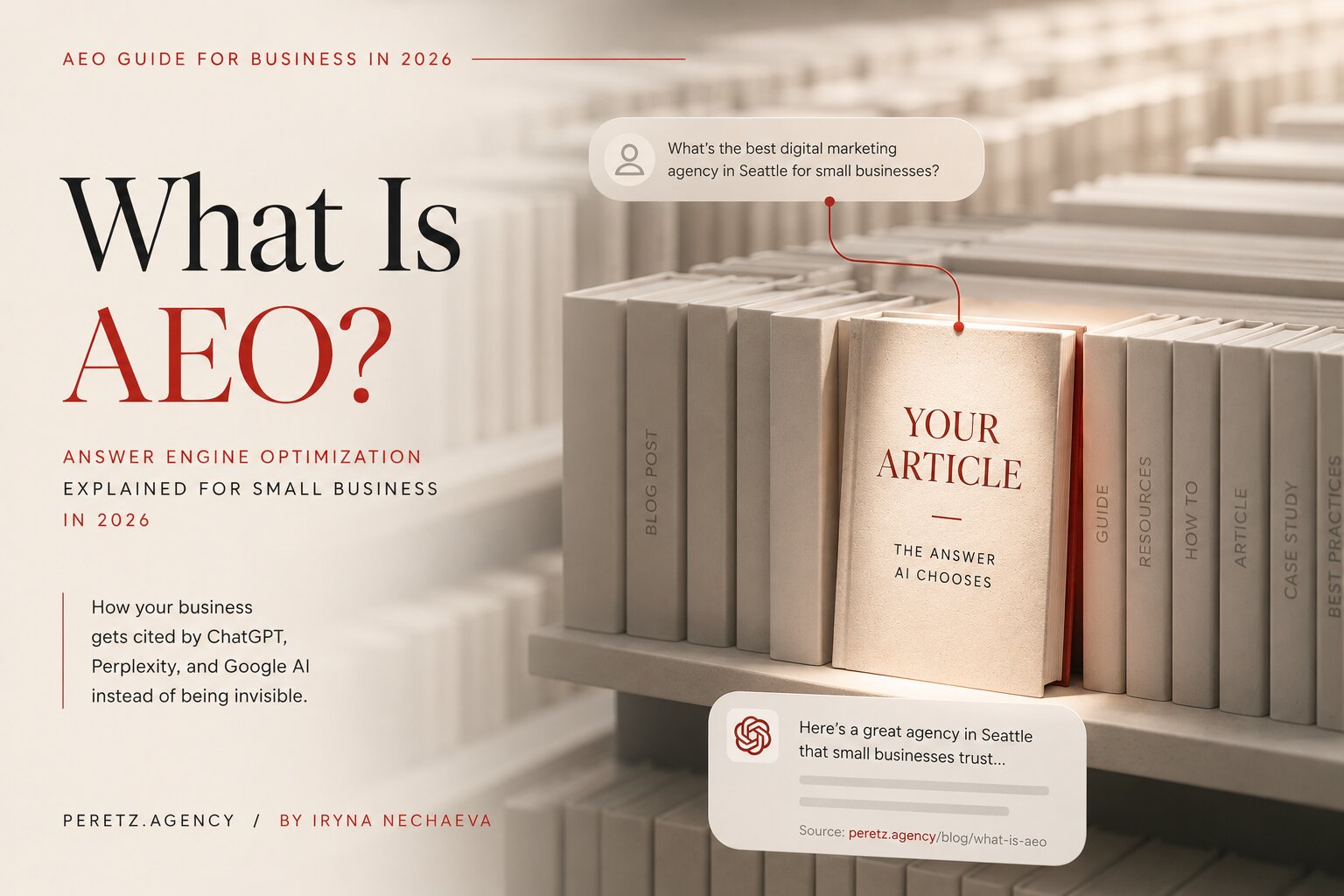
Open ChatGPT and ask: 'What's the best digital marketing agency in Seattle for small businesses?'
Something comes back. A name, maybe a few names. An explanation of what to look for. A recommendation.
Your business is either in that answer or it isn't. If it isn't — you just lost a potential client who didn't even know you existed.
That's the AEO problem. And it's getting bigger every month.
When I started writing articles for Peretz Agency's blog, I noticed something: some of them started getting cited in ChatGPT and Perplexity answers without us doing anything specifically to make that happen. The articles that got cited had one thing in common — they answered specific questions clearly, directly, and with data in the first few paragraphs. The ones that didn't get cited were good articles but they buried the answer. They made the reader work for it. That observation is essentially what AEO is — and it changed how I write every piece of content for clients after that.
AEO in One Sentence
Answer Engine Optimization (AEO) is the practice of structuring your content so that AI-powered search platforms — ChatGPT, Perplexity, Google AI Mode, Gemini, voice assistants — select it as a source when generating answers to user questions.
Traditional SEO asks: how do I rank higher in Google?
AEO asks: how do I become the source that AI systems trust and cite?
Different question. Different strategy. Both matter.
Why This Is Urgent in 2026
Here's the scale of what's happening:
- ChatGPT now handles over 2 billion queries daily and reaches 883 million monthly users
- Google AI Overviews appear in nearly 55% of all Google searches
- AI-referred sessions to websites grew 527% year-over-year through mid-2025
- Gartner predicts traditional search volume will drop 25% by 2026 due to AI chatbots and virtual agents
- 38% of Google searches already end with zero clicks — users get the answer in AI Overview, Featured Snippet, or People Also Ask without visiting any website
- 42% of CRM software buyers now use AI search as part of their evaluation process — HubSpot, January 2026
The shift isn't coming. It's already here and accelerating. For businesses that depend on search-driven discovery — which is most businesses — this is not an optional conversation.
The good news from HubSpot's own AEO strategy: they saw a 1,850% increase in qualified leads. Internally, leads coming from AEO converted at 3x the rate of regular organic traffic. AI-referred traffic converts at higher rates because those users arrive with context — they've already compared alternatives and done research before clicking.
AEO vs SEO vs GEO: What's the Difference?
These three terms overlap and confuse everyone. Here's the clearest breakdown:
|
Approach |
Where it works |
Goal |
Tactics |
Metrics |
|
SEO |
Google, Bing |
Rank higher in search results |
Keywords, backlinks, technical optimization |
Clicks, rankings, organic traffic |
|
AEO |
Google AI Mode, Featured Snippets, voice assistants |
Be the answer AI extracts from your page |
Question-answer structure, FAQ schema, direct definitions |
Featured snippet appearances, voice citations, zero-click visibility |
|
GEO |
ChatGPT, Perplexity, Claude, Gemini |
Be cited when AI generates a full answer |
Entity authority, structured data, off-site brand mentions |
AI citation share, brand mentions in AI answers |
The short version: SEO gets you found. AEO gets you extracted. GEO gets you cited. In 2026, you need all three — but most businesses are only doing the first one.
How AI Search Actually Works (The Part Most Guides Skip)
To understand AEO, you need to understand how answer engines process content. It's not like Google's keyword matching.
AI search uses something called Retrieval-Augmented Generation (RAG):
- Stage 1 — Query interpretation: the AI parses the user's question and converts it into a semantic understanding. Not 'what words match' but 'what is this person actually asking?'
- Stage 2 — Retrieval: the system searches its index for documents semantically relevant to the question. A page about 'optimizing content for AI search' can surface for 'answer engine optimization' even without that exact phrase.
- Stage 3 — Ranking and selection: retrieved documents are scored on relevance, authority, recency, and structural quality. The AI picks the clearest, most trustworthy, most extractable source.
- Stage 4 — Answer generation: the AI synthesizes selected sources into a response, often with citations.
The implication: content that was optimized purely to rank — long, comprehensive, keyword-dense — may perform poorly in AEO if it doesn't contain clear, extractable answers. Conversely, content designed for AEO (modular, direct, structured) often improves traditional SEO too.
5 AEO Techniques That Actually Work
1. Answer First — Always
Research shows 55% of AI Overview citations come from the first 30% of page content. This is the single most impactful AEO change you can make: put the direct answer to the page's main question in the first 40–60 words. Before the context, before the setup, before the explanation of why the topic matters.
Most pages do the opposite — they build to the answer. AI systems don't read the way human readers do. They extract. If the answer isn't in the first block of content, they move to a source where it is.
Rewrite your most important service and blog pages right now. Find the primary question each page answers. Put a clear 2–3 sentence answer at the very top. Everything else stays — you're just reordering, not rewriting.
2. FAQ Schema — The Most Underused Technical Tool
FAQ schema is JSON-LD markup that explicitly tells AI systems 'this is a question, this is the answer.' Pages with FAQ schema appear in AI-generated answers 40% more frequently than equivalent pages without it.
Every service page and blog post should have an FAQ section at the bottom — 5–8 questions your actual clients ask. Mark it up with FAQ schema. This is a 2-hour implementation that most businesses have never done.
Featured Snippets from FAQ content can appear within 2–4 weeks of implementation. AI Overviews typically within 1–3 months. Faster than traditional SEO by months.
3. Make Every Section Self-Contained
AI systems extract individual passages, not entire pages. A section that requires reading everything before it to make sense will not be extracted. A section that answers its heading question completely and independently will be.
Test: cover every section of your page except one. Can someone read just that section and get a complete, useful answer to the section's question? If not — rewrite it.
4. Build Topic Clusters Around Real Questions
Instead of one long page covering everything about a topic, build a cluster: a pillar page with comprehensive coverage, supported by shorter, highly focused pages that each answer one specific question with maximum directness.
Example: instead of one 5,000-word 'Social Media Marketing Guide,' build: a pillar page plus separate focused pages for 'How much does social media management cost', 'How to choose between TikTok and Instagram,' 'What is AEO and why does it matter,' and so on.
Both Google and AI systems reward topic clusters. AI systems specifically reward the focused, specific pages — because they're easy to extract from.
5. Off-Site Brand Mentions — The AEO Signal Most Businesses Ignore
AI systems don't just read your website. They read the entire web. A business mentioned consistently in relevant publications, industry blogs, LinkedIn posts, Reddit threads, and review platforms builds what practitioners call 'AI share of voice' — the density of your brand across trusted sources that AI systems pull from.
42% of CRM buyers use AI search in their evaluation — and AI systems building those answers pull from every trusted source that mentions you, not just your website. This means PR, guest posts, podcast appearances, and LinkedIn thought leadership are now AEO tactics, not just brand-building.
The AEO Audit: 5 Questions for Your Website Right Now
Before any technical implementation, run this checklist on your most important pages:
- Does the page answer its main question in the first 40–60 words — before any buildup or context?
- Does the page have a FAQ section with real questions your clients ask — marked up with FAQ schema?
- Can each major section be read and understood independently, without context from the rest of the page?
- Does the page have clear H2 and H3 headings phrased as questions or direct statements — not clever marketing copy?
- Is the page updated within the last 6 months, with a visible publication/update date and named author with credentials?
If you answered no to three or more — your pages are invisible to AI search for a significant portion of queries where you should be showing up.
AEO vs SEO: Why You Need Both
The most common question when people learn about AEO: 'Should I stop doing SEO and focus on AEO instead?'
No. AEO is an upgrade to SEO, not a replacement.
Traditional search still drives significant traffic. The technical and content fundamentals of good SEO — quality content, clean site structure, authoritative backlinks — also support AEO performance. Content that satisfies AEO requirements (clear answers, structured data, entity authority) typically improves traditional SEO simultaneously.
The most effective approach in 2026: build content that satisfies both. Well-structured, authoritative pages that rank in Google and get cited by AI systems. The Georgia Tech / Princeton / IIT Delhi study (2024) found sites optimized for generative engines see 30–115% higher AI citation rates. Those same optimization choices improve Google rankings.
What This Means for Small Businesses Specifically
AEO creates something unusual in the digital marketing landscape: an opportunity where smaller businesses can compete with larger ones on equal terms.
Traditional SEO favors high-authority domains — brands with thousands of backlinks and years of domain history. AI systems don't work that way. They look for the clearest, most structured, most directly useful answer to a specific question — regardless of domain size.
I've watched this happen with the Peretz Agency blog. We're not a massive site with thousands of backlinks. But articles that clearly answer specific questions — with data, with structure, with named expert authorship — get cited by ChatGPT and Perplexity alongside content from much larger sites. The playing field for AI citation isn't about who has the most authority. It's about who gave the clearest answer to this specific question. That's something a small business can genuinely compete at — often better than large companies whose content is written by committee and optimized for brand voice rather than directness.
The AEO Opportunity Timeline
Speed of results compared to traditional SEO:
- Featured Snippets from AEO-optimized FAQ content: 2–4 weeks after implementation
- Google AI Overviews inclusion: 1–3 months
- ChatGPT and Perplexity citation: 1–4 months, depending on content authority and off-site mentions
- Traditional first-page Google ranking: 6–12 months minimum
This is significantly faster than traditional SEO. The businesses moving on AEO now are building citation authority that will be very difficult for late-movers to replicate — because AI systems learn from citation patterns over time, just as Google learned from backlink patterns.
How Peretz Agency Approaches AEO
When I write content for Peretz Agency's blog — and when we create content for clients — AEO structure is built in from the start, not retrofitted afterward.
Every article starts with a direct answer to the primary question in the first paragraph. Every article has a FAQ section with FAQ schema. Every H2 heading is phrased as a question or direct statement. Every article is written by a named author with stated credentials.
These aren't separate AEO tactics. They're just good content practice that happens to align perfectly with what AI search systems select.
Beyond on-page work, we build the off-site signals that create AI share of voice: LinkedIn thought leadership, strategic guest contributions, and consistent brand presence across platforms AI systems index.
Want to know if your current content is AEO-ready — and what it would take to start appearing in ChatGPT and Perplexity answers for your category? Contact us at hello@peretz.agency or call +1 425 471 94 96.
FAQ
FAQ: What People Actually Ask About AEO
Is AEO the same as GEO?
Related but different. AEO focuses on appearing in answer features within classic search engines (Google Featured Snippets, People Also Ask) and their AI layers. GEO (Generative Engine Optimization) targets the standalone AI systems — ChatGPT, Perplexity, Claude, Gemini. In practice, the optimization techniques overlap significantly. Most content improvements help both.
Do I need a developer to implement AEO?
For FAQ schema, yes — someone needs to add JSON-LD markup to your pages. It's a 1–2 hour technical task per page, not a major project. The content changes — answer-first structure, question-formatted headings, self-contained sections — require no technical skills.
How do I measure AEO results?
Track: Featured Snippet appearances (Google Search Console, Ahrefs), Google AI Overview mentions, citations in ChatGPT and Perplexity responses for your target queries (manual checking or tools like Semrush AI toolkit), and brand mention volume off-site. Don't measure AEO success by click volume — zero-click visibility still has real business value through brand recognition.
Will AEO help my local business?
Yes — and it may help more than traditional SEO in some cases. Local service businesses that optimize Google Business Profiles and create voice-friendly FAQ content have seen increases in calls from voice searches. When someone asks Google Assistant 'best plumber in Seattle' or 'dentist near me open now,' the answers come from structured, AEO-optimized sources.
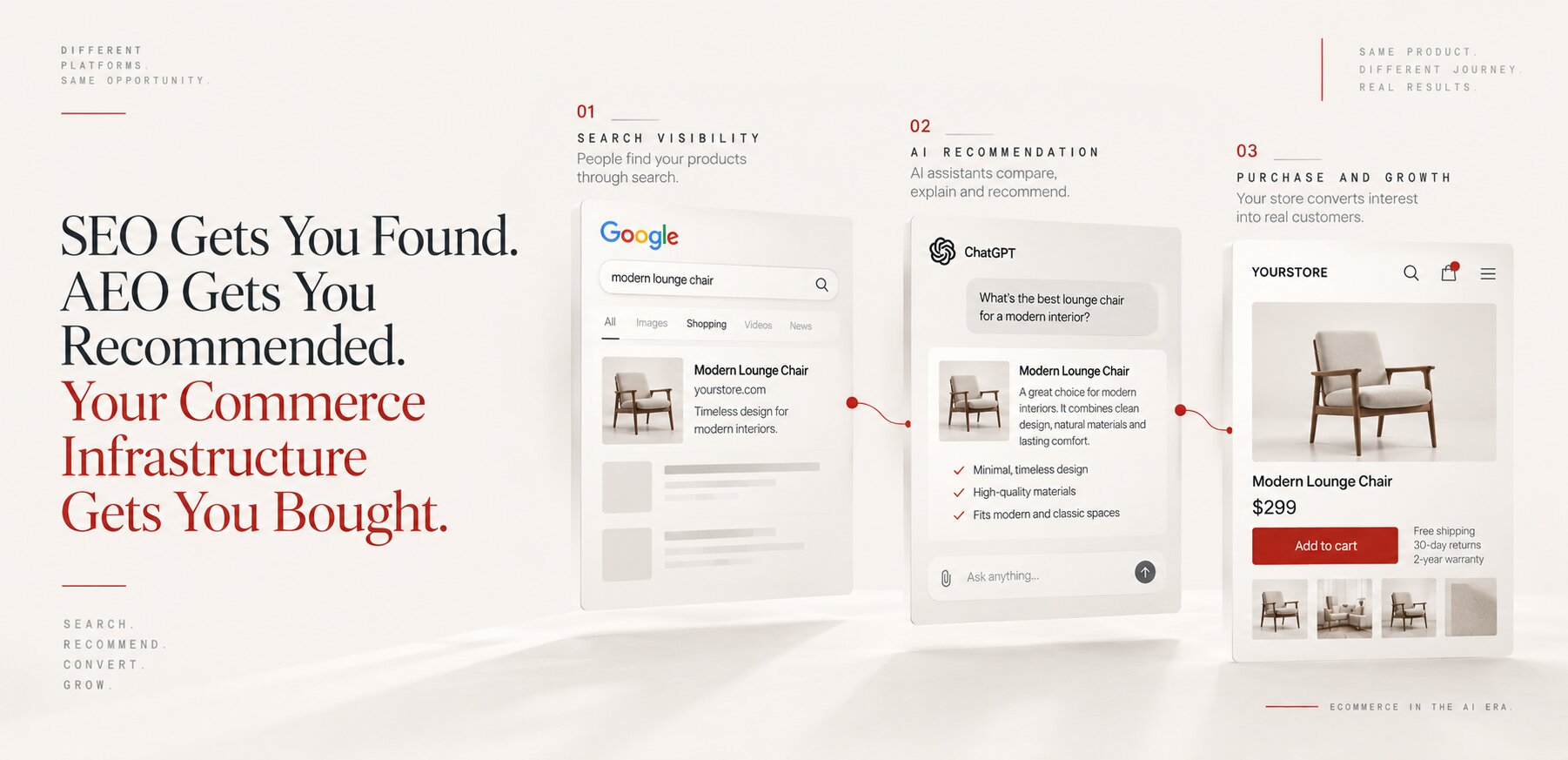
What that looks like for an e-commerce store specifically, including what the paid layer now costs, is covered in SEO Gets You Found. AEO Gets You Recommended. Your Commerce Infrastructure Gets You Bought..
For businesses operating across multiple languages, see multilingual AEO, since visibility in one language rarely transfers automatically to another.
- Share
-

-

-

-

Related Reading
-
15. 06. 2026
AI-Powered Web Design and AI Video Editing in 2025-2026

-
27. 06. 2026
Your Business Is Invisible to AI Search in 2026 — Here's How to Fix It
-
23. 06. 2026
Why Most Businesses Are Using AI Wrong in Marketing — And It's Killing Their Conversions
-
29. 06. 2026
How AI Is Changing Product Development in 2026 (But Great Ideas Still Win)
-
08. 07. 2026
Threads vs X in 2026: Which Platform Should Your Business Actually Be On?
-
17. 08. 2026
SEO, AEO, and GEO in 2026: What Actually Matters to Google, and What Your Marketer's Report Should Show
-
06. 09. 2026
SEO Gets You Found. AEO Gets You Recommended. Your Commerce Infrastructure Gets You Bought.
-
17. 06. 2026
Why Your Business Isn't Getting Leads From Its Website (And How to Fix It in 2026)
-
16. 09. 2026
Multilingual AEO: Why Translation Isn't Enough for AI Search