

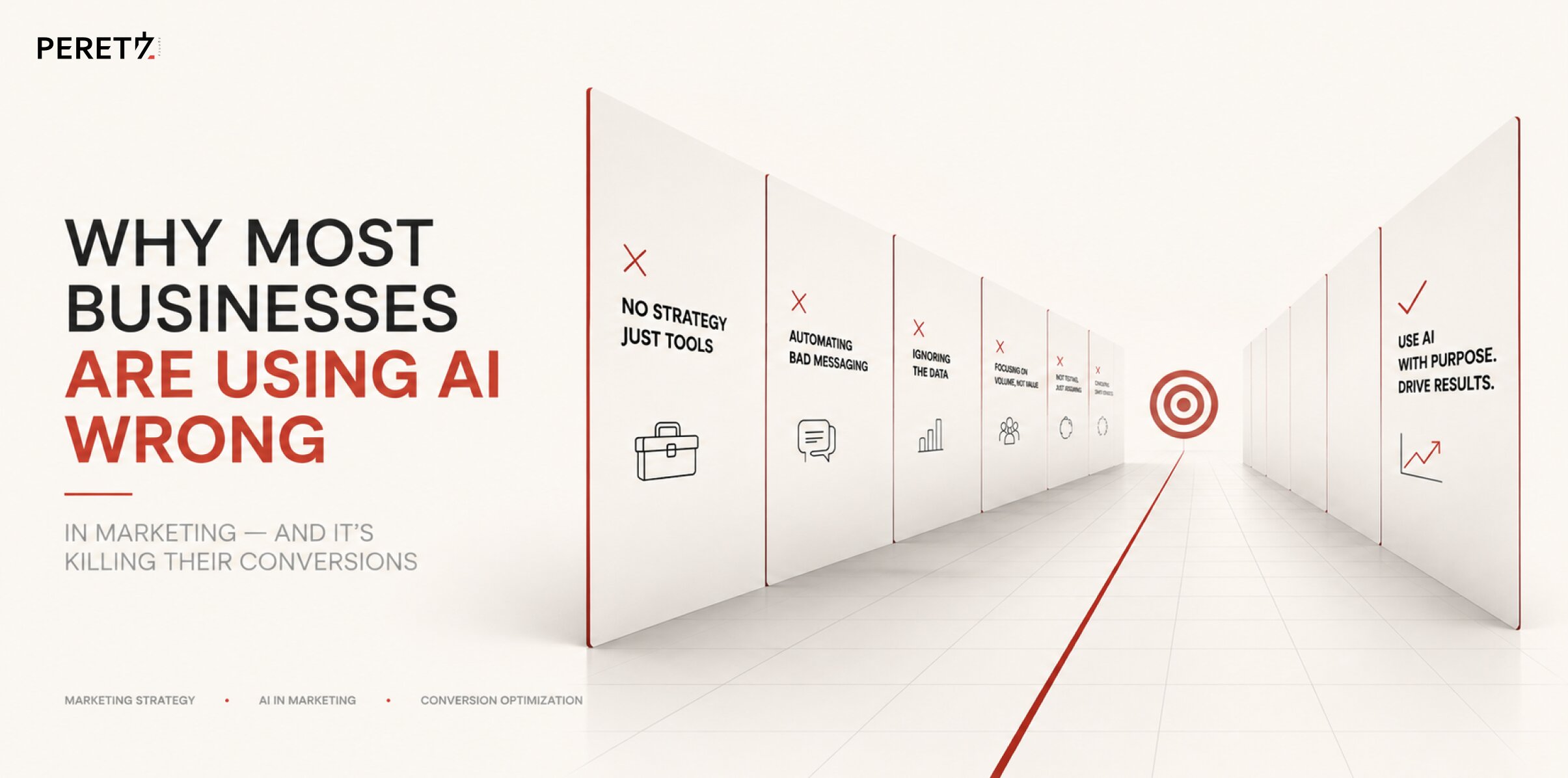
Everyone is using AI in marketing in 2026. Blog posts. Instagram captions. Landing pages. Email sequences. Ad copy. The output volume is staggering — and for many businesses, it costs almost nothing to produce.
So why aren't leads increasing?
This is the question nobody in the AI hype cycle wants to answer honestly. The uncomfortable reality: AI has made it dramatically easier to produce marketing content — and dramatically harder to stand out with it. Businesses that understood this distinction are pulling ahead. Businesses that didn't are generating noise at scale.
In this article, I break down exactly where AI genuinely helps in marketing, where it's quietly destroying conversions, and how to use it correctly if your goal is actual business growth — not just content volume.
The data that should make you pause: A 2024 Adobe survey found that only 39% of business leaders reported AI-generated content converting at a higher rate than traditional methods. The rest saw no improvement — or a decline. A B2B SaaS case study found that scaling AI content production from 4 to 40 articles/month increased organic traffic 300% — but qualified leads (MQLs) dropped 15%. When they cut back to 12 targeted, human-briefed articles, MQLs grew 45%.
The Core Problem: Volume ≠ Conversion
AI has solved the wrong problem for most marketing teams.
The bottleneck in marketing was never content production. The bottleneck was always strategy, specificity, and trust. AI solves for volume. It doesn't solve for judgment, real experience, or the human signals that actually move people toward a buying decision.
Here's what's happening across the industry in 2026:
- 80% of marketers now use AI for content creation (HubSpot 2026 State of Marketing)
- AI-generated content floods every platform — blog posts, LinkedIn updates, Instagram captions — most of it indistinguishable from every other piece on the same topic
- Google's March 2026 Core Update explicitly penalizes AI-heavy output with no original perspective, experience, or proof
- Buyers have learned to recognize AI content. They register it as slightly off, slightly generic, slightly not trustworthy — and move on
The result: more content, less differentiation, lower conversion rates for businesses running AI-first content strategies without human editorial control.
McKinsey research shows personalization drives 10–15% revenue lift on average. With AI, the cost of personalization approaches zero. But personalization without authentic brand voice and real customer insight is just templated content with a name in it — and buyers see through it immediately.
Where AI Genuinely Helps in Marketing (Use It Here)
1. Research and Competitive Analysis
AI compresses research from days to hours. Competitive landscape analysis, keyword research, topic ideation, summarizing industry reports, identifying content gaps — these are tasks where AI dramatically improves speed without sacrificing quality, because the output is raw material, not finished content.
Use AI for: 'Find the top 20 questions US small business owners ask about social media management costs and rank them by search volume.' Then build content around real search intent, not what the AI thinks sounds good.
2. Content Outlining and Structure
AI is excellent at producing content architecture — headers, logical flow, section sequencing. A well-structured outline built with AI gives a human writer a scaffold to fill with real expertise, original case studies, and genuine perspective. The structure is generic. The content that fills it doesn't have to be.
3. A/B Testing Variations at Scale
This is one of AI's highest-value uses in marketing. Generating 20 subject line variants for an email campaign, 15 headline options for a landing page, 10 CTA phrasings for an ad — and then testing them against real audience data — is a legitimate performance lever. The variation cost drops to near zero. The signal comes from real human behavior.
4. Repurposing Existing Human Content
Take a well-performing blog post written by a human expert with real case studies and original insights. Use AI to repurpose it into LinkedIn posts, newsletter snippets, Instagram captions, and email sequences. The source material is authentic — AI just adapts the format. This is one of the most efficient content workflows in 2026.
5. Personalization at Scale in Email and CRM
AI-powered email personalization — based on actual behavioral data, purchase history, and engagement signals — consistently outperforms generic blasts. Subject line personalization, milestone-triggered sequences, and dynamic content blocks are areas where AI's ability to process signals at scale genuinely improves performance.
6. First Drafts with Strong Human Briefs
A well-briefed AI can produce a useful first draft in minutes. The key word is 'first.' The brief must include: your specific audience's real pain points (not generic ones), your actual product positioning, real client examples or statistics, your brand voice and tone, and the specific outcome you want the reader to take. Without this, you get generic output. With it, you get a starting point that saves 60–70% of the writing time.
The pro workflow: Brief AI with specific customer insights → get a structured first draft → rewrite 40–60% of it with real examples, opinions, and original data → publish something that actually differentiates.
Where AI Is Killing Conversions (Stop Using It Here)
1. Brand Voice — The Trust Signal AI Can't Replicate
Trust is built through specificity, consistency, and authenticity. AI produces content that sounds plausible and complete — but lacks the micro-signals that tell a reader 'this is written by someone who has actually done this.' No real client stories. No actual numbers from real campaigns. No opinion strong enough to create disagreement.
In 2026, buyers have been exposed to enough AI content to recognize the pattern subconsciously. They can't always articulate what's wrong — they just register it as slightly generic, slightly untrustworthy, slightly not worth their time.
Real consequence: Businesses with AI-heavy content strategies are seeing stable traffic but weaker lead quality, longer sales cycles, and prospects who don't convert — not because the SEO failed, but because the content didn't build enough trust to close.
2. Landing Pages and Sales Copy
This is where AI use does the most damage. A landing page is a conversion instrument — every word, structure choice, and CTA is engineered to overcome a specific objection and move a specific person toward a specific action.
AI landing page copy tends to be:
- Generic benefit statements ('Grow your business. Save time. Get results.')
- Missing the specific language your actual buyers use to describe their pain
- Structured like every other landing page in your category
- Unable to anticipate and address the real objections your specific audience has
The result is a page that looks complete — but converts at 1–2% instead of 5–8%. At scale, that gap is enormous.
3. Video Content and UGC-Style Ads
In 2026, AI-generated video has a tell. Viewers often can't articulate what it is — they register it as a feeling: something slightly off, slightly too smooth, slightly plastic. In marketing contexts, that feeling is fatal. Because the thing marketing video needs to build — above everything else — is trust. And trust is extraordinarily sensitive to authenticity signals.
The same applies to UGC-style ads. The entire power of user-generated content is its apparent authenticity. An AI-generated 'UGC' video is a contradiction in terms — and increasingly, audiences recognize it.
4. Thought Leadership Content
LinkedIn posts, industry takes, opinion pieces, podcast talking points — content that is supposed to represent your expertise and perspective. AI can write it. But AI-generated thought leadership is, by definition, not thought leadership. It's a synthesis of what other people have already said, averaged into a position that offends no one and stands for nothing.
Real thought leadership requires:
- An actual opinion that some people will disagree with
- Experience that cannot be Googled
- Specificity of context that comes from actually having done the work
This content type must be human-written, even if AI helps with structure, research, or editing.
5. Community Management and DM Responses
AI-powered automated responses to comments, DMs, and social media interactions destroy community trust faster than almost anything else. Audiences in 2026 are sophisticated enough to recognize automated responses — and the signal they send is 'this brand doesn't care enough to actually engage with me.'
For businesses where social media is a trust-building channel (which is most businesses), the community management layer must be human. The content can be AI-assisted. The relationship cannot.
The Framework: AI as Infrastructure, Human as Signal
The businesses generating real ROI from AI in marketing in 2026 use a consistent framework. They don't ask 'how do we use AI to create more content?' They ask 'how do we use AI to help our humans create better content faster?'
The distinction is operational but the outcome is completely different.
|
Marketing Task |
AI Fit |
Why |
|
Research & competitive analysis |
✅ High leverage |
Compress weeks to hours |
|
Content structure / outlines |
✅ High leverage |
Scaffold for human expertise |
|
A/B testing copy variants |
✅ High leverage |
Test 20 variants instead of 2 |
|
Repurposing existing content |
✅ High leverage |
Format adaptation only |
|
Email personalization (behavioral) |
✅ High leverage |
Signal-based, not template-based |
|
First drafts (with strong briefs) |
⚠️ Medium — depends on brief quality |
Requires heavy human editing |
|
Brand voice / tone of voice |
❌ Low — use human |
AI averages; brands differentiate |
|
Landing pages / sales copy |
❌ Low — use human |
Conversion requires specificity |
|
Thought leadership content |
❌ Low — use human |
Requires real opinions + experience |
|
Video / UGC ads |
❌ Low — use human |
Authenticity signals are critical |
|
Community management / DMs |
❌ Never automate |
Destroys trust immediately |
The Real Competitive Advantage in 2026
In a world where everyone has access to the same AI tools and can produce the same volume of content at near-zero cost, competitive advantage has fundamentally shifted.
The businesses winning in 2026 have more content. They have better content — content that demonstrates real expertise, takes real positions, references real results, and sounds like a specific human being, not a language model.
Generic content is now a competitive disadvantage. Google's algorithms know it. Buyers know it. The only people who don't know it yet are the businesses still measuring success by content volume instead of lead quality.
AI amplifies what you already have. If you have real expertise, real results, and a real point of view — AI makes you dramatically more productive. If you don't have those things, AI scales the absence of them into thousands of words that convert no one.
The question to ask before using AI for any marketing asset: 'Can AI produce this without my real experience, my actual client results, or my genuine opinion?' If the answer is yes — the output will be generic. If the answer is no — AI can help you produce it faster, but the human element must be the input, not the revision.
How We Use AI at Peretz Agency
We use AI extensively — and deliberately. Here's our actual workflow:
- Research phase: AI for competitive landscape, keyword gaps, topic angles, and summarizing industry data
- Strategy phase: Human strategist only. AI cannot design a strategy specific to your business, your audience, and your goals.
- Content creation: AI for first drafts and structural scaffolding; human specialist for all final copy, brand voice, case studies, and CTAs
- Ad creative: Human creative direction always. AI for copy variant testing only, never for primary creative direction
- Analytics and reporting: AI for pattern recognition in data; human strategist for interpretation and recommendations
- Community management: 100% human. Always.
The result: we produce content significantly faster than a fully manual process — and it converts because the signal of real expertise is still in it.
Working with clients who've tried AI-only content workflows, we consistently see the same pattern: traffic holds or grows, but lead quality drops and sales cycles lengthen. The fix is always the same — less AI volume, more human specificity. Every time.
FAQ
Should I stop using AI for content marketing?
No. Stop using AI as a replacement for strategy, expertise, and genuine voice. Start using it as infrastructure — a tool that makes your human specialists faster and more productive. The businesses that win aren't the ones who avoid AI or the ones who automate everything. They're the ones who use AI to scale what's already working.
Will Google penalize AI-generated content?
Google's 2026 updates don't penalize AI content per se — they penalize content without original perspective, genuine expertise, and real user value. AI-generated content that lacks these qualities is increasingly penalized regardless of whether AI produced it. Human-written content that also lacks these qualities is penalized just as much. The quality standard is the same.
How do I know if my AI content is hurting conversions?
Track the metrics that matter: not traffic, but lead quality, sales cycle length, and conversion rate from content-sourced traffic. If your organic traffic is growing but leads are declining in quality, your content is attracting generic interest rather than buyer intent. This is the most common AI content failure pattern in 2026.
What's the minimum human input needed for AI content to convert?
At minimum: a real client example or case study specific to your business, at least one genuine opinion that your target audience might disagree with, specific numbers from your actual work (not industry averages), and your brand voice applied to every paragraph. Without these, AI content is indistinguishable from every other piece on the topic.
What actually separates a working AI-built site from a demo is covered directly in Claude can build the website, it can't build the understanding.
- Share
-

-

-

-

Related Reading
-
20. 06. 2026
SMM Agency vs Freelancer: What's Better for a Small Business in 2026?

-
19. 06. 2026
How Much Does Social Media Management Cost in the US in 2026?
-
18. 06. 2026
Why Your Instagram Ads Aren't Working in 2026 — And How to Fix Them
-
27. 06. 2026
Your Business Is Invisible to AI Search in 2026 — Here's How to Fix It
-
30. 06. 2026

I Audited 50 Instagram Accounts This Year. Here's What Actually Separates Growth from Stagnation.
-
04. 07. 2026

What Working With a Kindergarten Taught Me About B2C Trust — And What Every Premium Brand Needs to Hear
-
07. 07. 2026
What Is AEO? Answer Engine Optimization Explained for Small Business in 2026
-
22. 07. 2026
Why "Authenticity" Became 2026's Most Overused Word — And What Actually Works Instead
-
17. 08. 2026

When Everyone Can Publish 500 Articles, What Is Content Worth?
-
19. 07. 2026
High CTR But Low Conversion Rate? Here's Why Your Ad Copy Is the Problem
-
20. 07. 2026
How Long Does It Take to See Marketing Results? Why Agencies Promising Faster Are Lying to You
-
22. 09. 2026

Claude Can Build the Website. It Can't Build the Understanding. Not Yet.