

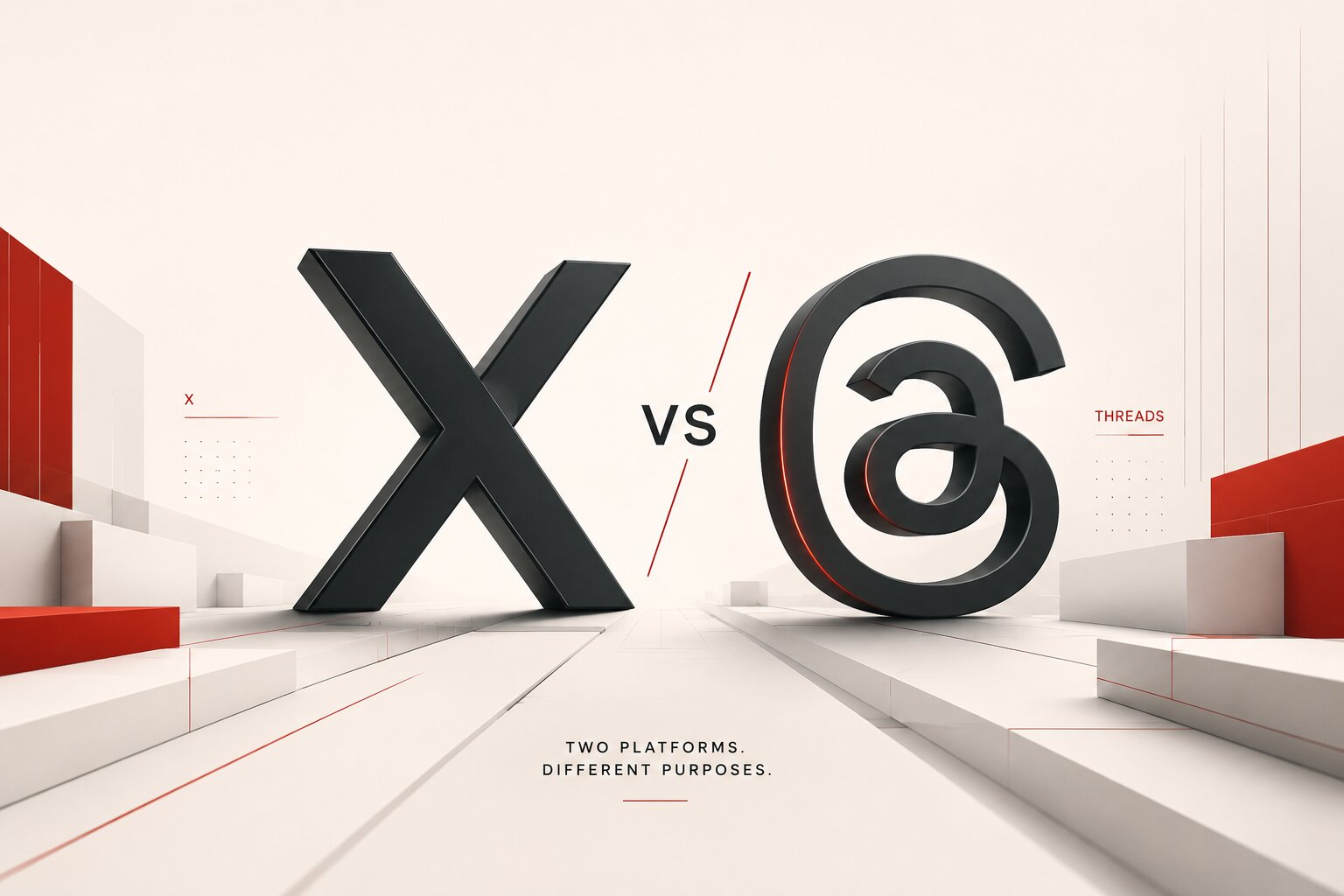
In January 2026, something happened that would have seemed unlikely two years ago.
Threads surpassed X in daily mobile active users — 141.5 million versus 125 million. The platform that launched in July 2023 and was written off by many as a Twitter clone that would fade out like every other Twitter clone had not, in fact, faded out.
For small business owners, this milestone raises a real question: does this change anything about where you should be investing your time?
The short answer is: it depends — but less on the user numbers than on something more specific about your business. Let me walk you through the actual data and the framework I use when clients ask me this question.
Honest disclosure: I manage Threads for clients in Ukraine, where the dynamics are somewhat different from the US market. For the American market specifically, I'm working from data rather than direct campaign experience on X. I think it's worth saying that upfront — because the honest answer is more useful than a confident one that's based on incomplete experience.
The Numbers: What's Actually Happening
|
Metric |
Threads |
X |
|
Monthly active users |
450 million (growing fast) |
540–570 million (declining slightly) |
|
Daily active users (mobile) |
141.5 million ✓ LEADS |
125 million |
|
Daily web traffic |
8.5 million (very low) |
145 million (dominant) |
|
Average time per session |
4–5 min/day |
32–34 min/day |
|
Engagement rate (brands) |
0.45% |
0.02% |
|
Engagements per post |
58 average |
328 average |
|
US monthly active users |
33.9 million |
95–99 million |
|
Primary age group |
25–34 (28.75%) |
25–34 (38.5%) |
|
Ad rollout status |
Testing — Q2 2026 rollout |
Active, recovering |
|
Ad revenue 2026 projection |
$11.3 billion |
$2.26 billion (recovering) |
|
B2B companies still active |
Growing |
67% (down from 82% in 2022) |
What this table actually tells you: Threads leads on mobile daily users and brand engagement rate. X leads on total users, web traffic, time-on-platform, and raw engagements per post. Neither platform dominates everything. The right choice depends on which metrics matter for your specific goal.
Why the Daily User Milestone Matters — But Isn't the Whole Story
Headlines loved the January 2026 milestone. 'Threads overtakes X!' makes for a clean story. But the data is more nuanced, and the nuance matters for business decisions.
Threads leads on mobile — X leads on desktop and web
Threads had 141.5 million mobile daily users versus X's 125 million. But X had 145 million daily web visits compared to Threads' 8.5 million. If your audience primarily accesses content on desktop — B2B decision-makers at work, for instance — this gap matters significantly.
X users spend 7–8x more time on platform
Average Threads session: 4–5 minutes. Average X session: 32–34 minutes. This reflects the fundamental difference in how people use these platforms. X is a real-time information feed — people check it throughout the day, dip in, respond to breaking news, follow unfolding stories. Threads is more casual, conversational, lighter. Neither is better — they serve different content consumption modes.
Threads has far higher brand engagement rate — but X generates more total engagements
Threads' brand engagement rate is 0.45% versus X's 0.02%. But X's average post generates 328 engagements versus Threads' 58. The difference: X has more total users and more active power users who engage frequently. Threads' smaller but more engaged-per-user base means your content reaches a higher percentage of followers — but potentially fewer total people.
Here's how I explain this to clients who get confused by these numbers: engagement rate is about how much your existing audience responds to you. Total engagements is about absolute volume. If you have 1,000 followers on Threads and 0.45% engage, that's 4–5 people. If you have 10,000 followers on X and 0.02% engage, that's 2 people. Scale matters. The rate doesn't tell you much without the denominator.
The Real Difference: What Each Platform Is For
Beyond the numbers, Threads and X serve fundamentally different functions — and understanding this is more useful than any engagement rate comparison.
X: real-time, news-driven, high-intent professional audience
X remains the dominant platform for real-time conversation around news, politics, sports, and industry developments. It's where journalists source stories, where breaking news spreads first, and where industry discourse happens. 67% of B2B companies are still active on it — down from 82% in 2022, but still the majority.
X users are more likely to follow brands for customer service, product news, and industry commentary. The platform rewards speed and opinion. A well-timed tweet on a breaking industry topic can generate significant visibility. A polished evergreen post will be buried.
Threads: community-driven, conversational, casual
Threads functions more like a digital town square — slower-paced, more conversational, lower-stakes than X's often adversarial tone. Users there are 28% primarily looking for entertaining brand content, followed by educational content (15%) and influencer partnerships (14%). It's a platform where brands can be warmer, less guarded, and more community-oriented.
The Meta integration is significant: Threads users are primarily Instagram users. If your business already has a strong Instagram presence, Threads offers a natural extension to a text-first conversation layer without building a new audience from scratch.
X's Controversy Problem and What It Means for Brands
This is the uncomfortable part of the Threads vs X conversation that most platform comparison articles skip.
X under Elon Musk has faced sustained advertiser controversy. Ad revenue fell from $4.14 billion at peak to $2.26 billion in 2024 — a 44% decline. Major advertisers including Apple, Disney, and IBM left the platform in 2023 and only partially returned in late 2025. X's ad market share fell to just 0.2% of global digital ad spending.
34% of European media companies reduced their X posting frequency by more than 50% in 2025. Outlets including The Guardian, NPR, and Swedish public broadcaster SVT stopped posting entirely. For brands in regulated industries or with brand-safety concerns, this environment creates real risk.
Brand safety consideration: X content moderation policies changed significantly under current ownership. For healthcare, legal, financial, and educational brands — categories where association with harmful content creates liability — this is a real strategic consideration, not just optics.
Who Should Be on Threads
Based on the data and what I see in practice:
- Brands already strong on Instagram — the audience overlap and Meta integration make Threads the lowest-friction text-platform extension
- Consumer brands targeting 25–34 demographics — this is Threads' dominant age group in the US
- Brands in brand-safety sensitive categories (healthcare, education, legal) where X's content environment creates risk
- Businesses building community and conversation rather than one-way broadcasting
- Small businesses without dedicated social media teams — Threads' lighter content cadence expectations are more manageable
- Brands interested in early-mover advertising advantage — Threads' full ad rollout is Q2 2026; early presence now builds the organic audience that will be retargeted with ads
Who Should Still Be on X
- B2B companies — 67% of B2B firms are still active on X, and industry conversations, thought leadership, and professional networking still happen there primarily
- Businesses in news-adjacent categories — media, PR, publishing, politics, finance — where real-time relevance is the primary content value
- Brands with strong existing X audiences — switching platforms means abandoning earned audience
- Businesses targeting 35+ professionals — X's demographic skews older than Threads
- Any business where customer service happens publicly — X is still the dominant platform where customers complain publicly and expect brand responses
The Honest Answer for Most Small Businesses
Most small businesses I work with don't need to choose between Threads and X. They need to choose whether either platform is worth their limited time at all. For most local service businesses, restaurants, clinics, real estate firms, e-commerce brands — Instagram and TikTok are where their clients actually are. Threads and X are platforms for conversations about the industry, not for finding customers in most categories. That said: if you're already comfortable on Instagram and want to add a text layer to your social presence without building a new platform from zero — Threads is the obvious next step. The Instagram audience is already there. The platform is growing. And ads are coming in 2026, which means early organic presence will be retargetable. If you're a B2B business, consultant, agency, or thought leader — X is still where your professional peers are, controversies notwithstanding. Being on X means being in the room where industry conversations happen. That's worth something even if the platform's trajectory is uncertain.
The One Scenario Where You Should Be On Both
Thought leadership and expert positioning.
If your business model depends on you being seen as an expert — agency, consultant, strategist, specialist of any kind — being present on both platforms is worth the additional effort. They serve different audiences in the same general professional space. Content that performs on Threads (warmer, more conversational, community-focused) and content that performs on X (sharper, more opinionated, real-time relevant) are genuinely different — but the same person can produce both.
The minimum viable approach: one original Threads post per day (conversational, low-stakes), and engage with 3–5 relevant X conversations per week rather than broadcasting. Neither platform rewards passive lurking. Both reward showing up consistently in conversation.
What to Expect From Threads Ads in 2026
Meta has begun testing promotional posts and sponsored content on Threads, with a full ad rollout expected Q2 2026. Initial formats: sponsored posts and promoted accounts — similar to early Instagram ads.
The integration with Meta Ads Manager means Threads advertising will be accessible through the same infrastructure as Instagram and Facebook ads. If you're already running Meta campaigns, adding Threads placements will be a checkbox, not a new system to learn.
The early opportunity: brands building organic Threads audiences now will have retargetable warm audiences when ads launch. This is the same window that existed for Instagram in 2012 and Reels in 2020 — the businesses that built early ended up with structural advantages that late arrivals paid to replicate.
How We Approach This at Peretz Agency
When clients ask about Threads or X, we start with a simpler question: where do your actual clients spend time, and what kind of conversation do they want to have with a brand like yours?
For most of our clients — local businesses, e-commerce, B2B services — the answer points to Instagram and LinkedIn first. Threads as a secondary text layer makes sense for Instagram-heavy clients. X makes sense for B2B clients who need thought leadership presence.
Neither platform is mandatory. Both reward consistency over volume.
This is exactly the kind of decision that only makes sense once you've answered the five questions a real strategy answers.
Want a platform strategy built around where your specific clients actually are — not just where the headlines say you should be? Contact us at hello@peretz.agency or call +1 425 471 94 96.
- Share
-

-

-

-

Related Reading
-
02. 07. 2026
TikTok vs Instagram for Small Business in 2026: What the Data (and My Clients) Actually Show

-
07. 07. 2026
What Is AEO? Answer Engine Optimization Explained for Small Business in 2026
-
06. 04. 2021
How to Rank Your Google Business Profile Higher in 2026 (Without Paying for Ads)
-
17. 06. 2026
Why Your Business Isn't Getting Leads From Its Website (And How to Fix It in 2026)
-
14. 02. 2021
SEO Copywriting in 2026: What Actually Ranks — and What Converts
-
07. 09. 2026
What Is a Social Media Strategy and Why Does a Business Actually Need One?