

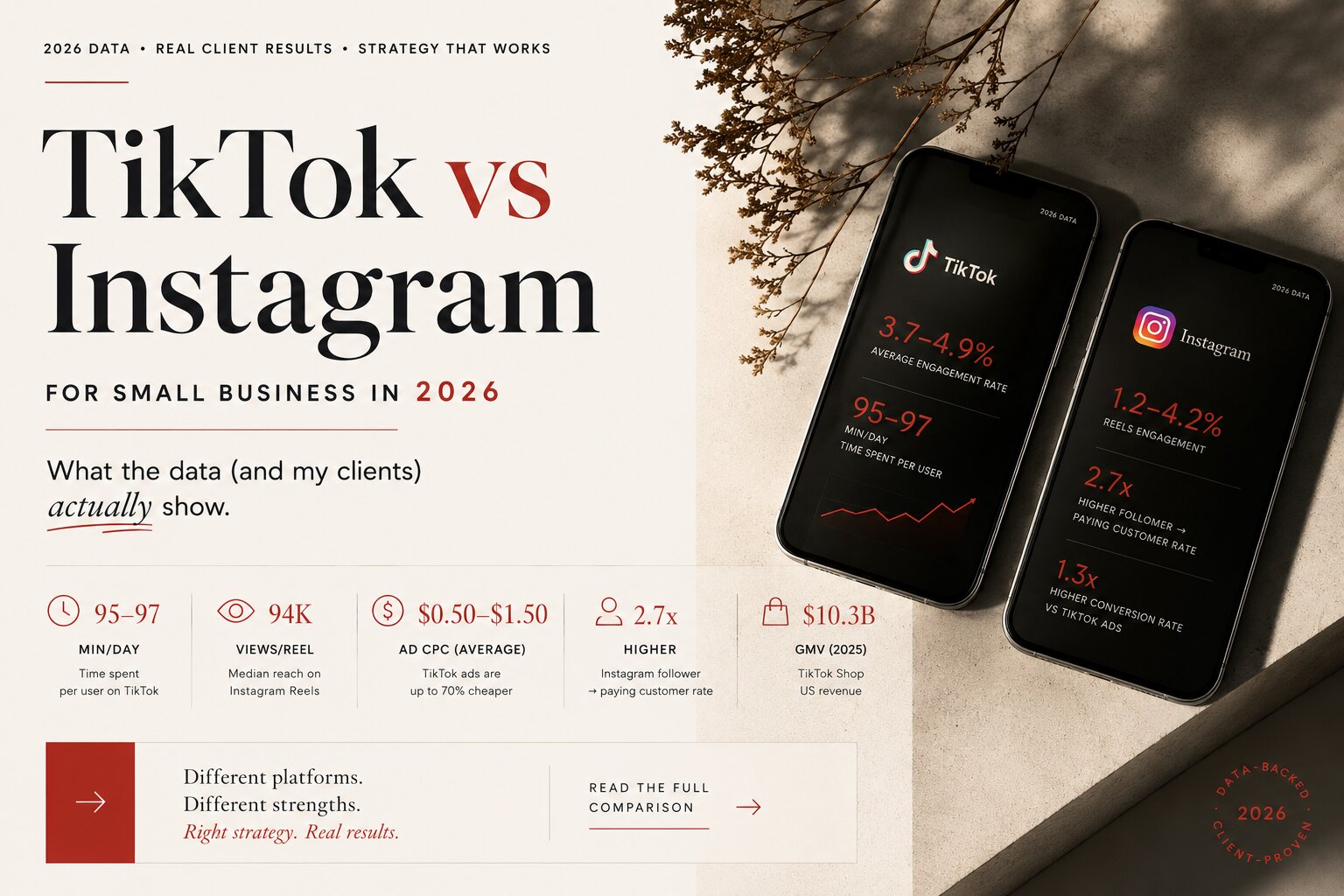
The TikTok vs Instagram question comes up in almost every strategy conversation I have with small business owners right now. And almost everyone is approaching it the wrong way.
They're asking: which platform is bigger? Which one has more engagement? Which one should I be on?
These are the wrong questions. The right question is: given what my business sells, who my customer is, and what stage of growth I'm at — which platform gives me the highest return on the specific resource I have least of right now, which is time?
I've managed social media across both platforms for clients in e-commerce, local services, B2B, education, and hospitality. I've watched accounts succeed on TikTok and fail on Instagram. I've watched the opposite. The pattern that emerges from real work isn't 'TikTok wins' or 'Instagram wins.' It's that the platforms serve fundamentally different functions — and most small businesses are either using both wrong or picking the wrong one for their specific situation.
This article gives you the real data from 2026 and the framework I actually use when helping clients make this decision.
The Numbers You Need to Know (2026 Data)
Before the framework, the numbers. These are current figures from multiple industry sources including eMarketer, Statista, DataReportal, Sprout Social, and Outfame research published in 2025–2026:
|
Metric |
|
TikTok |
|
Monthly active users |
3 billion+ |
1.9 billion |
|
Daily time spent per user |
33–55 min/day |
95–97 min/day |
|
Average engagement rate |
0.5–1.7% |
3.7–4.9% |
|
Instagram Reels engagement |
1.2–4.2% |
— |
|
Median reach per Reel vs TikTok video |
94,000 views/Reel |
15,800 views/video |
|
Ad CPC (average) |
$3–$5 |
$0.50–$1.50 |
|
Ad CPM (average) |
$6–$15 |
$3.20–$10 |
|
Instagram Reels vs TikTok ad conversion |
1.3x higher conversion rate |
Baseline |
|
Instagram follower → paying customer rate |
2.7x higher than TikTok |
Baseline |
|
TikTok Shop US GMV (2025) |
— |
$10.3 billion |
|
Revenue per US user |
$223 |
$109 |
|
Gen Z daily active time share |
Lower (declining) |
Higher (growing) |
What this table actually tells you: TikTok wins on engagement rate and daily time-on-platform. Instagram wins on conversion rate, revenue per user, and follower quality. These aren't contradictions — they reflect that the two platforms serve users in fundamentally different modes. TikTok is entertainment-discovery mode. Instagram is decision-and-relationship mode.
The Algorithm Difference That Changes Everything
Understanding how each platform's algorithm works is more important than any engagement stat, because it determines what's actually possible for a small business account.
TikTok's Algorithm: Content Over Followers
TikTok distributes content based on content quality signals — hook strength, watch time, completion rate, shares — not on follower count. A brand new account with zero followers can reach 50,000 people on its first video if the content performs well in initial testing.
This is why TikTok is the default recommendation for businesses starting from zero audience. The platform will show your content to non-followers if it earns their attention. Instagram won't, not to the same degree.
That doesn't mean Instagram growth is a lost cause, it just runs on a different mechanism. If your Instagram specifically has stalled, these are the ten most common reasons why, and the fix for each.
I've seen new TikTok accounts reach 10,000+ views in a week from a single video. I've watched the same video reposted to a new Instagram account sit at 40 views. The reach gap for accounts without existing audiences is real and significant. If you're starting fresh and need visibility fast, TikTok's algorithm is genuinely more favorable.
Instagram's Algorithm: Relationship Over Discovery
Instagram's algorithm prioritizes content for people who already have a relationship with your account — through follows, previous interactions, and demonstrated interest patterns. Reels are the exception: they get significant discovery reach to non-followers, which is why Reels now account for roughly 50% of all time spent on Instagram.
The implication: Instagram rewards consistency and relationship-building over time. TikTok rewards individual piece of content quality, often regardless of account history. For an established business with an existing audience, Instagram's relationship algorithm is more valuable. For a new business trying to build an audience from nothing, TikTok's content algorithm is more accessible.
Platform Fit by Business Type: What I Actually Recommend
E-commerce (Physical Products)
This is the most nuanced category because TikTok and Instagram are both investing heavily in social commerce, and the right answer depends almost entirely on your product and price point.
Here's the distinction I've seen play out: impulse purchases — beauty, gadgets, fashion under $50, trend-driven items — increasingly convert better on TikTok because the short-form video format builds enough trust in 30 seconds to drive a purchase, and TikTok Shop removes friction from the checkout path. TikTok Shop hit $10.3 billion in cumulative US GMV by Q3 2025 and is growing fast. Considered purchases — premium products, higher price points, items that require visual quality signals — still convert better on Instagram. Instagram Reels convert at 1.3x the rate of TikTok ads for direct sales (eMarketer, 2025), and Instagram followers convert to paying customers at 2.7x the rate of TikTok followers (Outfame, 65,000+ user study). If your product needs to look good to sell, Instagram is your primary conversion platform.
Local Service Business (Restaurant, Clinic, Salon, Gym, Contractor)
For local service businesses, the platform decision is clearer than most people think.
Instagram is the primary platform for most local service businesses in the US in 2026. Here's why: local services sell to people in a specific geographic area, often across a wide age range. Instagram's audience is more demographically diverse (28.3% aged 25-34, strong presence in 35+ demographics) and has more mature local business tools — including Meta Ads with precise geographic and demographic targeting, local business features, and a shopping infrastructure that works for service bookings.
TikTok has a role for local businesses — specifically for viral brand-awareness moments and reaching younger demographics. But for a restaurant in Bellevue or a dental clinic in Seattle, Instagram is where your clients are and where your advertising dollars go further.
Local service business recommendation: Instagram as primary platform (3–5 posts/week including Reels), TikTok as secondary experiment (1–2 posts/week of your best-performing Instagram Reels, with TikTok watermarks removed). Budget 80% of your social media time to Instagram, 20% to TikTok.
B2B / Professional Services
This is where most people get the TikTok recommendation wrong. The conventional wisdom says TikTok is a consumer platform and B2B businesses should stick to LinkedIn and Instagram.
That's increasingly not true.
I've seen B2B businesses — agencies, consultants, SaaS companies, professional service firms — generate genuine leads from TikTok content. The key insight is that TikTok's algorithm shows educational, specific, expertise-demonstrating content to people who are interested in that topic — regardless of whether they 'look like' a B2B buyer. A video explaining why businesses keep hiring the wrong marketing agency, or what most Meta ads audits reveal, or how AI search is changing client acquisition — these perform well on TikTok and reach decision-makers who use the platform personally even if they don't identify it as a 'work tool.' That said, LinkedIn is still the primary B2B platform and Instagram builds brand credibility. TikTok is a top-of-funnel awareness play for B2B, not a direct lead generation channel in most cases. The content needs to be genuinely educational and specific — not polished brand content.
Education / Courses / Coaching
TikTok is genuinely strong for education businesses, and here's the specific reason: 49% of US consumers now use TikTok as a search tool, up from 41% in 2024. 64% of Gen Z has used TikTok for online searches. If your audience is under 35 and looking for information in your topic area, TikTok is increasingly where they're searching — not Google, not YouTube.
Educational short-form video builds trust faster than almost any other format. A 60-second explanation that's genuinely useful creates more credibility than 10 polished promotional posts. For coaches, course creators, and educators, TikTok's discovery algorithm and search behavior make it a primary platform worth serious investment.
The Paid Advertising Reality: Where Your Budget Goes Further
The organic platform question and the paid advertising question have different answers — and conflating them is one of the most expensive mistakes businesses make.
TikTok Ads: Cheaper to Reach, Harder to Convert
TikTok's average CPC runs $0.50–$1.50, compared to Instagram's $3–$5. CPMs are $3.20–$10 versus Instagram's $6–$15. On paper, TikTok looks dramatically cheaper.
But cheaper reach doesn't automatically mean better results. TikTok Spark Ads achieve 142% higher engagement and 69% higher conversion rates than standard TikTok ads — but they require creator-native content, not polished brand assets. The content production requirement is higher, and the audience's tolerance for anything that feels like an ad is near zero.
TikTok paid advertising works best for: brand awareness at scale, product discovery for impulse-purchase items, reaching Gen Z and younger millennials, and retargeting your existing TikTok audience.
Instagram/Meta Ads: More Expensive, Higher-Intent Conversions
Meta's ad infrastructure is significantly more mature. Instagram Reels convert at 1.3x the rate of TikTok ads for direct sales. Instagram's Advantage+ targeting, Conversions API integration, and shopping infrastructure give you more control over your conversion funnel than TikTok currently offers.
For service businesses, B2B, and higher-ticket products, Instagram/Meta ads typically deliver better cost per qualified lead despite higher initial CPMs — because the quality of conversions is higher.
When I'm advising a client on paid media allocation between the two platforms, my default for most small service businesses is: start with Meta Ads on Instagram, prove the conversion math, then test TikTok Ads for awareness. TikTok paid advertising requires significant creative investment to perform — you need content that looks native, not like an ad. If you don't have the creative production capacity to feed TikTok's format requirements, the cheaper CPC won't translate into better results.
The Content Trap Most Businesses Fall Into
This is the mistake I see most often when businesses try to run both platforms: they produce content for one and repost it to the other.
This almost never works.
TikTok audiences immediately reject content that looks like it was made for somewhere else. Polished, branded, visually consistent content that performs on Instagram will underperform on TikTok — sometimes dramatically. TikTok rewards raw, specific, trend-aware, educational content. The production values that signal quality on Instagram signal 'this is an ad' on TikTok. The practical implication: if you're going to run both platforms seriously, you need two distinct content approaches. Not two separate content calendars producing completely different volume — but two different creative directions from the same ideas. The same insight or story told in Instagram's visual, relationship-building format and TikTok's raw, personality-driven format.
A realistic content workflow that works for small businesses:
- Develop the core idea or insight (one per week)
- Create the Instagram version: polished Reel or carousel with clear CTA, visually branded
- Create the TikTok version: talking head or raw demonstration, trend-aware, no watermarks, more conversational tone
- Never cross-post the same file directly — it signals inauthenticity to both algorithms
The Decision Framework: Which Platform First?
If you can only invest seriously in one platform right now — which most small businesses should, rather than diluting effort across both — here's how to decide:
|
If... |
Start with |
Then add |
|
Your audience is primarily 18–34 |
TikTok |
|
|
Your audience is 35+ |
|
TikTok |
|
You're starting from zero audience |
TikTok |
|
|
You have existing audience |
|
TikTok |
|
You sell impulse/low-ticket products (<$50) |
TikTok |
|
|
You sell considered/premium products ($50+) |
|
TikTok |
|
You're a local service business |
|
TikTok, as a secondary channel |
|
You're in education/coaching |
TikTok |
|
|
Your primary goal is awareness/reach |
TikTok |
|
|
Your primary goal is leads/conversions |
|
TikTok, as a secondary channel |
The answer for most US small businesses in 2026: Instagram as primary platform with a secondary TikTok presence for discovery. The exception: education/coaching businesses targeting under-35 audiences, and product businesses in impulse-purchase categories, where TikTok can justify being the primary investment. The same logic applies when choosing between text platforms, see Threads vs X in 2026.
What I Tell Clients Who Ask Me to Pick
When a client asks me directly — TikTok or Instagram — my honest answer is usually: Instagram is your workhorse and TikTok is your wildcard. Instagram builds the relationship consistently. It's where your existing audience is, where your Meta Ads reach qualified leads, and where conversions happen most predictably. TikTok gives you access to audiences you'd never reach on Instagram, at organic reach levels you can't match on any other platform, but it requires a different content approach and a higher tolerance for unpredictability. Most small businesses I work with can't sustain serious execution on both platforms simultaneously — not because of budget, but because of time and creative capacity. So I tell them: master Instagram first. Prove the model. Then add TikTok as a discovery layer once you have a content engine that works.
How Peretz Agency Handles Platform Strategy
When a client comes to Peretz Agency for social media strategy, platform selection is one of the first decisions we make together — before content calendars, before creative direction, before anything else.
We look at: your existing audience (if any), your product/service category, your price point, your target demographic, your content production capacity, and your primary business goal. Only then do we recommend a platform mix and allocate content effort accordingly.
What we don't do: recommend both platforms at equal intensity when the client doesn't have the bandwidth to execute both well. A single platform done right consistently outperforms two platforms done mediocrely.
Platform choice is step three of a real strategy, not step one, see what actually comes before it.
Want a platform strategy built for your specific business situation — not a generic 'be everywhere' recommendation? Contact us at hello@peretz.agency or call +1 425 471 94 96. First conversation is always about your business, not our packages.
We looked at how creator collaborations actually perform by platform and niche fit in Collaboration Strategy: Why One-Off Partnerships Don't Build Lasting Growth.
- Share
-

-

-

-

Related Reading
-
17. 06. 2026
Why Your Business Isn't Getting Leads From Its Website (And How to Fix It in 2026)

-
19. 06. 2026
How Much Does Social Media Management Cost in the US in 2026?
-
29. 06. 2026
Meta Ads in 2026: What Budget Do You Really Need to See Results?
-
13. 11. 2020
Why Launching a New Site Is Good for SEO: The Nicole Case
-
01. 02. 2021
Why Responding to Online Reviews Matters in 2026 — And How to Do It Right
-
18. 06. 2026
Why Your Instagram Ads Aren't Working in 2026 — And How to Fix Them
-
02. 07. 2026
I've Rebuilt My Career Twice Because of War. Here's What That Actually Teaches You About Strategy.
-
08. 07. 2026
Threads vs X in 2026: Which Platform Should Your Business Actually Be On?
-
27. 07. 2026
Why Your Instagram Isn't Growing in 2026 (10 Fixes)
-
19. 08. 2026

Collaboration Strategy: Why One-Off Partnerships Don't Build Lasting Growth
-
24. 07. 2026
Marketing Agency Burnout Is a Business Risk, Not Just a Personal One
-
24. 07. 2026
Is Social Media Marketing Dead in 2026? What the Data Actually Says
-
07. 09. 2026
What Is a Social Media Strategy and Why Does a Business Actually Need One?