I've Rebuilt My Career Twice Because of War. Here's What That Actually Teaches You About Strategy.



Chapters
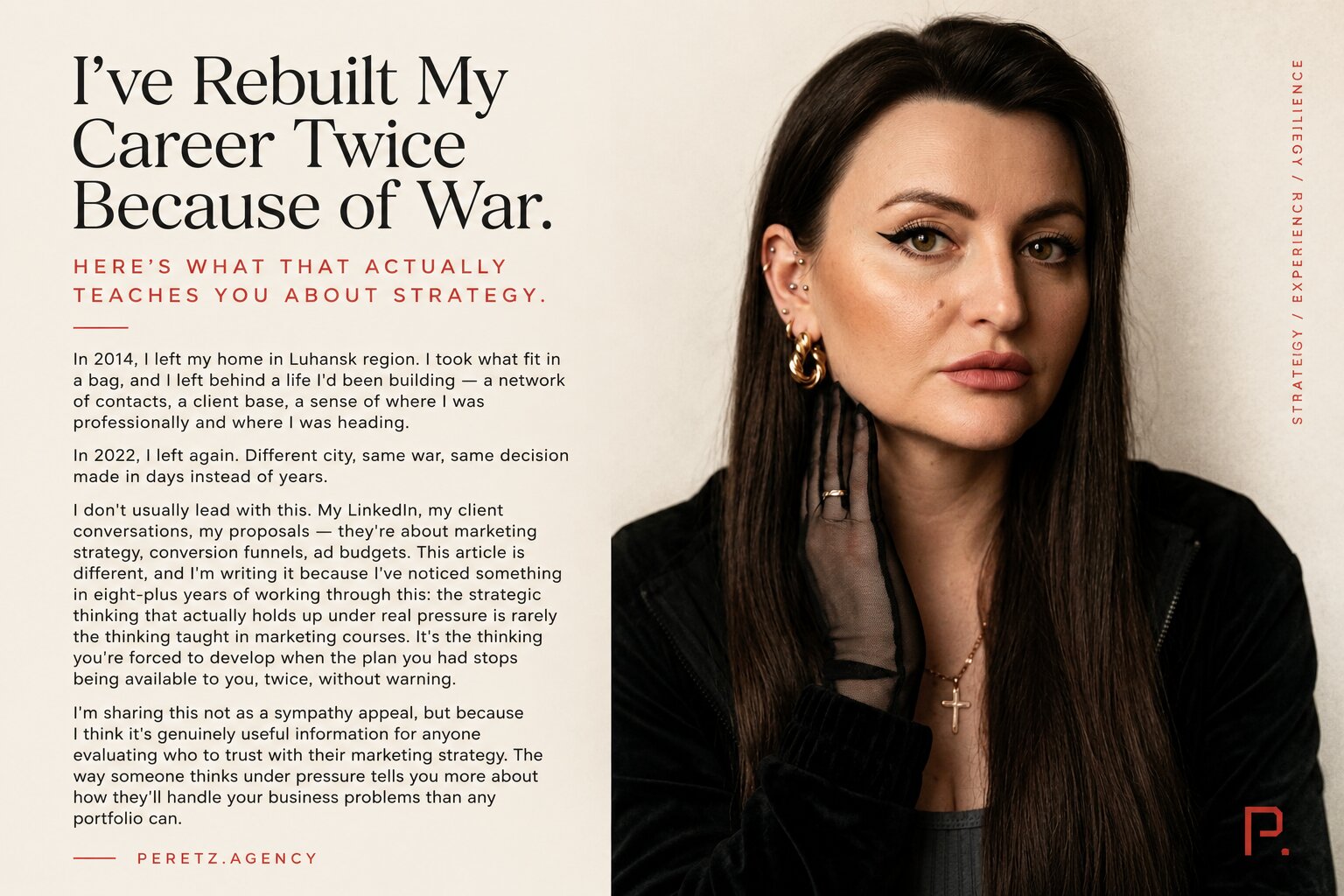
In 2014, I left my home in Luhansk region. I took what fit in a bag, and I left behind a life I'd been building — a network of contacts, a client base, a sense of where I was professionally and where I was heading.
In 2022, I left again, this time from Kharkiv. Different city, same war, same decision made in days instead of years.
I don't usually lead with this. My LinkedIn, my client conversations, my proposals — they're about marketing strategy, conversion funnels, ad budgets. This article is different, and I'm writing it because I've noticed something in eight-plus years of working through this: the strategic thinking that actually holds up under real pressure is rarely the thinking taught in marketing courses. It's the thinking you're forced to develop when the plan you had stops being available to you, twice, without warning.
I'm sharing this not as a sympathy appeal, but because I think it's genuinely useful information for anyone evaluating who to trust with their marketing strategy. The way someone thinks under pressure tells you more about how they'll handle your business problems than any portfolio can.
PLAN VS STRATEGY
Lesson One: A Plan Is Not a Strategy
Before 2014, I had a plan. Career trajectory, client relationships, a sense of professional momentum that felt solid because it had been building for years.
A plan assumes the conditions that built it will continue. A strategy assumes they might not.
This sounds obvious when I write it out. It wasn't obvious to me until I had to live it. The difference between a plan and a strategy is that a strategy has a built-in answer to the question: what happens if the floor disappears? Most businesses — and most marketers — never ask that question, because they've never had to. I had to ask it twice, with no warning either time. What I learned is that the businesses and the people who recover fastest from disruption aren't the ones with the best original plan. They're the ones whose thinking was never fully dependent on a single set of conditions in the first place. They built optionality in without realizing that's what they were doing.
This is something I now build into every marketing strategy I create for clients, even ones who will never face anything close to what I've faced. A content strategy or an ad campaign built around a single platform, a single channel, a single assumption about the market — that's a plan. A strategy has contingencies built in from the start, not bolted on after something breaks.
DECISION SPEED
Lesson Two: Speed of Decision Matters More Than Perfection of Decision
In 2014, I had time to think — weeks, not days. In 2022, I didn't. The decision to leave, to restart, to figure out how to keep working, had to be made in a matter of days, with incomplete information, under genuine pressure.
What I learned from making both kinds of decisions — the slow one and the fast one — is that the speed almost didn't matter for the outcome nearly as much as I expected it to. What mattered was whether I'd built the habit of deciding from principles rather than deciding from comfort. When you've thought clearly about what actually matters to you and why, fast decisions and slow decisions converge on similar answers. When you haven't done that thinking in advance, even a slow decision tends to be reactive rather than strategic. I see this constantly in marketing work that has nothing to do with war. A client facing a sudden algorithm change, a competitor undercutting their pricing, a platform deprecating a feature they depended on — the businesses that respond well aren't the ones who deliberate longest. They're the ones who already know what they actually stand for, so the decision under pressure is really just an application of principles they'd already worked out.
CONTROL
Lesson Three: What You Can't Control Teaches You What You Actually Control
There's a particular kind of clarity that comes from losing access to almost everything you thought you needed. I couldn't control where I lived, what infrastructure was available, what my client relationships from before would look like after. What I could control was much smaller — and much more specific — than I had assumed.
I could control how I showed up to the work I still had. I could control whether I kept building skills even when the immediate payoff wasn't visible. I could control how honestly I communicated with clients about what I could and couldn't deliver in a given week. That's a short list. But it turned out to be the entire list that actually mattered. I bring this same narrowing to client strategy work now. Businesses waste enormous energy trying to control things they fundamentally can't — algorithm changes, competitor behavior, market conditions. The marketing strategies that actually work are built around a clear-eyed inventory of what's genuinely controllable: your offer, your message, your consistency, your relationship with the people who already trust you. Everything else is noise dressed up as strategy.
TRUST
Lesson Four: Trust Is Built Slower Than You Think, and Faster Than You Fear
Rebuilding a client base from displacement twice taught me something uncomfortable about how trust actually works, versus how marketing theory describes it.
The textbook version says trust builds slowly, incrementally, through consistent delivery over time. That's true, but incomplete. What I learned is that trust also has moments of acceleration — points where someone sees you handle a difficult situation honestly, and the trust jumps forward faster than the slow incremental model predicts. The first time a client saw me deliver real work despite genuinely difficult circumstances, without making excuses or overpromising — that built more trust in one project than a year of comfortable, low-stakes work would have. This changed how I think about client relationships generally. I stopped trying to project an image of effortless competence and started being straightforward about constraints, timelines, and what's realistic. Counterintuitively, that honesty builds trust faster than the polished version ever did. People can tell the difference between confidence and performance, even when they can't articulate why.
SPECIFICITY
Lesson Five: Specificity Is a Survival Skill, Not Just a Marketing Tactic
When resources are genuinely limited — time, energy, infrastructure, attention — vague effort doesn't work. You can't afford to try a little bit of everything. You have to identify the specific thing that actually matters and commit fully to that, because you don't have the surplus capacity to hedge.
This is the lesson that shows up most directly in my marketing work. I have very little patience now for vague strategy — 'let's try to grow our social media' or 'we want more brand awareness.' Vague goals are a luxury of abundant resources. When resources are tight, you need to know exactly what you're optimizing for, exactly who you're trying to reach, and exactly what success looks like in a specific, measurable way. Specificity isn't a nice-to-have in strategy. It's what makes limited resources actually work. I ask every client a version of the question I learned to ask myself: if you could only do one thing well this month, what would it be? Most businesses have never had to answer that question, because they've never had to operate under real constraint. I have. And it makes the strategy work faster and cleaner than starting from an open-ended brainstorm ever does.
WHY I'M TELLING YOU
Why I'm Telling You This
I'm a marketing strategist, SMM specialist, and targetologist with eight-plus years of experience across military communications, premium brands, real estate, and education. I work with businesses in the US and Europe through Peretz Agency, building strategies across social media, content, and paid advertising.
None of the professional facts in that paragraph explain why my strategic thinking works the way it does. This article does.
When I evaluate a new client's situation, I'm not just looking at their numbers. I'm looking for what they actually control, what they're treating as fixed that isn't, and what they're treating as flexible that should be a fixed commitment. That instinct — to separate the controllable from the uncontrollable quickly and act decisively on the part you can actually move — wasn't something I learned in a marketing course. It's something I had to learn twice, under conditions I wouldn't choose for anyone, and it's the most valuable thing I bring into every strategy I build.
If you're evaluating who to trust with your marketing strategy, I'd offer this: ask not just what someone has built, but how they think when conditions change. The second question tells you more.
Want to talk through your marketing strategy with someone who builds with contingency in mind from day one? Contact us at hello@peretz.agency or call +1 425 471 94 96.
- Share
-
-

-

-
Related Reading
-
02. 07. 2026
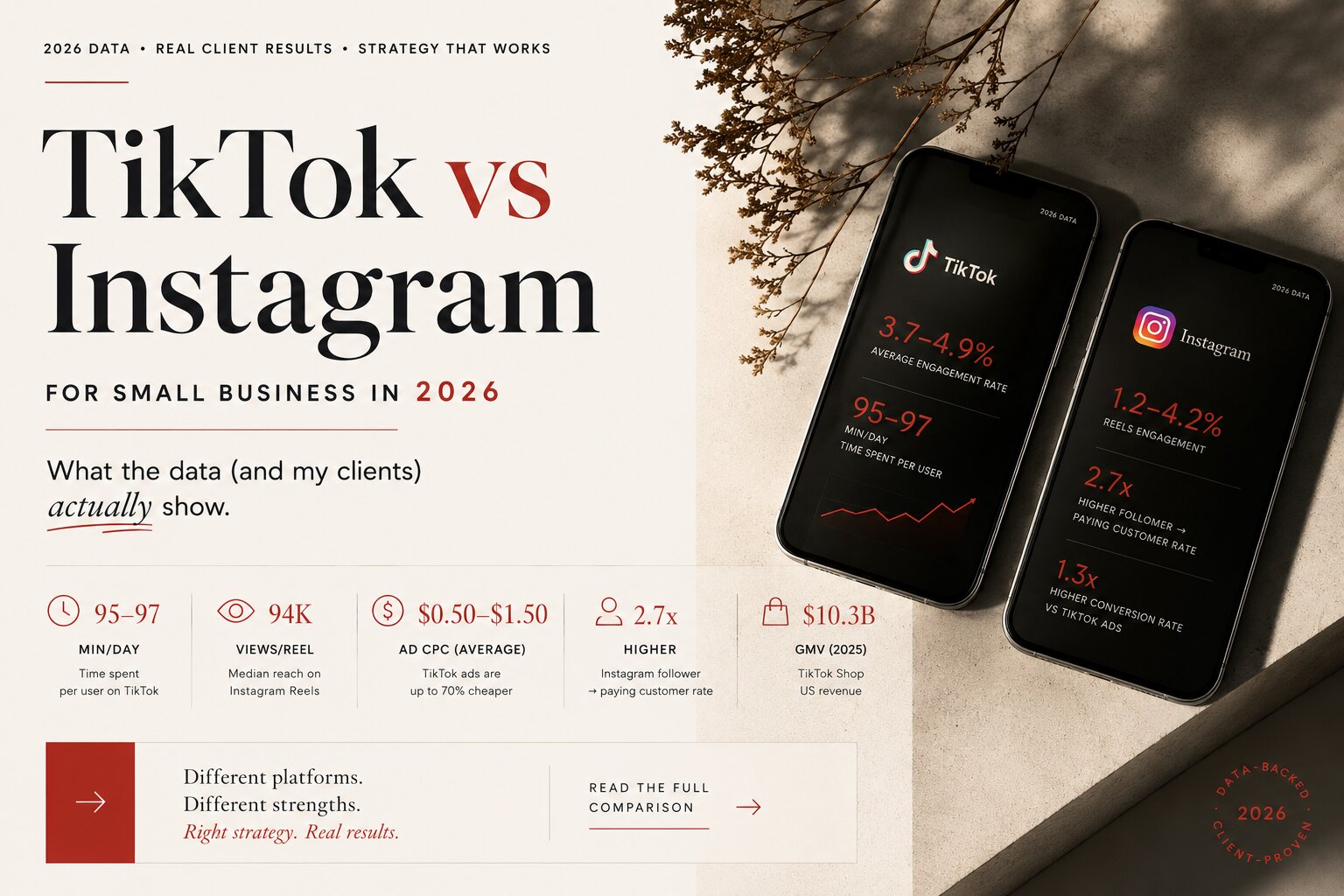
TikTok vs Instagram for Small Business in 2026: What the Data (and My Clients) Actually Show

-
29. 06. 2026
Meta Ads in 2026: What Budget Do You Really Need to See Results?
-
26. 06. 2026
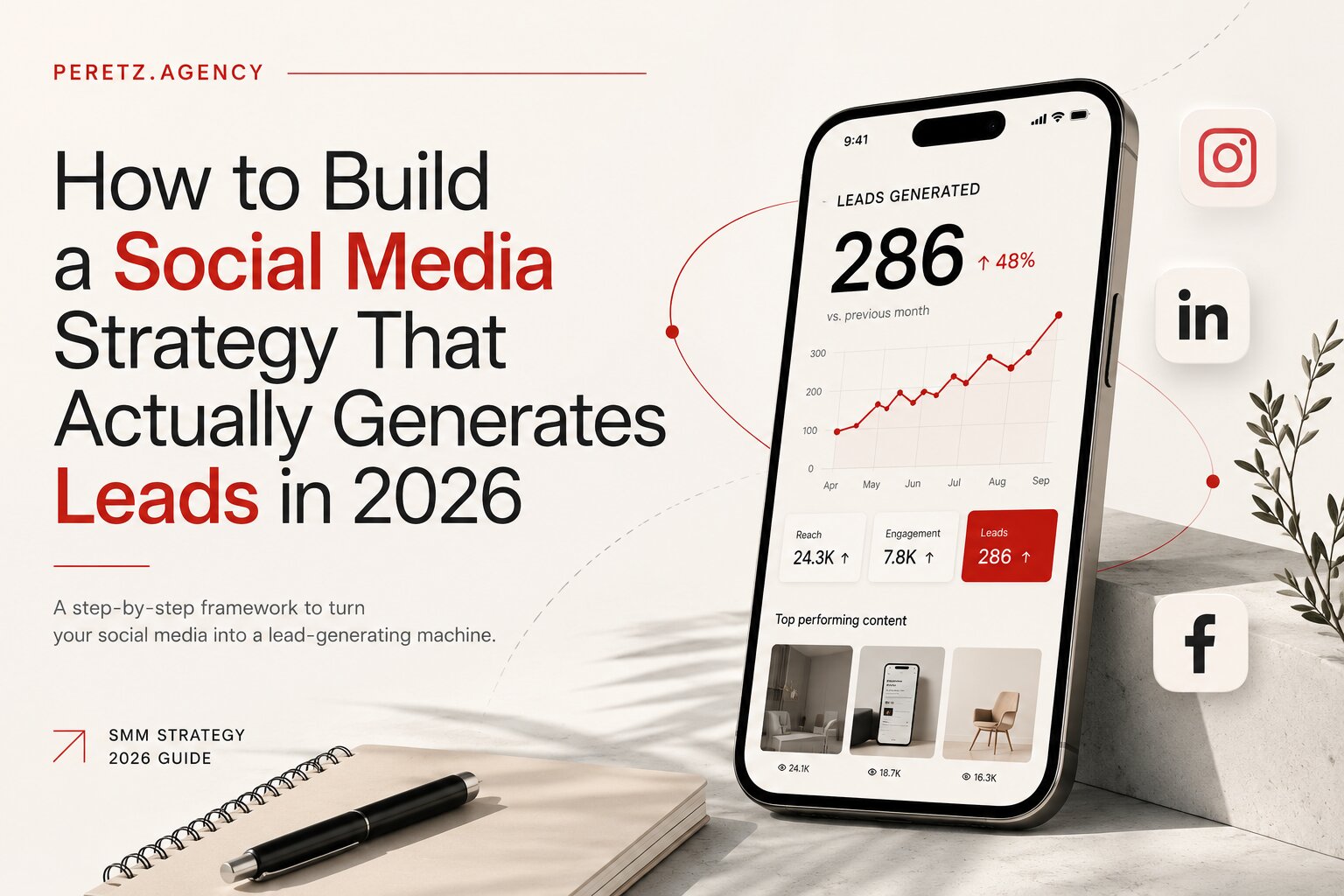
How to Build a Social Media Strategy That Actually Generates Leads
-
20. 12. 2020
Why Your E-Commerce Store Needs a Blog in 2026 — And How to Start One That Actually Works
-
01. 02. 2021
Why Responding to Online Reviews Matters in 2026 — And How to Do It Right
-
24. 06. 2026
How to Choose a Web Design Agency in Seattle: A Business Owner’s Guide for 2026
-
31. 07. 2026
We Design for Reality, Not for Ideal Scenarios