Google Search Console: the Page Indexing Report Has Stopped Updating



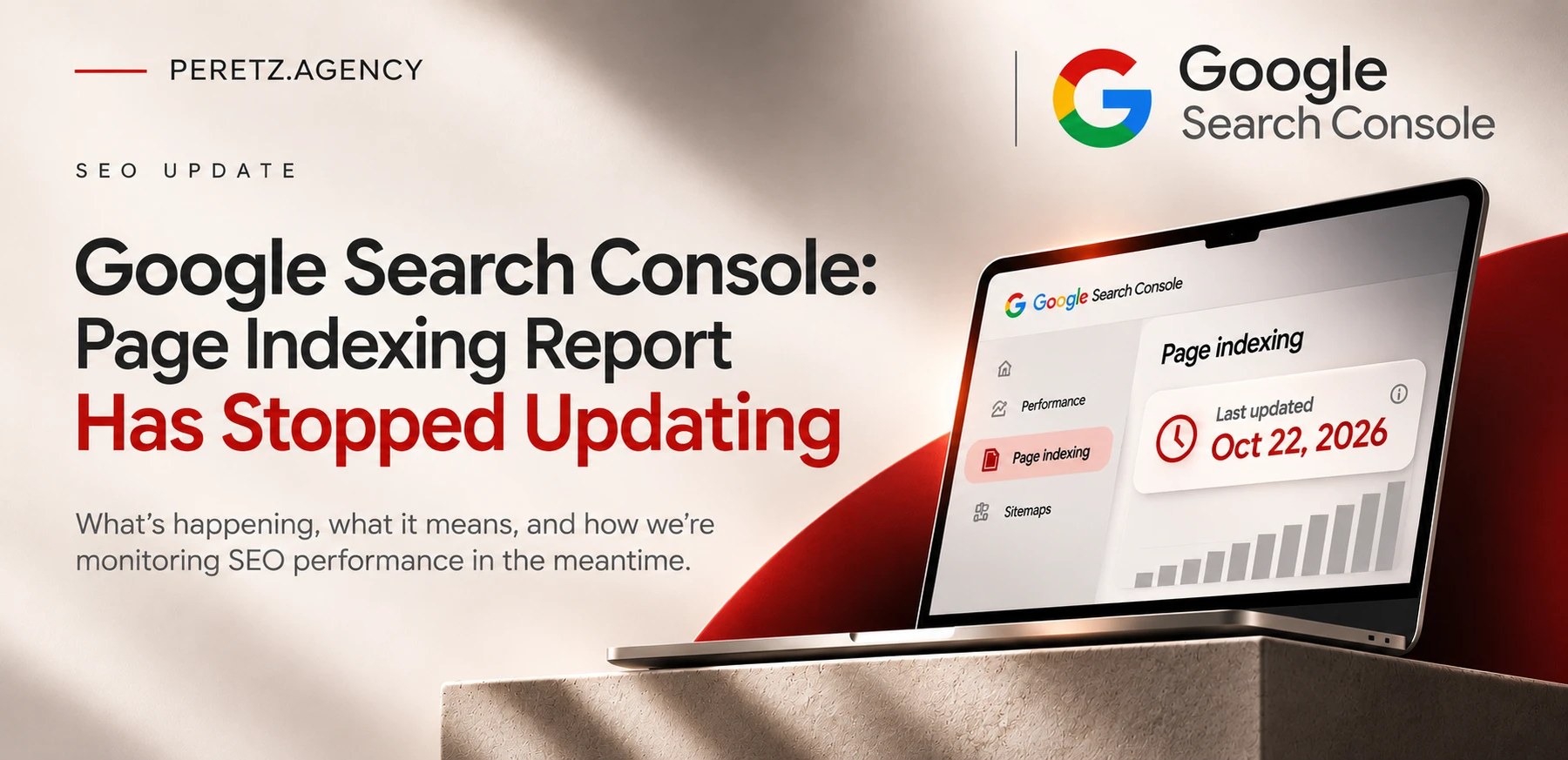
What is happening, what it means for your site, and how we keep track of SEO while the report stands still. Status as of November 7, 2026.
IN SHORT
The short answer
Since about October 22, 2026, the Page indexing report in Google Search Console has stopped showing new data on many sites, ours included. Other reports keep updating, and URL Inspection shows crawl dates from November. As of November 7 Google has published no incident note and no date for a fix. Nothing on your site needs fixing because of this: the delay sits in Google's reporting, and only Google can restart it.
We looked for a fix on our side and did not find one, because there is none to find. What we can do is read the data that still moves, and not let a frozen chart push anyone into changes the site does not need.
WHAT WE SEE
What we see on our projects
On several sites we look after, the Page indexing report has not moved since October 22, 2026. The counts of indexed and not indexed pages stay exactly where they were, and the date under the chart stays the same day after day. New pages published since then do not appear in it, and pages we removed or redirected have not left it.
At the same time the Performance report keeps updating with clicks, impressions, queries and positions. URL Inspection, run on single pages, returns fresh crawl dates. So Google keeps visiting the sites, and Search Console keeps receiving data. Only the summary report about indexing has stopped.
For a client the practical problem is simple. The indexing chart is the one people open to answer "did Google pick up our new pages?" Right now that chart answers a question about October.
HOW WIDE
Not one site, not one account
The freeze does not look tied to one site, one host or one kind of setup. On November 4, 2026 the publication SEO After AI described one Search Console account with seven properties of different size, country and language. All seven showed the same last update for Page indexing, October 23, twelve days behind. In the same account the Performance report had been updated about five and a half hours earlier, and URL Inspection showed one of their pages crawled on November 3.
Earlier, on Reddit, a site owner wrote that the report on their property had not updated since October 16. So the start date differs between accounts by about a week, but the picture is the same: the summary stops, everything else keeps going.
A frozen report is a reporting problem, not an indexing problem.
When the same delay appears at once on unrelated sites, the cause is almost never in robots.txt, canonicals or a sitemap. If it were, the sites would break in different ways and on different days.
INDEXING OR REPORT
Is Google still indexing?
Nothing we have seen says that Google stopped crawling or indexing. It helps to keep two things apart: what Google does with a site, and what Search Console shows about it. The Page indexing report is a summary that Google builds in batches. When those batches stop, the chart stops, while crawling and indexing go on underneath.
The signs that they go on are visible in the same account. URL Inspection shows crawl dates after the freeze. New pages appear in the Performance report with their first impressions. John Mueller of Google made the same point in late October: indexing usually does not change quickly, and when it does, the change shows up in Performance first.
What the freeze does take away is the overview. You cannot see in one place how many pages entered or left the index in the last two weeks, and you cannot use the chart to confirm that a fix worked. For a site that has just launched, moved or cleaned up thousands of URLs, that is a real loss, even if nothing is wrong with the site itself.
GOOGLE'S POSITION
What Google has said
As of November 7, 2026 Google has published no official confirmation of this delay and no date for a fix. The only reply so far came from John Mueller in a Reddit thread at the end of October. He did not name a delay. He said that indexing data for most sites does not change quickly, that people could save their energy, and that Google speeds up reports where it thinks fresher data is actually useful.
The places where Google normally posts such notes are empty for now. The Data anomalies page in Search Console help shows no recent issues for Page indexing. The Google Search Status Dashboard shows no incidents, but it covers crawling, indexing and ranking in Search itself, not the reports in Search Console, so an empty dashboard proves little here.
We will update this article when Google says something specific or when the report starts moving again.
THIRD TIME
The third freeze in a year
This has happened before, twice in the last twelve months, and both times the data came back.
In November 2025 the report stopped at about November 18. On December 1 Google Search Central wrote that the Index Coverage report had longer than usual delays, and that this affected only reporting, not crawling, indexing or ranking. The data caught up in the middle of December, roughly a month after it had stopped.
In June 2026 the report stuck at June 11. On July 1 John Mueller apologised on Bluesky and said the team was working on it, with no date yet. Through July the report moved in jumps, first to June 29, then to July 9 and later to July 23, with flat stretches in between and data that looked weekly rather than daily.
Treat the indexing chart as a lagging summary, never as a live signal.
The lesson for anyone who reports on SEO is practical. A chart that can stop for a month should never be the only proof that a site is healthy, and every screenshot of it should carry its "last updated" date.
WHAT STILL WORKS
What still tells the truth
Search Console is still useful while Page indexing is frozen. These are the sources we rely on, each with its limits.
Performance. Clicks, impressions, queries, pages and average position keep updating. A new page that starts getting impressions has been indexed. The reverse does not hold: zero impressions does not mean a page is missing from the index, it may simply rank for nothing yet.
URL Inspection. For one page it shows whether Google has it in the index, when it was last crawled and which canonical Google chose. The indexed result describes the last version Google processed. The live test checks whether Google can fetch and render the page now, and does not promise indexing.
URL Inspection API. For more than a handful of pages we check the important ones through the API. Google's documented limit is 2,000 requests a day and 600 a minute per property (usage limits), which is enough for the pages that matter on most business sites.
Crawl stats. Under Settings, this report shows how often Googlebot requests the site, with response codes and host status. Check the date it shows before you trust it. A sudden rise in server errors there matters far more than a frozen indexing chart.
Sitemaps. The report still shows when Google last read each sitemap and how many URLs it found. The filter by sitemap inside Page indexing is frozen together with the rest of that report.
Server logs. If your hosting keeps access logs, they show Googlebot requests by the minute, independent of any report. Verify that the requests are real Googlebot by reverse DNS, because many bots borrow its name.
OUR ROUTINE
How we check sites now
For the sites we support, the routine during the freeze looks like this.
- We mark every indexing chart in client reports with its "last updated" date, so nobody reads October data as November.
- New and changed pages go through URL Inspection a few days after publication. For larger sets we use the API on a list of key URLs.
- We follow Performance by page: new pages should start collecting impressions within days or weeks, depending on the site.
- We read Crawl stats for errors and response time, and confirm that robots.txt, canonicals and redirects on key templates still say what we expect.
- We keep sending new URLs through IndexNow and the sitemap. IndexNow feeds Bing and other engines, not Google, but it gives an independent check that the pages are reachable.
A technical check of this kind is part of our SEO and website promotion work. One of the stranger cases we found this autumn had nothing to do with Google at all: a hosting firewall that blocked AI crawlers while the site owner saw nothing wrong.
WHAT NOT TO DO
Mistakes that cost more
The real risk of a frozen report is the reaction to it. These are the moves we advise against while the chart is stuck.
Do not change canonicals, robots rules or the sitemap because the graph is flat. If URL Inspection shows the right canonical and a recent crawl, the page is fine. Changing working settings to "wake up" a report can do real damage that shows up weeks later.
Do not send every page to "Request indexing". The button has a daily limit, and repeated requests do not make the summary report update. Use it for the few pages where a fresh crawl matters, such as a corrected price or a new key page.
Do not report a drop or a gain from this chart. If a client report shows indexed pages "unchanged since October 22", say why. A number that has not moved because the report is stuck is not stability.
Indexing questions belong to the wider picture of what matters for Google in 2026, and a report that lags for a few weeks changes none of it.
FAQ
Frequently asked questions
Why has the Page indexing report in Search Console not updated since October?
As of November 7, 2026 the report has been frozen on many sites since about October 22 or 23, and on some since October 16. Other reports keep updating. Google has not explained the cause or given a date for a fix.
Does a frozen Page indexing report mean Google stopped indexing my site?
No. In the cases we and others have checked, URL Inspection shows crawls after the freeze, and new pages appear in the Performance report. The summary report has stopped, not the crawling and indexing behind it.
How can I check whether a new page is indexed right now?
Use URL Inspection for the page, or the URL Inspection API for a list of pages. Then watch the Performance report: first impressions for the page confirm that it is in the index.
Should I resubmit my sitemap or request indexing again?
Only if something actually changed. Resubmitting an unchanged sitemap or requesting indexing for many pages will not restart the report. Keep the sitemap accurate and request indexing only for the few pages where a fresh crawl matters.
Has this happened before, and how long did it last?
Yes. In November 2025 the report stopped for about a month, and Google said only reporting was affected. In June and July 2026 it stuck at June 11 and then updated in jumps until late July. Both times the data came back.
Sources
- SEO After AI: Seven properties, one frozen date in Search Console (November 4, 2026)
- Search Engine Journal: Google Responds To Concern Over Search Console Indexing Reports (October 27, 2026)
- Search Engine Journal: What Search Console Can Still Tell You When Indexing Data Lags (October 30, 2026)
- Search Engine Roundtable: Google Search Console Page Indexing Report Delayed (June and July 2026)
- Google Search Console Help: Data anomalies in Search Console
Not sure whether Google sees your new pages? Let's check what the data says about your site.
- Share
-

-

-

-

One notification a week with the new PERETZ articles. Nothing else.