How Long Does It Take to See Marketing Results? Why Agencies Promising Faster Are Lying to You
Real SEO takes 3-6 months, social media up to 9. Here's the honest timeline, and why agencies promising faster are lying.


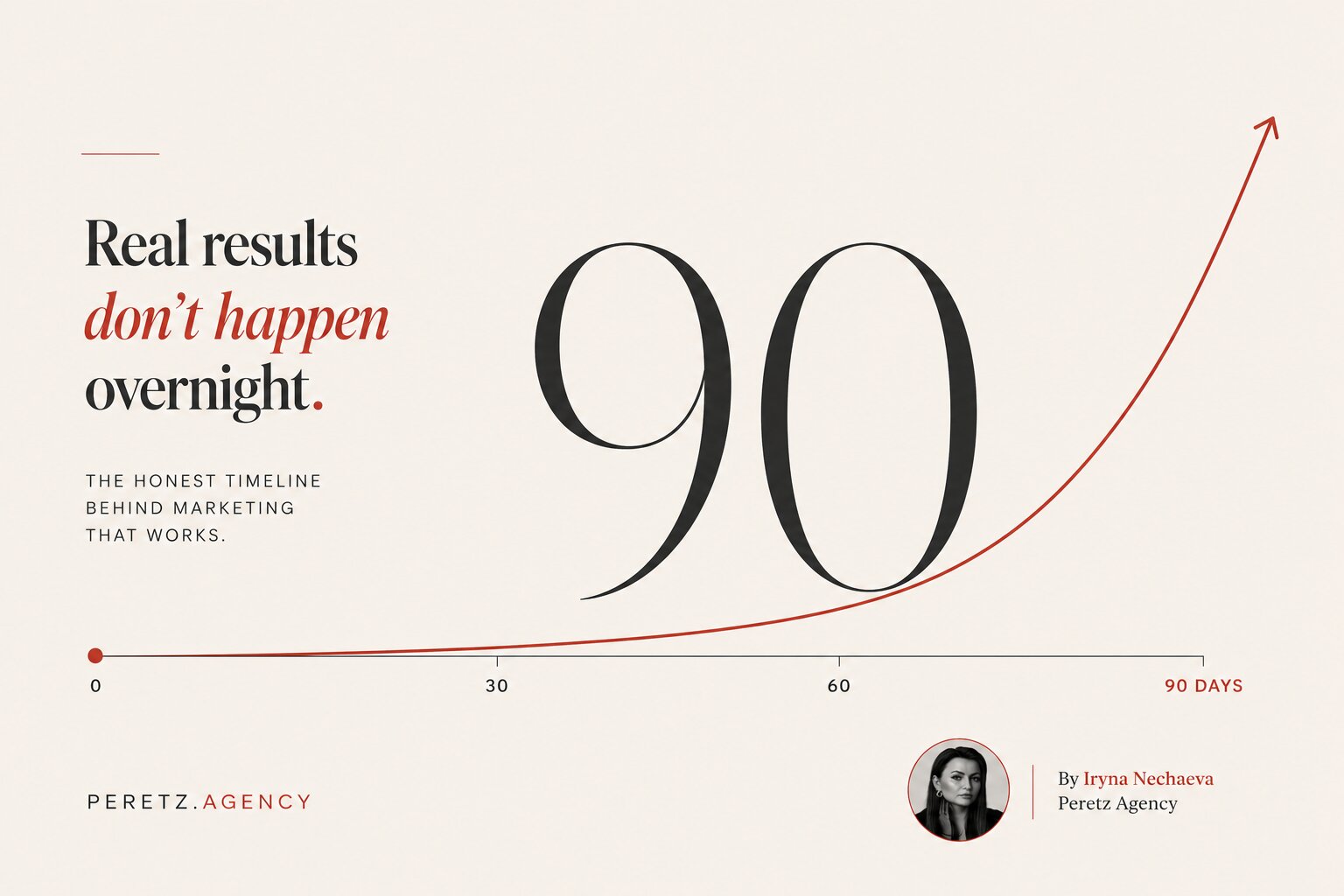
WHY AGENCIES PROMISING FAST RESULTS ARE LYING TO YOU
Google's own guidance says it plainly: no legitimate SEO provider can guarantee a number-one ranking. Not Google employees. Not the agency with the confident sales deck. Nobody. The algorithm runs on over 200 ranking factors that shift constantly, based on competition, user behavior, and updates no outside party controls.
So when an agency tells you they can double your traffic in a week, or guarantee page-one rankings within 30 days, they're not describing a faster version of the same process everyone else runs. They're describing a different thing entirely, usually one of two things: keywords with zero real search volume that are trivially easy to “rank” for because nobody's competing on them, or tactics aggressive enough to risk a penalty once Google notices.
This article is the honest version: what actually happens, channel by channel, in the real timeline, so you can tell a legitimate agency's patient plan from a sales pitch dressed up as one.
THE REAL TIMELINE, CHANNEL BY CHANNEL
| Channel | Realistic timeline |
|---|---|
| SEO, low-competition local keywords | 4–8 weeks to first movement |
| SEO, local, moderately competitive | 90–120 days for first-page results |
| SEO, competitive national keywords | 12–18 months |
| Email marketing (opted-in list) | 30–60 days for measurable improvement |
| Paid ads (Meta, Google), traffic flow | Days, but stable optimized performance needs 60–90 days |
| Organic social media, meaningful results from zero | Up to 9 months |
The number that should reframe every conversation about social media results: platforms show your content to only 2 to 10% of your followers due to algorithm restrictions. Ten thousand Instagram followers might mean 200 to 1,000 people actually seeing a given post. An agency claiming fast, dramatic organic social results from a standing start is either not accounting for this, or hoping you won't ask.
One technical detail almost no client is told: domains younger than about 18 months often experience what SEO professionals call the sandbox, an observed ranking delay regardless of content quality. If your site is new, build that into your expectations before judging any agency's first-quarter performance.
WHY THE 3-MONTH MARK IS THE HONEST THRESHOLD, NOT THE FINISH LINE
Across 2026 industry research, one number keeps appearing independently from source to source: meaningful movement, not final results, meaningful movement, typically becomes visible around the three-month mark, for both SEO and paid channels running at a normal pace. By month three, a competent agency should be able to point to specific, tracked improvements: crawlability fixed, technical debt cleared, initial content indexed, early ranking movement, a documented pattern of what's been tested and what's been learned from it.
That last part matters more than any single metric. If by month three an agency can't clearly articulate what they tested, what they learned, and what they're doing differently as a result, that's the actual red flag, more than any specific number being lower than hoped. A strategy that never changes based on data isn't a strategy. It's a subscription.
One honest caveat: three months means something different depending on the size of the project and the team behind it. For a small local business with one target keyword, three months is real time, and visible movement is a fair expectation. For a larger project, a multi-market launch, a competitive national campaign, a team still being assembled, three months can genuinely mean nothing has surfaced yet in rankings or traffic, while the foundation underneath is already solid. The question isn't whether you can see results at month three. It's whether the agency can show you exactly what's been built so far, and why it will hold up the results that come next.
THE MONTHS THE GRAPH LOOKED FLAT
One of Yevhen's longer engagements, years before I joined the team, makes this concrete. He's told me the story more than once. A large e-commerce client, an established bike retailer with already-solid SEO, wanted more: clean up dead, no-longer-relevant search queries, and build out categories for e-bikes and monowheels that were just starting to gain search volume at the time. The team built article clusters, strong photo content, video.
Nothing dramatic happened for four months.
By month five, results arrived, and once they started, they didn't stop, faster and larger than anyone had projected. But months two through four were quiet enough that the owner's confidence was visibly slipping. Not panic, just the specific kind of doubt that shows up when you've invested real money and the graph still looks flat.
The team didn't change the strategy. The foundation work in months one through four was exactly what made month five possible, not a delay before the real work started, but the real work itself, running quietly until the compounding caught up to it.
There's a version of this idea in investing: a position can be right and still get abandoned before it pays off, simply because the person holding it runs out of patience before the market catches up to the analysis. Marketing timelines have the same trap. The strategy isn't usually wrong. The nerve to hold it for five months while the graph looks flat is the harder part.
SIX MONTHS: WHERE SEO STARTS TO COMPOUND
Six months is generally where SEO specifically starts to compound: content published early gains traction, backlinks start mattering more, and the deliberately slow first quarter starts paying for itself. An agency that front-loaded technical fixes and content foundations in month one is the one whose month six looks good. An agency that promised rankings in month one usually has nothing left to show by month six, because there was no foundation under the promise.
THE REAL RED FLAGS, NOT JUST “PROMISES FAST RESULTS”
Skips the audit and goes straight to a package and price. A legitimate agency looks at your current rankings, technical SEO, backlink profile, Google Business Profile health, and competitors before proposing anything specific.
Won't name the actual keywords or their search volume. Some agencies deliver technically true “#1 rankings” for phrases nobody searches for. Ask directly: what's the monthly search volume for each term you're targeting? Hesitation is the answer.
Reports on activity, not outcomes. Posts published, impressions delivered, without connecting any of it to leads, conversions, or revenue. Rankings and traffic are signals. Business results are the point.
Refuses to share tool access or raw data. A legitimate partner gives you visibility into Search Console, Analytics, and ad platforms directly. “We have proprietary methods” is usually cover for “we'd rather you not check.”
Suspiciously low pricing for the promised scope. If the math doesn't add up on price versus deliverables, the actual work usually doesn't add up either.
Long-term contract with no performance visibility. Locking in 12 months before showing any interim proof of process shifts all the risk onto you.
The single best question to ask any agency in the first conversation: “What's your honest timeline, and what will you show me at each checkpoint along the way?” A confident, specific answer with checkpoints is a green flag. A vague answer, or an answer that skips straight to a guaranteed outcome, is the whole red flag in one sentence.
There's another reason worth naming plainly, one that rarely makes it into a sales conversation: overpromising is often what an already-overloaded team does instead of saying no. We unpacked that pattern in Marketing Agency Burnout Is a Business Risk.
WHY AGENCIES OVERPROMISE IN THE FIRST PLACE
This isn't really a mystery, and it's worth naming plainly: overpromising wins pitches. A vague promise about “comprehensive SEO” and “proven techniques” is easier to sell than an honest three-month runway with no guaranteed outcome. The agencies willing to say “this will take six months and I can't guarantee a specific ranking” are competing against agencies willing to say whatever gets the contract signed, and the second group wins more pitches in the short term, which is exactly why the pattern persists.
I'd rather lose a pitch to an agency promising something I know isn't true than win one by promising it myself. When a client asks me how fast this will work, I tell them the real number, even when it's not the number they were hoping for, because the alternative is a relationship that starts with a lie I'll have to explain away in month four.
A client who hears the honest timeline upfront and still says yes is a client who'll still be here in month six. A client who was sold a fake timeline is a client I'll lose the moment reality catches up to the promise.
WHAT A LEGITIMATE 90-DAY PLAN ACTUALLY LOOKS LIKE
Month one:
full audit, current rankings, technical health, competitor gaps, tracking infrastructure verified before a single campaign setting is touched. No visible ranking movement expected yet, and an agency claiming otherwise for a competitive term should be questioned directly.
Month two:
initial content and technical fixes live, early paid campaigns exiting their learning phase, first tracked signals, impressions increasing, early keyword movement, initial engagement data, even if none of it is headline-worthy yet.
Month three:
the honest checkpoint. Documented pattern of what worked, what didn't, and what's changing as a result. For paid channels, stable optimized performance should be visible by now. For SEO on lower-competition local terms, first-page results are a realistic expectation. For competitive national SEO, this is still early, and a good agency will say so plainly rather than manufacture a metric to look busy.
Month six and beyond:
compounding. Earlier content and technical work starts paying for itself, rather than each month being its own isolated sprint.
An honest exception worth naming: sometimes movement happens faster than the median timeline, and that's real too, it doesn't have to mean someone lied. A new domain with a genuinely tight content structure and consistent publishing can see meaningful position movement within a month. That's not the same as a guarantee. It's what happens when the fundamentals are unusually clean from day one, worth celebrating when it happens, never worth promising in advance.
HOW PERETZ AGENCY HANDLES THIS CONVERSATION
Every client conversation starts with the same honest sentence: here's what will be visible in 30 days, here's what will be visible in 90, and here's what we genuinely cannot promise no matter how the pitch would sound better with a number attached to it. We'd rather a client choose us after hearing the real timeline than sign based on one we can't deliver.
The audit comes before the proposal. The tracking gets set up before the first campaign launches. And if a client's expectations don't match what a channel can realistically deliver in the timeframe they're imagining, we say that in the first conversation, not in month four, when it's a much more expensive thing to explain.
We looked at what marketing owes a product before it ships in Architecting the MVP: What Marketing Owes a Product Before Launch.
Considering an agency and want a second, honest opinion on their timeline before you sign anything? Contact us, we'll tell you what's realistic, even if it's not us you end up hiring.
Explore SEO & Website Promotion
Not sure yet which channel actually fits your business? A Strategic Session gets you a real answer before you commit a budget anywhere.
- Share
-

-

-

-

One notification a week with the new PERETZ articles. Nothing else.
Related Reading
-
19. 07. 2026

High CTR But Low Conversion Rate? Here's Why Your Ad Copy Is the Problem

-
23. 06. 2026
Why Most Businesses Are Using AI Wrong in Marketing — And It's Killing Their Conversions
-
17. 06. 2026
Why Your Business Isn't Getting Leads From Its Website (And How to Fix It in 2026)
-
09. 07. 2026

Traffic But No Leads? Your Customer Is Doing Math You Never See
-
21. 07. 2026

Why Growing Bellevue Businesses Eventually Outgrow Their Websites
-
19. 08. 2026

Architecting the MVP: What Marketing Owes a Product Before Launch
-
20. 07. 2026

Most Companies Don't Need a New Website. They Need a New Structure.
-
24. 07. 2026
Marketing Agency Burnout Is a Business Risk, Not Just a Personal One