Why Growing Bellevue Businesses Eventually Outgrow Their Websites
Most Bellevue businesses don't outgrow their design. They outgrow the structure behind it. Here's how to tell the difference before your next redesign.

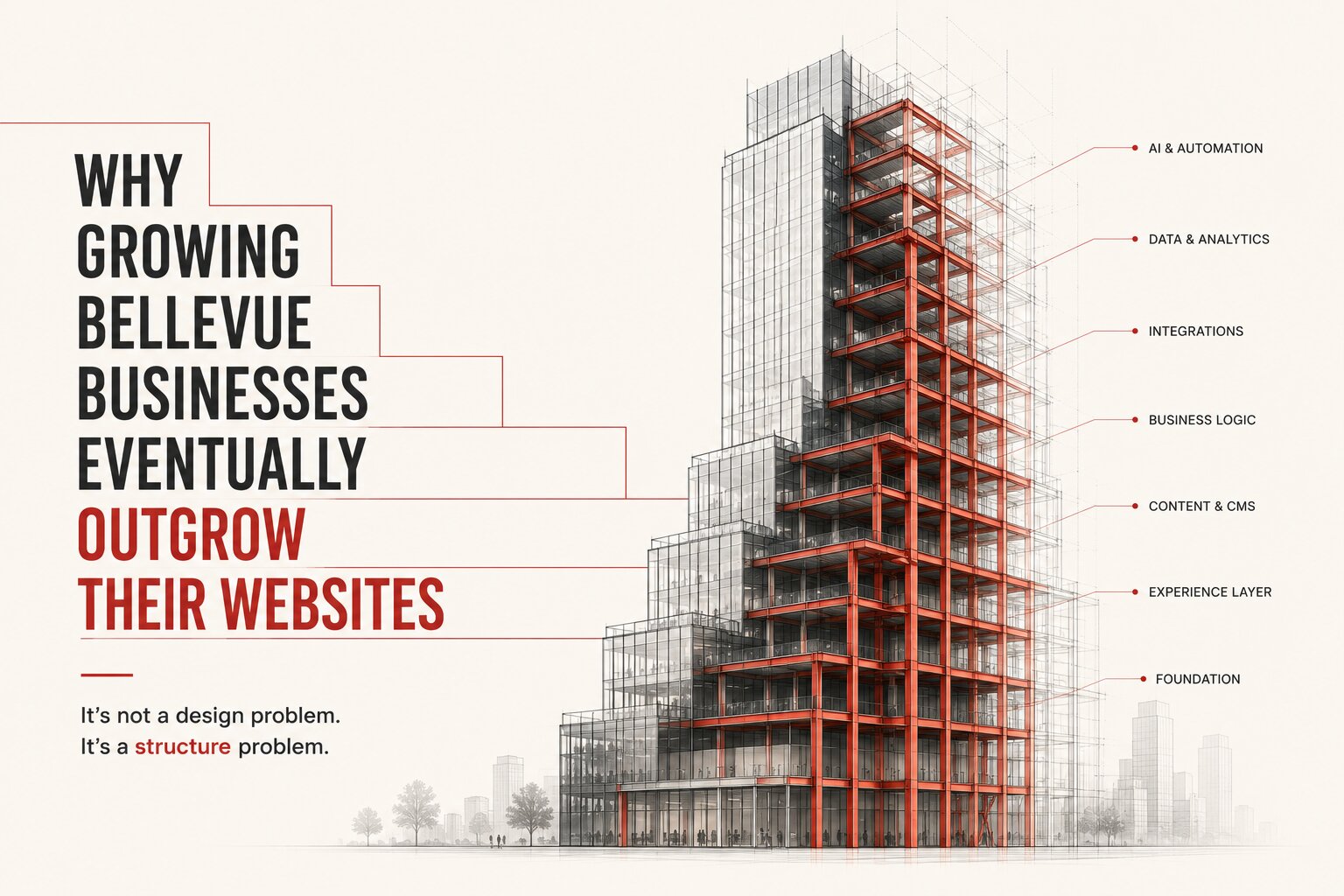
A website rarely announces that it's become the wrong size for the business running it.
There's no error message.
No warning.
The site keeps loading, keeps taking orders, keeps showing up in search.
Everything technically works.
Most websites don't break.
They simply become too small.
Like an office that was perfect for twelve people and somehow now holds forty.
And yet, somewhere along the way, for many growing companies in Bellevue and across the Eastside, the website quietly stops fitting.
This isn't unique to websites.
Almost every successful system eventually reaches a point where the structure that once enabled growth begins to limit it. Businesses reorganize departments. Cities expand beyond their original road networks. Software evolves into new architectures. Even living organisms constantly replace and reorganize cells as they grow.
Growth doesn't simply add more.
Growth changes what the structure itself needs to become.
THE REAL SIGNS, NOT THE OBVIOUS ONES
The obvious sign is visual.
The website looks older than the competition.
That's real.
But it's rarely the first sign that matters.
The structural signs appear much earlier.
New services no longer fit naturally into the navigation.
Marketing campaigns are designed around CMS limitations instead of customer needs.
Sales teams start sending documents manually because the website can't generate them.
Inventory lives in spreadsheets because the catalog no longer reflects how the business actually operates.
The CRM technically integrates with the website—but nobody completely trusts the integration.
Content keeps growing.
SEO slows down.
Not because the content became worse.
Because the structure beneath it stopped supporting growth.
Individually, each of these feels like a minor inconvenience.
Together, they're describing the same problem.
The business has quietly outgrown the website built for an earlier version of itself.
NOBODY WAKES UP BECAUSE THE WEBSITE HAS BECOME TOO SMALL
Nobody wakes up thinking,
"Our website no longer fits our business."
Instead, they wake up because marketing needs another landing page.
Sales needs another spreadsheet.
Operations invent another workaround.
Customer support asks for another manual process.
Someone eventually says,
"The website can't really do that."
By themselves, these are ordinary business problems.
Together, they usually point to something much larger.
The business has outgrown the structure beneath it.
GROWTH IS USUALLY THE CAUSE, NOT NEGLECT
This isn't a story about neglected websites.
It's usually the opposite.
The businesses that reach this point are often the ones doing everything right.
They hire.
They expand.
They launch new services.
They win larger clients.
They enter new markets.
The website wasn't built badly.
It was built for a different stage of the company.
Researchers in organizational design have observed for decades that as organizations grow, they naturally become more complex. More people create more communication paths. More services create more dependencies. More customers create more exceptions. Digital systems evolve in exactly the same way.
Growth doesn't eliminate complexity.
It exposes the limitations of structures designed for yesterday's business.
Ironically, that's often good news.
Companies rarely outgrow their websites because they're failing.
They outgrow them because they're succeeding.
WHAT SEVEN YEARS BUILDING AN AI PLATFORM TAUGHT US ABOUT GROWTH
Our perspective doesn't come only from building websites.
For nearly seven years, we've worked alongside the Bellevue-based team at Neon.ai, contributing to the evolution of one of the region's most ambitious enterprise AI platforms.
Neon.ai builds patented Collaborative Conversational AI (CCAI) systems—enterprise panels where multiple AI specialists and human experts work through a problem together, with every step auditable rather than hidden inside a black box. Their BrainForge platform turns an organization's internal documents and knowledge into a private, fine-tuned model the organization owns outright, deployed on its own infrastructure rather than rented by the token.
Their positioning captures something we recognize immediately: own your AI, don't rent it. It's the same instinct behind every structural fix we make to a website. Renting a workaround is always faster than owning the architecture. It's also why the workaround is still there two years later.
Unlike consumer AI platforms, enterprise AI products continue evolving for years. Every new customer introduces different workflows. Every integration creates new dependencies. Every feature affects dozens of other parts of the system.
Much of our work has involved Python development and the continuous engineering required to help an enterprise software platform evolve without losing its flexibility.
Working on a product like this teaches an important lesson.
Complex systems almost never become difficult because of one catastrophic decision.
They become difficult because of hundreds of perfectly reasonable decisions made over many years.
One integration.
One API.
One new feature.
One customer request.
One workaround.
Each decision solves today's problem.
Together, they determine whether tomorrow's growth becomes easier—or significantly harder.
That's exactly what we see when we work with growing businesses.
The technology is different.
The principle is the same.
Whether we're helping evolve an enterprise AI platform or redesigning a business website, success depends on the same question:
Can the underlying structure still support where the business is going next?
WHAT TO CHECK BEFORE ASSUMING IT'S A DESIGN PROBLEM
Before assuming the answer is a new design, ask a few honest questions.
Can new services be added naturally?
Are employees creating manual workarounds that nobody officially owns?
Does the website reflect the business as it operates today—or as it operated when the site launched?
Has SEO growth plateaued despite continued investment in content?
Has marketing started simplifying campaigns because the CMS can't support better ideas?
If several of these questions sound familiar, the issue may not be visual.
Companies often assume they've outgrown the design.
More often, they've outgrown the architecture.
Those are very different problems.
EVERY STRUCTURE HAS A DESIGN HORIZON
Every structure is built for a particular stage of growth.
An office.
A warehouse.
An organizational chart.
An AI platform.
A website.
If the business succeeds, each of these eventually reaches a point where the structure itself becomes the next project.
That's not failure.
That's what healthy growth looks like.
If this article feels familiar, don't start by asking whether you need a new website.
Start by understanding why the current one no longer fits.
Our Strategic Session helps business owners determine whether the next step is a website redesign, custom software, AI integration, automation, or something else entirely. Before recommending any solution, we take the time to understand how your business has evolved and where its current structure is beginning to create friction.
When a website redesign is the right next step, our Website Design process focuses on rebuilding the underlying architecture, not simply creating a more modern-looking interface.
- Share
-

-

-

-

One notification a week with the new PERETZ articles. Nothing else.
Related Reading
-
15. 07. 2026
Everything You Build Starts Aging the Day You Finish It

-
17. 07. 2026
The Code Remembers Every Version of the Business
-
20. 07. 2026

Most Companies Don't Need a New Website. They Need a New Structure.
-
20. 07. 2026
How Long Does It Take to See Marketing Results? Why Agencies Promising Faster Are Lying to You