


I HAVE A PROBLEM WITH FINISHED PROJECTS
Not with finishing the work. Eventually, you have to launch the website, open the building, deploy the software, approve the strategy, send the invoice.
I mean the word itself.
Finished.
It creates a strange sense that something has reached a state in which it can now remain.
We do not really think this way about most things around us.
You build a house and immediately begin maintaining it.
You buy a car and change the oil. Then the brakes. Then the tires. Something starts making a noise. Something leaks. Something simply looks tired.
Museums spend enormous amounts of time and money preserving objects that were “finished” hundreds of years ago.
We understand this perfectly.
Things age.
And yet, in business and technology, I still hear versions of the same sentence:
We finished the website. Or: We completed our digital transformation in 2021.
Okay. And then what?
THE STRANGE THING ABOUT OUR OLDER PROJECTS
When we started discussing this idea, I tried to remember a strong product we had built five years ago that now looked completely obsolete.
And I couldn’t.
There are designs I would change today. Animations I would make faster. Interfaces I would simplify. Of course.
But I couldn’t think of one of our serious long-term projects and say: this is old. Throw it away.
For a moment, this was a problem. I was trying to write an article about how everything ages and could not find enough aging products in my own work.
Then the reason became obvious.
We never left them alone.
One project started as a catalog. Then the company needed to sell online. The catalog became an e-commerce platform. Online sales created new operational problems. ERP appeared. Then CRM. Marketing brought traffic. Traffic brought data.
The data told us that some pages worked and others did not. A button was in the wrong place. A message was unclear. Customers behaved differently from what we expected.
So we changed something. Then something else.
Several years later, technically, it is still the same project.
But it is not the same product.
I think this is where we often confuse a project with the thing we actually built.
The project can end. The product continues living. At least, it should. Why launch day is a milestone rather than a finish line is the subject of Your Business Doesn't Go Live. It Comes Alive.
I GREW UP WITH COMPUTER PRICE LISTS
There was a period in Kharkiv when computer stores printed enormous price lists. Pages of processors, motherboards, graphics cards, memory, hard drives.
I was probably twelve or fourteen. Boys my age would take those lists and study them almost professionally.
We knew the hardware. We knew what we wanted. More importantly, we knew what we could not afford.
So we assembled computers on paper. This processor. That motherboard. A cheaper graphics card for now. More memory later.
Then you calculate the total, realize you have built something completely unrealistic, and start again.
I loved it. Looking back, it was probably our very small version of Silicon Valley.
Years later, I worked with one of the early computer retailers in Kharkiv. We built an online store for them. It was early enough that simply doing e-commerce well already created a serious advantage.
And the website worked. It sold. The company was known. They were among the first.
Competitors started appearing later. Their websites were different. Cleaner. More convenient. The way people bought online was changing. Checkout became faster. Product pages improved.
But our client’s website still worked.
And this is where the story becomes uncomfortable.
Because the company was not doing nothing. They were growing. They opened physical locations. Then more locations. Several in Kharkiv. Locations in other cities. They invested real money into expansion.
I had not thought about one particular conversation for years. Only while discussing this article did I remember it properly.
We had actually told them where we thought the business should go next. Not a new color for the website. Not a redesign because designers always want to redesign something.
We believed they should invest deeper into online sales, warehouses, logistics, and the infrastructure behind the e-commerce business.
They chose physical locations.
I cannot tell you that our strategy would definitely have saved the company. Twenty years later, everyone is a brilliant consultant. You already know what happened to retail. You already know what happened to e-commerce. It is very easy to look backward and explain the future after it happened.
So no, I cannot prove that we were right. But I remember the fork. And I know which direction we recommended.
By 2021, the company no longer existed.
What strikes me now is that they did not stop growing. They kept building the version of the company that had already won.
That is different. And much more dangerous.
“IT STILL WORKS” IS OFTEN TRUE
This is probably the hardest part.
When a client says: it still works. Very often, he is right.
The website opens. The catalog works. Orders arrive. Customers call. There is no dramatic failure.
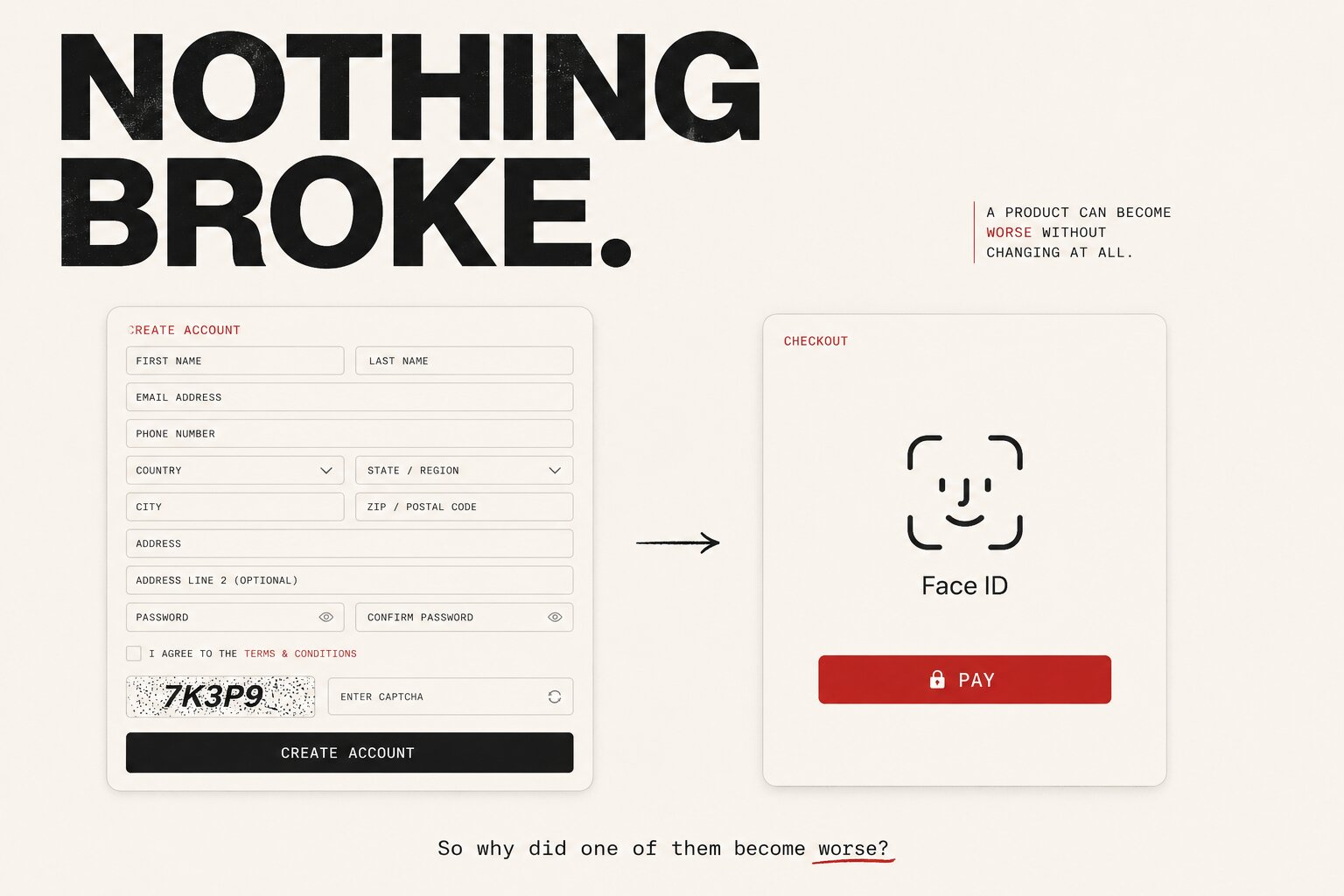
Imagine an old checkout. Name. Last name. Email. Phone. Address. Password. Confirm password.
Somewhere along the way, a competitor asks for a phone number and lets the customer buy.
Nothing happened to your website. Yesterday it worked. Today it works. No code changed overnight. No server failed. No database disappeared.
But the product became worse. Not compared with itself. Compared with what the customer now knows is possible.
A product can become worse without changing at all.
This is why I separate aging from failure.
If we built something and it does not perform the function it was supposed to perform, we failed somewhere. Maybe the strategy was wrong. Maybe the architecture was bad. Maybe the implementation was poor. That is a different problem.
Aging is more deceptive. The system can continue doing exactly what it was designed to do.
The problem is that doing exactly that may no longer be enough.
SOME THINGS REALLY DO AGE BETTER
I also do not believe that everything becomes ugly after five years. That is nonsense.
We built a website for a company producing exclusive furniture approximately seven years ago. They barely touched it. And the site still looks good.
The design is minimal. The content is beautiful because the product itself is beautiful.
There are details I would change today, but I would not call the website visually obsolete.
There are old Mercedes that still look better than half the cars on the road. There is architecture that survives generations. There are interiors and objects you can put into a design textbook decades later.
Some things age beautifully. Some things may even become timeless.
But there is a difference between an object and a living business system.
A beautiful chair does not care that your competitor changed checkout. A pyramid does not need a CRM.
A website, an e-commerce platform, a strategy, a company — these things exist in relationships with people, technology, behavior, and competition. And those relationships move.
The furniture website still looks beautiful. But when I look at it now, I see something else.
I don’t feel that the company is moving.
The website does not look bad. It looks static. There is a difference.
THE WORK NOBODY SEES
Maybe this is one reason companies keep investing in the wrong things.
Visible work is easier to understand. You open a new store. There is a sign. A door. Inventory. Employees. You can take a photo. You can stand in front of it and say: we opened another location.
You launch a new CRM. Everyone gets a new interface. Something visibly changed.
Now spend two weeks studying analytics. Looking at pages. Traffic. Customer behavior. Where people leave. What they do not click. What they no longer search for.
And after two weeks, your conclusion may be: do not invest here.
That’s it. No new building. No beautiful interface. Nothing to photograph.
But that one conclusion may save more money than the visible project created.
I have seen this problem for years. People often struggle to value work they cannot see. Research. Analytics. Maintenance. Thinking.
The strange part is that this invisible work is often the only thing telling you whether the visible work should happen at all.
Maintenance has the same problem. People hear the word and imagine someone keeping the server alive. Updating software. Fixing bugs.
Yes. That is part of it. But I think maintenance is much bigger.
Sometimes maintenance means looking at a product that works perfectly and asking: does the world still need it to work this way?
MAYBE THE TITLE IS WRONG
The title of this article says that everything you build starts aging the day you finish it.
Maybe that is not completely accurate.
Time itself is not the problem.
If a company tells me: we completed a digital transformation in 2021. I cannot seriously answer: it’s 2026. Everything is obsolete.
I would need to look. What did you build? What happened after 2021? How did customers change? What did competitors do? What does the data show? Did the system expand? Did anyone maintain it? Did anyone question it?
Maybe it works extremely well. Maybe the architecture was strong and the company kept adapting it.
Or maybe the company completed a digital transformation in 2021 and then made the worst possible mistake.
It treated transformation as something that had been completed.
So perhaps things do not age simply because time passes.
They age because the world continues moving after we decide the work is done.
FINISHED
I still like finished projects.
There is a moment when the website goes live. When the software is deployed. When the interior is photographed. When everyone has spent enough nights discussing one button and finally agrees to stop.
You need that moment.
But I no longer think it means what many people think it means.
Before launch, we have assumptions. We may have experience. Research. Data from previous projects. We may be very confident.
Then we launch.
And people who were never in our meetings start using what we built. They click the wrong thing. Ignore the message we spent three days writing. Love a page we almost removed. Ask for something we did not build.
Competitors respond. Technology changes. The business grows.
Reality enters the project.
Maybe completion is simply the first moment when reality can finally participate.
And from that moment, you have a choice. You can listen. You can change the product. You can add to it. Remove from it. Sometimes rebuild it.
Or you can point at the system and say: it still works.
The computer store from my childhood had a website that worked. It had stores. Customers. A name people knew. For years, it had every reason to believe in the system it had built.
The system kept working.
The world kept moving. Until working was no longer enough.
That aging becomes especially visible during a migration, we mapped out what most teams miss in The Website Migration Checklist Most Agencies Skip.
When that aging reaches the framework itself, upgrading becomes its own decision with its own costs. We broke it down in Upgrading an Old Laravel or PHP Site in 2026.
I don’t know if your product has aged or simply stopped being maintained.
From outside, they often look identical. The website still opens. Nothing broke.
We can look at something you built years ago and tell you honestly which one it is.
Sometimes the answer is: leave it alone, it’s still working.
Sometimes it’s: the invisible work you’ve been skipping — the analytics nobody read, the question nobody asked — is the actual project.
If the thing quietly aging is a WordPress site specifically, When Does a Business Outgrow WordPress? covers what that aging usually looks like in practice.
- Share
-

-

-

-

Related Reading
-
08. 07. 2026

Everyone Wants the Prestige. We Study the Turn.

-
07. 07. 2026
I Didn’t Dream of Having a Job. I Dreamed of Building Something.
-
01. 07. 2026
THE STORY BEHIND SV GROUP
-
26. 06. 2026

The Story We Never Planned to Tell - Case MEDPRESSO
-
06. 07. 2026

Some Clients Change Your Business. MDC LUX Changed Ours.
-
14. 07. 2026
Wrong Move. Right Move. Too Late.
-
21. 07. 2026
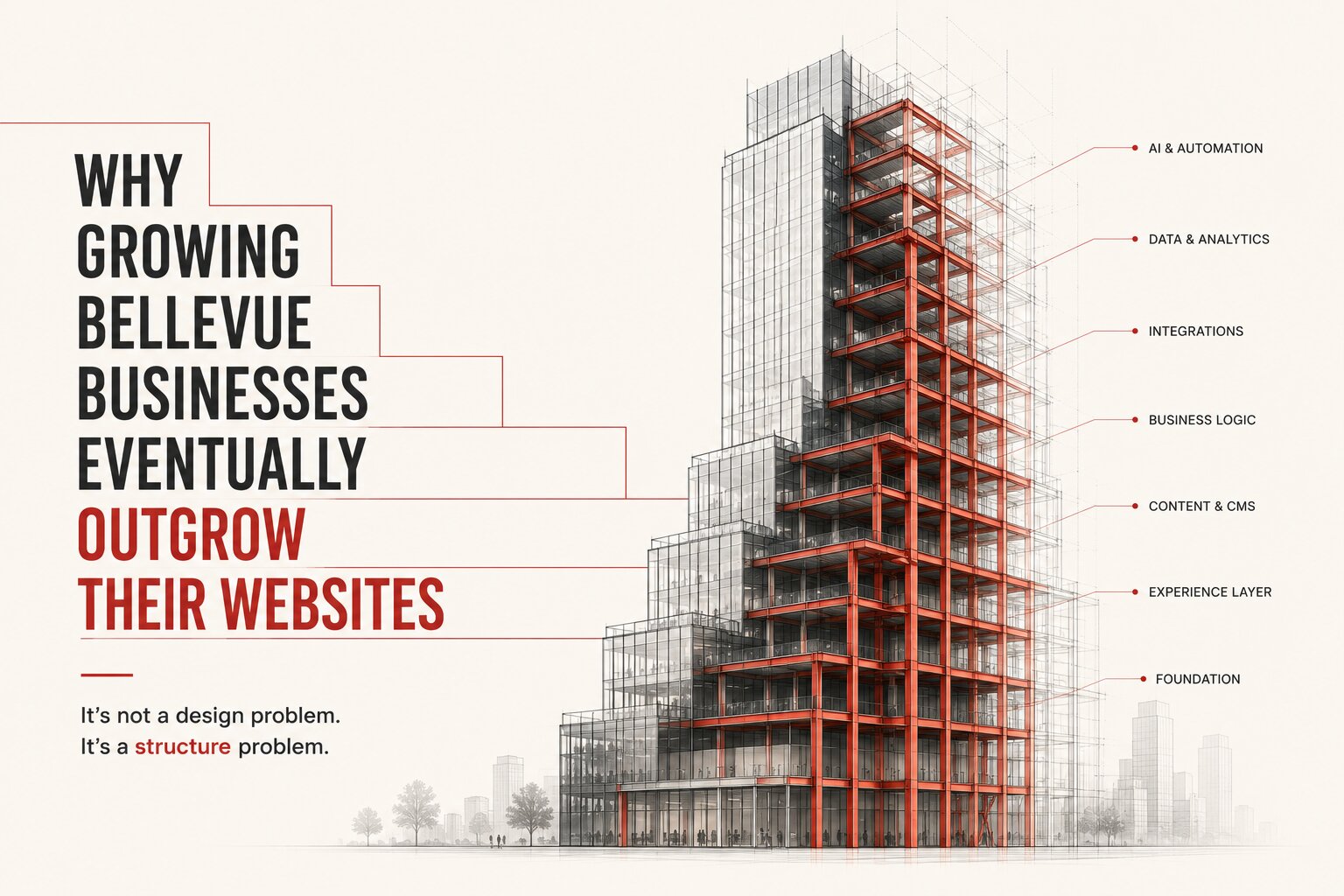
Why Growing Bellevue Businesses Eventually Outgrow Their Websites
-
22. 07. 2026

A Place to Build
-
29. 07. 2026

The Hidden Cost of Standing Still: Why Modern Businesses Lose Competitive Advantage Long Before They Notice
-
23. 08. 2026
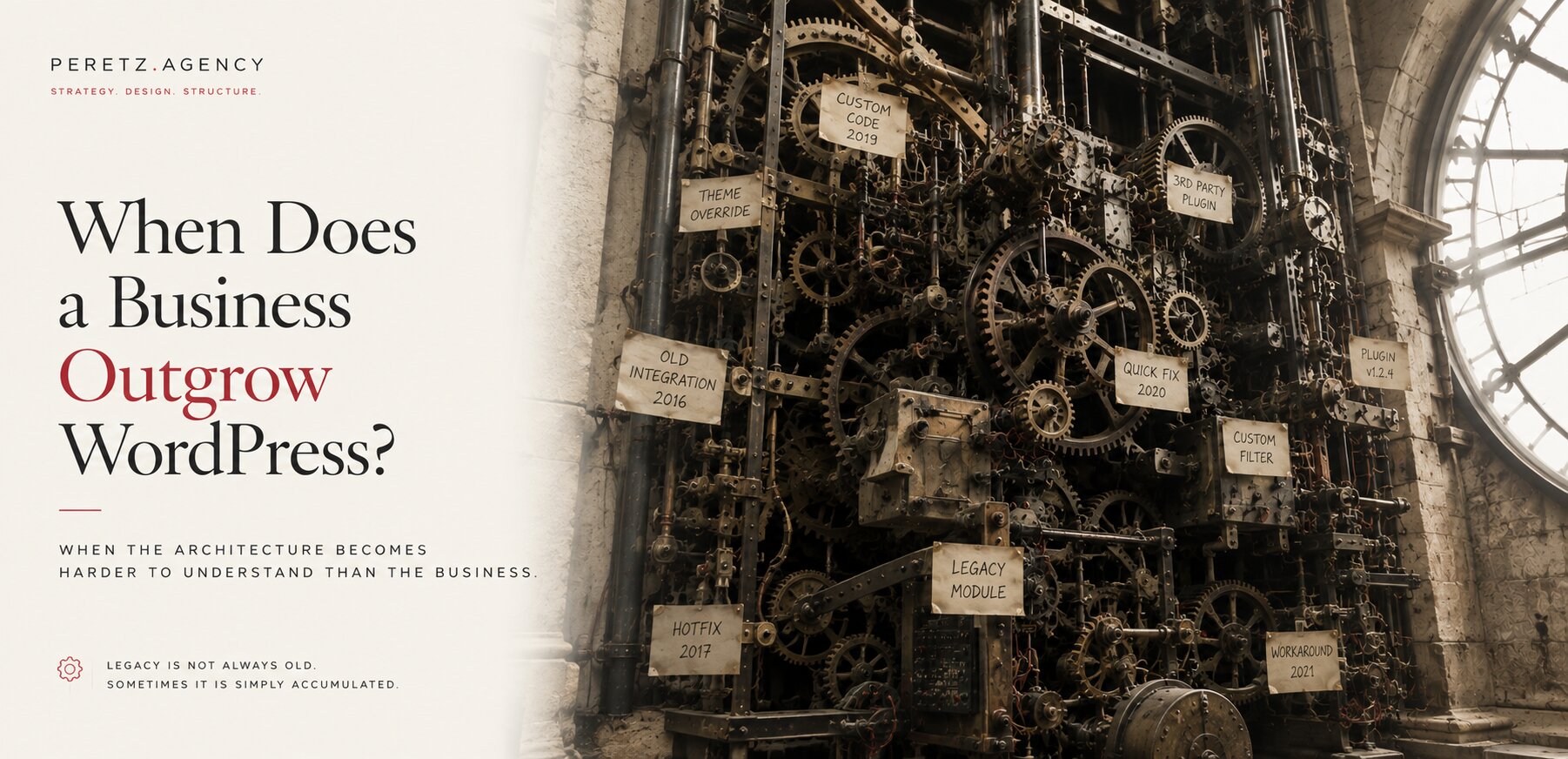
When Does a Business Outgrow WordPress?
-
27. 08. 2026
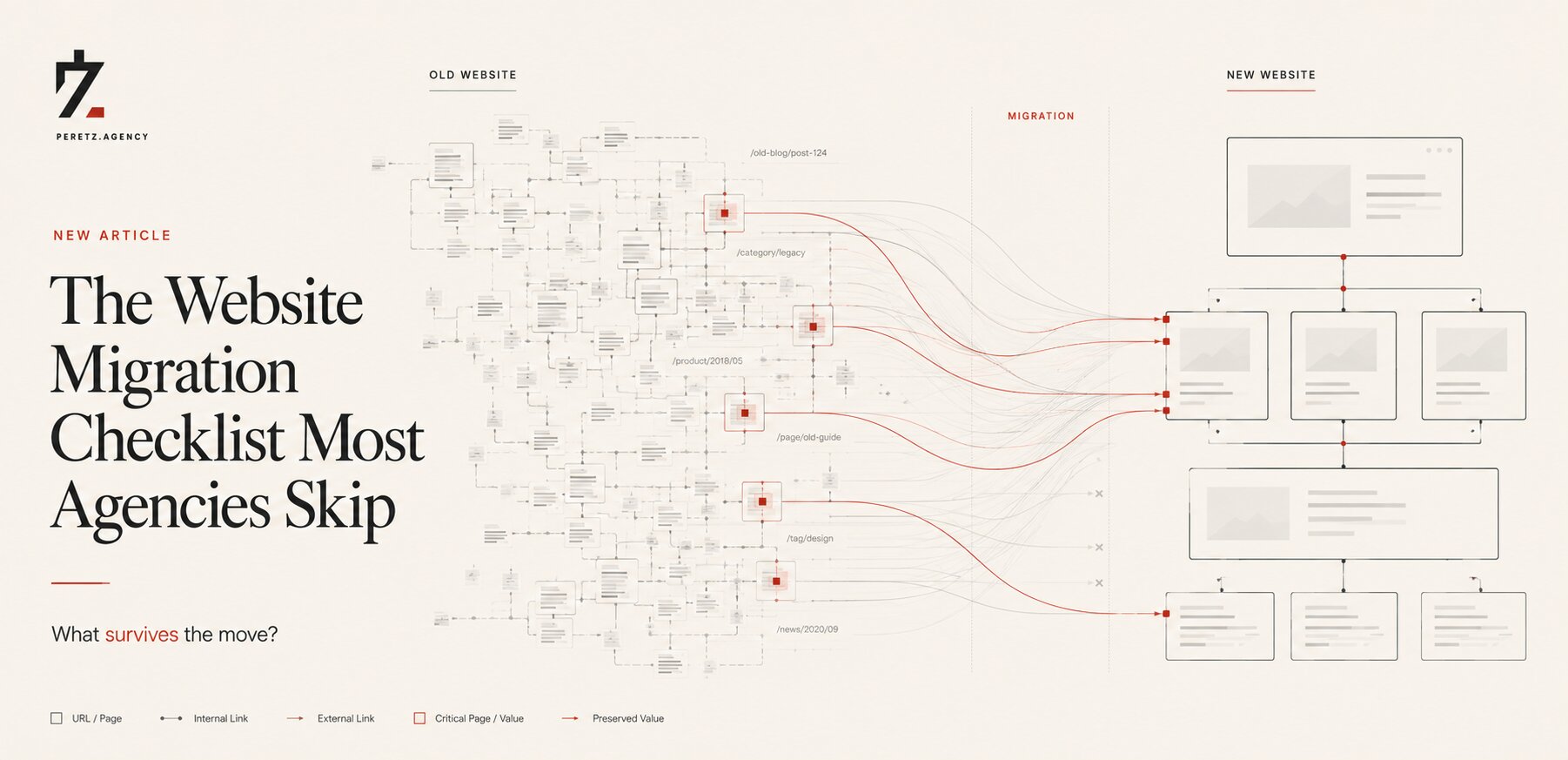
The Website Migration Checklist Most Agencies Skip
-
17. 07. 2026
The Code Remembers Every Version of the Business
-
20. 07. 2026

Most Companies Don't Need a New Website. They Need a New Structure.
-
29. 09. 2026
Upgrading an Old Laravel or PHP Site in 2026
-
01. 10. 2026
Six Laravel Versions in Three Days