


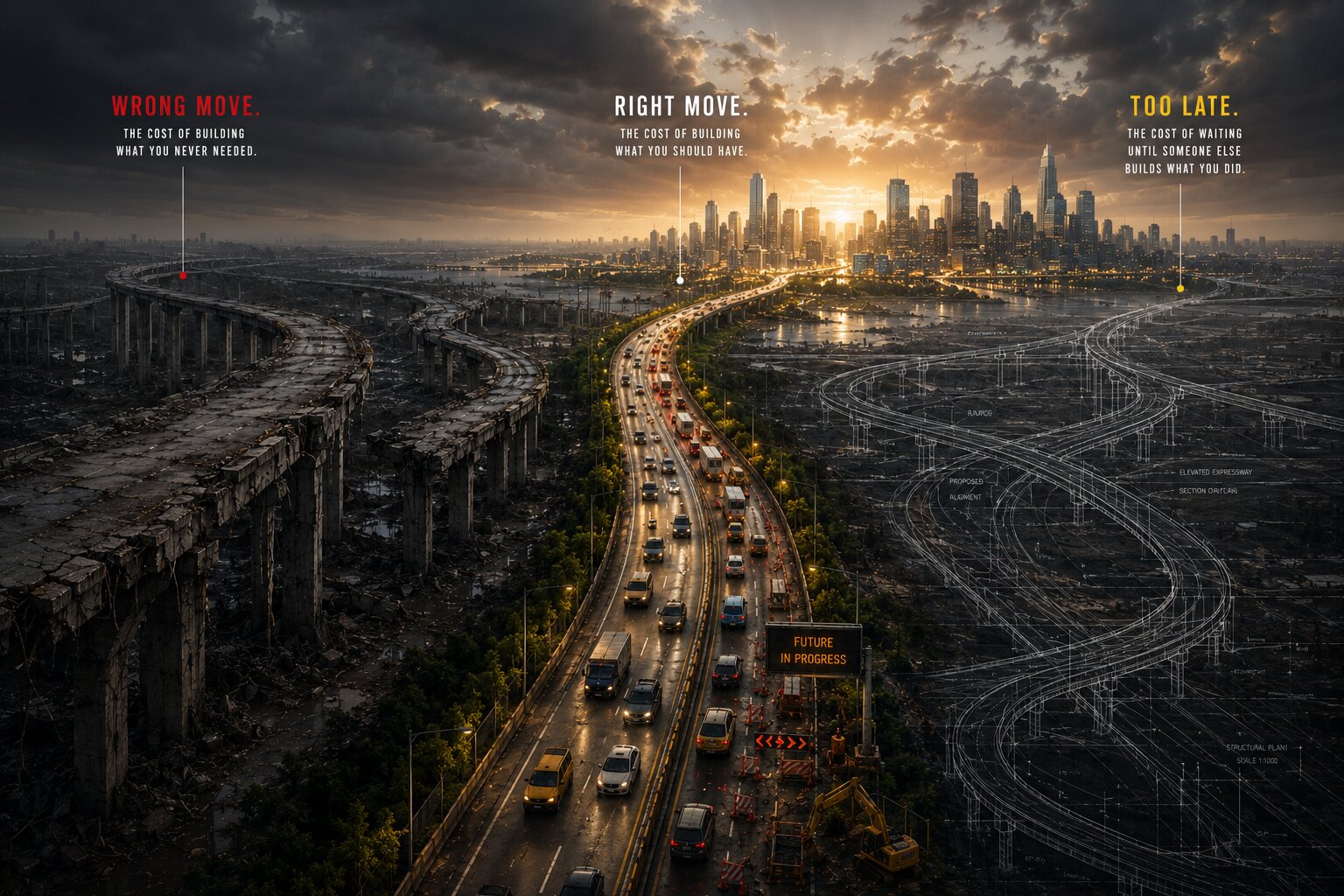
TWO WAYS TO BE WRONG
There are two expensive ways to make a bad business decision.
The first is to build something you never needed. The second is to correctly identify what you need — and wait until the opportunity belongs to someone else.
One wastes money. The other can cost you time, market position, years of learning, and sometimes the opportunity itself.
I have seen both.
Companies spend months building websites that were never going to solve their actual problem. They launch e-commerce platforms without understanding how customers will find them. They implement software before defining the process the software is supposed to improve.
And I have seen the opposite. The demand was there. The audience was there. The competition was weak. The timing was right. Everyone agreed.
And then nothing happened. A few months became a year. A year became four. Someone else launched. Then someone else. The opportunity that once existed was no longer the same.
The wrong decision can waste years of investment. The right decision made too late can cost you the opportunity itself.
The difficult part of strategy is not simply deciding whether to act. It is understanding what deserves action — and when.
THE SOLUTION BEFORE THE QUESTION
Most projects begin with a noun. A website. An app. An e-commerce platform. A CRM. A rebrand. An AI system. A new department. A fundraising round.
By the time an agency, consultant, developer, banker, or another specialist enters the conversation, the solution has often already been selected. The conversation becomes how should we build it — not should we build it at all. That distinction changes everything.
A company says it needs a new website because sales are falling. Perhaps it does. Or perhaps the company cannot clearly explain what it does. Perhaps its offer is indistinguishable from ten competitors. Perhaps the website already receives enough traffic, but the wrong audience is arriving. Perhaps leads are being generated and then lost inside a broken sales process. Perhaps the market has changed while the company has not.
A better website may improve the presentation of the problem without solving the problem itself. And because the new website looks better, everyone may believe progress has been made.
That is what makes the wrong solution dangerous. Failure is visible. Misdiagnosis can look like success.
PAY TO BUILD, NOT TO KNOW
A company may be prepared to spend tens or hundreds of thousands of dollars building something, but resist spending a fraction of that amount understanding whether it should be built at all.
Research feels like a delay. Development feels like progress. Research produces questions. Development produces screens. A strategy session may conclude that the original idea is wrong. A development sprint gives everyone something to look at.
But movement and progress are not the same thing. You can move very quickly in the wrong direction, and for a while, it will still feel like you are moving forward.
Before a serious investment, we want to understand the market. Is there demand? Are people actively looking for this? Who is the audience, and can they afford the product? How large is the addressable opportunity, who already serves it, and how strong are they? How expensive will it be to reach the customer, and what happens after the product launches?
These questions are not a ceremonial phase before the real work begins. They are part of the real work. Sometimes research tells you not to build. Sometimes it tells you to build something smaller first. And sometimes its most important conclusion is the opposite: you need to move now.
PROJECTS WE COULD HAVE SOLD
This has happened many times, particularly with websites and e-commerce. For years, one of the most common assumptions was remarkably simple: we will build an online store, upload the products, and it will somehow start selling.
It will not. An e-commerce platform is not demand. It is infrastructure for capturing demand. The website still needs traffic. Search visibility may require years of content, technical SEO, and link building. Paid acquisition requires budget. Customers need a reason to trust a store they have never heard of. Then there are operations, fulfillment, support, returns, photography, and constant optimization. The cost of building the store may be only the beginning.
For some businesses, the right answer was not a better e-commerce platform. It was not to build one yet. At different points in the market, a company could start with an Instagram account, work directly with influencers, test products, learn what people actually bought, generate revenue, build an audience — and only then invest in its own e-commerce infrastructure.
That was not doing nothing. It was sequencing the investment differently.
Not building is sometimes a strategy. Doing nothing rarely is.
There is an enormous difference between deciding not to build something because another path makes more sense, and endlessly postponing something the business has already established it needs. One is a decision. The other is avoidance.
EVERY SPECIALIST'S OWN SOLUTION
If the only tool you have is a hammer, every problem begins to look like a nail. Business works the same way.
Ask a web agency why your digital performance is weak, and the answer often involves a website. Ask an advertising agency, and it may involve more campaigns. Ask a software company, an AI consultancy, a recruiter, or an investment banker, and the problem tends to require exactly what they sell.
This does not necessarily mean anyone is acting dishonestly. Specialists are hired because they know how to solve particular types of problems, and naturally see the world through the expertise they've spent years developing. The problem begins when diagnosis becomes inseparable from the solution someone is paid to sell.
A company says, “We need an app.” A development company can estimate how much it will cost and how long it will take. But there is a question that should come first: what is supposed to change in the business after this app exists? If nobody can answer that clearly, estimating the project may be premature.
The same pattern shows up when a CRM gets implemented before anyone has defined the sales process it's meant to manage, or when a business automates a workflow without asking why the workflow exists in the first place.
Scaling a broken system does not repair it. It allows the problem to operate at a larger scale.
The implementation may be excellent. The diagnosis was not.
THE OPPOSITE MISTAKE
Not every project should be built. But once the problem is understood and the need is real, endless caution becomes its own form of risk. I have seen this happen too.
Several years ago, we were involved in analyzing an opportunity for a new digital platform. The existing digital infrastructure was no longer viable. The market was changing. There was an opportunity to create something new for a broader European audience.
We did not arrive at that conclusion because the idea sounded exciting. We looked at demand — people were searching for what the platform could provide. We could see the audience, and understood they had the purchasing power to buy relatively expensive products online. Competition was extremely limited. We also had existing work and knowledge that could have accelerated the launch.
The conclusion was clear. The opportunity was real. The timing made sense.
And then the company waited. The decision was delayed. Then delayed again. Months became years. The platform was never launched.
But the market did not wait with them.
Another platform entered the space and began performing well. Then another competitor appeared. Four years later, the original opportunity has changed so much that launching the same concept may no longer make sense. The question then was should we build this. The question today would be why should the market choose us instead of companies that have already spent years building their position. That is a fundamentally different starting point.
You are not launching the same product four years later. You are entering a different market.
Delay does not preserve an opportunity in its original condition. We often behave as if postponing a decision means keeping all options open. It does not. Markets continue moving. Competitors continue building. Customers form habits. Search positions are occupied. Brands become familiar. The company that launched four years ago is not simply four years ahead in time — it may be four years ahead in learning. It has already made mistakes you have not made yet, and spoken to customers you have not met yet.
WHEN CAUTION BECOMES RISK
Why do companies wait? Sometimes they do not fully trust the analysis. Sometimes they do not want to spend the money. Sometimes nobody wants to take responsibility for the decision. Sometimes the existing system still works just well enough to avoid urgency.
People often delay repairing a car while it still runs. There's a noise, something doesn't feel right, but the car moves, so the repair can wait. Until it can't. Businesses do the same thing: the website still works, customers are still coming, the competitor hasn't launched yet, nothing catastrophic happened this month — so the decision moves to next month, then the next quarter.
The absence of immediate consequences is interpreted as evidence that waiting is safe. It often is not.
There is a point where caution stops reducing risk and starts creating it. Data matters, demand matters, competition matters — but experience matters too. After years in business, you begin to recognize patterns that are difficult to reduce to a spreadsheet. You see how competitors behave, which ones move quickly, when an owner is losing interest, when a market leader has stopped behaving like one. You see gaps before they become obvious to everyone. This is not a substitute for analysis. It is what happens when analysis and experience begin working together.
NOT IN A SPREADSHEET
A friend once told me a story about a business producing graduation gowns for universities. At one point, a competitor invited them to a meeting. My friend assumed the competitor wanted to make an offer to buy his company.
Instead, the competitor asked: would you like to buy us?
That question revealed something important. They were tired. They were burned out. They wanted to leave. My friend realized that buying them might not be necessary — the competitor was already leaving the competition psychologically before it disappeared from the market operationally. He continued building his own business. It grew. The competitor eventually disappeared.
No spreadsheet would have fully captured that moment. Not every strategic advantage begins with information your competitors cannot access. Sometimes it begins with seeing the same information differently.
CHEAPER TO BUILD, NOT TO BE RIGHT
This problem is becoming more important, not less. AI has dramatically reduced the distance between an idea and something that looks like a business. A person can generate a concept, name it, create a brand, build a website, write content, prototype a product, and launch — sometimes without hiring anyone. That is extraordinary. It is also creating a new problem.
The cost of producing an idea has fallen faster than the cost of determining whether the idea deserves to exist.
AI can help you generate twenty business ideas before lunch. It cannot make twenty markets appear. It can build a website, generate thousands of pages of content, and help build a product faster — but it cannot create demand simply because something exists, guarantee anyone will search for it, or remove the cost of distribution.
In some ways, the old barriers protected people from their own ideas. Building was expensive. Design required specialists. The cost of execution forced at least some ideas to face difficult questions before they became real. Now many of those barriers are disappearing — which is mostly a good thing, but it also means we can produce bad decisions at unprecedented speed. We can build before researching, generate before understanding, launch before asking who will care.
AI has made it easier to launch. It has not made it easier to matter.
A cheap product that nobody needs is still a product nobody needs. When execution becomes cheap, judgment becomes more valuable.
DISTRIBUTION IS THE BUSINESS
There is another question that often appears too late: we built it, now how do we market it? That question should make everyone uncomfortable.
Marketing is not something that begins after the product is finished. Before building, you should already have a credible hypothesis about who will buy this, why, why from you, how they'll discover it, what it costs to reach them, and who you're competing against for their attention.
A good idea without distribution can remain invisible forever. Distribution is not what happens after you build the business. Distribution is part of the business you are building.
This is where many ideas begin to collapse. The founders spent their energy on the thing they could see — the product, the interface, the launch — then reached the part that was always going to be harder: getting someone to care, to trust, to switch, to pay, and doing it repeatedly at a sustainable cost. The product was not necessarily bad. The business around the product was never designed.
THE COST YOU DON'T SEE
If you build something unnecessary, the cost is not only the original invoice. Every solution creates a system, and every system creates obligations. A website needs maintenance, content, security, and eventually another redesign. Custom software needs developers, infrastructure, and upgrades. A CRM needs licenses, configuration, and data discipline. The company does not pay for the wrong decision once. It continues paying for it.
But the cost of not acting is even harder to see. There is no invoice for the customers you never acquired. No line in the accounting system for the search positions a competitor built while you waited. No monthly statement showing the opportunity that used to exist.
That is why delay can feel free. Until one day it is obvious that it was not.
THE DECISION BEFORE THE DECISION
Before committing to a major solution, a company should be able to answer a few basic questions: what exactly is happening, and why? How do we know? Is there real demand, who is the customer, and can we reach them? Can the economics work, and who already occupies the market? What happens if we do nothing — or wait a year? What outcome are we actually trying to create, and what's the simplest intervention capable of producing it? And if the evidence says the opportunity is real, what exactly are we still waiting for?
These questions can lead to very different conclusions. Sometimes: do not build it. Sometimes: build something smaller first. Sometimes: fix something else before you build it. And sometimes: you have already analyzed enough — start now.
Strategy is not a sophisticated way to avoid making decisions. It should make decisions possible.
WRONG MOVE, RIGHT MOVE, TOO LATE
A business can fail by acting too quickly on the wrong idea. It can also fail by moving too slowly on the right one.
Today, AI is making the first mistake easier than ever — we can generate, design, build, and launch before seriously asking whether anyone needs what we're creating. At the same time, companies still make the second mistake exactly as they always have. They wait. They discuss. They postpone. They hope the opportunity will remain exactly where they left it.
It will not.
The answer is not endless analysis, and it is not blind speed. It is the ability to distinguish between a bad idea that should be stopped and a good opportunity that should no longer be delayed.
Do not confuse action with progress. Do not confuse hesitation with strategy. Research the problem. Understand the market. Challenge the solution. Know how the business will reach its customers. And when the evidence says the opportunity is real, recognize that time has become part of the decision.
Because the most expensive thing you build may be something you never needed. And the most expensive thing you never build may be the one someone else eventually does.
- Share
-

-

-

-

Related Reading
-
08. 07. 2026
Everyone Wants the Prestige. We Study the Turn.

-
07. 07. 2026
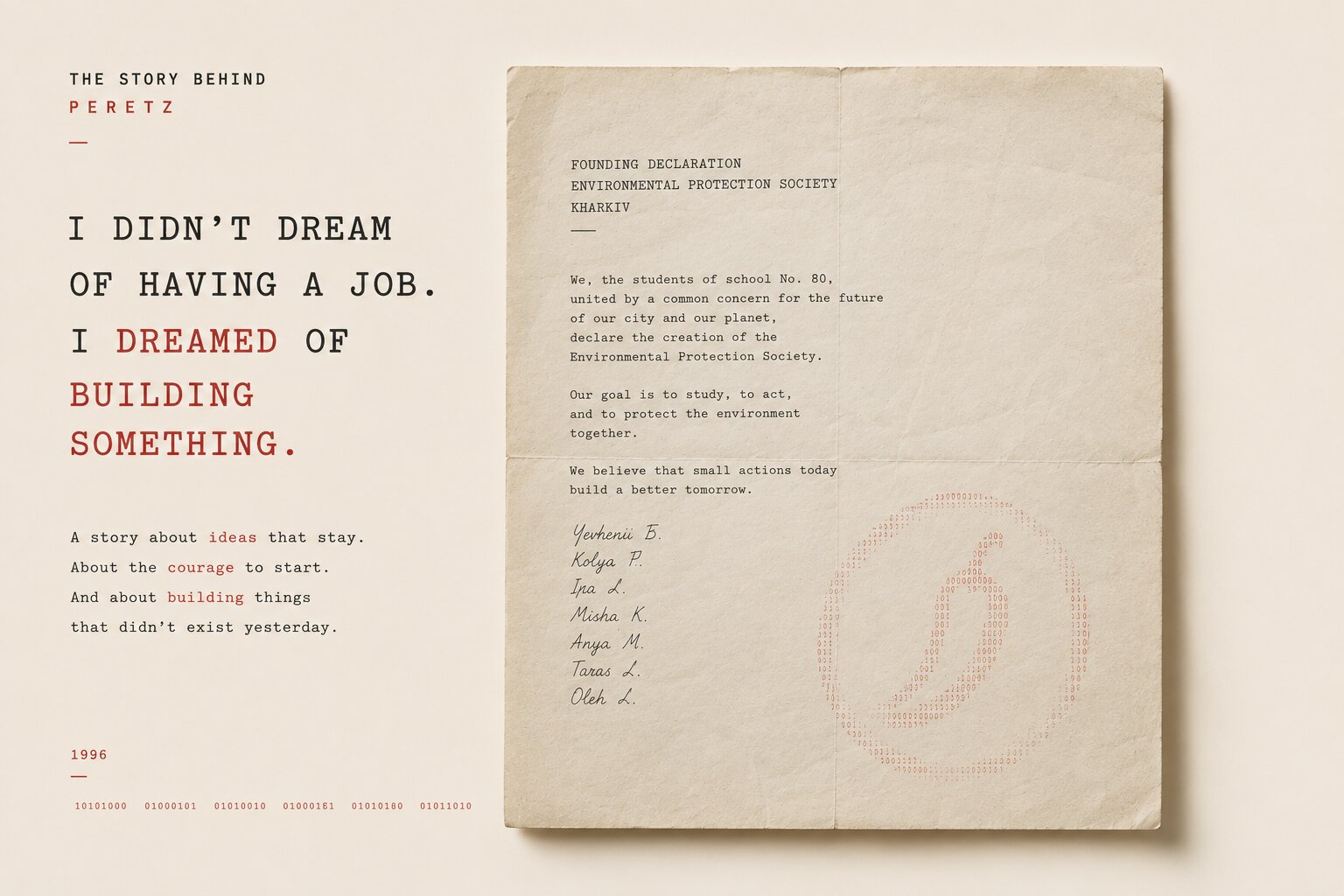
I Didn’t Dream of Having a Job. I Dreamed of Building Something.
-
12. 07. 2026

How to Build a Community, Not Just an Audience
-
26. 06. 2026
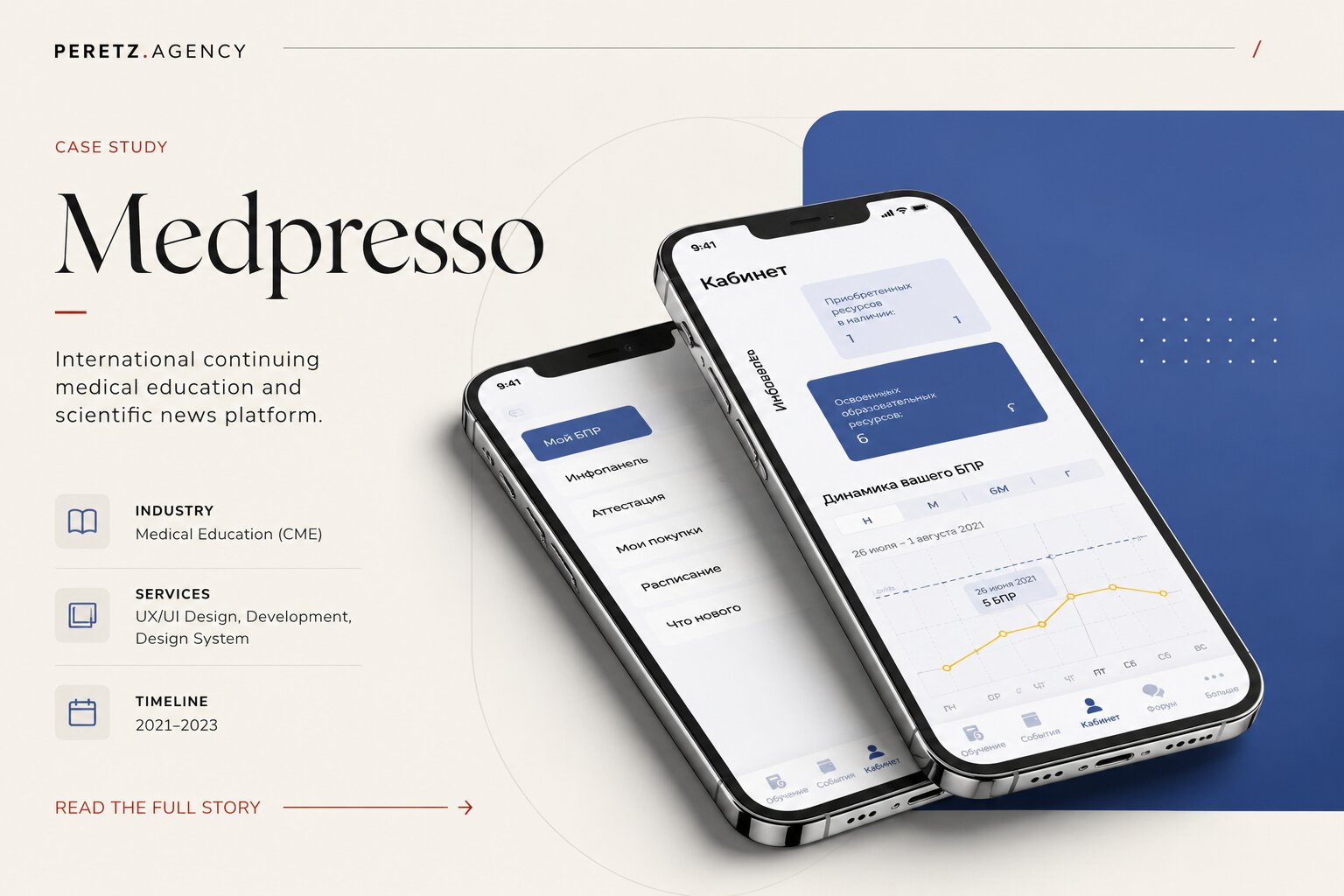
The Story We Never Planned to Tell - Case MEDPRESSO
-
06. 07. 2026

Some Clients Change Your Business. MDC LUX Changed Ours.
-
14. 07. 2026
You Know Your Business Depends on You. Build It to Work Without You Anyway.
-
15. 07. 2026

Four AIs Agreed. We Still Hadn't Verified Anything.
-
15. 07. 2026
Everything You Build Starts Aging the Day You Finish It