


THE ILLUSION
01. The Illusion Every Project Begins With
Every successful project starts with the same intention.
To reduce uncertainty.
Before a single screen is designed, before a line of code is written, before the first marketing campaign is launched, teams begin searching for answers. They analyze competitors, interview stakeholders, study analytics, review customer feedback, explore industry reports, compare technologies, estimate budgets, and define priorities.
The process is familiar because it is logical. Better information should lead to better decisions.
At least, that’s what we like to believe.
Research creates something far more valuable than data. It creates confidence. As documents become thicker and presentations become more detailed, uncertainty appears to shrink. The project feels increasingly under control. Eventually, there comes a moment when everyone around the table believes they understand the market well enough to move forward.
That moment is usually mistaken for certainty.
In reality, it is simply the point at which the team has gathered enough information to make its first informed assumptions.
Because that is what research actually produces.
Not certainty.
Assumptions.
The distinction matters more than most organizations realize. It's the same gap we cover in Usability Audit, where the goal isn't confirming what you already believe, it's finding out what you don't know yet.
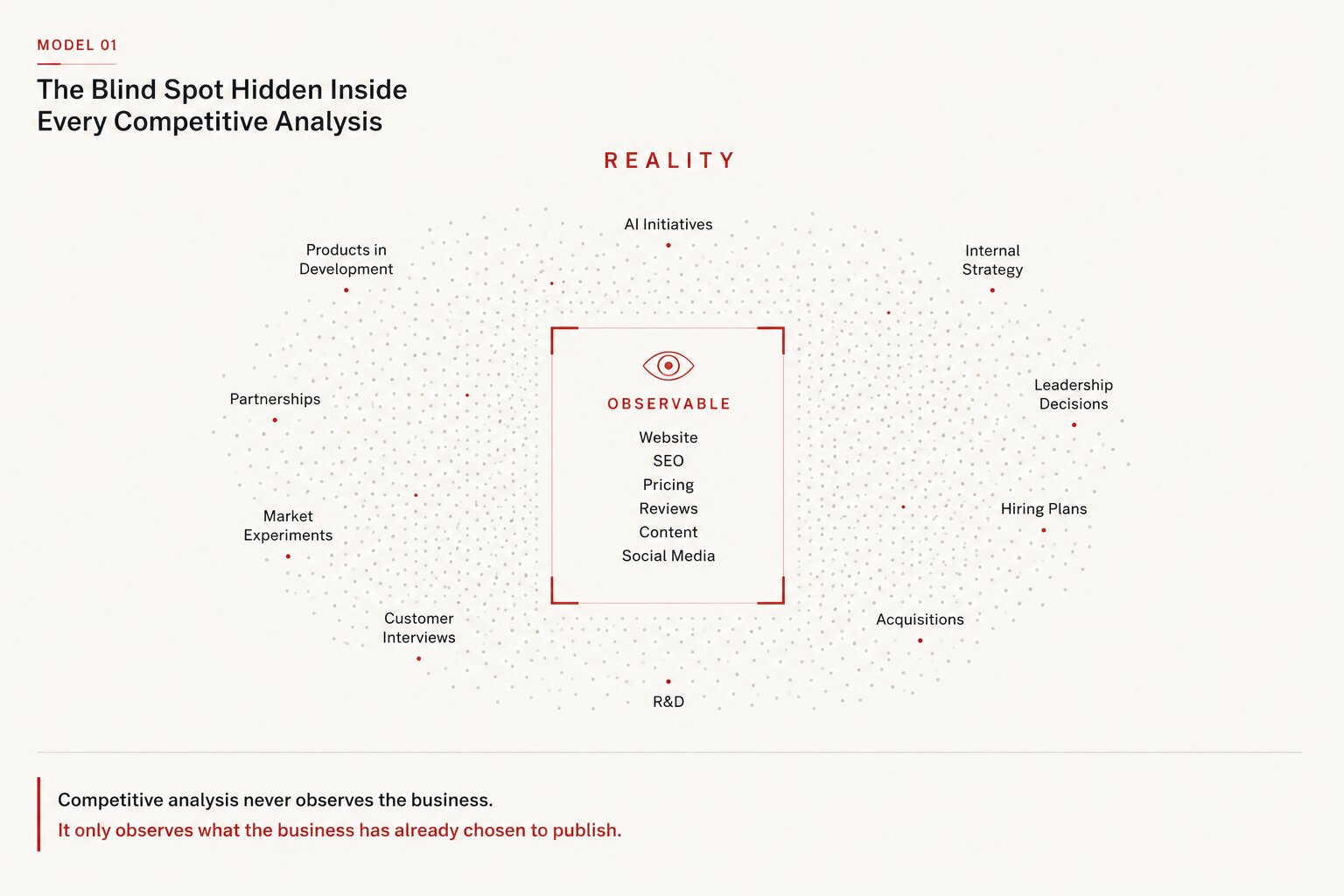
A competitive analysis does not reveal what competitors are building today. It reveals what they decided to publish yesterday. Customer interviews do not predict future behavior. They explain decisions people have already made. Analytics describe how users interacted with your product in the past, not how they will behave after your next release.
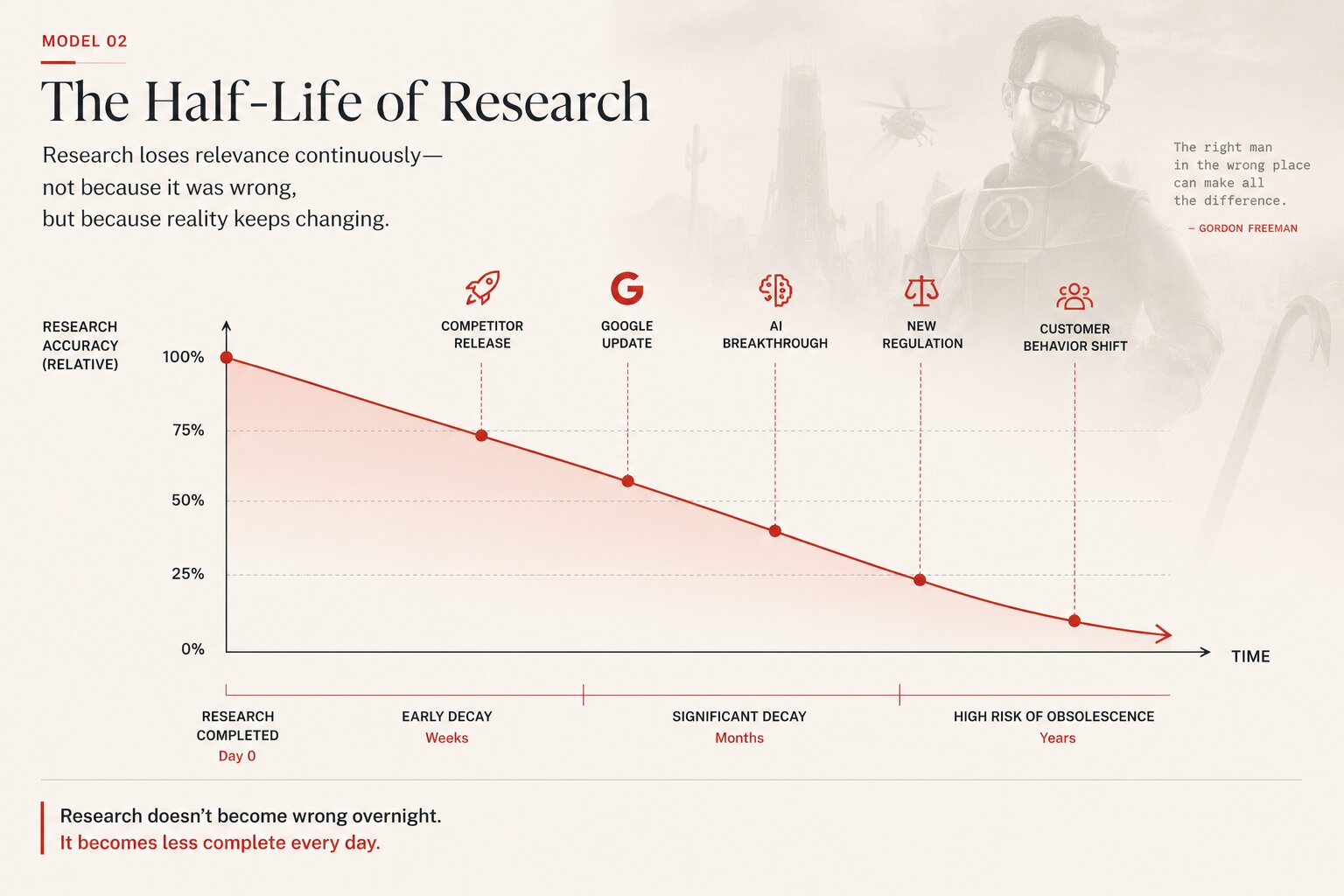
Every piece of research looks backward.
Some of it looks backward by a few minutes.
Some by several years.
None of it can observe the future.
Yet many organizations unconsciously treat research as if it were a photograph of reality itself instead of a photograph of reality at one particular moment in time.
That subtle misunderstanding shapes countless business decisions.
The project moves forward as though the world has paused long enough for everyone to catch up.
It never does. If your last redesign started from a brief instead of from evidence, Website Design is where we'd start differently.
THE BLIND SPOT
02. The Blind Spot Hidden Inside Every Competitive Analysis
Competitive research has become one of the standard rituals of modern business.
Open any strategy presentation, and somewhere near the beginning there will be a section titled “Competitor Analysis.”
Pages filled with screenshots.
Feature comparisons.
Pricing tables.
Positioning maps.
Strengths and weaknesses.
Traffic estimates.
Technology stacks.
SEO visibility.
Advertising activity.
Social media engagement.
Some companies invest weeks assembling these documents. Others hire specialized firms to do it for them. The reports often look impressive because they contain an extraordinary amount of information.
The problem is not the quality of the research.
The problem is its visibility.
Competitive analysis only measures what competitors have already chosen to expose.
We can study their current website.
We can analyze their advertising campaigns.
We can inspect their source code.
We can estimate their traffic.
Sometimes we can even travel backward through services like the Internet Archive and observe how the company evolved over the past decade.
What we cannot see is considerably more important.
We cannot see the redesign scheduled to launch next month.
We cannot see the product currently being tested behind closed doors.
We cannot see the conversations happening in executive meetings.
We cannot see the internal debates about pricing, positioning, acquisitions, AI adoption, or organizational restructuring.
In other words, we cannot see the future they are already building.
We’ve experienced this ourselves more than once.
During one discovery phase, we spent days analyzing a competitor’s digital ecosystem. Their website, positioning, SEO, content structure, and customer journey all suggested a particular strategic direction.
Less than two months later, they launched a completely redesigned platform that invalidated a significant portion of our analysis.
The research wasn’t wrong.
It simply described a company that no longer existed.
And they cannot see ours.
This changes the purpose of competitive analysis entirely.
Most organizations approach it as an attempt to answer a simple question:
What are our competitors doing?
But that question can never be answered completely because part of the answer has not become public yet.
A more useful question is different.
Given everything we can observe today, what futures become more likely?
That transforms research from documentation into strategic thinking.
The objective is no longer to describe competitors with perfect accuracy.
The objective is to understand where uncertainty exists, where assumptions are weakest, and which scenarios deserve continuous attention as the market evolves.
Because by the time your competitive analysis is finished, your competitors have already started creating the next version of the reality you are trying to understand.
And, if you’re fortunate, so have you. We cover a related blind spot, the one search engines create, in Your Business Is Invisible to AI Search in 2026.
STRATEGY IS A BET
03. Strategy Is a Bet, Not a Prediction
One of the most dangerous words in business is strategy.
Not because strategy is unimportant, but because we often assign it a certainty it has never deserved.
A strategy is frequently presented as if it were a carefully calculated route toward a predefined destination. It appears linear. Rational. Predictable. The better the presentation, the stronger the illusion becomes. Charts suggest momentum. Roadmaps imply control. Forecasts create confidence.
But beneath every strategy lies something much simpler.
A collection of assumptions.
Some are supported by evidence.
Others are educated guesses.
Many are simply beliefs that have survived long enough to become accepted as facts.
The uncomfortable reality is that no strategy can escape this. Whether you’re launching a startup, redesigning an enterprise platform, entering a new market, or introducing an AI initiative, you are making decisions about a future that does not yet exist.
You are placing bets.
Some organizations are willing to admit that.
Others spend enormous effort disguising uncertainty behind polished presentations and precise numbers.
Neither approach changes reality.
The future remains indifferent to our confidence.
This is why experienced business leaders rarely ask whether a strategy is correct.
Instead, they ask a different question.
What assumptions must be true for this strategy to succeed?
That single question changes everything.
It shifts the conversation away from defending ideas and toward testing them.
Instead of asking whether the market will respond as expected, we begin asking how quickly we can discover if we’re wrong.
Instead of protecting yesterday’s conclusions, we begin designing systems that continuously challenge them.
This distinction separates adaptive organizations from rigid ones.
The goal of strategy has never been to eliminate uncertainty.
Its purpose is to make uncertainty manageable enough to move forward while remaining willing to change direction when reality provides better information.
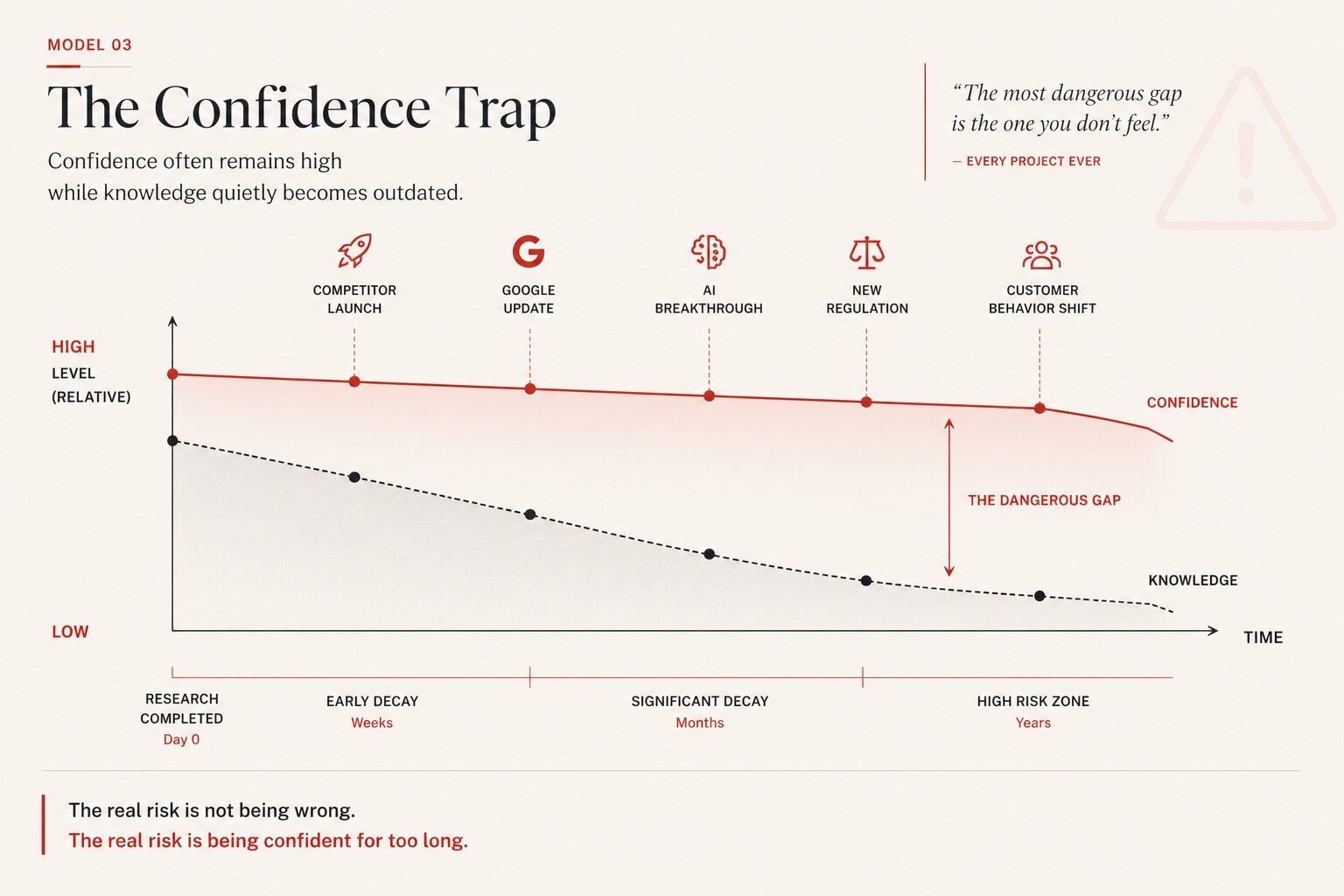
Companies rarely fail because their first assumptions were imperfect.
They fail because they continue acting as if those assumptions are still true long after reality has changed.
That is where strategic debt begins to accumulate.
Not in the quality of the original thinking.
But in the unwillingness to replace it. We look at the same trap from a technology angle in The Build vs. Buy Equation Has Changed.
NO FINISH LINE
04. Why Research Has No Finish Line
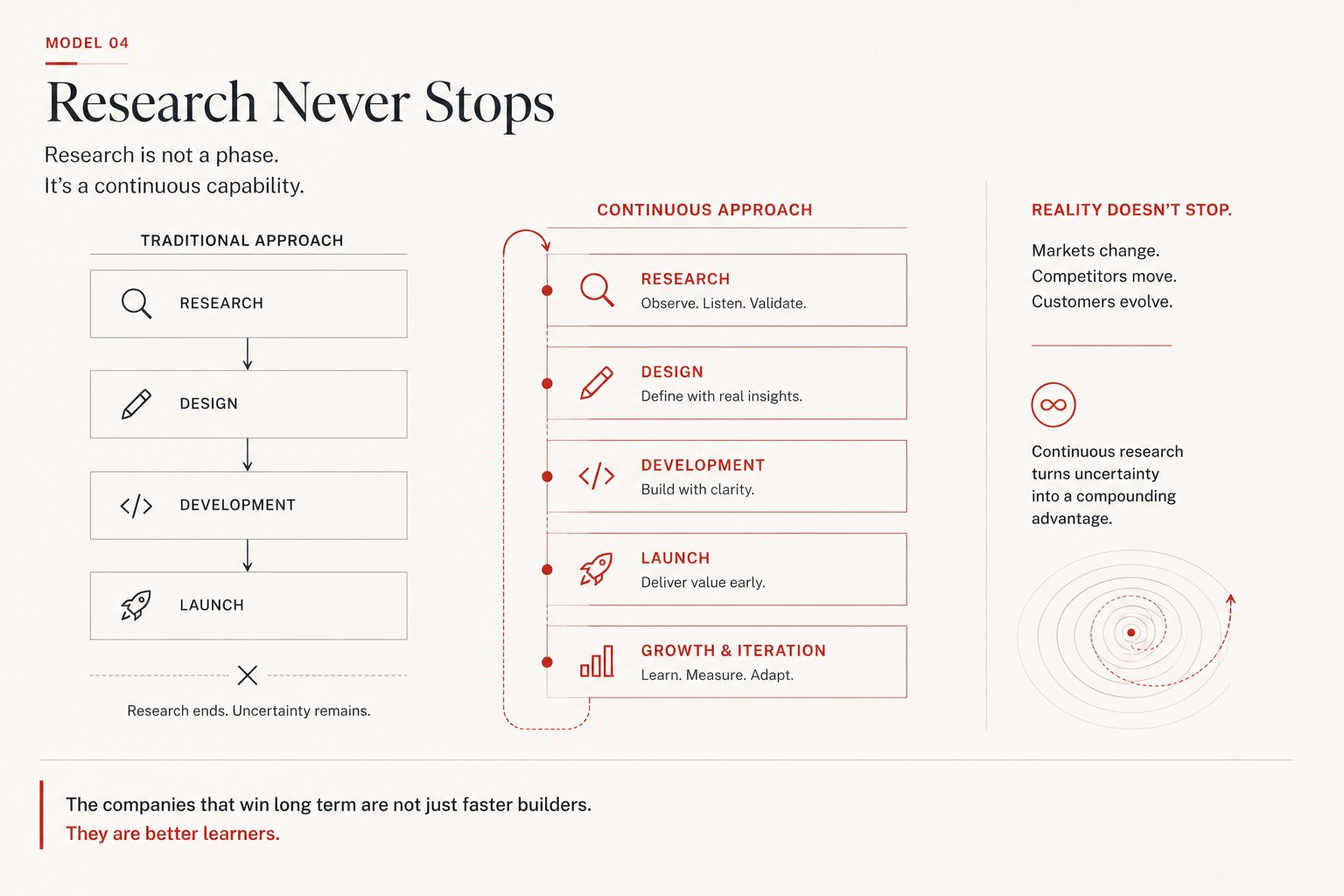
One of our largest healthcare platforms remained in active development for years.
During that time, search engines changed repeatedly, user expectations evolved, medical content standards shifted, and entirely new AI capabilities emerged.
Had we treated the original research as a fixed blueprint, the platform would have slowly become outdated while still being built.
Instead, the project continuously absorbed new information.
Looking back, many of the best decisions were impossible to make on day one because the information simply didn’t exist yet.
Imagine a digital transformation project scheduled to last nine months.
The first month is dedicated to discovery.
Stakeholder interviews are completed.
Competitor analysis is documented.
Customer journeys are mapped.
Technical constraints are identified.
The research phase concludes successfully.
The team celebrates reaching an important milestone.
Then the real project begins.
Design starts.
Development follows.
Content is written.
Integrations are implemented.
Testing uncovers new behaviors.
Marketing prepares the launch.
Months pass.
Now consider what happened outside the project while all of this was taking place.
Competitors released new features.
A startup introduced an entirely different business model.
Search engines changed how they rank content.
AI capabilities advanced again.
Customer expectations quietly shifted as they interacted with new products every day.
Economic conditions changed.
Internal priorities evolved.
Perhaps your own company hired new leadership with a different vision.
None of these events were visible when the research document was approved.
Yet every one of them has the potential to influence decisions being made today.
This is why treating research as the first phase of a project is fundamentally flawed.
Research is not something a team completes before beginning meaningful work.
Research is meaningful work.
It accompanies every important decision from the first workshop to years after launch.
Every usability test is research.
Every customer support conversation is research.
Every failed experiment is research.
Every unexpected analytics pattern is research.
Every sales objection is research.
Every competitor announcement is research.
The organizations that learn fastest rarely conduct more research than everyone else.
They simply refuse to stop observing once the project officially begins.
The irony is difficult to ignore.
Many businesses invest heavily in understanding the market before launch.
Then, after releasing the product into the hands of thousands of real customers, they dramatically reduce the amount of learning taking place.
As if the most valuable source of information had suddenly become less important.
Reality doesn’t work that way.
The market is not a report that can be downloaded once and archived.
It is a conversation that continues whether your business is listening or not.
The companies that consistently outperform their competitors are rarely the ones that begin with the best research.
More often, they are the ones that continue researching long after everyone else believes the answers have already been found. The Code Remembers Every Version of the Business is about the same idea from inside the codebase.
CHANGE ISN'T FAILURE
05. Changing Requirements Isn't a Failure. It's Evidence That You're Learning.
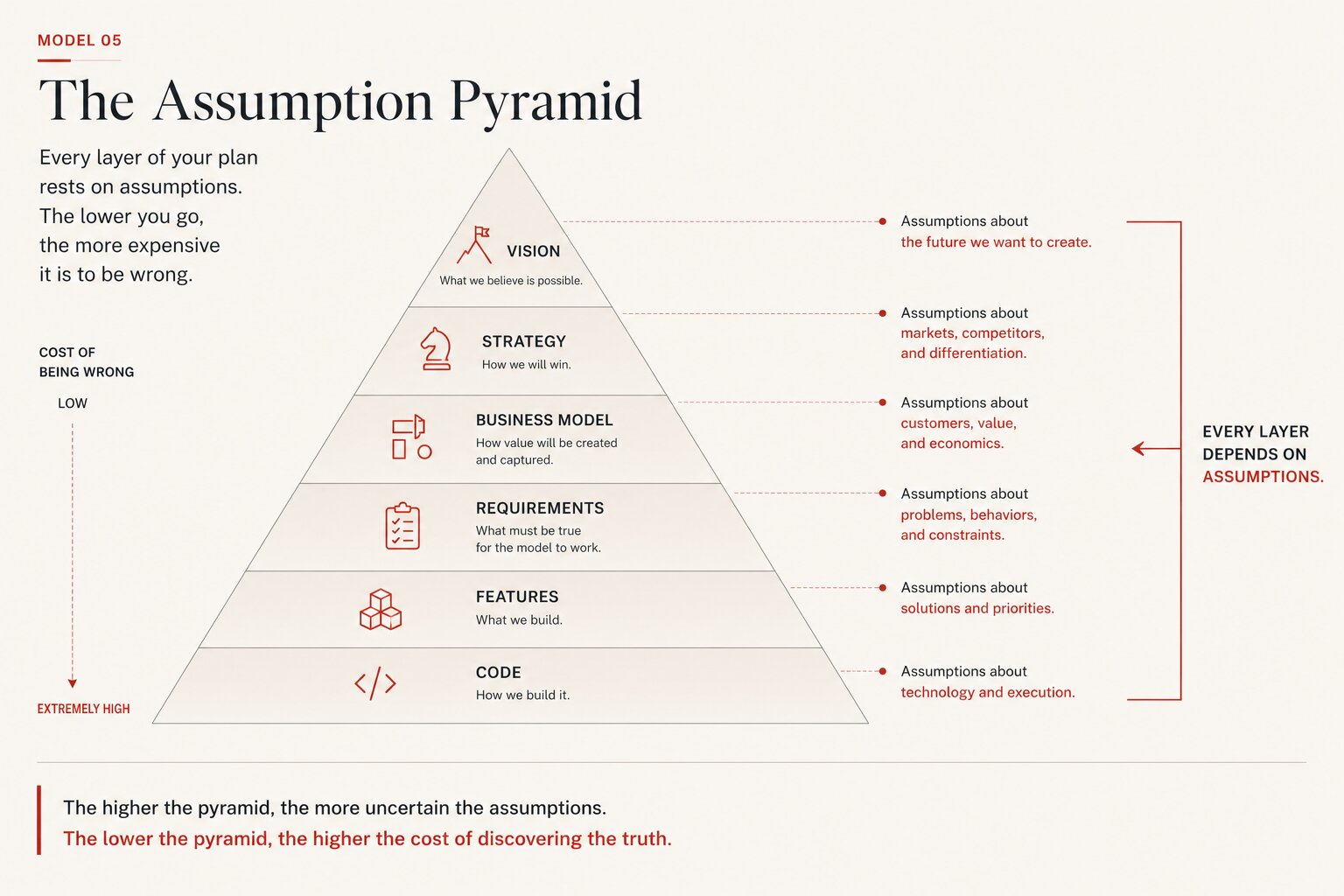
We’ve seen organizations arrive convinced they needed a complete website redesign.
After a few hours of strategic workshops, the website was no longer the primary problem.
Sales processes were.
Internal operations were.
Positioning was.
The website eventually changed as well,but only after the business itself became clearer.
Had we accepted the original request without questioning it, we would have delivered exactly what the client asked for.
And solved the wrong problem.
Few phrases create more frustration in digital projects than this one:
“The client changed the requirements.”
It usually arrives with a sigh.
Sometimes with a budget discussion.
Occasionally with a change request measured in dozens of pages.
Over time, the phrase has become almost synonymous with poor project management.
It shouldn’t be.
The assumption hidden behind this complaint is that the “correct” requirements existed from the very beginning, and someone simply failed to identify them.
Reality is rarely that cooperative.
Businesses don’t make decisions inside laboratories. They operate inside markets where customers evolve, competitors adapt, technologies mature, regulations change, and unexpected opportunities emerge with little warning.
The organization itself changes as the project progresses.
A sales team uncovers a new objection that was never mentioned during discovery.
Customer support identifies a recurring problem affecting retention.
Marketing discovers a completely different audience responding to the product.
Leadership adjusts priorities after entering a new partnership.
A new AI capability suddenly makes an expensive workflow almost obsolete.
None of these developments represent failure.
They represent learning.
The real question isn’t whether requirements will change.
They will.
The real question is whether the organization is willing to change with them.
Ironically, many companies celebrate projects where requirements remain perfectly stable from beginning to end.
That stability often feels like discipline.
Sometimes it is.
But sometimes it signals something far more dangerous.
It may simply mean the organization stopped asking questions.
Stopped listening.
Stopped challenging its own assumptions.
Stopped learning.
There is a difference between uncontrolled scope and intelligent adaptation.
One is driven by indecision.
The other is driven by better information.
Confusing the two has caused countless organizations to optimize for predictability at the exact moment they should have been optimizing for understanding.
Projects do not become successful because nothing changes.
They become successful because the right things change before it is too late.
Perhaps the most expensive decision any organization can make is continuing to execute a plan that everyone secretly knows no longer reflects reality. That's usually the moment traffic keeps arriving and leads quietly stop, a pattern we unpack in Traffic But No Leads? Your Customer Is Doing Math You Never See.
DESIGNING SYSTEMS THAT LEARN
06. Designing Systems That Learn Faster Than Markets Change
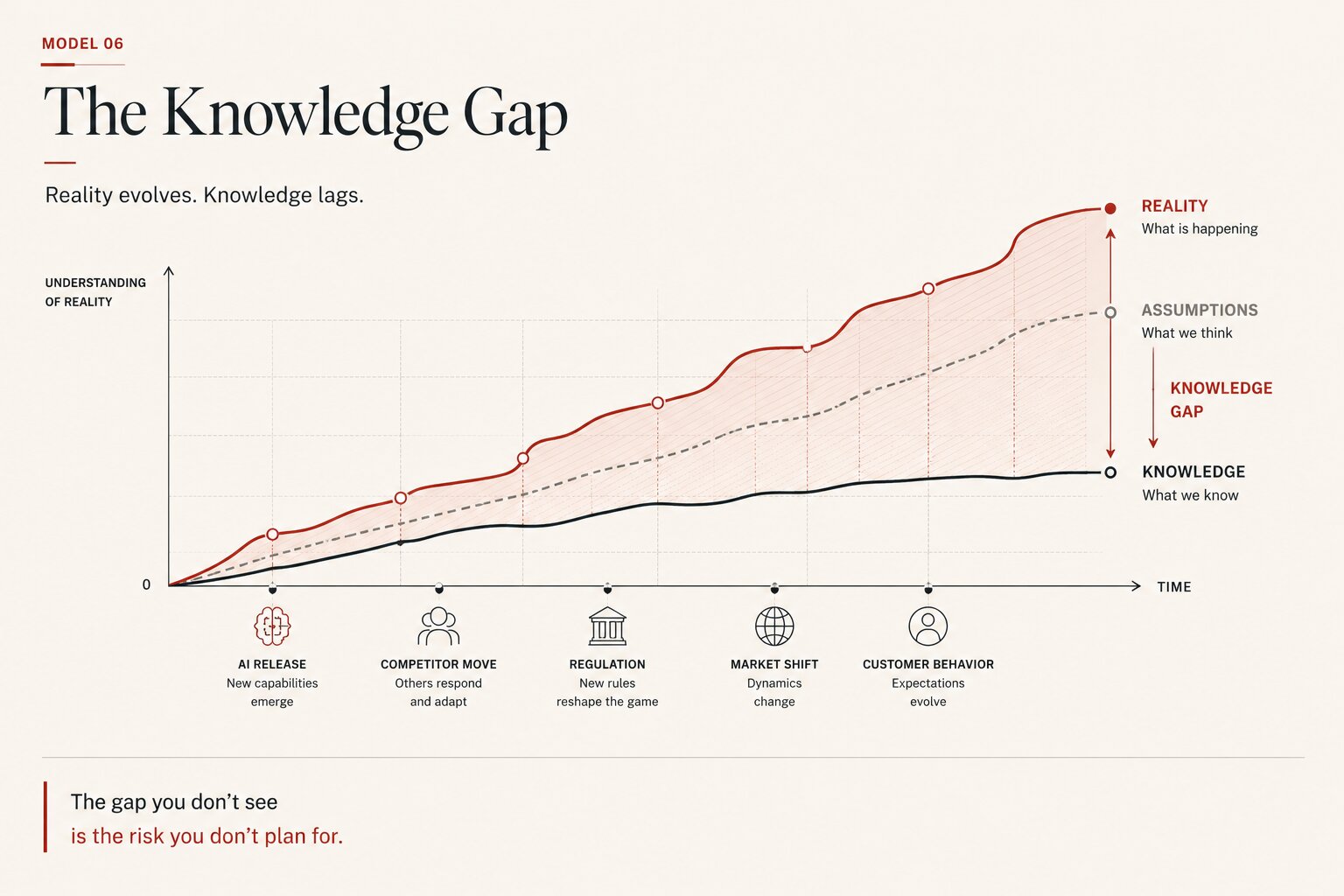
Three years ago, many repetitive workflows required custom development.
Today, some of those same workflows can be implemented in hours using AI-assisted tools.
The question isn’t whether the original architecture was wrong.
The question is whether the organization is willing to reconsider decisions made before those capabilities existed.
If research is continuous, then products cannot be designed as static solutions.
They must be designed as learning systems.
This idea changes the purpose of almost every business practice.
An MVP is no longer simply a cheaper version of the final product.
It becomes the fastest possible way to replace assumptions with evidence.
Analytics stop being performance dashboards.
They become instruments for discovering where your understanding is incomplete.
User testing stops validating design decisions.
Instead, it exposes flawed assumptions before they become expensive.
Even failure begins to look different.
Organizations often celebrate success while trying to avoid failure at all costs.
Learning organizations measure something else.
They ask:
How quickly did we discover we were wrong?
Because discovering a flawed assumption in the first month is dramatically less expensive than discovering it after two years of development.
Speed matters.
But not in the way most businesses think.
Speed is not about delivering features faster than competitors.
It is about learning faster than competitors.
Two companies may launch products on the same day.
One spends the next year defending the original roadmap.
The other spends the next year refining it every month based on customer behavior.
From the outside, both companies appear equally disciplined.
From the inside, they are following entirely different philosophies.
The first believes its greatest achievement was creating the plan.
The second understands that the plan was merely the beginning of a conversation with reality.
This distinction explains why some organizations become increasingly resilient over time while others slowly accumulate what we described in our previous article as Competitive Debt.
Not because they stopped working.
Not because they hired weaker people.
But because they gradually stopped learning.
Markets evolve continuously.
Customers evolve continuously.
Technology evolves continuously.
The only sustainable competitive advantage is building an organization that evolves continuously as well.
The future has never belonged to the companies that made the fewest mistakes.
It belongs to the companies that recognized their mistakes sooner,and had the courage to redesign their thinking before the market forced them to. Turning that into an actual operating rhythm is what Business Digitalization is for.
THE ABILITY TO ADAPT
07. We Don't Design Products. We Design the Ability to Adapt.
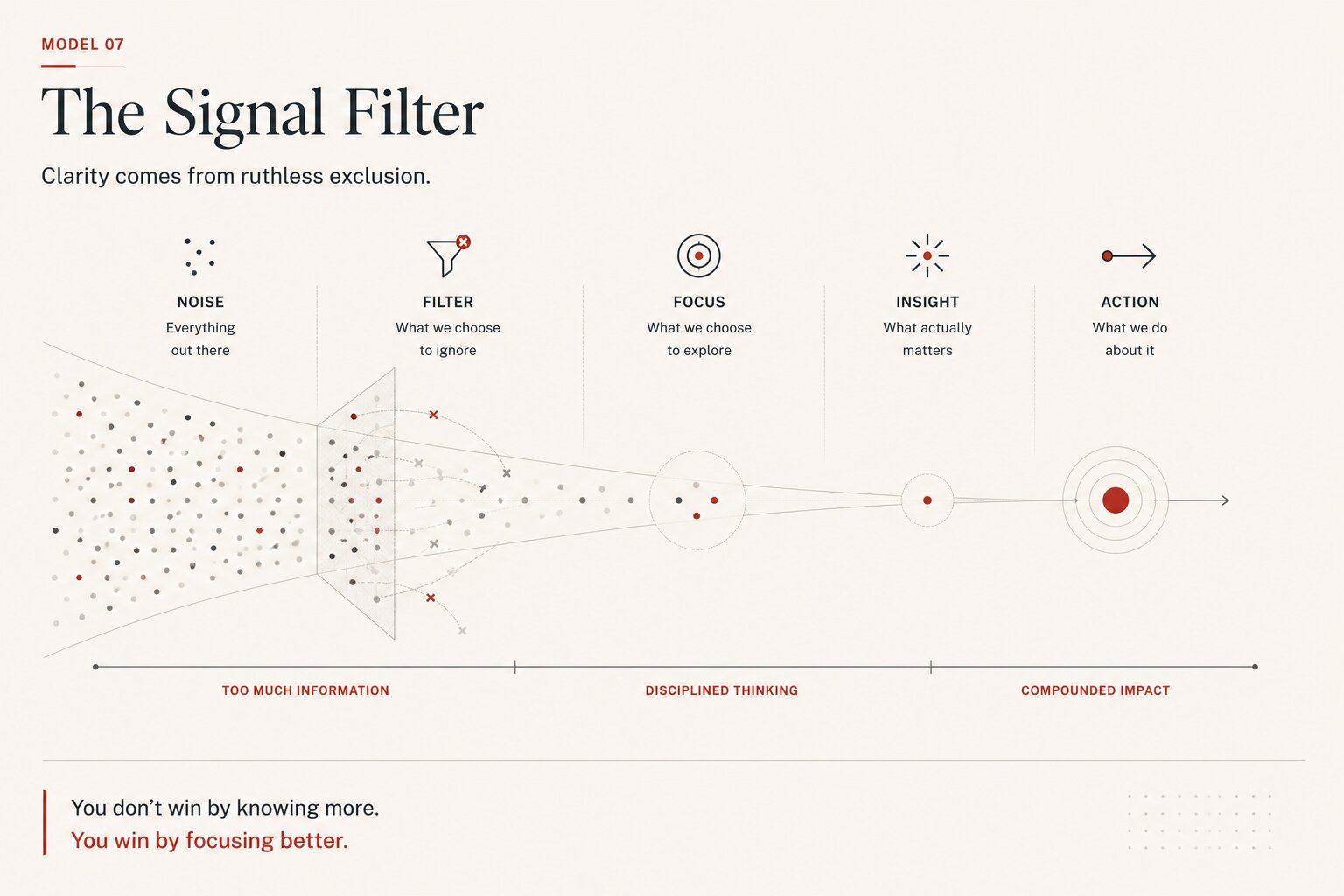
When people ask what we build, the expected answer is simple.
Websites.
E-commerce platforms.
Digital products.
Software.
From a technical perspective, that’s true.
But over the years, we’ve realized that these are rarely the things clients are actually buying.
They are buying a better position in a changing market.
The website is simply one expression of that objective.
So is the mobile application.
So is the CRM integration.
So is the AI implementation.
Each of them is a response to today’s understanding of reality.
None of them should be mistaken for reality itself.
This distinction has fundamentally changed how we approach projects.
We no longer see a website launch as the finish line.
It is the moment the real work begins.
Until launch, every decision is based primarily on research, experience, and assumptions.
After launch, every decision can finally be informed by evidence.
Real customers.
Real behavior.
Real outcomes.
The product begins teaching its creators.
Organizations that understand this treat every release as a beginning rather than a conclusion.
They expect assumptions to fail.
They expect priorities to shift.
They expect competitors to surprise them.
Most importantly, they build systems capable of responding without starting over.
This is why flexibility is often misunderstood.
Flexibility is not the willingness to change everything.
That creates chaos.
True flexibility is designing systems where meaningful change is possible without destroying everything that already works.
Architecture matters because of this.
So does design.
So does documentation.
So does governance.
Not because they reduce change.
But because they make change sustainable.
A product that cannot evolve is not finished.
It is fragile.
Eventually, reality will expose that fragility.
Not through a dramatic collapse, but through hundreds of small moments where the business hesitates while more adaptive competitors continue moving forward.
The companies that remain relevant for decades rarely build perfect products.
They build organizations capable of continuously redesigning imperfect ones.
That is a much more difficult capability to imitate.
And a far more valuable one. It's also exactly what growing businesses run out of first, the subject of Why Growing Bellevue Businesses Eventually Outgrow Their Websites.
DESIGNING FOR REALITY
08. Designing for Reality
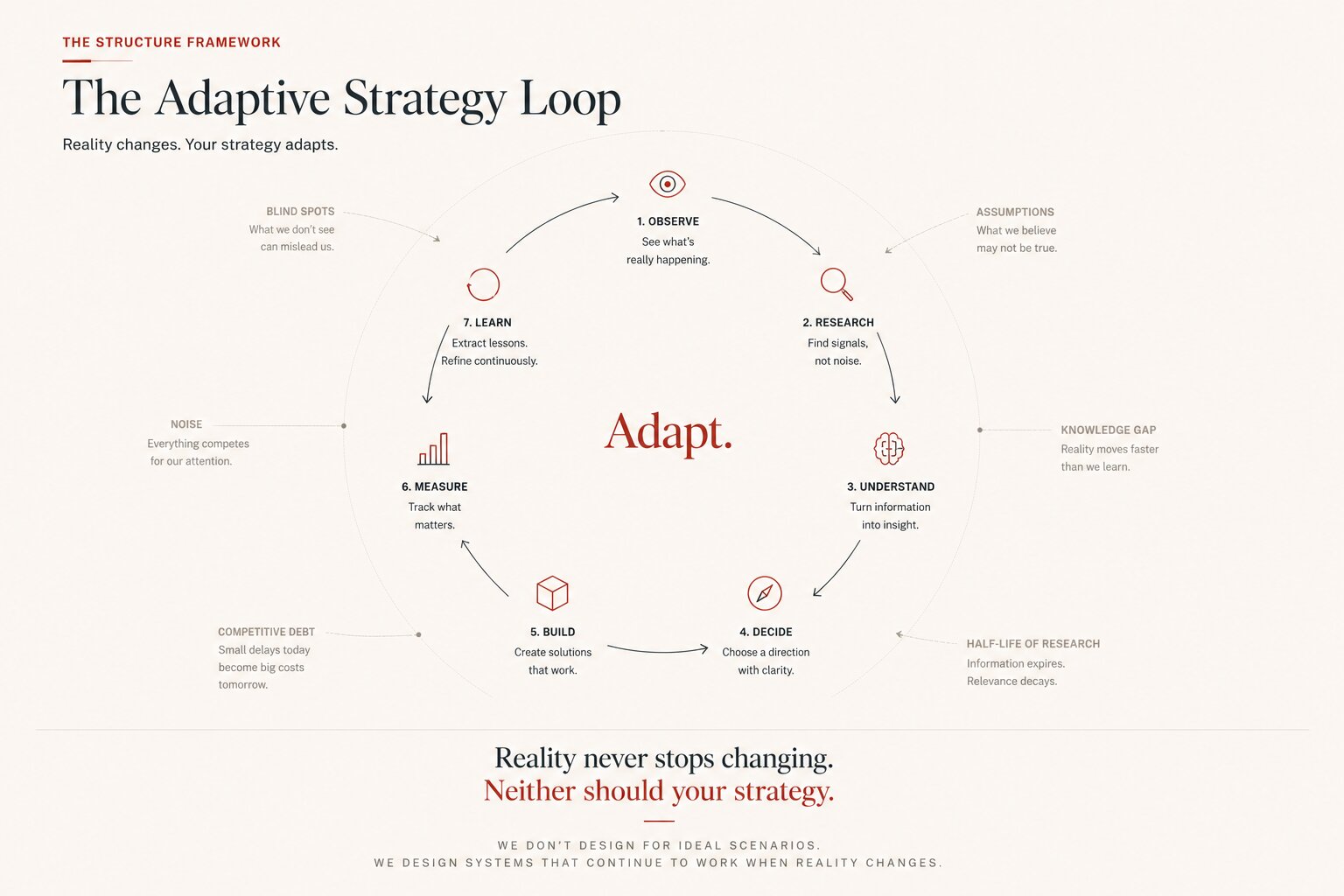
Every organization wants certainty.
It is comforting to believe that enough research, enough meetings, enough analysis, or enough planning will eventually produce the correct answer.
Business history suggests otherwise.
The organizations that endure are not the ones that knew the future.
They are the ones that remained curious after everyone else became convinced they already understood it.
Research matters.
Strategy matters.
Competitive analysis matters.
Planning matters.
But none of them exist to predict the future.
They exist to reduce uncertainty just enough to take the next intelligent step.
Then reality responds.
Sometimes it confirms our thinking.
Sometimes it quietly proves us wrong.
Both outcomes are equally valuable,provided we are willing to notice the difference.
This is why we don’t believe research belongs at the beginning of a project.
It belongs everywhere.
In every strategy session.
Every design review.
Every sprint.
Every product release.
Every customer conversation.
Every unexpected metric.
Every difficult question.
Reality is constantly updating itself.
Businesses should do the same.
Perhaps this is the greatest misconception in modern product development.
Companies often compete as though success belongs to those who make the fewest mistakes.
In practice, markets reward something very different.
They reward organizations that discover their mistakes sooner, learn from them faster, and adapt before those mistakes become expensive.
That is not simply a better product strategy.
It is a better way to build businesses.
Because we have never believed our responsibility was to design websites.
Or applications.
Or software.
Our responsibility is to help organizations make better decisions inside an uncertain world.
Everything else is simply the visible result of that philosophy. We describe what that looks like once the underlying structure is actually right in What Good Web Design Actually Does Once the Structure Is Right.
FINAL THOUGHT
Final thought
Reality doesn’t wait for your roadmap.
The businesses that thrive are not the ones that predict change most accurately. They are the ones that continue learning after everyone else believes the research is finished.
Over the years, we’ve redesigned websites.
Then we realized we were redesigning businesses.
Eventually, we understood something even more important.
Businesses themselves are never truly finished. If your last project didn't hold up, What If You're Solving the Wrong Problem? is a good next read.
They are living systems learning to survive in environments that refuse to stand still.
Once you accept that, the purpose of research changes forever.
It stops being the first phase of a project.
It becomes the operating system of the business. We wrote about the twenty years behind that shift in What Twenty Years Taught Me About Building Digital Businesses.
Before you start your next project, ask yourself:
Which assumptions have we stopped questioning?
What has changed since our research began?
What would invalidate our current strategy?
Where are we confusing confidence with certainty?
If we started this project today, what would we do differently?
If these questions reveal uncertainty…
…perhaps the next step isn’t another redesign.
Perhaps it’s a better understanding of reality. Let’s explore it together.
We looked at what a genuinely different e-commerce architecture can look like in What Happens to E-Commerce When a Website Stops Being a Website?
We go deeper into our actual design process, from objects to experience, in How We Design E-Commerce: From Objects to Experience.
Author: Yevhen Borovoi, Founder at Peretz Agency.
Not sure whether your current strategy is built for how the market actually behaves, or for how you assumed it would behave six months ago? A Strategic Session stress-tests your assumptions before the market does it for you.
- Share
-

-

-

-

Related Reading
-
04. 07. 2026
What Twenty Years Taught Me About Building Digital Businesses

-
24. 07. 2026
What If You're Solving the Wrong Problem?
-
23. 07. 2026
What Good Web Design Actually Does Once the Structure Is Right
-
02. 07. 2026
I've Rebuilt My Career Twice Because of War. Here's What That Actually Teaches You About Strategy.
-
27. 06. 2026
Your Business Is Invisible to AI Search in 2026 — Here's How to Fix It
-
09. 07. 2026
Traffic But No Leads? Your Customer Is Doing Math You Never See
-
29. 07. 2026
The Hidden Cost of Standing Still: Why Modern Businesses Lose Competitive Advantage Long Before They Notice
-
17. 07. 2026
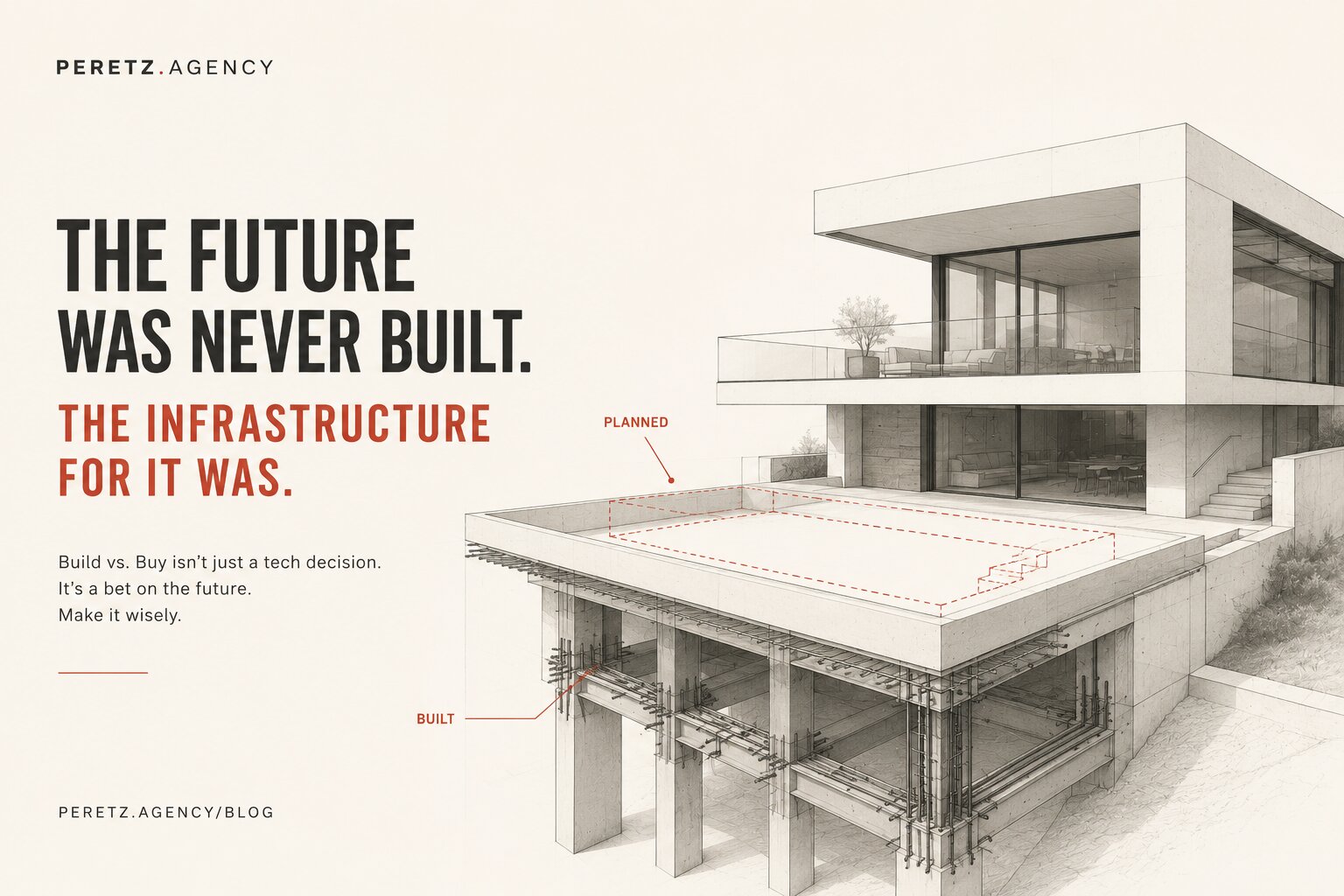
The Build vs. Buy Equation Has Changed. Most Companies Have Not Recalculated It.
-
17. 07. 2026
The Code Remembers Every Version of the Business
-
13. 08. 2026
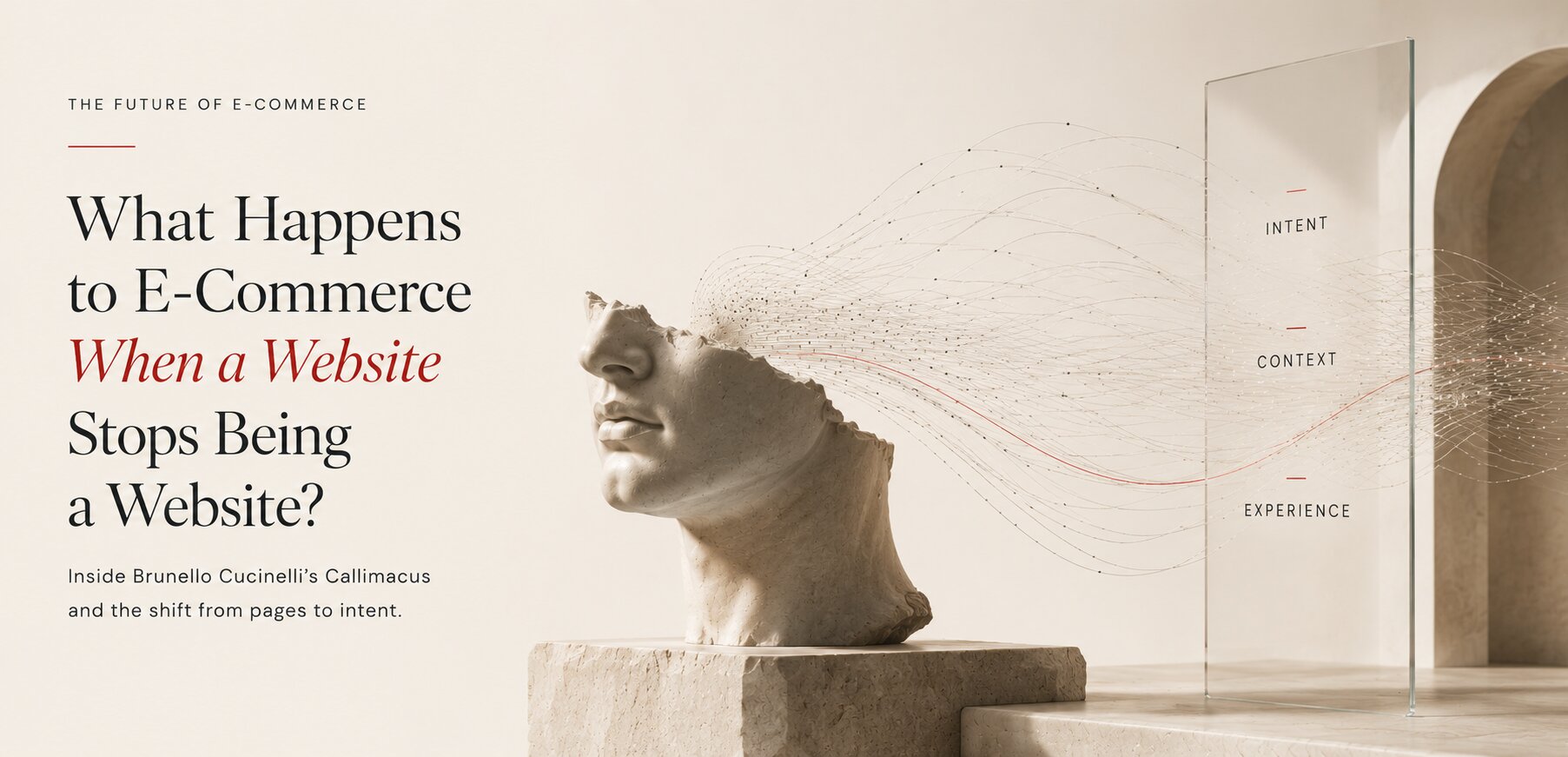
What Happens to E-Commerce When a Website Stops Being a Website?
-
14. 08. 2026

How We Design E-Commerce: From Objects to Experience