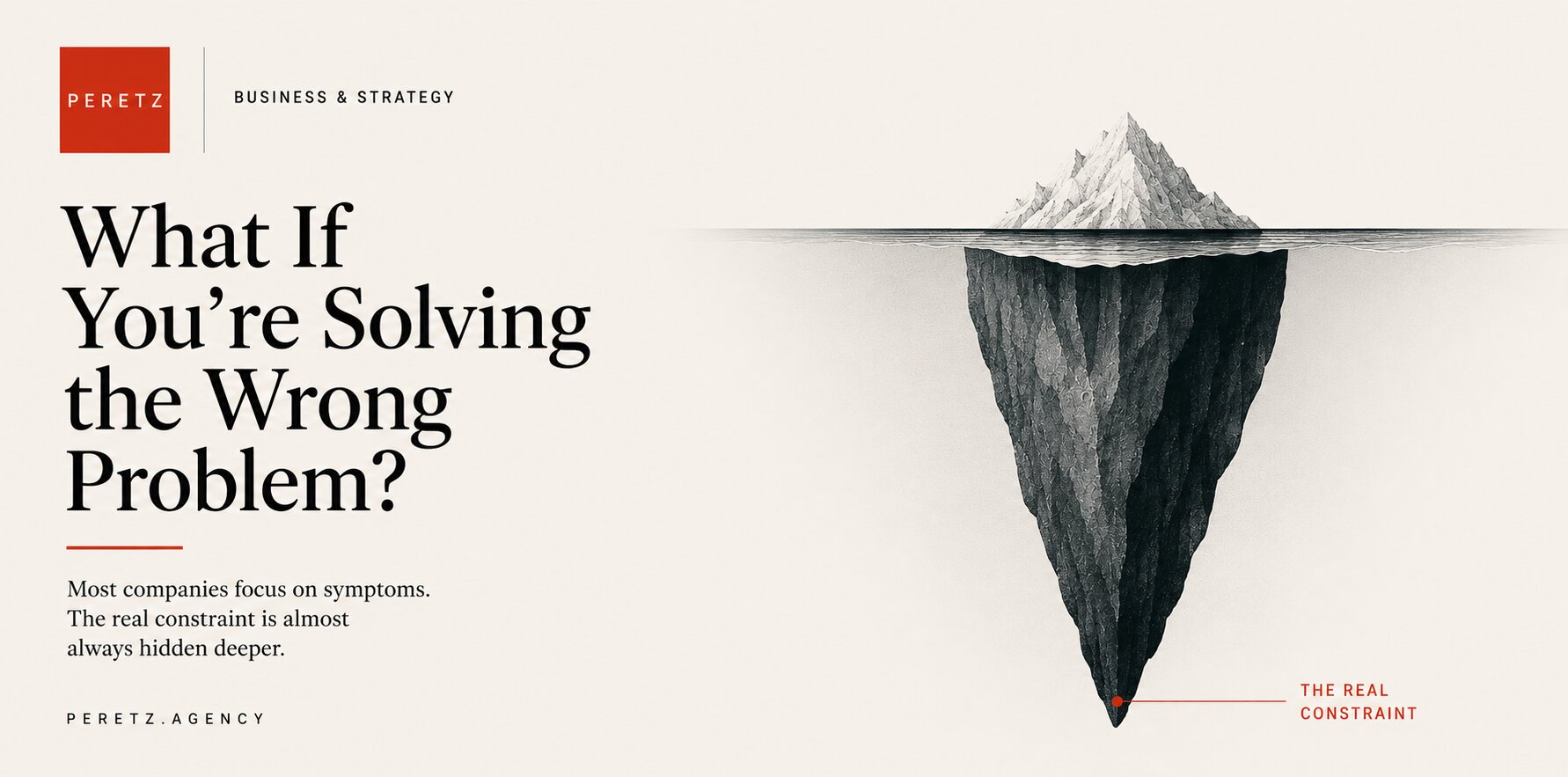
What If You're Solving the Wrong Problem?
Most stalled projects aren't failing at execution. They're executing the wrong answer, beautifully and on schedule.



Imagine your website receives twice as many visitors tomorrow.
What changes?
Will your business become more profitable? Will more visitors become loyal customers? Will your brand become stronger? Will your conversion rate improve? Will AI assistants recommend your company more often? Will your business become easier to scale?
Or will you simply see a more beautiful graph in Google Analytics?
For many businesses, the answer isn't obvious. And that's exactly the problem.
THE HIDDEN CONSTRAINT
Every growing business eventually reaches a point where progress begins to slow. Revenue plateaus. Organic traffic stops growing. Lead quality declines. Advertising becomes more expensive. Search rankings fluctuate. AI search starts changing how people discover information.
Something no longer works the way it used to.
The first reaction is almost always the same: "We need better SEO." "We need more content." "We should redesign the website." "Maybe it's time to integrate AI." "Let's launch another campaign." "Perhaps we need custom software."
All of these can be the right decision. The problem is that they're usually made before answering a much more important question.
What is actually limiting the growth of the business?
Over the years, we've noticed something interesting. Businesses rarely come to us with the problem they actually have. They come asking for solutions: a website redesign, technical SEO, a content strategy, AI integration, a custom platform, better conversion rates, more traffic.
Those requests are real. But they are often symptoms rather than causes.
A company may believe it needs more organic traffic when the real issue is that existing visitors don't convert. Another business may blame its website when the actual bottleneck is weak positioning. Someone asks about AI because everyone is talking about AI, while their biggest opportunity still lies in fixing customer onboarding.
The requested solution isn't necessarily wrong. It simply may not address the constraint that is preventing the business from growing. And until that constraint is identified, every investment carries the same risk.
You become better at solving the wrong problem.
THE METRIC TRAP
One of the biggest challenges in business isn't making decisions. It's making decisions based on the right signals.
Modern businesses have access to more data than ever before: traffic, sessions, bounce rate, engagement, click-through rate, conversions, average order value, lifetime value, search rankings, AI mentions.
The problem isn't a lack of information. It's deciding which information actually matters, because not every metric deserves to become a business objective.
A growing number of companies unconsciously begin optimizing what is easiest to measure instead of what creates long-term business value. Publishing another article is measurable. Increasing impressions is measurable. Growing social media followers is measurable. Improving search visibility is measurable.
But none of these metrics, by themselves, guarantee business growth. They simply describe activity. Activity and progress are not the same thing.
We've seen businesses celebrate record traffic while revenue remained flat. We've seen websites reach the first page of Google for competitive keywords without generating qualified leads. We've seen companies invest heavily in AI tools before fixing the customer journey those tools were supposed to improve.
None of those investments were technically wrong. They simply addressed symptoms before understanding the system.
That distinction matters, because once a business starts measuring success through secondary metrics, every future decision becomes easier to justify. More traffic must be better. More articles must be better. More keywords must be better. More AI must be better.
Until one day the business realizes it has become incredibly efficient at producing outputs that no longer create meaningful outcomes. Often the wrong problem is a human one dressed in business clothes, which is what Everyone Wants the Prestige. We Study the Turn. is about.
MORE ARTICLES WEREN'T THE ANSWER
Recently, we were asked to diagnose a large online news platform. The request sounded familiar.
Organic growth had slowed. The editorial team believed the answer was straightforward: publish more, cover more topics, increase the pace.
On the surface, the strategy made perfect sense. After all, every successful publisher depends on fresh content. But before recommending anything, we started with the same question we always ask.
Where is the actual constraint?
The analytics told a very different story. Roughly two thirds of the content library generated little or no meaningful organic visibility. Thousands of published pages attracted almost no search traffic. Many articles received impressions but almost no clicks. Others ranked for queries that had little commercial or editorial value. Readers frequently consumed a single article and left without discovering anything else the publication had to offer.
The issue wasn't a lack of content. It wasn't even content quality. It was the structure surrounding that content: internal linking, content architecture, topic relationships, search intent alignment, indexation priorities, technical SEO, user journeys.
Publishing another fifty articles wouldn't have solved any of those problems. It would simply have made the library larger.
Sometimes growth doesn't require creating more. Sometimes it requires helping existing assets finally perform the job they were always capable of doing.
SEARCH CHANGED. THE MISTAKE DIDN'T.
For more than two decades, businesses learned how to optimize for search engines. They improved technical SEO, built content strategies, earned backlinks, improved website performance, studied search intent. Everything revolved around one goal: become visible in Google.
Today, search is changing again. People still use Google. But increasingly, they also ask ChatGPT, Claude, Gemini, Perplexity, Copilot. Sometimes they never visit a search engine at all. Instead of browsing ten links, they receive one synthesized answer.
This changes something fundamental. Your content is no longer competing only for rankings. It's competing to become trusted knowledge: knowledge that another system is willing to understand, summarize, reference, recommend.
That requires a different way of thinking about content. Not content written for algorithms. Not content written to satisfy keyword density. But content structured well enough for both humans and AI systems to understand what your business actually knows. This is the same shift we mapped out in more detail in our piece on AI search visibility.
Over the past year, we've noticed an interesting pattern across several of our own projects. After publishing new content and seeing it indexed by search engines, we often begin noticing the same concepts, terminology, and ideas reflected in AI-generated answers surprisingly quickly.
Not because every LLM instantly crawls the internet. They don't. Different models use different data sources, update cycles, and retrieval methods. But the direction is clear: well-structured, authoritative content increasingly becomes part of the knowledge layer that modern AI systems rely on when answering users' questions.
That changes the role of every article you publish. You're no longer writing only for a visitor. You're writing for future conversations, conversations that may happen inside Google, inside ChatGPT, inside Gemini, or inside AI systems that don't even exist yet.
THE NEXT MISTAKE HAS STARTED
History has a habit of repeating itself. Years ago, businesses believed SEO was the answer to every growth problem. If traffic slowed, invest in SEO. If leads declined, invest in SEO. If sales dropped, invest in SEO.
SEO wasn't the problem. Misdiagnosis was.
Today, we're watching the same pattern emerge around AI. Businesses want AI optimization, LLM optimization, GEO, AEO, AI search visibility. These are all real disciplines. They matter. They will become increasingly important over the coming years.
But they are still tools. Not strategies.
Optimizing for AI won't fix weak positioning. It won't solve a broken customer journey. It won't compensate for poor messaging. It won't create expertise where none exists. And it certainly won't transform activity into business growth.
The technology has changed. Human behavior has changed. Search has changed. But one thing hasn't: businesses still risk investing in the first solution that sounds convincing instead of identifying the real constraint first.
DIAGNOSIS BEFORE SOLUTIONS
This is why our work rarely begins with a recommendation. It begins with questions.
Not "Do you need SEO?" Or "Should you redesign your website?" Or even "Should you integrate AI?" Those conversations come later.
First, we need to understand something much more important.
What is preventing the business from growing today?
Sometimes the answer is technical SEO. Sometimes it's content strategy. Sometimes it's analytics. Sometimes it's website architecture. Sometimes it's positioning. Sometimes it's AI integration. And sometimes the biggest opportunity has nothing to do with what the client originally asked for.
That's why every Strategic Session begins with diagnosis, not solutions.
Businesses rarely fail because they lack ideas. They fail because they become incredibly efficient at solving the wrong problem.
Design conversations run into the same trap, which we wrote about in Why Some Websites Look Cheap Even When They Are Well Designed.
If the wrong problem is a suspect, the next question is how to prove the real one. We describe the method, clue by clue, in The Columbo Method: How to Find What's Actually Wrong With a Business.
If you're not sure what's actually limiting your growth, that's exactly where a Strategic Session starts. We diagnose first, before recommending SEO, content, or anything else.
- Share
-

-

-

-

One notification a week with the new PERETZ articles. Nothing else.
Related Reading
-
27. 06. 2026
Your Business Is Invisible to AI Search in 2026 — Here's How to Fix It

-
09. 07. 2026
Traffic But No Leads? Your Customer Is Doing Math You Never See
-
19. 07. 2026

Before You Hire Bankers, Diagnose the Business
-
20. 07. 2026

Most Companies Don't Need a New Website. They Need a New Structure.
-
31. 07. 2026

We Design for Reality, Not for Ideal Scenarios
-
27. 08. 2026

Why Some Websites Look Cheap Even When They Are Well Designed
-
27. 09. 2026

Design You Don't Notice: Why the Best Design Disappears
-
04. 07. 2026

What Twenty Years Taught Me About Building Digital Businesses
-
21. 10. 2026

The Columbo Method: How to Find What's Actually Wrong With a Business