Before You Hire Bankers, Diagnose the Business
A transaction is a tool, not a strategy. Why balance sheets show where a company is, not how it got there.


THE WRONG QUESTION
A board meeting ends, and someone says the word first: “maybe it's time to talk to a bank.”
Nobody quite remembers deciding this. Revenue is down. Margins are tighter than they were eighteen months ago. The valuation the owner has been quietly imagining doesn't match what people are saying at conferences anymore. Within a week, someone is drafting a list of banks to call.
Nobody has yet asked why any of this is happening.
We've seen this pattern repeatedly, and it's exactly why we believe strategy has to come before execution. One of the most common mistakes owners make is assuming that a transaction itself will solve a business problem. Raising capital, refinancing, selling the company, bringing in an investor, these are all tools. None of them is a strategy.
Before we recommend any process, we first try to understand whether the issue is external or internal, temporary or structural, financial or operational. The same symptom can require completely different decisions depending on its underlying cause.
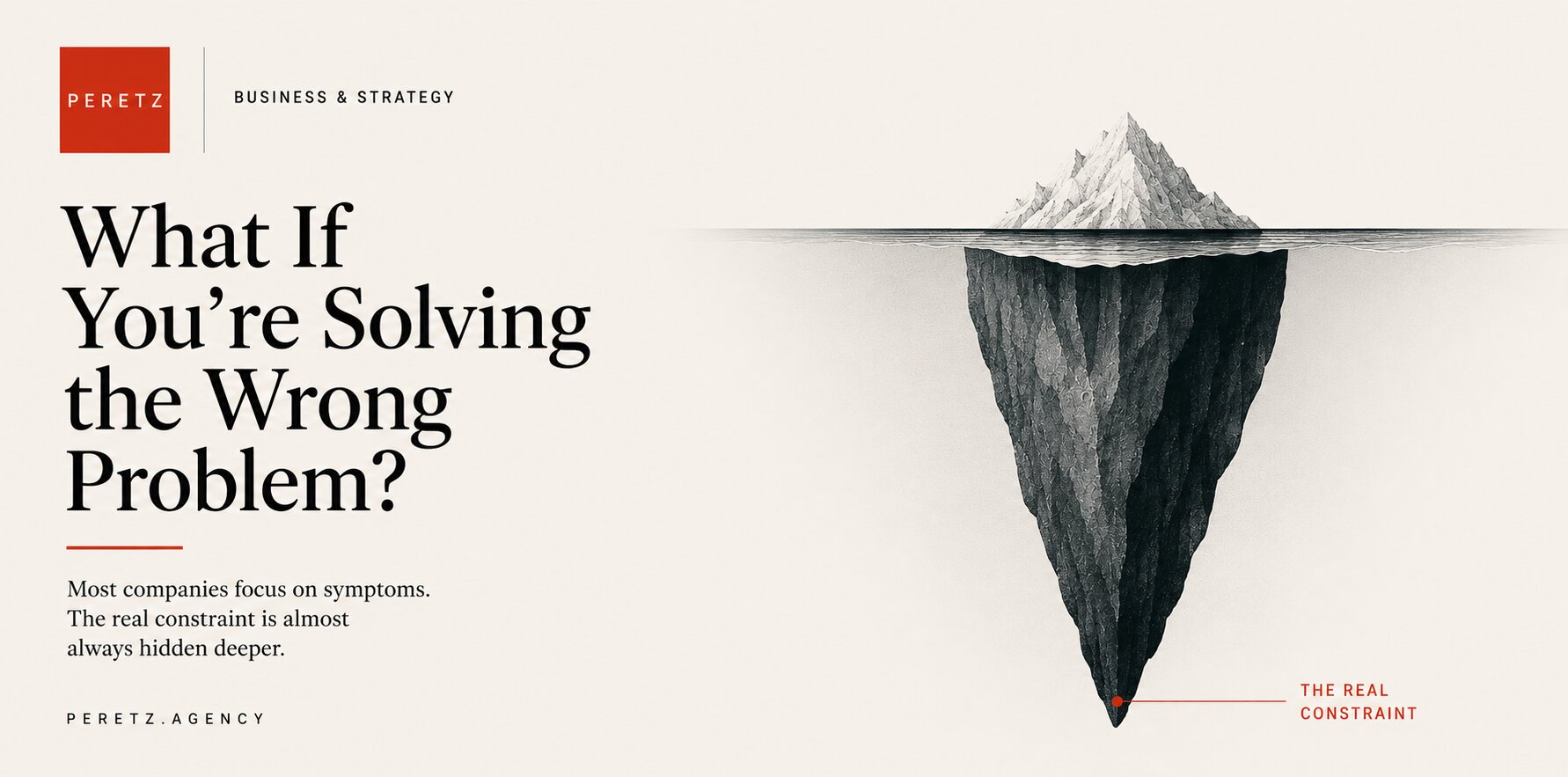
We've written about this principle more broadly, beyond M&A specifically, in What If You're Solving the Wrong Problem? The tools change. The discipline of diagnosing before acting doesn't.
A DIFFERENT KIND OF DIAGNOSIS
One story from Yevhen's early client work begins inside a manufacturing plant, not in a boardroom. The owner wanted to discuss financing. By the end of the walk, financing wasn't the most important question anymore.
Like many businesses, the first questions centered around financing. Should the company raise capital? Expand? Modernize equipment? Bring in outside advisors? But after spending time inside the operation, those questions no longer seemed like the right place to start.
Every production line, every warehouse, every bottleneck, every delayed shipment reflected a decision that had been made, or postponed, years earlier.
Some investments had been made too early. Others had been delayed for too long. Some processes had evolved with the business. Others had simply accumulated because no one had stopped to redesign them.
What looked like a financing question was, in reality, a business architecture question.
Capital might eventually become part of the solution. But without first understanding which decisions had created today's business, any transaction would have been treating symptoms rather than causes.
It's a story we keep coming back to. It also changed the order in which we ask questions.
Every business is a collection of past decisions. Balance sheets tell you where a company is. Decisions explain how it got there.
THE FIRST DIAGNOSIS: MACRO OR MICRO?
The importance of macro indicators depends on the sector, but we usually start with a few universal questions: interest rates and the overall cost of capital, credit availability, M&A market activity and valuation multiples, sector-specific demand trends, regulatory changes. After that, the analysis becomes industry-specific.
Manufacturing businesses are far more exposed to supply chains, commodity prices, and labor costs. Healthcare is often heavily influenced by reimbursement policy and regulation. Consumer businesses depend more on consumer confidence and discretionary spending. Commercial real estate is closely tied to financing conditions and interest rates. The framework stays the same. The weight of each factor changes by industry.
Then there's the business itself. We'd add several things to how most people think about company-level diagnosis. Quality of earnings, not just EBITDA. Customer concentration trends, not only current concentration, because losing dependence on one client is a very different story from becoming more dependent on it every year. Management depth: can the business continue operating successfully without the founder? That question alone often has a direct impact on valuation. We'd also look at recurring versus one-time revenue, pricing power, cash conversion, and the operational KPIs specific to the industry. The decision to sell usually ripens long before the first call to a banker, as described in Nobody Wakes Up One Morning and Decides to Sell.
Buyers are purchasing future cash flows, not historical revenue.
PATTERNS WE SEE REPEATEDLY
A few scenarios show up again and again in real businesses.
Companies seek capital when the real issue is operational inefficiency. Additional funding only postpones the problem.
Owners want to sell because growth has slowed, when the business could create substantially more value after addressing several structural issues first.
Businesses underestimate customer concentration until one major customer leaves.
And companies enter a transaction process before they have a clear understanding of their own objectives, even though different goals require entirely different transaction structures.
A FRAMEWORK, NOT A DECISION TREE
It's tempting to reduce all of this to a clean matrix: diagnosis on one side, strategy on the other. We don't fundamentally disagree with that instinct, but we'd resist making it look more deterministic than it is.
“Strong business, weak market” doesn't automatically mean wait. Waiting may be right. But sometimes a weaker market still offers the chance to acquire competitors, refinance strategically, or bring in a long-term investor before conditions deteriorate further.
“Weak operations, attractive market” doesn't automatically mean fix the business first, either. That's usually correct. But if market timing is exceptionally favorable, an owner may still decide that selling before every operational improvement is complete maximizes overall value more than waiting would.
The matrix is useful as a starting map. It stops being useful the moment someone treats it as an answer key.
WHERE BANKERS ACTUALLY BELONG IN THIS
None of this is an argument against hiring bankers or advisors. It's an argument about sequencing.
Investment bankers and advisors create real value once the strategic objective is clear. They structure transactions, identify buyers or investors, create competitive tension, negotiate terms, and manage execution that's genuinely difficult to run alone. That expertise is not optional once you know what you're trying to do.
The earlier strategic diagnosis determines whether you're asking the right question in the first place. Once that question is clear, experienced bankers and advisors become essential to executing the best answer to it.
Transactions change ownership. Diagnosis changes understanding. Without the second, the first often solves the wrong problem.
Let's talk
If you're weighing a transaction, a capital raise, or a sale, and you're not fully certain the diagnosis is right yet, that's exactly the conversation worth having first.
Book an Exit & Succession Readiness Session
For broader business questions, a Strategic Session covers more ground.
- Share
-

-

-

-

One notification a week with the new PERETZ articles. Nothing else.
Related Reading
-
15. 07. 2026

Four AIs Agreed. We Still Hadn't Verified Anything.

-
19. 07. 2026

The Cost of AI Isn't Generation. It's Verification.
-
17. 07. 2026

The Build vs. Buy Equation Has Changed. Most Companies Have Not Recalculated It.
-
14. 07. 2026

You Know Your Business Depends on You. Build It to Work Without You Anyway.
-
30. 07. 2026

Most Companies Don't Own Their Website. They Own a Collection of Dependencies.
-
24. 07. 2026
What If You're Solving the Wrong Problem?