


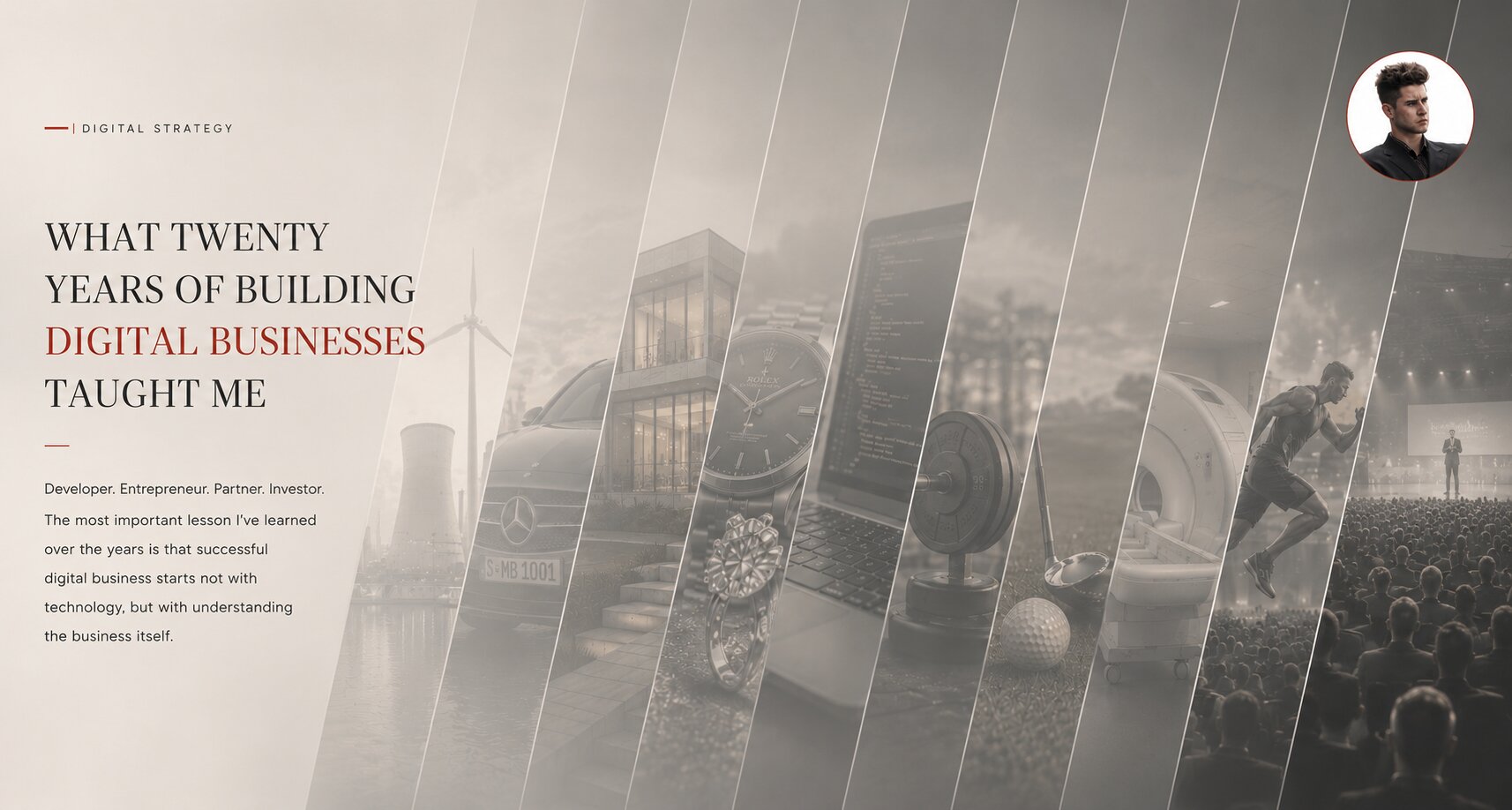
The hardest part of building a digital business has never been technology. It’s making the right business decisions before the first line of code is written.
For more than twenty years, people have introduced me as a web designer, a developer, the founder of a digital agency or someone who builds digital products. None of those descriptions are wrong. But none of them describe what I actually do.
I have never believed my job is building websites. I believe my job is helping business owners avoid expensive mistakes.
Sometimes that means building a website. Sometimes it means honestly telling someone they don’t need one right now. Those conversations have always been the hardest. They have also been the most valuable.
BUSINESSES
I Didn’t Learn This by Building Websites
I learned it by building businesses.
Over the years I have worked as a developer, a designer, an entrepreneur, a partner and a co-investor, and I have built my own companies. I launched my own online stores, created digital products, invested my own money and worked alongside people who were risking everything they had.
Each role taught me to see business differently. Developers think about functionality. Designers think about user experience. Marketers think about traffic. Investors think about risk. And business owners think about something else entirely: the payroll that has to be met, the clients they can’t afford to lose, the sales that may not come today.
That is when I understood something simple. Digital projects almost never fail because of technology. They fail because the business wasn’t ready for them.
After that I stopped starting projects with the question “What kind of website do you want?” I started asking very different questions.
THE ORDER
The Website Was Never the Problem
Around 2015 I started seeing the same picture again and again. The industry was changing. Minimalism was replacing outdated design. Websites were becoming faster, cleaner and more beautiful, and almost every business owner wanted a modern one.
I watched people put nearly every dollar they could afford into it. The project launched. Everyone was happy. The team congratulated each other.
Then reality arrived. There was no money left for SEO. None for content. None for advertising. And certainly none for developing the business further. Six months later the site needed updates, a year later fresh content, and a year after that the market had changed so much that some decisions had to be revisited from scratch.
That was when I understood something important. The website wasn’t the problem. The order of the investment was. The business had invested in an event, when it should have invested in a system.
From then on I stopped seeing a website as a finished product. For me it became just one element of a living business.
ONE CLIENT
One Client Changed the Way I Think
A business owner came to us with a perfectly clear request: he needed a new website. We talked for a long time, and gradually something became obvious that he didn’t want to hear at first.
A new website wouldn’t solve his problem.
The business had no promotion strategy. Not enough content. No budget for SEO. No long-term development plan. Even a perfect website would have stayed practically invisible.
We made a difficult decision: build nothing.
A few months later he came back. In the meantime he had sold part of his assets. Not because he wanted a more expensive website, but because he finally understood that he wasn’t investing in a website. He was investing in a business.
The second time we started completely differently. We thought about the system, not the design. We built content, planned search visibility and set a long-term strategy. The website became just one of the tools.
Years passed, and the numbers speak for themselves. In 2019, 26% of the company’s sales went through the website. By the start of 2026 it was 73.8%. A business that once came to us “for a website” was selling almost three quarters of everything it sold online.
Then the war reached its warehouses. Russian strikes destroyed about 76% of its stock. Insurance covers only part of the loss, and a long list of costs appeared that no budget had ever planned for. In early September the company had to cut 30% of its team. What survived is mostly slow-moving stock, and by August 2026 the share of sales made online had fallen to 33%.
Not because the website stopped working. Because there is almost nothing left to sell.
The company is holding on. I’m not telling this as a marketing lesson. Without its ending, the story simply wouldn’t be honest. A website can only sell what the business has. And when a business is wounded, the website is the first to feel it.
Websites don’t build businesses. Businesses give websites a purpose.
$150,000
The $150,000 Lesson
Over the years I have seen plenty of expensive projects. But one of them permanently changed how I think about digital products.
The client wanted to build a marketplace that could compete with one of the country’s largest retailers. The budget was around $150,000. For most people that is a huge amount of money. But it quickly became clear that the amount wasn’t the issue. Priorities were.
Every meeting ended the same way: “Let’s add one more feature.” Then one more integration, one more module, one more workflow. Everyone wanted to build the perfect product right away. Nobody wanted to prove the first version was needed at all.
What surprised me most was the attitude to content. Whenever I talked about unique product descriptions, articles, categories and a well-built catalog structure, the answer was almost always the same: “We all sell the same products. Why rewrite what’s already written?”
At first glance it sounded logical. But markets don’t reward logic. They reward value. Months went into building functionality, and almost no time was left for the things that actually make one business different from another.
Today I understand that the project didn’t fail because of technology. It failed because complexity replaced common sense.
Complexity is expensive. Understanding is worth far more.
MY STORE
The Best Business Lesson Came From My Own Store
Long before I advised other entrepreneurs, I opened my own online perfume store. Back then I thought the hardest part would be building a good website. In reality it turned out to be the easiest part of the business.
Every product had to be photographed and described. The catalog had to be structured, categories filled, articles written. There were customers and suppliers to deal with, questions to answer all day, orders to process, promotion that never stopped.
That was when I first truly felt what a business owner feels after launch. A website is not a business. It is only one of its tools. And that was when I stopped thinking like a developer and started thinking like a business owner.
That experience permanently changed every recommendation I give. You can spend twenty years building websites. But until you have tried running a business yourself, making payroll, finding customers, worrying about tomorrow’s sales and answering for your own money, it is impossible to fully understand the person sitting across the table. The lesson is harsher still when war forces you to rebuild a career from zero, twice, as our colleague describes in I've Rebuilt My Career Twice Because of War.
THE ADVICE
The Advice Most People Don’t Expect
People often come to me with a new business idea and ask the same question: “How much will it cost to build?” I rarely answer right away. Instead I ask another question: “Have you ever worked in this industry?”
If the answer is no, my advice usually surprises them. Go work there first. Don’t start a company. Don’t order a website. Don’t look for investors. Don’t hire developers.
Live the business from the inside first. Sell the first product. Talk to customers. See how money is actually made. Understand why people buy and, even more important, why they leave. Discover the problems nobody can see from the outside. No agency, no consultant and no AI can replace that experience.
Technology doesn’t create understanding. It amplifies whatever understanding already exists. If you understand your business well, technology will help you grow faster. If you don’t, it will only help you spend money faster.
OWN MONEY
If This Were My Own Money
There is one question behind almost every recommendation I make.
If this were my own business… If this were my own money… Would I make the same decision?
If the answer is no, I have no right to recommend it to someone else.
That’s why we don’t start with websites. We start with businesses. Because our job isn’t to sell development, SEO, advertising, or even artificial intelligence. Our job is to help a business owner make the right digital decision.
Sometimes that decision really is a new website. Sometimes it’s process automation. Sometimes it’s search visibility. And sometimes the most valuable advice is very simple: “Not yet.”
LUCK
Luck Is Not a System
Large consulting firms have long known that successful digital transformation isn’t about adopting a new technology but about changing how a company creates value for its customers. But most business owners can’t afford those firms, and their scale doesn’t fit. Their real choice is different: a local expert, a marketer a friend recommended, a consultant who once did well in their own market.
And that is where the trap is. Success in one market can be a system. Or it can be luck: the right timing, the right niche, no competition. That kind of experience often doesn’t transfer to another market, another country or another scale. And a person who got lucky once rarely realizes it.
Experience you can’t explain is experience you can’t repeat.
Today everyone calls themselves an expert. So here are the questions I would use to check any advisor, including us.
How the expert thinks
- They can explain why their past success worked, not just what they did
- They can name their own mistakes and what they changed afterwards
- They can tell universal principles apart from tricks that worked in one market at one time
Whether they have real business experience
- They have run a business themselves or risked their own money
- They speak the language of money: margins, customer acquisition cost, cash flow, not just traffic and likes
- They have worked in more than one market, or are honest about where their experience ends
How they behave with you
- They ask about your business before proposing a solution
- They are willing to say “not yet,” even if it costs them the deal
- They agree on how success will be measured before the work starts
- They don’t sell one tool or platform just because it’s the one they know
- They are transparent about who does the work and who owns the result: code, accounts, data
- They show case studies with numbers and context, including what didn’t work
How they work with AI
- They say openly where they used AI and where they did the work themselves
- They can show where every fact, figure and source in their report came from
- If you ask “why this conclusion?”, they answer themselves instead of rereading the report
Red flags: guaranteed results; “it works for everyone”; a ready-made recipe before any questions about your business; talking only about tools; being unable to name a single mistake of their own; sources you can’t open; numbers with no origin; generic phrases that would fit any business. And one sign I see more and more often: a report that still contains the AI’s own notes, such as “we recommend verifying this data.” The person didn’t even read what the AI explicitly asked them to check.
That last group matters more than ever. In the University of Melbourne and KPMG global study of 2025, which surveyed more than 48,000 people in 47 countries, 66% said they rely on AI output without evaluating its accuracy, and 56% had already made mistakes in their work because of AI. In October 2025, Deloitte Australia had to partially refund the Australian government for a report worth A$440,000 after it was found to contain a fabricated quote from a court judgment and references to academic papers that don’t exist.
If that can happen to a Big Four firm, imagine the local expert. The problem isn’t the size of the consultant. It is discipline. That is why the real cost of AI is verification, not generation. At Peretz we check every figure in our articles against its original source before publishing. If it doesn’t hold up, it simply isn’t in the text.
FAQ
Frequently Asked Questions
Should every business build a custom website?
No. Sometimes it is far more important to validate demand, understand your customer or build a marketing system first.
Should AI be my first investment?
Usually not. AI strengthens processes that already exist. It doesn’t replace a business strategy.
How much should I budget for digital development?
There is no universal answer. It depends on your market, competition, business model and long-term goals.
What’s the first question you ask new clients?
Not “What’s your budget?” Something much simpler: “Why do you believe your business needs this particular project right now?” The answer very often changes the entire conversation.
How do I choose a digital expert or consultant?
Look less at how loud their success was and more at whether they can explain why it worked, name their mistakes, speak the language of money, say “not yet” and show where every figure in their conclusions came from.
Can I trust a report prepared with AI?
Yes, if the author has checked every fact, figure and source and can explain the conclusions themselves. According to the University of Melbourne and KPMG study, 66% of people rely on AI output without checking it, so it is always worth asking.
FINAL
Final Thoughts
If someone asks me today what I have been doing for the last twenty years, I probably won’t say “building websites.” I will say something else: for twenty years I have been learning how businesses actually work.
Some lessons came from successful projects. Others from expensive mistakes. The most important ones from my own experience as a business owner.
And if there is one thought I would like every business owner to keep before investing in a new website, AI, a CRM or any other technology, it is very simple.
Don’t start by asking “What should we build?”
Start by asking “What business am I really trying to build?”
The technology can wait. The right decisions can’t.
Sources: University of Melbourne and KPMG, Trust, attitudes and use of AI: A global study 2025; Fortune, October 2025: Deloitte partial refund to the Australian government.
Not sure what your business actually needs before you invest in technology?
- Share
-

-

-

-

Related Reading
-
17. 06. 2026
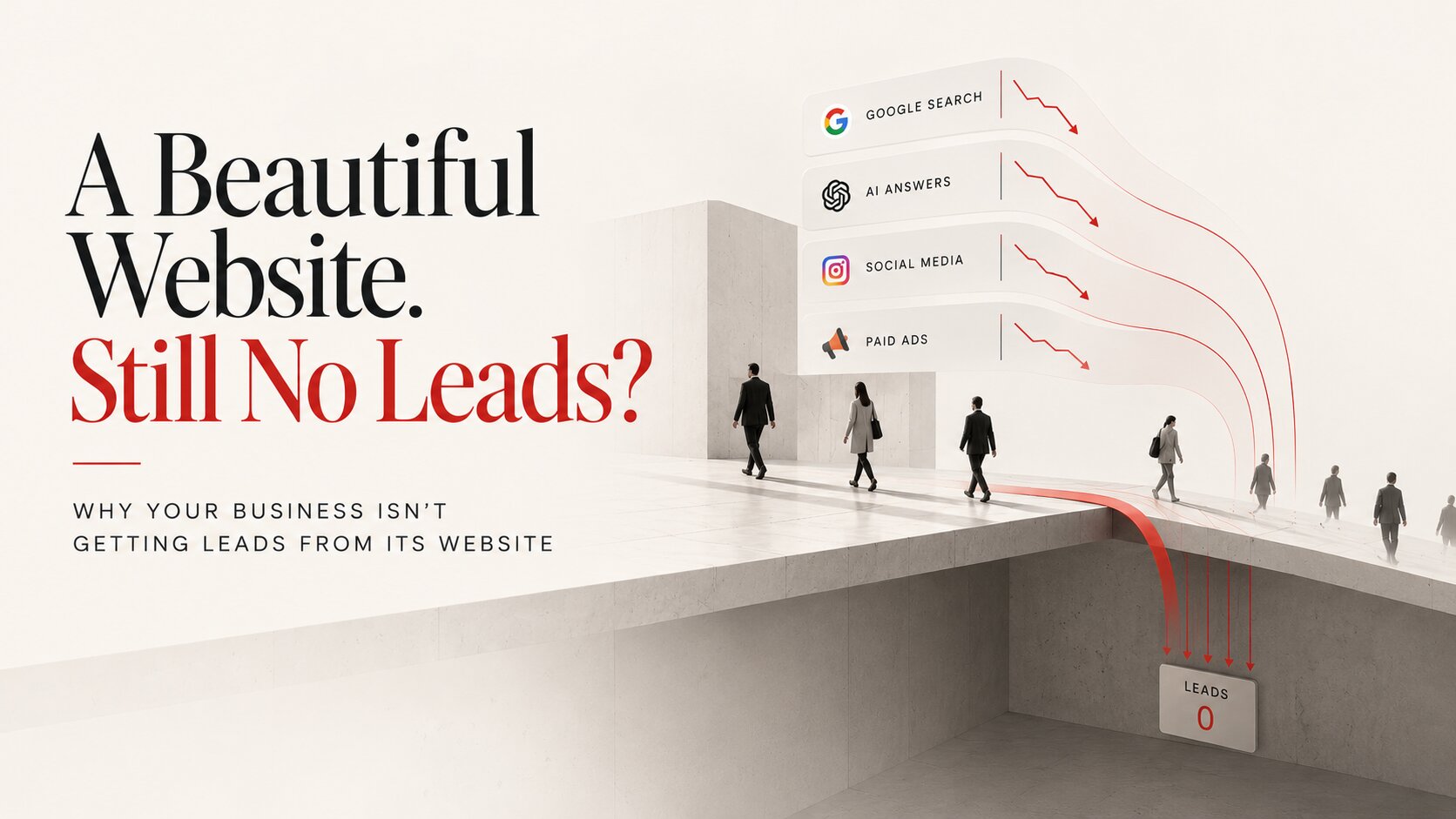
Why Your Business Isn't Getting Leads From Its Website (And How to Fix It in 2026)

-
24. 06. 2026

How to Choose a Web Design Agency in Seattle: A Business Owner’s Guide for 2026
-
18. 06. 2026
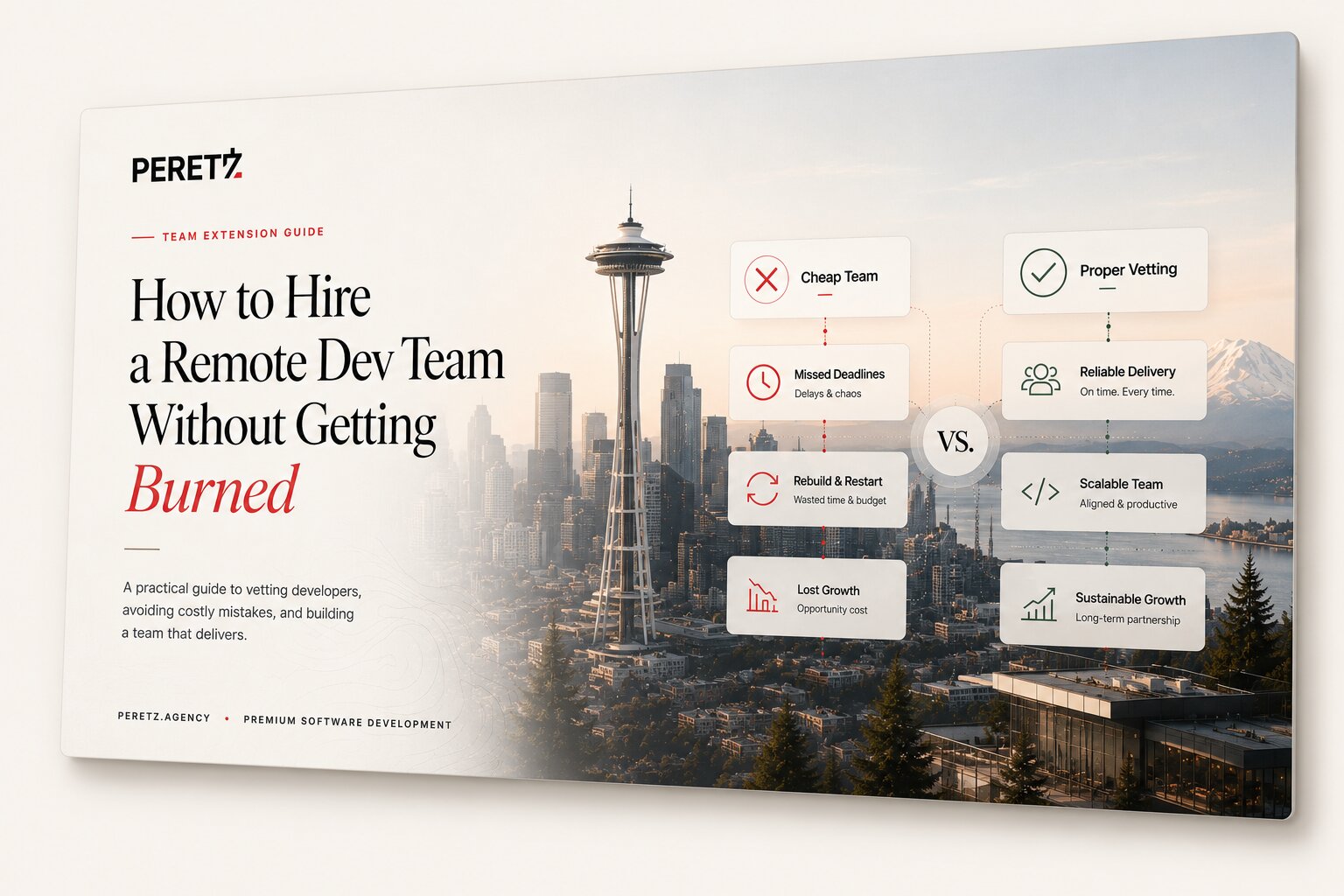
How to Hire a Remote Dev Team Without Getting Burned
-
14. 02. 2021
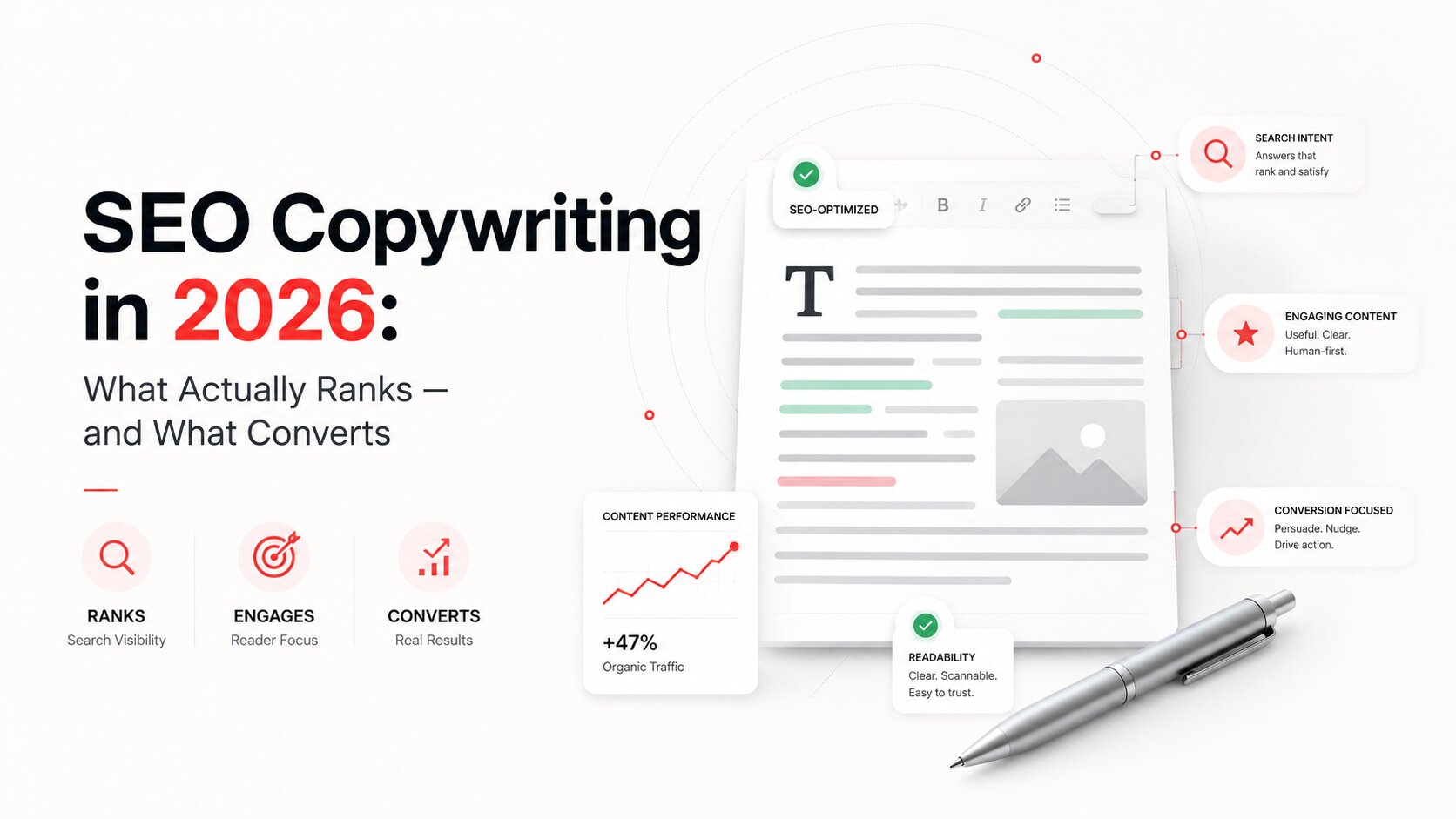
SEO Copywriting in 2026: What Actually Ranks — and What Converts
-
12. 03. 2021

In-House vs Outsourcing in 2026: What Business Owners Actually Need to Know
-
01. 07. 2026

THE STORY BEHIND SV GROUP
-
31. 07. 2026
We Design for Reality, Not for Ideal Scenarios
-
17. 07. 2026
The Build vs. Buy Equation Has Changed. Most Companies Have Not Recalculated It.
-
27. 09. 2026

Design You Don't Notice: Why the Best Design Disappears
-
24. 09. 2026
The Website Is Not Dead. It Has Just Lost Its Job.
-
21. 09. 2026

What Building the Systems Teaches You About Buying Them
-
02. 08. 2026
Every Enterprise System Started as Someone's Spreadsheet
-
24. 07. 2026
What If You're Solving the Wrong Problem?
-
30. 06. 2026
The Most Expensive Mistake Business Owners Make Before Hiring a Digital Agency
-
21. 09. 2026

The Software Should Fit the Business
-
19. 07. 2026

The Cost of AI Isn't Generation. It's Verification.