



"A website is never the final product. It is the first visible expression of a business that will continue evolving long after launch."
Yesterday another client told me, "The website is finally live." I smiled. Not because the project was over. Because I knew the difficult part was about to begin.
A MILESTONE
Launch Is a Milestone. Not the Destination.
There is a moment in almost every digital project when someone says, "Congratulations. The website is live." For many agencies, that sentence marks the end of months of work. For us, it has always meant something else. It means the business has finally entered the real world.
Because websites don't build companies. Companies build websites. A website is simply the first visible expression of everything happening beneath the surface, strategy, operations, customer experience, marketing, sales, technology, and hundreds of decisions that no visitor will ever see.
Launch day doesn't prove those decisions were correct. It simply exposes them to reality. The real work starts the next morning.
WHY WE BUILD
We Didn't Change What We Build. We Changed Why We Build It.

When Peretz was founded more than twenty years ago, I genuinely believed we were building websites. That was the service clients purchased. That was what proposals described. That was what invoices reflected.
But something kept happening after every launch. Clients almost never returned asking for another website. They came back because their businesses had changed. One company expanded into new markets. Another doubled its product catalog. A clinic opened additional locations. A manufacturer introduced entirely new services. A startup realized its original business model no longer reflected reality.
The website wasn't failing. The business had simply outgrown it.
That realization fundamentally changed the way we approached every project. We stopped asking, "How do we build a better website?" Instead, we started asking, "How do we build a digital foundation capable of growing with the business?"
That single question still guides every project we take on today.
HIDDEN COST
The Hidden Cost of Success

Most founders don't intentionally create technical debt. They create momentum. When you're launching a company, everything feels urgent. Customers are waiting. Competitors are moving. Investors expect progress. Revenue matters. Documentation can wait. Processes can wait. Infrastructure can wait. Website maintenance can wait. SEO optimization can wait. The goal is simple: reach the market as quickly as possible.
Every entrepreneur I've worked with has said some version of the same sentence: "We'll organize everything later." Later we'll document the architecture. Later we'll clean up the repositories. Later we'll implement proper deployment workflows. Later we'll review Search Console. Later we'll modernize the framework.
Later becomes next quarter. Next quarter becomes next year. Eventually, the company becomes successful enough that nobody wants to touch the system that helped create that success. Ironically, growth often hides the very problems that will eventually slow it down.
Successful businesses rarely stop because of one catastrophic failure. They slow down because hundreds of small decisions quietly accumulate over time.
TECHNICAL DEBT
Technical Debt Is Never Just Technical

The software industry has a useful expression for this phenomenon. Technical debt. McKinsey compares it to financial debt. Every shortcut becomes the principal. Every future workaround becomes interest. At first, those payments seem insignificant. A few extra hours. A slightly slower release. One undocumented integration. One forgotten password. One manual deployment. Then another. Then another.
Eventually, development becomes slower. Maintenance becomes more expensive. New engineers need weeks instead of days to understand the system. Innovation begins competing with maintenance. What started as a technical shortcut gradually becomes a business limitation.
The numbers back this up. In a 220-company study, McKinsey found that businesses in the top quintile for managing technical debt posted revenue growth roughly 20 percent higher than those in the bottom quintile. Technical debt isn't just an engineering inconvenience. It's a measurable drag on growth.
In reality, organizations accumulate far more than technical debt. They accumulate:
| Type of Debt | Long-Term Business Impact |
|---|---|
| Technical Debt | Slower development and higher maintenance costs |
| SEO Debt | Declining visibility and weaker organic growth |
| Documentation Debt | Longer onboarding and dependency on individuals |
| Knowledge Debt | Lost expertise when employees leave |
| AI Readiness Debt | Lower productivity and slower adoption of modern workflows |
None of these problems usually appear overnight. That's exactly why they're dangerous. We break down each of these five forms in more depth in The Hidden Cost of Standing Still.
INVISIBLE PROBLEMS
Invisible Problems Stay Invisible Until They Become Expensive
One missing sitemap update doesn't destroy a website. Neither does an outdated robots.txt file. Or an incorrect hreflang implementation. Or a broken canonical tag. Or a forgotten Search Console warning. Or analytics connected to an account nobody can access anymore.
Individually, each issue seems insignificant. Together, they quietly reshape how search engines understand your business.
We've seen companies continue publishing high-quality content for months while organic visibility continued falling. Not because the content was poor. Because search engines couldn't properly discover, index, or interpret it. The team worked harder. The results became weaker.
That's one of the most frustrating forms of technical debt. You're investing more effort while creating less value. And without monitoring tools like Google Search Console, many businesses don't even realize it's happening.
ONE SYSTEM
The Website Is Only One System
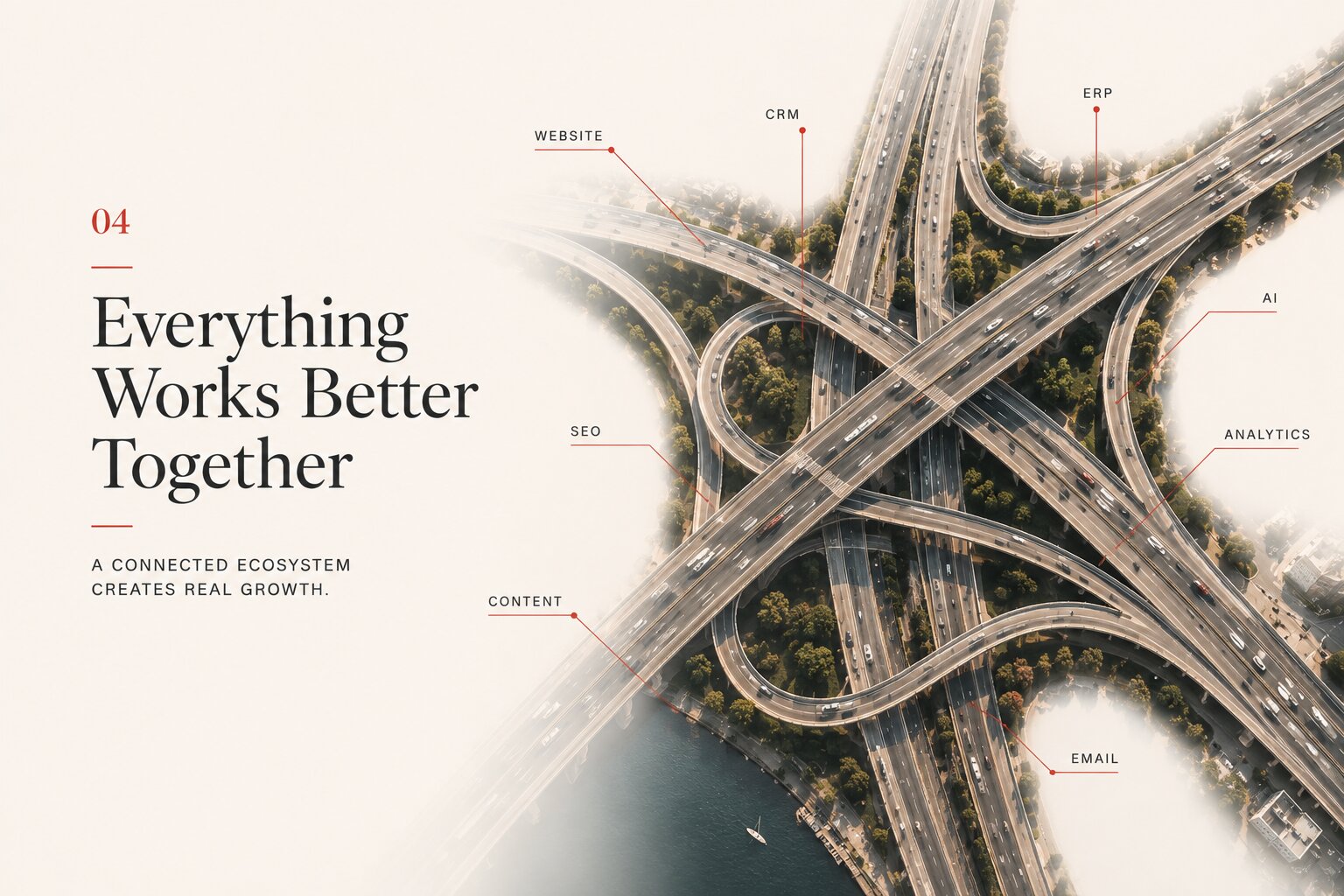
One misconception appears in almost every growing business. Owners often believe they own "a website." In reality, they own an ecosystem. Website. CRM. ERP. Marketing automation. Email platforms. Analytics. Hosting. Cloud infrastructure. Payment providers. Search Console. Domain management. Security. Backups. AI workflows. Content operations.
None of these systems exist independently. They influence each other every day. That's why replacing a developer doesn't automatically solve a business problem. And replacing an agency rarely fixes an architecture that has been evolving without structure for years. Before changing people, you need to understand the system they inherited. We wrote about exactly what that ownership actually includes in Most Companies Don't Own Their Website.
Businesses rarely become difficult because they grow. They become difficult because their systems stop evolving while the business continues to do so.
AI EXPOSES DEBT
AI Doesn't Eliminate Technical Debt. It Exposes It.

Artificial intelligence has changed software development faster than any technology I've seen in my career. Today, a strong engineer equipped with tools like Claude Code, Codex, or Cursor can accomplish work that once required an entire team. Routine tasks that previously consumed days now take hours. Documentation can be generated in minutes. Architectural options can be evaluated almost instantly. Research that once required an entire afternoon can be completed before your coffee gets cold.
It's an extraordinary shift. But it has also created one of the biggest misconceptions in modern business. Many companies believe AI will solve years of accumulated technical debt. It won't. It simply exposes it faster.
If your architecture is clean, AI accelerates development. If your documentation is current, AI helps new engineers become productive almost immediately. If your business logic is well structured, AI becomes another highly capable member of the team. But if nobody understands why the system works the way it does, AI spends most of its time trying to reconstruct yesterday instead of helping build tomorrow.
Industry research points in exactly the same direction. Most developers now use AI in their daily workflow, yet many still verify AI-generated code before trusting it. The conclusion is surprisingly simple. We go deeper into that verification gap in The Cost of AI Isn't Generation. It's Verification.
AI hasn't replaced engineering. It has made good engineering dramatically more valuable.
CURIOSITY
Curiosity Is a Professional Responsibility

One lesson has followed me through every stage of my career. The day you stop learning is the day you begin making decisions based on yesterday's world. Technology changes. Search changes. Customer expectations change. AI changes. Markets change. If we expect our clients to evolve, we have no right to stand still ourselves.
That's why learning has never felt optional. It is part of the responsibility we accepted the moment someone trusted us with their business. Some weeks I'm studying enterprise architecture. Other weeks I'm exploring AI-assisted development. Sometimes I'm reading about logistics. Sometimes construction. Sometimes organizational design.
At first glance those subjects appear unrelated. They're not. Every complex system follows remarkably similar principles. Understand it. Simplify it. Document it. Improve it. Repeat.
Whether you're restoring an abandoned garden, designing enterprise software, repairing a car, or scaling a digital business, the process is surprisingly similar. The tools change. The thinking doesn't.
PART II
Part II. Real Partnership Isn't Promised. It's Built.
"A truly successful project isn't measured by launch day. Its value becomes clear five, ten, or fifteen years later, when the business keeps confidently moving forward."
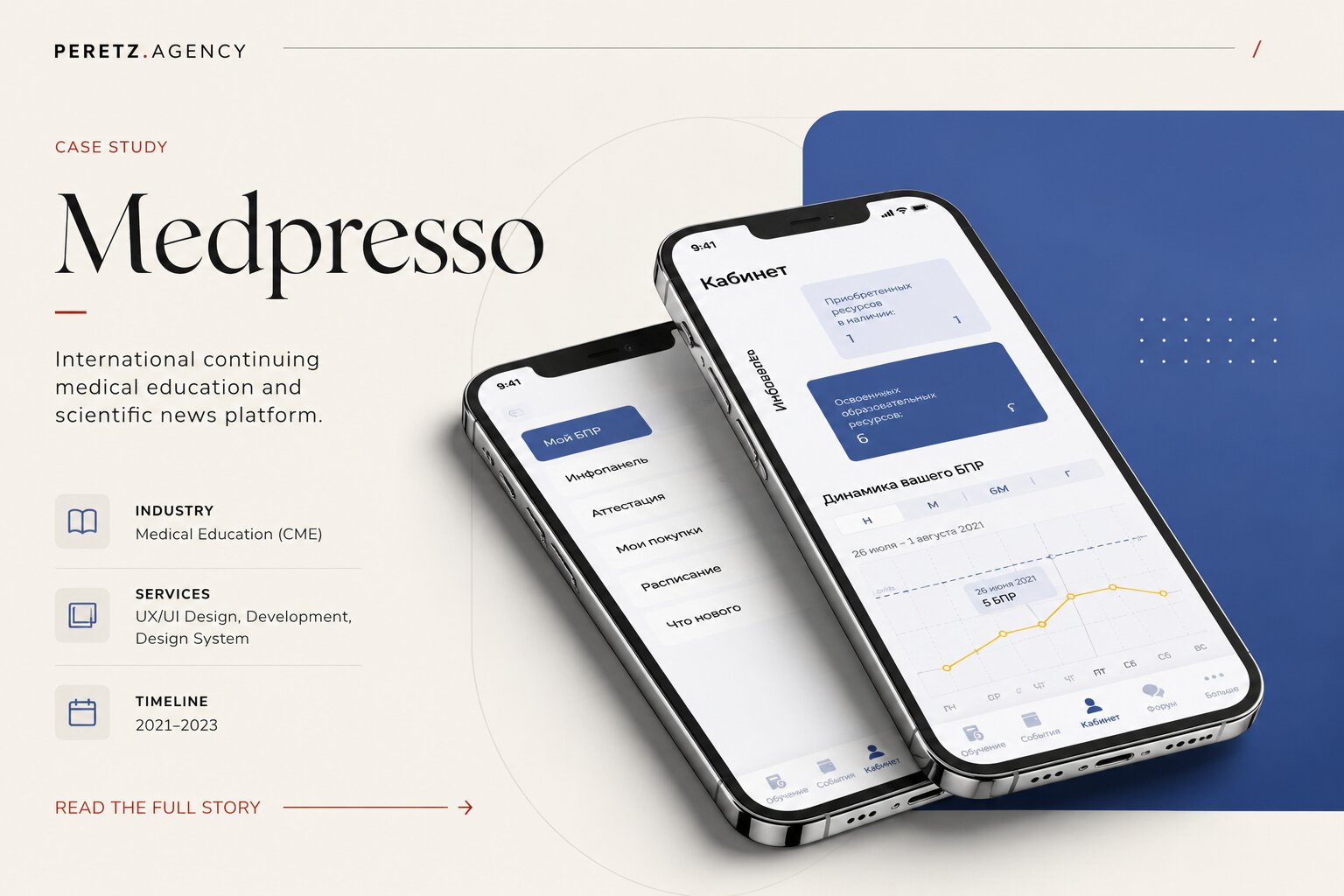
One project shaped our thinking more than almost any other. Medpresso.

During development, two key engineers accepted offers from another company and left almost simultaneously. It wasn't a conflict. It wasn't betrayal. It was simply the reality of a growing industry. Many companies would have paused the project until replacements were found. That would have been the easiest decision. It also would have been the wrong one.
Our client's business hadn't stopped. Patients were still visiting. Content still needed to be published. New functionality still had to be planned. So instead of waiting, we changed direction. While new developers studied the architecture, the rest of the team continued improving everything that didn't require immediate engineering. We redesigned interfaces. Refined user journeys. Prepared future functionality. Expanded the design system. Reviewed content structure. Strengthened UX.
The roadmap continued moving. Not because everything went according to plan. But because we stopped protecting the schedule and started protecting the business. You can see the full Medpresso project in our portfolio, and the fuller story behind it in the case study.
That experience permanently changed the way we manage projects. Business continuity isn't about making sure nothing goes wrong. It's about ensuring progress continues when something inevitably does.
TWENTY YEARS
Twenty Years of Recognizing Patterns
People occasionally ask where our philosophy comes from. The answer isn't a framework. It isn't a methodology. It comes from people.
Over the past two decades, 142 professionals have been part of Peretz's in-house team. Together they represented software engineering, design, project management, SEO, content strategy, operations, and business support.
| Discipline | Specialists |
|---|---|
| Software Engineers | 42 |
| Design Specialists | 65 |
| Project Managers | 7 |
| SEO & Content Specialists | 16 |
| Other Business & Operations Specialists | ~12 |
| Total Contributors | 140+ |
After working alongside more than a hundred professionals over two decades, something interesting begins to happen. You stop remembering individual bugs. You begin recognizing recurring patterns. The same documentation gaps. The same technical shortcuts. The same missing business processes. The same communication failures. The same architectural decisions that either help companies scale, or quietly prevent them from doing so.
Our philosophy wasn't developed in a meeting room. It emerged from watching those patterns repeat themselves for more than twenty years.
Months later, another developer who had contributed to the same ecosystem disappeared after the city where he lived was occupied during the war in Ukraine. His code remained. His knowledge didn't. His commits still exist inside the repository. His explanations don't. We wrote about that same loss, and what it taught us about continuity, in Your Website Doesn't Fail When Your Developer Leaves.
That experience reinforced another lesson. No business should depend entirely on one person. Not a developer. Not a designer. Not a founder. Not even an agency. People move. Life changes. Companies evolve. The only sustainable strategy is to ensure knowledge survives beyond the individuals who created it.
A resilient project isn't the one that avoids disruption. It's the one that continues creating value despite it.
MORE QUESTIONS
Why We Always Ask More Questions Than Expected

Clients occasionally wonder why our discovery process feels unusually detailed. Why do we ask about operations? Sales? Internal workflows? CRM? Content production? Analytics? AI adoption? Future hiring plans?
Because websites don't exist in isolation. Every digital product eventually becomes a mirror of the organization behind it. Messy businesses create messy systems. Clear businesses create resilient systems.
The better we understand the business, the fewer assumptions we need to make later. Technology is rarely the hardest part of digital transformation. Understanding is. And that's why every successful project begins long before the first line of code is written.
PART III
Part III. Building Something That Outlives You
"The real measure of a digital product isn't whether it launches successfully. It's whether it continues creating value years after launch."
NEVER FINISH
The Best Businesses Never Really Finish
There is one question I ask myself before almost every important decision. Not, "Will this solve today's problem?" But, "Will this still make sense five years from now?"
That question has guided our work far more than any framework, methodology, or technology trend. Because businesses rarely struggle because of today's decisions. More often, they struggle because yesterday's decisions were never designed to survive tomorrow.
The companies that remain competitive aren't necessarily the ones with the largest budgets or the biggest engineering teams. They're the ones that continue evolving while everyone else assumes they've already arrived. Success is never static. The moment a business stops improving, the market continues without it.
CONTINUOUS PROCESS
Growth Is a Continuous Process
Over the years I've realized something surprising. The same principles appear everywhere. When restoring an abandoned garden. When repairing a neglected vehicle. When studying enterprise architecture. When helping a company redesign its digital ecosystem.
The process never really changes. First, understand. Then simplify. Then improve. Then keep improving. Nature works this way. Engineering works this way. Architecture works this way. Healthy businesses work this way.
Nothing valuable remains healthy simply because it once reached a good state. Everything that grows requires continuous care. Digital products are no exception. A website isn't finished after launch. Neither is software. Neither is SEO. Neither is documentation. Neither is strategy. Every one of them becomes part of a living business that continues changing every day.
Launch creates momentum. Continuous improvement creates market leaders.
VISIBILITY
Visibility Has Become a Competitive Advantage
One of the biggest shifts we've witnessed over the past few years isn't technological. It's cultural. For decades, expertise remained invisible unless someone invested enormous effort into publishing it. Today, artificial intelligence has fundamentally changed that equation. Research. Outlining. Translation. Editing. Keyword analysis. Content optimization. Tasks that once required days now take minutes.
That doesn't make expertise less valuable. It makes publishing expertise dramatically easier. And that changes competition. Years ago, a brilliant specialist who wrote two articles per year could still dominate their niche. Today, another company can publish high-quality educational content every week using AI-assisted workflows supported by real expertise.
Search engines see it. AI models learn from it. Potential customers discover it. The market begins associating visibility with authority. That's why one of the greatest risks today isn't lacking expertise. It's failing to share it. We cover this shift toward visibility as a search signal in more depth in Your Business Is Invisible to AI Search in 2026.
Knowledge that remains inside meetings creates very little value. Knowledge that becomes discoverable compounds over time. For search engines. For AI systems. For future customers. And for your own team.
NOT AN AGENCY
Why We Don't Think Like a Traditional Agency
People occasionally ask what makes Peretz different. The honest answer isn't design. It isn't development. It isn't AI. Those are tools. What makes us different is the question we ask after every project begins.
"What does this business need to become over the next five years?"
That question changes everything. Sometimes the answer is a website redesign. Sometimes it's software modernization. Sometimes it's AI integration. Sometimes it's improving SEO. Sometimes it's documenting architecture before writing another line of code. And sometimes the best advice is surprisingly simple. "Don't spend your money on this yet."
Short-term revenue has never been our primary metric. Long-term business health has. Those decisions don't always maximize this month's invoice. They often maximize the next decade of collaboration. We wrote more about choosing structure over a quick rebuild in Most Companies Don't Need a New Website. They Need a New Structure.
MORE THAN A WEBSITE
A Company Is More Than Its Website
One misconception still exists across many growing businesses. People believe they're investing in a website. In reality, they're investing in how their business will operate. How new employees will onboard. How customers will discover them. How sales teams will work. How marketing will scale. How AI will access knowledge. How future developers will understand previous decisions. How the company will adapt when something unexpected happens.
Technology is no longer a separate department. It has become part of the business itself. Ignoring it doesn't freeze it in time. It simply allows technical debt, SEO debt, documentation debt, and organizational debt to continue growing unnoticed.
Every digital decision is ultimately a business decision.
THE PHILOSOPHY
The Philosophy That Never Changed
Looking back, I realize something else. The projects I remember most are not the ones with the largest budgets. They're the ones where both sides were willing to be honest. Where difficult conversations happened early. Where mistakes were acknowledged instead of hidden. Where priorities changed without blaming each other. Where unexpected setbacks became opportunities to build something stronger.
Trust isn't created because everything goes according to plan. Trust is created because, when the plan changes, everyone chooses to move forward together.
That's why I've never felt comfortable calling clients "accounts." Or projects "deliverables." Behind every project is someone's company. Someone's family. Someone's employees. Someone's future. When a founder trusts us with that responsibility, the work becomes bigger than software.
FINAL THOUGHT
Final Thought
People sometimes ask what we build. The easiest answer would be websites. It would also be the least accurate. We help businesses build the ability to keep evolving. Websites are part of that. Software is part of that. Digital strategy is part of that. SEO. AI. Documentation. Architecture. Research. Content. Every one of those disciplines exists for the same reason: to reduce the distance between where a business is today and where it wants to be tomorrow.
When someone shakes our hand, I don't think about the project we'll deliver over the next few months. I think about the years that follow. The technologies that don't exist yet. The opportunities we can't see today. The challenges nobody can predict.
A contract defines the scope of work. It doesn't define the depth of responsibility. That part is a choice. We've made that choice for more than twenty years. And we'll continue making it every time a client trusts us to help build something that deserves to last.

Because a website can go live in a single afternoon. A business comes alive over years. And the greatest digital products aren't the ones that launch successfully. They're the ones that never stop growing.
Author: Yevhen Borovoi, Founder at Peretz Agency.
If your business has outgrown the system that got it here, a Strategic Session is where we start mapping the gap between where you are and where the next five years need you to be.
- Share
-

-

-

-

Related Reading
-
26. 06. 2026
The Story We Never Planned to Tell - Case MEDPRESSO

-
05. 08. 2026
Your Website Doesn't Fail When Your Developer Leaves. It Fails Years Earlier.
-
29. 07. 2026
The Hidden Cost of Standing Still: Why Modern Businesses Lose Competitive Advantage Long Before They Notice
-
30. 07. 2026

Most Companies Don't Own Their Website. They Own a Collection of Dependencies.
-
19. 07. 2026
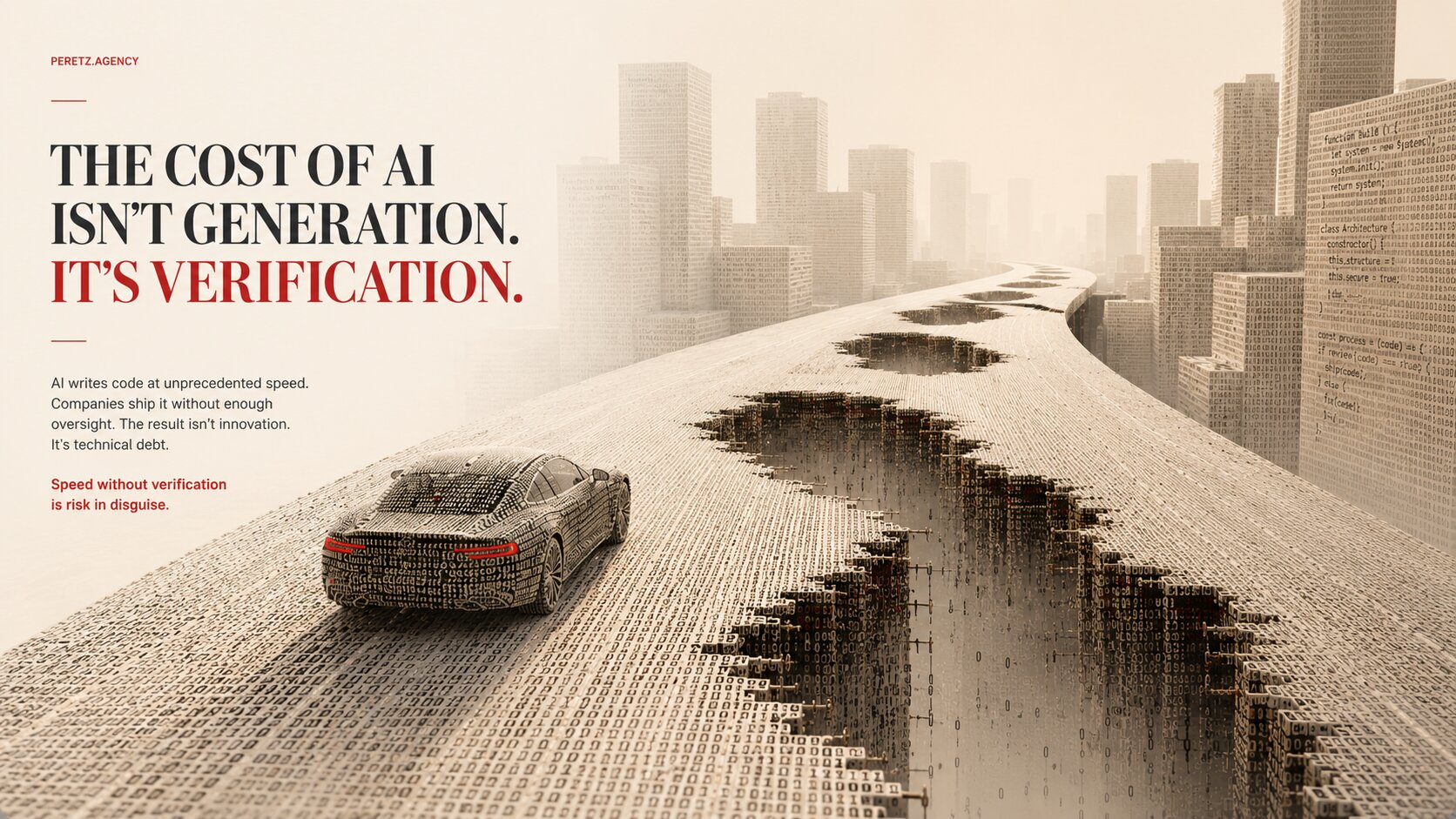
The Cost of AI Isn't Generation. It's Verification.
-
27. 06. 2026
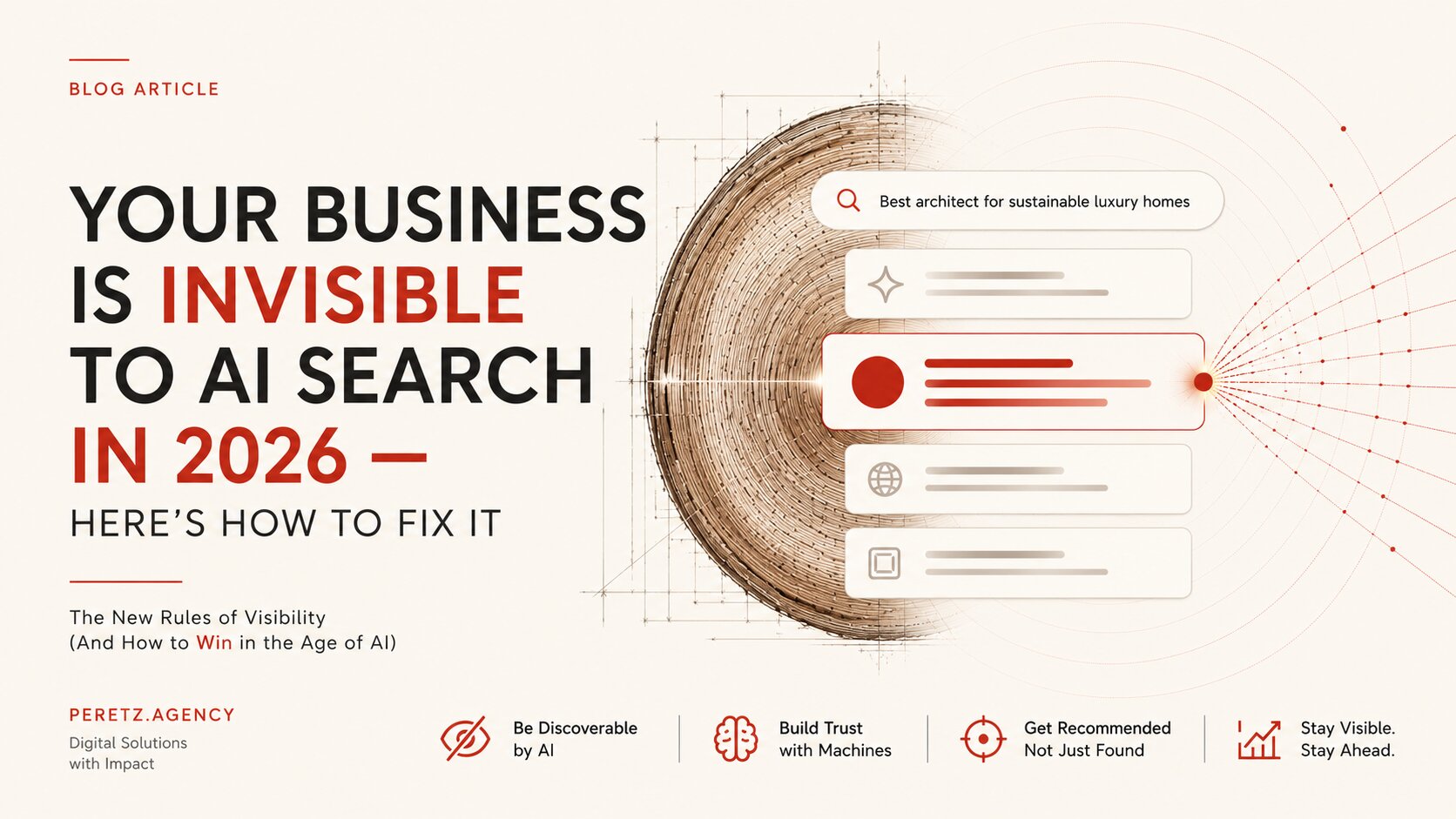
Your Business Is Invisible to AI Search in 2026 — Here's How to Fix It
-
20. 07. 2026
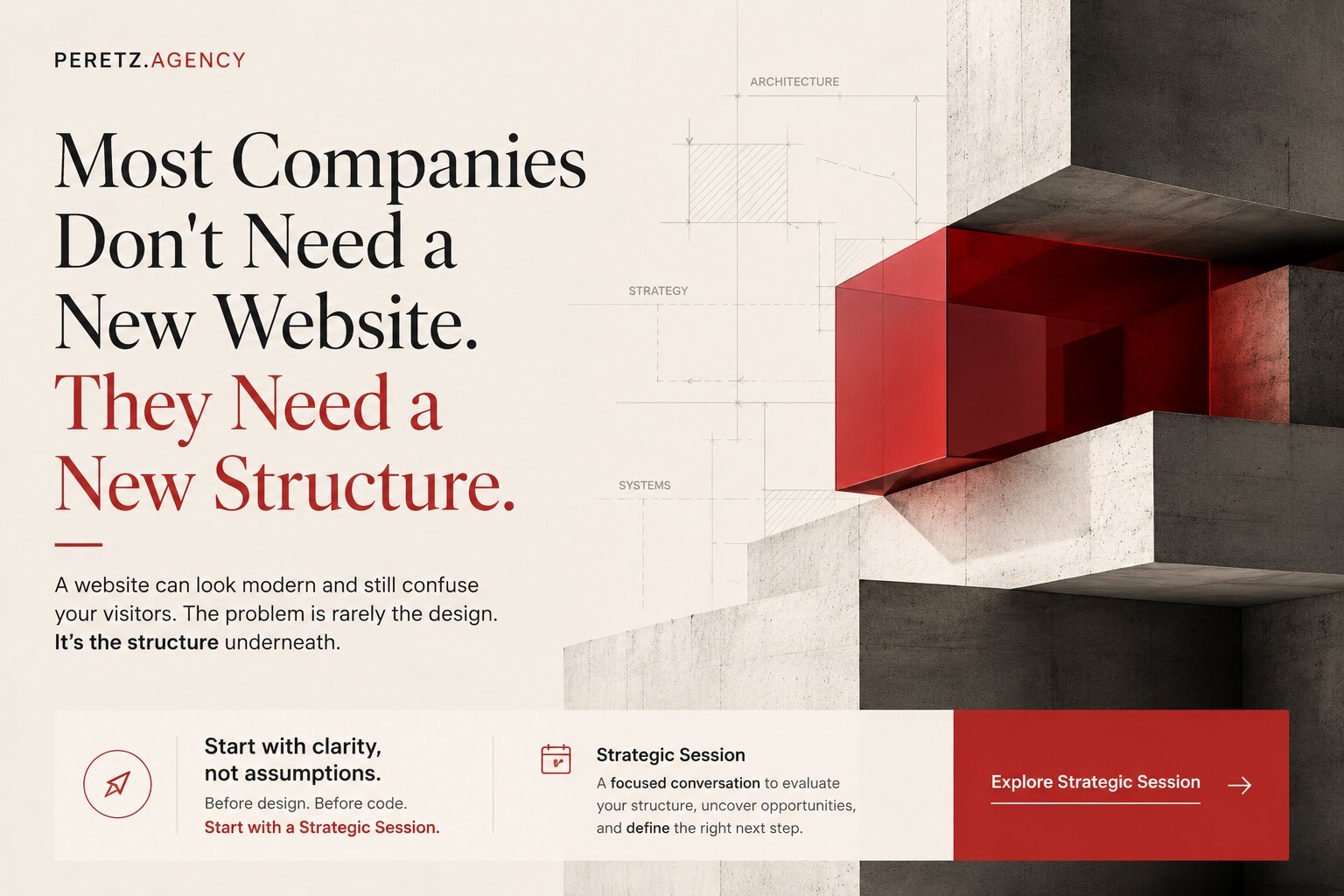
Most Companies Don't Need a New Website. They Need a New Structure.