

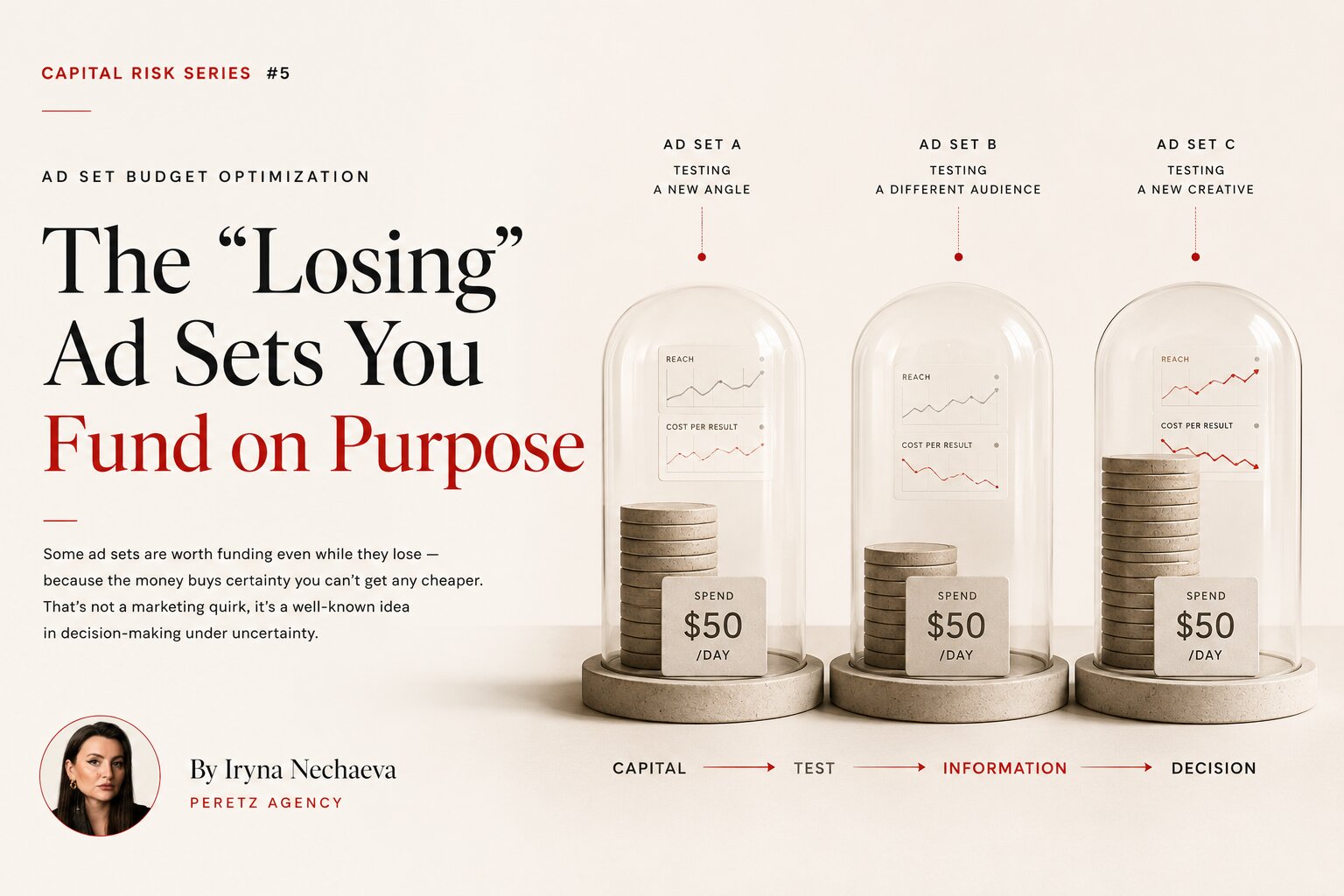
Picture three ad sets running side by side. Two weeks in, one is clearly ahead. The other two are behind, spending money, producing worse numbers. Every instinct says: kill the losers, put everything behind the winner.
Sometimes that instinct is exactly right. And sometimes it's how a business throws away its best idea before it ever got a fair look. The difference comes down to a question almost nobody asks out loud: was that ad set actually losing, or was it just being starved before it had enough data to prove itself?
Ad Set Budget Optimization, ABO, is the setting that keeps that question answerable. Give each ad set its own fixed, protected budget, and none of them can be quietly drained to feed whichever one looks best this week. What you're buying with that structure isn't performance. It's the ability to actually find out.
WHAT IS ABO
What Is Ad Set Budget Optimization (ABO)?
Ad Set Budget Optimization (ABO) is a Meta Ads campaign structure where the budget is controlled at the ad set level rather than the campaign level. Each ad set gets its own fixed daily or lifetime budget, and Meta cannot move money between them. This gives advertisers direct control over how much each test receives, which makes ABO useful when the goal is to compare new audiences, creatives, offers, or other concepts before scaling.
That's the technical definition. But control isn't the real reason we use it.
We use it when we need to buy information.
LOSING ISN'T WASTED
A Losing Ad Set Isn't Automatically a Wasted One
There's a well-worn idea in decision-making that applies here more directly than most marketing advice admits: when you genuinely don't know which option is better, spending money to find out has real value, even if the specific dollars spent "lose." Economists call it the value of information. A market researcher would call it the cost of a proper test. In an ad account, it just looks like an underperforming ad set that never got shut down.
The distinction that matters: if you spent $500 discovering that an audience doesn't work, that can be a reasonable investment in information. If you spent $500 on something you already knew wouldn't work, that's waste. Same amount, completely different category of spend.
This is the reframe I give clients who want to pull the plug on anything that isn't winning by day three: that ad set isn't necessarily failing. It might be doing exactly its job, which is answering a question you didn't know the answer to. The money spent finding out whether an audience, an angle, or a creative direction actually works is not the same category of spend as money wasted on something you already knew wouldn't work. Confusing the two is how a business quietly stops testing anything new, because everything that isn't an immediate winner gets treated as a mistake.
WHAT ABO PROTECTS
What ABO Actually Protects You From
Under Campaign Budget Optimization, Meta's algorithm moves money continuously toward whichever ad set has the strongest signal right now. That's efficient in aggregate, but it means a newer or slower-warming ad set can get starved of spend before it ever accumulates enough data to prove itself one way or the other. The test gets cut short. You don't find out if it would have worked. You just know it didn't get the chance.
ABO removes that risk by giving each ad set a protected, untouchable budget. Three ad sets at $50 a day each spend exactly that, regardless of which one the algorithm would prefer to favor. You're not maximizing short-term efficiency. You're paying, on purpose, for a fair and complete answer.
The reverse risk is real too, and worth naming honestly: ABO's protection isn't free. Money can genuinely sit on a true underperformer for longer than it should, because nothing is automatically reallocating it. The difference between "still gathering the data I need" and "already have my answer, just haven't acted on it" is a judgment call, and it's the one place ABO requires an actual human paying attention, not a setting doing the thinking for you.
READING THE DATA
How to Tell the Difference, In Practice
The honest test isn't a fixed number of days. It's whether you've actually reached the point where the answer means anything, and that requires separating two things most advice collapses into one.
Meta typically uses around 50 optimization events within a seven-day period as the benchmark for an ad set to exit the learning phase. That's a real, documented threshold, and it matters: below it, delivery is unstable and costs swing widely while the algorithm explores. Reading results during that period produces misleading data.
But that threshold is not a universal statistical test for declaring a winner. Fifty events helps Meta learn. It doesn't automatically mean the human has learned enough to make every business decision. The right sample size for your actual decision depends on what you're testing, your conversion volume, the size of the difference you're trying to detect, and what the decision costs if you get it wrong. Treat the learning phase as the point where your test window starts, not the point where it finishes.
If an ad set hasn't exited the learning phase yet, you don't have readable data at all. You have noise. Killing it here is guessing, not deciding.
If it has stabilized and is still clearly behind by a margin that matters for your business, that's actionable. Reallocate and move on.
If it has stabilized and the difference is small or ambiguous, that's not a verdict either. A narrow gap needs more data than a wide one before it means anything.
If budget is too thin for any ad set to exit learning in a reasonable window, the test itself is broken before it starts. No budget model fixes an underfunded question.
The practical discipline I use: decide what would count as a real answer before the test starts, not after you're already tempted to cut the ad set that's currently behind. Deciding the threshold in advance is what keeps a legitimate test from turning into an excuse to follow whichever number looks best today.
ABO VS CBO
ABO vs CBO: Which Budget Strategy Should You Use?
This isn't an argument that ABO is right and CBO is wrong. It's a case for using each one for what it's actually good at.
| Dimension | ABO (Ad Set Budget) | CBO (Campaign Budget) |
|---|---|---|
| Budget controlled at | Ad set level, fixed per ad set | Campaign level, algorithm distributes |
| What it's good at | Protecting a fair test for every concept | Efficiency once you know what works |
| What you're buying | Information, a complete answer | Performance, on a known winner |
| Requires | A human watching and deciding | Trust in the algorithm's allocation |
| Main risk | Money sits on a real underperformer | A promising idea starved before it proves itself |
For the testing approach we use at Peretz, we often start with ABO when the open question is which concept deserves budget: a new audience, a new creative direction, an offer that hasn't been tested at scale. Once a concept has earned the right to scale, we move toward campaign-level budget allocation so the algorithm's efficiency works in our favor rather than against an unresolved question.
In practice that usually means: test in ABO, let each concept run until it's actually readable, then duplicate the winner into a CBO campaign to scale, while leaving the original ABO test running as a clean comparison point. That's our approach, not a universal rule Meta enforces, and accounts with different volume, seasonality, or risk tolerance reasonably land elsewhere. We go deeper into the governance logic behind that choice in Campaign Budget Optimization Is a Governance Decision, Not a Toggle.
WHY THIS BELONGS
Why This Belongs in the Same Conversation as Everything Else
Every part of this series comes back to the same idea: what looks like a technical setting inside Meta Ads is usually a financial or strategic decision wearing a settings label. Spending limits are risk management, covered in Your Meta Spending Limit Is a Circuit Breaker, Not a Setting. Billing thresholds are cash flow, in Meta Quietly Rewired How It Collects Money From Advertisers in 2026. Daily versus lifetime is fixed cost versus variable cost, in Daily vs Lifetime Budget in Meta Ads. CBO versus ABO is centralized versus decentralized allocation, and inside that choice, ABO specifically is a decision to pay for certainty instead of assuming it.
It's the same logic behind why a business builds a smaller first version of a product instead of the whole thing: you're buying the cheapest possible answer to a question you can't answer from a spreadsheet. We wrote about that side of it in MVP Isn't a Minimal Product. It's the Cost of Entry.
When I look at a client's account and see every single ad set running under CBO, including ones that are clearly brand-new concepts nobody's validated yet, that tells me something specific: nobody in this account is currently paying for information. Everything is being judged on today's number, with no protected space to actually find out whether an idea deserves more time. That's not a technical gap. It's a decision nobody consciously made.
HOW WE APPROACH THIS
How Peretz Agency Approaches This
Every new concept we test starts in ABO, with what counts as a real answer decided before the test runs, not improvised once the early numbers start looking discouraging. Once something proves itself, it graduates to campaign-level budget allocation. Nothing skips the testing phase just because it's more convenient to let the algorithm decide from day one.
Every platform has defaults. Mature companies decide whether those defaults deserve to stay.
The series closes with the setting that reveals it was never really about Meta at all, in Meta Ads Learning Phase: The Compound Interest Nobody Lets Finish Compounding.
Author: Iryna Nechaeva, Marketing Strategist | Analyst | Targetologist at Peretz Agency.
Not sure whether your account is actually testing anything right now, or just optimizing toward whatever already looks best? We review budget structure and testing discipline as part of every account audit.
- Share
-

-

-

-

Related Reading
-
07. 08. 2026
Campaign Budget Optimization Is a Governance Decision, Not a Toggle

-
07. 08. 2026

Your Meta Spending Limit Is a Circuit Breaker, Not a Setting
-
08. 08. 2026
Meta Quietly Rewired How It Collects Money From Advertisers in 2026
-
10. 08. 2026
Daily vs Lifetime Budget in Meta Ads Is a Fixed-Cost vs Variable-Cost Decision, Not a Setting
-
09. 08. 2026

MVP Isn't a Minimal Product. It's the Cost of Entry.
-
28. 07. 2026

Why Your Cost Per Lead Keeps Going Up in 2026 (10 Fixes)
-
11. 08. 2026
Meta Ads Learning Phase: The Compound Interest Nobody Lets Finish Compounding
-
06. 09. 2026
SEO Gets You Found. AEO Gets You Recommended. Your Commerce Infrastructure Gets You Bought.