

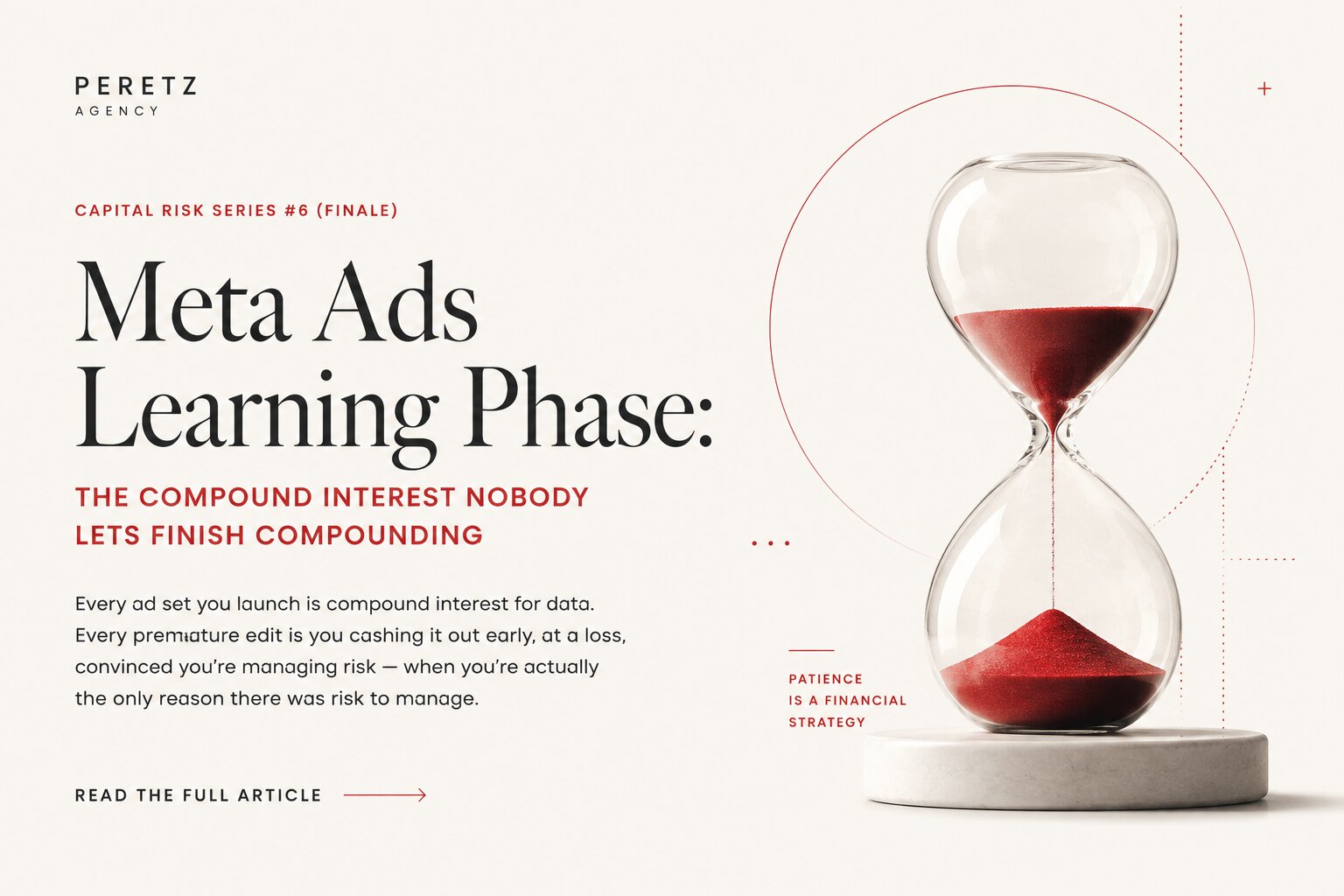
Five articles into this series, and every single one has led here, to the same conclusion wearing a different costume. Spending limits, billing thresholds, daily versus lifetime, CBO versus ABO, take away the interface, and every one of them turned out to be a financial decision Meta lets you make without realizing you're making it.
The learning phase is the last one, and it's the rawest. Underneath the technical explanation, it isn't really about an algorithm. It's about whether you have the discipline to let something compound before you touch it, the same discipline that separates people who build wealth from people who panic-sell every time the market dips.
Every ad set you launch is compound interest for data. Every premature edit is you cashing it out early, at a loss, convinced you're managing risk, when you're actually the only reason there was risk to manage in the first place.
THE FIRST FEW DAYS
What's Actually Happening During Those First Few Days
When an ad set launches, or gets significantly edited, Meta has no behavioral data specific to that exact combination of audience, budget, creative, and bid strategy. It's starting from zero, testing delivery across segments, placements, and times of day, trying to find a pattern reliable enough to bet real money on.
The threshold Meta needs to trust that pattern is 50 optimization events within a rolling 7-day window. That number isn't arbitrary, it's the minimum sample size where Meta's models can statistically distinguish a real signal from noise. Below 50, the algorithm isn't confidently targeting your best customers. It's guessing, and charging you full price for the guess.
This is why CPAs during days 1-3 of learning look artificially inflated. You're not looking at your real cost per result. You're looking at the cost of the algorithm still figuring out who your real customer is, a genuinely different number that happens to show up in the same column.
THE EXPENSIVE THING
The Expensive Thing Almost Nobody Names Correctly
Ask most advertisers what kills a learning phase and they'll describe one dramatic mistake, slashing the budget, rewriting the targeting overnight. That's not usually what actually happens.
It's rarely one big decision that ruins a learning phase. It's a hundred small ones, a tweaked headline here, a nudged bid there, a quietly added audience exclusion, each one reasonable in isolation, each one quietly sending the counter back to zero.
Every significant edit, a budget change over 20%, a new optimization event, a creative swap, a targeting change, a bid strategy shift, or pausing for seven days or longer, restarts the 50-event count from scratch. Not slows it down. Restarts it. Whatever signal had accumulated is gone.
THE 2026 TWIST
The 2026 Twist That Makes This Worse Than It Used To Be
As of Meta's April 2026 update to its Andromeda delivery system, the definition of a "significant" edit quietly tightened. Advertisers across multiple industries reported learning phase resets triggered by changes that used to be perfectly safe, small bid adjustments, minor audience additions, light creative tweaks. The rules didn't just stay strict. They got stricter, without most advertisers being told the ground had shifted.
The practical result: the safe margin for casual mid-flight tweaking has shrunk. Businesses treating the learning phase as something to fine-tune in real time are, more than ever, quietly paying to reset their own progress.
THE DISCIPLINE
The Discipline Nobody Wants to Hear
Here is the finding that should reframe every campaign you're currently "optimizing" in real time: in Meta's own research, ad sets that exit the learning phase see roughly 19% lower cost per result than ad sets that never do, exit speed and delivery quality are directly linked. Reaching that 50-event threshold cleanly, without interruption, isn't a formality. It's the difference between the algorithm actually learning and the algorithm perpetually re-guessing.
This is the single hardest thing I have to teach a new client, and it has nothing to do with Meta Ads mechanics. The instinct to check a campaign daily and nudge whatever looks slightly off is the same instinct that makes people check their investment portfolio every morning and sell the moment it dips. Both feel like diligence. Both are, statistically, how you guarantee a worse outcome than doing nothing.
Meta's own guidance says the same thing in plainer language: allow at least 7 days after any significant edit before evaluating results. A campaign showing $80 CPA on day one, $60 on day two, and $50 on day three isn't failing, it's compounding, and the businesses that panic and "fix" it at day two never see day five.
WHEN PATIENCE ISN'T IT
When Patience Genuinely Isn't the Answer
None of this is an argument for blind waiting. There's a real failure state, Learning Limited, where an ad set simply cannot mathematically reach 50 events in 7 days, no matter how long you leave it alone. The causes are specific and fixable.
Budget too low for the target cost per action, the math doesn't allow 50 events in the window, regardless of ad quality.
Too many overlapping ad sets splitting the same audience, fragmenting signal across competing learning processes.
An optimization event that fires too rarely to generate a reliable pattern, often fixable by moving to a higher-funnel event.
The framework that works: first check whether the structure can mathematically reach 50 events in 7 days at all, if not, no amount of waiting fixes it. If the math works, give it the full window, and bundle any genuinely necessary edits into one change instead of a week of small ones.
WHY END HERE
Why This Is the Right Place to End the Series
Every article in this series has made some version of the same argument: what looks like a Meta Ads setting is almost always a financial or psychological decision wearing a technical disguise. Spending limits are risk management, covered in Your Meta Spending Limit Is a Circuit Breaker, Not a Setting. Billing thresholds are cash flow, in Meta Quietly Rewired How It Collects Money From Advertisers in 2026. Daily versus lifetime is fixed cost versus variable cost, in Daily vs Lifetime Budget in Meta Ads. CBO is centralized allocation, in Campaign Budget Optimization Is a Governance Decision, Not a Toggle. ABO is paying for certainty, in Ad Set Budget Optimization: The "Losing" Ad Sets You Fund on Purpose. The learning phase is where it all converges into the plainest version of the question: can you sit with uncertainty long enough for it to resolve on its own, or does not-knowing make you intervene before the process is finished?
When I inherit an account and see a change log full of small, frequent edits on every active ad set, I don't need to look at performance to know what's been happening. Someone has been managing this account out of anxiety, not strategy. The fix I recommend most often is telling the client, plainly, to stop touching it for seven days. That's usually the hardest advice I give, and the one that works most reliably.
HOW WE APPROACH THIS
How Peretz Agency Approaches This
Every campaign we launch gets a pre-launch checklist so structural decisions are settled before it goes live, not iterated on during the window when iteration costs the most. Once a campaign is in learning, our default is a genuine no-edit window.
Every platform has defaults. Mature companies decide whether those defaults deserve to stay.
Author: Iryna Nechaeva, Marketing Strategist | Analyst | Targetologist at Peretz Agency.
Watching a campaign that never stabilizes, no matter how many small adjustments you make? We review edit history and structural discipline as part of every account audit.
- Share
-

-

-

-

Related Reading
-
07. 08. 2026
Campaign Budget Optimization Is a Governance Decision, Not a Toggle

-
07. 08. 2026

Your Meta Spending Limit Is a Circuit Breaker, Not a Setting
-
08. 08. 2026
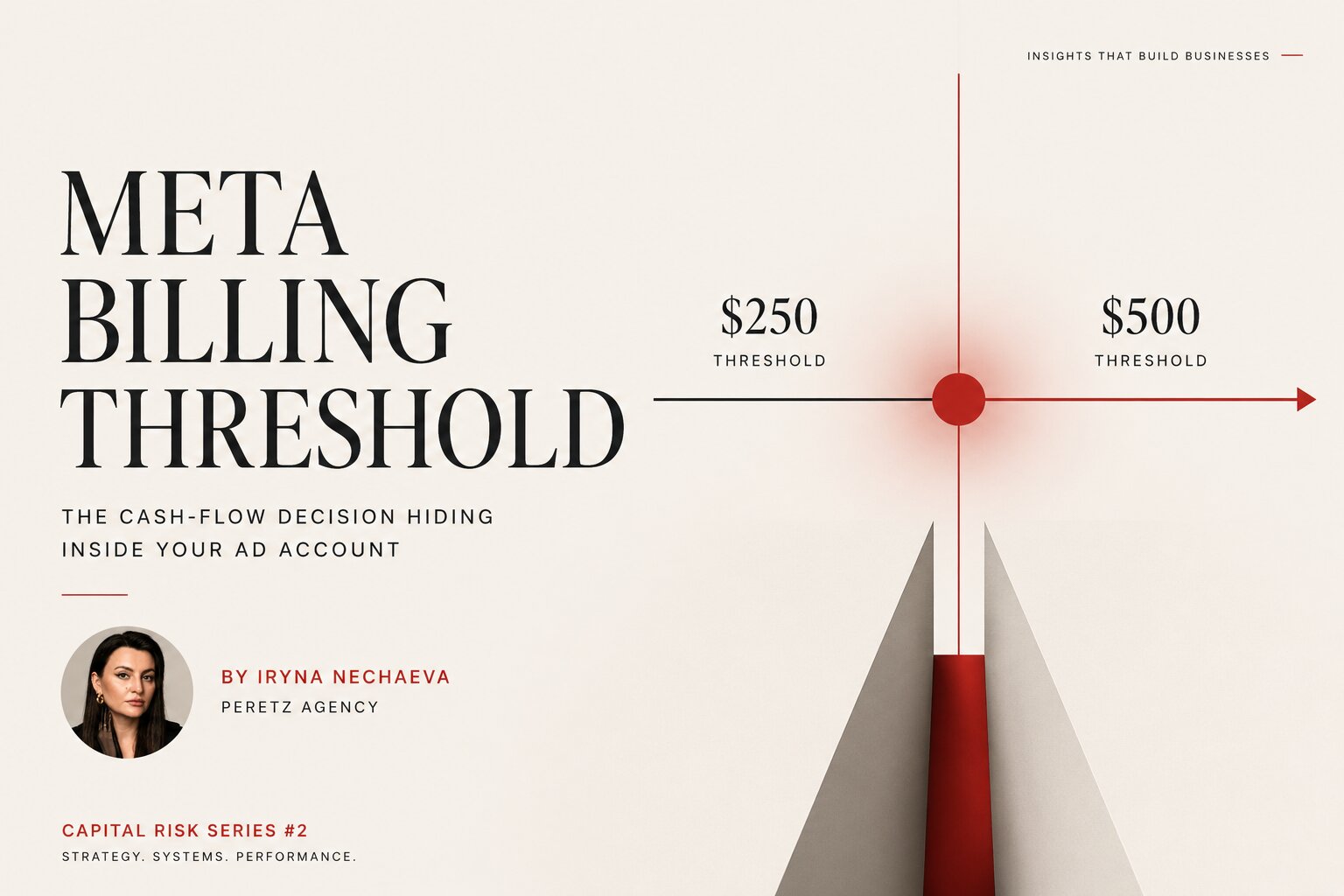
Meta Quietly Rewired How It Collects Money From Advertisers in 2026
-
10. 08. 2026
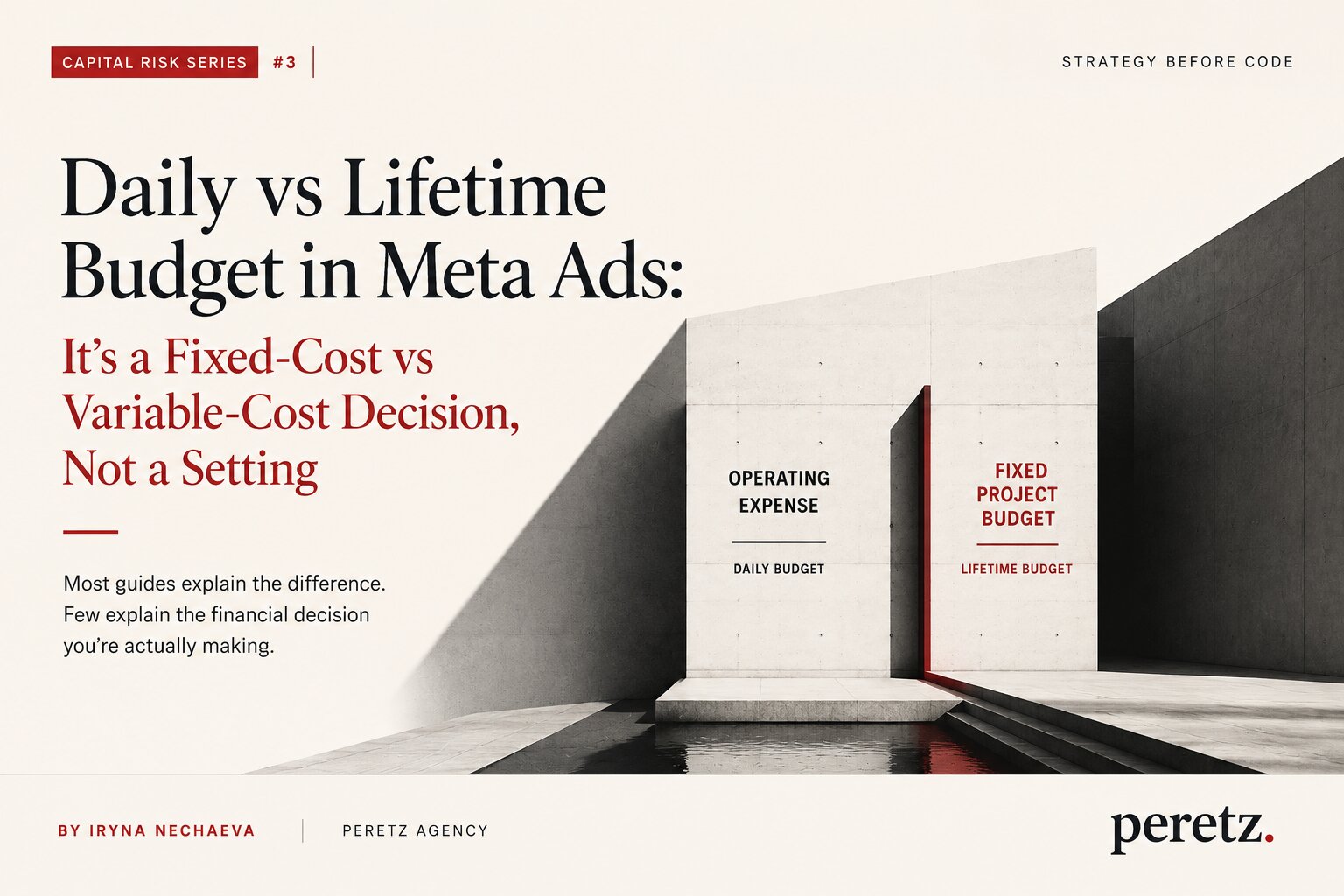
Daily vs Lifetime Budget in Meta Ads Is a Fixed-Cost vs Variable-Cost Decision, Not a Setting
-
10. 08. 2026
Ad Set Budget Optimization: The "Losing" Ad Sets You Fund on Purpose
-
06. 09. 2026
SEO Gets You Found. AEO Gets You Recommended. Your Commerce Infrastructure Gets You Bought.